Under Pressure: Highlights from the 2025 Library Deans and Directors Survey
Watch on YouTubeVideo summary
Bu sunum, Ithaka S+R tarafından yürütülen 2025 Yılı Kütüphane Dekanları ve Direktörleri Anketinin öne çıkan bulgularını ele almakta olup, akademik kütüphanelerin hem geleneksel sorumluluklarını sürdürürken hem de yapay zeka gibi yeni zorluklarla başa çıkma yollarını incelemektedir. Araştırma, dört yıllık kar amacı gütmeyen üniversitelerdeki tüm kütüphane liderlerine her üç yılda bir gönderilen ve 2010'dan beri devam eden kapsamlı bir çalışmanın sonucudur; bu anketin en yeni döngüsü sonbahar 2025'te gerçekleştirilmiş olup, toplamda %36 yanıt oranına sahip olan 483 katılımcının verileri analiz edilmiştir. Katılımın büyük çoğunluğu doktora derecesi veren araştırma yoğun kurumlarında görev yapan ve neredeyse yarısı özel kar amacı gütmeyen kurumlarda çalışan liderlerden oluşmaktadır, ancak raporun kapsamı finansal kısıtlamalardan açık erişim algısına kadar çok daha geniş bir yelpazede bulgular içermektedir.
Personel ihtiyaçları açısından yapılan değerlendirmeler, önümüzdeki beş yıl içinde yapay zeka ve makine öğrenimi alanlarında personel sayısının artırılması gerektiğini göstermektedir; bu alanda artış bekleyenlerin oranı %31 iken azaltma planlayan hiç kimse olmamaktadır. Ayrıca eğitim veya bilgi okuryazarlığı hizmetleri, değerlendirme ve kullanıcı deneyimi gibi geleneksel servislerde de büyüme beklentisi mevcuttur ancak teknik hizmetler ve koleksiyon geliştirme alanlarında ise personel artırımı ile kısaltması arasındaki görüş daha bölünmüştür. Geçmiş üç yılda pozisyonları kaldırılmış veya izinli olan kütüphanelerin %51'i teknik hizmetlerde, %50'si de ön cephe servislerinde personeli azaltmıştır ve bu geçmiş kesintilerle gelecekteki beklenen kısaltmalar arasında belirgin bir tutarlılık bulunmaktadır.
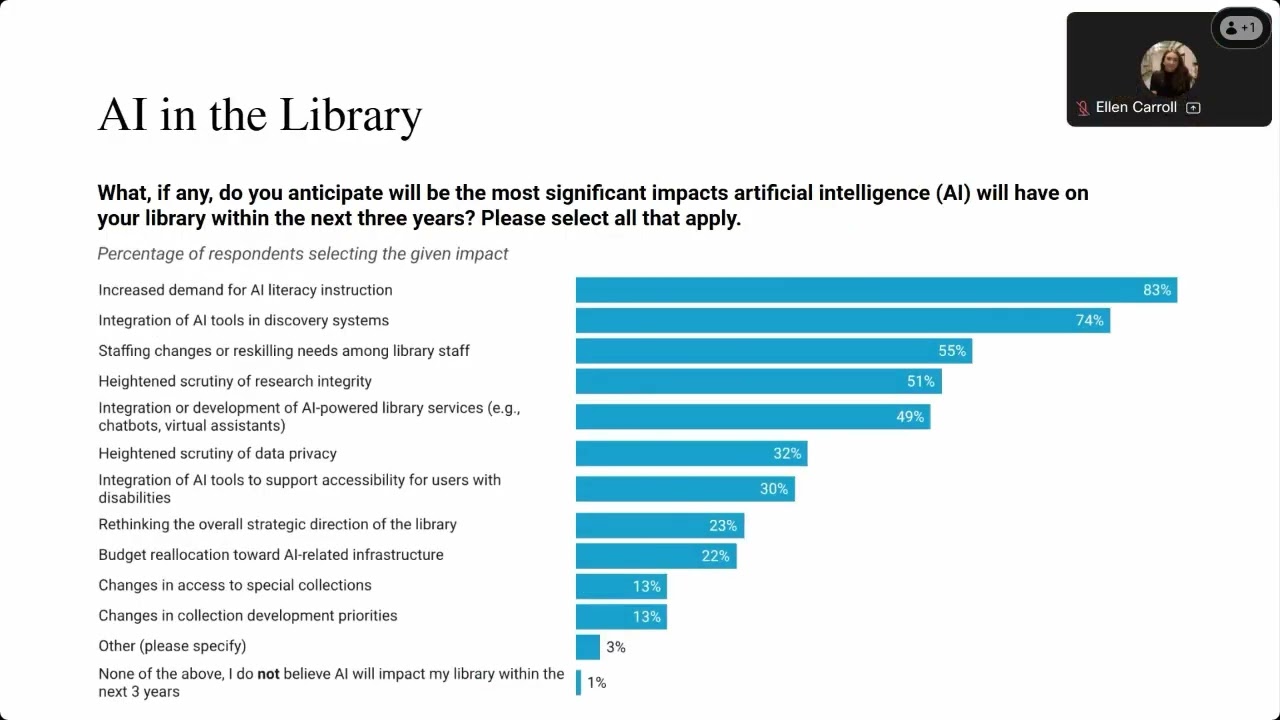
Yapay zekanın kütüphane üzerindeki etkisi konusunda liderlerin çoğunluğu (%83), yapay zeka okuryazarlığı eğitimi talebinin artacağını belirtirken, keşif sistemlerine entegrasyon ve personel yeniden beceri kazanımı ihtiyacı da önemli bir etki olarak görülmektedir. Ancak kütüphanelerin iç işlemlerinde yapay zeka araçlarını kullanma oranları eşit değildir; en yaygın kullanım alanı keşif ve erişim (%40) iken, bazı kurumların hiç yapay zeka kullanmadığı tespit edilmiştir. Bu durumun temel nedenleri arasında stratejinin düşük önceliklendirilmesi, personel yetkinliğinin sınırlılığı, zaman eksikliği ve etik kaygılar yer almaktadır; özellikle üçüncü tarafların bireysel veriye erişimi konusunda endişeler son on yılda zirve noktasına ulaşmış olup, yapay zekanın getirdiği yeni bir gizlilik gözetimi ihtiyacı doğurmaktadır.
Son olarak kütüphanelerin kendi değerlerini iletişimlendirmek için hangi verileri paylaştıkları incelendiğinde, kullanım verilerinin (kapı sayıları veya indirme istatistikleri) en sık raporlanan veri türü olduğu görülmektedir; ancak düzenli bir raporlama deseni olan kurumların oranı oldukça düşüktür ve bu durum kütüphanelerin kurumsal kaynakları korumak için etkilerini gösterme yeteneğini sınırlamaktadır. Yapay zeka destekli içerik kullanımı metriklerinin değişip değişmediği henüz tam olarak araştırılmakta olup, liderlerin stratejileri geliştirmek ve veri gizliliğine odaklanmak adına bu alanlarda daha fazla çalışmaya ihtiyaç duyulduğu vurgulanmaktadır; sunumun detayları QR kod üzerinden erişilebilen kapsamlı raporla paylaşılmıştır.
Read the full video transcript
Hello, and thank you for joining us. My
name is Ellen Carol, and I'm a senior
analyst at Ithaka S+R.
>> And I'm Tracy Bergstrom. I'm the senior
program manager for libraries and
scholarly communication at Ithaka S+R.
>> We're pleased to be here presenting
highlights from our 2025 survey of
library deans and directors.
We conduct this work through our
organization, Ithaka S+R.
Ithaka S+R is part of Ithaka, a
not-for-profit with a mission to improve
access to knowledge and education for
people around the world.
>> [snorts]
>> We conduct a survey of deans and
directors at college and university
libraries in the US every 3 years in
order to track the perspectives,
priorities, and strategies of these
leaders over time.
The most recent cycle was fielded in
fall of 2025 and examined how library
leaders are navigating both
long-standing responsibilities and
emerging challenges facing the
profession.
For today's presentation, we focus on
four themes that together illustrate how
academic libraries are navigating this
moment.
We'll begin by examining current hiring
priorities across library areas, then
turn to how libraries are responding to
artificial intelligence as an emerging
technology.
Finally, we'll examine leaders'
perspectives on data privacy before
closing with how libraries are assessing
and reporting their own metrics
internally.
Each survey cycle, we send the survey by
email to library deans and directors at
all four-year, not-for-profit colleges
and universities in the US.
We've surveyed this population since
2010, so the questionnaire includes a
mix of legacy items that allow us to
examine change over time, which we'll
show some of those data later on, and
new questions that respond to
developments in the field since the
prior cycle.
In the 2025 cycle, we had a final sample
of 483 respondents for a response rate
of 36%.
We have some sample demographics shown
here.
I do want to highlight some context on
the institutions at which these library
leaders work.
So, the participating libraries were
most commonly housed within
research-intensive institutions that
award doctoral degrees, and a little
over half were private not-for-profit
institutions.
So, for our presentation, I mentioned
that we focused on some specific areas
of the report that we believe are most
relevant to our CNI colleagues in the
interest of time.
But that said, the report contains a
much broader set of findings ranging
from how library leaders are navigating
financial constraints to perceptions of
open access initiatives. So, we
encourage you to check out the full
report if you're interested in learning
more about any of these themes and the
many additional findings gleaned through
the survey.
And with that, we will get into the
results.
To better understand how leaders are
envisioning staffing needs in the near
term and what this might signal for the
workforce, we asked respondents to
consider a range of functional areas and
indicate whether they anticipate
increasing or reducing the number of
library staff in each area over the next
5 years.
So, the dark blue bars show the share of
respondents who anticipate staff
increases, while the light blue bars
show reductions.
So, starting with areas of anticipated
staff growth, we see a few patterns
standing out quite clearly here.
At the top, 31% of respondents expect to
increase staff in AI and machine
learning, and none anticipate reductions
in this area.
So, this likely reflects both the
current prevalence of AI and the fact
that many libraries are still building
capacity here.
We also see expected staff growth in
more established service areas. So, 27%
of respondents indicate increases in
instruction or information literacy
services,
followed by 21% in assessment, user
experience, or data analytics,
and another 21% who expect to increase
staffing around student success,
engagement, and outreach.
When we turn to anticipated staff
reductions, though, the picture is less
clear.
Respondents were overall more hesitant
to identify areas where they might
reduce staffing, and there's less
consensus about where those reductions
might occur.
But that said, a few areas of
anticipated reduction do emerge. So,
frontline services are most frequently
identified for potential staff
reductions at 19%.
However, this is matched by 20% of
respondents who anticipate staff
increases in the same area.
We see a similar pattern for technical
services, where 17% anticipate
reductions, but a comparable share
anticipate increases.
And for collection development or
subject specialists, 13% staff
anticipate staff reductions, um but this
is again closely mirrored by those who
expect growth.
So, overall, while anticipated areas of
staff growth in the near term,
particularly around AI, instruction, and
analytics are relatively clear,
expectations for where staff will be
reduced are often divided, with the same
functional areas appearing on both sides
of the ledger.
But we can gain a clearer understanding
of libraries' staffing trends um by
looking at the areas where libraries
have already downsized.
So, this figure shows the areas in which
staff roles were reduced among
respondents who reported that their
libraries had eliminated staff positions
or instituted furloughs within the past
3 years.
Among these libraries, 51% reduced staff
in technical services, followed closely
by 50% that reduced staff in frontline
services.
Then looking further down the chart, 33%
reported reductions in collection
development, subject specialists, or
departmental liaison roles.
Notably, the order of these past
reductions closely aligns with the areas
that leaders anticipated reducing on the
previous slide.
So, this suggests some consistency
between where leaders have already
absorbed staffing cuts and where they
expect future reductions might occur.
>> One of the major developments affecting
the library space in the time between
our most recent survey cycles, of
course, was the proliferation of
generative AI.
This cycle, we included foundational
questions about AI use and anticipated
need for growth within libraries.
To examine the perceived effects of AI
in the library more closely, we asked
library leaders to identify the ways
they expect AI to significantly impact
their library over the next 3 years.
The most frequently cited impact, as we
can see, is increased demand for AI
literacy instruction, selected by 83% of
respondents.
This is followed by the integration of
AI tools into library discovery systems
at 74%.
More than half also anticipate staffing
changes or reskilling needs amongst
library staff.
The survey also asked the leaders where
their libraries are currently employing
AI tools to support internal library
work or library services.
Interestingly, the data indicate that
libraries are integrating AI tools at
different rates and in different ways.
So, while there's more consensus around
the ways that AI will impact the
library, as we saw in the previous
slide, there is unevenness around
libraries' actual use of AI tools in
their internal operations.
The most commonly reported area of AI
use was discovery and access at 40%
followed by research support services
and internal data analysis.
We also see AI use in areas like
metadata creation and validation, as
well as cataloging and processing of
special collections.
In the previous slide, you may have
noticed that 24% of respondents indicate
that their library does not currently
use AI tools in library operations.
To further investigate this area, we
asked these respondents to follow a
follow-up question on what barriers, if
any,
were impacting their ability to use AI
tools in the library. And again, we see
a lot of variation across the types of
barriers encountered, but those most
frequently selected are issues related
to strategy and staffing.
Specifically, AI being a low priority
relative to other library strategies was
the most common barrier selected by 50%
of respondents.
This was followed by limited staff
skills in AI at 48% and then again,
ranking very closely, we have lack of
time or staff capacity, as well as
ethical or moral opposition to AI as
commonly encountered barriers, each
selected by 46% of respondents.
This question, in relation to others in
the survey, really calls to the
forefront that strategy in relation to
the implementation and and use of AI is
clearly still a developing area for
libraries at the present.
Perhaps in response to growing needs for
libraries to integrate and support AI,
we can see that concerns around user
data privacy are increasing.
On the right, half of library leaders
are concerned about third-party access
to individual-level data, reaching the
highest point since we first asked this
question, as you can see, in 2019.
In a related question we saw a few
slides ago, 32% of library directors
indicated they foresee heightened
scrutiny of data privacy as a
significant impact of artificial
intelligence
on the library within the next 3 years.
Finally, one of the areas we're really
thinking about right now is what types
of data are useful to libraries to
communicate their value.
To this end, we introduced two questions
on this topic in the last cycle.
The first that you see on the screen
here asks,
"What types of data does your library
routinely share with your direct
supervisor?"
Who a library director's supervisor is,
whether the library organizationally
reports to the provost or another entity
on campus, is also tracked within the
survey if you're interested in this.
But here we can see that utilization
data, including potentially door counts
or download counts,
tops the list at 77% of directors who
share this information.
This is followed by narrative evidence
at 73% and user experience data at 66%.
While responses were largely consistent
across Carnegie classification and
sector, leaders at baccalaureate
institutions were more likely than those
at other institution types to share data
on teaching and learning outcomes.
As a companion question, respondents
were asked how frequently their library
share data with their direct supervisor.
28% indicated that they share data
monthly, followed closely by another 26%
who report that they have no regular
reporting pattern.
This is an area we're continuing to
follow up on, including if libraries are
beginning to see changes in content use
or metrics as a the of AI,
and how this may affect what is reported
within an institution to show engagement
with the library.
If you're interested in this topic,
please follow up with one of us as we're
just beginning this research.
So, a few implications from the findings
that we've shown today.
First, anticipated staffing needs point
to growing demand in areas such as AI
and machine learning, instruction and
information literacy, assessment, and
student success.
These latter categories have long been
areas of focus for research libraries,
but new demands around AI expand the
library's scope of responsibility.
Growing expectations around AI support
are adding pressure to library staff and
services.
Though the scale and nature of these
demands vary as we've seen.
Many libraries have not yet integrated
AI into their internal operations citing
limited staff capacity or expertise,
ethical concerns, and competing
priorities.
AI has also amplified long-held concerns
about patron privacy as suggested by
leaders increased attention to data
privacy.
And finally, irregular data reporting
practices may limit libraries ability to
demonstrate impact. This is an
increasingly important challenge as
leaders work to communicate value and to
maintain institutional resources.
We've showcased these particular issues
today in this short presentation because
we're using these findings to think
about future work and ways in which we
can support libraries. We very much
value your input and reactions to these
findings. Please don't hesitate to be in
touch with us.
Thank you so much for your attention
today. The full report can be found via
the QR code that you see here on your
screen.
We look forward to updating this group
in the future about research we continue
to update on these important topics.
Thanks.