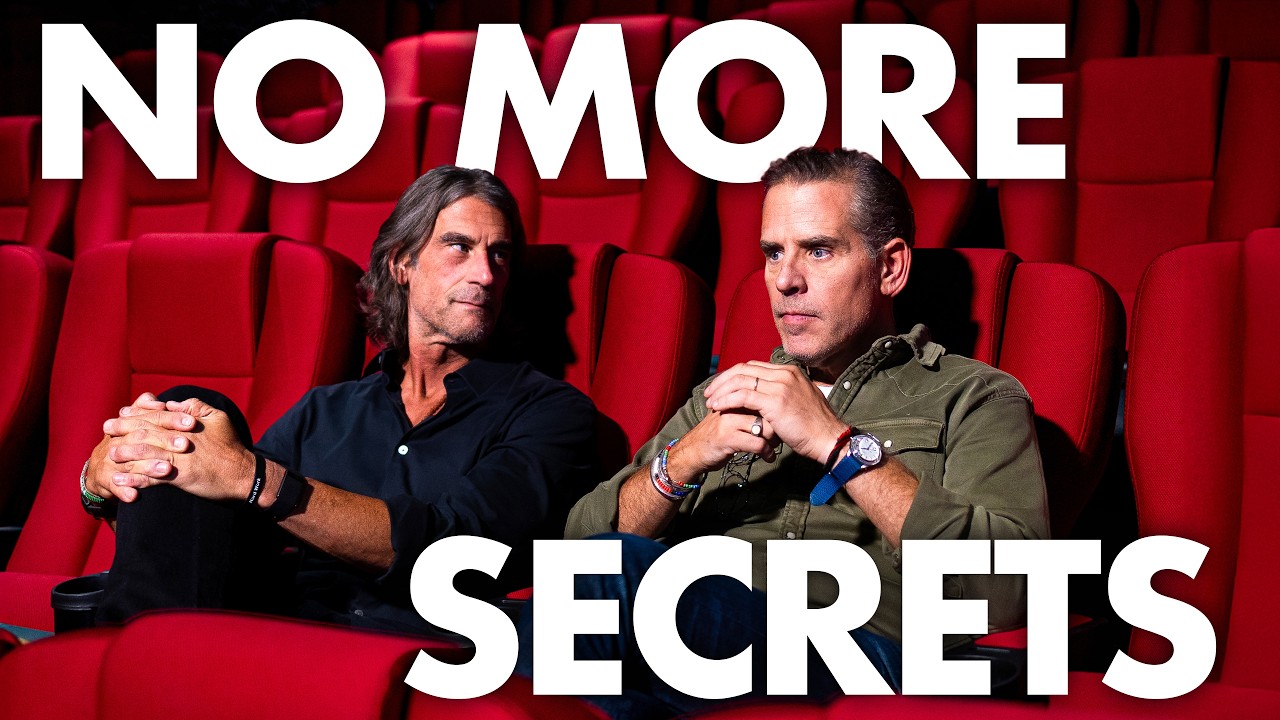
Video summary
Hunter Biden opens by detailing his lifelong struggle with addiction, which he attributes to a genetic predisposition compounded by severe childhood trauma following the tragic car accident that killed his mother and brother when he was eight years old. Initially using alcohol as a coping mechanism for anxiety and feelings of emptiness, he constructed a persona centered around drinking in Georgetown before facing a nine-year odyssey marked by repeated relapses. His path to recovery was ultimately forced by an extreme public exposure through media investigations that revealed his digital footprint, emails, and text messages spanning over two decades, presenting him with a stark choice between spiritual or physical death. He survived by accepting this "complete exposure" as a gift that obliterated his ego, allowing him to live authentically while emphasizing that true sobriety requires an internal drive rather than external imposition.
Central to his recovery process is the critical distinction between guilt, which arises from specific actions, and shame, the belief that one is inherently unworthy, as unaddressed shame often leads to relapse. To combat self-obsession and intrusive thoughts, Biden turned to art to occupy his mind and found purpose in serving others, while also confronting deep-seated resentment toward those who vilified him by realizing that holding onto hate would only perpetuate his cycle of addiction. He illustrates this personal evolution through actions like appearing on Tucker Carlson's show to confront these feelings directly, learning that seeking amends is fundamentally about personal healing rather than waiting for forgiveness from others, and even acknowledging past mistakes such as kicking his dog Mo to understand that trauma can stem from one's own behavior.
However, Biden clarifies that while he has found personal healing and humility, these experiences were not gifts to his loved ones who endured significant harassment, threats, and violence against his pregnant wife and family members, for which he feels ongoing guilt over not fully recognizing the damage inflicted. He takes full responsibility for his addiction but rejects blame for the invasion of his privacy, attributing much of the narrative corruption surrounding his life to Donald Trump, while also addressing the broader societal prevalence of cruelty that he links to fear and unhealed trauma. He highlights the importance of empathy as a counterforce to this cruelty and discusses the unique challenges faced by younger generations due to social media exploitation and the loss of formative experiences during the pandemic.
Ultimately, Biden advocates for a spiritual belief system rooted in interconnectedness and service, stressing the necessity of continuity of care in addiction recovery and the transformative power of community support. He underscores that overcoming isolation and embracing compassion are essential not only for individual healing but also for societal progress, noting how his journey has shifted from self-pity to a focus on helping others. By sharing these insights, he aims to demonstrate that while the path to recovery is fraught with pain and scrutiny, it can lead to a profound transformation where one learns to live authentically through service and connection rather than isolation and shame.
Read the full video transcript
I wish I could say I'm on my way to
saintthood. I'm not even close on my way
to
>> degenerate. Yeah, I am. That's exactly
right.
>> Welcome to the club.
>> Yeah.
>> Hunter Biden, the son of President Joe
[music] Biden.
>> Hunter has been in the center of major
political and legal controversies.
>> He addresses his lifelong battle with
addiction.
>> When I took my first drink, it seemed to
be an answer to everything. And then it
wasn't just Coke, it was crack. And then
you chase that [music] answer into your
own prison cell. And I had the binary
choice of live or die.
>> The intensity
>> Yeah.
>> of what you had to endure. Like I don't
think anybody can understand what that
must have been like.
>> I was given the greatest gift that any
addict could ever ask for if they can
survive it. Total and complete exposure.
That [music] has stuck with me. The
shame.
I don't know why I haven't even telling
you this right now. [music]
If you think that you are alone, I'm
[music] here to tell you you can make
it.
It's great to have you here, man. I'm so
excited to talk to you. We have uh a
bunch of points of intersection. We're
both of a certain age. We're about the
same age.
And we both came up in and around DC in
the late 80s and early 90s. You know, I
was doing what I was doing and you were
in and out. I mean, you went to
Georgetown. My parents live in
Georgetown.
>> I was thinking this morning, there's a
fairly decent chance we might have been
at the same bar at the same time. I
promise you [laughter]
if you were at any
>> partying uh and and and not realizing
it,
>> it's auditory this this mission that
you're on. I mean there are very few
people whose lives are not touched by
addiction either directly or indirectly
or tangentially. Uh, and I see you as
somebody who has done a lot of work and
is now whole enough to enter the public
sphere and talk about this not from a
perspective of of trying to repair your
public image, but from a real
serviceoriented
motivation to advance understanding and
compassion around this cunning,
baffling, and powerful disease that has
afflicted you, it's afflicted me,
>> it's an animating, you know, reason why
I do this podcast. Uh, and even if it
impacts one life positively and saves
them from some of the suffering, you
know, that you suffered and I have
suffered, then it's worth it, you know,
and I and it comes across loud and
clear. It's clear that's why you're
doing it. Where does the, you know,
addiction story begin for you?
I first got sober in 2003. I'm I'm going
to go back. Um and when I first the
first time I got sober, which I stayed
sober for extended period of time. And
uh um I was a firm believer in the idea
that that you know I was a drunk because
I was genetically predisposed to be a
drunk and and that's it. And
[clears throat] there doesn't have to be
any other reason.
>> I mean that's very much an AA thing.
It's like we don't really need to spend
a lot of time wondering why, you know,
I'm starting to change my mind about
that.
>> And I did. And um this time around and
uh and one of the one of the people that
helped change my mind was uh uh Kabora
Mate,
>> Dr. Mate, same for me.
>> Yeah. and uh and based upon his own um
uh anecdotal evidence as uh treating um
hardcore addicts in Toronto for extended
periods of Toronto, right? Or Vancouver.
Vancouver. Yeah, Vancouver for an
extended period of time.
>> He came to the conclusion that not, you
know, a large percentage but 100% of the
people that he was treating all
experienced um significant trauma in
their lives. And it may not be a direct
causal connection to addiction, but it
is a um but there is an obvious
connection just by virtue of that as he
I think says in some of the things about
she said he there's not a single person
that is an addict that he has treated
that has not had significant trauma in
their life.
>> Um and so yeah,
>> for me where does my addiction begin?
Part of it may be my genetic predisposal
um to uh to addiction, which they
haven't been able to figure out, you
know, what gene that is necessarily, but
part of it's a trauma of um of my early
childhood. My mom and sister and my
brother and I were in a car accident. It
was an incredibly violent um uh uh
accident that killed both of them. My
brother and I were trapped in the car
for an extended period of time.
um they finally got us out and I spent I
spent about a month in the hospital with
traumatic brain injury and my brother
spent um you know longer in a body cast
for extended period of time
>> and equally significant was the fact
that it was essentially like never to be
spoken about again.
>> Yeah, it was
>> it wasn't there wasn't like an open kind
of like let's heal this wound kind of
environment. My mom as we called her
mommy. Mommy and Casby were always
spoken about, but never the accident and
never that trauma afterwards. Never the
um you know the aspect of loss. It was
only the honoring of the of the um of
her memory of their memory. And um and
the reality was is that I was surrounded
by love after that. My aunt Valerie
moved in with us and um she raised Bo
and I when uh until my dad got remarried
and we got remarried as we we say and my
uncle Jimmy converted the the garage
into an apartment for himself and he was
there and my my my grandparents on both
sides we spent you know uh [sighs] you
know an enormous amount of time with and
then the wider community because my dad
had just got elected. He was 29. And so
my childhood was filled a lot of love.
But you know what? I was um uh my
brother and I reacted very differently
uh to to it. You know, I was filled with
anxiety. And when I took my first drink,
um I remember it clear as day is that
before I got sick from
uh over taking too much of the alcohol
in is that it seemed to be an answer to
everything.
>> Mhm.
>> You know,
>> how old were you? Well, I mean, at that
time, I literally snuck a glass of
champagne under a table like when I was
eight years old, eight or nine years old
and um and uh and then snuck another and
um and I didn't like continue drinking
after that, but I remember that um
vividly remember that. And um and then
when I you know I started drinking in
high school and it was the thing that
you know you could ask the girl to dance
and you know and or you could um you
know whatever it is that whatever
feeling of being alone in a room uh uh
full of people however it manifested
itself was gone once I took a drink and
um and that you know and and so I
developed a persona around uh drinking
in Georgetown. I think the reason that I
most wanted to go to Georgetown because
the drinking age was 18 in DC until the
year I got there.
>> Yeah, I know. Like I got grandfathered
in. I think um I think I was right on
the cusp there. But now it was kind of
amazing. I'm 59 about to turn you
grandfathered. Yeah. Yeah.
>> And uh yeah, just being 18 and going hog
wild. Yeah.
>> It was, you know, it was a good time. I
mean it works. That's the thing
>> that you're speaking to also. They say
why? Because it worked.
>> It's very effective. Suddenly, no
anxiety. You can walk into
>> the high school dance or the bar or the
cocktail party and just
>> no problem.
>> Yeah. And I think when I talk to a girl,
I can like, you know, be care tell a
joke. All of that.
>> Yeah. And I think when we say anxiety to
people out there, it's like everybody
has a little anxiety. what are you
talking well I you know and I don't know
whether it's this like um circular you
know I mean reinforcement but you know
the anxiety to me was almost
debilitating it it made me feel empty
inside I you know and and now I I I know
what all of it is and whether is the
result of the trauma and things like
that but it was all fear
>> everything every bad decision that I
made every habit that I formed was uh
based on fear. And what I mean by that
was it's was with everyone is that we
all have this delusion or illusion that
that uh that we need to be afraid of of
people, places, things um ourselves of
being found out that you're not really
who you profess to be that the mask is
going to come off. And so anyway, going
forward to what you were saying was so
nice to say, and I really mean that. It
means a great deal to me, particularly
coming from you, is this idea that I've
done the work and that it shows.
[laughter]
Here's another really honest thing. I
was given the greatest gift that any
addict could ever ask for if they can
survive. It is total and complete
exposure.
I was so publicly humiliated, so
publicly exposed with literally video
and and uh you know uh in in Technicolor
[snorts] on every newspaper in the globe
on every TV screen for a period of time.
I was the third most spoken about person
on Fox News for a 4-year period of time
other than Donald Trump and my father.
And on top of that, they did 16 hours of
documentary film and they took all the
pictures from my my digital life and,
you know, put them up for everybody to
see. And [snorts]
wasn't just coke, it was crack, you know
what I mean? And it was this much crack
and it was that. And what that did is it
it it gave me a binary choice. I wish I
could say that it was the result of what
most people have to do in order to get
to the space that at least I hoped that
I'm in today, which is this incredible
freedom of being exactly who I am and
being comfortable with that, which is
they just completely obliterated my ego
and I had the binary choice of live or
die. I could go back and I could use and
I knew I would die. And if I didn't die
a physical death, I'd obviously die at a
an even worse type of death. Or I could
choose to live. And I chose to live. And
I had to learn how to live in that um uh
in that fishbowl.
And with everybody seeing all of my
faults, not just the pictures, but like
the the out of context text to um uh you
know, like calling my mother a bad name
in in a in a fit of anger and and and
addiction um you know, or like lashing
out at so and so or you know, like
everything. Everything. how I spent my
money, you know, on, you know, on sex
and and things like all of it. All of
it. There's nothing out there that um
there's nothing that is that I have as a
secret anymore.
>> I don't think anybody could have had
their covers pulled and been more
nakedly exposed than you, like in the
history of the human race. By the way,
absolutely insane that you survived
that. I mean, there's rock bottom and
there's the dark knight of the soul, but
the intensity
>> Yeah.
>> of what you had to endure like to burn
in those flames for such an extended
period of time.
>> I I don't think any anybody can can like
understand what that must have been
like.
>> No. And and here's the thing. I mean
like the New York Post, you know, I I I
was told I don't know whether it's true
or apocryphal that I was on the cover of
the New York Post in like a year period
of time more than any single other
individual in the history of the paper
going back to when it was founded uh in
like the late 1700s.
And
in that though,
which you you like you it just creates a
choice.
If we can get back to the idea of how
did how do we allow that to happen to
anyone?
>> I mean, can you imagine it to any other
person where people wouldn't stand up
and say, but they didn't. You know why
they didn't?
And the reason I'm out there talking
about it is because I was a crack
addict.
and they have a vision and idea of what
a crack is
>> the lowest of the low in drug
>> addict and then you take crack you know
what I mean I think that the uh you know
I joke the only thing worse would be a
meth addict but the meth addicts all
online tell me [ __ ] you
>> worse but it's sufficiently dehumanizing
that no one's losing sleep over taking
shots at you
>> exactly no by the way no one didn't
matter whether it was on MSNBC or
whether it was on Fox News on the the
left, they dismiss me as being a uh
degenerate fail son who's drifted off
his father coattails his whole life. And
so, you know, but that's not Joe Biden's
problem. It's his problem as a father,
not as a president. So, you know, just
stay in the corner over here. [gasps]
>> That level of dismissal was was probably
the hardest. It was the hardest to to um
for me to get comfortable with um and
and accept as being uh the reality of my
life at that moment in time. The other
one was easier because it was such just
costic. It was just so vitriolic and and
irrational in um you know they spin from
you know that addiction which is really
easy to do. It's called eliminationist
rhetoric. And what they do is, you know,
they they uh they [sighs]
they put into the into the the
bloodstream of the public the worst
possible accusation that you can make
about someone, which is that they're a
pedophile. And that's the original thing
that Rudy Giuliani and Bernie Carrick
did. They went and stood on the
courthouse steps in Newcastle County in
Delaware and they held a laptop, which
was not my laptop, and uh and talked
about inappropriate images of children.
And what that does is is that if 5% of
the people can believe that, then 50% of
the people can believe that you're
capable of bribery or influence pedaling
or anything else. One of the things that
I point out to everybody
is that I don't know anybody in public
life uh that has been more exposed, had
their digital life more exposed than me.
22 years of my entire digital footprint,
and I'm not talking about a laptop. This
is why I always say there is the laptop
is [ __ ] What I'm talking about is
22 years of everything. Everything that
was deleted, everything that was still
existed in a cloud somewhere. So every
deleted photo, every actual photo that
was uh still in a cloud. They had all my
voicemails going back a decade. My
voicemails from different devices over
the period of that time. They had every
text message, every single deleted or
otherwise. They had um every single
email and you know what was not in that
all of that. That's why I always say
show me yours. Is this not a single
instance of a single communication from
me to anyone that worked for my dad or
my dad saying, "Hey, I need you to do
this on behalf of someone that I'm
getting paid by." Not one. Not one. So
the thing that is most attached to my
name as a symbol of criminality is
actually the thing that is the most
exculpatory that uh to me. But anyway,
back to what we were saying in terms of
level of of the recovery and why now for
me I don't have any fear
anymore.
And I have a message for people that are
still out there sick and suffering. If
you think that you are alone in your
misery and can't climb out of the of the
well of addiction that you fell into,
I'm here to tell you, you can make it.
And no matter what the consequences that
are coming down the pike for you, I
promise you,
>> you can make it.
>> I mean, if you could survive that
>> Yeah.
I mean
>> whatever somebody is going through
there's there's always hope and there's
always help but it is it is a you know
relapse is also a large you know part of
your story and I want to talk about uh
you know right thinking around relapse
>> it's all about willingness you know it's
sobriety isn't for the people that need
it it's for the people that want it and
you can't impose willingness on another
human being and so the hopefulness and
the possibility of achieving sobriety is
very much a function of your internal
drive and that has to be arrived upon
organically, right? Like you had to be
beaten down like nobody's business to
arrive at a place where you were broken
enough to try to do this a different
way. Uh and everybody has their own
version of that, right? You can't just
tell somebody, "Hey, it's time." Like
they have to decide that it's time.
>> Yeah, that's exactly right. And you know
I one of the other things that I say all
the time and I steal all this [ __ ] by
the way. None of it's original to me.
Any any of these like great lines that I
have are 100% stolen from people that
are much wiser than me that I listen to
in the rooms a long time ago. And one of
them is that I use all the time is um
getting sober's easy. All you got to do
is change everything.
>> Yeah, I've heard that one many times.
>> And to me there's a real truth to that.
and uh
and I got really really uh lucky and I
view it as a as as a miracle, but I've
witnessed others that in recovery that
have received this miracle
is the angel of uh Melissa in in my
life, my wife. Now, [gasps]
it's really really hard. And I the thing
that I'm most imp the people I'm most
impressed by in this world are the
people that uh that that uh that do it
alone that don't have the support system
that I did. But when I met Melissa, she
just intuitively knew things that um
that I hadn't hadn't done before. I
mean, she took every she she took my
phone, she erased every single number in
it. She uh you know she moved us to a
house that was secluded in the in the
hills and um you know she took my car
key she but she had to act as my jailer
for a period of time but it was also a
complete shift in I didn't have to
return immediately to the um to the
chaos or what some people would call the
comfort of of uh of all the people that
desperately were trying to get me clean
and sober.
And in that separation from that uh I
found something that I had never
accessed before in the early days or at
any period um in recovery which was my
practice of art which I had done my
whole life but I never had done it to
the degree that I um uh seven years ago
uh um became a way of life for me. And
um and so those two things and I always
say to people like I found my purpose
not with a big P, you know what I mean?
Like I think that's kind of like it's
kind of [ __ ] and if you or not it's
not [ __ ] but it it sets people up
for failure. This idea that you know
like yeah why you know I work at
McDonald's and I need to get clean and
sober and you're telling me to find my
purpose you know when I'm working two
shifts and I'm driving an Uber. I'm
like,
>> "Yeah, I mean, I think these words do
more harm than good often, you know,
because they make people feel bad
because they don't know what their
purpose is or like what, you know, like
you need to find meaning." It's like
it's well intended, but like, you know,
if you're someone like myself who's
walking around insecure and feeling like
a a fraud and all that, like it's just
totally [laughter] like you're like,
"What do you find?" You know, like, "Oh,
well, good luck with that." You know,
>> find your bliss. You know what I mean?
like and I'm like just Jesus Christ I'm
just trying to get out of bed. But for
me what I mean by it with the small P
purpose is that I literally found
something to do with my hands.
I you know one of the things about crack
addiction that I always uh say to people
is that there's a ritual piece of it and
the habit of the pipe and I mean I can
do all of the hand motions still and
it's it's I'm 70 years removed and I'll
be able to do them for the rest of my
life and there's this thing about
ignition and things and all of these
things that are are brain body um
connections that that I realized that
when I was painting and it doesn't have
to be painting. It doesn't have to. It
could be um running. It could be. All
I'm saying is that I know for me, I
don't have a prescription for anything
else, but what helped me was giving me
something to do hours at a time in my
free time that took me out of my head,
occupied my my body and my hands in
particular in an exercise that at the
end of I felt like I had done something.
And um and I've watched people do it
with um athletic things. I've watched
people do it with um uh uh you know
gardening. I've watched people do it
with but I just felt like I and I still
feel to this day if there's any
prescription that I have is uh I find
that to be a really really important
part at least of my recovery.
>> Mr. Andrew Yang, would you say that your
relationship with your phone is
intentional or reactive?
>> Mostly reactive, unfortunately. Uh, you
could even say abusive where it just
sends me pings and notifications and
vibrations and I just run to it and
respond saying, "What is it? What's the
matter?"
>> Well, I got good news for you, Andrew,
because there is a cellular company
that's going to help you with that very
problem. And it's actually gonna pay you
to use your phone less.
>> Well, I do like money. What's it called?
>> It's called Noble Mobile. Have you heard
of it?
>> I have. In a dream, it came. [music]
[laughter]
>> If you want to learn about Noble Mobile,
the company founded by the great Andrew
Yang sitting next to me right now. You
can do that and you can sign up and you
can change your relationship with your
phone entirely. Here's what you're going
to do. You're going to go to
noblemobile.com [music]
and you can try it for just $10 for your
first month when you use the [music]
very special VIP behind the velvet rope
code. Rich roll. Make your relationship
with your phone less abusive, more
deliberate, little more distant
>> and we'll all be happier.
You really get to know your mattress in
the summertime. Don't laugh. It's true.
the nights get warm and if you're
sleeping on a slab of synthetic foam,
you're going to feel it. And now I've
been on a birch mattress for about
[music] I think about five years at this
point. And I think the thing I noticed
the most this time of year is that I
just [music] sleep cooler. It breathes.
And that comes straight from what it's
built out of. Organic [music] cotton,
natural latex, real materials,
responsibly sourced, firm, yes, but also
comfortable. And [music] more
importantly, built to last. No
polyurethane foams, no questionable
offging, which matters when you think
about how much of your life you actually
[music] spend on the darn thing. And
they make it easy to find out for
yourself. It ships free, rolled up in a
box, simple to set up. You get 120
nights to [music] see how your body
responds, all risk-f free. And they back
every single mattress with a limited
lifetime [music] warranty. Because they
own their own manufacturing and stand
behind the work, they can [music] do
that. Sleep is the foundation everything
else is built on, and it's really worth
getting it right. I want all my
listeners to enjoy a deep, restful
night's [music] sleep with a new
mattress from Birch. Go to
birchliving.com/richroll
for 27% off sitewide. That's
birchliving.com/richroll [music]
and get 27% off sitewide.
For people that don't have direct
experience with addiction, uh it it's
important to understand the degree of
self-obsession uh that takes place in
the addict's mind and the incessant, you
know, looping of self-defeating
narratives. Like you're just lost in
your head.
>> Yeah.
>> And it feels impossible to interrupt
that or or to arrest that in any way.
And for you, like what I see is somebody
who found art as a way to quiet that.
Like, oh, I can just disabuse myself of
my self-obsession for a moment because
I'm present with this thing that I'm
creating.
>> And that becomes like a wedge where
you're like, "Oh, it is possible to not
just be thinking about myself all the
time."
>> And then to have something
three-dimensional or two-dimensional
that you were like, "Oh, I did this. Oh,
by the way, everything I you created at
first was genius.
>> Yeah. I mean, who cares whether it's bad
or good?
>> Picasso.
>> The point is that uh that you're making
yourself like at least nominally useful.
Uh and you're you're getting outside of
your head, you know what I mean? And
ultimately that can with greater work
become an act of service. I mean,
service is the antidote to the
self-obsessive mind of the addict. and
that's what you're doing and showing up
in all these public forums, but you have
to find something like for me it was
running. But I think where it gets
confusing for people is they start to
conflate like whether it's the art or
something athletic. They start to think
that that's the solution to the
addiction. like this is just like one
spoke in a wheel and it doesn't come at
the cost of actually like working the
program and you know like learning a new
way of life to your point like you have
to change everything
>> and first and foremost you have to put
your sobriety first and you have to like
work these steps and like do all the
[ __ ] [ __ ] that they tell you to
do that sounds stupid and you have to
believe in all of these apherisms that
you know feel like your you know
grandmother came up with
>> and that's part of it and then you get
to like sit down and you know draw
something or paint a picture and get out
of your own head for a minute. One of
the things that kept me trapped in my
addiction, in the cycle of relapse that
I was in, was that I wasn't being honest
with the people around me. And in doing
so, I wasn't being honest with myself.
And I had all these secrets, you know,
that all um uh had to do with uh my
failure to stay uh clean and sober for,
you know, it was like a the 10y year
odyssey um nine-year odyssey. And um and
the shame of that, you know, not just
the shame of the rooms that you find
yourself in, but the shame of failure,
of not being able to uh of not being
able to to uh to find a way through uh
with the
>> and the spectre of a father who's
literally
>> Yeah. But even with that, I think
everybody can associate with this. It's
just a shame of your to my my kids, you
know, my three older girls who were in
their teens at the time that I went
through the really harshest part after
my brother's death of u of uh my
addiction is that I had I was ever
present in their lives. Most of their
lives I was they didn't know me to have
a problem. I they knew that I was in
recovery and um but I was I was uh I was
never absent. And when they lost their
uncle who was like a second father to
them because we were that close, I
wasn't there.
You know, I became lost in my own
addiction. And that's what I always say
is that
again, I steal all these things is that
um addiction is never an excuse, but at
least it's an explanation.
And it's an explanation uh there that
that uh
I
before
could never admit the things that I had
done that I should have felt guilty for
to myself or otherwise because it just
filled me with shame and appropriately.
And I realized that guilt is an
appropriate emotion, meaning that you
should feel bad and seek amends for the
things that you've done to wrong to
other people um or to yourself. Um but
shame is something that's telling you
that you're not worthy of their love
ever and you get trapped in that cycle.
>> Guilt is feeling bad about something you
did. Shame is uh you know basically the
idea that you're a bad person,
>> not somebody who did a bad thing.
>> Exactly.
>> And guilt and shame, unless you reckon
with them uh and make peace with your
past, is inevitably just leading you
back to using. every single relapse that
I had between 2010 and 2019
>> and there were dozens
>> dozens of attempts. You know,
>> you wrote kind of an incredible uh piece
on your Substack about relapse and I
wanted to
>> I wanted to read a little bit of it. I
won't read the whole thing, but I want
to read a part of it. Uh it's titled The
Addiction of Nations. Uh and you can
find it on Hunter Substack. Relapse does
not begin with a drink or a pill. It
begins with a thought. The thought
arrives quietly. It does not announce
itself as danger. If it did, the person
would recognize it immediately and shut
it down. Instead, it appears in a form
so ordinary that it passes unnoticed at
first, the way a small seed disappears
into soil before anyone thinks to mark
where it landed. The moment usually
occurs during something unremarkable.
Driving home from work, sitting alone at
a kitchen table after the house has gone
quiet, walking past a place that used to
mean something else. The mind drifts and
somewhere inside the drift, a sentence
begins to assemble itself. Not a
declaration, more like a suggestion.
Maybe things are different now. The
sentence is so small that it hardly
feels like a decision. It feels like
curiosity. The mind turns it over once,
then sets it down again. A person who
has lived through addiction knows this
moment well enough to distrust it. But
distrust alone is rarely enough to erase
it. The thought remains, and once it
remains, it begins to grow. Not all at
once. Slowly, the way a root system
spreads beneath the ground where no one
can see it. The mind begins constructing
explanations around the idea. The
explanations feel reasonable because
they borrow the language of
responsibility and self-control. You
have learned something. You understand
the consequences now. You are not the
person you were then. The thought
becomes a narrative. The narrative
becomes a permission structure. And by
the time the person recognizes what has
happened, the small seed that appeared
earlier in the day has grown into
something much larger, an oak tree in
the middle of the mind. At that point,
the relapse is already underway. The
substance comes later. I mean, that's so
beautiful. It's a very eloquent and
poetic way of saying, you know, the the
the relapse train pulls out of the
station well before the drink. And it is
this seed of a thought that at its
inception, you know, is crazy and
insane, but if you don't find a way to
deal with it, it will linger. And it is
a seed that you will unconsciously
fertilize
>> to the point where it's impo like by the
time you pick up the drink or the drug
like
>> there's no thought involved like it's a
done deal and sometimes it's it's a
conscious decision and sometimes it's
that unconscious thing where you know
you hear these stories all the time like
oh I just I was in this situation and
then it just occurred to me to like
order the drink and then I was drinking
and I don't even know how it happened.
Well, it happened because of all the
things that you just, you know, kind of
beautifully elaborated on.
>> The only [clears throat] thing at least
I I this is my talk about the work. The
only thing that I allow myself to live
in fear of is my own mind.
It is like just you reading that back to
me gave me chills because every addict
knows exactly what it's like.
>> Yeah. I mean that was like reading my
mind.
>> Yeah. And the hardest hardest thing at
least for me one of the hardest things
in recovery is in any way trying to
articulate
to those who have not experienced the
why of it. Like how how like all the
work that you put in all of the the
healing that had been done all of the
the consequences that you know that
you're going to face. There's a scene in
that movie that got kind of got panned
um in uh with Denzel Washington, you
know, where he's flight.
>> Yeah. A friend of mine wrote that movie.
>> Yeah.
>> So that scene and you'll know the one
I'm talking about.
>> It's it's it's the most accurate
description of alcoholism on screen that
I've ever seen.
>> Ever seen. And it's him in the hotel
room. He knows that he has the biggest
day in his life. That if he just makes
it through this, he's back in the
captain's chair. and that
everybody on screen that has not faced
addiction looked at what he did and
thought that that was a Hollywood um you
know [ __ ] Like of course he
wouldn't go into the mini bar and drink
the mini bar. [clears throat]
>> But I mean you just you know exactly
what's going to happen.
So [sighs]
it is and uh today is different but I
really lived like this today
like I did not wake up today and and
there was not even a seed
um
and
there's also I don't know with you about
you I know for me there's this delicate
dance of not giving
these uh experiences and and this uh
this knowledge too much weight that it
paralyzes you in your life while at the
same time
being constantly
aware
>> Mhm.
>> of that in your life. You know, here's
another really selfish reason why I'm
doing what I'm doing right now.
You know, I say because it's in service
to other people that are still out there
sick and suffering. The real honest
answer is is first and foremost it's in
service to myself
is the person that I'm helping the most
by speaking about my experience
is me.
>> Yeah. the the you know service being
this cornerstone of recovery like you're
not going to be able to maintain
long-term sobriety if you're not uh you
know of service to those that are still
suffering and that comes across as some
kind of sacrifice or martyrdom. Uh but
the truth is is there's a selfish motive
to this. Like it's actually like selfish
service because in sponsoring somebody
else or showing up for somebody else,
>> this is more [clears throat] healing to
you than it is to the other person. And
it's a necessary aspect of disabusing
yourself of the obsession of the mind
and investing yourself in the well-being
of somebody else that is essential to
maintaining sobriety. So it is a selfish
act to be
>> selfless in your service. Uh, and if
service feels like annoying or
inconvenient or whatever, couching it in
in those selfish terms, uh, makes it
easier to pick up the phone and call
that person who's having a hard time
when you're sitting and spinning and
lost in thought and like just, you know,
kind of rehashing what happened
yesterday or, you know, like terrified
about what's going to happen tomorrow.
>> Yeah. you know, as much as I was
exposed, you know, there are those
moments of um in my addiction in which
I, you know, that I still experience as,
you know, as like real, you know,
traumas. um and and left to my own
devices
and in my own head, you know, they
become that seed.
[snorts]
>> And so again, like
>> the big thing though
>> is I wish I could say like I'm I'm on my
way to saintthood. I'm not even [ __ ]
close on my way to You're a [ __ ]
degenerate.
>> Yeah, I am. I am. That's exactly right.
>> Welcome to the club. Uh
>> at the core of all of this is
resentment. Resentment
>> is always going to lead you back to
relapse.
>> Yeah.
>> Resentment is an indulgence that the
addict or the [clears throat] alcoholic
cannot afford. And I don't know if
there's anyone on planet earth who is
more entitled to resent certain people
than you. like so many people
>> directly vilified you, you know, it's
it's absurd to call it the town square.
I mean, like globally, right? So, I'm
interested in how you were able to
relinquish what I'm sure were
deep-seated resentments against these
people who were attacking you uh for
things that were not evidence-based or
unfairly or whatever in your mind.
>> Okay, everybody's going to get mad at
me.
But uh again,
why do you think I went on Tucker
Carlson?
Because one of my deepest resentments
>> so that you could overcome your
resentment towards him.
>> Yeah.
You know, I know Tucker for 30 years,
and I didn't know him well. We weren't
close friends in any way.
>> Do you know him from the program? No, I
didn't know from the program, but he
lived in the same neighborhood in Spring
Valley where I was, and we had a lot of
mutual friends going back to the time
when, you know, uh, my high school
girlfriend, uh, went to high school with
him. I mean, I I've known Tucker and his
wife and my wife at the time. became
running buddies and friends and and and
so we were never friends, but we were um
but but we knew each other and we were
acquaintances and
>> which makes all the vilification on his
part all the more painful.
>> Yeah.
>> Because you had a you already had a
relationship that he was saying wasn't
true.
>> And what can I do um in service?
I think part of service is is that you
need to do things in service of
yourself, even if they're hard. And
resentments are the hardest. And like
you said, I have resentments towards,
you know, the Miranda Divine at the New
York Post and I have resentments towards
and what I I've decided is is that um
I just have to just go head on. And um
you know when Tucker asked if I wanted
to talk to him, I said, "Yeah, I do."
Because number one, it it it um it gave
me a lot of anxiety.
>> Mhm.
>> And I've decided to do everything that
I'm scared to do. I used to be scared to
sit down. You put a microphone at me and
and it, you know, it was hard for me to
formulate my thoughts and fast as I
wanted to or to sound as good as I
thought that I needed to sound or to not
stammer a little bit and, you know, take
out all the ands and butts and ums. And,
you know, I don't even think about that
anymore. And uh part of the reason is is
because
I keep in the back of my mind rich has
seen the worst of me. [laughter]
And I don't have to pretend to be
anything other than the person that I am
sitting in front of him right now or
make excuses or defend myself in any
way.
I just need to be me.
>> And you don't need anything from that
other person. Like if you were to
everything Tucker said about you
negatively and clipped it together into
like it would probably be hours of you
know
>> just
>> something very difficult to sit through
and then you're sitting across from him
and he's he's like pretty cheery about
it's not like he's like oh my god you
know I can't believe I saw you there's
none of that right
>> but I also didn't get the sense that you
needed that from him. No,
>> you know, you were just like, I'm here
to like overcome my own resentment.
>> Yeah. Yeah.
>> And it has nothing to do with how he
responds to me. It's all about my
relationship to this dynamic.
>> It's the reverse of what we learn about
forgiveness is that we as as addicts
have to see amends and we have to seek
forgiveness, but not the result of it.
The act of actually going and and saying
you're sorry with sincerity is not about
whether or not that person forgives you.
It's about the fact that you do it.
Again, it's incredibly selfish.
>> And the same thing with resentment
is it's it's my thing. It's not theirs.
I it's it's for me to lay down.
>> Yeah.
And um
because I I I could live the rest of my
life
just filled with hate over what they did
to me and how they did. You know how I
think about it now? They gave me the
most incredible beautiful gift that I've
ever been given in my entire life, which
was complete in total liberty. Complete
freedom from all of my secrets, complete
freedom from all of the shame.
They gave me this incredible chance at a
life in which I could simply be who I
am. Everything and and every day trying
to do the next right thing and failing
so often. Like I guarantee you I'm going
to do enough things in this podcast
alone to piss off 30% of the people
that'll be on here calling me a
pedophile and this and that and the
other thing and make decisions and do
things that are, you know, but it
doesn't even remotely affect me. And uh
now I'm open to criticism, you know what
I mean? I'm I'm open if I'm going to be
public and I'm going to be talking,
then, you know, I should be responsible
for the things that I say and hopefully
not be misleading or or or uh doing
something in a way that is hurtful or
harmful to somebody else. But
you know uh again like I wish I could
say that you know
that this practice that I had came to me
through this an enormous amount of like
hard work and I moved to Rishihash and I
lived with a monk for 7 years and I you
know and and I practiced but most of it
was um [music] uh just pure survival.
>> Yeah.
Fasting has been a recurring and very
popular topic on this show. And over the
years, I've hosted so many experts on
it, more than I can count. And the
throughine is always the same. The
benefits are real and evidence-based.
But actually doing it is kind of hard.
Well, [music] Prolong gets this and it
solves this problem for you. It's a
5-day plant-based program. Soup, snacks,
beverages designed to keep your body in
a fasting state while you're still
eating. All delivered to your front door
in a beautiful box of fasting benefits
without all the suffering. Developed
over decades with USC's Longevity
Institute, it's the only nutrition
program clinically shown to trigger
autophagy in humans. That's your body's
process of cleaning out and recycling
damaged cells. It also supports your
metabolism, your gut, and a healthier
relationship with food, which for a lot
of us is the thing that actually needs
resetting. So, ready for your own reset?
For a limited time, Prolon is offering
my listeners 15% off sitewide, plus a
$40 bonus gift when you subscribe to
their 5-day program. [music] Just visit
prolonlife.com/rich
roll to claim your 15% discount [music]
and your bonus gift.
prolonlife.com/richroll.
This episode is brought to you by
Airbnb. As summer winds down, crowds
thin out and the events arrive, the
marathons, the festivals, the games, and
suddenly hundreds of thousands of people
are descending on a city for a weekend.
I've been on the traveler side of that
equation plenty, landing in a city
that's completely full, scrolling
Airbnb, and finding somebody's actual
apartment, real [music] kitchen, local
neighborhood. Every time I think about
the person who lives there, off on their
own trip, their home [music] earning its
keep while they're gone. Because that's
the flip side almost nobody thinks
about. When the big event comes to your
town, that's your moment. Accommodations
fill up fast and your place with your
comfortable chair and your good coffee
setup and your actual functioning
kitchen could be precisely what they're
hoping [music] to find. You give
somebody the comfort of a real home and
you make real extra money. money to put
towards your own travels or that
renovation you've been circling. Your
home doesn't have to just sit there
while the biggest weekend of the year
happens outside it. [music] Your home
might be worth more than you think. Find
out how much at airbnb.com/host.
[music]
I completely understand this notion of
of your ego death being a gift. I
imagine that's difficult for the average
person who hasn't kind of flirted in
this world uh to to really get their
heads around. So, I think it would be
[clears throat] good if you could talk a
little bit more in explaining that. I
mean, obviously, it's our it's it's
healing our broken parts that make us uh
you know, able to be a healing energy
for other people.
>> And it's a level of humility uh because
you've been beaten down. so deliberately
for so long that allows you to be with
other people who
are undergoing challenges or or who
disagree with you and to to kind of
navigate those social environments with
a degree of grace. Uh but how do you
like further define that?
>> Yeah, that's a great question and I'm
not sure I have the answer, but I do
know this is that my ego death was much
easier on me than it was around for the
people that love me. [sighs]
the for the people that love me, for
Melissa, for my children, for um my dad,
uh um
the uh my friends, people that really
knew me, is that they have a righteous
anger about it, you know, and it's very
it's very trit for me to say,
you know, or maybe it's not trait, but
but it's uh for me on my lofty perch to
say like, I forgive, let's move on. It
was a gift to me. Well, it wasn't a gift
for my wife who had people show up at
our door when she was 7 months pregnant
with uh with red hats on um and chase
her down Mhalland Drive and drive her
off the road. You know, it wasn't a gift
for her when um you know, they
surrounded when we moved to to uh Venice
to get away from that. um when they
literally sat out in the in the canal
with uh bullhorns and
>> and chanted anti-semitic uh stuff uh and
uh [sighs]
>> because she's Jewish and and uh and so
there was a lot of violence in their
speech and and and real actual threats
of violence um that happened. So I and
again in like you know I get to be this
paragon of like of recovery and like oh
it was a gift to me and all my secrets
are exposed. Well what about all the
people that were in those pictures that
didn't ask for any of this that had to
you know had to answer questions to you
know their family and their friends and
and their lives you know the innocent
bystanders. Um and what about my mom?
What about my sister? You know, what
about my, you know, my aunts and uncles
and and and and their righteous anger
that the person that they know was was
this was happening to.
And I have to admit, I feel guilty about
that.
>> Sometimes
I feel guilty that sometimes I'm not
aware enough of the damage
that was done to them. Just think about
it from this perspective.
my three older daughters uh who are all
professionals and adults in in in their
lives now.
>> You know how hard it is like who's your
dad,
>> right?
>> Well, 7 months ago when you answered
that question, what do you do? Because I
know that they love me more than
anything in the world. But think of
them. It feels, you know, for them to
think that everywhere that they have to
go, they have to to be in some kind of a
defensive mode that they're either going
to fight on my behalf or they're going
to flee.
That every relationship, every new job,
every um new person that they meet at
their university or thing is going to be
the first thing is going to be what you
know.
>> Yeah. They can never outrun that.
>> Never outrun it. I get to be here and
talk to Rich Roll and I get to have this
like incredible conversation about
growth and spirituality and what I've
discovered in the worst moment of my
life was the greatest gift. And isn't
that a beautiful thing? What about them?
>> They're watching this podcast with, you
know, a lot of [ __ ] you energy.
>> Yeah. Not towards me anymore. and and
and but I but but 100% um uh I the the
[ __ ] you energy is is directed at the
people that did this and um because
there are people that did this. Let's
also remember
>> I take full responsibility for my
addiction. I take full responsibility
for the fact that I put a lot of it on
camera. I take full responsibility for a
whole lot of that stuff. But what I
don't take responsibility is for the
complete and total invasion of my
privacy and the corruption of the
narrative of what it actually said. And
so there you know and so do I have a
target in that in terms of who? Yeah. I
mean for me because I know for certain
that it is all the product of the
depravity of Donald Trump himself. Um
but again to your original question
about this is um you know around
resentment is yeah I've gotten to a
great place
like wow
me I'm I'm you know what I mean and I
really have I've gotten in a great place
where I'm I can write that about relapse
>> but there's people there's a lot of
casualties out there with the people
that you care about and for you, you
know, overcoming your your resentments
is life or death.
>> But normal people are,
>> you know, more than welcome to, you
know, nourish their resentments without,
you know, cataclysmic life consequences
as a result of that. And so that's
that's that's the gift of of the program
and the tools. And not everybody, you
know, has those tools as much as I think
like everybody would be a better person
if they went through the steps. Um,
most people don't have to and and so
they have to live with certain uh
difficult emotions without the capacity
to process them in the way that you
have. But I would imagine like listen,
you haven't transcended the mortal coil.
Like there's got to be [ __ ] that you
grind on still.
>> Oh, of course. Damn. One of the things I
grind on is is is um is Donald Trump,
you know, and I'm and and I and and I
say without any apology whatsoever or,
you know, unap unapologetically
is that um uh that there are people that
are um that are deserving of of my
derision, but I think of all of our
derision. I think that there are people
that are um you know
there is a sickness
that has descended upon the land
[laughter] to be to be uh to to steal a
uh another piece of pros and and and
it's real.
>> Mhm.
>> In my estimation, it's real. It's not
derangement syndrome. It's not anything.
there's this um uh there's this uh
license to cruelty um that exists and
>> encouragement and permissiveness.
>> Yeah. I had a really fascinating
conversation with an undocumented um
person yesterday that has been here for
38 years. They came when they were 2
years old and they went through the
whole process uh you know of DACA and
everything. excuse me, 28 years of DACA
and um and then it ended when they were
right at the end of it and Trump came in
and they have had um uh three family
members that they can't find now that
have been put into detention. And the
point that I made to them is their
question was why? This doesn't make any
sense.
None of them are criminals. They've all
been here for for decades. Yes, they
they came here on no account of of their
own quote unquote criminality of
crossing the border
>> and they paid taxes, you know, from
[snorts] the moment they got jobs when
they were 15, 16 years old is why are
they targeting them? And the answer is
this cruelty. Cruelty is the point with
them. It's the first time and I think in
uh I think since um you know in at least
that behavior has been modeled by a
president since Andrew Johnson and uh
after the assassination of Abraham
Lincoln is cruelty is the point. And um
and by the way, that was my whole story
as it relates to that, of this exposure,
of this humiliation, um of this uh uh
dehumanizing.
That was the whole point. It was never
about me. They thought that they were
going to if they could kill me in
whatever sense of the word, literal or
figuratively, they would end my dad. and
they were the he was the person that
they feared the most just by polling in
terms of of that and they were right.
>> They did miscalculate uh though in that
Trump thought he could go after you uh
for being this addict and I think he um
misunderstood
how that was going to be received. I
think that that really uh did not go
well for him because because everybody
>> has a relationship with somebody who was
suffering in in this regard and
>> you know best case scenario that fell
flat uh and I think it in many ways it
worked against him and I see now you
know there is a tide that's shifting
like I am hopeful uh you know when all
of these sort of hardcore MAGA people
are breaking ranks like it's fracturing.
>> Yeah. And I think people are waking up
to the realization that this is not the
way. Uh and you know I I am also very
inspired by
Gen Z.
>> I think Gen Z is the kindest generation
that uh that I've had the good fortune
of you know being connected with. And I
think that they are carrying a certain
hopefulness as well. Uh that has no time
for, you know, what we're seeing at the
kind of highest levels at the moment.
>> Well, they just have no time for the
[ __ ] They can they to them at least
to my experience like when I went out
with Andrew Callahan on he has he does
this he did this tour which was awesome.
It was it was Channel 5 Carnival.
>> Mhm. in part of the Channel 5 carnival
for a 56 year old guy and people that
that know me like watched like clips of
it and they were like what what were you
doing? Well, part of the carnival was
that he has a you know it's an audience
of about 2,000 people in these stadiums
and he invited me to go out with him on
the last three of them. It was one of
the mo it was one of the best things
that I've ever done for myself. It's
mainly, you know, like I say, draft age
18 to like 35 year old and um all the
people that
people sitting behind microphones in,
you know, wherever call like, you know,
the lazy in their basement, terminally
online, you know, out of touch, Gen Z,
D, what, whatever.
>> And uh and what I found was a incredible
community. I found people that were in
that didn't have any that it wasn't
about partisanship. It wasn't about, you
know, Republicans or Democrats, but they
cared. They cared deeply, but more than
anything, they cared deeply for each
other. And the evidence of that was
this. They did a talent show. And these
people would come up and do these silly
tricks, but people that you would look
at, you would that you knew were that in
any other setting were kind of scared of
their shadow. At least you that's what
you would have thought about them.
>> And they do these silly, funny,
sometimes serious things. And the whole
energy of the of that community was
love. like no matter what it is or how
silly it was, you got cheered and
high-fived and everybody and it was it
was one of the coolest eye opening
things that I've ever you know um I went
with these guys that that you know Dead
City Punk band there like legendary punk
band they used they did all those I mean
they're they're true anarchist each one
of them is a like
>> I love them they're my buddies you know
why because they're all in recovery and
They talk about it openly and you know
now do they you know do they literally
like uh you know I mean they are true
anarchists like I say dead city for life
like these guys but they're part of this
community they're part and and they're
and they're incredibly well read and
they understand what's going on and it's
the opposite reaction of the the people
that listen to Nick Fentes is that
instead of disconnecting instead
thinking everything's a joke. They know
that it's not. They understand all the
jokes, but they know that they have a
voice. And um I don't know if you feel
like this is all the things I learned in
recovery like you know what what we
haven't dealt with yet was the trauma of
co I mean over a million people died the
people that like the like and we act as
if this entire generation that didn't
get to go to their graduations or
weddings or or you know their or
grandmother dying or you know but
particularly the ones that missed like
the three years of you know
interactction ction with your friends
when you know when the most important
time in your life to have that.
>> Yeah. An entire generation deprived of
experiences we take for granted and we
dismiss
>> the impact of that period of time on
literally millions of young people.
>> And then you know what we did to them?
We allowed for these tech oligarchs and
their social media platforms to
literally prey on them
to make them at best unhealthy, at worst
dead. It's sick.
>> Mhm. [clears throat]
It's sick. And so I don't even remember
the question.
>> I don't either. But but I think to your
point,
>> you were talking about um this kind of
celebration of cruelty.
>> Yeah. I think that's working in lock
step with this
>> celebration of these tech oligarchs.
Like these guys are like rock stars, you
know, and they go on
>> friendly platforms and spin their yarns
and everybody kind of like, you know,
>> bows at the altar of these people as if
they're some kind of demigods. I mean,
they are like, you know, this is our
pantheon in our secular world right now.
>> And you know, like these people don't
have our best interest at heart. like,
you know, they're all about just
accumulating power and wealth
>> and we're meanwhile like worshiping them
for that
>> as we see this moral decay around us.
Like it is the Odyssey. Like did you see
the Odyssey? Like
>> I had Ryan Holiday on and we were
talking about the fact that like this is
this is like
>> a movie about the 12 steps. Like he is
going through the ringer and you know he
has to get to this point of surrender to
make it home.
you know, he's I mean, there's it's just
like the parallels are like all over the
place, but obviously also a parable of
like what's happening right now in
>> in in modern society where we don't have
a unifying
like anchor to bring us together. What
we celebrate is self-interest.
And you know, when cruelty is something
that, you know, we're seeing [snorts] at
the top of the pyramid, it's giving
everyone else this permission or this
encouragement to act accordingly.
And you know, Elon Musk said it himself
like, you know, empathy is weakness. We
need to purge our society of empathy.
And like this is just anathema to
recovery.
Empathy is like what is going to heal
us. And when I see you go on all these
podcasts and sit with all these like
controversial people and all of that,
like you are practicing empathy
sometimes with people who are deeply
unempathetic
simply for the purpose of modeling it
because all of the callousness and the
cruelty
is really a function of fear. Like you
said it earlier like all of the crave
and bad behavior is about fear and you
know like you can say well I'm mad at
this whatever the reason is you just
keep peeling the layers of the onion and
ultimately it always comes down to fear
like that is that is the emotion that
animates all of this at the same time.
So these are people who are masquerading
as you know alpha strong men
>> but they are the most
like fearful people
>> broken
>> in society. Yeah. They're they're
they're broken and they're inflicting
their unhealed trauma on the rest of us
and costumeuming it as as you know
masculinity or something like that. and
each one of them, you know, and I don't
know any of them personally, but I watch
um
I I've had little experience with um
with Elon and and because he really
really attacked me during the time
because of Twitter and that that gave a
whole new life and energy to the whole
Hunter Biden question of suppression of
you know blah blah blah
>> and um
[sighs and gasps] and I was really angry
and what the [ __ ] And um he's a really
broken person. He's had he has had 100%
incredible amount of trauma in his life.
And I don't say this to be revealing of
anything that's not already out there.
His father is a um a really really awful
human being. And
and people can go look for themselves,
but I think it very unlikely that his
father did not treat him like the way
that he treated every other child in his
life. his father and you can see it, you
know,
all of these, you know, that's why I
love Ryan Holidayiday is that um, you
know, I I I have his book, The Daily
Stoic, and I use it and um and I'm a a
huge believer in and in and uh the
lessons that we can learn, not from only
from Aurelius, but from from all of
those myths and, you know, the hero's
journey and Um,
and in those
in those incredible pieces of wisdom
that exist out there, whether it's Aldis
Huxley or whether it's Young or whether
it's um, you know, the Bhagat Gita, you
you know what's always the same is those
characters.
They're evil. They're they're the the
the archetype that of the broken person,
the sociopath, the psycho, what whatever
label that you want to put on them, the
malignant narcissist, the um each one of
the the carrier, the agamemnons
[snorts]
>> and and and
they repeat themselves. And that's why I
say nothing is new under the sun.
We are all on our uh on a personal level
on our own heroes journey but we we
are collectively
uh you know now we may live
in what I think it at a moment of which
is an inflection point um and we may be
living through the most significant step
in our evolution because of AI and I
know that you've had some people on here
that know way more about it than
>> [gasps]
[sighs]
>> But I think that at a moment in time in
which
compassion, understanding, and empathy
will be the central question of whether
we make it through or not. Is that
like
maybe I'm just a drop in the bucket, but
[laughter]
but you know what what what other choice
do we have?
>> Yeah,
>> I don't know. But like they are uh did
you ever see uh um what's his name? Sam
Alman he given an interview about I
think it was two or three years ago and
he said what he was asked what piece of
fiction do you um uh you know what in
fiction uh science fiction most
represents what you think the world
could look like um with the uh
introduction of AGI and super
intelligence. [snorts] And he said
without hesitation, he said, "Pantheon."
Have you seen Pantheon?
>> I haven't.
>> It's cartoon, but it's but it's the
voices are like William Herd. They're
like serious actors. And it's a series
that's on I think it's still on Netflix.
>> Go watch it.
>> The theme being
>> The theme being that we're all screwed.
[laughter]
>> I thought you were going to say like
Terminator.
>> No. No. But this is worse.
This is worse. And yet we barrel
forward.
>> This is this is the tragedy of the the
human species. Like we are nothing if
not builders who are insistent on just
continuing to move forward and innovate
irrespective of the downstream
consequences. Like we'll deal with that
when it happens. And history you know is
pretty clear that like there's always
unforeseen consequences. And the fact
that the people that are innovating,
doing the innovating, already have that
insight and it has no impact on on, you
know, how they're on the pace of this
advancement is deeply disconcerting. You
know, that's why I always go back to
again, I don't know, it's apocryphal and
or she really actually said it, but the
Mother Teresa's line and if you want to
change the world, go home and love your
family is um and I think that your
family doesn't have to just mean your
blood relatives, but that that family
that is the community that you're a part
of. And I get to I get to lay claim to a
family that is uh 50 million uh wide and
strong as do you of people that I know
that we have experienced that we we
share one thing the experience in pain
of addiction and the and the trauma in
and of it of itself and it's to varying
different degrees but I know there's a a
half a dozen rooms within stones throw
of me right here where I can if I need
to go sit
>> and and um and be witness to to their
pain and um and not feel alone. And
there's an amazing amazing selfish thing
about that. Again, like the single thing
the what one of wisdom which I've
learned from you. I literally I mean
I've learned from listening to you like
I'm sitting here talking as if I know
anything and the fact of the matter is
is that you've done more in service to
this than anyone else out there talking
about it. Um, and I've learned more from
you than I think that I could ever
impart if I you have another 50 years.
And that is that we are not alone. And
that um,
uh, that
all of the things that I just said are
things that, you know, you've spent, you
know, an entire career trying to, you
know, educate people about.
>> At the same time, like everything that
I've shared is not these are not my
original thoughts either. These are all
things that I've learned through
experience and and you know that I'm
just paring.
>> The cool part of this about it is if you
if if you aren't familiar with addiction
to everybody outside, you sound really
[ __ ] smart, [laughter]
>> which is really my this is my secret
agenda. Yeah.
Meanwhile, you learned it from a
toothless guy that was sitting in the
corner of a meeting who, you know, is
the oldtime that's been there 16 years.
And, you know, he doesn't have a job and
hadn't taken a shower in two weeks.
>> And he is like, you go, "Oh my,
>> this is the wisest person ever met in my
life." It
>> cuz these prophets walk among us.
>> Yeah.
>> I want to talk about the trauma piece a
little bit. Uh
you mentioned Gabbor Mate earlier. It
must have been it was probably like
eight or nine years ago.
>> Yeah.
>> Uh when I read In the Realm of of the
Hungry Ghosts and uh I was like I got to
meet this guy and I flew to Vancouver to
do a podcast with him and and he did
exactly what I wanted him to do which is
flip the table on me and then dissect my
>> Yeah.
>> story. And it was a real epiphany for me
because I grew up, you know, like I had
a like there's nothing I could point to
in my child like I didn't have a car
accident where people, you know, like
there were my parents didn't abuse like
they were always there. There's no
reason for me to think like I have
anything to complain about. I had my
insecurities and my feeling like I
didn't belong in my own skin and all
that stuff that you hear in the rooms um
with addicts and alcoholics. But my
alcoholism,
be it a genetic disposition, it just is
what it is. Like I had never delved
beneath the surface of that because that
really isn't part of what the program is
about. And Gabbor like really pulled the
covers for me and I was resistant to
what he had to say in that moment, but I
couldn't stop thinking about it. And so
I've been on this journey of trying to
unpack my past and make peace with
certain things and reckon with it
honestly, but it's nothing like what
you've had to contend with. And this is
outside of the 12step paradigm, right?
So where are you in your reckoning or
your healing with the things that
happened in your early childhood that
have repercussions in terms of your, you
know, behavior in adulthood?
It's still um it's still work in
progress, but I'm working and and
earnestly.
>> And what does that look like?
>> What does that look like for me? For me,
it has a lot to do with writing.
um is that um I spend a lot of time uh
uh because it's a way for me to be
in thought without it uh without it
being um uh dangerous.
>> Mhm. You know, I I find that when I just
um uh
find myself kind of um you know,
engaged in this delusional thinking,
meaning like that I understand the
future or am beholden to the past, you
know, that those kinds of thought like
the oh my god, like what about this and
what's going to happen then and things
like that. when I want to reflect on
something, the way that I find I'm able
to do it in a healthy way is through
writing.
>> And I don't I I would love to hear your
take on it, but you know, like I have
that one traumatic event, but the but
beyond that traumatic event, I was
surrounded by love.
I mean, surrounded by love. I have the
best example of a father I can ever wish
on anyone. If I am half the father my
dad has been to me, my sister, my
brother, then I am I I will have been a
success in this world. And I really
truly mean that is that he's incredible.
And what was it? And um and I'm still
unpacking it. You know, I I think part
of it,
and this is even hard, is it
the accumulation of of of a of selfish
decisions even as a child that created
shame in my life.
You know, I have this one memory that
sticks with me. And I've never actually
told anybody this
[snorts]
>> exclusive.
>> And I don't want to overblow it, but I
literally think about it all the time. I
got a dog and his name was Mo. It was a
black lab. All I wanted. It was a puppy.
And
uh and Mo lived for 16 years. The
greatest dog ever.
And I was uh
16 when I got Mo. And um and I I don't
want to overblow this because it wasn't
I remember trying to train Mo, my dog,
and getting so angry that I kicked the
dog
like where she whimpered and and um and
hid from me for like a period of time.
that has stuck with me, the shame.
I don't know why I'm even telling you
this right now other than the fact like
the things. And so I guess what I'm
trying to say is that your traumas don't
have to be
things that were um inflicted upon you.
Traumas sometimes are things that
you did yourself.
Like who is that? Who is that person
that was capable of kicking that dog?
Like I think about it all the time. And
the way that I think about it is this.
Can I really be a good person?
>> Am I or am I a bad person?
>> The fact that it stays with you and that
you think about it frequently
basically says you're not pathological
because somebody who is would wouldn't
reflect on that. Uh, and I think, you
know, it's an example of our pain is our
pain. It can be a car accident where
you're there's traumatic casualties or
it can just be, you know, a slight that
the person never thought of again and
has lived with you for 40 years and
influences your behaviors that turn into
these looping patterns that, you know,
send your life in a negative trajectory.
It is what it is. So, it's not about the
severity of the pain. It's simply
what you experienced. And I think that
in your case I think it's and listen I'm
not a psychologist like you know like
you know please like I'm the furthest
thing from a clinician but what I hear
is somebody who
>> went through you know had a incredibly
traumatic ordeal that even the most put
together person would struggle with
recovering from.
And yes you were surrounded with love
and you grew up in privilege etc. And so
that fuels your dismissal of recognizing
this thing really was traumatic even
though you were cared for in the
aftermath. And it's not just that
isolated event. It's also, as I
mentioned earlier, like the spectre of
growing up with like such a prominent
figure, you know, your your father, even
if he is and was like the most beautiful
and loving person possible, like
>> yeah,
>> that's that would be a challenge for
anyone, especially an anxietyriddled
young kid who had a who had a brother
who seemed to be kind of the embodiment
of of charisma and potential and all
these things like the insecurity that
that you know I would imagine you were
marinating in as a young person. So
there's that and then not for nothing
like the trauma of having to go through
the dismantlement you know that you
suffered you know from 2019 to 24 or
whenever it was the new cycle where you
were just pillaried like nobody ever has
been. Like all of these things are are
difficult things for a well-grounded
person to manage. Uh and the fact that
you're alive is remarkable in and of
itself. But I think there's real
I think there's real healing that is
still available to you by going like
what we learn in the rooms like you
don't avoid your pain, you go directly
towards it. And I think there there's
more freedom on the other side of
excavating whatever is there.
>> Yeah. And that's my point is that that a
lot of it what I do is is you ask me how
I'm I'm if I if I'm engaged in that
practice and what I find is is that I'm
willing to like explore those things
without getting lost in them. And that's
why I brought up the example which it
may seem like oh you're so full of [ __ ]
that's the worst thing that you know but
the um because it's not and I'm not
saying that that the trauma was to me
that that but what I do know is that
what still exists in me is
uh a voice
that says
you're not worthy of
this love like this moment in time right
now.
>> Mhm. Is it you?
>> You got to earn it. You got to earn it.
You got to write like a dope piece on
Substack or you got to crush some
podcast or you have to, you know, paint
something that, you know, everybody is
going to like freak out about. Like
that's the only way that you can feel
love and accept it because love is
transactional.
>> Yeah. And I think that I'm growing
beyond that. But I [clears throat] I
know I lived in that space for a long
time. I know that I live for instance is
that I went to law school and I excelled
and I went to Georgetown and then I
transferred to Yale and I got out and I
was scared to death of public speaking
so I knew that I didn't want to go into
politics. Um, but I was my brother and I
literally were were inseparable and I I
knew that he could have that. But the
real thing I wanted to be was an artist
and I wanted to write and
>> that wasn't part of the the the Biden
blueprint though. I would imagine
>> my dad would have been fine. I really
But you know who wasn't okay with that?
Me because I didn't think that myself
you know and by the way not because of
anything other than this. is because I
was scared to death because you know
what it takes to be an artist takes
courage
and I lacked it. So there's the fear but
it's that disavowel of self, you know,
[snorts] that creates the dissonance
like you're living out of integrity with
who you are.
>> Yeah.
>> With unhealed trauma like shocker, you
know.
>> Yeah.
>> Here comes the crackpipe.
>> Yeah. And it was answered everything.
That's the other thing I say to people
is why? because at first it was the
answer to everything and then you chased
that answer
into your own prison cell.
>> And um
but man, okay, back to fun things. All
right.
>> The fun things is is is that you know
despite all of that is um
like the other part about living in this
space that I'm living in right now. It
like it is it can it can be fun.
It's like part part of it is
>> is that and I mean this sincerely I get
to meet Rich like I get to come and talk
to you. You know, I'm I'm a super fan
and the idea that uh that I get to sit
here and have a uh discussion with
somebody that I know cares as deeply as
I do about some of these things. Um and
that has been uh uh that has given me
the opportunity to learn from the people
that he has on and elicites from them
things that have, you know, uh really
made a difference in my life is like
this. Yeah.
>> Yeah. It's cool. I mean this this idea
that you know sobriety is nothing but
martyrdom and suffering and pain like no
it's not that at all it's actually
liberation and there's a lot of joy and
>> tons of laughter and you know suddenly
life
>> uh you get to experience life in the
full spectrum you know in technol right
for better or for worse
>> and you know I'm I'm sitting here going
can't believe this [ __ ] guy Hunter
Biden is sitting he actually came to the
studio and he's doing this like How is
this my life? How did this happen?
>> Yeah,
>> I can't make sense of it other than to
say like, well, it's all because of
recovery. You know, it all stems back to
that. Like, it is not logical or
rational. It wasn't my plan to like be
doing this.
>> It's about every single day trying to
bring my,
you know, my my thoughts and my words
into greater integrity with my actions
and incrementally over like, you know,
[ __ ] 30 years. It's like this is, you
know, it's slow variety.
>> Uh somehow I've arrived at this point
where, you know, I have like the best
job in the world and I get to like
invite cool people that I'm just curious
about and hold them hostage and force
them to talk to me and then share that
with the world and and and this is
nourishing and beneficial to other
people. Like it's a commercial
enterprise, but fundamentally that's
even cooler. It's a it's a it's
[laughter] a Yeah. I mean, but it's like
it's a it's in the spirit of service.
Yeah.
>> And I also get to like support my
family. Like it's like a magic trick.
>> So I give you
>> it's in the it's what I'm getting at is
Sorry to cut you off is
>> because it doesn't make sense. It allows
me to
appreciate
the mystical and the spiritual in a way
that, you know, has always been
challenging for me because there is no
explanation.
>> Yeah. Yeah. And so I'm curious around
like your what does your relationship
with spirituality look like?
>> Well, I give you the that the that
[gasps]
you know this idea of serendipity and
the idea of the um uh of when you're
kind of like living in the flow. Um
that's my idea of spirituality. You
know, I was raised a Catholic and um I
have deep reverence for the faith of my
father and my grandmother and the way in
which they um uh practice their faith.
Um it the I I stopped going to to to
mass a long time ago and um and uh but
because for me the my the my
spirituality is rooted in you know the
perennial philosophy. It's rooted in the
idea that we are all um not just um
figuratively but literally connected. We
are all one thing. All of the source of
consciousness is a is is derived from uh
a a a single source of which we will
never be able to articulate or know. And
you know I I find it kind of funny that
this kind of whole idea of that we're
all living in the matrix and you know
this kind of uh I think from these
technologists that say that this is all
a simulation. I mean, you go back and
read the opponents um and it's literally
this it's the
>> it's more extreme than a simulation
complicated.
>> They're acting as if they're that
they're um their analysis is some how
novel. It's just using the language of
the moment uh in which
I
believe in the idea that our actions
have consequences but they begin with
how we treat each other and and but more
importantly how we treat ourselves
>> and everything emanates from that
>> and
um
and so that's my spirituality. I give
you the serendipity. So I uh uh I
uh am working with a organization called
Peak Path Health or Rehab Center and but
I'm working with them to here in LA and
um
and to set up a afterare foundation um
and a a foundation centered on the
continuity of care for people that can't
afford it.
>> Mhm. Because I don't know about you, one
of the re the realizations that I had is
the enormity of the privilege that I had
is that while I had to go to nine 10
rehabs um and go through I don't know
how many outpatient programs and and sit
through you know uh how much therapy and
and I did Iaska and I did I gain and I
did five DMT and I did all of these
things because I had access and the
capacity and capability because I could
Well, 99% of the people that suffer from
what we suffer from don't. And even if
they're uh the capacity insurance or
they go on scholarship like we offer,
they they afterwards go back into the
same exact environment. And there's like
um you know, it's not called recidivism,
but it's a a you know, 85%
the industry says like 75% you know,
relapse rate.
I think it's more like 90%.
>> And part of the reason is because the
giant chasm, the gap in in in recovery,
I think, is in the continuity
[clears throat] of care afterwards.
>> You can go to a treatment center for 28
days, but it spits you out the other
side. And if you don't have, you know,
some kind of support system and
structure and accountability, like
you're spinning in the wind.
>> Yeah. And so, you know what?
Now I get to try to build that.
>> Yeah.
>> And you know I think and it's like the
most amazing thing in the world and and
it's something I that I feel like I know
a lot about. It's something like I know
that I don't know everything about and I
get to go and find people to help me do
it. And you kept these connections and
your thing and again it's like you know
these selfish acts of service that are
you know you realize that they they just
propagate more and more opportunity and
more and more um kind of wonderment of
like what's next and you know
>> as long as you stay disconnected from uh
outcomes
>> which is and expectations.
>> Exactly. What is you know like what you
said my spirituality like It's you know
it's Krishna to Arjuna and the Bhagat
Gita that's what it is all all about you
know it doesn't have anything to do with
anything other than you detaching from
the outcome do your service your service
to yourself your service to your family
your service to your community do your
service well and detach from the outcome
and that is what it's about
>> maybe we can land this plane with uh
some thoughts for the person who is out
there who's still suffering
Yeah. Again, I I
know my own experience is that the thing
that made it feel impossible to me was
the idea that I was completely alone in
my suffering. And not only are you not
alone, but you are surrounded by people
that if you just have
a moment of clarity and and pick up a
phone, reach out for help, call someone,
uh, is that that the miracle
of what I'm experienced at least for
today is available to you. And it really
is.
Secrets uh grow in the darkness. Yeah.
>> Shame can't survive the light.
>> And that's the other thing
I made it through. People
>> Yeah. And if this [ __ ] guy,
I promise you,
>> I always say to people is this is that
here's one of the things that I'm
grateful for. I benefit more than
anybody that I know in my lifetime at
least from very low expectations.
[laughter]
If I show up to your dinner party and
I'm not whacked out on crack and you
know I mean like oh my god he was
amazing.
>> He actually like you know Yeah. He he
could like say words.
>> Yeah. [laughter] Exactly. Exactly.
>> Um Hunter this was amazing. Uh what a
treat. I appreciate you taking the time
>> and uh I really am a champion of of this
campaign you are on right now where you
are broadening understanding around
addiction and modeling a new way of
trying to communicate with people that
we you know maybe are are challenging
our worldviews and I I think that's the
way forward u not just politically but
as a culture if we you know want to surv
survive as a healthy society as a as a
you know liberal democracy. Um we have
to overcome this acrimony and I think
the compassion and the understanding and
the just the the ability to sit with
somebody and and listen and take them
seriously and engage with their ideas uh
is is laudable and uh I commend you for
that and
>> I really really appreciate it means it
means it more to me than you can
possibly imagine. Thank you.
>> Um well let's do this again man.
Absolutely.
>> I'm in the neighborhood.
>> Peace.