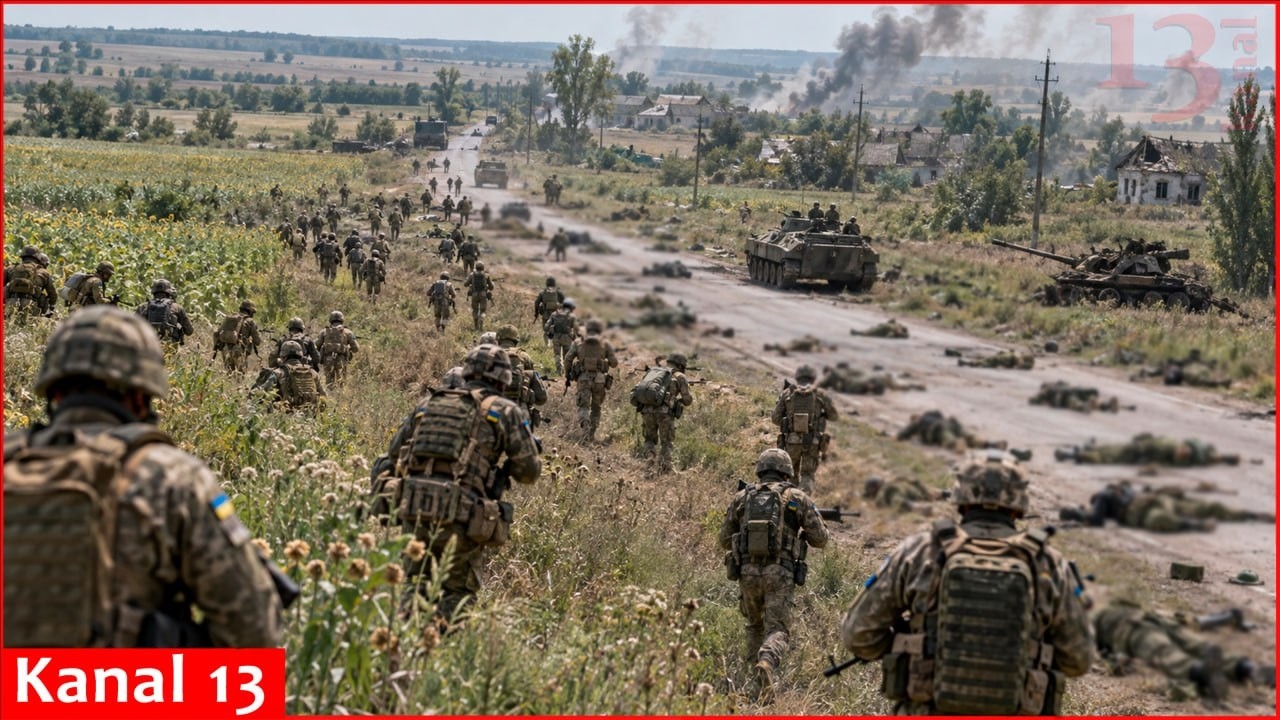
Ukraine is expanding the "kill zone" to a depth of over 40 km: a hellish season for the Russians
Watch on YouTubeVideo summary
The ongoing Russian-Ukrainian war is facing a significant evolution in the nature of its battlefield challenges, primarily driven by the expansion of what military leaders describe as a "kill zone." Yevhen Lysychak, commander of the 7th Rapid Reaction Corps of the Airborne Assault Forces, highlighted that this high-risk area currently spans between 30 and 40 kilometers in depth but is projected to grow even larger by January. This expansion represents a new stage in the conflict where the sheer scale of drone surveillance and attack capabilities has fundamentally altered tactical realities, making it increasingly difficult for forces to operate safely near the front lines without facing immediate threats.
The definition and extent of this kill zone vary slightly depending on the source, with some officials noting that while the average depth is roughly 20 kilometers, specific areas with dense drone coverage can extend up to 50 kilometers. In these zones, any vehicle or personnel entering the area faces a high probability of being spotted and destroyed within minutes. President Volodymyr Zelenskyy has vividly described this environment as a "death zone" where tanks, armored vehicles, and motorcycles are effectively burned upon entry, emphasizing that drones have made the threat persistent, larger, and impossible to simply bypass or avoid like in previous conflicts.
To survive and operate within this expanding hellish landscape, Ukrainian defense forces are prioritizing the maximization of technology to minimize human losses. Brigadier General Lysychak noted that Ukraine is reaching a critical threshold where robots will begin to partially replace human personnel on the front lines, allowing for fewer soldiers to be exposed directly to combat contact. This strategic shift involves not only introducing unmanned components but also mastering the remote control of modern equipment, ensuring that the primary objective remains protecting lives while maintaining operational effectiveness against an adversary that has created a vast, deadly surveillance net.
Read the full video transcript
One of the main challenges of the
Russian-Ukrainian War is the longest
kill zone in history. In the coming
months, the battlefield may face new
challenges. This was stated by the
commander of the 7th Rapid Reaction
Corps of the Airborne Assault Forces,
Yevhen Lysychak, during a speech at the
Yalta European Strategy Meeting.
According to the Brigadier General, the
current continuous impact zone is
between 30 and 40 km. However, it will
expand by January. By the end of the
year, this zone will be larger. There
will definitely be a next stage and a
new challenge. That's why the key
advantage isn't just having the
technology, but being able to quickly
adapt to today's reality, noted Yevhen
Lysychak. Maximizing technology and
minimizing human losses is the defense
[music] forces primary objective, the
Brigadier General emphasized. He added
that Ukraine has not only introduced an
unmanned component to the battlefield,
but has also mastered remote control of
modern equipment. According to Yevhen
Lysychak, Ukraine is on the threshold of
the next step, the partial replacement
of people by robots. For us, this means,
firstly, fewer people on the line of
combat contact and fewer personnel
losses,
the Brigadier General concluded. The
kill zone along Ukraine's front has
grown substantially with the drone
threat in some areas, a defense official
said. Davit Arakhamia, the Deputy
Secretary of the National Security and
Defense Council of Ukraine,
said that we have a kill zone in some of
the areas, which is [music] 50 km. He
called it a kill zone of drones. It's a
dead zone. Speaking at a drone summit in
Latvia, Arakhamia said the kill zone is
not that deep everywhere.
It is often described as roughly 20 km
deep and growing. [music]
But where drone coverage is dense, he
said, any vehicles there,
they will be demolished and destroyed in
several minutes. The kill zone is the
area near the front where surveillance
and attack drones are so prolific that
soldiers, vehicles, and equipment are at
much higher risk of being spotted and
struck. Volodymyr Zelenskyy called it a
[music] death zone
where any tank, armored vehicle, or
motorcycle that enters it burns. He said
that everything is destroyed by drones.
The concept of a kill zone has long
existed in warfare. These are areas
where an army may find itself trapped or
exposed, making it vulnerable to attack.
>> [music]
>> In Ukraine, the zone is different from
past wars because drones have made it
much larger, more persistent, and harder
to avoid. It also spans a large area
along a deep front that is under
constant surveillance. It's not a space
that forces can simply go around. It's
at the very center of the fight.
Oleksandr Mykhenko, Ukraine's Deputy
Minister of Foreign Affairs,
offered a slightly more conservative
estimate. He said in Latvia [music] that
drones have created a kill zone
that extends 20 to 40 km. Drones have
fundamentally changed warfare, he said.
>> [music]