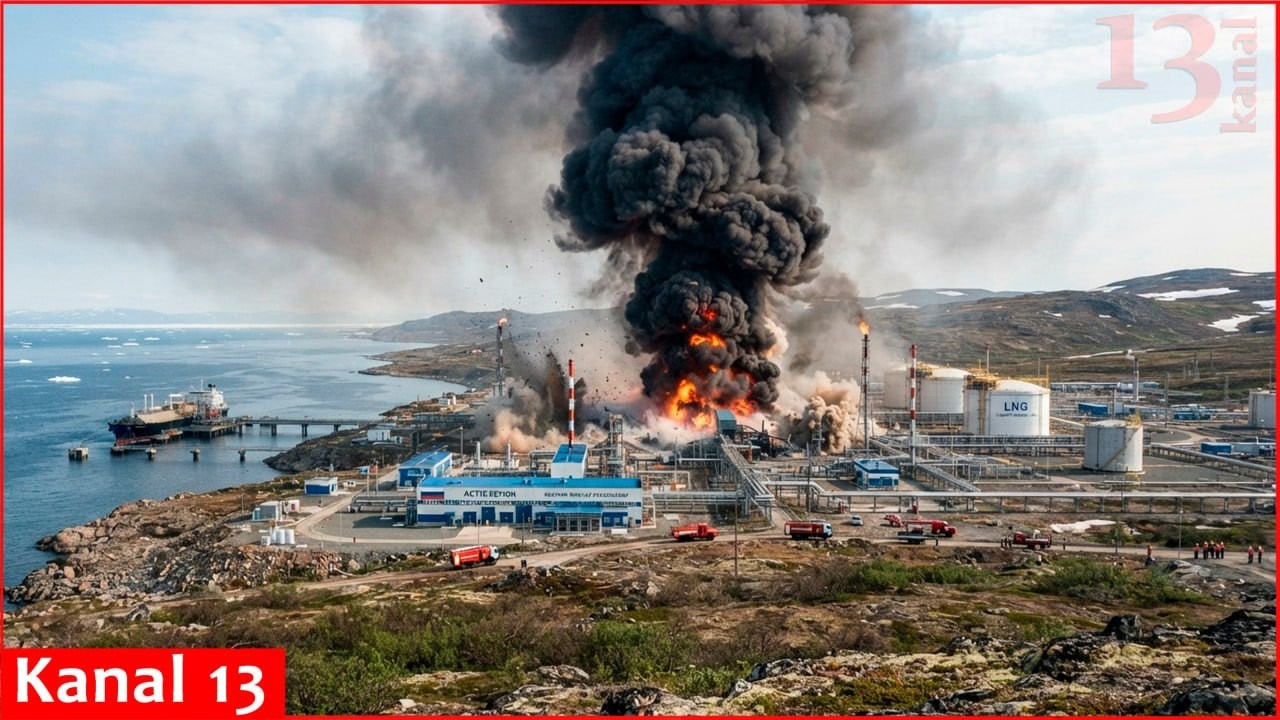
Ukraine is bringing the war to the Russian Arctic: the aftermath of attack on the Novy Urengoy plant
Watch on YouTubeVideo summary
Ukraine has successfully executed one of its longest-range drone strikes to date, targeting a critical Russian gas infrastructure facility in the Arctic region nearly 3,000 kilometers from the Ukrainian border. This attack on the Novy Urengoy plant marks a significant shift in the conflict, effectively bringing the war directly into Russia's most strategically important northern territory. Analysts highlight this event as proof that distance is no longer a protective advantage for Moscow, as Ukraine can now conduct precise strikes against stationary targets deep within Russian territory without needing to launch covertly near the objective, a capability previously demonstrated only in limited operations like Operation Spider Web.
The strategic implications of this strike extend far beyond the immediate damage inflicted on a single processing unit, as the targeted facility is situated just 600 kilometers from two of Russia's most vital energy projects: the Yamal LNG and Arctic LNG 2 plants. These major liquefied natural gas extraction sites are now potentially within the operational range of Ukrainian long-range drones, posing a direct threat to Moscow's primary Arctic energy exports. Furthermore, the Novy Urengoy plant serves as a crucial hub supporting the massive Urengoy oil, gas, and condensate field, which recently expanded its capacity in 2024 to process condensate from additional fields like Akimov and Valenzhinsky, making it an even more high-value target.
In response to this evolving threat, Russian authorities have begun strengthening their air defenses around Arctic energy infrastructure, acknowledging that the well-protected nature of these northern facilities is no longer guaranteed. However, experts note that expanding these defensive measures over such a vast geographic area presents significant logistical and operational challenges for Moscow. As Ukraine continues to demonstrate its ability to strike deep inside enemy territory, Russia faces the difficult reality of securing an increasingly large front line where its industrial and military assets are vulnerable to precision drone attacks that were previously considered impossible from this range.
Read the full video transcript
One of the longest-range Ukrainian drone
strikes targeted a Russian gas
infrastructure facility in the Arctic
region, nearly 3,000 km from the border.
Meanwhile, two major Arctic projects
related to the extraction and production
of Russian liquefied natural gas are
located just 600 km from the strike
site. According to the Norwegian
analytical publication High North News,
this attack brings Russia's war against
Ukraine directly to one of Russia's most
strategically important Arctic regions.
Journalists called this strike a
demonstration of Ukraine's expanding
long-range strike capabilities. They
argue that distance is no longer a
Russian advantage. Ukraine, meanwhile,
can conduct long-range drone strikes
against a stationary target deep within
Russia without relying on a covert
launch near the target, as was the case,
for example, during Operation Spider
Web. The consequences of the attack
extend beyond the damage inflicted on a
single processing facility. The targeted
plant is located just 600 km from
Russia's Yamal LNG and Arctic LNG 2
projects. This makes Moscow's two most
important Arctic energy projects
potentially accessible to Ukrainian
long-range drones, the article states.
Moreover, this plant is part of the
infrastructure supporting the operation
of the enormous Urengoy oil, gas, and
condensate field. In 2024, a new unit
was installed there, increasing
processing capacity and enabling the
processing of condensate from two other
fields, the Akimov and Valenzhinsky
fields. The publication notes that
Russia relied on the well-protected
nature of its military and industrial
facilities in the Arctic. But now
evidence is emerging that the Russians
are strengthening their air defenses
around Arctic energy infrastructure due
to the growing threat posed by Ukrainian
drones. Moscow will now have to operate
over a much larger geographic area over
which these defenses must operate, the
authors noted. As a reminder, on
September 9th,
>> [music]
>> Ukraine struck a major gas facility in
the Russian Arctic, the Novy Urengoy
condensate treatment plant and the
nearby Purovsky gas condensate
processing plant. Russian authorities
confirmed the drone attack and the fire
at the industrial facility in Novy
Urengoy. According to the Ukrainian
unmanned systems forces, the drone
struck a facility that processes gases
released during condensate production,
including ethane,
>> [music]
>> which is used as a feedstock for
petrochemical production. The previous
long-range strike occurred in July
against the Omsk oil refinery located
2,500