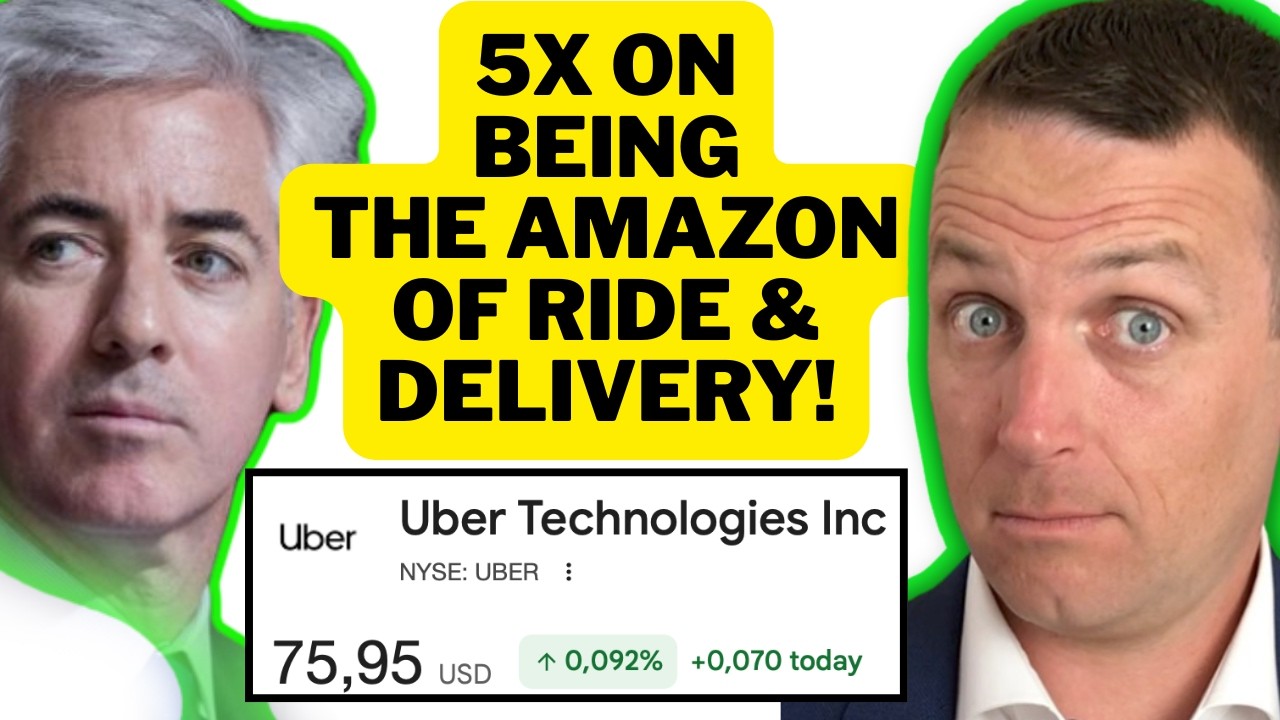
Uber Stock is a Strong Buy + Ackman's Top Position
Watch on YouTubeVideo summary
Bill Ackman's recent investment letter highlights Uber as his top position, presenting it as a compelling opportunity with significant upside potential despite current market fluctuations. As an investment researcher focused on finding compounders and value, the speaker analyzes Ackman's strategy of seeking stocks trading below their intrinsic value, noting that fees often force funds to trade at a discount to net asset value. Uber fits this criteria perfectly, currently trading at a P/E ratio near historical lows while projecting double-digit earnings growth. The core thesis revolves around Uber's potential to evolve into the next Amazon of logistics and delivery, leveraging its massive scale in ride-hailing, food delivery, and autonomous vehicle partnerships to create a dominant platform that captures value across various transportation fleets.
The financial analysis reveals a company at a critical turning point, having finally achieved profitability after more than a decade and possessing a strong balance sheet with over $40 billion in additional paid-in capital. While accounting metrics like stock-based compensation can distort short-term earnings, the speaker argues that true free cash flow is robust, potentially reaching $8 billion annually if growth targets are met. This cash generation supports aggressive share buybacks and strategic acquisitions, such as Delivery Hero, which expands Uber's global footprint. The valuation appears attractive compared to the S&P 500, with intrinsic value models suggesting a price target that could yield substantial returns over the next decade, provided the company maintains its competitive moat and continues to scale its operations efficiently.
However, the investment carries notable risks centered on technological disruption and regulatory uncertainty. The primary concern is whether Uber can maintain its dominance as autonomous vehicle providers like Waymo or other fleets bypass the platform entirely, potentially turning Uber into just another app rather than a logistics aggregator. Additionally, the competitive landscape in markets like China and Brazil presents challenges, and global regulations regarding worker classification could impact long-term profitability. Despite these uncertainties, the speaker views the risk-reward profile as highly favorable for investors comfortable with higher volatility, noting that even if the autonomous vehicle narrative slows down, the core business growth over the next two to three years should still deliver significant value before any major technological shifts alter the industry landscape.
Read the full video transcript
Good day, fellow investors. Bill
Ackman's new letter is out. Six new
positions, but we'll discuss that
tomorrow. Today, I want to focus a
little bit on strategy and go in detail
into Uber because it's a very positive
risk and reward investing situations,
Bill Ackman's top position, and you have
to see how it might fit your portfolio.
Just for reference, I'm an investment
researcher. I look at businesses. I'm
looking for compounders, but also from a
value investing perspective, which means
looking for a margin of safety. I run
three portfolios on my research
platform, working now on expanding the
diversified portfolio. Therefore, a lot
of research to narrow it down to the
best ones. And therefore, I'm always
interested in what Bill Ackman is doing,
discuss the situation there, perhaps
look into the opportunities. He is now
diversified from Amsterdam, switching to
London, now listed also in the US, both
his asset management company and the
fund, but he has beaten the market over
the last 23 years, done really well,
better than the S&P 500. You can see it
here. However, it's important to note
that for the past 15 years since the new
IPOs, permanent capital, etc., he did
not beat the market because from 2012,
actually, the S&P did 15% while the
compounded annual return is 12.5%
for Bill Ackman. But all on aggregate,
he's still doing great based on the
early bets. Last 12, 14 years have not
been that great, but there is always
something interesting going on with
Bill. If we look at his statement,
what's going on with the current
situation at Pershing. The stock price
declined, net asset value per share
declined, and some of the stocks went
down, and then the discount to net asset
value also widened. They are buying back
shares, which is something they think
there is a huge discount there. Did some
very interesting portfolio changes,
added six stocks, and he believes that
the price is below intrinsic value.
There is some debt that he's investing a
little bit with leverage. There is some
discount to net asset value, but keep in
mind the fees are 1.5% plus 16%
performance. When you sum up those fees
over a decade, that's your 20-40%
discount to net asset value. So, this
can never trade at net asset value. He
says that in the short term prices are
often disconnected from intrinsic
values, and that's what we're going to
discuss, especially with Uber today. His
target is earnings per share annual run
rate of 15% or more in the next 3 to 5
years, and half of those companies that
he discusses expect EPS growth of 20% or
more in the same period. Why this level
discount to NAV? But okay, it looks like
Bill is always in the search for the
next Amazon. Of course, we all are. Uber
might be the next Amazon of logistics,
delivery, and of course, the basis, the
drive. If we look a little bit at the
investments, the estimated growth rate
for Uber is 25% for others between 15
and 24.
A little bit lower on these great
businesses that have been recently
added, but still in the high teens. If
this is met, much higher than the S&P
500, better valuation than the S&P 500,
he will do great. And let's dig into
Uber. If we look at the stock price, it
is a little bit down from the peak of
approximately a year ago. P/E ratio
according to this is 16. We will adjust
it a little bit, but we are not far from
that at 19 20 given the stock base
compensation and everything. For a
company growing double digits, and if
they can keep their moat that they
currently have with the autonomous
vehicles, this will be a great
investment. So, Uber is on pace to grow
35% this year. The autonomous vehicle
might be integrated with Uber or be a
concern, but given the scale it already
has, the business is going on, the
business is growing,
it might be more positive than not. If
we look a little bit at earnings, they
have just acquired Delivery Hero to go
into that delivery of food, expanding
their markets,
combining all that logistics delivery
drive network into one platform so that
they become the go-to platform for all
those vehicle fleets with autonomous
drive with or not that use them so that
they become capital light business, huge
return on capital, scale growth. If they
can build that, the upside is big. They
are partnering with Lucid, [snorts]
Vern, for example, also in Croatia. We
have now This is already launched in
April 2026. So, this should be green
because there are robotaxis there
already with Rimac and everything. So,
they are in Zagreb driving to the
airport. You can take a robotaxi. By
Croatian law, there has to be a driver
for safety, but for now, I've heard some
stories it is working. Apart from that,
that's still a small part of the
business. The business is growing huge
great growth rates, trips, everything.
Gross bookings 22% growth. That's
amazing. Revenue 11%
on a constant currency growth slowing
down a little bit, but if you look at
operating income,
as this is a business that is supposed
to scale, they have 40% growth, earnings
per share 45% growth. Of course, non
generally accepted accounting
principles, but we can discuss that
immediately. Revenue growing, all looks
good. Profitability, they have finally
after more than a decade they have
reached good profitability. If they can
now scale, it will be great. I'm looking
a little bit at the balance sheet. You
can see here additional paid in capital.
There is a significant number, 40
billion more than 40 billion is what
they have burned up till now, but the
deficit is declining, which means they
are profitable now. And that is a big
turning point in any company. However,
if we look at the cash flows, we have
the profits and then we have to
calculate some other things. Stock based
compensation, 1 billion. Compensation is
a cost. Don't get confused, that has to
be deducted and we will double it
because these are grants issued at IPO
prices, lower stock prices to just keep
the dilution Uber has to spend double of
that. But again, on the network scale,
it will be likely a fixed stock based
compensation, therefore
10 15% of the business intrinsic
valuations. You'll see later. There are
some insurance reserves that they are
reinvesting because they need to put
those in insurance, but the claims are
not happening, which is also then a
positive. Nevertheless, all the money
extra is used for now acquisitions, some
acquisitions of businesses, now big with
Delivery Hero, but repurchases of common
stock, some swaps and things like that.
All in all, if I calculate the
repurchases of common stocks over the
last 6 months, plus some other free cash
flow calculations,
I get to 4 billion. They say 10 billion
of free cash flows minus 2 billion of
stock-based compensation, then they will
grow likely this year. So, we'll discuss
that. However, let's say they get to 8
billion of free cash flows per year. 8
billion of free cash flow price to free
cash flow of 20, which is really good.
And that is in line with Bill Ackman's
19 times earnings, near its lowest ever
valuation. Let me just discuss the
stock-based compensation adjustment. We
discussed this in a specific video how
it impacts companies today. It takes
away 10 to 15% of S&P 500, even more of
Nasdaq's true owners' earnings. Because
when you look at approximately 2 billion
of stock-based compensation for Uber,
but if you look at the number of shares
declining, the decline rate is just
1.5%,
but on the buybacks, they did spend 6.5
billion, which is 4.1%
of the market capitalization. If you
spend 4.1%, then the number of shares
outstanding should go down by 4.1%,
but those went down just by 1.5%.
If you give away 2 billion of stocks,
that's just 1.2% of the company.
However, if I look a little bit at they
spent 3.5 billion in the last 6 months,
and this is the stock-based compensation
situation. The cost of stock-based
compensation in the accounting is the
share price at the grant date. If they
have to repurchase at a higher date,
then the stock-based compensation
expense is actually more than double
depending on where the stock price is.
So, according to my calculations, 8
billion free cash flow, if we take into
account the growth rate, the 10 billion,
2 billion invested, okay, 8 billion.
Then, if we deduct 2 billion of
stock-based compensation and 2 billion
of buybacks, I get to 4 billion of true
free cash flow. But, investing is not
about now, it is about the future. And
we'll see later in the intrinsic value
calculation how I'm going to adjust. I'm
going to assume 4 billion that goes to
the management per year, and I'm going
to assume the 8 billion of free cash
flow growing at 20%. It is not such a
tragic impact as it looks now in the
future if things go well. Because, when
it comes to the future, Uber should be
the autonomous aggregator of all the
supply into one platform. If they make
it, it's a win situation for investors.
And that's also what Bill Ackman is
betting on. The risk is that all these
providers bypass Uber, "Oh, you don't
need to pay, but we still have booking,
we still have this, we still have that."
We'll see how it goes that there is
regulation offering less monopolistic
pricing, perhaps. High capex leads into
building their own fleet and things like
that. These are uncertainties or risks
that we cannot yet know at the moment
and we'll see how it develops over the
next years. But, keep in mind the risk.
If we go calculate the intrinsic value,
8 billion cash flows for now, 4 billion
goes to cover the stock-based
compensation, but that 4 billion should
remain at 4 billion over time. Free cash
flows grow at 20% per year, then we are
at a great return. Based on share,
four earnings per share or free cash
flow per share growing at 20 minus just
two per share per year for the
subsequent future. Here is my intrinsic
value template. You can download it for
free in my free value investing course.
I have added here Uber. You just click
here, you go to the template, and here
we have it. Free cash flow per share, I
have left it at four. Growth rate 20%
for the first five years, then 15% going
forward. The P ratio stays where it is.
The intrinsic value is 118.
Compare it to the current stock price,
you will get a great return. By 2045,
you can have
practically a 4x on your money just
based on that. And just here, where I
calculate the terminal value, I have
deducted the $2 per share in stock-based
compensation that now look big on an
earnings of four, but not that
significant on earnings per share of 15
down the road. If we go to more
exuberant growth rates and
Uber really becomes the platform of the
future, and even I download it on my
app, the P ratio goes a little bit
higher, the present value is insane
compared to the current stock price, and
you can almost hit a 10x over the next
10 years. This is the Amazon situation
scenario. Then, if we go to
probabilities,
perhaps I should change the
probabilities. Let's say the standard
scenario, 50%. Let's say 25% the best
case Amazon scenario. And let's say the
worst case scenario where Uber doesn't
make it, it just becomes an app, it gets
taken over by someone because the fleets
are bypassing it. Still a 10% growth,
but P ratio goes down, somebody takes it
over somewhere at the certain valuation,
then that would be the risk where you
can maybe lose 50%.
Compare the intrinsic values at these
probabilities, sorry, 25 here, it has to
almost double to be valued fairly in
these kinds of scenarios. When we go to
the comparative table,
it is the best investment out there
except for crazy risky charter, but this
is really
clear why this is Ackman's biggest bet.
And also Wall Street is very positive on
it. Here we have high the exuberant
targets of 150. Somebody is less
positive on compensation on being
bypassed by the fleets, but most
analysts have it as a strong buy. The
market is scared a little bit about
Waymo leaving things like that, which
Bill Ackman says is a great time to buy.
Discussing this robotaxis scare, let's
go into the conference call, and they
discuss how the conversation has shifted
whether there will be autonomous
vehicles to how broadly, reliably, and
economically it can scale. So,
practically in 5 years we'll all be
going around with robotaxis,
Zagreb, Verna,
this this partnerships. And you Uber
wants to be the platform. We also now
have
drones potentially delivering things
like that. So, it is insane. On the
question of competition discussing in
Brazil, lower
earnings, lower everything.
And here is another risk. It's not just
the Brazil, it's China. Extremely
competitive environment for the same
things that Uber is
trying to achieve. And that is then also
a question of risk, of understanding how
well this develop. The question is, does
it have a moat? To have a moat, you need
to have regulation backing so that they
can keep long-term profits. For now,
they don't have it. There are issues, UK
issues with workers, things like that.
And will Uber get it? Unlikely globally,
unlikely for the long-term, which is
another risk. But if everyone has the
app, then the no regulation can change
that. Then there are investments, they
will invest 10 billion across the
future years. That's why I lowered the
free cash flow there also on top of the
stock-based compensation. Is it a
commodity? If Uber is the first mover,
then it can gain. Risky? Yes. Many just
wait for proof that the business model
will be working, and then they might
enter. It's the same with electrical
vehicles. Only when Tesla really did it
in 2019,
all the others entered the market, and
now, 6 years later or 7, nobody made any
money. It might be like that, which is
the risk. Somebody will take it over,
private equity or something. But it
might also win, and then you have your
Amazon. If the growth sticks, and I
think here is Bill Ackman situation next
2 to 3 years,
autonomous vehicles are just small now.
They're not global. Uber is, and it will
keep on growing for the next 2 to 3
years. If that gets reflected in the
business, you have a 2x 3x higher
valuation, and then we'll deal with the
autonomous vehicles situation. Before
that, you already made your money. If
there is growth, P goes to 30 40, that's
your 3x already. If there is a slowdown,
it's very risky, but unlikely for now.
And that's the horizon next 2 to 3
years. There is no competition because
they already moved. Autonomous vehicles,
it seems also to me it's just cool
discussions like space, like AI. The
business is there. It's growing fast.
There's definitely a big yes on whether
you can make money on Uber. Positive
risk and reward, 3 5 10x if there is a
really big yes, 50% down if it's no, and
that even maybe. I'm looking for
compounders. It looks like Uber will
compound. From a value investing
perspective, it's not for me because I'm
just lacking the margin of safety. If
you can take more risk in your
portfolio, if you like taking more risk,
this is interesting. So, this is my
upside.
Risk is always a technological novelty,
apps download, something like this. The
old Uber gone in 5 years, the new is
questionable. It's a very positive risk
and reward
bet. Thus, not for me. See how it fits
you. I hope this video gave you value.
I'm looking forward to your comments.
You can check what I do on my research
platform. I'll see you in the next
video.