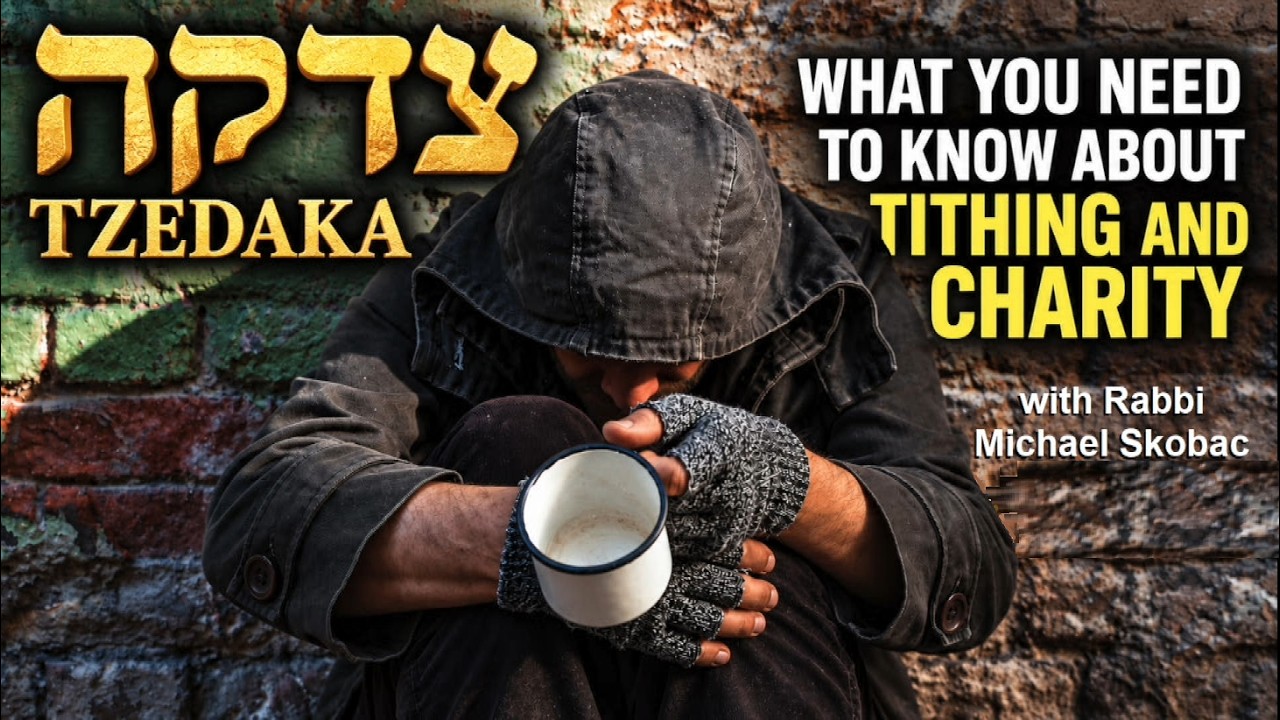
Tzedaka: What you need to know about Tithing and Charity - with Rabbi Michael Skobac
Watch on YouTubeVideo summary
The video explains that tithing, or giving ten percent of one's possessions, is a practice rooted in the Torah with origins tracing back to the patriarchs Abraham and Jacob. In ancient Israel, this system functioned as a taxation structure where specific portions of agricultural produce were separated for the support of the Levites and priests. The first two percent was given to the kohanim (priests) as *truma*, followed by another ten percent from the remainder designated for the Levites as *maaser*. Additionally, during the seven-year sabbatical cycle, a second tithe was taken in certain years to be eaten in Jerusalem or redeemed for money spent there, while other portions were allocated to the poor or used for animal offerings at the temple.
Beyond these ancient agricultural laws, which technically still apply today though often discarded due to ritual purity concerns regarding contact with death, there is a universal obligation known as *tzedaka*. The speaker clarifies that *tzedaka* is derived from the Hebrew root for justice rather than charity, emphasizing that giving to those in need is a mandatory act of righteousness rather than an optional gesture based on feelings. While tithing one's income (*maaser kisafim*) is debated regarding its biblical versus rabbinic status, the commandment to support the needy is unequivocally biblical. Consequently, the general recommendation for modern practice is to give between ten and twenty percent of one's net income to support the poor, Torah institutions, and legitimate charitable causes, with ten percent viewed as the minimum and twenty percent considered an ideal target for most individuals.
The video further details eight levels of giving *tzedaka* established by the medieval authority Maimonides, ranging from the lowest level of giving with a displeased expression to the highest level of providing interest-free loans or employment that enables recipients to become independent. A significant aspect of this teaching is the value placed on anonymity; the most optimal form of giving involves donating to organizations where neither the donor nor the recipient knows each other's identity, protecting the dignity of both parties. This approach contrasts with direct handouts where identities are known, which can sometimes lead to embarrassment for the recipient or dependency issues.
Finally, the speaker addresses the issue of fraud and welfare cheats, noting that while the Talmud warns that those who pretend to be disabled will eventually suffer from their deception, believers should not hesitate to give due to the possibility of a few scammers. The merit of giving is so profound that even if one hundred beggars are approached and only one is truly needy, the act remains virtuous. Ultimately, *tzedaka* is elevated in importance within Jewish law, with the Talmud teaching that charity holds equal weight to all other commandments combined, reinforcing the idea that supporting the vulnerable is a fundamental duty of stewardship rather than a mere suggestion.
Read the full video transcript
Tithing or giving 10%
of our possessions appears in the Torah
as a practice of the patriarchs.
After Abraham's victory against the four
kings, we're told that he gave 10% of
the spoils to Malited, who was a priest
of God.
And as Jacob was fleeing from the wrath
of his brother Asov, he pledged to give
God 10%
of whatever he receives from God.
Later, the Torah legislated a number of
different tithes
which effectively served as a taxation
system in the land of Israel.
Now we know that of the 12 tribes, the
tribe of Levi Ley,
which included the family of the
kohanim, the priests,
they were not given a portion of land in
Israel. So the priests and the Levites
were supported by the rest of the
nation. And the system of tithing
basically went as follows.
A person who had produce 2%
approximately 2%
of one's produce went to the priests to
the kohanim and this was called truma.
So the first 2% let's say a person has a
hundred bushels. So two bushels off the
top are going to go to the priest and
that is called truma.
Now the priests were one family in the
whole tribe of Ley. So there were more
Levites than Kohanim. More Levites than
priests. So more money had to be
collected to support the Levites. And so
from the rest of what remained, that's
going to be 98 bushels left over. 10% of
that
went to the Levites. And that was called
maair.
Maser from the root esser. Esser means
10. So maser basically means a tenth the
tithe goes to the Levites. Now what's
interesting is that the Levites had to
give 10%
of what they received to the priests.
That was called shumat mahaser.
So whatever the Levites got, they had to
take 10% and they had to give it to the
priests as well.
Now there was a calendar
that was a 7year sabbatical cycle.
We know that there was a biblical
practice called the shmita
where during the seventh year people
were not allowed to work their land or
harvest their land. It had to layow. It
was ownerless.
And so in this seven-year cycle, during
years number one and two and four and
five,
another 10%
was taken and it was eaten by the owner
in Jerusalem. So you yourself, you
wouldn't give it to anyone else. You
would take the next 10% again after you
gave 2% to the priests and in then 10%
to the Levites. You took another 10% in
years number 1 2 4 and five. And you
would take that produce and eat it in
Jerusalem. And that was called maer
sheni the second tithe. Now, it wasn't
always practical to ask someone to schle
all of that produce to Jerusalem. It
could be that they had a lot of produce.
Maybe they maybe they had crops where
they had many, many hundreds of bushels
of apples or whatever it was. So, who's
going to be able to go to Jerusalem and
eat that many apples? So what they were
able to do was to redeem that produce if
they weren't going to bring it to
Jerusalem physically. They could
basically take the monetary value of
that produce,
leave it, leave the produce at home and
now take that money and go to Jerusalem
and spend the money in Jerusalem on
food. Go to a fancy restaurant, buy nice
wine, whatever you're going to do. This
is what happened with the second tithe.
It's called the ma sheni.
But in years number three and six of
this sabbatical cycle,
you had the ne that next 10% the second
10%
went to the poor and that was called
maer ani the tithe for the poor.
And there was actually another tithe
that was given and this was called the
maer beha the tithe of the animals. And
here you would give 10% of your flocks
and it was given to the temple.
And there were other ways in which the
poor and those in need were supported.
So I mentioned the schmita year, the
sabbatical year. So in that seventh
year, your produce that you had on your
property was not yours. You couldn't use
it. It was there available for anyone
else to come onto your field and take
it. And so poor people would definitely
do that. And the priests and the Levites
would certainly
take what was available during the
Schmita year. But every year there were
other things that supported those in
need. There was something called pa
which means the corner. So when people
had a field they had to leave a corner
of the field unh harvested and again
anyone in need could go and take from
the corner of the field. There was
something called leet which was when
let's say for example ears of corn would
fall to the ground in the harvesting
process. You were not allowed to pick up
those ears of corn that fell down while
you were harvesting. You had to leave it
there for the poor. Or
which is when you had forgotten sheav,
you would take, for example, bundled
wheat and you'd make them into sheav and
if you forgot one or two of them in the
field, you couldn't go back and get it.
You had to leave those forgotten sheav
for the poor and the needy. And there
were similar laws for a vineyard, not
just for your fields. In the vineyard
there was something called parrot which
was when individual grapes fell to the
ground during the harvest. You had to
leave those grapes there for the poor to
pick up or oolos which were small
clusters of grapes and that also had to
be left for the poor. So in the bible
there was a whole system of tithes
basically different ways in which those
in need could be supported.
These laws only applied to the produce
of the land of Israel. So during the
biblical times, if you were living in
New York, for example, these laws had no
application there except for one thing
that we'll see in a few minutes. Today,
today, the laws of the sabbatical year
still apply.
And the laws of Truma and Maaser, again,
the portion that was taken off for the
priests and the portion that was given
to the Levites, these laws still apply.
These are still separated from the food,
but they're not given to the priests and
the Levites.
They are discarded in various ways. One
of the interesting ways they're
discarded is that all of the animals in
the biblical zoo are basically sort of
sold to priests. Priests sort of legally
own all the animals in the biblical zoo.
And you're allowed to feed the animals
of priests this produce. The priests
themselves are not allowed to eat it
because to eat these separated tithes
like the truma, the priest has to be
ritually pure. It can't have any contact
with with something that was bringing
them to a state of ritual impurity. And
the the number one thing that makes us
ritually impure is contact with someone
or something that's dead. And so today,
everyone is considered to be in the
status of ritually impure because we've
all had contact with someone that was
dead or someone that was in the same
room or the same building with someone
that's dead. And we're not going to be
able to remove that status without the
red heer, which is a different topic
altogether. In any event, today in
Israel, they still separate truma and
mahaser from the produce, but they are
discarded. They're not eaten by the
priests or the Levites. And even if
you're living outside of Israel, if
you're here in Toronto and you buy
produce from the land of Israel, you
still have to remove the truma and the
maser from this produce even outside of
Israel.
Now there is a universal practice
both for people living in Israel and out
of Israel called another tithe. It's
called maer kisafim the tithe of your
money tithing our income. And the sages
debate whether this is a biblical
commandment or a rabbitic requirement or
just a custom.
However,
there is an independent biblical
obligation of giving saddaka.
Aside from this practice of tithing your
income,
there's a separate idea which is
certainly a biblical requirement. Again,
as I said, tithing your money, there's a
dispute about whether it's actually a
biblical commandment, but there is a
biblical obligation to give to daka. It
says in Deuteronomy 15 7 to8, if there
is a needy person among you, do not
harden your heart and shut your hand
against your needy fellow. rather you
must open your hand and give him
whatever is sufficient for his needs.
Now stucka is usually translated as
charity but it is a misleading
translation.
Charity is related to the Latin word
karas
from which we get our word charisma
and it has to do with feelings
like feeling charitable because of
someone's plight
but sedaka is not based upon anyone's
feelings it comes from the Hebrew word
sedc which means justice
that which is right to do whether you
feel like doing it or not, it is the
right thing to do because we are not
considered the ultimate owners of our
possessions. We are considered to be
stewards
and we have to follow God's instructions
for how we make use of our resources.
And giving to those in need is a
requirement. It is what is just and
right. It's not something that's
optional. based upon whether you feel
charitable or you feel generous.
Now the relationship between
which again is clearly a biblical
commandment and
tithing your money which again I said
there are three ways in which it's seen.
It's a very complex relationship.
How do we understand the relationship
between the obligation biblically to
give staka and the practice whether it's
rabbitic or biblical or just a custom of
giving onetenth of our income it's a
very complex relationship so for our
purposes here now I'm going to conflate
these two ideas
the basic requirement is to give between
10 and 20%
of our income to support the poor to
support Torah institutions
and [snorts] any legitimate charitable
cause.
Many authorities say that this is
calculated on our net income after
taking off taxes and expenses.
The formula for calculating this is
complex
and there are several online maaser
calculators that will take you through
the calculations.
The strong recommendation
unless someone is in the category of a
Warren Buffett or a Bill Gates is not to
give more than 20%.
Many consider this or close to it an
ideal.
Many authorities say that ideally if you
can you should give close to 20% of your
income to staka
and 10% is considered the minimal
amount. It's the minimal amount unless
of course someone is destitute
and they can give obviously less than
10% but they have to give something.
Mymanad's writing in the 12th century
delineated eight different levels of
giving sedaka. The lowest level of
giving staka
is when you give to the poor
but with an unpleasant
disposition on your face. Meaning that
you're giving to them whatever they need
but it's clear from your face that
you're not happy about giving it and you
have a rotten disposition, a rotten look
on your face. One step up from that is
to give less than what they actually
need, but to do it with a pleasant
disposition.
A step up from that is when you give
what is needed and you do it pleasantly,
but only after you are asked.
A step up from that is when you give to
someone in need before you were actually
asked by them. A step up from that is
when the poor person knows their
benefactor,
but the donor does not know who the
recipient is.
One step higher than that is when the
donor knows who the recipient is, but
the recipient doesn't know the identity
of the donor.
A level higher than that is when the
donor does not know who they are giving
to and the poor person doesn't know who
made the donation. It's interesting that
in the holy temple in Jerusalem they had
a chamber a special chamber where anyone
could go in and you either would leave
money there or you would take money out.
So no one knew what you were doing when
you went in. Some person might go in and
leave a $100.
Someone might go in and take out $50.
And this was a way of protecting the
anonymity of who is giving and who is
receiving. Today the optimal way of
giving staka is for example donating to
an organization that will distribute the
money to the poor. So there you don't
know who's receiving the money. The poor
person doesn't know who gave it to them.
And that would be the second highest
level of giving my man says what's the
highest level? The highest level is to
give a poor person either an
interestfree loan or a job. Meaning that
you do what will help make them
independent so they won't need to
collect staka in the future.
The rabbis had a very dim view of
welfare cheats
because first of all it was thievery.
There was stealing and secondly it
discouraged people from giving charity.
The Talmud in tract kitubot 68a the
rabbis taught if a man pretends to have
a blind eye or a swollen belly or a
shrunken leg he will not leave this
world before actually coming into such a
condition.
However, we should not be deterred by
such charlatans.
Rabbi of Sans, a greatidic master from
the 18th century said, "The merit of
giving charity is so great
that I am happy to give to a hundred
beggars if even one of them might
actually be needy."
But some people however act as if they
are exempt from giving charity to a 100
beggars if there is even a possibility
that one of them might be a fraud.
The truth is that in the eyes of the
Torah,
this commandment to support those who
are needy is considered to be one of the
greatest commandments in the Torah. The
Talmud teaches in tractate Bababatra 9a
that charity is equal in importance
to all the other commandments in the
Torah combined.
[music]
Heat.
[music]
Heat.
[music] Heat. Heat.
[music]
>> [music]