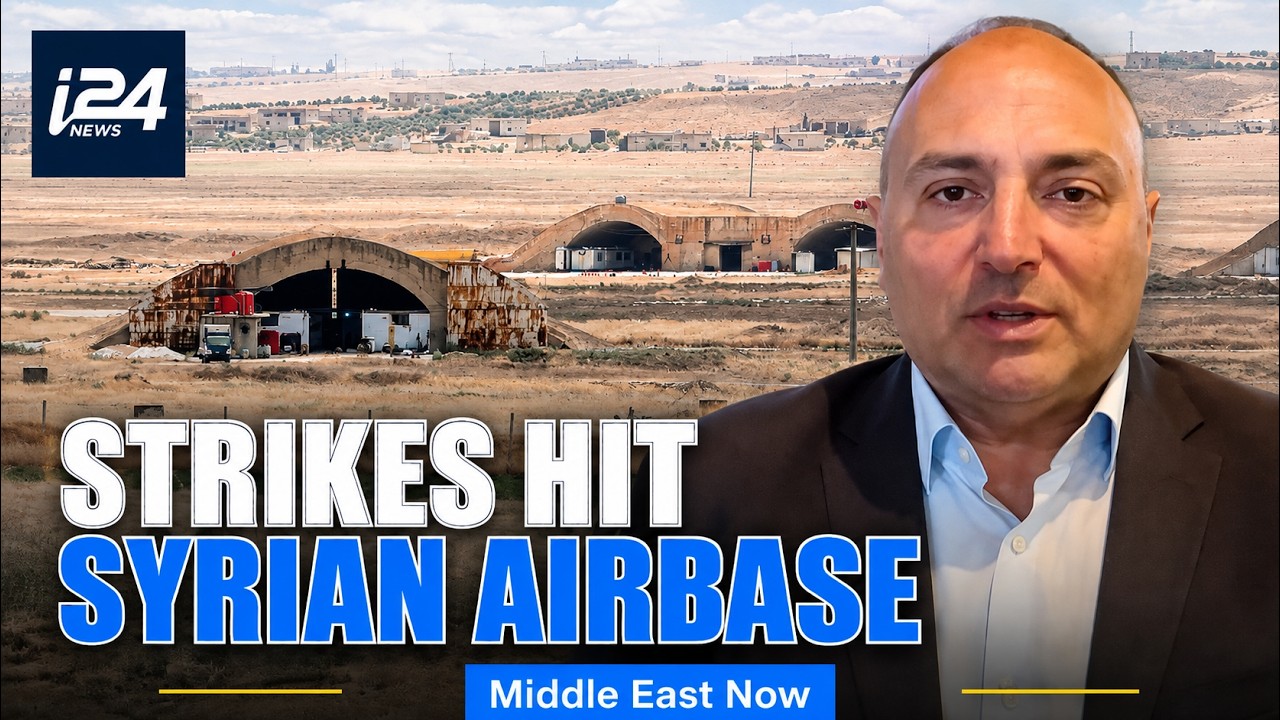
Turkey and Syria slam Israel for strikes on Syrian airbase attributed to IDF
Watch on YouTubeVideo summary
Syrian state television reported that Israeli air strikes hit an airbase in northwest Syria early Tuesday, causing material damage without casualties. The report specified that eight separate strikes targeted the runway in Idlib province, a facility Turkey has been rehabilitating and which serves as a hub for foreign fighters. While Israel has not commented on the incident, US Ambassador to Turkey and Special Envoy to Syria, Tom Barrack, confirmed the strikes via social media, describing them as an unnecessary escalation that fails to advance regional stability. This event highlights the growing tension between Ankara and Tel Aviv, raising concerns about miscalculations and the potential for further conflict in a volatile region.
Retired Turkish Ambassador Cengiz Çandar joined the discussion to characterize these actions as reckless and undiplomatic, noting that actual hits on another country's airbase near the border represent aggressive behavior rather than mere rhetoric. He emphasized that both sides are increasingly using hostile language and engaging in actions that escalate friction points, with Turkey viewing Israel's continuous bombing of Syrian infrastructure as contrary to international law. Çandar argued that Syria does not currently pose a threat to Israel and that attacking it repeatedly prevents the country from rebuilding a viable economy, which would ultimately benefit all parties including Israel. He suggested that if such aggression continues until after upcoming elections, it indicates Israel is on a warpath with everyone, a strategy he strongly advises against.
The conversation also addressed Turkey's expanding military footprint in Syria and other regions like Somalia, Libya, and potentially Gaza, which some view as encroachments into Israel's security orbit. Security analyst Yaakov Lappin noted that Turkey views these areas as part of its historical Ottoman sphere, feeling entitled to re-establish presence there regardless of local regimes. However, the transcript suggests that the true nature of the threat remains classified intelligence; it is unclear whether Turkey was planning to deploy advanced air defense systems, drones, or radar capable of threatening Israeli airspace. The strike may have been a preemptive move against capabilities intended for use by the Syrian regime itself, which Çandar described as being composed of jihadist and fundamentalist elements that vow to conquer Jerusalem, posing a significant security concern for Israel following October 7th.
Ultimately, the incident underscores a deep divergence in perspectives regarding security threats and diplomatic engagement in Syria. While Israeli decision-makers appear convinced of imminent threats requiring pre-emptive strikes, Turkish officials view these actions as disproportionate and destabilizing. The transcript reveals that while rhetoric from Ankara has been increasingly hostile toward Israel, the physical reality involves Turkey supporting a Syrian government structure and rehabilitating infrastructure, creating a complex security dynamic. Experts warn that without returning to diplomacy and dialogue, this cycle of aggression and counter-aggression could lead to further escalation, potentially drawing in regional actors and undermining long-term stability in the Middle East.
Read the full video transcript
Syrian state television today claiming
that Israeli air strikes hit an airbase
in northwest Syria early Tuesday causing
material damage without any casualties.
Israel has made no comment. But the
Syrian TV report said eight separate
strikes took out the runway in the
northern northwestern province of Idlib,
gave no further detail. War monitors in
Syria added that Turkey, which is a main
backer of Syria's government, has been
rehabilitating the airbase, which is
also a known hub for foreign fighters
over the years. But the incident
prompted US ambassador to Turkey and
special envoy to Syria, Tom Barrack,
social media to say that he, quote
unquote, confirmed Israeli air strikes,
as he put it, are, quote, an unnecessary
escalation that does not advance
regional stability, close quote. And
we're joined by retired ambassador
Cengiz Çandar, former Turkish
ambassador. And good to have you with us
back on the show here, Cengiz. Um, with
this fears of Israel-Turkey
miscalculation, you know, we see this at
least, if it's true what's being claimed
in Syrian television, what seemed that
Americans seem to be sure about, um, the
suspected Israeli air strikes that hit
an airbase in Syria,
you know, how how fraught are these
friction points, these friction lines
between, let's say, Turkey and Israel at
this point?
>> Well, I think, um, it's getting to be
quite reckless.
Um, it's getting to be quite, um,
Well, well, well, how can I say it? To
be very diplomatic, we need to make sure
that communication lines are kept open,
and, um, we always say we shouldn't go
one step further.
Uh, but, um, apart from the rhetoric
coming from both sides, what do we see?
We see on the ground, um, actual hits,
uh, using fighter jets, um, on another
country's airbase. And, uh, this is
aggressive behavior, and I agree with
the, US ambassador's uh, wording that he
put there. This was quite reckless.
This was quite near to the Turkish
border.
So it's a clear message coming from the
Israeli side, obviously.
But having said that,
reading what's been delivered by both
sides,
we are upping the ante all the time.
Both sides
declaring
quite
Well, how can I say it? Undiplomatic
words towards each other. But having
said this,
how we see it in Turkey as such is that
there's an escalation, there's an
aggressive behavior coming from the
Israeli side with actions, not only
words, but actual actions.
>> Well, let me cut in there for a minute,
Cengiz.
Look, Israel isn't launching strikes
this deep in Syria for practice. And
you're talking about the threats
emanating from Israel at this point, but
there's clearly a a perception of
threat, you know, coming out of Syria,
which is a patchwork of jihadi groups
supported by the by the Turkish
government, which you talk about hostile
rhetoric, and we could write a book on
the rhetoric that's come from Ankara in
the last year just towards Israel, all
the illegitimate talk and things like
that. So, you know, what stability
exactly do you think Ambassador Baric
and others are pushing for right now?
>> Well, Turkey and as far as I can
understand with Ambassador Baric as
well,
they're trying to build alliances at the
moment. Now, Syria is not the state
that is going to cause any harm to
Israel at the moment or for the
foreseeable future. So attacking it all
all the time, continuously using your
words, you know, rehearsing
our actions on the ground, etc., these
are all contrary to international law.
What needs to be done is to make to make
sure that we go back to talking. We go
back to diplomacy. We go back to
actually seeing eye to eye on certain
things. If the Syrians can get together
and build a state again, a viable state
that runs,
that that has a viable economy, etc.
It's not going to be detrimental to
anybody, including Israel. Now, what we
do see is that Israel doesn't want any
sort of
viable, standing, stable economy or
country in Syria.
>> Well, from where you pulling that from?
Getting this from a from a strike on a
remote airbase that Turkey's allegedly
building up? We don't want anything
stable in Syria.
>> These are the actions of the Israeli
state that has been ongoing for quite
some time. You've been attacking
aggressively a state. You've been
calling them jihadist, etc. But, they
haven't attacked you. Not a single
attack has come your way. You You've
enlarged your territory. Turkey is, yes,
building
the network there so that the government
can function. And it's been called by
another state to come in and help. And
we're trying to do that. On the
contrary, Israel is bombing non-stop.
This has to stop. We We're We're looking
at this from a time frame of Is this
going to continue until the elections?
Or is this going to stop after the
elections? If it doesn't stop after the
elections, it means that Israel is on a
warpath non-stop with everybody. And if
you want to have another country like
Turkey on your warpath, go ahead. I
don't recommend it at all. This is This
is a very reckless, very undiplomatic
way of going forward.
>> Well, it certainly is undiplomatic, but
the assertion that there are no threats,
you know, emanating from Syria, well,
apparently Israeli decision makers see
that differently. If If in fact this was
an Israeli strike in Syria again, but I
guess that we have it
from the former Turkish ambassador.
Cengiz, thanks for being with us.
Bring that in the studio now with Yaakov
Lappin, our security analyst in here.
And look, Turkey's military footprint,
let's just talk about that, you know, on
top of the rhetoric. You know, our this
our former ambassador friend here makes
it seem like it's, you know just a lot
of words in the air but there are
military encroachments you know coming
into Israel's orbit such as Syria which
shares a border with Israel let's remind
everyone. Um we see that in Syria we see
it in Somaliland we see it in Libya
places where the Turkish military is
moving in or like would like to move in
Gaza perhaps being one of them. You know
how do you summarize Yacoub from your
perspective you know Turkish let's say
beyond the rhetoric which has been hard
to find a country more hostile in the
rhetoric towards Israel actually you
know Iran maybe in a challenging zone
there but you know what do you say about
the military footprint actions of Turkey
that clearly might be threatening
Israel?
>> Well look I think that uh Turkey views
Syria like so many other areas in the
region under this Turkish president
Erdogan as a sort of stomping former
imperial stomping ground of the Ottoman
Empire and they feel very entitled to be
moving right back into these areas.
It somewhat amuses me when Turkey
complains about Israeli defensive buffer
zones that are actually very small. In
Syria when
>> Turkey Turkey as well about defensive
buffers.
>> Look at the Turkish military presence in
northern Syria which precedes this
regime which is in fact friendly to
Turkey there's no doubt about that but
Turkey had that buffer zone also under
the Assad regime when it was not welcome
in Syria and that didn't seem to matter
at all to Turkish decision makers. Uh
you know we're not we're not even going
to start talking about uh Cyprus and and
other areas where where the Turkish
military uh is occupying so really you
know this rhetoric is is amusing to me
but look at the end of the day what we
have here is a very partial picture.
Clearly assuming as you say this that
this was Israel some sort of
intelligence came in of a threatening
capability it's not the airport itself
it's what Turkey was planning to install
to deploy into that airport. We don't
know what what that is could it have
been some sort of advanced air defense
system that would have uh uh
seriously threatened Israel's ability to
operate in the in the in those skies.
Let's not forget this is also a pathway
that has reportedly been used to work to
Iran to get to Iran. Was it some sort of
drone capability, radar, missiles,
offensive, defense? We don't know. This
is classified intelligence.
>> I'd argue the bar is high for Israeli
decision makers to say let's strike this
thing close to the Turkish
>> Close to Turkish border. This is a very
dramatic message to the decision makers
in Turkey saying We've asked you not to
deploy this. We see that you're about to
do it. Don't do it. It's not the first
time, David, because we know that in
April of 2025 a strategic airbase called
T4, which is in the middle of the Syrian
desert in the center of the country, was
reportedly struck by Israel after once
again intelligence came in reportedly
showing that Turkey was about to deploy
threatening capabilities in this area.
Now, the the other issue is it's not
necessarily Turkey that would be
activating these capabilities. It would
be the Syrian regime potentially. And
well, who is the Syrian regime? Well,
it's easy to play down the threat of
jihadists when they're not when you're
not the one on the receiving end. But we
know that the Syrian army is made up of
jihadists, fundamentalists, people who
have vowed to
conquer Jerusalem. They sound like
Hamas. We know where this rhetoric
leads. And after October 7th, Israel
cannot allow these forces to build
threatening capabilities.