Video summary
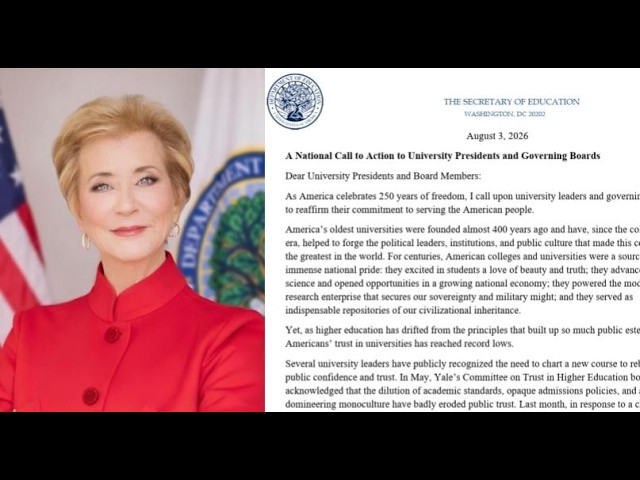
The video examines a significant development in US politics and education, focusing on a public letter sent by Education Secretary Linda McMahon to college leaders under the Trump administration. This document outlines seven key areas for reform, including affordability, merit-based admissions, free speech protections, intellectual diversity, research integrity against foreign influence, academic rigor amidst AI challenges, and prioritizing American interests above global commitments. While these topics address established academic values alongside current concerns like DEI and cost issues, they also reflect a distinct conservative agenda that frames education through the lens of Return on Investment (ROI) and national security. The letter explicitly calls for universities to orient their research toward US economic and security needs while excluding benefits to adversaries, effectively proposing a shift from a globalized academic model to one focused primarily on domestic priorities.
A crucial detail revealed in the analysis is that this aggressive stance was not developed entirely unilaterally by the administration but involved collaboration with prominent university leaders and associations such as the Association of American Universities (AAU). Senior figures from institutions like Washington University, Arizona State, Johns Hopkins, and the University of Kansas participated in crafting the letter's content. Public reactions to this move have been sharply divided; while some view it as a tactical shift away from direct federal control toward cooperation, others condemn it as an attempt to force universities into abandoning academic freedom and institutional autonomy. Organizations like PEN America strongly criticized the initiative as ideological pressure, whereas groups such as AGB emphasized that many of these goals are already shared but must be achieved through independent governance rather than political coercion.
Looking ahead, the video predicts a period of strategic maneuvering over the next five months as institutions decide whether to comply with Secretary McMahon's demand for public statements by late 2026. Compliant schools might adopt careful language and programmatic changes—such as canceling race-based scholarships or launching national security-themed programs—to secure federal funding, while non-compliant ones risk investigations or loss of grants. The situation carries significant political weight given the upcoming November elections, where incidents like student protests, syllabus content, or espionage prosecutions could be used by both sides to attack opponents or bolster their platforms. Ultimately, the outcome depends on whether higher education institutions collectively resist this "renationalization" effort or if they fracture under pressure, potentially causing the initiative to collapse as easily as its predecessor did last year.
Read the full video transcript
Greetings. Today, I wanted to talk about
a current event in politics [music] and
education. On Monday, the United States
Secretary of Education, Linda McMahon,
sent a public letter to the leaders of
American colleges and universities,
along with governing boards and some
associations. It's an important
development in the Trump
administration's campaign against higher
education, so I thought we could examine
it and see what it might mean for the
academy over the next few years.
There'll be links in the show notes.
To begin with, a quick summary of
letter's contents. It calls on colleges
and universities to commit to reforming
themselves along certain lines:
affordability, return on investment or
ROI, intellectual diversity, and
opposition to foreign actors, more focus
on merit, and emphasis on America first
as an organizing principle. There's a
lot there. All of these topics appear in
the form of questions, which I'll quote
an excerpt here.
Quote,
"Transparency and merit in admissions.
How will your institution ensure that
admissions criteria are transparent and
wholly described to prospective
applicants? And how will your
institution ensure admissions decisions
are based on merit, achievement, and
your university's educational purpose?
Two, free speech and open inquiry. How
will your institution protect the free
exchange of ideas, wide-ranging debate,
and open-minded campus discourse? And
how will you guarantee that unruly and
violent protesters do not harass
students or disrupt classes, research,
public lectures, and campus operations?
Three, intellectual pluralism and
academic vitality.
How will your institution encourage
intellectual pluralism in all its
academic units? And how will your
institution ensure the research
enterprise is dedicated to serving the
American people who fund it?
Four, affordability, value, and student
outcomes. How will your institution
ensure that families can access
affordable, high return degrees. And
what will your institution do to contain
costs, improve pricing transparency, and
ensure that every academic program
equips students to repay their loans?
Five, academic standards and rigor in
the age of AI. How will your institution
incentivize rigor in the age of AI,
combat grade inflation, and prioritize
excellence in teaching and learning?
Six, safeguarding research integrity
from malign foreign influence. How will
your institutions protect the academic
programs from foreign influence and
safeguard the integrity of the research
enterprise?
Seven, prioritizing American interests.
How will your institution answer this
national call to action? How can your
campus and faculty advance American
security interests, deliver academic
programs that meet urgent workforce
needs, and contribute materially to the
nation's prosperity?
Unquote.
Now, all of that might sound abstract or
lacking in concrete details for the
short term, but McMahon carefully,
clearly laid out one marker.
She, quote, called on every
postsecondary institution to publish by
the end of 2026 a clear public statement
outlining its commitment to implementing
reforms that will help restore public
trust in higher education. Unquote. I
started calling these hypothetical
statements McMahon statements.
Now, a Bloomberg article added some
important context to this letter's
development. The Department of Education
owns it, but some academics participated
in its creation. First, one association
helped. Quote, the administration's
latest move was developed in partnership
with university leaders, primarily the
Association of American Universities,
which represents dozens of top research
institutions, including all eight Ivy
League colleges. Unquote.
Second, senior leaders at four
administra- at four universities played
roles, two presidents among them and two
chancellors. Quote, "Those include
Andrew Martin at Washington University
in St. Louis, Michael Crow at Arizona
State University, Doug Girod at the
University of Kansas, and Ronald Daniels
at Johns Hopkins University." Unquote.
Bloomberg adds, "Girod serves as chair
of the AAU's board and Daniels is its
vice chair."
Elsewhere, the American Enterprise
Institute's Jenna Silver story wrote
that she played a role in its
development.
Now, after this letter went out, public
reactions have appeared. Inside Higher
Ed interviewed several people, and I
draw attention to some of their
responses. For example, the American
Council on Education's Ted Mitchell
described letter as, quote, "Far less
belligerent than previous discussions of
what higher education ought to be
doing."
Unquote.
More, he saw the letter as stepping back
from strongly asserting federal control
over campuses. Quote, "I think and I
hope that it's a realization by the
administration that universities should
not be instruments of the state. I do
think that this is a tactical shift. I
hope even more it's a philosophical
shift to working together to make
institutions as good as they can be."
Unquote.
In contrast, the Writers Association PEN
America was strongly critical. Quote,
"The letter is another blatant attempt
by the Trump administration to pressure
colleges and universities to abandon
principle and hew to the
administration's priorities and
ideologies." The association called on
colleges and universities to stand
strong against this latest salvo and for
the values of free expression, academic
freedom, and institutional autonomy.
Unquote.
Meanwhile, the Association of American
Colleges and University, AAC&U, its
president Lynn Pasquarella took a
different tack, emphasizing that
academia is already engaged in some of
this work, and that's not appreciated.
Quote, "While there's always room for
improvement, it is disappointing that
these long-standing commitments are
framed in a way that calls into question
the dedication of institutions and the
millions of faculty, staff, and
administrators who devoted themselves to
advancing educational opportunity,
research, innovation, and the public
good." Unquote.
Now, along those lines, the Association
of Governing Boards, or AGB, posted an
abnormally concise response saying that
we're already working on this and that
campuses need autonomy to do it well.
Here's the passage. Quote, "Many of the
priorities outlined in today's letter
from the Secretary of Education reflect
shared goals across higher education.
How those goals are achieved, however,
is the sole purview of governing boards
and institutional leaders exercising
their fiduciary duties in alignment with
their institution's unique mission.
The US system of higher education has
been built and strengthened by the
principles of board independence,
institutional autonomy, and
mission-driven leadership. It is vital
that we protect those principles to
ensure reforms are shaped by the
fiduciary responsibility and the
long-term interest of our institutions
and their students, not by political
coercion." Unquote.
Now, the president of the State
University of New York System's
University Faculty Senate, Bruce Simon,
offered some thoughts on Blue Sky. One
that which stood out to me is this.
Quote, "Compact 2.0 offers an
opportunity for colleges and
universities to stand up for their
founding missions and foundational
principles and functions, open up a
dialogue with the American people, and
offer their own ideas about restoring
trust in higher education and what that
entails." Unquote.
I would add a few other thoughts. To me,
this letter feels like a second take of
last year's compact. I like Simon's
Compact 2.0 framing. 1.0 failed to get
any traction, so they tried again. This
time working with some academic partners
and shifting the approach.
It's important to emphasize the
continuity here.
Uh if you haven't seen it before, I
spoke to last year's compact in my Trump
versus higher ed YouTube series.
There'll be a link in the show notes.
Now, the questions that Mann's letter
that Mann's letter raises are
interesting mix. Some are established
academic values like doing good teaching
and research or current academic
concerns such as dealing with DEI.
Some reflect public concerns about
higher ed like perceived price and
politics problems.
Others are standard conservative goals,
job preparation, viewpoint diversity.
The neoliberal framing of education in
terms of ROI is one held in many
quarters within and without the academy.
And still others are Trump themes,
merit, which I read as code for no DEI,
anti-protests, which I read Gaza, and
the American first anti- foreigner
argument. I I want to dwell on that
because one theme which hasn't got a lot
of attention over the past couple of
days is that last point. The letter
clearly wants an American first America
first academy and opposes some
international connections. There is this
call for the latter, calling for the
post-secondary sector to focus on
American benefits to the exclusion of
benefits to others. Quote,
"University-sponsored research can drive
economic growth and deliver medical
innovation and technologies with vital
military applications.
University leaders must ensure that the
research enterprise is oriented towards
advancing the US national interests, not
our adversaries, by refusing gifts with
problematic conditions and ensuring that
foreign actors do not unduly influence
academic programming, research
personnel, researcher assignments, or
student admissions.
Institutions must also ensure that
malign foreign actors do not gain access
to sensitive research or technology.
It ends with a question, how will your
school protect academic programs from
foreign influence and safeguard the
integrity of the research enterprise?
Unquote.
More direct still is this call for
renationalizing
academic work. Quote.
American taxpayers invest hundreds of
billions of dollars into higher
education every year. American
universities must put Americans and
American interest first. That means
prioritizing American students and
faculty, orienting the research
enterprise to support the country's
economic and security needs, and putting
American societal accept success ahead
of global commitments.
Then the question, how will your
institution answer this national call to
action? How can your campus and faculty
advance American security interests,
deliver academic programs that meet
urgent workforce needs, and contribute
materially to the nation's prosperity?
Unquote.
I wonder how international students,
staff, and faculty feel when hearing
those words.
This proposed shift of the American
academy from its generation plus of
globalized work to a renationalized one
might be one of the most important
points in this letter.
Further, making the higher ed sector
more cognizant of its role in national
security is a major shift, to put it
mildly.
I mentioned public reactions. I've also
received private reactions, which I
can't and won't share directly, but I
can summarize. Many people feel that
this call to action is a way to rope
administrations and institutions into
the Trump administration's plans. Some
have criticized the AAU's collaboration
and call for all of higher education to
resist.
Friends who are most strongly opposed to
Trump, who view his government as
fascistic, are especially strong on the
oppositional stance.
So, where might this go next?
Over the next 5 months, it'll be
interesting to see who makes the public
statement McMahon calls for.
I expect some very careful language in
such announcements, as well as careful
strategy.
Some might prepare to appear cooperative
in order to improve odds of getting
federal funds. They might try some
programmatic moves to make their
commitment more evident, such as
canceling a race-based scholarship or
announcing the national security-themed
program.
If McMahon follows up, the department
might start targeting campuses with
punishments if they haven't posted one
of her statements,
as well as publicly rewarding those who
have done so.
Grant awards and withdrawals,
investigations launched or called off
are just a few options ahead.
I wonder about reaction against the four
contributing universities and also the
AAU. How many faculty, students, and
staff at Arizona State University, Johns
Hopkins University, the University of
Kansas, and Washington University in St.
Louis will protest their presidents and
chancellors for participating in the
letter-crafting process?
Will fall semester see any subject to
no-confidence votes?
I wonder to what extent the letter's
move against international connections
will motivate those populations,
either from the international academics
or Americans on their behalf.
On the association level, will any other
institution publicly criticize or even
withdraw from the AAU?
There's the possibility of intersections
with the November elections, which are
just 3 months away. Higher education
could emerge as a political issue if
candidates in the media make it so.
Fall semester, starting in just a few
weeks, can give ample fodder in the form
of posted syllabi, student protests,
staff and faculty political statements,
classroom recordings, conference
presentations, and so on. Perhaps some
academic leaders will urge making a
McMan statement to reduce chances of
getting attacked.
Incidents may also play a role over the
rest of 2026. Consider another
prosecution of a Chinese national for
espionage.
Trump administration officials might
pounce proclaiming the case evidence of
why academia needs to make McMan
statements as soon as possible.
Campus election work such as voting
drives might give candidates and
officials materials to attack with
adding calls to join Compact 2.0.
Student and faculty and staff protests
may do something similar letting
Republicans draw attention to the
secretary's second point.
It's important to bear in mind the
opposite may occur. If higher ed largely
gives letter a cold shoulder and the
Trump administration gets distracted as
it often does, Compact 2.0 could fall
away as easily as version 1.0 did.
Let me close by turning the topic over
to you. Are you seeing any reactions to
this letter at your institution or in
your networks? The comment box stands
ready for your thoughts and questions.
>> [music]