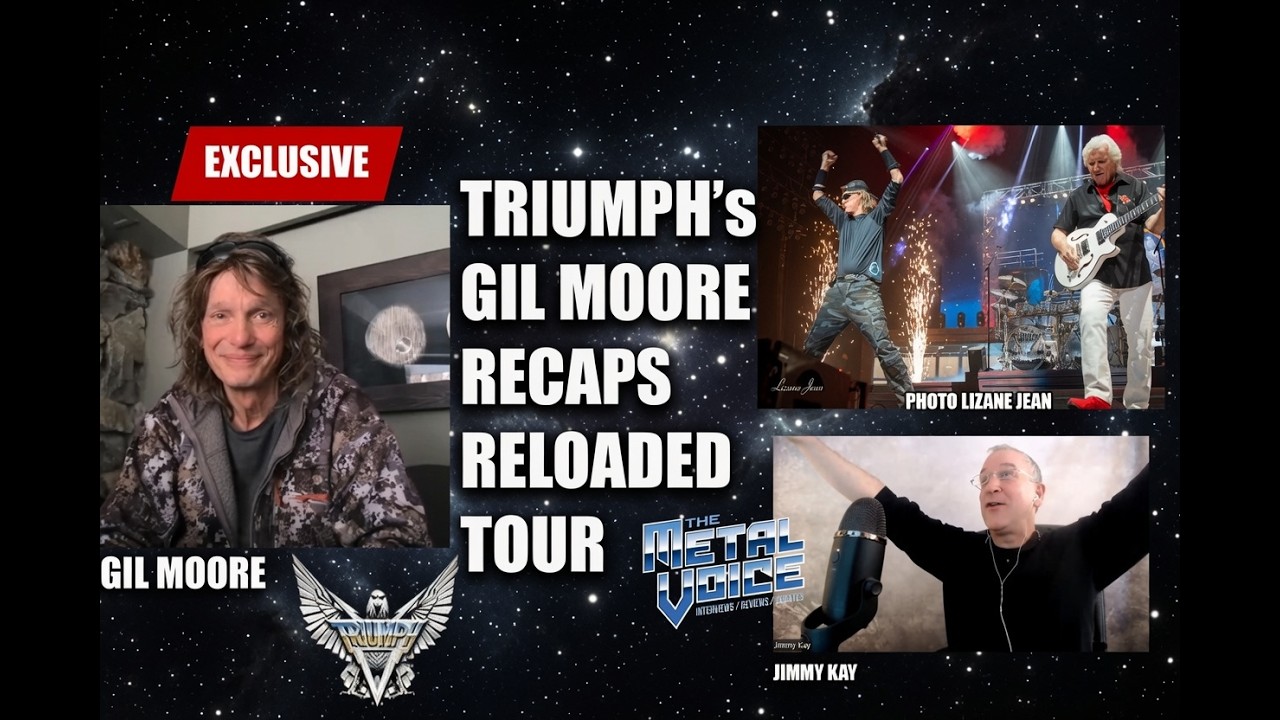
TRIUMPH Gil Moore Interview-Reloaded Tour Recap, More Dates? New Documentary Details Revealed
Watch on YouTubeVideo summary
Gil Moore reflects on Triumph's successful "Reloaded" tour, emphasizing that despite initial doubts about his readiness after decades away from the road, extensive preparation paid off significantly. He describes feeling like he was getting back on a bike once familiar with the rhythm of touring again, noting how physical conditioning and vocal exercises helped him keep up with four other seasoned musicians. The band faced some early growing pains, such as sound issues in Florida that required changing their crew, but these challenges were quickly overcome by Sault Ste. Marie, where they found stability and confidence before exploding into a well-oiled machine across the Midwest and Texas audiences who responded with overwhelming enthusiasm.
The tour's success was bolstered not only by Moore's return to drumming duties—often sharing responsibilities with Brent Ford on dual kits—but also by the seamless integration of Derek Sharp as Phil X's substitute, proving that Triumph could adapt without losing its essence. The band maintained a strong family-like bond both internally and with their fans, creating an atmosphere where every show felt like a reunion rather than just another performance. This deep connection was evident in social media reactions shifting from skepticism to near-universal praise, while the group's long-standing marriages within the lineup reinforced their stability against industry volatility.
A new documentary is currently being filmed to chronicle this entire journey, starting from the tentative Edmonton show that reignited interest and continuing through the complexities of reuniting a legendary act after twenty-five years. The project aims to capture behind-the-scenes moments, including technical innovations like dual drum setups and personal stories of apprehension turned into triumph for each member. Moore stresses that there was no official plan or strategy driving this revival; instead, it emerged organically from fan demand and fortunate circumstances involving the NHL playoffs, resulting in a narrative that feels authentic rather than manufactured.
Ultimately, Triumph views itself as an indie band dedicated to playing for people regardless of location or streaming trends, fostering genuine relationships with communities ranging from major cities to small towns like Green Bay and Sault Ste. Marie. The tour also served as a massive fundraiser for Sounds United, raising over half a million dollars through ticket sales that supported free music education programs across Canada. Moore expresses profound gratitude toward the fans whose love made the experience unforgettable, describing concerts as family reunions where everyone felt uplifted together—a legacy he hopes will continue to inspire future generations while expanding wellness initiatives using music's therapeutic power.
Read the full video transcript
[music]
>> Yes, that's how the interview should
start, right? With a nice shirt.
>> Nice shirt.
>> Back Back on the show, Gil Moore.
Triumph. Wow.
What is this? 50th anniversary reloaded
Triumph. Look at this. It looks great,
isn't it?
>> Amazing. Did you make that yourself or
is that official Triumph merch?
[laughter]
>> You know, I was We caught the last date
on tour
in Montreal,
which was rescheduled due to a hockey
game that they lost, right?
>> [laughter]
>> But it's okay. I I Actually, in
retrospect, Gil,
I was happy that it was at the end of
the tour because you guys were revved
up.
You guys were like in a groove. So,
quickly tell me about
the start of the tour.
W- Were you prepared? Did you find that
you were I know you were working out,
doing the vocal exercises, everybody was
working out, but did you think you were
prepared enough when you started on that
first date?
>> Uh I didn't think I was prepared enough,
but
you know, I'm I'm overly
uh cautious, so
it turns out I was prepared.
So, I just didn't know it yet.
And uh
it turned out like the the the tour for
me was actually a breeze, you know? So,
I guess all the gym hours and all the
drum hours and um
you know, all the vocal
working I did and everything was it it
it paid off because it then became like
a lot of my friends said
it's like getting back on a bike.
And I thought, you know, that's easy for
you to say.
Uh
and I and I knew I'm okay, so I'm
getting in with
you know, four other guys or five if
Mike makes it.
But Mike didn't make it. [clears throat]
Four guys who play all the time.
And I got to, you know, hold my own with
them. So it was pretty daunting.
But
it it Yeah, turned it just turned out
like preparation and then
um actually what I did on the road, I
think, you know, paid off. Just like a a
lot of sleep, a lot of sticking
exercises and um
a lot of the diet stuff that I that I
did was really, I think, beneficial.
You know, I'm I'm lucky. I've got one of
my daughters is a real athlete and she's
really dialed into nutrition, so
she kept me on the
primrose path to to health.
>> Were there any like unexpected
challenges that you had that you weren't
expecting?
>> No.
>> Expecting.
So every you you accounted for every
>> It was lucky. I mean,
like I said, it was partially the
preparation, I think, but you know, as
far as drums are concerned, like Brent
was a genius the way he laid the drum He
laid the drums out. I didn't. He kept
saying, "What are we going to do your
way?" And I kept saying, "No, no, no,
we're going to do it your way." And so
we went back
We went back and forth
on it. And uh
I just said, you know, like
the technology's improved so much
and you're on top of it, like you're
you're
dialed right in, so let's take advantage
of that.
>> Yeah.
>> And you know, if I see something that I
think is is wacky, I'll put my hand up,
but
there's nothing wacky like Brent's um
he's a he's very, very professional and
very knowledgeable and very skilled. And
so,
that in itself, I suppose, was another
reassuring factor is that
you know, he's been eat eating,
sleeping, and drinking this whole thing
when I wasn't
uh for a while. And uh
so, everything I knew or thought I knew
from back in the day
had changed quite a bit, but he was able
to, you know, get me kind of up to speed
on a lot of things. So, it was a it was
a huge advantage there.
And of course, the other the other guys,
too. I mean, Rick was very helpful and
Phil and and and Todd. I mean, the
I I don't know what to say about the
guys I played with. Like, so you this
another another factor, I suppose, to
me. You you go on stage and you realize
like, these four guys
are really, really playing well.
So, uh it's like being on a winning ball
team, you know, it's it's you know, I I
I guess the you know, the the tide ri-
you know,
elevates all ships or whatever.
That sort of thing.
So, it helped me help me out like I felt
like, hey, I'm on a winning team, man. I
got to get bat. I got to knock one. I
got to at least get on second base or
whatever. I don't want to get fired.
>> [laughter]
>> Yeah, I get that. You know what's
interesting? Bon Jovi just went out and
they did their their opening night. And
you know, he's had I mean, it's not the
same as you guys. It's different, but
the same at the same time, right?
>> Yeah, yeah.
>> He's got vocal issues. So, he's got a
band that has to elevate him, right? And
back him and do the back vocals and just
elevate the music, right? So, he's kind
of like I'm watching the videos online.
I'm going, you know what? It's kind of
remind me of Triumph, you know, they're
they they made it work in their own way,
right? It's not 1980 anymore, but they
made it work in their own way.
I mean, what kind of feedback are you
getting?
>> The feedback we got was unbelievable.
Like, um
you know, when the tour started, there
was
the there were there were those fans who
were like, "Bring it on. Can't wait." Um
you know, any version of Triumph is
great by me. And then there were those
that were uh the naysayers that were
uh you know,
the the you know, Rik's not going to
show up. Gil's not going to show up. Uh
you know, they're going to mail it in or
something or it's going to be all on
tape.
All of which was baloney
because
uh
we proved them all wrong.
And one show at a time they were just
got knocked down like bowling pins and
you can see the social media Anybody can
see the social media. It's 99.99%
positive. Only guy that was upset
couldn't get a parking spot. So,
that was a big that was a big change and
it was you know, it's a it's a
confidence booster for us. But what I
think happened with the fans, uh to my
way of thinking, was we had a family
like we were very close with all the all
the cities. That's why Triumph was a
touring band. We went to the people. We
played for the people. So, we had a
close relationship with our fans, which
I think nowadays it's it's harder. A lot
of these bands they get a hit on
streaming or something like that and
they never actually meet their fans and
then poof, they're gone.
So,
when we're coming back, it's like it's
like old friends getting together.
And you know, I looked at our I looked
around at you know, Mike and Rik and I
go, "Okay, so Mike's been married over
50 years to Rosie.
That's what I call love, you know, he's
been Rik's been married for 50 years to
Jeannette. Just celebrated their 50th
anniversary. That's what I call love,
right? I've been with Sandy for 35-plus
years. My God. So, we have long-term
marriages in this band. And we have
great relations with our family. So,
what happens we go out on the road,
first of all, our family comes out with
us.
So, we have our real families, our kids,
our grandkids, our wives, they all
support us. But, guess what? The other
family, which is
our fans,
they show up and they show up with the
same kind of love. Like,
from the stage, you could see people
crying.
Um you could see people cheering and
crying. Like, it was
very much like
a family reunion is what, you know, this
this tour was. And I And I think it it
shocked a lot of people that the band
was playing at the level
that we were now capable of playing at
and that we had no backup tapes,
everything was live.
Nothing was mailed in, everything was
real.
So, the result was uh
it was pretty incredible. I mean,
I've been around Rik Emmett my whole
life. I've never ever seen him as happy
as on this tour.
>> You know what?
>> It's all over his face. Like, you can
see it a mile away. And And like, I was
backstage with him and, you know,
hugging him. And he's like He's like a
He's like a kid. He's like so excited.
You know, even the guys in April Wine
were excited for us because they could
see this
thing going on.
And I was like talking about the
double-barrel shotgun in interviews
before the tour. Well, guess what? I was
not wrong about that because
when Rik and Phil show up downstage,
it's like Look out.
It's [laughter] a
Get out of the way, here it comes.
>> You know what? You know what's amazing?
It's amazing because, you know, we've
interviewed Rik many times, too.
And there's always this reluctant a
reluctancy to go back with Triumph on
stage.
Man, he belonged on that stage and he
was happy. You could It It just oozed
right out of him. Exactly what you said.
The fans could feel it. You guys could
feel it on stage and we could feel it
as part of the audience. It was an
amazing experience. And you know what?
I'm going to say one more thing, Gil.
When the tour started off, we were all
watching videos online and you know,
there's a couple of tweaks there and the
band was sort of just getting in the
groove.
But as it progressed, you could see the
social media reactions going from I'm
not sure to yeah, it's okay to like oh
my god, this is incredible. Oh my god,
this is the best show of the year. It
just kind of got better and better as
you kept going from city to city, right?
It was just
That's what I saw online. That's what I
saw online.
>> I felt the same way. Like uh you know,
we went down
sort of pre-tour almost to to work with
Make-A-Wish because it was such a such a
great organization.
And um
and it was good uh
it was an alternative plan how we were
going to rehearse. So, we actually
played a little early. Like we we
weren't fully rehearsed, I guess I'd
say. And we ended up
we ended up having to change our sound
crew. Like we we got so many complaints
about the sound. We we had to fire the
sound guys.
Um which was unfortunate. Uh but you
know, I I I the way I see the tour, it's
kind of kind of like you know, when you
you go to get your lawn mower for the
first time in the spring to cut the
grass and you forgot to drain the gas
out of it. It's got stale gas in it, you
know.
Uh you know, you didn't clean the
underside. Still got some grass
clippings from last year. You try to
start the thing up and it's like
you know,
it's [laughter] like
it's got a rough go. You finally get the
thing going and it's kind of coughing
and sputtering. That was kind of like
the rock and roll machine, you know, get
it getting going. And uh no matter how
many rehearsals we had at Metalworks,
there's there's no comparison to being
on a big stage, right? So, and there was
a little bit of you know, when we were
playing in Florida, you know, every now
and then, you know, we look at each
other and the and the look was
do you know where I am? Do I know where
you are?
And so there was this I'll call it the
look of uncertainty, right? And also a
little bit of comedy in there because it
would be like, "Oh my god." You know,
like
the roller coaster's going and the seat
belt's loose.
And you know, then we came to Sault Ste.
Marie and you got to love Sault Ste.
Marie because
>> Mhm.
>> great people, great venue by the way,
GFL. Uh Gardens is a fantastic uh arena
they have there.
And so we got to kind of settle down,
put fresh gas in the tank.
And all of a sudden it was like we knew
sound guys.
Boom, big change
in Sault Ste. Marie.
Then we come down and we play, you know,
uh
Scotiabank Arena in Toronto and TD
Coliseum in Hamilton. Of course, then
cross the border. So, by the time we hit
Chicago,
you know, and we're going in the Midwest
to St. Louis, Kansas City and stuff, all
of a sudden things starting to cook.
And then by the time we get into Texas,
it's
boiling. It's on fire now.
So,
it was like you said, it was a
uh
jelling of like the musicians, uh
a blowing off of some
uh
you know, cobwebs I'll say or or just
not, you know, having adequate rehearsal
time or whatever. So,
but uh
yeah, once once it's uh once it got got
going, it was like a well well-tuned
machine.
>> Yeah. Yeah, I agree. I mean, then there
was Phil X, which was
at first, when I saw that he wasn't on
stage in Montreal, which is the last
show again,
I was kind of like, "Ah, man, Phil X
isn't there. He's such a big part of the
band still, right?" But then, you know,
Derek Sharp, man, he really did justice.
He was a I don't even want to call him a
substitute, but he really gelled well.
The guy is a great huge talent. So,
you pick you man, you know how to pick
them, man. You know how to pick them.
>> Yeah, I mean uh
you know, Phil picked really picked
Derek or suggested Derek, and uh he did
a great great job. And uh you know,
obvi- obviously we you know, Phil's you
know, an original band member and he's
our guy. But yeah, of course.
>> we're working a blow a show out uh
because Phil couldn't make it. So, so
yeah, I don't know what you call what
you call that, but we've got a good
bullpen.
Uh Derek is a
a really great player, as you saw,
really talented. Um he's a rock star
uh in his own right, and we're we're
just lucky to have him.
>> Did Did you know
>> play some more shows with us. I don't I
don't know.
>> Well, I'm assuming look, he's got Bon
Jovi commitments, right? Phil X, it's
obvious, right? He's on tour now, they
have to rehearse. So, I'm assuming that
kind of played into the sort of planning
the Triumph tour, right? What if?
I would assume, right?
>> Yeah, I mean you know, we can't predict
what Bon Jovi's going to do, and I I I
get the fact like, you know, Phil's been
been loyal to Bon Jovi for many many
years.
And so uh you know, I can put myself in
his shoes. Uh it easily enough, and
[snorts]
uh you know, Phil's a very loyal guy.
So, he loves both bands, and uh we found
out a way to make it work. If for some
reason there's a conflict that comes up
at the last minute, you know, Derek
comes in, and uh
he is now, you know, rehearsed enough
and stuff that uh
it it's it's it's tremendous how well
you saw it in La Belle, so
>> Oh yeah. Oh yeah.
>> Yeah, everyone else saw it.
>> All right, so so the big question is
this the big question, you ready for
this?
>> Yeah, yeah. I like big
>> rock and roll machine continue?
>> Well,
we're certainly we figured out that
we're capable of it. Um
and I guess I I kind of look at it like
this, you know, like in sports the thing
that kills sports teams is a bad
dressing room.
And you know, we look at a lot of these
bands that are out there and they can't
get along with each other.
>> Yeah.
>> You know, or the wives can't get along.
Try Triumph's the opposite. So,
we've got
like a super dressing room where
everyone
is it's a
you know, mutual admiration society I
suppose you'd call it. Like everyone
gets along great.
Everyone's got a great sense of humor,
which is imperative.
Everyone likes pyro, which is mandatory.
Uh
Yeah, it couldn't be any better in in
the dressing room, right? And then back
to our families. Like family support, I
mean, we've got family support like no
band out there.
And that's why I say that the the fans
is just an extent a part of the extended
family. Like so it's uh
when they ask us to do shows Yeah, I
suppose it depends on a lot of things um
what we might do in the future. Uh
definitely going to do another film.
So, that's already partially in the can
like you and I were talking about before
the interview.
Uh so, that's going to be neat to have
another doc out there.
And I think we'll probably play some
more shows, but uh until they're you
know, they're locked in and everyone's
>> Yeah, you don't want to you know
>> I don't I don't want to start shooting
my mouth off.
>> Is Europe a a territory that you'd be
interested in as well?
Just again, I'm not I'm you're not
committing to anything here. I'm just
>> Yeah, you know, I I I don't want to I
don't like getting ahead of myself. I I
just uh
you know, I've I've a lot of things that
are that I'm equally, you know,
passionate about here at Metalworks with
our
charity uh which by the way Sounds
United
um
was benefited very very very much from
the tour, which is another bonus
>> Wow, yeah.
>> uh for me. Yeah, the charity raised over
half a million so far.
>> Wow.
>> uh on on the on the tour. So, that's
great for, you know, the kids that are
going to benefit from that.
And um
that was um
Yeah, that was that was great. Um so, I
have to think about that. I have to
think about what it it entails to, you
know, keep the charity rolling.
Um
So, I have I have a lot of distractions.
Um you know, our school is um at
Metalworks, our school is expanding like
crazy right now.
>> Wow.
>> Hard to keep up with it. Um there's
great management. My son-in-law Craig
runs the school and
um
my daughter Holly is, you know, in
charge of all the uh
a lot a lot of I guess the other the the
yin and the yang. The two of them are
are and and they've got great staffs.
So, they could probably just kick me to
the curb and it wouldn't change
anything, which
>> [laughter]
>> But, I I I I I I like it. I like being
involved in it and uh you know, trying
to see the young people that have, you
know, come into the industry.
Um very exciting. You know, yesterday
uh Drake's engineer Noel Cadastre, who
was uh one of our very very first grads
and one of our most successful,
obviously, dropped by the studio
yesterday driving a brand new Ferrari
and
>> [laughter]
>> he's living the dream, you know.
So, it was cool to see him. He's such a
humble man, too, for considering how
well he's done. So,
>> So, what is this documentary? Okay, so
the first documentary was basically
Triumph, right? The the the the legacy,
the history,
where you are today. Actually, it was it
sort of left off when your first sort of
quasi reunion that you had at
Metalworks, right?
>> Yeah.
>> Sort of like
uh just getting the band get to getting
the band back together for a few songs,
right? With the fans.
>> Pretty much.
>> Where does Does this documentary start
from that point
going on tour as this reloaded tour? Is
that what the
What's the direction of it?
>> the first documentary doesn't answer
what now.
You know? It it it sort of culminates in
the in the sort of fan super fan fest,
I'll call it.
At Metalworks and and then you know, the
guys ride off into the sunset and it's
like who knows? There's no end to this
and I get you got me saying I've said
for I've been saying for 25 years like I
will I'm not going back on the road with
Triumph. That will never happen.
And I was 100% serious
um
when I said that.
And uh and Rick said more or less the
same thing, too. Like I'm not going back
on the road. Even his own solo career he
retired. I'm not playing anymore. So
there was
Neither one of us were looking like
anything was going to happen, but uh
the the the fluke in all this it all is
a series of flukes. I mean, the fluke
number one was just, you know, do this
the thing that happened in the in the
hockey playoffs and they you know, hey,
come on out to Edmonton. Uh This is from
Rogers and and Live Nation. Come on out
to Edmonton, guys. Just have a laugh.
Bring your family.
You know, play let's let's see if we can
bring some luck to the Oilers.
Um win the Stanley Cup, which of course
unfortunately they didn't. The Panthers
took it, but
uh it just seemed like a
a lark. It didn't seem like putting the
band back together. And and we really
didn't. I mean, we just flew out there.
We go into a rehearsal rehearsal hall,
rehearse for 2 and 1/2 hours or
something like that. And then we went
and did it. And I was like
I was not in any shape at that point
really to play drums. So I I hadn't done
any of the preparatory work to to do a
tour or anything like that. I was just
kind of like, okay, well, let's not make
a mess of it, Gilbert, we'll do our
best.
And uh
but what that sparked of course was
a lot of interest from fans and a lot of
speculation and and then
uh
Live Nation all of a sudden plotted a
tour and said, you really we really need
to do this.
Which I still thought was
probably not going to happen and was
probably
um
I don't know. What what what what band
takes two and a half decades off and
then starts playing again? [laughter]
Nobody does that.
Right? But we did. So
that's that's funny that we were able to
do that. I I think it's kind of like
when we first went to America and we
said we're going to headline every show
from day one.
And
they all said, you know, everyone that
knew what they were doing said, you guys
are crazy, that'll never work. And
we made it work.
>> Yeah. Yeah. So so is that did you have
footage from from Edmonton
and on?
From the time you got the call to go to
Edmonton? So there So this new
documentary, and again, I'm sure it's
not you haven't figured out all the
details, but it's it's starting from
Metal Works, that sort of little tiny
reunion you had.
>> Yeah.
>> Going to Edmonton with Live Nation.
Going on tour with Reloaded and
everything it took to get there. I would
assume, right?
>> Yeah, I think it would be like having a
seat an insider seat and seeing what was
going on. There was seeing the
uncertainty and seeing like having to
put together like the whole concept of
double drums on a double drum riser and
what that entailed and
you know, the incredible job that Brent
did um with that. Uh you know, or you
know, my journey back into
performing. You know, like
you know, Rick Rick this is the thing,
maybe the band wasn't performing, but
Rick was performing. He was performing
as a solo artist all this time. I
wasn't.
>> Yeah.
>> So,
uh yeah, I was more I was never
concerned about Rick. I knew his playing
is great. He's going to be fine. Um as
long as he feels good, you know, and as
long as his his health is solid, like
he's going to be he's going to be great.
The other guys are obviously great.
So, I was most concerned about myself.
This is So, it's documents, I think each
person's
journey. I mean, I think I think Rick it
wasn't his playing, but I think there
was still a lot of apprehension, a lot
of uncertainty, like, should I do this?
Should I not do this?
You know, I I think it's that
does she love me? Does she Does she hate
me? kind of stuff that we do to
ourselves, you know?
>> Were you filming yourselves like
throughout this whole sort of
behind-the-scenes
>> Yeah.
>> transition?
>> Yeah, our our Metalworks team was doing
that. And
>> Wow.
>> because I said like, win, lose, or draw,
even if this thing even if this ship
sinks in the harbor before it ever,
you know, leaves,
we're going to film the whole thing. And
so maybe yeah, maybe the the end of
Triumph is this the ship sinks.
You know?
>> I don't know. Yeah, yeah. But but wow.
>> Yeah, yeah, we never I don't think
anybody could have forecast how well it
went. So,
when the social media started
like
doing, you know, and it was and then the
and then in the venues, like as you saw,
like the the fan reaction, people were
just standing up the whole show. It was
like,
there was nobody that was
And then we didn't play any shows that
were
there wasn't this kind of massive
excitement. And it was all I think that
was better than yesterday, you know? It
was like, we kept Every show was better
than yesterday.
>> [laughter]
>> Really, they weren't they were all the
same,
you know? It was very very uh
en- enlightening, I think,
um
>> Wow, yeah.
>> for all of us to see how
this
five-piece version of Triumph worked.
The splitting up of the drums so that we
effectively have Brent playing keyboards
and just Gil playing drums or we have
Gil singing out front and Brent playing
drums or we have Gil and Brent both
playing drums and Rik or Phil or Todd
singing out front. So, it was kind of
this
uh
relay race of
the it's just a different setup than any
band I've ever played in.
And uh
>> Yeah. Have you foreseen have have
as I mean it was it's it's it's it's
brilliant how you foreseen I don't know
if that's the right word.
Another story there, right? There's
another story. It's like this is the new
Triumph, right? Or the reloaded Triumph.
I think it's
I didn't even know you guys were
filming. Like I had no idea. Like this
is a great story. It really is.
>> My daughter Holly came up with the name
for the tour.
Uh you know, the Rock & Roll Machine
Reloaded and as it turned out to be the
right
title for the tour because it was like
you know, a a reloaded setup. I mean, we
had we had hoped initially that Mike
might be there and it would still be
like that, but we would have been six on
stage, not five.
And uh you know, unfortunately, he
couldn't make it. So,
this the reality became this [snorts]
five-piece
band.
And uh
it just uh
it's it's amazing. Like it went from
being loosely formed to being as hard as
a piece of granite
by the time we were rolling through the
Midwest and heading down to Texas, it
was like
galvanized.
>> Yeah. Yeah, I agree. I mean, is there
anything else you want to tell everyone?
>> Well, I just uh
I'm just very thankful, you know, to the
fans. Like the reaction
uh
I I I
wouldn't let it go to my head. I I mean,
you you you could. All that adoration
and everything that we experienced and
all the nice comments on social media
are really really
gratifying and so on, but
you know, you get back to you know, kind
of how we started. We
as I mentioned earlier, like we went we
were a band for the people. We went and
played before the term indie was
invented
applying to bands as an indie band. I
felt like we were an indie band because
we would go and we would play and we did
it our way.
And we went to the towns that we thought
were important, which weren't always the
Philadelphia and the New York and you
know, Detroit and all the Chicago, LA,
all the big ones. Yeah, they're they're
great and they're important. Toronto's
important. But you know, like what about
the people in Sault Ste. Marie, you
know? What about the people in Green
Bay, Wisconsin? You know, it's
uh
that's where I think we formed a family
that a lot of bands
don't have.
Uh
and that's the change in
you know, whether it's the cost of
touring or whether it's because of
streaming or
the number of factors that are in there.
Um
I still think, you know, music is uh a
great thing to bring people together and
I think what people felt at a Triumph
concert is I think they felt like a like
I said, it's like a family reunion.
That's the best way I could describe it.
And it was a very good family. It still
is a really good family. So uh
really really thankful to
you know, the people that
uh you know, made us feel so good. We We
We got more pats on the back on that
tour than anything I've ever done in my
life, I think. So
was uh
really a great experience for and I know
I can I can speak for all the guys when
I say that cuz they all felt exactly the
same way. It's like, "Have you ever felt
like an audience give you this much?"
That was a
>> [snorts]
>> No.
Never. Never. So.
>> quite the experience. It's quite the
experience.
>> yeah.
>> And two different versions, I love the
Reloaded. You know, it really defines
the band and who they are today and who
you are today.
Yeah. Good stuff. I'm really excited to
uh
hopefully this documentary won't take 5
years to come out, but uh
>> [laughter]
>> No, I don't think it'll take 5 years,
but you know what, Jimmy? I think what a
lot of these things, like I said
earlier, it's like
we didn't plan this. Like we didn't plan
the tribute album. You know, it's
something that things that kind of
just
>> Yeah.
>> that it comes at a time We didn't plan
Edmonton and the NHL and all of that. We
didn't So, you know, I've said for a
long time, and it's truth, the official
plan is there's no official plan.
>> [laughter]
>> I like it like that.
>> Yeah. Maybe it's the best way to do it,
right?
>> Best way to do it. We'll see what
happens, you know? See what happens. See
what See what's shaking. See how
everybody feels.
>> Quick plug on the charity one last time.
>> Yeah, I mean, Sounds United, obviously,
is um
near and dear to my heart and and what
Sounds United does provides free music
education and music wellness
uh over digital digital platform right
to your right to your phone.
And uh free for all young people in
Canada. We're also using it uh in some
uh in the dementia area as well for
elderly patients and so on. So, uh
appreciate everybody that helped the
charity uh on the tour. Much
appreciated. And uh yeah, we're hoping
to grow it over the years into the
future and uh use music as a wellness
tool
for the community, which is uh it's
absolutely a great great uh
use of music and I think it's becoming
more uh
uh
there's more awareness. I would I was
going to say fashionable, it's not
fashionable, it's more there's more
awareness
uh
for how impactful music and the is on
the brain and the well-being of a human
being both both playing it, listening to
it, sharing it,
uh etc. etc. So, it's a a great legacy
piece for a a guy that's uh
uh always enjoyed music and you know,
wanted to uh say, "Gee, this is a great
experience. Too bad everybody can't have
it." Well, this is
kind of a way. Doesn't You don't have to
be a uh musician even to uh
you know, get the benefits of uh the
wellness aspects of Sounds United. You
know,
thanks to all those that supported it.
>> All right, on that note, Gilmore
triumph. Check out the shirt.
>> [laughter]
>> There's my shirt.
Where the heck's my logo?
>> Invisible ink.
>> [laughter]
>> All right, have yourself a wonderful
day, Gil.
>> You too, brother.