Train Unexpectedly Crashes into Suburban Garden | Plainly Difficult
Watch on YouTubeVideo summary
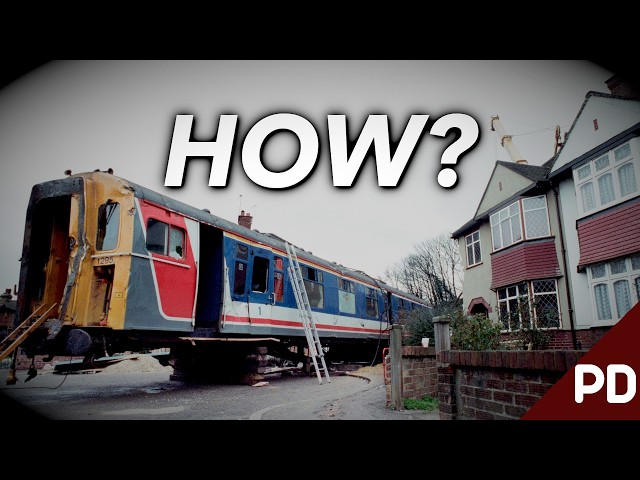
On March 4, 1989, a tragic collision occurred just outside the South London suburb of Purley, where an electric multiple unit train crashed into the garden of a residential home. The incident involved a four-carriage Class 423 train departing from Horsham that was routed onto the up fast line toward London Victoria, while simultaneously a longer eight-carriage service approaching from Littlehampton passed through the same area on the fast line. Despite the approaching train acknowledging automatic warning system signals and seeing double yellow and single yellow indicators, it proceeded past Tango 168, which was set at danger to protect the junction. The resulting impact caused the first six coaches of the incoming train to derail and tumble down a steep embankment into the gardens of nearby houses, leading to multiple injuries and five fatalities before emergency crews cleared the wreckage by March 9th.
Initial investigations by the Ministry of Transport's railway inspector immediately blamed the driver of the Littlehampton service for passing a red signal at danger, citing a lapse in judgment as the primary cause. Consequently, the driver pleaded guilty and was sentenced to twelve months in prison, later reduced on appeal to four months. However, subsequent analysis revealed that the conviction was based on an incomplete understanding of the signaling infrastructure at the time. The signal in question, Tango 168, was a multi-aspect signal located at a complex junction with six platforms and multiple tracks, creating potential for drivers to misread signals on adjacent lines or confuse distant signals with their own due to visual distractions and long sighting distances common in that era's railway design.
The root cause of the disaster extended beyond individual error to systemic failures in train protection technology. At the time of the crash, British mainline railways relied almost entirely on the driver as the final line of defense, lacking any automatic braking systems capable of stopping a train that passed a restrictive signal. This stood in stark contrast to the London Underground, which had utilized reliable tripcock train stop protection since the early 1900s. The absence of such technology meant that even with modern signaling upgrades implemented in 1986, human error remained unchecked until the introduction of Train Protection and Warning Systems (TPWS) a decade later. This period highlighted the urgent need for mandatory train protection systems to prevent similar accidents during what became known as the dangerous years following railway privatization. Ultimately, while the driver's actions were legally culpable under the laws of 1989, the infrastructure design flaws and the lack of automatic safety mechanisms played a critical role in turning a signal infringement into a fatal catastrophe.
Read the full video transcript
Train crashes,
train crashes never change. It seems the
more things change, the more they stay
the same. When I tell you that our story
today has many similarities to another
crash,
one train that has crashed into the rear
of another due to drive not reacting
appropriately to the signals in front of
them, you might be thinking about the
more recent Bedford tragedy, which
happened this year, 2026.
This is the similar event I'm thinking
of, but our story today actually took
place 37 years before, just outside the
humble South London suburb of Purley.
The event shows that the railway is
still reliant on the one consistent
safety device aboard a train, the
driver.
It would highlight the need for train
protection, a need that many are still
arguing for today.
So, what am I going on about then? Well,
today it is a story that ended up with
an electric multiple unit train being
lifted out of someone's 1930s suburban
house garden.
My name is John, and welcome to Plainly
Difficult. This video today wouldn't
have been possible if it wasn't for my
YouTube patron and coffee members. If
you want to get access to the channel's
videos, you can from just £1 per month.
As always, the links will be in the
pinned comment below.
Purley, Purley, Purley.
So, this is Purley. It is a town just
south of the major South London town of
the Croinks, aka Croydon.
The borough is the fourth largest in
London by size. It is a cultural center
of sorts, being famed for the home of
dubstep and for having all of its bus
stop shelters being stolen by a scammer.
Yes, that actually did happen. Anyhows,
if you want to escape Croydon for
Brighton, you have a high likelihood of
needing to go through our disaster
location,
Purley. Today, the area is known for its
massive Tesco's.
But our story took place 2 years before
the creation of this landmark, in the
year 1989.
Interestingly, it was the year I was
born.
But less info on me. Let's get to the
track layout and the signaling
arrangements in 1989 around Purley
station. And geek warning, you will hear
the terms automatic semi-automatic
control signals a few times here, so you
have been warned. The station has a
whopping six platforms with six tracks
running through it. Named the up fast
towards Croydon and ultimately London,
the down fast away from Croydon, and the
up and down slow, again towards Croydon
and away from Croydon respectively. In
addition to this, there is an up and
down loop line which takes trains to the
magical worlds of Caterham and Tattenham
Corner.
The down slow and up loop platforms are
bidirectional, allowing trains to come
from said amazing places to be able to
be routed onto the fast line and into
and out of a siding to the north of the
station.
Now, the signals in the area were fairly
recent, having been upgraded in 1986.
This allowed the signaler to operate a
routing via push button entry and exit
routing, where the signaler pushes a
button on their controller to route and
set the signals for said route.
This is great for routing trains across
the slow line onto the fast line, where
the computer logic of the signal box
takes the stress out of setting each
signal away from the signaler. It's all
interlocked, so no conflicting movements
can be set without signal protection.
Now, we could talk for hours about the
signaling arrangements for this area,
but for not wanting to waste air and
hard drive space on my Zoom H4N, I'm
going to talk mainly about one signal.
This is Tango 168.
It is controlled by the Free Bridges
signal box a few miles to the south.
This signal is placed at the end of the
up fast line and it protects Purley
Junction as trains come across from the
slow line to the fast line.
It is a semi-automatic signal. This
means it can be set to auto mode when
movements across the junction aren't
taking place.
Meaning the signal will act like an
automatic signal being activated by the
passage of trains.
When a train is clear the section, 168
protects it
and it can automatically clear without
any input from the signal.
When in controlled mode, the signal has
to be cleared by the signal. This is
used when say a train moves from across
the slow line onto the fast line and
Tango 168 will be held at danger. Now,
this would not be a surprise for a
driver as the preceding signals would
check the train down with Tango 182
showing double yellows, Tango 178
showing single yellow and Tango 168
being at danger. The line speed
throughout the area was 90 mph with a 25
mph speed restriction across the point
work when crossing over.
The trains in the area run on the South
London tried and tested 750 volts DC
third rail system via the brown trouser
conductor rail.
Now, with all that background done and
dusted, it's time to move on to how
commuter train ended up in someone's
back garden.
The disaster.
It is just a bit past half past 1:00 in
the afternoon on the 4th of March 1989
and a four-carriage class 423 London
Victoria-bound train is just pulling
into Purley platform three on the up
slow line. The train had started off at
Horsham further south at 12:50.
The driver canceled the AWS warning for
Tango 170.
As the train approached the stopping
position, the signal cleared with a
junction one indicator showing the route
was set for the train to go over onto
the up fast line. This would mean that
the signal at the end of platform one,
Tango 168 would be at danger to protect
the movement of the ex-Horsham train
onto the fast line.
The guard for the train checked the
platform and rang the two bells to the
driver telling him it was ready to
depart. The driver brought their train
up to the speed of 25 mph to navigate
the points onto the fast line.
Meanwhile, a 12:17 Littlehampton to
London Victoria service was approaching
Purley on the up fast line.
This was made up of two four-car Class
421 trains making a formation of eight
carriages.
The train passed Tango 182 showing
double yellows followed by Tango 178
showing a single yellow yellow. Both of
these signals the driver acknowledged
the AWS warnings. The train was
traveling at roughly 60 mph when it
reached the end of platform 1 at Purley.
Tango 168 was at danger. The train went
through the red signal and collided with
the fourth carriage of the ex-Horsham
train. As the two trains collided, the
first six coaches of the
ex-Littlehampton train
derailed and began tumbling down the
steep embankment into the houses'
gardens that backed onto the railway.
Multiple carriages flipped over sliding
down onto their roof. Being Mark 1
derived rolling stock, their crash
protection was pretty lackluster. Thus,
many inside the trains were thrown
around causing multiple injuries.
A light running locomotive on the down
slow stopped just outside Purley station
and made a call to the signal by the
signal post telephone
telling them what they had just
witnessed. The first 999 calls came in
from nearby residents that had found an
electric multiple units train in their
garden. Soon enough, emergency workers
would arrive on the scene and begin
assisting the injured and survivors at
the crash. Emergency workers would work
until 5:00 p.m. searching the wreckage
with the last survivor being removed
about quarter past 3:00 in the
afternoon.
In total, over 80 people were injured
but sadly five would lose their lives in
the crash.
The line was closed until the 6th of
March where repairs to the track and
signaling was made. The damaged vehicles
that lay on the embankment were strewn
around people's gardens and they would
have to be craned out progressively
until the 9th of March when they were
fully clear.
The crossover point work point work was
replaced and the speed restriction was
in place until normal operations were
allowed to resume on the 27th of March
1989.
The driver of the ex-Little Hampton
train would be charged with
manslaughter. They would plead guilty
and receive 12 months imprisonment
reduced to 4 months on appeal.
Which leads us on to the cause.
The investigation.
The Ministry of Transport's railway
inspector would delve into the crash and
release a report in October 1989 placing
the blame clearly at the feet of the
Little Hampton train driver.
The train and signaling had no issues
and were found to be in correct working
condition.
And testimony of drivers of other trains
through the area earlier had shown the
signaling was working as it should have
done.
The main cause was the lapse of judgment
where the driver passed Tango 168 at
danger. That was a pretty easy
conclusion to come to and this was
reflected at the time with the driver's
guilty plea and conviction. But as time
went on the 12 months would get reduced
to 4 months and in the mid-2000s his
conviction was completely reversed
because there was a lot more going on
with that signal.
The lord who oversaw the overturning of
the conviction said something about the
infrastructure of this particular
junction was causing mistakes to be
made.
You see Tango 168 was what is considered
a multi-spade signal.
It would turn out that there were
multiple trains over the years had
passed it at danger which would
logically point at one thing that the
way the [clears throat] signal set up
was meant it was conductive to an
accident. Looking at the diagram there's
potential for read across where driver
could misread a signal on the adjacent
line. For example, reading across at
Tango 178 to Tango 180 or read through
where the driver saw a signal beyond and
thought it was theirs. For example, from
Tango 168 to Tango 166. Now, I'm not
saying that's what happened on the day,
as those aspects were shown to be a
danger after the crash.
But, I couldn't find out any information
on what they were showing before.
Small infrastructure issues can create
multi-SPAD signals. There's notorious
signal on the Watford DC, Whiskey Sierra
35, which has multiple SPADs. Many
theories exist for this, as there are
many distractions along the line,
especially at Wembley Sidings, where
weird and wonderful trains pass by.
There's also another notorious signal,
actually just a couple of miles away
from Purley, Tango 22,
which is notorious for reading across
and long sighting, where a signal is
viewed from such a distance that drivers
switch off and forget it's at danger.
The ultimate failure was caused by the
driver not reacting to the restrictive
signals before 168,
but British trains at the time had one
massive flaw, that there was no real
train protection system beyond the
driver and the automatic warning system.
The crash was a decade away from the
implementation of TPWS, which would mean
multiple more train crashes would occur
during what I call the bloody years of
early post-railway privatization.
I find it so frustrating that this
period had nothing to stop a train
passing a signal at danger, especially
when the London Underground had a very
reliable system of tripcock train stop
protection since the early 1900s. As was
then, as we still see today, the meat
sack at the controls is the first and
last defense of safety.
So, that's my video on the Purley train
crash. It's going to be a three on my
scale, and this is what I've got with my
root cause analysis card. Do you agree?
Let me know in the comments below.
This is a Plain Dealing Productions
audio on the channel Creative Commons
Attribution Share Alike license.
Plain Dealing videos produced by me,
John, in a currently very hot corner of
South London, UK.
It is the 12th of August today and it is
near 30°.
Anyway, thank you very much for
watching. And all we have to say is
thanks for watching. And Mr. Music, can
you play us out, please?