Video summary
Melissa Armo introduces her "Golden Gap" trading strategy, which centers on identifying and capitalizing on price gaps generated by significant institutional money flow rather than retail speculation. Her system employs a rigorous 26-point checklist to evaluate potential setups, with the strict rule that only gaps scoring 20 points or higher are traded in the direction of the gap. This disciplined approach prioritizes consistency and risk management over gambling, acknowledging that stocks often decline faster than they rally, which is why Armo frequently prefers shorting opportunities. By focusing on high-quality institutional moves, traders can avoid the pitfalls of overtrading and instead seek out one premium setup per day to maintain a structured edge in volatile markets.
The core philosophy behind this method draws a parallel between trading success and becoming a professional athlete, emphasizing that realistic preparation and hard work are essential for achieving financial goals. Armo promotes her comprehensive "Golden Gap" course, designed to teach traders how to pinpoint entries and exits using the specific 26-point criteria to find stocks with professional bullish gaps. The curriculum highlights that significant profits can be generated by following institutional money without needing large position sizes, making it an accessible path for those who wish to avoid the high costs and limited opportunities often found in futures trading. This educational focus ensures that participants learn to distinguish between bearish traps and genuine momentum plays driven by power players.
Practical application of the strategy is demonstrated through successful trades in major stocks such as Dick's Sporting Goods, Meta, and Chevron, where both day trades and options were utilized to capture momentum. To support traders navigating current market conditions, including potential Federal Reserve rate hikes, the course offers a Labor Day special bundle available until September 7th for $89.99. This package includes the main Golden Gap course along with additional classes on options and trends, providing free access to trading newsletters and market reports through the end of 2027, as well as two one-hour mentoring sessions. The comprehensive support system is designed to help traders who are not yet seeing results with their current methods by offering mentorship and a complete framework for handling volatility.
The video concludes with a Q&A session where guest Melissa discusses using volume gaps to effectively identify institutional participation, reinforcing the idea that finding just one good stock per day is sufficient for success. The overarching message is that traders must avoid gambling behaviors and instead adopt a professional mindset that values education and mentorship when existing strategies fail to yield results. By combining a strict scoring system with a focus on quality over quantity, this approach aims to equip traders with the tools necessary to navigate market gaps safely and profitably while maintaining long-term discipline in their trading careers.
Read the full video transcript
she associates with large institutional
participation. Her approach can be
applied to day trading, swing trading,
longerterm investing and options with a
particular emphasis on identifying where
uh what what she calls power money uh
may be flowing. And with the September
and October earnings season approaching,
Melissa believes traders should be
preparing now for the potential moves
that earnings can create. Oh, we're
excited about this. So, everyone, please
welcome Melissa Armo.
>> Hi, can you hear me? Hey Melissa, we can
hear you.
>> Wonderful. Thanks for having me. Just
want to see here where do I see
questions from people? Under chat or
questions?
>> Um,
it would be under questions.
>> Okay, great. And how long do I have to
speak to here today?
>> Uh,
minutes. So, you have until three.
>> Three o'clock. Okay.
>> Yeah.
>> Okay. Great. Thanks so much for having
me. Welcome everyone.
Today I'm going to talk about trading
the side of institutional money and the
side of momentum. For those of you that
don't know, I appear on TV. I talk about
the stock market. I talk about the
economy. I talk about really what's
happening right now for you to make
money today. If you have questions, you
can email me at melissthetockswish.com.
You can also call me at 9293200gap
if you have questions. I live in New
York City and um you can follow me also
on X Facebook or YouTube. So again, fall
is coming. I actually took a walk in
Central Park this morning. It was 63
degrees. Uh and I really felt like, oh
gosh, fall is almost here. One of the
things about fall that's going to be
very exciting for the market is that we
have a big Fed meeting coming up in
September. And based on the statements
from Friday from the new Fed chair, I
really think the possibility that they
could raise rates. That's going to
create a lot of volatility in the
market. And I will tell you right now
that I actually mostly short. I will go
long, but I mostly short. Uh we shorted
Marll. Actually, we did a put in Marll
on Friday. You can take a look at that
chart. If I have time at the end, I'll
bring it up. But even in a bullish
market, you can short. And the reason
that I like to short so much is because
stocks fall faster than they rally. So,
we've been, you know, going the whole
year and we've been celebrating the
250th birthday of the United States. And
when I talk to people and I go to
different celebrations in New York City,
you know, one of the reasons that people
love to trade the US stock market is
because you have the freedom to trade
the market from anywhere in the world.
All you need to know is how to trade.
You need a computer and you need charts
and you need an account. Now even you
can trade on your own with a small
account and you can trade on margin with
less than 25,000. That started a couple
months ago and it really has opened up a
whole wide world for people who want to
trade the market. Years ago you used to
need 25,000 to have margin. Now you
could open up account with two grand and
have four to one margin. So people are
interested in making money even if they
have a full-time job that they love and
they don't want to trade full-time. you
can trade in the side for extra money.
Why? Because financial freedom means
peace of mind. And so again, for me
personally, when I speak on TV lately,
I've been saying I think that the
inflation numbers are too high. Again, I
think they're going to raise rates. I
think inflation still too high. Yes,
we're saying, well, it's coming down. I
still think the cost of things are very
high. So for people, they need to have
to find ways to make money to cover
those costs. And ultimately, money
equals freedom. I mean, that's how I
look at it. Yes, you can buy nice things
when you have a lot of money, but really
it gives you freedom and peace of mind.
So again, how can you make your dream of
becoming a successful trader come true?
Well, you have to learn what to do. If
you're gambling, you're not going to do
well as a trader. If you have no
strategy, you're not going to do well
either. So, the crux of the problem for
many many traders is they trade the
market, they take trades, they risk
money. Uh they take ideas from strangers
online having no idea why that stranger
suggested that pick in the first place.
But really, many people do not have a
winning strategy or any strategy at all.
And this is why many traders fail. So,
this is really the crux of the problem.
I've been teaching people for 15 years.
I've been trading for almost 20, if you
can even believe it. And all the people
that I talk to, they always say the same
thing. They tell me they're buying
support. That's not a strategy. That is
not a strategy. Why? because it's not
going to work all the time because
there's a million support levels in a
chart. How do you know which one's going
to hold? How do you know which one's
going to fail? Well, you don't. Okay,
with any level of conviction. So, I
developed a system when I started
trading where I could find just one good
pick a day. And I knew that if I could
find one good pick a day, I could make
money. And then I started doing options.
So, then I did options and would hold
the pick for longer in an option. And I
do day trades. But I developed the
system with the idea for myself to trade
myself. And so I developed the checklist
where I go through and I rate the gap
using 26 points in a chart. And if the
chart rates 20 points or more, then I'll
take the trade in the direction that the
stock is gapping. So I only do gaps.
We're going to talk about what that is
in a minute. But getting back to what I
was saying, you got to have a strategy.
So for me, my strategy is gaps. And I
don't just do any gap at all. I don't
short every bearish gap. I don't go long
every bearish gap. I don't short every
bullish gap. I don't uh go long every
bullish gap either. In fact, I can try
to pull up right now the more bell. Can
you see my chart here? Let's pull this
up here.
>> Yeah, if we could see six different
charts
>> since I'm talk just mentioned the
Marbell.
So,
>> yeah, Marv
>> here. Marll had earnings
and this is a gap. Okay. So the stock
closed whatever it was the 27th at 24145
open in the morning boom this was Friday
the 28th and it opened at 22525.
So this is a gap. A gap is between the
close and the open. This is a bearish
gap. There are also bullish gaps. Here's
a bullish gap where the stock closed at
one price at 19377 then open at a higher
price at 2101.
Now again we're talking about Marbell
here from Friday but we did a put in
that. We did a put You could be out or
you could still be in it. Okay, I did it
for the Friday expiration of September
4th. I can't even believe it's almost
September. Um, but anyways, this is a
gap. So, you say, "Well, why didn't you
go long here? This is a gap on support."
Again, it's not that easy. That's why
people often fail. And you can't go long
support all the time or short resistance
all the time. It's just simply simply
not going to work. Um, and we'll talk
about that more in a minute here. But
getting back to what I was saying, one
of the reasons I'm successful is I'm
very, very consistent with what I do.
I've been online here with Anthony
before giving discussions and lectures a
couple times a year. And I always talk
about the same thing. I always talk
about gaps. I always talk about
shorting. I always talk about how
important it is to be consistent. I'm
not jumping around doing whatever the
get-richqu thing is, whether it's
Bitcoin or this or that. I'm just do
gaps and I trade stocks and companies
that you know you've heard of. You'll
get filled in them. They have volume.
And again, now that it's opened up a
market where you can trade on margin and
you can do options, too. My god, they
have they have Monday, Wednesday, Friday
options now, which they didn't used to
have. They have Monday, Wednesday,
Friday options at Apple. They have daily
options now when the QQQ is on the spot,
which is great. So, I mean, there's no
excuse for anyone to say, "Well, I don't
have enough money to trade." That's not
true. You could have a small account and
trade. And if you have a lot of money,
you're not going to make money if you
don't have a good system and if you're
not consistent with what you do. So, you
got to have good results. And to have
good results and win, you got to have a
good strategy. So, this was one that we
did. This was 825. This was just the
last week we did DKS. Stock closed up
here, gap down, open, rallied, fell.
Kind of funny when I looked back on
this. This went fell off a cliff. I got
out of this. It's so funny. And it fell
like $15 through where I got out of it.
But I entered it as a short. This was a
margin trade at 14340. Got out at 1458,
made 366. It was a good trade. It was a
good pick. I picked it based on my
rating system that this would follow
through to the downside. Again, this is
Dick Sporting Goods and it had earnings
and it had a gap. So, this was Monday to
Tuesday, but I kind of laughed because
I'm like, "Oh my god, I should have held
it all the way down." I typically day
trade and I'm done in the morning. So, I
like to be done fast by 10:00 a.m. the
latest, but this fell all day. This is a
great example of followthrough and we're
talking about trading the side of
momentum. This is a great example of
momentum. The momentum in DKS was what?
To the downside. So if you went long
here, you lost. Okay? You flat out lost.
You had to short it. Another one we did
was Meta. This was 817. This was two
weeks ago. Stock closed here, gap down
again. Here's the momentum. This red bar
depicts what? It depicts selling. So if
is falling, you have to be short or you
could buy a put. Again, a put is an
option. It's a fixed risk, okay? Which
you would choose the date. And again, I
trade options based on momentum. So
again, you have to be short because if
you're long, you're going to lose here.
So we did a day trade in this. 58160 was
the entry. Exited at 567. This was a
huge trade. I did hold this one a little
bit longer. Made 36,500 in one trade in
one day. Why? Because look from tip to
tail at the size of the bar. You only
need one trade like this a day to make
money. That's all you need. And that's
why you don't have to trade all day and
do a million things. And if you take
less trades, guess what? You're going to
have less losses. You know what I mean?
You'll have less losses. So, it's about
finding the good one. So, really, one
quality strategy is all you need to pay
yourself in a regular basis. Knowing one
good strategy you could replicate over
and over for profits really can change
your trading world. I think a lot of
people that trade, they know that they
can make money in the market. They
probably made money and lost money or
taken other classes. They know it can be
done, but people never really click or
gravitate with a good system. And so
they never stick on one system or stay
with one system and people jump around
too much. Do you know what I mean? That
as a result of that they lose. And then
as people lose money, they lose
conviction that they can do it. They
lose confidence in themselves and they
lose conviction in the market. And then,
you know, I've heard this people say,
"Oh, the market's right." No, the market
is just doing its thing. You know what I
mean? It's there every day and you can
go after it every single day and make
money. You just have to know what you're
looking for and what to do. Okay. So
anyways, the market can offer you a real
lifelong career if you have a strategy
that makes money consistently.
Professional gaps are high in campaign
strategy. So you can unlock the keys to
your personal profits in the market by
learning how to find momentum picking
one stock a day. And I do this again
based on my gap system. So gap trading
really is where the real money moves
momentum of the market take hold.
Trading gaps makes it possible to trade
for a living. And actually, uh, one of
the other ones we did, now this was a
long, um, we did crowd,
let's pull this up here.
We went long this, it was Thursday.
Show you this, even though I do prefer
to
to short. Look at this. This was a
bullish gap. Stock closed here at 18918.
Stock gapped up here and open at 208.25.
We did calls. This is an example of
momentum. Why? From tip to tail, the low
was 20610, ran all the way up to 229 and
change. That's what you need. That's how
you make money. Again, whether you did
as a day trader, whether you did as an
option. Beautiful, beautiful, beautiful
move. Look at that. So, that's an
example of a long. But again, it's
power. So, what is a professional gap? A
professional gap is a gap that moves in
the direction of the gap. It is called a
professional gap because professional
traders and investors are making and
creating the gap. In the case of a
bullish gap, professionals are buying
the stock, therefore the stock moves
higher in the trading day. In the case
of a bearish gap, professionals are
shorting the stock, therefore the stock
moves lower on the trading day. Um,
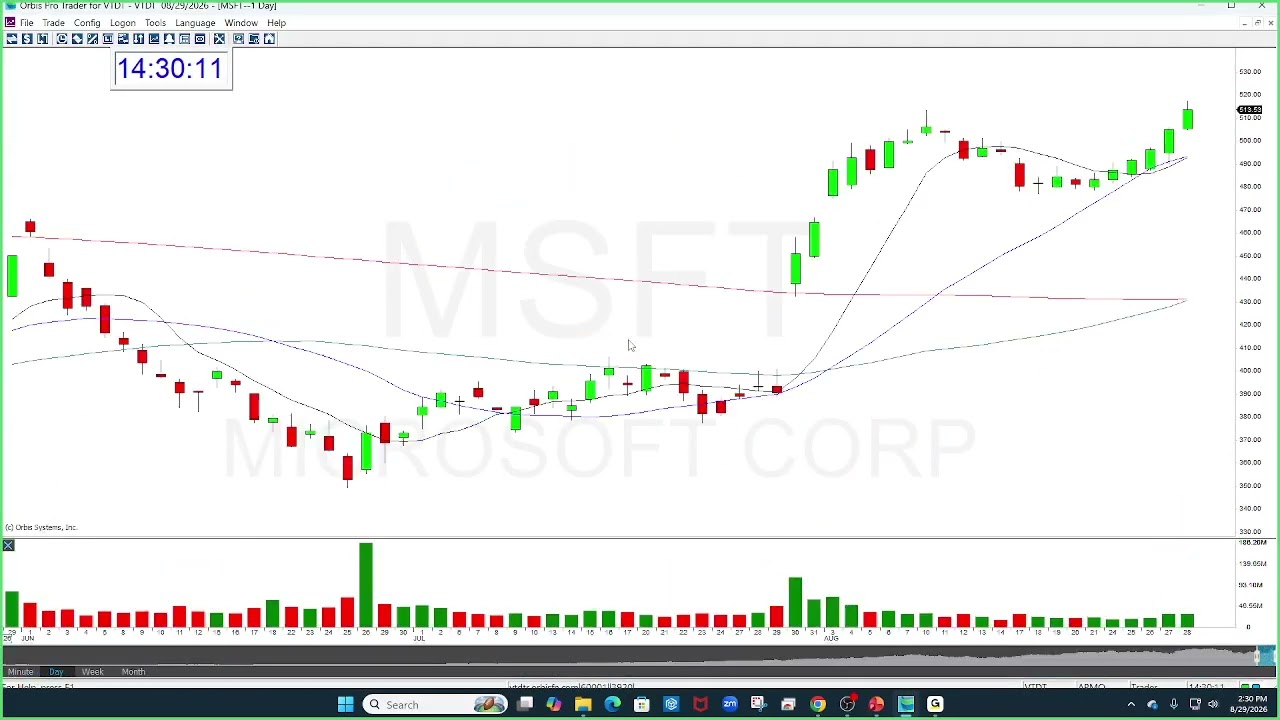
someone's asking about Microsoft. I
don't know if that was a question for
the last guy that was here or me. Um,
I'll give you my thoughts on Microsoft.
I actually think Microsoft is a good
long. So I disagree with the previous
presenter. This is this is a beautiful
show of strength. This is this is a good
long here. You know, assuming the market
doesn't fall. If the market falls and
fails and falls like it did Friday and
continues lower, nothing will survive
and nothing will hang on. But barring
that, if that doesn't happen, Microsoft
actually is a great long here. This is a
beautiful trade. You could have gone
long at all last week. So this is an
example actually of multiple
professional gaps that are made and it's
where the stock has made a turnaround
and is getting bought with institutional
money. Remember what is institutional
money? Institutional money is money
that's made with big professional
traders, hedge funds, large banks. You
want to be on the side of that money.
Again, you want to be on the side of
that because that's how you're going to
make money trading. You follow me? So I
name my gap rating system the golden gap
because finding gaps are rate high per
my system. It's like finding gold. Okay.
So golden gaps are professional gaps.
They're gaps that have a high odds of
working on the day in the correct
direction of the gap with large momentum
to move. Now I was just talking about
the market. The market gapped up and
failed failed on Friday. That's not a
good sign for the market. Again the
market did not like what uh the new Fed
chairman said on Friday. whether or not
we have any momentum or move in the next
two weeks because we're coming to the
Labor Day holiday. I don't know. We
might have some movement this week um
because we have some data points out
this week, but then we're getting into
the holiday. Labor Day is late this
year. It's the following Monday. But
again, barring that, barring the market,
you know, not falling off the cliff, you
know, there are stocks that you would
want to look at and see, oh, are these
continuing higher or are they continuing
lower? Okay, so again, how did I know
how to do DKS or even the crap or the
Marll. I understood what to do. I looked
at the gap. I went through my system.
Again, it's a checklist. It's something
that I teach and you can learn. It's not
something just arbitrary. It's something
I do and it helps me make a decision to
take the trade and put my own money at
risk. You know, a lot of people don't
know what to do and then they have a
hard time taking risks. Then people go
into fear. They're afraid to take risks,
but that's the only way you can make
money in the market. So, it's very,
very, very important to actually have
what I call 100% conviction that you
want to do it. Meaning that it's crazy
if you don't because you actually could
make money doing it. You know what I
mean? There was another one we were
doing. Now, we've backed off this. This
is a watch for this week. If it falls
through, I did not do this Friday. Let's
try to have a little bit of a rally
Friday. This is CVX. has been doing
Chevron. Oil has been running up the
majority of this year because of the
conflict with the Iran war. So, we did
the 195 calls. It expired on the 14th.
We did this back on the 10th. This was a
nice chart. So, here was the gap right
here. Stock closed here, gapped up
again. We're talking about momentum. In
this case here, the stocks getting
bought.
So, you'd want to be long it. Okay.
People were buying this and it worked.
So, this was really cheap. $135 sold at
350 made 159% I'm I've been trading like
I said for almost 20 years so I risk an
advanced risk so 9450 risk made 15,50
what if you risked a smaller amount
could have risked 1350 10 contracts you
could have risked five could have taken
one risk $135 the point is you would
have made money okay you would have
turned over your profit got in and out
date two so again if I do an option I'm
looking for the momentum I'm not
necessarily holding it till the last day
of expiration ation. Any questions about
that or anything I just said here?
Okay. So, how do I choose what to do
each day? I go through a checklist.
That's how I stay consistent. I'm also
consistent with my risk. So, I'm not
risking $1,000 on one trade, 5,000 on
another, 3,000 another. Your results
will be all over the place. Then you
could take, you know, two good trades,
have one winner and one loser, and one
the winner could be a huge winner. You
could be upside down if you risk too
much or the risk wasn't equal in the
loser one. So, you have to pick an
amount of risk you're you're okay with
that you feel confident you could risk
and you can continue to take multiple
trades throughout the week and that you
don't be afraid and you don't want to
kill it and you got to give trades a
chance to work. So, when I started out
trading, I wanted to trade full-time
because I was doing mortgages. I wanted
a new job, a new career, and then I
threw myself into trading, but at that
time, I didn't know what to do. It took
me about three years to figure it all
out. But I have people with me. Some are
full-time, some are retired, some are
part-time traders. Everybody's a
different story in a different phase of
life um in a different age group. So,
whatever works for you, but like I said,
I only trade in the morning for the day
trades. And the options, the newsletter
that I have, they go to your email
directly.
So, the consistency factor, like I've
been talking about, it's looking for the
same thing over and over and over and
over and over again, but in different
charts. And again, the rating system has
to be there where it gets the point
number. That's the only reason to do it.
Otherwise, it may reverse or it may not
work at all or it may not move. Okay?
The only way you can make money in
something is if it moves. You know, it's
going to be hard if you're just
scalping, scalping, scalping because
you'll make 10 cents and you'll lose 50
cents and you'll be upside down. So, I
don't scalp. I'm really looking for a
good move of a dollar or more in every
single trade I take or one to one. Okay,
any questions here so far?
Okay,
anyways,
getting back to what I was saying, you
need the right tools to be successful
and you need good results. What do I
mean? I mean, you have to have more
winners than losers. Sometimes you'll
have a big winner, but that's not
necessarily something that you can
always plan. You just flat out need more
winners than losers or you're not going
to make it and you'll get frustrated.
And again, your confidence level will
take a toll, too. And then you'll tend
to make bad choices. That's where people
get in the fear mode and then they get
greedy. You know what I mean? So,
anything that can put the odds in your
favor to trade will give you an edge.
The 26 point golden gap rating system
gives you an edge. It reads the price of
the gap and using technical analysis on
an advanced level pin points which stop
to trade that day and in what direction.
The high probability is in the quality
and detail in the rating system. Again,
26 points is an enormous amount of
detail. It takes about 5 to 10 minutes
to rate one gap if you're new. It takes
less than five minutes once you become
experienced with the system. So, this is
what I do every day. I get up and rate
the gap. Go through the points and rate
it. If it rates 20 points or more, then
I'll take it in the direction of the
gap. Again, if it doesn't, then I don't
do it. So, if I don't get any good gaps,
then I don't trade anything that day. Or
if I get three, I could do all three.
But I'm usually looking for the best
best possible pick that I can find each
day. And that's what I like to focus on.
And then I then I put on the size. Okay.
So again, it makes it very easy where
you're not, you know, going in and out
of a million different things if you're
only focusing on one thing a day. So the
checklist is what tells me what to look
for in the stock that it's going to move
in the direction of the gap and it's
going to have the big momentum that I
want that I could take whether I want to
take small size or whether I want to
take big bank size that it'll be
worthwhile to take the trade. Now, I
started talking about this earlier where
I was saying I prefer to short. Why?
Because stocks fall faster than they
rally. Like I said, the market fell on
Friday. So, I don't know where we go on
Monday. We'll see. You know, again,
we're getting into a week here right
before the holiday, but the market kind
of panicked a little bit on Friday with
the new Fed share statements. So, things
like to fall very quick when they're
going to, whereas there really isn't
There is panic buying, but it's very
it's so rare that you almost never see
it. In fact, I can't think of anything
really off the top of my head that I
could say was the last time I saw panic
buying. I've seen it before in stocks
over the 20 years I've traded, but it's
rare. That's almost like an emergency
where everybody wants to rush in, rush
in, rush in, and it's so rare that you
almost never see it. And you really
don't even see it that often with the
market. Whereas if people are in stocks
and something happens again, it could be
a war or could be a plane crash or could
be earnings whatever and then there's an
emergency the stock can sell off and it
can sell off very very quickly and that
creates the panic. Okay. So I like to
trade and get in and out of trades fast
and because stocks fall faster than they
rally I like to short. I've also, you
know, found over the years a lot of
traders don't know how to short or
they're not very good at shorting, are
they? They prefer to go long. Again, I
don't know why. I honestly don't know
why. I guess it's just the nature of
human nature. People like the idea of
buying low and selling high. But
actually, you're better off and you'll
make more money trading if you trade
with momentum. Do you know what I'm
saying? So, here was a short we did. We
did Meta. We did the 575 puts. This was
back on 17th. And we did the expiration
date. the 21st. So, let's go over this
one here. 17th was here. Oh, this was
the day we did the day trade. So, we
also did a put stock closed here, gap
down, open, fell, closed here, gap down,
fell off a cliff. Boom. So, again, see
where it was. Here's where it opened,
dropped, dropped, boom, and came all the
way down here to 540. So, this fell
beautifully just within two days. Again,
if you didn't want to do the day trade
that I talked about because you were
like, "Oh my god, that's too expensive."
Or whatever, you could bought a put
which I don't think these were expensive
though honestly but we did it away from
the strike here because I did the 575s
open at 590 cost was 625 sold at $31.
This is a huge trade huge in and out day
number two you're out returned
investment was 396%. You only need a
couple of these. You know you only need
a couple of these a week.
If you did two you would have made
$4950. This is also a good way for
people to try to grow their small
accounts. Lots of times people are in
trades or in other accounts and they
want to try to grow them, grow them,
grow them. Trading, doing overtrading
isn't going to help you grow your
account. If anything, you should be
super duper extra careful with trades
that you're taking. If you have a small
account, you should really be picking.
But, you know, again, because you want
to grow it. If you have a $5,000
account, you're trying to grow it to 10.
If you have 10, you're trying to go up
to 15 and then 20 and so on and so
forth. So anyways, how do I determine
what the smart money is doing? I use my
tools. It's my rating system. And again,
it's based on techn technical analysis
in the gap. So I find gaps and rate them
using this checklist. The checklist
tells you what to look for in the price
of the stock. Who is in control? The
bulls or the bears? Okay. If the bulls
are in control, you want to be long. the
bears are in control. You want to be
short, okay? That's the only way to make
money. So really, training on the side
of institutional money is how you're
going to find momentum, how you're going
to get the big move, and then you're
going to get the direction right too
where you're not going to get run over
because again, you're trying to win. You
don't want to lose, which means you
don't want to be against institutional
money. See what I'm saying? Now, again,
with the new Fed chair,
meeting in a couple of weeks and a lot
of people think that they're not going
to raise rates. The market clearly
thinks that after the last several
months, but I'm not so sure. So again,
if you're someone that wants to trade
news or fundamentals, that's great if it
matches up with the technicals, but I'm
watching the technicals. Okay? So I look
at charts. I'm trading based on
technical analysis, but it's technical
analysis in the gap. But that's how I'm
reading who's going long, who's
shorting, and what's really happening.
What's the underlying uh momentum in
that stock per set. A lot of people
again want to trade the news. Like for
example, everything that's happening
with the war, people think it's over. I
don't think that's over. I don't think
it's over at all. I think it could even
go into next year into 2027 now at this
point. So, I mean, again, if the
technicals and the fundamentals match
up, fine. But what if they don't? You
got to go with the technicals. You got
to go with the price. You got to go with
what you've seen right in the chart
that's live. So, the rating system that
I use as a tool, and I use this each
morning to determine what stock to trade
and when. It's a very useful tool in any
market, but particularly in this type of
market. Um, it also can help you decide
if you should exit alone. Okay? It is a
very useful tool. It takes the guesswork
out of your trading. Again, that's what
you want to do. You don't want to be
worrying about what should I do? Should
I do this? Should I do that? You know
what I mean? You're going to be all over
the place. Um, Anthony, are you there?
Did I lose my screen? Did something
happen? I just saw my screen went to a
little dot. Are you there, Anthony?
Can anybody Everybody see my screen? It
looks like it just got smaller for some
reason.
Anthony must be gone.
Brian, can you see it? Okay,
that was weird. Anyways, getting back to
what I was saying, in order to become
successful in the market, you really
have to have a specialty. So, I got into
shorting. I got into gaps and I got into
reading institutional money or what I
call power money in the market. This
brings momentum and opportunity because
again all these ones I was showing you
here was opportunity. Whether you went
long in the crown um or again whether
you did something and you shorted the
Marll like we did there was opportunity
there to the downside. Again, got to get
the entry right, got to get in right,
got to get out right. you're always
always always looking to something to do
it where you have to be with whoever is
pushing the stock's direction. So
sometimes the stock's direction is going
up, sometimes it's going down. Again, I
prefer to short, but I will go long.
Like I told you, I did the I did the
crowd long.
So, you know, you're here today. I
listen to lots of people since this
morning. If you've been here all day, I
I want to say, you know, that train
education is very important. I took one
class and from that class when I first
started out 20 years ago, I learned the
basics of technical analysis. I learned
I learned a bunch of stuff though that
really I didn't learn how to make money,
but I knew that I could with technical
analysis. I think every class you take,
you take something away from it. It may
not be enough for you to make money, but
you have to take away what you can from
each thing that you do. I think what
happens is people have high expectations
sometimes with certain classes that they
take, especially for the for the price
that they're paying if it's something
cheap. You have to be realistic when you
decide you want to do this. There's two
ways to go about it. You can go about it
the same way I did. I took my own money.
I developed my own system. It took me
three years and it cost me a lot of
money to get to where I am today. Or you
can pay someone to learn from them. And
that may involve a series of classes
because you may not necessarily pick the
very first class you ever take and learn
how to trade. And for many people, it's
just not that's not their program. They
take one and they don't learn anything
or then they have to take another one or
they find something else. And it's a
journey. It's a journey. But I will say
that trading education is important and
having a mentor is important to call the
trades like I called the trades I'm
talking about live in the room. Far too
often, I think traders just don't
understand exactly how important
education is. And the fact is, it's okay
to ask for help. If you need help and
you don't know and you're not doing
well, you're losing, it's okay to admit
that what you're doing isn't working.
Because the sooner you come to terms
with reality, if you're losing money,
that you don't know what you're doing,
and that you need help, guess what? The
faster you can turn it around. And you
can turn things around very quickly.
very quickly you get on the right path
and you're making money Monday, Tuesday,
Wednesday, Thursday, Friday. Even having
one week or two weeks or one month of
substantial gains really will change
your attitude will change your account
because your account's going to look
bigger and then you'll be like, "Oh my
god, I can really do this." You know,
for a lot of people, it's a it's an
attitude adjustment, too. So, again,
it's about the focus. I can't stress
enough that you can trade with a small
account. It does it's not about risking
a lot. It's not about gambling. It's
It's not about trading all day. It's
about focus and consistency. So, you
have to be very practical and
professional when you do this and take
it seriously. You can't just say, "Oh,
I'm going to take this trade and kill it
with a small loss and then jump into
something else." That would drive me
nuts. When I take something, I'm in it
to win it and I put in the stop. So,
again, let's talk a little bit about
more what gaps are. So, my winning
strategy is called Golden Gap, but what
is a gap? A stop gap in the opening
price today is different than the
closing price of yesterday's trading. A
gap is a break in price action from one
day to the next. Simple. So again, here
was a bullish gap we did when we went
long CVX rally. You could have shorted
this in the last week. We didn't do
this, but you could have. So that close
here, gap down, open, fell again. Oil
fell in the last two weeks.
We did some longs in here though. That
did work. But this was a bearish gap.
Talked about this already. DKS, this gap
down, fell. Boom. That was a big one.
So, we determine who is in control first
and then I decide, do I want to do an
option in it? Do I want to do a day
trade in it? Do I want to do both? But
it's all about getting the direction
right? Because if you don't get the
direction right, you're going to lose.
Again, this was such a big move to the
downside for Meta. Now, this pushed back
and then they settled that lawsuit that
was this week and then it gapped up and
fell. But this was a beautiful,
beautiful sell-off here. You know, these
stocks that we're doing, these are big
moves, huge moves. So, what is a golden
gap? It's a gap that rates 20 points or
more per the Golden Gap 26 point rating
system. You take the trade in the
direction of the gap. You do the trade
as a day trade or an option. So, I'm
preparing what I want to do and make my
decisions way before the open. I go
through the checklist. I might write 30
things or 20 things or 15 things.
Depends how busy we are. Earning season
is the busiest time. Like I said, fall
is going to be a very busy season and
earning season starts again at the fall.
We're at the end of earning season now.
Marll was earnings, but this is a tail
end of earning season. But I get gaps
every day. I can have news gaps, I can
have sector gaps, I can gaps for the
market. So again, I go through, see the
gap, rate it, and then determine is
institutional money going to continue
this stock in the direction of the gap.
If it is, I'm saying, okay, if it rates
20 points or more, it's going to have a
lot of momentum. It's going to go and
it's going to be profitable. Therefore,
I'd want to do a put if it's gapping
down or I want to short it as a day
trade. But seeing this institutional
money, seeing what it looks like is the
benefit. Okay, that's how you win big on
the side of power. I find that most
people just don't, again, don't
understand how important that is. It
sounds very, you know, trading 101 that
you got to get the direction right, but
honestly, it really is that simple.
You've got to get the direction right in
the trade. You've got to be on the right
side of power. If you're not, you're
going to lose more than you win. If you
are, you're going to win more than you
lose. It's really is that simple. So, a
lot of people, unfortunately, they'll
just don't know how to read the the
power. And and like I said, too many
people are all over the place. So, I
like gaps because they help me pick the
direction, get a good move, and then
whether you have a small size or a big
size or do as a day trade an option, you
can win. So, for me, it's all about the
checklist. Again, this also helps me
stay organized. A lot of people trade,
they're all over the place. They're not
organized. You want to be organized. So
the rating system helps me determine who
is in control. And and then I narrow it
down and say, "I'm going to do this
trade today. I'm going to do that trade
today. I'm going to do one. I'm going to
do two. I'm going to do an option."
Whatever. Again, I'm always looking for
the bears or the bulls. One of the
reasons people are confused right now
about the market, you could say the
market's in a range. The market's in an
uptrend. I'm talking about the QQQs, but
it has not made a brand new alltime high
yet. Again, the gap up Friday that found
and fell was not a good sign for the
market. You know, barring the fact that
we're going into the holiday period,
which is tough to trade around the
holidays because it's usually low
volume. You know, it wasn't a good sign
that the market did that. So, people are
confused. If you're someone that trades
futures, you're getting smacked around
in the last several weeks. Actually,
again, the QQQs have not made brand new
alltime highs. So, I mean, again, I
might trade the market sometimes, but I
trade specific stocks usually on most
days. So, I'm looking for a big flow of
money that's going in a certain
direction. That's how I make the
decision that I want to do it. And don't
forget, institutional money is in charge
of the market and stocks at all times.
And I'm looking for the quality. Now,
when I'm in the room, I call the trades
live in the room. If you join and you're
in the room, I call the trade. I set the
entry, the exit, the stop, and we take
the trade and I say where I'm getting
out and you can take the trade with me.
But, you know, I don't think it's hard
to follow me in the room. I'm only
usually doing one trade a day, maybe
two. It's really about trying to get
done fast and make the money as quick as
we can in the morning and then I have
the rest of the day to myself. So, the
gaps again happen in the morning. You
can have lots of gaps on any given day,
but not all gaps are good. We're looking
for gaps that really are important. They
signify a change of direction or a
bigger move in the same direction. So,
you've got to understand which gaps are
meaningful and which gaps are not
meaningful in the market. like we had
the gap up on Friday. I didn't go long
the market. I didn't think it was going
to follow through. I turned out being
right. I didn't short the market though
Friday. Why? Because we gapped up. So, I
did not short it, but I didn't think it
would follow through long. So, I didn't
get caught in a long or I'm sure a lot
of people did because we did gap up and
we started to rally, but then we failed.
When I heard the Fed statements in the
morning, I thought I thought to me my my
interpretation was that they're going to
raise rates. That's that's was my
interpretation and that's what I thought
despite the data that we had the last
two weeks. People kept saying, "No,
they're not going to raise rates."
Again, for sure, for sure, for sure. If
anything happens in September where they
raise rates, the market's going to react
because there's it's built into the
market right now that there will be no
rate uh uh raise in rates at all in
September. That is where the market's
at. People are certain of that. I
disagree. You know what I mean? I could
be wrong, but again, I'm not long or
short the market right now either way to
see. But power money is in the market in
a big way right now. Why? because I
don't think the Fed's going to raise
rates and people also think the war is
over too and I don't think that's true
either, you know.
Um, so again going back to what I was
saying, why is shorting the way to go
for fast profits? Because of panic. And
so think about it. It really and and you
think about it and be intellectual about
it. You're like, okay, this totally
totally makes sense. I want to be long
if institutional money is buying it. I
want to short if institutional money is
selling it. So, how do you make money?
You make money in the market. Get
organized. Say, "I'm going to do this
many trades a week. I'm going to do
options. I'm going to do day trades."
You need a structure in place in order
to make any money at all consistently.
It's about the consistency that many
traders lack in their system. Someone's
asking about my win rate. My room rates
around 70%. So, for every 10 trades you
take with me, bigger seven are going to
win and three are going to lose. And
that's a that's a winning system. And
then again, Many of the ones that win
are more than 100%. So, it covers the
losses and you're still ahead. If anyone
tells you of 100% or 95% or anything
like that, I'm telling you right now,
that's not realistic. There's things
that happen in trades sometimes it's out
of your control where you're going to
lose. So, prepare yourself for that. But
you still have to have more winners and
losers. That there that is hands down.
But really, if you had a 51% win ratio,
you'd be profitable. you'd be profitable
if you size your trades consistently. I
mean, I have a higher win ratio than
that, but that's the truth. Again, a lot
of people don't size their trades right.
They'll risk $500 on one trade and 2,000
another trade. It'll kill a trade or,
you know what I mean? People just do all
kinds of crazy things, which they should
not do. So, that was a good question
though. So, I'm looking to measure gaps
that have a high probability of
directional bias for the entire day. Big
move and an early setup in the morning
and again create a money manage a, you
know, plan for yourself. Say, "I'm going
to make $1,000 this week, then I'm going
to make $2,000 next week." I mean, you
got to you got to sit down and act like
this is your business and be serious
about it. Again, a lot of people are not
serious about their trading. I was very
serious about it even when I started day
one because I wanted to do it as a
career. You know, I didn't know it was
going to take me as long as it did to
figure out what I was doing. I thought I
could figure it out in six months. I
figured I'm pretty smart. I could figure
this out in six months. Well, it took me
three years. So, I mean, the markets the
market's a beast when you're going after
you're trying to figure things out. But
now that I know how to do it, trading is
easy for me. Doesn't mean I don't have
some days that are hard. Yes, some days
are hard. But trading itself over the
year, week over week, day over day is
for the most part easy for me. So, it's
experience and me doing this now for 20
years. So, if you're in a tough spot and
you're feeling like the market is just,
you know, gut-wrenching for you right
now, but you don't want to quit, know
that it'll get easier once you get into
a system and start to make money. It's
just for anybody that goes through this.
So, the journey is different for
everyone. Nobody starts out and starts
training and starts making money right
out of the g the gate. That's
impossible. But you got to get realistic
about what it takes to do it. The money,
the time, and learning something good,
you know? So, anyways, I go through the
checklist and And I think learning is
important because it helps people get
conviction. You got conviction. You want
to understand why. It's going to help
you take the trade. It's going to help
you hold it. It's going to help you be
aggressive. So, it's great to have
dreams. I had dreams that I wanted to
train. You have to be realistic and
grounded so you can attain them. It's
like anyone that wanted to become an
athlete. The US Open is uh in New York
right now, Queens. I'm not going, but
it's going on right now. uh you know
people just don't become tennis stars
you know without practicing practicing
practicing practicing you know the
people that got there that are playing
at the US Open took a lot of money and a
lot of work and a lot of time that's how
it is you know
so we're getting into the end of the
year I can't believe it um and I'm
getting ready for a big end of 2026
going enjoy Labor Day weekend picnics
the end of the summer but think about
what I said today you got to empower
yourself to do well in trade. My class
is a complete system where I learn the
end where I'll teach you how you can
figure out the entries and the exits and
you will learn the 26 points which is my
system and again the class is called the
golden gap course. It's a full course in
how to strategically find pick and place
stocks that aren't professional bearish
gaps. The class is not for a month.
September, uh, it's the end of the
month. September 26th and 27th, 9 to5.
Class tuition is $69.99. Classes online.
You can be anywhere in the world and
take it. And I'm doing a huge Labor Day
special, which is going on through Labor
Day, which is late this year. It's
September 7th for the bundle, which is
all three classes, the Golden Gap, the
options class, and the trends class. And
if you sign up for the bundle which is
$89.99 you will get all these classes
are September in the end of September
beginning of October you will get the
trading free to the end of next year end
of 2027 options newsletter and mark
report free to the end of 2027 and two
1-hour mentoring sessions with me and
again this is with the bundle package.
This is the Labor Day special which ends
on September 7th.
Um Anthony put my email in there. Any
questions from anyone?
It's been a very good year. Things have
been going very, very well. You have to
be focused. We had a good week this
week. Even though there wasn't that much
to do, I narrowed it down to pick the
right things. But that is how it is all
the time. You have to pick the right
things. Again, go back and look at the
crowd that I showed you. You know, 100
shares when that ran all the way up.
stocks that run 20 30 points in one day.
You don't need to have a huge size. If
you could afford to, you can, but
there's real money to be made in the
market if you're looking and following
on the side of institutional money.
Otherwise, you're getting chopped up to
bits and pieces. And again, for the life
of me, I'll never never know why people
want to trade futures. I don't know the
leverage in it, the cost to do it. I
don't know. People think it's cheap, but
the market has had no good trades the
last few days in it and the last week in
it. It's been ridiculously
just going nowhere. So, the reason that
I like to trade stocks is because
there's so many stocks out there and
there's so many things to pick from.
Chances are I'm going to find a good
one. You know, at least one good one a
day and that's all I need.
I think I ended on time here for the
next person. Any questions here?
Melissa, thank you for being here today.
You're always so great at this.
>> Oh, thanks Anthony. Thanks for having
me.
>> Yeah,
that was a very interesting look at
using gaps in volume to identify where
institutional participation may be
creating opportunities. Uh we appreciate
the valuable insight.