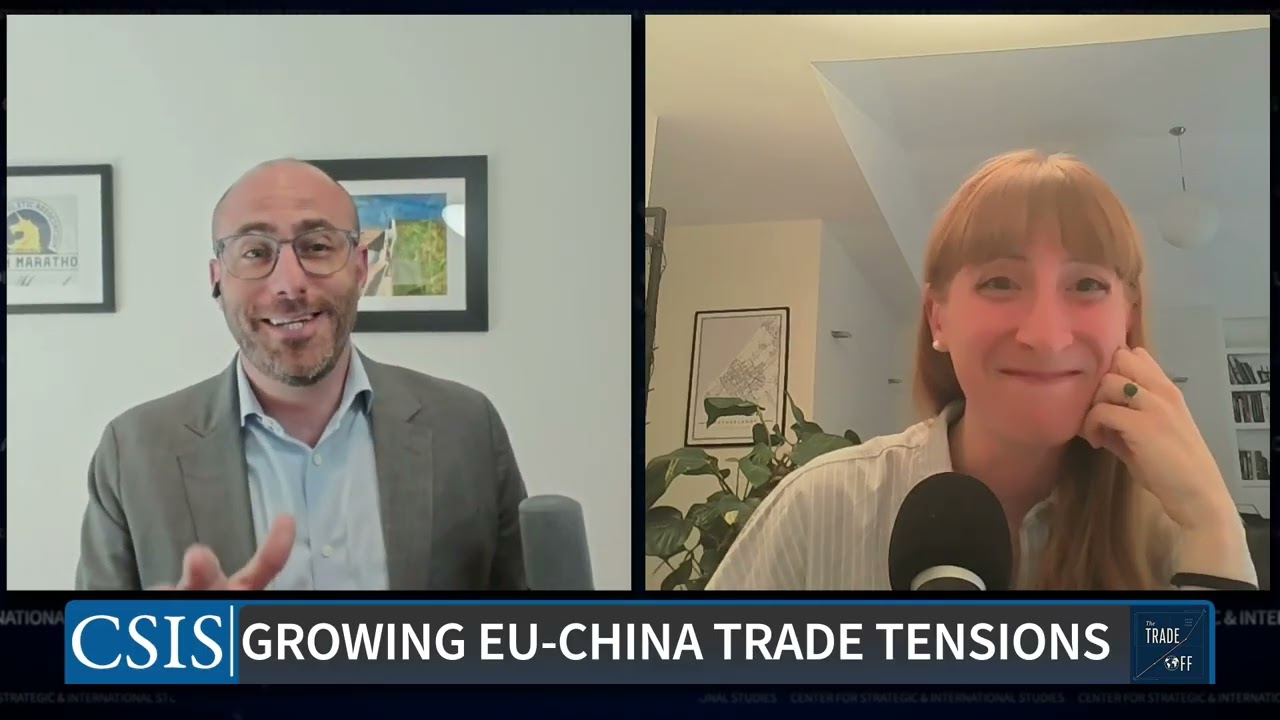
Trade Deficits and Growing EU-China Tensions | The Trade off
Watch on YouTubeVideo summary
The European Union recently recorded a significant goods deficit with China of approximately 360 billion euros last year, reflecting growing trade tensions between the two powers. While earlier discussions about a "China shock" were sometimes misunderstood as solely driven by simple import growth or deficits, current analysis points to a more complex issue known as production substitution. Experts argue that the core grievance lies in China's unfair economic practices, specifically illegal subsidies and currency devaluation, which are causing European manufacturers to lose market share globally. Research suggests that only about one-third of this loss is directly attributable to Chinese competition; the remaining two-thirds stem from internal structural weaknesses within the EU economy that require independent reform rather than just trade protectionism.
In response to these challenges, there has been a notable shift in Brussels since 2023 toward recognizing both unfair external practices and critical supply chain dependencies as security issues. This evolution is evident in new policy frameworks like the Industrial Accelerator Act, designed to boost local investments and positive economic spillovers, alongside emerging proposals for diversification instruments that would force companies to maintain multiple suppliers or face tariffs. However, a significant tension remains between EU-level initiatives and national interests; while Brussels pushes for collective action on dependencies such as rare earths and semiconductors, member states like those in France and the Netherlands often prioritize safeguarding their own specific country interests before fully aligning with broader Union strategies.
The urgency of these debates was highlighted by recent events involving Nexperia, a Dutch semiconductor company where investment screening mechanisms were used to force divestiture from Chinese ownership after an acquisition completed years prior when no such laws existed in the Netherlands. This incident exposed Europe's vulnerability regarding critical supply chains for the automotive sector and demonstrated China's ability to respond quickly and assertively to Western restrictions. Furthermore, experts note that while the EU possesses economic levers like market access, its deterrents lack credibility because policymakers are hesitant to impose immediate costs due to political constraints in a democratic system with constant election cycles. Additionally, Europe faces an inherent disadvantage in timing; demand-side measures taken by the EU take longer to inflict pain on China compared to supply-side restrictions imposed by export-led economies, giving adversaries time to adapt before European actions fully materialize.
Looking ahead, the focus is shifting toward addressing vulnerabilities related to smart connected systems and artificial intelligence, where reliance on Chinese technology for everything from cellular modules to software stacks poses new cybersecurity risks. The upcoming State of the Union address in September and subsequent high-level dialogues are expected to reveal whether the EU will adopt a suite of instruments including anti-coercion tools or simply continue delaying strong action. As geopolitical friction increases with entities like China seeking full control over their technology stack, Europe must navigate a difficult path between maintaining competitiveness through green technologies while ensuring security against data theft and hacking risks without completely severing economic ties that are vital for both sides.
Read the full video transcript
Today on the trade off, the EU ran a
goods deficit with China of about 360
billion euros last year, about a billion
euros a day. Now trade tensions are
rising between the Union and China. That
and more today on the trade off.
>> [music]
>> I'm Philip Le director of the economics
program here at CSIS and today I'm very
pleased to be joined by our guest
Francesca Ghiretti,
uh the director of the economic security
and resilience initiative and senior and
newly minted senior associate
non-resident here at the economics
program.
Um she works at Rand, she's worked at uh
Merics in the past. Her PhD is from
King's College in London. She's an
excellent colleague and one of the best
voices on economic security, Europe,
China, and the rest. Uh Francesca,
welcome. Thanks for having us or thanks
for being here.
>> Thank you Phil. Thank you for having me.
>> Excellent. Uh well, as I was saying,
it's uh things are heating up and it's
not just uh the temperature there in
Europe. Um
uh there's a lot of discussion these
days around sort of a China shock 2.0.
Um
you know, let's put aside the fact that
I think the first shock was a little
misinterpreted and misunderstood, but
the second shock does appear to be
relatively real and I feel like the
narrative around this shock is really
taking hold in Europe. Um what are you
seeing in Europe today? How have moods
changed? What are people thinking about
trade with China today?
>> I think a lot of the um grievances that
have been boiling for a few years across
Europe are really coming to some sort of
uh um
some sort of synthesis, right? So, when
we think about China shock 2.0 and
obviously we're seeing quite a few
papers arguing that this is happening,
others arguing that this is not
happening. So, I would say, you know,
the debate is kind of the same that it
was in terms of the China shock 1.0.
But, what is really at the bottom of it
is
an a grievance around China's unfair
economic practices. And we're talking
about specifically two elements. One is
the unfair and illegal subsidization of
specific sectors, and the other one is
the devaluation of the RMB. And
basically, how these are contributing to
the EU loss of manufacturing
and of market share in third countries.
So, basically, the core issue is really
the production substitution. Not as much
deficit per se, not as much just the
simple
growth in import from China to the
European Union, but this production
substitution that is happening. And
there have been really good good papers
looking into these. One is from Brad
Setser and Sandra who have looked
specifically at Germany, the heart of
the manufacturing production in Europe.
But, also you have a number of papers,
for example, from the Kiel Institute who
argue that when it comes to exports, at
the end of the day, really only 1/3 of
the loss of global market shares that
the EU is seeing in its products are to
be attributed to the China shock or
China
production substitution. The rest of the
2/3 are more of internal issues that the
EU needs to solve for itself.
>> So, that's really fascinating. So, I
mean, I I think
you know, obviously, Europe often sort
of looks inward when they sort of see
challenges and they think about sort of
the ways in which they need to reform.
Are you seeing more energy put into
actually actualizing those reforms? I
feel like one challenge there is it's
always like, well, yes, so here's the
problems and then you kind of talk about
the problems for a while and then kind
of nothing gets done. Like, are we
seeing more momentum there or is this
kind of the same old story?
>> Depends what we mean by Europe and here
is going to be a sort of the the
underlying
tension throughout this podcast this web
webcast and throughout the whole debates
that have to do with Europe. I think
since 2023 we've seen tremendous
momentum in Brussels not only in the
recognition of the China challenge
itself and the actions around how to try
to tackle this China challenge but also
in terms of recognizing that there are
some structural issues that the European
Union itself is facing. You know, if we
think about the letter report the Draghi
report they were all meant to diagnose
what was going wrong propose something
new and Institute Montaigne has just
recently published a very interesting
report in which they're assessing that
at the end of the day step forwards have
been made when it comes to the Draghi
report.
So there's been a lot of momentum in in
the European Union in Brussels
specifically and maybe we can talk about
some of these measures
in the course of the webcast one of
these is the industrial accelerator act
which is sort of this industrial policy
that the European Union has to
at the end of the day grow the positive
spillovers of investments in into the
European Union and maybe we can talk
about the new measures that may be
proposed in the autumn in relation to
China specifically.
Now if
>> you go ahead sorry.
>> I was I was going to say this is
Brussels though. This is like my short
comment was going to be this is Brussels
member states have somewhat shifted and
you have seen some seen some shifts in
Paris definitely in in The Hague and
we'll talk about this probably in Berlin
as well but not as significantly so you
do still see a lot of the usual trying
to preserve and safeguard the country
interest before that of the European
Union.
>> Yeah. So, that's
always a tension in European policy. And
you know, I certainly don't
don't begrudge them that. It's an
incredibly hard problem to solve.
So, before we get to The Hague and and
specifically sort of some issues that
that they have been having recently.
This sort of brings us in there. You
know, there's kind of two sides of the
coin on the China challenge. One of
course as you mentioned is
the policies that they see the the the
PRC taking that are harming competition,
therefore harming sort of the industrial
base and other issues. The second, which
I feel like is a newer focus, at least
from my experience from Europe, is the
sort of looking more critically at
dependencies on China, right? So,
whether that be rare earths or
semiconductors
or you know, any net manner of thing,
even chemicals I think are becoming more
of a focus.
How does that fit into this
conversation? And and you know,
obviously, for every country, economic
security or
economic block, economic security is a
sort of new and hard thing to think
about. But for the European Union
specifically, economics and security
being sort of interlinked is is a
challenge given sort of national
competencies versus the EU. So, what's
the conversation there like?
>> Right. So, a lot on the table. I totally
agree with you. You know, sort of the
the more long-term
issues that the EU and China have had
since the early 2000s really, since the
so-called textile war of 2004, 2005,
2006, right? So, very very early on when
people say, you know, that the issue
started in the mid-2010s, yes, but there
were some a lot of things still brewing.
And those had to do with the so-called
lack of level playing field, right? Now,
I'm afraid of using the term so-called
because China has just published a paper
on so-called excess capacity. So, I feel
like I'm also having using the same
term. That's not what I meant. Um so the
lack of a level playing field, unfair
competition, and so on and so forth have
been there for 20 years, right? So, that
is sort of the most traditional issues
that the two have that in theory should
have been solved with a comprehensive
agreement on investment and then
everything that happened around that in
the early 2020s.
Um in terms of the dependencies, this is
likely So, there are two debates that
are important. One is the economic
security argument. So, basically when
those security enter the conversation of
the economic relation between the
European Union and China. So, when it's
not just about imbalances, but it
becomes about an element of security.
And that is with FDI screening in 2016.
And specifically, there's an element of
thinking about the know- Sorry, the
knowledge transfer and how that
knowledge transfer could have military
um applications as well. And that grows
into then the whole debate that we get
until 2023 and the economic security
strategy.
The dependency side really emerges with
COVID-19, right? When there is an
evident case of oh, our supply chains
are heavily dependent on this one single
point of failure. And if things don't go
well, not just because there is a
political intent or a geopolitical
intent, just because something can
happen, then we don't have the supply
that we need. And some of the supplies
are obviously vital.
So, there starts the thinking around
supply chain diversification, production
at home of critical imports, and and all
these sort of things.
This somewhat materializes in a series
of policies from the sort of 2021 to
now, whether it has to do with
semiconductors, whether it has to do
with critical infrastructure, critical
minerals, and so on and so forth.
But we get to a point in 2025,
before that actually, but you know, sort
of 2025 where we realize we do need
something to incentivize or force the
hand of companies to diversify in
critical um areas. So, that is where the
proposal of what could be seen as a
resilience instrument or a
diversification instrument emerges. And
the idea behind it are two, in general.
So, one is to ask companies in relevant
sectors with relevant items to have more
than three, sorry, at least three
um suppliers.
And the other one is, well, we raise the
barriers. So, basically, we impose
tariffs to increase costs so that
companies in the areas of interest, in
the items of interest, are forced then
to um diversify because it becomes too
costly to import from that one single
point of of import. So, dependency
really entered the core of the debate
from the 2020s, but they do develop
throughout those six years until now.
2021, you have the um economic coercion
against Lithuania, obviously, which is
another instance in which, you know, the
European Union realizes, "Oh, it's not
just that we have dependencies, it's
that these dependencies can be
weaponized." Uh 2021 is also the year of
the exchange of sanctions between the
European Union and and China as well.
And so, you have all these developments
also in relation to Russia's invasion of
Ukraine in 2022 and the supply uh
Chinese supply to to to Russia and so on
and so forth.
>> Yeah. So, I think the the situation of
Lithuania, I think is a really great
example, at least from my perspective,
about how much things have changed over
the last few years. Because, you know, I
was in government at the time and and,
you know, it actually took, uh at least
from my perspective, it took us a lot of
time to make sure the European the some
of the bigger countries actually
responded kind of the right way to that.
Cuz some of the initial comments from,
say, like the Germans was not super
productive, right? They sort of laid
this at the feet of the Lithuanians in a
way that, you know, I just don't think
would happen today. So, it is something
that I think is evolved quite a bit.
Um, so thinking a little bit So, I'd be
curious, do you do you have any sense of
like where is are those conversations
going and cuz you start you kind of laid
out two different approaches. One is
sort of a a price mechanism, so a tariff
on concentration. One is, you know, in
my sense sort of
uh uh creating a price through the
administrative burden to industry of
sort of of having these pliers. I mean,
where is that shaking out right now as
far as you can tell and and like do you
have any sense of what strategy the
Europeans might adopt?
>> I mean, to be totally transparent, I do
not have a sense of which of the two
they're going for. Um, if you asked me a
few weeks ago what I I would have said,
well, probably DG Trade also doesn't
have a sense, but by now I think they do
have an idea of where they'd rather go.
Um,
but in the meantime, you also had and
we'll know and, you know, we get to
that, but we'll know probably by the
State of the Union that Ursula von der
Leyen is going to um
is going to deliver on the 16th of
September, right? So, by then we we
should know. Um, that is the case also
because in the meantime, obviously,
three working dialogues have started
between the Europe- Sorry, four working
dialogues have started between the
European Union and China. So, when
uh when Šefčovič, the Commissioner for
DG Trade and Economic Security, and Wang
Wentao, the Minister for Economics from
China, met, four work streams started
between the EU and China to debate
progresses in four areas. Now, I'm not
going to be able to list them. Let's
try. It's trade and investments, IP, WCO
reform, and export controls. Actually, I
was able to do that. Um, and they should
make progress by October. So, basically,
two things happened more or less at the
same
which is at the end of June, mid-June,
the council, the leaders of the European
Union gathered and in theory
there was a rumor that they could have
adopted some serious tariffs
against China. Instead, they mandated DG
Trade to create new instruments
potentially and a solidarity measure,
which, you know, should be launched
again, I think, during the State of the
Union.
And shortly after that, the dialogues
with the Chinese started on these four
work streams. And so, we have this
timeline, which kind of overlaps between
State of the Union, the visits from
Denisa Dones, Sefcovic, the October
deadline, and then obviously at the same
time, the November deadline of the
extension on Sorry, on on the pause for
the export controls on railroads.
>> Yeah, absolutely. And that's something
where I think the the export control
extension, you know, Europe is in kind
of a position of almost being a bit a
bit on the sidelines in terms of sort of
like they're sort of watching what
happens
with high interest as as we all have.
But, it's in a bit of a awkward
situation in that sense, right? As this
is happening at the same time.
Um I'd love to touch really briefly. You
mentioned Nexperia and sort of that
we've mentioned the Dutch bid. I'd love
to just chat about that a little bit.
So, for those who haven't been tracking,
you know, um we've seen an increase in
sort of investment screening mechanisms
that have come up on board. Um Nexperia
was a situation where the investment
screening kind of came after the
investment had happened. So, as a
result, the Dutch government used a law
they would they would we reached way
back in the in the bag and used a law
from 1952 to basically force a
divestiture of a Chinese companies from
or Chinese from from a Dutch
semiconductor company. And that led to
sort of immediate sort of
actions that led to disruptions of um
supply chains, especially for
automakers.
Um
you know, I think this is an area where,
[snorts]
you know, we've had a lot of shocks in
the recent years. This is another shock
to supply chains. Um
do you have a sense of like how how how
big a deal was that? I think it for an
American audience, many just candidly
don't know about it. How big of a deal
was it on on the continent? And how do
you have any sense of like how this
might have changed or how this may
change in the future the way that Europe
handles these issues?
>> It was a huge deal
for three reasons. The first one is that
it was a headache to understand what was
actually happening. [laughter] There's a
lot of things were moving at the same
time. So, we were kind of okay, so what
exactly is happening and what are the
consequences?
The second reason is that it was a case
that
developed very quickly and the
escalation also happened very quickly.
And as Europeans, we weren't necessarily
used to that pace, like fast pace,
right?
>> Yeah.
>> And also in terms of strength and speed
of Chinese response, I think that is
something that we should go back to. And
then the third reason is that it hit at
the core of the dependency / supply
chain issue that we we were talking
about, right? So, these chips are
absolutely fundamental for the
automotive sector, which is at the same
time reason of pride and pain for all
Europeans these days, but also it
brought to the realization that the
automotive sector doesn't really have a
proper plan B, right? So, you know,
either those chips were going to arrive
or production could have stopped.
Um so, these are the three reasons why
it was huge.
Um and I'm going to mention I'm going to
try to walk us through the bit of the
timeline. I have notes down because
[laughter]
But, I'm going to mention one thing that
I find quite interesting. The
acquisition by Wingtech of Nexperia, if
I remember correctly, it happened in
2019. And you correctly highlighted that
in 2019, the Netherlands didn't have an
FDI screening mechanism because their
screening mechanism became active in
2023. But, interestingly enough, 2019 is
the year in which the EU regulation on
FDI screening became active. Um so, you
know, there's always that idea of oh,
the EU is so nagging. They pass so many
regulations. And then member states take
Sometimes they do take their sweet time
before having their version implemented
and passed. But, you know, had the had
the Dutch has had a screening mechanism
in 2019, I I'm not saying we would have
seen something completely different, but
perhaps, you know, it would have been a
different process in terms of scrutiny
and asking for certain requirements
before the acquisition was completed.
Now, maybe now somebody will come back
and they will say, "Oh, but you know,
the screening mechanism from the EU was
active from October 2019 and this
happened before." Yeah, fair enough.
But, you know, I was trying to make a
point.
>> [laughter]
[gasps]
>> No, it's a very good point. Yeah, yeah.
And you know, this I feel like we just
keep finding new tools that we wish we
had slightly earlier. So, you know,
that's
very few of them have not happened yet.
So, speaking of
you know, deterrents and instruments,
you've recently written that Europe
remains extremely weak on economic
deterrents.
I'm curious you wrote that about a year
ago.
What do you sort of diagnose? Is it
still the case or have they built all
the tools they've needed and and shown
their commitment to using them? Um and
to the degree to which they still have a
problem around sort of their ability to
create deterrents, um
what do you assess as what do they need
to do and and do you think they're going
to do it?
>> Right. So,
I agree on the point that the issue is
credibility. So, if we look in terms of
tangible ways in which the EU could
deter actions, especially economic
coercion or, you know, the use of
economic levers to impose costs, there
are so many papers that show that the
EU, if it wants, it does have that lever
and it can
find ways to deter such an actions such
actions.
What we're facing at the moment is not a
lack of means, is clearly a lack of
credibility. And it's not just Beijing,
even in Washington, I'm pretty sure that
people don't believe that the EU would
be willing to impose impose any real
costs because it's not really willing to
pay any of the costs often time imposing
economic restrictions or using economic
levers comes with, right? So, whether it
is Okay, you confirm that, great. So,
whether [laughter] it is is
whether it is because they think simply
that the EU is kind of this
beast from the liberal economic system,
they will try to negotiate until the end
sort of an agreed solution before they
actually act, or whether it is because
people think that, you know, at the end
of the day, even for decisions where you
need qualified majorities and not all
the 27 on board, you still need
political support. Like, you won't be
taking very difficult decisions if you
do not have political support. So,
the convention is that well, the 27 will
never be able to agree on something like
that. Somebody will always emerge and
say, "Well, no, let's try something
different." So, we lack credibility for
that reason. And I don't think that,
again, that particular meeting of the
council in June helped because it gave
once again the impression that the EU
prefers to kick the can down the road
and do something technical rather than
take a rather strong strong action. Now,
why does that in their deterrence? Well,
because you can have the most perfect
measure in the world and you can be the
most you know well placed economically
speaking and economic lever wise country
in the world, but if nobody believes
you're going to you you're going to ever
use any of them, then you're not
deterring
anyone.
And I think that up to a little while
ago the convention was that eventually
the other people were exercising
restraint as well.
Obviously that kind of crumbled when the
second Trump administration
got in
into the White House and with the
tariffs of April 2025, but in relation
to China, I really do think that between
the next period case and the rare earth
export controls, that also create a
situation and awareness of well, maybe
are not exercising restraint anymore.
And and just recently the EU imposed
sanctions in relations to the Russian
invasion of Ukraine is sanction 14
Chinese entities, gave plenty of notice
to China that this was happening,
but China responded sanctioning 14.
Sanctioning, yeah, basically posing on
the export ban list 14
European entities. So this happened
quickly. And what we see is that not in
this particular sanction case, but in
other cases China is willing to
escalate. So sort of the bottom line is
evidence is showing to the Europeans
that whatever type of deterrence they'd
like to be able to do, for example by
adopting the anti-coercion instrument,
other countries don't see that as as
working. They don't see they They see
the European deterrence.
So, I suppose feel the difficult
question is how do you
change this?
>> Yeah.
>> And
I don't know what you think. I would
love to know what you think, but part of
me is you need to show that you are
willing to do this, right? That you are
indeed willing to act.
>> I I totally agree. I mean, I think even
when I was So, I was in the last
administration, we
at the time did not think it'd be very
likely the EU was going to use the
anti-coercion instrument. Um
we thought if they were going to use it,
they're going to use it against us.
But what we were really saying
>> wrong, no kidding. [laughter]
>> Yeah, exactly.
Uh yeah, look,
uh E-EAS and and DG Trade were always
very uh quick to remind us that they
they put it into place because of the
first Trump administration, you know, it
was it was
>> [laughter]
>> so
um
but and I think the the challenge here,
to your point, is the more episodes of
like bonafide coercion the Europeans
experience without using their
anti-coercion instrument, it just every
single time it becomes less and less
credible um because there's ample
opportunity to use it. Um I'd be curious
I mean, there's two things you sort of
hit on there with the one is the
credibility, which I think at some point
you just got to use it or just admit
that you're never going to use it.
Um
the other is sort of the thing you've
hit on twice, which is sort of speed.
Like the speed which with China responds
and you know, maybe Europe I don't think
anyone's really necessarily set up to to
respond that quickly in the sort of
democratic system. Um but maybe Europe
is sort of uniquely poorly set up to to
respond quickly. Um
say a little bit more about sort of like
the the the speed of gameplay here and
how you how you think Europe might be
behind.
>> What I've been So, for a while I've been
thinking about timing, right? Which
seems to be something when we think
about strategies or statecraft. For a
long time, we've sort of forgotten about
timing as one of the elements that are
fundamental to winning a contest or a
conflict or something like that, right?
And it may be because, you know, lately
I'm exposed to a few colleagues who've
been doing defense, like hardcore
defense, and so they're a little bit
more aware of these things than than I
am.
Uh but I've been thinking about timing,
and I think that it's not as much the
fact that the speed of response, so it's
not as much how quickly
if China hits the EU adopts something as
quickly, I think it is really the timing
that something takes in order to impose
pain on the on the adversary or on on
the subject that is being hit, right?
And China has a major advantage, which
is they are an export-led
type of economy, which means in this
particular case, that they supply other
countries with a lot of very important
and critical things. Upstream, rare
earth, and critical minerals are one
example, right? So, if they cut off that
supply, we've already seen that the pain
can be felt relatively quickly. Right?
Which means that very quickly you will
have
companies and individuals feeling the
impact of this restriction. Now, the
European Union is a really great market
with a fantastic consumers, and we know
that, for example, a company like China
Sorry, a country like China needs um
economies and uh markets such as that of
the European Union. So, were the
European Union indeed close its market,
eventually it would impose quite a bit
of pain on China. But that eventually is
the problem. The pain wouldn't be as
quickly felt as it has been for the
supply-driven type of restrictions. So,
demand-driven type of restrictions take
a longer time to impose that pain, and
in the meantime, you are in an
escalation ladder, right? So, you are
very likely to feel the pain yourself.
And I think this awareness is becoming
much, much more real in in the European
Union of the fact that we can impose
pain,
but that pain will take a long time to
bring the desired effects.
And in terms of just one more thing
about speed, I think that Yeah.
In the case of an Xperia, for sure,
there was a lot of surprise that the
Chinese were able to respond so quickly,
and they they were able and willing to
respond so quickly and so assertively,
and we're seeing that being the case
more and more in in most recent cases as
well.
>> That's fascinating. I think that's a
real it maps well onto I think the sort
of change in China's approach between
the first and second Trump
administration, too. I mean, I think
they're, you know, obviously the
escalation was much smaller, but, you
know, that at the time, the 301 in China
was a really big deal, and they didn't
like it. Um, but their response was
shutting off the Chinese market to US
agriculture, right? And I think that,
you know, by all accounts, they were
sort of surprised how little impact that
had, and to your point, it was it was a
demand channel, right? Yes, farmers in
the US weren't happy, but we were able
to subsidize a little bit, and it and it
didn't have sort of that immediate pain
point. Whereas this time, you had
executives from our the big three
automakers saying, "Lines will shut down
within a few weeks unless you do
something, right?" And so, that's a to
your point, it's a very different sort
of calculus of pain. And the one thing I
also want to add really quickly, it's
just to get your thoughts on was that,
you know, this is kind of the irony of
having a
a responsive government in sort of a
democratic society that, you know, one
reason Europe might be less willing to
take pain is because
there's elections.
Like where where as policy makers are
responsive to their to their people in a
way that like obviously I wouldn't want
it any other way, but it makes economic
statecraft a little bit more challenging
than in other societies.
>> I would argue is perhaps worse than that
because it's not even the normal
election cycle where in theory you get 5
years to do something average you right.
We are in constant election. Right, you
do notice that our governments are in a
constant state of election by which a
government can fall any moment and a new
prime minister can be can be voted in or
not voted in or appointed, right? Which
makes it really difficult to any sort of
trade-offs. And so you end up in this
spiral by which
yeah, statecraft becomes almost
impossible.
>> Okay, well you bum me out even more.
>> I have great faith in the European Union
though. I just wanted [laughter] to
>> Excellent. Excellent. I'm glad to hear
it. All right, one last thing before we
sort of close out here.
You've recently talked about another
sort of potential vulnerability of our
sort of economic dependence, which again
as a trade economist I hate talking
about all these things, but you know, a
trade still is very useful.
Which is to say sort of the the increase
sort of reliance on Chinese products
that are not just sort of the you know,
mechanical assets, but they're sort of
overall smart connected systems
themselves. So whether this be sort of
you know, cellular modules or or
software or anything that even even
certain
you know, solar panels depending on sort
of the the
technology goes along with it.
You've written recently written really
excellently on this. Tell us a little
bit of more about like where you see
concerns here and where do you see
Europe in sort of the understanding of
this problem? And where are there
solutions that that aren't sort of
throwing the baby out with the
bathwater, if there are any?
>> Yeah.
So, we we're talking about connected
technologies um at large, which are I
would I would recommend people reading
what Charlie Parton has been writing
about this for I would say years
literally, you know. Um so,
a- anything that we've written kind of
piggybacks on the amazing work that
Charlie has been doing.
But basically, I think this really
embodies very well the two souls of the
China issue that we're facing at the
moment. One is the competition one, and
so is basically what the Industrial
Accelerator Act is trying to solve,
which is if you invest in Europe and you
want to build a green technology in
Europe, then we need to make sure that
that particular tech is uh you know,
being built possibly by as many European
workers as possible, bringing positive
spillovers to the economy at at wide.
So, it's not just basically an assembly
plant. So, it's this idea I I think we
can't really call it local content
requirement, but we're going in that
direction, right? In terms of the the
requirements that would bring positive
spillovers to the economy, and possibly
even knowledge transfer. And this is one
side of the story about the connected um
technologies, because a lot of these
technologies have to do with electric
vehicles, photovoltaic panels, wind
turbines, and so on and so forth, right?
So, all those kind of things that
perhaps in the past didn't necessarily
have a specific connection, but now they
they do.
And that is one one side of the story.
So, it's the competitiveness, making
sure that Europe is still able to
manufacture and sell these these items.
The second part of the story is very
much well embodied by the Cybersecurity
Act 2.0, which is another regulation
that the EU is working on, and is
basically the idea that we don't for
many of these products, we don't really
have a good overview of what type of
data they collect, if they collect data,
where data go, and where data is stored,
and how is used. We don't even know how
easy it is to hack this platform or
hijack these
products once they are in the street,
right? So, because we don't have the
certainty, that creates a cybersecurity
issue. And in that case, obviously, one
of the approaches thinking about risky
actors and trying to keep risky actors
out of of these products. Another
approach is thinking about is it even
possible to mount, in this case,
European or American software on a
Chinese hardware, for example, is one of
the solutions.
So, the issue is that any kind of have
some memories of the 5G debate, you
know, the core-periphery
dichotomy and all of that.
But the issue at the moment is basically
trying to find a way to
bring home these two solutions that they
matter for the same type of items and
products,
but they really do touch upon two very
different types of challenges.
>> Yeah. That's Yeah, that's fascinating.
And the the challenge I think I I think
we have over on this side of the pond,
so to speak, is, you know, this these
two require an immense amount of
technical expertise just to even
understand the problem.
Uh and then, you know, the problem is
not generally best solved by tariffs,
which is the tool of choice these days
over here. So, understanding the problem
by itself really hard, and then sort of
getting to a solution that sort of
solves the underlying problem. And
ideally doing that sort of uh you know,
uh with with close partners, which is,
you know, maybe a trade and technology
council would be a useful plan or
something, you know.
>> If it's too late. Yeah, no.
No, but you know, maybe just one last
thing, these will become ever will
become increasingly more relevant as we
think about artificial intelligence and
embodied artificial intelligence, right?
So, we do see already a lot of
collaborations between Chinese entities
and European robotics entities. So, it
does really seem that despite all the
attempts of filling these regulatory
gaps and making sure that especially the
security element is well prepared for
the future challenges, we're not in that
position and the technology is evolving
relatively quickly. And you have
entities not just in China, but
definitely in China, that they really do
want to have the full tech stack under
their own offer. So, these are things
that are going to become very real and
very tangible extremely quickly.
>> Yeah, and more and more we're going to
be dealing with things where we can't we
don't have the technological lead. And
so, you know, it's going to be more and
more difficult to sort of to to convince
especially industry to sort of forego
good options, you know, in the name of
competitiveness.
Well, excellent friend, well, thank you
so much for joining. Before we go, I
just want to ask you like, you know, we
we've just started a new presidency of
the EU. We got the Irish in there. What
are you thinking over the next 6 months?
Like where for economic security policy
or just broader
economic policy vis-a-vis the EU and
China? What are you looking out for and
and
what are you interested in seeing going
forward?
>> First of all, what's an amazing
presidency, the Irish presidency. We're
looking forward to it.
Um who doesn't like the Irish, right?
>> I do. I do. Listen, as as a quarter
Irish, love the Irish, you know.
>> There you go.
>> [laughter]
>> Not Irish at all, but you know,
whatever.
Um okay. So, let's start with the short
term. Short term, any news that we get
regarding the four working groups that
are happening between the European Union
and China is something to watch out for,
especially when we think about market
access. What are the sectors that, you
know, these these phantomatic of
potential market access offer from China
is covering? What is the EU asking about
that market access. And export controls,
you know, specifically in the sense of
both the for the rare earth export
controls, but also in theory for the
export ban that China had imposed on
Experia's chip, they both uh ran out in
in November. So, watching both the
European negotiations, but then
especially the US-China
um summit and what comes out of that,
you know that.
Other things that I will be watching is
the um state of the union as of 10th of
September, and specifically what type of
instruments are announced. Is going to
be an overcapacity instrument,
diversification instrument, resiliency
instrument, all three of them, only two
of them? And then the solidarity
measure, right? On top of the
instruments, the the council has tasked
the DG Trade to work on a solidarity
measure, which would be extremely
interesting to watch. We know that one
of the main challenges that EU member
states have is showing solidarity to one
another. So, these will be something
very, very fundamental and and
interesting to watch. In relation to the
EU-China again uh negotiations, the
Neelie Kroes will be going at the end of
September, if I'm not mistaken. Uh
Sevkovic will be going at the beginning
of October. And I think now the um High
Representative Vice President Kaja
Kallas will be going this autumn as
well. So,
there are a lot of meetings. And what
I'm wondering around that is are we is
is is a situation by which we replicate
something similar to what the US and
China have even possible? So, can you
try to stabilize the relationship while
to a certain extent still hitting each
other with some measures? Or
our type of tension is much more
existential because it has to do with
China's economic system and approach.
And so, it will will more difficult to
reconcile the two. This is sort of the
question mark that I have for the next
uh few weeks a month. And then the last
one again, development of the industrial
accelerator act, how exactly does it
come out of that, and the cybersecurity
act. I'm sure I'm forgetting something,
and I know there's things in the
pipeline regarding chemical
diversification and so on and so forth,
but this is what I'll be watching I'll
be watching for the next few months.
>> Well, I think well, that's plenty. So,
that's fantastic. That's it's a busy
dance card for for Europe and China, and
really excited to see or interested to
see what comes out of those meetings. Uh
Fran, thank you so much for joining us,
and I I meant to do this at the
beginning, but apologies. If you want to
hear more from Fran, she has a fantastic
podcast, Geoeconomic Competition, a
weekly show about all these issues and
and plenty more. Uh so, please check
that out.
Uh and thank you again, and see you
soon.
>> Thank you, Phil.
>> All right. Bye.
>> [music]