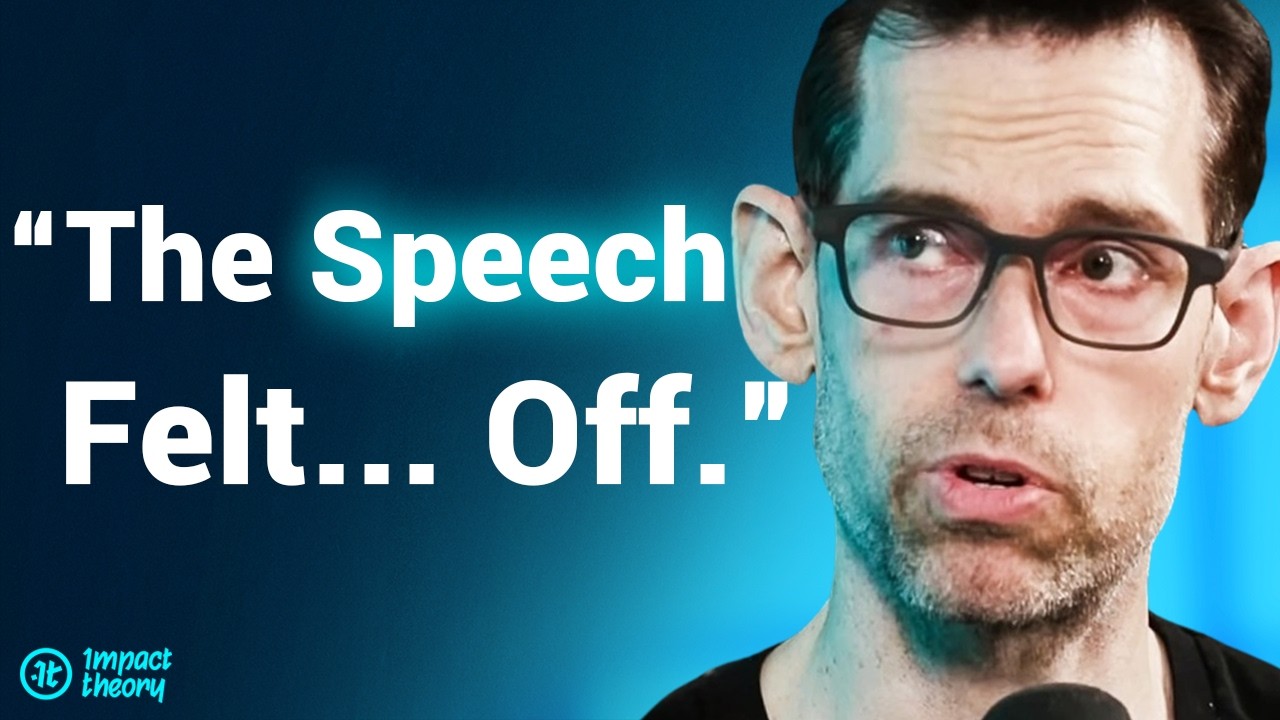
Video summary
Tom Bilyeu analyzes Donald Trump's recent address to the nation, characterizing it as an awkward and forgettable event that failed to resonate with viewers. He notes that while Trump claimed the economy was thriving, a review of the last eleven months reveals limited legislative achievements beyond one major bill and numerous name changes. Although Bilyeu acknowledges specific wins like eliminating taxes on tips and overtime for workers such as bartenders, he argues these are insufficient given Republican control of the House and judiciary. The speech itself felt more like a recitation than a performance, lacking the confidence Trump usually displays when entertaining crowds or leveraging media attention to highlight accomplishments that many consider debatable at this stage. The core issue facing Republicans heading into potential midterms is whether tangible economic improvements can be demonstrated rather than just promised. Bilyeu warns that spin and optimistic rhetoric about low prices will not prevent voters from seeking change if they do not feel their financial situations have genuinely improved since the Biden administration or even earlier periods. He suggests that without a clear demonstration of affordability, Republicans are on a collision course with significant losses in both the House and Senate. Furthermore, he expresses concern that failing to rectify economic issues quickly could lead the country toward socialism as an alternative solution, which he views not as a benign policy but as an accelerant for existing societal problems despite its theoretical appeal. Bilyeu identifies a faction within the MAGA movement that feels betrayed by unfulfilled promises regarding mass deportations and other benefits expected to make America great again after being interrupted in 2020. To regain enthusiasm before November, he ironically suggests Trump should adopt socialist-style policies temporarily, such as issuing direct checks or deregulating industries to create a speculative "gambling machine" similar to the stock market boom during the Great Depression era. This strategy aims to induce euphoria and excitement among voters right at the midterms, creating an illusion of prosperity reminiscent of the 1920s that could secure re-election votes even if underlying economic fundamentals remain fragile or detached from reality due to a potential bubble in AI valuations. However, Bilyeu contrasts this short-term political maneuvering with what he believes is necessary for long-term national salvation: strict austerity and debt deleveraging modeled after Margaret Thatcher's approach. He argues that the current economy cannot sustain itself because it relies on detached business fundamentals fueled by a speculative bubble rather than actual productivity gains from AI, which will not arrive fast enough to justify current valuations. Implementing this path would require difficult decisions like refusing bank bailouts and allowing some debt holders to go unpaid, measures that would inevitably cause political backlash and likely result in losing the midterms. Ultimately, Bilyeu concludes that while his advice for a structured deleveraging is realistic only if implemented immediately after taking office, it is politically unfeasible now given the current landscape where billionaires are vilified and tax dollars generated by entrepreneurs face scrutiny. He acknowledges that Trump might be maligned during this period of austerity but could eventually be remembered well in history for balancing the budget and preventing a global debt crisis. Nevertheless, without immediate action to address these realities before losing control of Congress, the nation risks sliding into policies that exacerbate current problems rather than solving them, leaving no viable path forward under existing political constraints.
Read the full video transcript
Trump went on TV, he told everybody,
"The economy is great. We're chilling.
It's good." And then you look back at
the last 11 months. The biggest thing
Trump has done in his presidency so far
was a big beautiful bill and change a
bunch of names on things.
>> Yeah.
>> I don't think any of those two things
will ultimately help the average working
person. No tax on tips was a big win. I
will give him that. No tax on overtime.
I used to be a bartender and I used to
rely on both of those things. So, I
definitely understand that there is
going to be a se of people that are
benefited those two. But on the grand
scheme of thing with the control of the
House, the Republicans, the judiciary,
the Supreme Court, I feel like you could
have done a lot more in your first year,
year and a half. How do you feel about
Trump's address in general and just kind
of where we are?
>> Yeah, let's get into it. This this one
was weird. To say that it felt off would
be an understatement, but for people
that don't know, Donald Trump addressed
the nation this week, but rather than
feeling confident, it felt like a
speedrun of a speech he was mad about
giving. And some people say that Susie
Wilds literally told him he had to do
it. Trump appeared to be reading rather
than performing, which is a big part of
what I think made this feel so weird for
people. The speech itself, though, was
from where I'm sitting largely just a
straightforward recitation of his
economic accomplishments so far. From
his perspective, let's be very clear
about that. People have done breakdowns
about the number of exaggerations in his
speech, and being honest, I was tempted
to count how many times he said some
variation of, "No one has ever seen
anything like it." He says that so much,
I was literally afraid I wouldn't be
able to count that high. Now, many
assume that the speech was in direct
response to his falling poll numbers. It
seems pretty reasonable to me. He's
having a hard time of it right now.
Others believe he seemed off because
there was no crowd for him to feed off
of and he's a guy that likes to be up in
front of people a bit like a comedian.
Other people still, and this one is wild
to me, are making out like this was some
40 chess move. And it was him using the
address the nation format to get the
legacy media to cover his string of
accomplishments, but his string of
accomplishments are debatable right now.
We need more time to see how the economy
is playing out. So, that one just feels
super weird to me, especially if he's
going to give one of the most awkward
cadences of his career. He's so good at
being Trump. I'm not saying he's like
some super talented ortor, but he's a
very talented entertainer and so he's
very good at getting people's attention.
So, that format just felt super weird.
So, if that's what we were trying to do,
I would say that was a swing and a miss.
So, for me, the speech was just meh. It
was nothing groundbreaking. It was
ultimately forgettable. This is one of
the things that makes news now because
there's nothing else crazier going on.
But I don't think this is something
that's going to be remembered. This is
going to be ultimately from a midterm
perspective is do people actually feel
like things are getting cheaper? If
things are getting cheaper, then he's
going to do well at the midterms. But
right now, spin and promises about the
economy being great are not going to
save him. And the the Republicans, if
they want to be successful at the
midterms, they are going to have to
realize that that is the truth. The only
thing that matters is when I'm spending
money. Am I able to get to the end of
the month in a place that's better than
where I was a few years ago? Even just
saying that it's better than when Biden
was in office isn't really going to do
it. You've got to get them back to a
point where they feel like they're doing
well. Because if they're less stressed,
that's not going to be enough to stop
them for voting for change. If you want
to stop them for voting for change,
they've got to feel like they've already
got the change that they were looking
for. So right now I would say the
Republicans are on a collision course
for a blue wave or at a minimum just
losing the House and the Senate. So they
better hope that something actually
comes to pass in the coming months
between now and next November.
Otherwise, not going to be good for
them. Not going to be good for them. And
then for us as a country, I worry that
the thing that's going to replace it is
very much going to be socialism. And
that will be way worse. Like literally,
if you were going to design a set of
policies that were meant to exacerbate
the exact problems that you're dealing
with, it would be socialism. I know they
sound good on paper, but they are the
accelerant that people should fear. But
if Trump isn't able to rectify the
economy fast enough, that's precisely
what's going to happen.
>> Where we are as a nation, we were, it
felt, I as if we were sold a bill of
goods. I'm trying everything not to
bring up this Nick Fuentes clip where he
really much kind of broke all the way
bad and was like, "Trump lied to you. He
spun you. He played you. He said he was
going to do these things. There was
going to be mass deportations. All these
things were happen. They didn't come to
pass. And because they didn't come to
pass, we now hold up our vote. If you
want us to come back for the midterms,
we need to start seeing mass
deportations. We need to start seeing
these things." And I think that there is
a faction with MAGA within the right
that is like, "Hey guys, y'all said
y'all was going to get all these things.
Y'all were going to make America great
again. We're going to get all these
benefits. We got interrupted in 2020 by
Sleepy Joe, but now this is our chance.
And the chance has come and we haven't
seen anything get passed. We've seen one
bill get passed and like I said, a slew
of renamings. What do you think
something he can do practically that
would actually push the needle? And I
know make prices come down sounds good,
but a new Fed chair is going to come
through that's going to have debt
implications. Like if you were talking
to Trump right now and you're saying,
"Hey, the American people could really
use this." What do you think is the one
pulse or one button he can push that
would get that 2024 enthusiasm back with
his base?
>> Trump, you want to get reelected? Here
is exactly what you need to do. You need
to give people free. That's it. Be a
socialist. Lean all the way in. Make
your socialism sound awesome to people
on the right. So, give big checks to the
military. Ding ding ding [laughter] ding
ding. Make sure that you are putting
money into people's hands. Let them slot
into the gambling machine like they did
during COVID. let them get really
excited about that chance, that chance
that something might happen. Deregulate
all of that stuff so that people can
absolutely go ham in the gambling
machine. Please be aware of Daniel
Conorman's idea of the loss domain.
Everybody's in the loss domain right
now. So, what they want is a shot to win
it all back. And so, you're going to
want to help get that enthusiasm peaked
right at the midterms. It's not going to
help and it's going to completely
obliterate them. But, if you can get
them excited, euphoric right at the
midterms and it's like, see, we brought
the party back. This is 1920s, baby.
Don't worry about the fact that it's
late in the year 1929. Just it's the
1920s, ripping and roaring. The stock
market's going crazy. People are hiring
jobs. They're all about to get
clobbered. But like if you can create
that kind of enthusiasm, then you're
going to be fine at the midterms. Now,
if I were going to save the country, it
would look something like this. Trump,
you're you're going to be maligned while
you're in office, but you're going to be
remembered well by history. And what
you're going to do is Margaret Thatcher
this You're going to go
completely into austerity. You're going
to do an actual beautiful deleveraging.
And you're going to tell the American
people, "Listen, it's going to be hard,
but we have a K-shaped economy, which we
cannot do. Especially because the
upside, all the people that are making
money because they're in the markets
right now, that is a bubble. How do we
know it's a bubble?" Because history.
We've lived through this before. We can
see that we have totally detached from
business fundamentals. And if for AI to
become worthy of those valuations, these
companies would have to have so much
productivity that it would be literally
ahistoric, which is possible, but is not
going to come very fast. And we cannot
bank on a maybe future. And that is what
we're doing right now. We need to deal
with the reality that we're in and
facilitate that being possible, but we
have to deal with the world that we're
in right now. And that world requires us
to balance the budget. And therefore,
we're going to have to make some
extremely difficult decisions and
balance the budget becomes the core of
all of that. Margaret Thatcher shows the
way forward with something like that. It
does have austerity measures. It does
mean that you can't be bailing out
banks. It does mean that there are going
to be a lot of people holding debt that
are not going to get paid back, and that
is what it is. But you're going to do it
in a structured way where you're going
to do the four parts of a beautiful
deleveraging and all of them hurt
somebody and you're going to hurt
everybody as little as possible in
balance so that we can get an economy
moving forward where we are not
continuing to saddle the world with
debt. And he would be maligned. They
they will lose the midterms, that's for
sure. And so then it just becomes a
question of knowing what needs to get
done. Does it become possible if you do
it this late in the game? He might have
been able to do this if he had done it
right out of the gate. But now, if you
lose the midterms, you're gonna get the
wrong kind of socialism where it's like
all free all the time. Billionaires are
bad. Businesses are here to rake you
across the coals with a total blindness
to every tax dollar we have is generated
by an entrepreneur somewhere. So yeah, I
that advice isn't really realistic given
the political realities, but it is what
has to