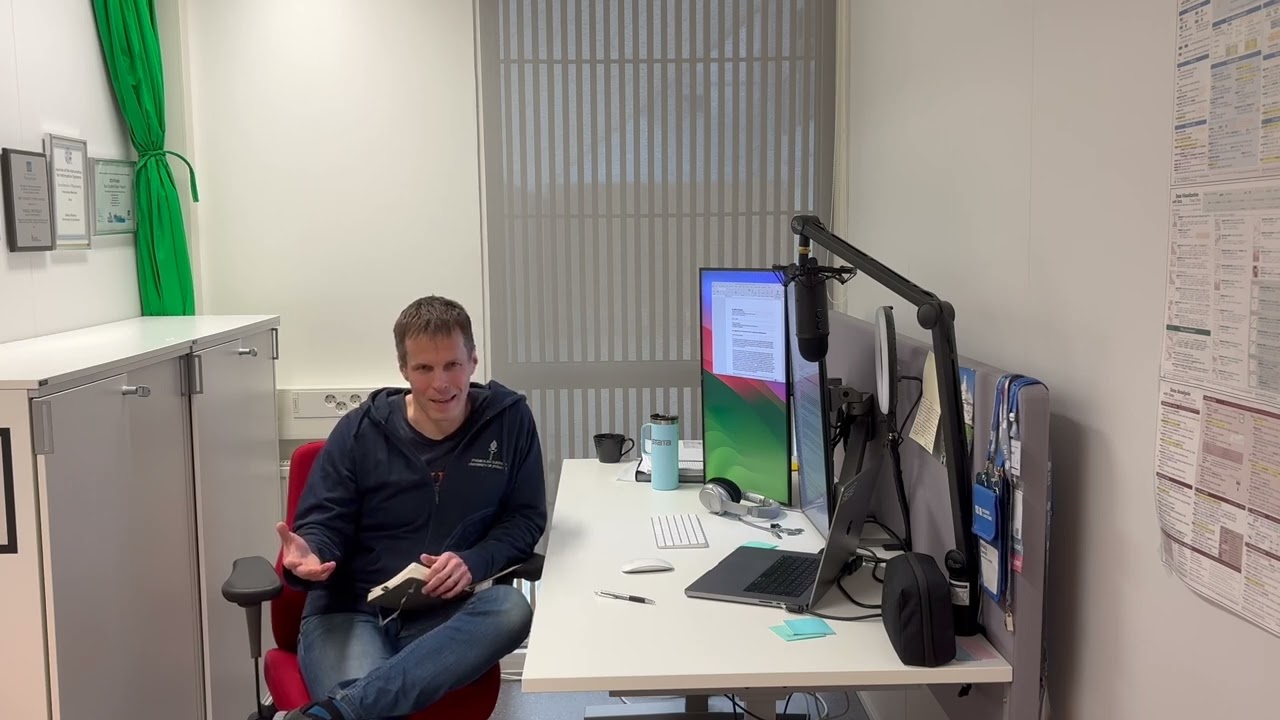
Video summary
Professor Mika Rantakokko from the University of Jyväskylä shares his insights on doctoral student recruitment, emphasizing that open calls are rare because funding bodies typically require a specific candidate in mind before approving projects due to the inherent risks involved. He notes that while many applicants apply through these limited channels, only one position is usually available out of over ninety applications, making it crucial for candidates to understand what distinguishes a successful application from an unsuccessful one. A significant issue he highlights is the increasing use of artificial intelligence in crafting applications, which often backfires by signaling a lack of genuine effort and personal investment; recruiters prefer human-written documents that reflect true motivation rather than generic AI-generated text that can be easily detected as impersonal or insincere.
When reviewing application materials such as CVs and motivation letters, Rantakokko advises against using AI to customize these documents because they should remain neutral records of one's background rather than tailored pitches designed solely to impress a specific project director. He stresses the importance of honesty in motivation letters, particularly regarding whether an applicant is casting a wide net by applying to multiple positions simultaneously; while it is natural and rational to apply broadly given the competitive landscape, candidates must avoid faking specific interest if they are not genuinely committed to that particular role or research area instead focusing on their broader desire for an academic career. Furthermore, applicants should clearly explain how their existing skills and willingness to learn can contribute to a project even if they lack direct experience in specific methodologies like qualitative research, as the program is designed to train students over four to five years regardless of initial expertise levels.
The submission of a research plan also serves as a critical indicator of an applicant's commitment and attention to detail, with Rantakokko warning against including irrelevant topics or hallucinated references that suggest careless AI generation rather than thoughtful preparation. He suggests that if applicants are applying to many positions, they should be transparent about this in their plans while still tailoring the content slightly to show understanding of general research principles relevant to the field without fabricating deep familiarity with every specific project detail. Additionally, international candidates should demonstrate awareness of and adaptability to the local academic environment, such as explaining how they might adjust to the Finnish study system if coming from a different country, thereby reducing perceived risks for recruiters who want assurance that new hires will integrate smoothly into their teams without excessive difficulty.
During interviews, Rantakokko underscores two key strategies: being honest about knowledge gaps and admitting when one does not know an answer rather than improvising incorrect information or wasting time on unfamiliar topics. He recommends keeping responses concise and staying focused on the question asked to maximize the value of limited interview time, especially since professors may ask difficult questions that test a candidate's depth of understanding in specific areas like abductive research. Ultimately, he observes that successful candidates often apply selectively rather than broadly, having thoroughly researched their target institutions and demonstrated clear knowledge of where they are applying, which signals genuine dedication; while recruiters cannot hire every promising applicant due to limited slots, those who show authentic commitment, self-awareness, and a realistic approach to the recruitment process stand the best chance of securing a position.
Read the full video transcript
Hello, I'm Mika Rantakokko, I'm
professor of entrepreneurship at the
University of Jyväskylä School of
Business and Economics.
We just completed the recruitment of a
doctoral student and I thought that this
would be a good uh
moment to reflect a bit on how the
academic recruitment market works and
what you should consider when you are
applying for a doctoral student or
post-doc position. And to set some
context, um
I have recruited a student from an open
call
last time 5 years ago. So, we don't
typically do open calls because it's
very difficult to evaluate the person.
Also, when we apply for funding
we typically have a person in mind
because unless we
have the person in mind, then getting
the funding is a bit risky because that
means that the success of the research
project would be contingent on a person
who we have not even met before.
So,
getting these uh
open calls and getting a student
position from an open call
is is very
unlikely because the positions are few
and the applicants are many. We have
more than 90 applicants and we could
only recruit one student.
And let's talk a bit about what makes
a good doctoral student application and
what are the things to avoid.
One thing in this application round that
I could clearly see is that a lot of the
applications in various documents
showed AI use and this is uh
a double-edged sword. I would say that
using AI
to write your application is actually
going to hurt your chances of getting a
job. Even if it allows you to write
many, many applications, when we see
that the application is AI written, then
that's going to be counted against the
applicant.
So, let's assume that we have
five applications that are clearly
written by a human, a lot of effort have
been put into those applications, and
then we have 90 applications where we
can see that they're mostly produced by
AI with little effort from the
candidate.
We are not going to interview those
people who provided these AI written
applications. Of course, there's like
it is not black and white. You might
have some documents where you use AI for
some purposes
and that might be okay, but we value
human written applications. Let's Let's
take a look at some some specific issues
and um
one clear turn-off for me
is a CV that is customized to the
position
by AI.
And
CV is supposed to be a neutral document
that documents what you have done and if
we can see a CV
that contains references to the project,
contains highlights that are clearly
there to increase the perceived
attractiveness of that CV from the
perspective of the project director or
owner
no one does that. So, I haven't seen
that done before AI.
So, we assume that a human would have a
neutral document that is the same
document sent to every position. And if
we see these two customer CVs, that is
an indication that it was an AI written
document.
I wrote five applications to different
positions at our university over lunch
with AI just to show my colleagues how
easy it is to produce this kind of
document.
So, don't use AI to do your CV. The CV
is supposed to be neutral, it's supposed
to show the facts and it's not supposed
to communicate, for example, your fit or
your motivation. That is something that
the person who does the recruitment will
judge based on the CV. So, that's number
one, no AI CVs.
Then another thing is is motivation
letters
and the motivation letters had a couple
of issues that were
kind of turn-offs, at least for me.
One is that the motivation letter
basically restates the CV. The
motivation letter should not restate the
CV, explain your
background, ex-
but they should explain two things.
Good motivation letter should explain
what is your motivation to apply to the
position.
And here I would encourage you to be
honest.
And by honesty I mean that if you're
applying for any a doctoral student
position where uh in management or in
business school more generally in any
university in Europe just say that
you're casting a wide net because
if you are just applying to many, many
positions, then it's very hard to have
specific motivation to a specific
position. So, unless you have a specific
position motivation to our position,
don't fake that you would do because we
read lots of applications, we will see
if there's no genuine motivation to our
position per se.
Now, is it
Is it necessary to have a genuine
motivation
to our position specifically?
The answer to that question is no.
If there is
a candidate
who is uh
let's say very promising
even if they were looking for other
positions
and it's clear that they're looking for
other positions, we don't count that
against them because it's natural that
if there are only
a handful of positions available and
lots of applicants, it's rational to
apply to multiple places. And we
interviewed one candidate who was
applying to multiple positions and we
told that candidate that this is
completely okay. So, we don't expect you
to dedicate yourself to one position
where uh
the chances just based on the numbers is
pretty low.
Uh
if you don't have a specific motivation
to a project, then you should indicate
your general motivation. Like, why do
you want to do a doctorate in the first
place?
Uh why do you want to go for academic
career? Because that's generally why
people do a doctorate. And um
these These candidates that we
interviewed, all of them provided a very
credible explanation of why they wanted
to go for academic career.
And um
so, think about like, what is your
motivation and should be honest about
it.
The second thing that you need to have
in your motivation letter is to explain
how you plan to contribute to the
research project. So, our research
project was about entrepreneurship and
AI and we were looking for
a person that
does qualitative research and we were
also open for for people who are have
profiles that would make them mixed
methods scholars. So, either qualitative
or qualitative and quantitative.
Uh
Explain your background, like, what
makes you a good person to do that kind
of research? What makes you
uh
want to learn specifically that kind of
research? So, don't explain in your
motivation letter who you are, where you
come from, but explain the motivation
either specifically to the project or
generally toward academic career.
They're both okay. You don't have to be
specifically interested in the project.
I've done many projects that I do
not because I'm interested in the topic
specifically, but because I like the
process of doing research. And that's
completely fine, it produces good
outcomes
and that works.
And explain how you plan to contribute.
What is your basic training? If you lack
training, then you might say that
I don't have any much experience in
qualitative research, but
uh
this is the This is the things that I
would do to learn. So, indicate your
readiness to learn even if you are not
ready to
contribute to the project from
the day one. When we look for a doctoral
student, then we're typically looking
for a commitment between 4 and 5 years.
And if that person has uh
half a year of qualitative If one person
has half a year of qualitative research
experience, another person doesn't have
that experience
it's not critical difference because
during the four or five years that the
student is in the program, they will be
trained to do the kind of research that
we hire them to do.
Um so, what we are looking for more
is is genuine interest and
being able to explain how you might fit
into the project based on on what you
know and what you're interested in.
So, that is the motivation letter.
Then we ask for research plan
and
there are there were a couple of of
errors or couple of not errors, but
things that really turn me off in terms
of research plans. And we don't ask for
research plan to indicate that that
person has a plan that is ready to
implement be implemented when they
arrive into the program.
Why we ask for research plan is that
that is a way of of showing some
commitment to the process.
If you submit a research plan that is
completely irrelevant
to the position that we apply.
So for example, if you submit the
research plan about human resource
practices in in multinational
corporations and we look for a
researcher in a position that is about
AI and entrepreneurship, then that is
not a relevant research plan.
Another thing that is a disqualifier
is that if you have an AI written
research plan. And uh
we had a
one plan
that cited a document
written by
uh Sufian who was uh who is the the
leader of the project. And uh the
problem is that while it's a good idea
to cite the person's study who you are
work with,
that was a hallucinated reference. So uh
the plan was citing a non-existent paper
uh from a person who is doing the
recruiting with me. And that means
simply that uh
uh we will we will see that the person
who applies to this position is not
careful enough that they notice that
they have
basically falsified references in their
research plan. We didn't of course check
them all, but this is something that we
noticed.
So the idea of a research plan is that
you uh you do yourself because uh we can
see when it's AI generated and it just
tells that uh the student doesn't have a
motivation.
Now the challenge for this then is uh
what why this is challenging is that if
you have a general motivation, but not a
specific motivation for this position,
uh
how should you deal with uh the research
plan?
And uh
my I have a couple of things that I I
would like to say about that topic. Uh
be open about it that you're applying
for multiple uh multiple places. Just
say that you read two references and
then include those and then say that
because you are applying for 30
different positions, uh the outcomes are
uncertain. You just explain like general
research principles. But tailor it to
the position. So and and do it by hand
because that shows some commitment.
For every Let's say that uh
you can be pretty much sure that every
position that you apply with with an AI
generated research plan, there will be a
person that has similar qualifications
to you who has written the plan
themselves and show commitment to the
position that way. And
they will be uh the
things that we we state in the uh job
advertisement,
but we also looking to
uh do uh a low risk recruitment. And
uh low risk recruitment means that when
we hire a person, we know that that
person will come when they are hired and
not take another position. And we also
know that that person
uh has some familiarity with how the
education system works here.
So uh
indicate for example, if you This
applies particularly to uh people
applying from different countries,
indicate that you have some
understanding of the environment where
you're applying to.
And discuss how you would adapt to a new
environment. So how easy would it be for
you for example to adapt to the Finnish
study environment if you come from for
example uh
India.
We had some Indian applicants.
Uh
if we have a person who comes
and faces lots of
difficulties in adjusting to the Finnish
system, then that is something that the
person who does the recruitment would
like to avoid. So try to uh
indicate that you're familiar if you're
not familiar with the Finnish system
then that you're familiar with the
European system. You generally know how
things work. Try to make it appear that
when you are recruited, then things will
proceed smoothly with you. You can for
example talk about how you have adjusted
to different environments in the past.
So this is something that usually is not
listed in recruitment advertisements,
but this is another kind of like passive
factor that might make a difference when
we consider
uh whether we screen the applicant in or
out for interview. When you get to the
interview, then uh it doesn't make that
much of a difference anymore.
In the interview, um
one most important thing is uh is uh or
two most important things are
uh
be honest which doesn't mean that don't
lie, but honest means that if
if you go for a doctoral student
position, you might be interviewed by
two professors who know about the topic
a lot more than you do. If they ask you
a difficult question, just say that
well, you don't know the answer. That's
much better than trying to improvise
something on the spot. So
acknowledge your limitations and show
readiness to learn and that is uh the
most important
thing. The second most important thing
is that
you have 30 minutes to begin an
interview,
stay on topic and keep your answers
short. If you don't know an answer to a
question that you're being asked, for
example, if we ask you uh
what is abductive research? Maybe we've
read that uh
word in your research plan, you don't
know the answer,
just say that I'm not sure what that
means and then proceed instead of going
in circles for multiple minutes uh on a
topic that you might not be fully
familiar with.
Uh
if you spend 5 minutes talking about
topic that you don't are not fully
comfortable, then that is 5 minutes less
than you could be talking about topics
that you know more about.
So that is my final advice.
And uh I would
the just thinking about the the person
who we ultimately decided to hire
and the person I hired the last time
when I recruited a doctoral student from
an open call, what is common between
these two people?
What is common is that neither of these
persons were applying to multiple
places.
Uh they were or they were to many
places. So the student that I recruited
um
5 years ago who is now graduated, uh he
applied if I remember correctly to three
positions uh in the EU area and he just
picked positions, did his homework,
uh
looked at what these people who were
recruiting
had been studied in the past and then
indicated that they knew where they were
applying to.
And this candidate that we now recruited
also knew where he or she was applying
to and and that really showed in the
interview. So that is uh my my final
tip.
And uh unfortunately, we cannot recruit
every person. So I would really uh I I
don't One thing that I really like about
recruiting is that uh
you uh you get lots of promising
candidates. You get many people who you
could hire, but then you can't offer the
position
but to just one person.