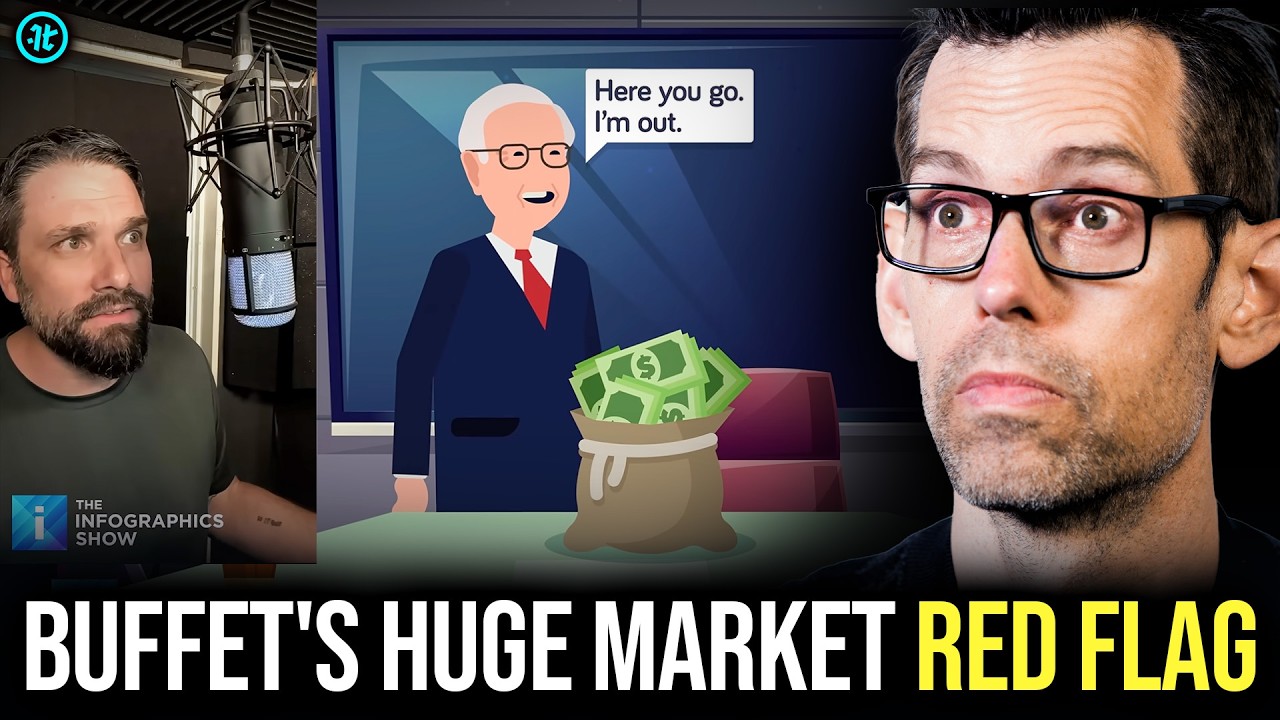
This Number Is Higher Than It Was Before The 1929 Crash — We Had To React
Watch on YouTubeVideo summary
Warren Buffett's recent strategy of accumulating nearly $400 billion in cash while significantly reducing his Apple holdings signals a deliberate move away from an overvalued market rather than mere tax planning or age-related adjustments. This approach mirrors his historical caution during the 1969 Nifty Fifty bubble, where he warned against speculative ventures like Pets.com compared to fundamental companies such as Amazon. Current indicators suggest the market is dangerously overheated, with the CAPE ratio exceeding forty times earnings—surpassing both the dot-com peak and the levels seen before the 1929 crash—and Buffett's own valuation metric approaching a critical danger zone of two hundred percent. The artificial boom driven by AI speculation relies heavily on closed-loop spending that fails to generate real profits, while rising unemployment rates have already triggered recession warnings as early as August 2024, pointing toward an ongoing "stealth recession" exacerbated by the risks associated with illiquid assets in a shifting economic landscape.
The systemic fragility of the US financial system is further highlighted by massive unrealized losses across major lenders, where institutions like BlackRock face deficits seven times larger than Silicon Valley Bank's 2023 collapse because nearly every bank holds similar low-rate bonds that must be sold immediately if depositors withdraw funds suddenly. This dynamic turned theoretical paper losses into realized ones during SVB's rapid failure and caused the largest US mortgage lender, United Wholesale Mortgage, to suffer a thirty-five percent drop in a single day due to strains in private credit markets where firms like Blue Owl restricted redemptions. Although the inverted yield curve is currently unwinding as the Federal Reserve cuts rates—a pattern that historically preceded recessions in 2000 and 2008—this normalization reflects underlying economic stress rather than safety, with additional global threats including Middle East instability, China's economic struggles, and a declining labor force participation rate converging to create multiple red flags for investors.
In response to these converging risks, Buffett views his massive cash reserves not as idle funds but as preserved buying power intended for distressed opportunities when the market corrects, echoing his 2008 bailouts of Goldman Sachs and GE while advising against autopilot investing strategies that fail during volatility. The speaker emphasizes that waiting out a potential crash could tie up capital for over a decade without guaranteeing recovery, making it prudent to reduce equity exposure and maintain strategic optionality until clarity emerges from the chaos. Ultimately, economics is framed as warfare requiring investors to align their personal philosophies with this harsh reality by establishing pre-defined metrics during calm periods rather than reacting emotionally when markets fluctuate, ensuring that broad diversification does not blind them to the immediate dangers of holding assets in an overheated environment where waiting for a crash could result in prolonged capital immobilization.
Read the full video transcript
Everyone right now is comparing today's
AI stock boom to the.com bubble of 99.
But the sharpest minds on Wall Street
have a different vision. One of those
people is Warren Buffett. Warren Buffett
is uh I know that he's no longer with
Burkshire Hathaway. I mean, he's
chairman, but he's not actively running
the company anymore. But what he's doing
and what his company is doing is really
pointing at something everybody needs to
understand. If you don't understand
this, you're going to be managing your
portfolio at one of the highest risk
times in a way that does not make sense.
you almost certainly have economic
disruption coming at you uh at some
point in the nearish future, but nobody
is going to be able to get the timing
right. So, this is about understanding
the economic forces, what signs to look
for, how to keep yourself sainely
positioned. That's what we're going to
go through today. So, let's hit it.
>> Everyone thinks Warren Buffett is
selling Apple to avoid a potential 21%
capital gain tax hike, but that doesn't
fit [music] his history. Buffett has
always been a forever investor. He
doesn't panic sell. Something else is
driving this. He's been building cash
and shifting heavily into short-term US
Treasury bills at a scale rarely seen in
his portfolio. That kind of move usually
shows up when cracks start forming in
the economy before they're visible.
Because when Buffett stops holding, he's
not reacting to headlines. He's reacting
to what's coming next. By the close of
the first quarter of 2026, Warren
Buffett's holding company, Birkshshire
Hathaway, was holding a record pile of
cash. That figure came to $397.4
billion. Not stock, not businesses, just
cash and government paper.
>> Let's start defining terms. So the odds
that um Warren Buffett has any
meaningful amount of cash is almost
zero. Uh he's going to be holding
everything basically in government debt.
Um so keep that in mind when he's
talking about that. He is still going to
be earning a return on his money. He's
just trying to be in the safest place
that he can be because he's looking at
the industry and he's saying, "Okay, I
think things are overpriced right now.
There are no deals to be had." We're
going to get into this here in a minute,
but this is something that Buffett has
done before. Um, this is coming to us,
by the way, from the Infographics Show.
Um, somebody I'm newly familiar with.
Um, so very interesting. By all means,
please support the channels that we um
feature here on the reacts. Uh, these
guys put together some incredible stuff.
So, but it's important to understand
what Buffett is actually doing, what the
signals actually mean, what Buffett
himself is saying about it. Um, and
there there are places where I feel like
uh this video may fall into typical
narratives about Buffett versus the
actual underlying reality. And so, we're
going to tease that apart as we go. But,
as we go through this, think about your
own portfolio. That is a key here.
understanding why Buffett is doing what
he's doing, how you are subject to the
same forces. Buffett has made his choice
about what he's doing. Ultimately,
you're going to need to make your
choice. We're going to look at some deep
history from Buffett's choices that
don't quite get covered in the video,
but I'll fill in those blanks as we go.
>> To understand the scale, it's larger
than the annual output of countries like
Finland, Portugal, or Chile. It rivals
the value of many of the world's biggest
companies. And it didn't appear
suddenly. Between 2023 and 2024,
Birkshshire dumped a net 172.9 billion
in stocks with roughly $134 billion sold
in 2024 alone. It was the biggest
sell-off in the company history. While
markets were hitting record highs,
Buffett was doing the opposite. He was
selling quarter after quarter, and the
selling never stopped. In the first
quarter of 2026, the firm unloaded
another net $8.1 billion. After the 2022
bare market, the next two years weren't
supposed to be scary. 2023 and 2024
turned into some of the strongest years
for United States stocks in decades.
Markets climbed, portfolios recovered,
and for many people, it felt like the
only mistake was being outside of the
market. And right in the middle of that,
Buffett built up his reserve. His cash
pile more than doubled. People should
have paid attention. Every business show
on TV calls this smart tax planning. a
careful man trimming his tax bill before
rates climb.
>> He's going to go through uh that this
doesn't quite match up with Buffett's
history. But I want to be very clear,
Buffett himself is saying this is me
backing out of the market because of the
tax strategy. Um there when people talk
about Buffett, they give a narrative
that Buffett has this uh the Buffett
danger line or red line, I forget what
he calls it. Uh he's going to mention it
in a minute. Um and that they make out
like that's the thing that just drives
Buffett's decisions. you hit that line
and he bails out and anything else that
he says is, you know, BS or whatever.
Now, listen, I think Buffett is a very
careful speaker. I think he understands
that he moves markets. Um, but this
Buffett's own words are that this is
about strategic cash planning. Um it is
pretty clear that by Buffett's own
analysis almost no matter what uh
analysis you run and we're going to give
the different things that Buffett has
historically used including the metric
that he says is the metric um but all of
them are flashing red. So I very much
doubt while this probably also the
timing of it has to do with him being
strategic. Tax efficiency is one of the
single most important things you can do
as an investor to make sure uh that
you're in a good spot. And if you
believe that now is a time to sell and
he has done this before, he has sold off
before. So whether this violates um that
there have been times where he didn't
sell in preparation for tax, keep in
mind that if he's going into a phase
where he knows he's going to sell and
that means that he's going to take a tax
burden, then doing it in the most
taxefficient way makes sense. So, I
don't think even though it's sort of
presented here like, okay, Buffett is
doing he's basically giving you a
narrative that isn't true. He's doing
something else. I don't think it's quite
that. I think that Buffett is he knows
he's going to sell for reasons we're
going to detail shortly. He knows he's
going to sell, so he's going to do it in
a taxefficient way. And that very much
is something you guys need to think
about as investors, doing things in a
taxefficient way. Uh, that's very, very
important.
>> A careful man trimming his tax bill
before rates climb. But it contradicts
Buffett's own past. In 1986, the
corporate tax rate was set to jump from
28% [music]
to 34%. That should have set off a fire
sale if taxes ever drove his choices.
Instead, he left his core holdings in
place. For 60 years, he built fortunes
by sitting still. Tax rules have never
once knocked him off of a stock he
believed in. Buffett has said his
favorite holding period is forever. His
best time to sell a great business is
almost never. Coca-Cola is the proof
he's held it for decades.
>> Buffett is very clear that his favorite
time to hold something is forever, but
it's not the only time uh that
determines when he sells something. So,
this is where um getting into the nuance
is going to become very important. When
people take the bumper sticker version
of investing, uh they make mistakes. So,
be thoughtful about that.
>> Bust he never once dumped, not even to
dodge a tax bill. So, we're supposed to
believe he sold his Apple stock just to
save a few cents on a tax form. Buffett
didn't just trim his portfolio. He
reduced his Apple position from nearly
half of Birkshshire's stock holdings
down to about a fifth. Then he did
something even more surprising. On
January 1st, 2026, he stepped down as
the boss of Birkshshire Hathaway. So, I
love this video. I think it's really
phenomenal. Uh so, forgive me for
picking on some of the things, but uh
are we supposed to believe that he's
handing the keys off? um you know in
this moment yet this guy is
so old. So the fact that he is um
retiring now should surprise absolutely
nobody. I'm surprised that he made it
this long. So I don't think this is some
you know big thing that he's trying to
hide. I think the reality is that it,
you know, the time has come to retire.
He's done what he came to do. He's got
somebody that he's been training up for
a long time. He's going to remain on as
chairman. There's nothing weird
happening here. This is very similar to
how I feel about the way that the people
way that people speak about the
Rothschilds is they want to put this top
spin of like all this um cloak and
dagger stuff instead of just okay,
what's the mundane thing that just
matches all of the um things that we
see. The mundane read of what is going
on with Buffett is I'm getting super
old. I've led this company
extraordinarily well. I understand that
I'm slowing down. I've got to pass this
off. uh I look at the market and just
like I did back in 1969 which we're
going to cover uh I'm going to sell out
of the market completely and not
completely but I'm going to largely sell
out of the market because there are
certain metrics that I look at and when
you cross the line of these metrics
unlike other people who invest
emotionally who want to grab every last
dollar that they can possibly get out of
a bull run. I don't do that. I have
these breakers if you will. When a
breaker is triggered I realize there are
no deals. I back out. Now that I know
that I'm selling, I've got to do this in
a uh taxefficient manner. And so even
though his other times when the
companies weren't like crazy overvalued,
I could see the sort of near-term them
crawling back out of the hole in terms
of overinflated valuations. I just held.
There's no need to like dip in and out
with every move. I'm I'm going to hold
through this. But now, and this is why I
want to show this video now is
different. there's something else that's
going on that makes me want to get out.
That's the part like if if you know you
want to see me ringing alarm bells. This
is the thing that I'm ringing. The guy
who normally holds is saying I'm telling
you why I'm getting out and there are
very clear numbers that you can look at
that tell you that you want to get out.
Now I'll shorthand it. Everything that's
happening right now is because the stock
market has become overvalued. This is
both me channeling what um Warren
Buffett has said and I think is saying
with all of these moves and what I'm
seeing in my own analysis that we are
reaching historic levels of
overinvestment. Um,
we'll see this specific number in a
second, but we are over on a very
important metric, even more than we were
before the uh 1929 crash that led to the
Great Depression. Okay, that's how hot,
to use a nice generous term, that's how
hot the stock market is right now.
Everyone, it's just everyone that
invests is shoveling cash into this
ridiculously small number of stocks
essentially all making one bet on AI and
Buffett is telling you it's too much.
It's too much. And so now that I know
that I'm going to get out, I'm doing it
in a tax efficient manner. And it just
so happens to coincide with the fact
that my partner and probably bre best
friend uh Charlie Munger died a year
ago. I just now's my time. So again,
looking at it with wolves howling and
the sense that there's some conspiracy
is is going to blind you to some really
basic that you can see in the math
that is very obvious. Uh and if you can
get out of emotional thinking, all of a
sudden it just becomes super clear. The
timing mattered. The cash pile was
already built and the major selling had
already happened before the transition.
And Abel's first move as the new chief,
well, he kept right on selling. Nothing
changed. What does Buffett see on the
horizon that the rest of us don't? It's
too hot.
>> There were only a couple of moments in
Buffett's career where he stepped back
from stocks almost entirely. One of them
was 1969. Markets were running hot,
driven by what were later called the
Nifty50. These were high-flying names
like Polaroid, Xerox, and Avon that
investors treated as guaranteed winners.
Buffett looked at the bigger picture and
decided there was nothing left worth
buying. So, he did the unthinkable. He
shut down his investment partnership and
handed the money back to his own
investors. He simply walked away. What
came next proved him right. By 1973,
that bubble had burst and a brutal bare
market wiped out years of gains. The big
names got slaughtered. Polaroid crashed
about 91% from its high. Avon fell
roughly 86% and Xerox dropped almost
71%. These weren't obscure or lowquality
companies. They were some of the most
respected names in the market at the
time. A great company is not the [music]
same thing as a great stock. a great
company is not the same as a great
stock. Okay, we need to talk about what
um actually happened in 1969. Now, he
acknowledges this. I want to be very
clear. The guy that made this video is
aware of this. He just doesn't take the
time to elucidate it. He truncates it to
saying uh later this became known as the
Nifty50s. Now, the reason that I think
Buffett got out in the um in ' 69 was
because of something that came before
it, which was called the GoGo era. So
everybody was just overinflating stocks
and things were going to the moon. This
would ultimately lead to the Nifty50s
but or the Nifty50 where you saw this
massive consolidation where everybody
thought okay these companies are what
they call a one decision stock. You
decide to buy it and you're just going
to hold it forever. Buffett looks at the
way that people are behaving and he's
like, "Hold on. You guys are pulling
forward so much future revenue that it's
going to be next to impossible for these
companies to make good on this. This is
the important thing to understand. We've
been talking a lot about how what's
going on right now with AI matches what
happened in the dotcom bubble. That's
100% true. But we've actually seen this
pattern repeat before. And now we get to
watch Buffett's behavior over time." And
so he's seeing this at the end of the
go- go era and he's realizing okay hold
on a second like these valuations are
getting extreme. They're starting to go
up above Buffett's red line which is uh
what is the the amount that these stocks
are trading at divided by GDP. And as
that number reaches 200% so when the
value of the stock market is 200% the
value of GDP like yikes you're you're
starting to get into a scary place. And
so that's when he has historically
backed out. And so we see that going
into the um the we see that in the go-
go era leading into what'll become the
nifty50. Now the the really important
thing and god damn it, if you haven't
been listening, I want you to listen
right now. So we'll be right back to the
show, but right now let's talk about
what it actually takes to produce video
content at scale. Most people think you
need a videographer, an editor, a motion
graphics person, and a social media
manager. That [music] is a full
production department. And most
businesses do not have the budget for
one. So, the content just doesn't get
made. But the creators scaling fastest
right now don't usually have huge teams.
They just have better tools. Here at
Impact Theory, we've been using Agent
Opus by OpusClip for some of our clips,
and we are very impressed. You can take
a script or an audio recording, upload
your brand assets, choose a visual
style, and Agent Opus produces a full 60
to 90 second animated video that's ready
to publish. It's 100% your message and
on brand, coherent from the first frame
to the last. Check out Agent Opus for
yourself at agent.opus.pro/explore.
That's agent.opus.pro/explore.
We'll be right back to the show. But
right now, let's talk about one rule.
When traveling, beef sticks go in the
bag. Plain and simple. Always. Airports,
hotels, a day that runs long with no
food options in sight. I do not leave
that to chance. Paleo Valley beef sticks
go in my bag before I go anywhere. I
literally don't leave the house without
them. When the day goes sideways and I
need food right now, the right choice
for me is always on me. I eat these
because they're the real thing. 100%
grass-fed and grass-finished beef.
Organic spices, naturally fermented.
There's no soy, no gluten, no junk.
[music]
6 g of real protein per stick, and they
actually taste incredible. No chalky
aftertaste, no weird chemical bite, just
food I'm glad that I'm able to reach
for. Most meat sticks are [music]
garbage wrapped in a health label. Not
these. That's why they've earned a
permanent spot in my bag. [music] get
15% off your entire order. Click the
link in the show notes to save right
now. All right, now let's get back to
the show. Guess what happens in 1973. So
he says, "Hey, the bubble burst in
1973." The thing that happened in 1973
that made Warren Buffett look like a
genius was the Arab oil embargo. So
there was a shock to the oil supply that
ends up causing this massive wave of
inflation. Now, for reasons that we've
talked about before, this is playing out
very differently. But the fact that
right now we have the same level of
instability in the same region of the
world that caused uh a massive problem
then and absolutely detonated the um
market and Buffett was like, "Thank God
I got out." We're seeing something very
similar now. Why isn't the same thing
happening in the Middle East? Why before
when we had a supply shock did we then
have massive inflation? Now we have a
supply shock and we're seeing a little
bit of inflation, but we're not seeing
the massive inflation that we thought we
would see. We're seeing a destruction of
demand. The answer is the economy was
already very weak at the level of
building things at the level of needing
the oil. Both in China, it's actually
more in China than the US. China
accounts for roughly 74% of the decline
in oil demand. So, they've been able to
just completely shut off their demand
somehow some way. And I think the answer
is, and and we've covered this in detail
before, so I'll just speedrun it now.
The fact that they haven't kept their
refineries going, which has nothing to
do with incoming supply and has only to
do with demand. The fact that they
didn't turn or leave that on, they
turned that off as well. And the fact
that they didn't keep buying when the
price dropped back down tells you that
what China's actually dealing with is
pre-existing decline in demand. And they
were using the cover story of the war in
Iran to mask the fact that they just
didn't have the demand. So they stopped
filling their coffers up to the billion
dollar or billion barrels that they had
and they're just like, we're going to
pretend that this is about the Iran war,
but really this is destruction of
demand. So that's why we're not seeing
the same thing. But we've got
instability in the same region that
ended up causing the problem in 1973
that made the market end up tanking when
we had a similar concentration of
stocks. So you've got the Nifty50 gets
hit with oil disruption in the Middle
East causing that bubble to burst. Now
we see this play out very similarly in
um the dot bubble. Now the.com bubble
people normally rightfully talk about it
as this is something with a massive
infrastructure buildout. You get this
gap between when the debt is due and
when the revenue actually comes in. It's
a very direct parallel to AI. But you
also have the fact that even before AI,
we've got the magnificent 7. You have
this massive reduction in the number of
actually productive growing stocks. And
because of that, and people are still
flowing in because they're trying to
avoid inflation, right? You got to hide
in the stock market. That's driving
valuations beyond anything that would be
considered normal. So we're once again
approaching uh Buffett's red line of the
value of the stock market divided by GDP
and we have something called the cape
ratio and the cape ratio has gotten
completely unhinged again. So the a cape
ratio so you guys know this is developed
by Nobel laurate Robert Schiller and
it's uh the stands for cycllically
adjusted price to earnings ratio. So,
the cape ratio, sometimes known as the
Schiller PE uh ratio. So, it divides the
current price of an index, usually the
S&P 500, by its 10-year average of
inflationadjusted earnings per share.
Now, why this matters is that standard
trailing 12-month PE ratios are super
deceptive, okay? Because in economic
booms, corporate profits are going to
surge temporarily, and that's going to
make stocks look like they're cheap on
paper. But when you go into a recession,
the profits are then going to collapse
and it's going to make the stocks look
expensive. So the idea behind having the
cape ratio is that it's going to smooth
out all of these cyclical distortions
and you're looking at a 10-year business
cycle snapshot. So it provides a much
more realistic uh fundamental baseline.
Okay. And the crazy thing right now with
the math is that the historical
long-term average of the cape ratio is
roughly 16 to 17 times.
Right now, the S&P 500 cape ratio has
been holding at 40 times. That is crazy.
In the entire history of US capital
markets, a cape ratio above 40 has only
been reached and sustained once during
the absolute peak of the 1999 to
2000.com bubble. Okay? Right before the
NASDAQ like [snorts] hemorrhages 75% of
its value, that's when we hit that. And
this is what I alluded to earlier. Even
the 1929 market peak that led to the
Great Depression didn't climb this high.
it didn't reach the cape levels that
we're at now. And so that's where it's
like, okay, you start whether Buffett
actually uses the cape ratio or not,
which he does not seem to, by the way.
He doesn't talk much about it. He has
another metric that we talked about and
but they're both screaming red. So this
is where it's like almost no matter what
metric you look at at these days. Is it
concentration into a few number of
stocks? Is it the um value of the market
divided by GDP? Is it the trailing
10-year uh performance of the shares?
Like no matter what you look at, it's
all red. It's all red. And so now
knowing that nobody gets the timing
right, that there's going to be some
period, maybe a day, maybe a year, maybe
5 years, where there's still a lot of
money to be made in the bull run and the
people that are doing it while they're
doing it are going to look like
geniuses. What do you do with this
information? Right? You're going to have
to make your own decision, but this
should hearing all of these alarm bells
and looking all of this going off should
really give people pause about what to
do. All right, we're going to uh talk
more about what Buffett has done
historically because there's a lot of
narrative around what he did in ' 69,
but we're going to want to uncover what
he really did. We'll talk more about
that in a minute. Um, but yeah, you want
to put all these pieces together. What
do you do? What do you actually do in
these moments? All right, let's keep
going. Buffett realized that years
before anyone else. 30 years later, he
did a softer version of the same thing.
In 1999, the dot mania was in full
swing. Companies with no profits were
being valued at billions. Pets.com
became a household name more for its
advertising than its business model.
While the market was celebrating the new
era, Buffett publicly pushed back,
[music] warning that returns built on
speculation wouldn't last. He wasn't
caught up in the hype. He believed the
market was priced so high that returns
would crawl for years.
>> Here's something. It's a really
important idea that we have to tease
out. So, um he's talking about people
that are investing based on speculation.
So, speculation uh as opposed to a um
the value of the company is strong. So
when you're looking at a company and
you're looking at it in terms of how
much free cash flow is this company
likely to have access to and this by the
way when pressed Warren Buffett will say
the number one most important metric and
he's very clear that you never want to
judge anything on a single metric
because times can be crazy. Um context
is always different. There's never any
like just set in stone thing. But
according to Buffett, if you're looking
for one real thing uh to pin all your
hopes on, it's discounted future cash
flows. So, it's a somewhat complicated
idea that has to do with what are the
likely um what's the likely inflation
rate? What are interest rates going to
be? Uh there's a lot of sort of future-f
facing guessing that you're going to
have to do. But right now, you're trying
to figure out really for real with all
of the headwinds and all of the things
that may happen in the economy, and
that's the discount part. What are the
likely cash flows for this business
going to be? Now, the reason that cash
matters so much, you'll hear from
investors, including Ray Dallio, that
cash is trash. But then you'll hear from
a business perspective that free cash
flow is everything. Now, the reason free
cash flow is everything, the reason that
people should have been way more clued
in in 2000 that we had a problem. The
reason that people should be clued in
now with AI that we have a problem is
that if you have the cash flow coming in
from the operation of your business,
that says that people really need your
services. They are paying for it.
They're willing to give you their
hard-earned money uh because they want
to use the thing. That means it's a real
ongoing concern of a business. If the
business on the other hand like OpenAI
and Anthropic are both known as default
dead, meaning they don't generate enough
revenue to continue to exist. If they're
unable to borrow money or um sell
equity, uh they go out of business.
That's where you start getting into
trouble. So the future discounted cash
flows become a much bigger question mark
in AI for instance. So, there's a lot of
belief. There's a lot of hype. There's a
lot of people that are very excited
about what it could be, but they're
actually placing their bets on
speculation. They don't know that that
revenue is going to come in. They
certainly don't know the timeline that
that revenue is going to come in.
They're speculating on the fact they're
gambling. They're gambling on the fact
that somebody else is going to believe
that it's going to come in and that they
can time it or get out sooner or that
hey eventually for sure like these
revenues are going to come in because AI
is going to be so revolutionary or again
at least somebody else is going to
believe that and I'll be able to sell to
them and get out at the right time. So
when you're betting on speculation
number go up somehow some way for
someone and then I can get out when I
need to get out versus you're actually I
still say you're betting but you're
betting based on fundamentals. I believe
this company's going to be here for a
long period of time which is a gamble
but I'm betting that this company is
going to be here for a long period of
time based on the fact that people are
actually paying for the services or the
product that it puts out. And because
they're able to do this so profitably,
they're far more likely, even though
there may be some turmoil, they're far
more likely to survive a downturn. So if
you look at the dot bubble of the 2000s
and you realize that was the Amazon, not
the Pets.com. Pets.com had to keep
raising money to be viable in the same
way that Anthropic and Open AI have to
do today. It's not that they don't have
revenue. It's that they don't have
nearly enough revenue to account for the
thing called capex, which is capital
expenditure. How much money do I have to
keep spending year after year to
actually build my business, pay my
employees, all of that stuff? Well,
technically capex is just the things
you're buying. Anyway, what are my
expense structure? You're often going to
hear with AI capex because capex is like
the biggest thing that they have to deal
with, which is building out the data
centers, refreshing the chips, etc. So
what are the needs of the business and
are they ahead of or behind that uh the
revenue coming in and so if you looked
at Amazon you would see a business oh
this is a real business they've got real
money and they were even though their
stock price fell by something like 97%.
Even though that happened, the business
made real money and so their growth
might growth rate might have slowed. Um,
their stock stock price obviously took a
massive hit, but they were able to
survive the just massive economic
downturn that was that bubble bursting
because they had real cash. So if you
accurately predicted their discounted
future cash flows, you would have
realized, all right, these guys are a
worthwhile bet because of what I see
their growth rate actually selling real
products, showing growth trajectory,
they're profitable. Yeah, count me in.
You look at something that's
hemorrhaging money. That is an unwise
bet. And so when you start putting all
that together now this moment in the
world hopefully gets clearer for
everybody but certainly it becomes
understandable why Buffett is doing what
he's doing. Right back to it.
>> NASDAQ began a fall that erased about
3/4 of its value. Pets.com went straight
to zero. Microsoft stock dropped 50% in
a year. It took 17 long years to climb
back. Intel did even worse. What ties
those two moments together isn't luck.
When he [music] stepped back in 1969,
his reasoning was simple. He couldn't
find anything worth buying at a sane
price. He did not predict the crash. He
just saw the gap between what businesses
were worth and [music] what people paid.
He doesn't guess the storm. He just
looks at a gap between price and value
and only steps back when that gap gets
too wide. Two exits, two moments where
he stepped [music] away. It's something
he's almost never done. Now place early
2026 on top of that. The total value of
the US stock market [music] compared to
the real economy is sitting at
historically stretched levels again. In
some measures, it matches [music]
previous peaks. In others, it exceeds
them. Buffett even has a name for this,
the Buffett indicator. It stacks the
value of all stocks against the size of
the economy. He says [music] if the
danger line gets close to 200%, you are
playing with fire. It hit that level in
1999 right before the crash. In early
2026, it's [music] back there. The
market is now dominated by a handful of
tech giants known as the magnificent
seven. Apple, Microsoft, Nvidia, [music]
Amazon, Alphabet, Meta, and Tesla. At
times, those seven names alone have made
up a third of the entire S&P 500. That
level of concentration means a small
group of stocks is doing a huge share of
the market's heavy lifting. There was a
similar pattern in 1969 during the
Nifty50 era. This is almost pedantic but
uh technically nifty50 era was more it's
clocked at 70 to 72 so call it 71 72 or
the peak uh bursting ultimately in 73
he's confusing the go- go with the
nifty50 anyway
>> and more about recognition because when
the same structure shows up again it
usually isn't random for years Apple was
Buffett's untouchable favorite the one
tech business he said he truly got then
he gutted it between 2022 In 2024, Apple
sales grew by about 1 and a.5% per year.
A successful company, absolutely, but
not a fast growing one. At the same
time, the stock kept climbing. By 2024,
investors were paying more than 30 times
the company's annual earnings to own it.
The stock was dramatically outpacing the
actual business. Apple's growth did pick
back up later as newer iPhone cycles
pushed sales higher in 2025 and 2026,
but the timing is critical. By the time
growth came back, the price had already
raced miles ahead of it. That is what
Buffett looks for. He knows what happens
next better than almost anyone. A great
business can keep doing fine, growing
its profit each year, and the stock can
still crash. Why? Because the price was
borrowing against a future that never
arrived. that you must understand that
when people are trading at the levels
that they're trading now, what they're
saying is I believe that the future
revenues are guaranteed. They are going
to be massive and so I'm willing to pay
that money now uh for that long distance
future. But remember, the price is only
going to keep going up if we are
inflating a bubble. So people just
believe, oh no, no, no, we're not like
the revenues that are promised in 10
years. Forget that. I'm willing to pay
for revenues that are coming in the next
20 years. Forget that. I'm willing to
pay for revenues that are coming in the
next 30 years. That is where you get
yourself into a bubble inflating
territory because eventually somebody
goes, I'm not willing to pay for revenue
that's not coming for the next 20 years.
There are too many things between here
and there that could go wrong. Again,
thinking about discounted cash flows. I
don't buy that this is all going to come
in the way that they say that that it's
going to. I think there's going to be
competition. I think there going to be
changes that make them vulnerable. And
so, people start selling out. Obviously,
Buffett is early to selling out, but
that's really what ends up happening is
people just no longer believe that
narrative because it's purely
psychological. It is just right now
people are desperate to put their money
somewhere. They're desperate to get uh
growth somewhere. But if the actual
revenues of the business aren't growing
now, you're just saying I have more
confidence in the future. But to be
honest, I think it is just people going
where's everybody putting their money
right now? They're putting into tech.
Tech is the bet. I've got to put my
money somewhere, so I'm going to put it
there. Most people do not have the
discipline that Buffett has to say,
okay, I'm probably going to miss out on
some returns, but I'll be in a safer
position if something ends up tanking,
uh, if the market tanks, if the bubble
pops, whatever. I'm going to be in a
much safer position. So, it's somebody
that is going to have to look as
investors in the face and say, "Listen,
guys, we're sitting in treasuries which
are yielding, you know, let's say 4.75,
5%, 5 and a half, somewhere in there. uh
and your friends are all getting a 17%
return. That becomes very hard for them
to justify for more than maybe a year
you can get away with it, maybe two
years because people really believe in
you. You're Warren Buffett. You start
pushing into that third year and people
are like, "Yo, man, my money's just not
shouldn't be with you. You're obviously
getting something wrong. I need to start
moving my money." Um and so that's where
all of this gets tricky is it's people
saying the truth, which is nobody knows
the future. Nobody knows when this is
actually coming. and I would rather be
at risk. And so my advice to you guys is
you don't have to use Buffett's metric,
but I would have a metric. Like what is
your metric? What is the thing that
you're like, okay, if this is met, then
I'm going to do something different. He
was selling because the stock and the
business were telling two different
stories. At some point, Buffett had to
decide which one he believed. But Apple
wasn't alone. The biggest tech firms
poured more than $200 billion into AI
gear in 2024. Microsoft, Google, Amazon,
and Meta led the charge, building data
centers and buying mountains of chips
[clears throat] from Nvidia. It was an
arms race of spending rarely seen. And
the payoff, the actual profit flowing
back from AI products. Goldman Sachs dug
into it hard, and they found it
painfully thin. Open AAI is the poster
child for the AI boom. The world treats
it as a money machine, yet its own
numbers tell a darker tale. It pulls in
billions in sales, but loses far more
than it makes. For every dollar it
earns, it burns through a$1.25 and the
money moves between those giants in a
strange circle. Nvidia pours billions
into OpenAI. OpenAI then spends that
money buying Nvidia chips. Microsoft
hands OpenAI billions, too, but a chunk
comes as credit for Microsoft's own
cloud service. The cash leaves one
pocket and lands right back in another.
None of it requires an actual outside
customer to turn a profit. The money
just spins from one giant to the next.
It looks like a successful business
ecosystem. Instead, it is just a closed
loop of corporations paying each other.
In the late 1990s, the dot boom laid
mountains of fiber optic cable across
the country. Firms bet internet demand
would explode overnight. It didn't, at
least not fast enough. Most of that
cable sat dark for years, and the
companies that laid it went broke.
Buffett's late partner, Charlie Munger,
said almost the same thing about the AI
frenzy before he died. In his final
interviews, he tore into the hype,
calling it crazy and lining it up next
to wild cryptobats. He spent his last
days warning anyone who would listen.
The tech world is laying dark cable all
over again, just faster. So, what'll
pull the plug this time? The warning
signs were never in the stock market.
They were in the job market, and Buffett
selling lined up with it almost
perfectly. Claudia S, a former Federal
Reserve economist, came up with one of
the simplest recession warning systems
ever devised. It watches just one thing,
unemployment. More specifically, it
looks for a very particular shift in the
unemployment rate, which has reliably
shown up when the economy starts turning
south. The rule is simple. It tracks the
3-month average of unemployment and
compares it to the low point from the
past year. When the average climbs half
a point above low, history says a
recession has likely already begun. In
the 11 recessions since 1950, this alarm
went off every single time. In August
2024, the alarm crossed its line again.
The reading hit 0.53 points above the
floor.
>> This is um one of the things that I've
been saying for a while is that we're
almost certainly in a stealth recession
and have been for a while. Uh you always
have to be very careful about the way
that people spend data. Um because
they've changed the numbers so many
times in terms of how we track
inflation. um it made it look like we
might not be in an inflationary space,
but the reality is this is just shucking
and jing about what numbers we actually
track. um I forget if we actually hit
two quarters of um down GDP or not uh to
meet the official definition but when
you get to what is the official
definition trying to express it's trying
to express that people are feeling
poorer uh that there's a contraction in
the economy and obviously I think people
understand that people have felt poorer
for a while um so that's why most people
are aren't going to give you more than
to call it a stealth recession but I
think that um that's pretty self-evident
the labor market's gotten even worse. Uh
so yeah, if this is an alarm bell that
should be taken seriously, um ooh buddy,
>> both Apple and Bank of America didn't
bunch into the exact same window. He
slashed his Apple stake by nearly 50%
from April through June of 2024. Bank of
America liquidations followed from July
through September as the red line got
crossed. At that precise moment, the
most careful investor alive headed for
the exit. The same jobs alarm rang again
in 2001, 16 months after the dot burst
began in 2000. It rang again months
after the great crash of [music] 2008
started and once more after the 2020
shock. Every time it sounded before the
official numbers caught up. Stock prices
can stay disconnected from reality for
years. They can rise on optimism,
momentum, and the belief that tomorrow
will be better than today. Hiring is
different. The moment real companies
start cutting real jobs, something has
broken underneath. The SOM rule
triggered in 2024, but the recession
everyone expected never fully arrived.
Instead, the Federal Reserve cut
interest rates, hiring stabilized, and
the economy managed something closer to
a soft landing. By early 2026, the
indicator had eased back toward normal
levels. Even some cautioned against
treating it like a crystal ball. The
post-pandemic job market was unusual
enough, she argued, that it might not
follow the same patterns as past cycles.
If this was just a short-term recession
bet, [music] this was his moment to pile
back in. He could have admitted his
timing was early and he bought back into
the market, that proved him wrong.
Instead, he did the opposite. Bergkshire
Hathaway's cash pile swelled to its
biggest size ever, long after the scare
had supposedly passed. And that says a
lot. The market was acting like the
danger was over. Buffett was acting like
it hadn't arrived yet. Buffett was
supposed to have a sacred bond with the
Bank of America. Back in 2011, the
institution was bleeding. Buffett rode
in with a $5 billion lifeline and a
public show of faith. That move steadied
the whole bank. He was its white knight.
He started dumping his stake in July
2024 and kept [music] slicing it all the
way into 2026. Buried in the bank's
filings is an asset called held to
maturity bonds. The bank snatched them
up while interest rates sat near zero,
planning to hold them for years. Then
rates shot up and the market value of
all those old low rate bonds collapsed.
The damage was huge. By 2023, Bank of
America was sitting on more than $100
billion in paper losses. At [music] the
peak, it topped 130 billion. Imagine you
buy a house at the top of the bubble and
lock in a cheap mortgage. Then interest
rates double and the housing market
collapses. [music] Your home is suddenly
worth far less than you paid. You can't
sell. Selling would lock in a big loss
enough to wipe you out. So, you try to
wait it out. You hold a thing that
quietly bleeds value. And you pray the
market comes back first. That is the
held to maturity trap. That $100 [music]
billion black hole was nearly seven
times the loss that killed Silicon
Valley Bank in 2023. The bank vanished
in a matter of days. [music] The moment
depositors realized the danger. The
pressure on the Bank of America did not
vanish. it lingered. This doesn't affect
one bank. [music] It is a threat to the
whole system. Nearly every big American
lender loaded up on the same low rate
bonds during the cheap money [music]
years. JP Morgan did it. So did the
regional banks. And now they all sit on
the same buried losses. By itself, the
loss isn't fatal. A bank can simply wait
for the bonds to mature and collect
their full value. The problem is that
banks don't control when depositors ask
for their money back. And if withdrawals
start piling up, the waiting is no
longer an option. The bonds have to be
sold and [music] the losses stop being
theoretical. Silicon Valley Bank proved
how fast that death spiral runs. It took
days. Buffett knows banks better than
almost anyone. He rescued the Bank of
America with his own money. He saw what
was coming and then he walked away. For
2 years, everyone watched the inverted
yield curve. A problem can happen in
housing and you know that could be
really detrimental. something that we
actually had on the list to cover today
but didn't get around to it. The largest
mortgage the largest mortgage lender uh
in the US right now is in trouble. Um so
they're taking a stock hit presumably
based on bad reporting in terms of their
numbers. So yeah, we we have an ongoing
issue. There it is right there. So um
>> there it is
>> given the importance. So yeah, the exact
tweet reads, "The largest mortgage
lender in the United States, United
Wholesale Mortgage, fell to an all-time
low after suffering its largest drop in
history." And if you're looking at your
screen, it's a rough drop, man. That is
like off a cliff.
>> Yeah. Down 35% that trading day.
>> Youch. Youch. In a single day. So, um,
if there's strain in the mortgage
market, if there's strain, which we've
covered before, in the private credit
market, which nobody knows how big
that's going to be, but they know that
there's a problem because they're some
of the biggest companies like Blue Owl
have just outright had to deny people uh
the ability to take their money out of
the program. So, the program was
originally designed to let people sort
of come in and get their money uh
whenever they wanted. Uh the problem is
it creates this mismatch between the
amount of free um cash that they have
that they can actually make available to
people and the rate at which somebody
might want to come and get it. So you
create the possibility of a bank run
which is exactly what they were just
describing there uh inside of this um
private credit market. And so now we've
got a shaky private credit market which
has an unknown potential for massive
systemic impact. and we've got the um
housing mortgage market at least you
know if the largest of them is in the
indicator which of course it is uh
you've got some shakiness there. So
again looking at something that um these
kind of historical things have happened
before and when we've seen problems in
the housing market uh it's been
indicative of something much le either
that was building in the system before
or it was about to have a systemic
knock-on effect.
>> But the inversion is often just a
warning. The real trouble tends to
arrive afterward when the curve begins
to unwind and the economy catches up to
what the bond market was signaling all
along. Think of it as an earthquake
warning system. The inversion is the
early trimmer. The long low rumble that
says pressure is building. Everyone
braces during the rumble. But the real
damage, the part that levels buildings,
comes when the shaking stops and the
ground suddenly settles. That settling
is the uninversion. The US curve entered
exactly that phase in late 2024,
climbing back toward normal through 2025
and into 26. The record inversion of
2022 and 23 has now begun to unwind.
That's the same sequence that appeared
before the recessions of 2000 and 2008.
Not because an uninverted curve is
dangerous by itself. It's dangerous
because of what usually causes it. The
curve normalizes when the Federal
Reserve starts cutting rates and the Fed
does not reach for the emergency break
when the road is clear. The uninversion
is not the cause of the storm. It's
proof that the people with the most data
have decided things are serious and they
can see the cracks forming in real time.
By the time the alarm stops, they have
decided the ground is about to move. And
the everyday investor, well, they watch
the curve return to normal and they feel
relieved. To them, it's good news. Look
at the whole timeline and the picture
becomes clear. The jobs warning appeared
in 2024. Buffett's biggest selling
happened around that same period. The
yield curve began moving back toward
normal. Banks were still sitting on
losses from rate shock. And quarter
after quarter, Birkshshire's cash pile
kept growing. Any one of those things
could be dismissed on its own. But
together, they explain why Buffett
wasn't acting like someone who thought
the risks had passed. He was selling. He
was raising cash. and he kept doing it
even as markets pushed to new highs.
That is the part that matters because
Buffett isn't known for predicting
crashes. He is known for refusing to pay
tomorrow's prices today. And by early
2026, he was holding nearly $400
billion, waiting for something he
believed was worth the wait. Now we're
reaching Buffett's endgame. By late
2024, Birkshshire's Treasury Bill
holdings had reached roughly $288
billion. That was more short-term
government debt than the Federal Reserve
itself was holding at the time. By the
first quarter of 2026, Birkshshire's
total cash pile was approaching $400
billion. Buffett has spent his entire
career telling investors that cash is a
terrible long-term asset. So why was he
suddenly sitting on more of it than ever
before? The answer is that Buffett has
never viewed cash as an investment. He
views it as buying power. When assets
become expensive, cash looks lazy. When
assets become cheap, cash becomes
valuable very quickly. He has run that
play before. In 2008, while the rest of
the financial system was scrambling for
liquidity, Buffett was one of the few
people in a position to provide it. He
handed Goldman Sachs a $5 billion
lifeline. The terms were so good they
still teach them in business [music]
schools. He cut a similar deal with
General Electric. He had cash in hand
and the nerve to use it. This is the to
bring it all together. You've got a lot
of things going on in the economy that
are red flags. It doesn't matter what
flag you use. If you use the cape, if
you use the Buffett indicator, if you
use unemployment, uh if you use the
limited number of stocks that carry the
vast majority of the value, uh all of
them are flashing red. So the question
becomes, what are you going to do in
this moment? Now, I am definitely not
qualified to give you guys advice on
that. You need to speak to a
professional about what you think you
should be doing with your money, but
this feels to me like a highly
consequential time. You've got um uh
what's his face? Uh Ray Dallio saying uh
that we're roughly 80% of the way
through the bull market. So, it's like
there's some money left to be made, but
it certainly isn't going to last
forever. Uh you've got all these
indicators flashing red. You've got the
fact that people really are just looking
for a place to put their money. You've
got massive uncertainty in the Middle
East, which has historically caused
problems when we had a similar setup
like this before. You've got problems in
the mortgage market. You've got problems
in private credit. So, uh you've got
everybody betting on AI, you've
basically got one global bet being
placed uh on AI. And historically
speaking, when you have this kind of um
concentrated bet and people are building
something with very expensive
infrastructure where they're having to
do it on debt, uh they haven't come in
at the same time. So that first wave of
investors usually gets wiped out and
then it's the inheritance generation
that comes along and they're able to
pick up the dark fiber or the railway or
in this case the data centers and make
something out of it. So no one can see
the future, certainly not me. you have
to be very very careful. But like I said
um earlier today, this video really um
prompted me to reach out to my own
investing team and to push the strategy
that I'm using, which is optionality,
which is what he was talking about uh
here. So one, I want to be well
diversified. I don't want to be um tied
overly tied to AI or tech stocks, the
Magnificent 7. I don't want to be overly
tied to the stock market. uh I want to
be somewhat in the riskon uh space in in
equities because you never know and so I
don't want to be um standing around, you
know, um sitting on my hands for three
years and and missing out. But at the
same time, I don't know if the crash is
ever going to come. I don't know if it's
going to come tomorrow. And so I want to
make sure that I'm all weathered up so
that no matter what comes, um I'm going
to for sure limit my upside, but I'm
also going to limit my downside. Uh so
again, you guys need to make sure that
you're building a strategy that makes
sense for you. But there's just so many
uh warning signs, fragility that unless
you think you see something that nobody
else sees, to me it's it's time to be
careful. it's time to make sure that you
can move uh if the market does go down
that you've got the optionality to go
back in if you want at really good
prices. Um but yeah, this is a time to
be very very thoughtful at an absolute
minimum. Figure out what your metric is.
So if Warren uh Buffett uses discounted
future cash flows, what are you looking
at? Make sure you're looking at
something. Make sure that emotions are
not the thing that's driving you. that
you have a very uh pre-established
metric that you're going to respond to
that you decide on when you are
emotionally sober. Don't wait till
you're in the thick of it and either
losing money or making money and then
you can't see things clearly anymore
because you're just so caught up in the
feelings.
>> I'm getting a bunch of the bros in the
chat. Should I go to cash? Should I go
to gold? Should I do this? Should I sit
on my hand? So knowing this, you're
saying still invest, still buy assets,
but just make sure you have an indicator
that you're circling on your specific
research that you
>> you need to understand why you're doing
what you're doing. So um remember I what
I feel in these moments is uncertainty.
I don't feel confidence. So I'm happy to
talk to people about what I do, but the
last thing I want is people misreading
that, oh he knows. Oh my god, he sees it
clearly. Yeah, I should just do what
he's doing. Um I'm not even certain in
my own life. So people should be
extraordinarily paranoid. Uh but the way
that I look at what Buffett is doing is
there's a set of metrics that he pays
attention to that have to do with the
absolute foundational health of the
business. When I look at the
foundational health of AI, it's not
there. When I look at the historical and
our entire stock market is predicated on
AI. So I look at the the fundamental
health of the businesses that make up
AI, the bulk of what people are betting
on, it isn't there. Um, I look at
historical trends of what these new
technologies with massive infrastructure
buildouts look like. They turn into
bubbles. The bubbles ultimately burst
because there's so much debt that people
have to take on that there's just it
it's a real like physics problem in that
you're going to have to pay for this
debt, but you're not getting the
revenues that you need to service the
debt. So eventually people stop giving
you the debt. Eventually people stop
buying your stock. And so you're in a
spot where you just go out of business.
So, this happened to WorldCom. This has
happened to so many railway companies as
those buildouts have happened. So, I
look at that and I'm like, uhoh. Uh, I
look at labor force participation.
People are ejecting out. I look at our
overall economic growth. It's very low.
I look at instability in the Middle
East. I look at the fact that the
instability in the Middle East hasn't
caused a recession. Um, so we were able
for like the first time in God knows how
long to actually reduce our demand for
energy. like that tells you that
something else is going on. I've
obviously already talked about China. I
think that they're they're struggling
massively, but that means that now
you've got the two biggest economies in
the world, both on shaky footing. And so
I just look at all these things and I'm
like, okay, it's been an awesome bull
run. I've made an obscene amount of
money through this bull run. So now, am
I willing to step back for a little
while? Not entirely. like I'm still
going to stay in the stock market, but
right now my direction of travel is to
reduce my exposure to equities,
especially not eliminate, reduce my
exposure as a percentage to equities,
especially anything that's tied to um AI
because I think AI is going to be the
most transformational technology ever.
But I have a sense, and it's just that
based on all the things that I just
walked you through, I have a sense that
this is ultimately there's going to be a
gap between initial companies getting
wiped out and then other companies
coming along and learning from all those
mistakes, taking advantage of what's
been built and then moving forward. But
because there'll be that period of
disruption, there'll be an opportunity
to buy back in at a lower price. And
something we haven't talked about yet,
when you're pulling forward all of this
revenue and you're saying like, "Hey,
this is going to take 15 years before
this is realized." That's exactly what
we saw with Microsoft during the com
boom. So, it's like, yeah, Microsoft is
a real company. It's absolutely
phenomenal. And it did ultimately get
back. It was like 15 or 17 years
somewhere in there for them to get back
to their highs from the 2000 bubble. So,
now imagine you don't sell. You're like,
I'm just going to ride this out.
Microsoft's going to be amazing.
Nobody's going to supplant them. The
irony is you would be right. You would
actually be correct, but it's going to
take you 15 plus years to get back to
that. You start running the math on
that, you're in the 2040s, man. So,
like, are you willing to go, hey, I'm
going to hold these stocks. Let's say
you're right about Anthropic or OpenAI
or or uh Nvidia or whoever. But let's
say that just like in 1973 when the
Nifty50 bubble burst and those stocks
did eventually come back, but it took a
very long time. Are you going to be
willing to say, "I don't have access to
that money for 15 years." If you're
willing to say, "Yep, I'm willing to
have that tied up. I don't want to think
about this. I'm not a day trader. I
think Tom is crazy. Uh, nobody can
predict the future." Which, by the way,
I say and is very true. Uh, so I'm just
going to let this ride. There's there's
no problem here as long as I'm willing
to wait. Great. If you're willing to
hold that stuff, phenomenal. It it will
uh if you're broadly diversified enough,
it will likely come back. I think they
even ran the math on the Nifty50. If you
had had a broad distribution across the
Nifty50 and you were willing to wait the
whatever 15ish years for it all to come
back, you ended up keeping pace. it was
almost to uh the decimal point identical
to just being in the S&P 500. So, if
you've got that kind of time and you're
not worried about that money, great.
Nice and easy. And that's what I'll do
with um a meaningful amount of money.
I'll leave it in the market. I'm not
going to worry about it. I don't need to
touch it for literally decades and I
will come out ahead. It's great. So,
this to me isn't in market out of
market. This to me is what are your
percentages? Now, that's just me. Again,
you guys need to have your own
decisions. Do not blindly do what I do
in case I'm way off here. Uh, what I'm
trying to present to you guys is cause
and effect. I'm trying to present to you
metrics that are probably worth looking
at. I'm trying to present you the
context of one of the greatest investors
of all time, what he's looking at,
putting it back into that historical
context of mapping it to that instead of
conspiracy. you start putting all of the
pieces together and it feels like this
is a time not to be on autopilot, not
that you should be racing for the doors,
that it's a time not to be on autopilot,
to make sure that you have a strategy
based on metrics that you decided on
when you were emotionally sober so that
you're not making a decision in a time
of panic. If you like this conversation,
check out this episode to learn more.
One of the most important things that
any of us are going to be thinking about
in this time is what is going to be the
economic philosophy that we get behind.
Once we understand that economics
becomes warfare,