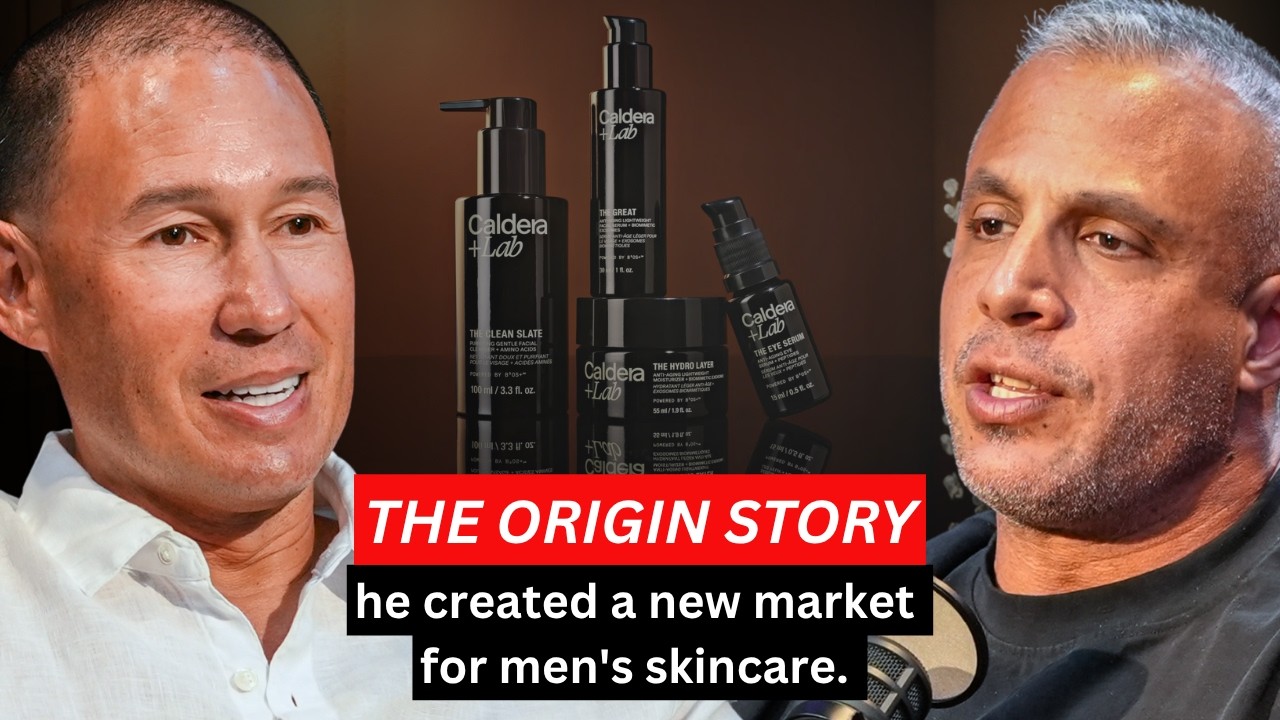
Video summary
Jared from Caldera Lab founded his dedicated men's skincare line after experiencing severe skin issues in Wyoming's harsh high-alpine climate, realizing that existing products failed to address male-specific biological needs such as thicker, oilier skin influenced by testosterone. Rather than repurposing women's formulas or relying on generic options with cheap scents, the company launched in January 2019 using custom formulations derived from wild-harvested "survivor plants" like fireweed and elderberry, which possess elevated antioxidant levels due to their difficult growing conditions. This commitment to quality was reinforced by prioritizing rigorous third-party clinical trials over industry norms of simply slapping logos onto existing products, a strategy that resonated deeply with men interested in self-optimization, fitness, and longevity while achieving rapid initial success and high customer loyalty rates near 70%.
The brand's scientific approach focuses on targeted regeneration rather than treating the entire face at once, avoiding harsh traditional retinol which can damage skin layers like scabs by instead utilizing plant-based alternatives that encourage healthy aging without causing irritation. Their product line features serums and moisturizers containing patent-pending exosomes designed specifically for male dermis depth to deliver ingredients effectively while maintaining moisture balance, with the company expanding their offerings from dry-skin formulas to include options for oily or normal skin types in response to customer feedback regarding humid climates. A standout bestseller is their body bar soap, which manages to create a thick lather despite being natural through extensive research and development, reflecting the brand's dedication to innovation while maintaining a core demographic of men aged 40–60 who are increasingly joined by female customers purchasing for themselves or partners during holidays.
Caldera Lab has evolved from self-funding in Jackson Hole to raising Series A capital after moving its headquarters to Austin in 2021, now operating with over twenty virtual employees across the United States while remaining focused on skincare innovation rather than diversifying into supplements. The company validates their dramatic improvements in fine lines and skin quality through costly but necessary clinical studies involving dozens of participants per study lasting up to three months, ensuring that highly concentrated products like the Great serum can last for two months with daily use before launching at major retailers like Nordstrom across thirty-three top markets including a successful flagship debut in New York City. With profitable growth exceeding double digits annually and plans to continue developing hair care and new deodorant later this year, Caldera Lab aims to build the best possible brand while fostering healthy competition within an emerging men's skincare market they helped create through their unique microbiome-focused science and ethos-driven marketing team.
Read the full video transcript
You just found the most downloaded
fitness, health, and entertainment
podcast. This is mind pump. Today's
episode, we have the CEO of Caldera Lab
on the podcast. So, Caldera Lab is
really innovating in the skin care
market. First off, they're one of the
top skin care companies for men. I know
that was a a place nobody wanted to go.
Well, they did and they crushed it.
Their their products are natural and
they make your skin healthier. So, we
wanted him on the show to talk about the
history behind this company, why Target
Men, why the name, and how does their
stuff actually work. So, we know you're
going to love this episode. And of
course, it's brought to you by Caldera
Lab, and if you go through our link,
you'll get 20% off. Go to
calderab.com/mpump.
Use the code mindpump20 to get the 20%
off discount. Here comes the show.
[snorts]
>> Jared, welcome to the show.
>> Thank you. Thanks for having me. So, uh,
founder, uh, of Caldera Lab, and I've
been meaning to ask you this. So, it I
feels like you guys have created a like
new category of skincare. You went after
an audience that I don't think anybody
wanted to touch
>> in skincare. Like, what gave you the
idea? And by the way, you guys are
crushing. You do a good good job. So,
you obviously you your hunch was right.
>> But what made you want to go for skin
care for men? Like, how did that all
start?
>> Yeah. Yeah, it's a great question. So
I've never built a physical product
before um as a business entrepreneur. I
was an entrepreneur um and am
entrepreneur uh for most of my career.
Um I start off started off in the adtech
industry and in down in Southern
California couple years out of college
and um about 15 years into that had an
opportunity to sell a portion of the
business and take some time off and
that's when my wife and I with a new
baby uh started living in Jackson Hole,
Wyoming and uh living in that high
alpine climate if you ever go to like
Tahoe and whatnot your hands start to
get really dry and ashy, your skin
starts to dry out, your lips all that
stuff um started to happen to me and I
was, you know, just turning 40, new
baby, starting to see the the signs of
aging and getting really chafed. All
this stuff, the products I had been
historically using for men, uh for me
that from my 20s and 30s just stopped
working entirely and started to make my
skin even worse. So very cliche started
using some my wife's products and um
there was like one or two that just
transformed my skin and I was like wow
like how this is incredible you know why
doesn't this exist for men and that's
that's how it all kind of kicked it off
from that from that point forward.
>> So you're like okay guys need this but
also guys don't are not historically
don't care about skinare stuff.
>> How do we like make them care about
>> Yeah. Did you think about that? Were you
like, "Well, dudes don't really like how
am I going to sell this to guys?"
>> You know, interestingly, I started to
see a trend, you know, like I mentioned,
just turned 40 of my friends starting to
use more skincare products, right? Uh,
including myself and people in Jackson
Hole, guys who are like rugged, you like
mountaineers, like hardcore back country
skiers and stuff like that, you know?
Surprisingly,
>> you know, they tell me, "Oh, yeah, I was
using this one product." I'm like I'm
using the same one you know [laughter]
>> interesting
>> so so it started clicking it started
clicking wait a minute there are there
there are men who are using skincare
products maybe it's not in mass but I
saw the vision at some point there's
going to be an inflection point when it
does happen where men are going to be
more of a consumer in this category that
was that was the long-term vision do you
think like uh how huge the Jackson Hole
move had to be cuz so for me personally,
this is before meeting color. I didn't
even realize I had that issue until
experiencing going to like Reno and Lake
Tahoe and living in California near the
coast
>> and getting a little bit older. Didn't
notice it as a kid. For some reason, as
I as I got into my late 30s, started to
notice like, oh my god, when I go over
here, as much as I love going to Tahoe,
um just my lips start cracking and my
skin gets certain dry and I have
psoriasis now and so that flares up. So,
had you not made that move, do you think
you make that? Do you think you see
that? Do you think you even notice the
difference in your skin? Were you
noticing it even in in California?
Not as bad, you know, because uh you
know, I was living by the ocean. Yeah.
You know, so
>> which is nice when have had the nice uh
moisture in the air.
>> Uh but once I got into that that high
elevation, it just amplified things
exponentially. It's like being out in
the desert in Palm Springs and stuff
there. It's dry as well. You know, you
dry out quite quickly. And so that that
that really took my skin health to a
different place that I had never
experienced before. And you know, skin
is like that. It's like that one, you
know, thing that visibly when when when
you see someone or they see you. If your
skin's not healthy, that's the kind of
the first thing that you
>> That's right.
>> you know, identifies the person looks a
little tired or they don't there's
something going on there, you know. And
so for me, you know, when I started
experiencing these things and I was able
to solve them with some of the products
from for my wife, that inspired us. like
why doesn't these types of of of
products exist for for men? And the
thing was that, you know, there are
ingredients that that work better for
men's skin because men's skin is 25%
thicker. It's two times more oilier and
it's and it's and it's managed by
testosterone, right? So, you know,
there's question of why don't just use
women's skinincare, right? Well, that's
built for women's skin, right? our skin
is different
>> and that's what really inspired me to
dive in deeper and start learning about
how to really build product for a men's
skin profile.
>> So that first one that you tried that
was a woman's product and you already
noticed it start to help. How much is
your formulation different from that?
Because I imagine that was probably the
base. You're like, "Okay, there's
something here that this is kind of
working. How do I improve on that? How
how did that process look like?
>> Great question. So, what we did is we
started to analyze and look at and
research all the different activives out
there. The activives are the ingredients
that actually have uh that make a
difference on the skin that actually
they're like the supplements, the
vitamins for your skin. Okay? And there
are are activives that have clinical
data and research around male skin, male
hair, male endocrinology. And so, we
started to zero in and focus on those,
right? that have clinical data that
actually improve your your skin quality.
And that's kind of where the whole
journey started to like unlock one door
after another that oh wow, you can
actually build a whole formula tailored
around men's skin. And this hadn't been
done from what we researched before.
Everything was kind of unisex or is
mostly like women's brands or women's
formulas that we repurposed for men with
different scent profiles. That's what
was happening in the men's skincare
category at the time. You know, you
know, in the in the skincare industry,
it's interesting because I think it's a
lot like the supplement industry. You
can go to these co-manufacturers. You
can show up and you're like, "Hey, I'm
this new brand. You know, I'm really
good at marketing. I want to build a
new, you know, supplement or skincare
brand, right?" And they're they'll
they'll show you a menu. Here's your
cleansers. Here's your moisturizers.
Here's your other products.
>> You just slap your
>> You can you can put this scent in here.
You like this scent? Okay. Go go go to a
branding agency. Come back and select
our packaging. We'll put this all in
there. You'll be in business in six
months.
>> Wow. And that exists that existed.
>> Isn't that like isn't it like the uh
clone and perfume game like the same way
too? Isn't a lot of stuff like that?
>> I think I think so.
I mean perfume is I think perfume is
like owned by like one like one major
conglomerate owns like most all the
scents
>> and then all these fancy brands just put
their logo on that scent and it's like
there's not like this and they they sell
it like it's this crazy formulation that
they did.
So, I got to give you a little push back
cuz my wife
>> stopped using her women's skincare stuff
and she uses she steals my Caldera Lab
stuff.
>> Nice.
>> She likes it way more
>> than the other stuff. So, it's although
it's formulated for men, it's also
different because when I look at women's
products, when I look at the
ingredients,
>> uh your stuff is, and this is such a
bastardized term, it's natural. There's
a lot of natural ingredients
>> whereas the other products are like very
like chemical based type stuff. Is is
that like a big is that like a big deal
for you guys to make sure that okay
>> huge deal that was from inception
back when we started to dive into this
category. What was happening in the in
the women's category there was this
clean movement. You know people were
stepping away from toxic skincare, toxic
home products, things of that nature. We
just had a baby. my wife went super into
it and uh that was always paramount to
us to have uh a product line that came
from natural ingredients but high
quality natural ingredients and there
are there are ingredients that are
naturally derived that have like really
high quality almost medical grade you
know performance right and those are
kind of the the activives and so
>> we've always built our products with
science and and nature as a combination
Right. That's the ethos of of how we
select our ingredients and build our
formulations. So clean now and and and
you know toxifree that is that is kind
of the the the table spa stakes right in
Europe there's like 1,200 ingredients
banned right here
>> better not here
>> there are about 20 you know and so you
know historically there's all these you
know brands and products that had a lot
of these things that were maybe not so
good for you know and we're finding
these out you know now with people
getting sick and whatnot
>> now how much how much more uh difficult
andor expensive is it to go the whole
natural route than to just jump on the
bandwagon and throw some of the
>> it's a lot more complicated, right?
Because you know the the
>> the stuff that is chemically made,
right? It is it's it's made in a lab,
right? It's very they they produce it
very easily and it can combine well with
other chemicals. When you have naturally
derived products or natural ingredients,
right,
>> they have to be tested with the other
ingredients for stability and irritency
and things of that nature.
>> I mean, all products do generally, but
when they're naturalbased, right? Um,
they just have a little bit more of of
potential to, you know, interact with an
other ingredient, not the way that you
intended it,
>> right? as far mixing the smell of it,
the tech. Like I I could see how,
>> oh, these two great natural things are
supposed to be good for your skin, but
boy, they just don't
>> they don't work together.
>> Now, does did you run into that a lot?
Did you run into like, oh, I really want
this in it, but it's just like they just
>> Yeah. So, you know, when we kicked this
thing off, we started reaching out to
the top scientists, top formulators, top
green chemists in the industry, telling
them about our our vision of wanting to
create a high performance premium
skincare brand for men. And a lot of
them, they all loved it. They all said
we were crazy at the same time. And just
because, you know, from their
experience,
the industry wasn't ready yet, right?
and and some of the brands before us
just failed. You know, pretty much every
every male celebrity skincare brand out
there before us didn't didn't make it,
you know, and so we said, you know,
that's a great place to be. You know, if
if someone tells you don't go there in
business, you probably want to look
deeper.
>> It's open water. It's essentially.
>> Yeah. Green pastures there.
>> Yeah. So, in fact, so that's actually
one of the questions I was going to ask
you cuz you're doing this and you're
like, cool, less competitors. However,
everybody seems to fail.
>> Yeah.
>> In this uh in this area.
>> So, a big part of this um I I know this
for a fact, but I'd like to ask you was
going to be like, how do we reach this
audience? How do we get men to consider
skincare products when historically it
just hasn't worked no matter what
football player or athlete or whatever
has presented it. Uh so, you must have
looked at this and said, "Okay, how are
we going to approach this and and
connect with men?" And what what did
that look like?
>> Yeah. So, you know, I I I I've built
this business a lot around my own
personal journey and those of the people
and my friends around me. You know, as I
mentioned, as I started get getting
older, my skin started to suffer. You
know, I started investing more and more
into nutrition, into fitness, and
wellness, right? Longevity, taking care
of myself, and and self-care being a big
part of that, right? as we've brought
this brand to market and we've
identified a group of customers and a
lot of them are your customers, right?
Who are into those same things,
>> right? We started tapping into uh a
self-optimization movement,
>> right? This this longevity movement,
this fitness movement, this this kind of
wellness, you know, category, right?
That's
>> that's it's a consumer shift, right?
>> Totally.
>> It's a consumer shift. Did you did you
see it or did you like kind of feel it
as it was happening? Was it like
something like you for
>> a little bit of both? I knew, you know,
from myself and those around me, it's
like, you know, I have friends who kind
of went the other path, you know, don't
work out, eat like you know, don't
can't care, you know, don't don't really
think twice about, you know, their their
wellness overall, right? And and they're
great. They love what they're doing,
right? And then I have other friends
like myself who are very conscious
about, you know, how we show up every
day and what we put in our body and how
we train and how we, you know, think
about
>> everything that that is our whole
wellness uh optimization stack, right?
And so seeing that that movement take
place and starting to tap into that
advertising wise, right, on social,
right, and p through podcasts and
whatnot, tapping into where those
customers out there are consuming their
content and then showing up with with
ads that, you know, explain our ethos of
of a brand that that skincare is also
about skin health and your overall
health and tapping into that movement.
That's where we I think we we hit a
chord with our consumer. When did you
guys uh hit the market? What year?
>> So we launched in 2019. We started
product development in 2017. So we
worked on one product for almost two
years and then we did a actual clinical
trial to validate the performance and
then we launched in January of 2019.
Okay. So we're partners early.
>> What what was the we'll get there cuz I
want to ask that. But uh what was what
percentage of the skincare market was
men when you started? because you see
them like what did it look like? Like
how how big of a sliver?
>> I you know I think it's it was very it
was low single digits. [laughter]
>> It's almost non-existent.
>> Yeah. Yeah. Low single digits for
premium skincare for men. Our first
product that we launched the good which
is our hero skew. It's $110.
>> That's the other part that I thought was
>> I mean you about a double leap.
>> If you wrote the double leap right there
it's like I got to convince dudes
>> and I'm going to make 110 bucks.
>> Yeah. And that that that
>> that's why everyone said we were crazy.
>> Yeah.
>> Yeah. Okay. So So and this is how you
know you did a great job cuz we've
worked with we've I've seen this with a
couple companies, not very many where
they come out with a product, everybody
says crazy.
>> Mhm.
>> And then it does so well it creates a
new market.
>> I feel like you guys have done that.
Like how do we know what the stats are
now on what percentage of the skincare
market has it changed since 2019? It's
been growing double digits. Been been
growing double digits. I don't know the
exact I haven't looked at the the recent
data, but you know, our business is
growing exponentially.
>> Okay.
>> And and and so and 98% of our customers,
you know, in our surveys, I say they're
they're male customers and we look at
our customer list and this is all men
and they're buying for themselves. So
the the movement is here.
>> Did it did was it right out the gates or
was it a slow
>> No. So, so when we launched, you know,
we we we didn't know like if we were
going to be sitting in a ware with a
warehouse of 10,000 of these things,
right?
>> And we only ordered 10,000 because, you
know, that was kind of the the minimum
order and we didn't want to like, you
know, be too aggressive.
>> Launched and day one, we started
selling. We started selling and and, you
know, we you know, we started ramping
and ramping. Every month was bigger than
the next. And and by the time from
January when we got through summer, we
started to see our our our inventory was
really depleting and people re repeat
purchasing and uh we're like maybe
this is a real business. We'll have to
place another purchase order. So placed
another order. Immediately we started to
get feedback, you know, love your
product. I use a cleanser. I use a
moisturizer. Can you bring those out to
market as well? you know, and and that
and that that when we started to get
that feedback loop coming in, that was I
think the the moment that we said,
"Okay, we have confidence of in moving
forward in in in really starting to grow
and build this thing."
>> Your customer retention is crazy. Yes.
>> Okay. Cuz I because Okay, so
[clears throat] I I'd love Adam, you got
to share how we started working with
them because
>> Well, for for I will get there too, but
I want to So you had an advertising
background before this,
>> correct? Right. It did, but but that was
on the B2B side.
>> Okay.
>> So, never totally different.
>> Yeah. Yeah. Yeah.
>> Totally different, but still have
>> you. Yeah. Under Yes.
>> Yeah. So, you have a you have a decent
foundation. I mean, to the point where I
mean, I'm so curious to even how you you
branded like the brand is is beautiful.
It's obviously Did you hire that out?
Did you figure that out yourself? How
how many reiterations were there to like
what this should look like and
everything? Did you spend a lot of time
on that? How much did you have to spend
before you could even see if there was a
market first? So, were you
>> deep underwater financially before you
even, you know, went out there? Like,
what did that look like?
>> So, a lot of questions, but all good
ones. Yeah. So, uh researched a lot of
about the industry early on like you
know who are the who are the branding
companies for these these brands you
know these creative agencies that you go
to like with an idea and they then they
create your brand your packaging and
things of that nature you know who are
the PR agencies who are the contract
manufacturers who who are the you know
formulators so so researched all these
things and and then you know the
competition that exists in men's the
competi you know the women's category.
Built all that research and then decided
to to design a plan and a strategy,
right? Coming up with the name, you
know, uh the location where the the
business is going to be founded, you
know, what's our first product, you
know, what's the cogs, all those things,
right? And so, you know, costwise, yeah,
you I had to invest a lot of money in
this company initially to get it off the
ground to to to to design the brand to
to do the packaging, to make that firstQ
order, you know, of 10,000 units, right?
And then build the website, you know,
put together a small team of, you know,
product development specialists and in
e-commerce and then launch, right? So,
so it takes takes a little bit, you
know, and I didn't have any experience.
So, yes, I understood the ecosystem of
advertising and how things are are
created. Yeah.
>> But it was entirely new and it was a
challenge. It was an exciting challenge
because moving from,
>> you know, ad tech into consumer
>> is a completely different beast in many
ways. You're dealing with real
customers, right? And those real
customers if they don't repurchase,
you're dead in the water. Yes. You know,
>> and and you know, I think
>> what set us apart when I know what set
us apart is our product development. So,
you know, going back to that, you know,
idea of going to a contract
manufacturer, they have these formulas.
You can just buy them. You you get
exclusivity to them, whatever. Put a
scent into them, you're you're in market
with your new men's skincare business.
That also happened that happened in the
women's side as well. So, the brands
that we identified in the women's
category that were doing really
interesting work were doing all custom
formulation,
>> right? So they're starting from scratch,
right, with their own briefs and their
ingredient selections. And then you
iterate and iterate and iterate. You
test through clinical trials and things
of that nature. And then you go to
market. It's a long time. It's like two
to three years to bring a product out to
market. There's a lot of risk. What if
it doesn't work once you launch it? It
has stability issues, all those things,
right? You just wasted all that time
versus that whole fail fast mentality.
So we took the long hardway approach of
product development. But that's the only
way that we've identified you can build
really like interesting formulas that
actually have efficacy
>> and get repeat purchases.
>> Yeah.
>> And that's been our moat is our product
development. And then we went even
further re recently with that, you know,
you got,
>> you know, proprietary formulas, right,
with existing ingredients that ex that
you can buy from like top, you know,
ingredient suppliers,
you know, peptides and and exoomes and
all those things, right? Yeah. um we
actually went into the biotech category
where we started working on building our
own proprietary ingredients with our the
top labs in Europe,
>> right? So the exoome category is the one
that we focus in most recently. So, you
know, product development for us is what
really has separated us and has allowed
enabled us to build a brand, get into
market and grow year over year, quarter
over quarter, become profitable, and
then start to hit the wave that we're
hitting now, right? Where word of mouth,
you know, our our whole distribution
channel is working. We're now going, we
just went into Nordstrom's, you know,
you know,
>> wow, sick.
>> What happened that we launched that in
May?
>> Awesome. And now we've already been, you
know, shared that we're the number two
men's brand. You know,
>> sick.
>> I don't know if I can say that, but
[laughter]
>> well, okay. So, the other thing that cuz
all that's important for sure because
what I mean customer focus, they get the
product, they love the product. They
tell that's one of the best ways to
build and lay a foundation. But the
other thing that I think people
entrepreneurs just they they miss so
much is that
>> I don't care if you have the best
product in the world getting in the
hands of thousands of people to go test
and fall in love with it to go tell
thousands more people. [clears throat]
So, did you have a, you know, at that
time, did you have a social media or a
podcast strategy? Like, how were you
going to get this in the hands? I've got
this awesome product. You know, you're
going to win there. You've tested people
who aren't even interested.
>> Everybody that's your friend, okay, your
circle, so 100 people maybe, right, are
telling you how awesome it is, but 100
people doesn't build a multi-million
dollar business.
>> So, what's the strategy of how do I get
this out to everybody?
>> Yeah. So, it was a lot of fail and
learn. Okay. you know, was like, "Yeah,
we we you know, we have our website.
Okay, great. [snorts]
>> You know, social account, that's that's
you need that for sure, right? Uh go and
get a Meta account and start
advertising, right? Did that to try that
on our own. Then we then we like, okay,
we're not doing it so well. So, let's
hire an agency, you know, uh for for
growth marketing, right? Let's let's
what's let's what's let's what's, you
know, hire some consultants to help us
like think through how to like build a
growth funnel, right? How to build ads,
how to build landing pages, right? how
to think about the this this whole
growth funnel, you know, the top of
funnel, midfunnel, low, like all these
things that, you know, exist in um DTOC
marketing, we didn't have any experience
in, you know, and and or very little,
right, with the team I put together. And
so, every year we got a little bit
better, a little bit smarter, and we
went from one agency to the next, and
finally I built an in-house team. And
that was tough. That was tough. we, you
know, that was almost, you know, seven
years ago probably, right? And um
or six years ago and and and that was
that was when we really started to see
progress take place is when we started
to build our in-house team and learn how
to how to do all those things
internally. Isn't it funny that has I
have a I'm a part of a a founders group
with a lot of successful founders and
one of the common themes we were just
all together not that long ago in Miami
that we all shared all of us that have
been doing this for 10 plus years is uh
that turning point uh we all hired all
these agencies we all had stories of
this one that one this one and all the
learning experiences and then eventually
when it all came together was when we
built it in-house cuz in And you know,
what do you think that is? You think
it's uh nobody's ever going to, you
know, love your child the way you do and
you know, like, yeah, it's just no one's
going to know your voice and brand as
well as you, right?
>> Yeah. I feel I feel the the same way.
What was So, you you build it all in
house. And by the way, too, just to give
you some some flowers,
>> uh we use uh the ads that you guys make
of us. So, your whitelisting ads you run
of us. We try and teach all the other
partners how well you guys do that. We
have to coach a lot of other partners on
like how you take the content that we
make when we talk about our our partners
and brands that we love and make ads out
of it. And you're whoever is doing that
on your team does a phenomenal job. Does
such a good job that we use them as the
example of like you guys need to figure
this out cuz we don't do it for them. We
literally just do what we do which is
talk about the brand that we love and
they know how to chop it, piece it
together and make it a great ad. You
know what's cool about that is, you
know, the team that we built, they
didn't, you know, they didn't come from
like the top brands and stuff. You know,
the team that I built were very
talented, smart, young professionals
earlier in their career, right? Who you
saw had a really high upside potential
and they've developed those skills in
house. Yeah.
>> With our brand,
>> right? And they've become a part of our
brand. They they know it inside and out.
They are the brand.
>> That makes sense.
>> Yeah. It's such a good It's such a good
question because well, there's no
question u how good your products are.
Your re the your repurchase rate or
loyalty has got to be through the roof.
Yeah.
>> And I know this because
>> I have a lot of uh I have a big family,
come from a big Italian family. There's
a lot of uh male cousins. There's like
nine of us that grew up together, all
the same age.
>> And once a year we do a Christmas party
for Mind Pump. And so we'll invite them.
And every guest that we invite to this
Christmas party, we give them like a
little goodie bag that includes like
some gifts and stuff. And we've put in
Caldera Lab products in there. And now
my cousins, no interest in skincare.
Zero. Like these are dudes that wash
their face with like, you know, dish
soap. Like they could care less. Every
single one of them is a regular customer
of Yeah. Cuz they used it once and
they're like, "Oh my god, this stuff is
incredible." Yes. So your loyalty, I
mean, do you can you share what that
looks like because it's got to be
through the roof.
>> Yeah, we're we're at the high high mark.
So for a consumer brand, anything like
over 30 40% is is is is decent. We're at
the almost 70%. High high 60%.
>> Crazy. Wow.
>> Are men typically loyal like that with
products or is that even a harder market
to get?
>> I mean, I've heard men are loyal. I'm
loyal, you know, once I buy, you know,
shoes or clothes or any, you know,
brands that I enjoy that work for me, I
stick with them, you know. So, so I know
that we've always heard that. And but
yeah, our customers are are super loyal.
>> That's an interesting question. I wonder
that comparing men and women because
women typically are better customers,
right? They're they're buyers. They
they're consumers.
>> But I bet
>> once you win a guy over, we're probably
more loyal to a brand. Like we're I'm so
that way with everything. I find a
sandwich, I eat the same damn sandwich
every time.
You never leave.
>> Yeah. My wife hates it. She's like, "You
want to go back to the same restaurant
over and over again?" Well, there's
there's something to be said about once
you win that customer over like it's
they're probably
>> Okay, Adam, I want you to tell them how
we all how we we started working with
them. We
>> How long has it been though?
>> It has. So, do you remember what year?
Cuz it had been pretty close to when you
guys were launching. Were we your first
podcast you ever worked with?
>> I think so. I think it was I think we
did a few podcasts within a short period
of time
>> within a 30-day mix. I think you guys
were one of four or five.
>> Yeah. And I I remember when it came
across myself, my myself and and I
actually don't know if C if Katrina was
helping me at this time if it was all
the way back to Taylor, but I've always
ran the the partnership side. And
typically the way this looks is I I do a
lot of the negotiating talking to the
partners. if I think it's something
that's even worth bringing to these
guys, I'll bring it over to them and
say, "Hey, here's a company that wants
to work with it, try it out, see what
you guys like." And uh I had got it and
I'm so of the four of us, I'm probably
maybe I'd include Doug in there, too.
Interested in more of the stuff, right?
They they tease me of being the more
feminine one out of all of us, right?
So, I I care about how I look. I care
about that stuff, right? Yeah. Justin
washes faith gasoline. Justin S doesn't
do anything. Uh, and so I started using
I have psoriasis
>> and so um and I'm very anti all the
steroid creams they try and give you and
stuff like that.
>> And you got sensitive skin and I have
very sensitive skin and uh man it's like
instantly I saw a difference and I loved
it and I was like man I really like this
but I remember going these guys are
nuts. [laughter]
>> Neither one of these knuckleheads use
anything like this. And so I bring it to
and I said hey I really like this. I
like this brand. I liked everything
about your branding, your website. I saw
obviously love the product. And I said,
"Let's just try this." And I don't even
remember what I I originally pitched you
guys on advertising because I think I
believe I was like, "I'm going to just
give them a really low price because I
don't want to I don't want to fail you.
I don't want to like because it could be
flat."
>> Mh.
>> And uh and and convince the guys to at
least try it. And uh I'm pretty sure it
took off really really well.
>> We were sold. I'll tell you what sold
me. So, I'm a big science guy. So, I
looked at some of the ingredients and
I'm like, "Huh, this is interesting."
>> It's for me, I thought this is really
good for the microbiome of the skin.
That's what that's where I came from.
That's correct.
>> Cuz I know that the skin
>> uh microbiome of the skin is very
important. Um, a lot of people don't
realize that there's a microbiome on
your skin.
>> Um, and you know, you had something
earlier about how your skin is one of
the first things people notice. Well,
that's because the skin shows it
displays a lot about your health. Gut
health issues will show up on your skin.
Liver issues will show up in your skin.
even issues with blood lipids will show
up on your skin.
>> Uh so that kind of got me interested.
But what sold me was you couldn't get
two guys with more different skin than
Justin and I.
>> Yeah.
>> Like it was actually wild to
>> He's dry and ashy. I'm oily and dark.
Okay.
>> And how can we have the similar results?
>> We used the I think it was the good,
right? That's the serum.
>> And both of us were like like I'm like,
"Oh, it's oil. It's going to make my
face super oily." No, it's like balance
it out. this guy puts it on and looks
and we're just both like,
>> "Yeah,
>> I think we're sponges like I think we're
going to use this," you know, and so we
were just totally sold
>> from that point.
>> I also think that's part of it too is um
and I I believe this in the supplement
market too, the supplements that do the
best and show or when people can feel it
right away,
>> right? So, if it was like one of those
products where it's like use this for 30
days and we promise your skin will be
better and it's like, you know, what
dude is going to do this every day? But
it's like you do it one time and you can
kind of feel and see the difference
right away.
>> And so something that it's like, okay,
this is cool. And so yeah, it was a bit
of twisting the arm to get them to try
it. They were open was funny.
>> Yeah.
>> And so they were like they were open to
it, but then the response we got from
our audience was just incredible.
>> Were we were we a big part of that
initial push to kind of get into that
audience? Did that make a big
difference?
>> That that opened our eyes big time. that
that
>> your type of audience, you know, people
who are into self-optimization, into
wellness and longevity, into fitness,
right? That that there's a customer base
out there for us,
>> right? And we tapped into that through
your podcast. It it validated what we we
assume was going to be a really strong
customer base and now it's just been,
you know, pure chemistry. you know, it's
it's been, you know, an incredible
relationship and uh your customers are
are some of our highest value customers.
>> I you know, I imagine too because it is
such a perfect marriage when you think
about the storyline of of what you did
and what you try to do by bringing
creating a new market. What happens when
you this is similar to what's happening
even in the peptide space and why we we
do really well for those companies is
there's there's there's a bit of an
education process that you need, right?
like trying to educate men on why this
is good for them. The microbiome of the
skin understand that this is some of the
things that I think that s we do on the
podcast so well cuz getting them con and
then once you convince them to try it
you deliver on the product. So it's like
we do a really good job of explaining
like why this is so good, how this sell
for you, why it will work
>> and then when you deliver on the back
end of oh it's a hell of a product. It's
just this win-win and it's been it's
been it's been an incredible thing to
watch and we joke about it all the time
about like who would have ever thought
that we would have a skin product is
probably one of our number one
>> worked if it was just aesthetic
marketing at all. Yeah. I think the
whole natural and health angle for men
like that clicks cuz it's like okay this
is like
>> functionally good for me like it's my
skin benefits from this as opposed to it
being just like oh I'm going to look
youthful. I don't know a lot of dudes
that talk like that. I
>> I got to say though, it's just the
weirdest thing. I've done a few ads for
you guys and they're they're true. I
They're honest.
>> I've had people come up to me in the
gym, dudes, and they've commented on my
skin, which is very strange to have a
grown man,
>> but it's happened like four times.
>> Yeah.
>> And I immediately
I'm like, "Oh, well, that was a company
that I work with, Kelly." In fact, I've
had people stop me and ask me if I was a
a spokesperson for you guys because we
ad [laughter]
that. So, talk a little bit about the
some of the the science that goes in
>> to the products and the ingredients. Uh
the first product you have was that was
that the good was that the Okay. So,
what went into that or what's in that
that makes it work so well and let's
kind of go through some of the some of
the different ones that you have now.
>> Yeah. Yeah. So, the good. So, so being
in Jackson, this is a cool story, right?
Early on, my wife and I started meeting
with local botnists.
Botnist, somebody who studies plants,
right?
>> And um
>> I bet you get great ones out there.
>> You probably have some incredible botist
out.
>> Incredible botnist. Ethnobbotist.
Ethnobbotist is somebody who studies how
humans work with plants for medicinal re
purposes and things of nature
>> that nature. So we we had an idea of of
you know could we find plants in the
region
that had skinincare healing properties
that we could use in our in our products
and in working with the botist there in
Jackson Hole in the mountain west uh we
identified several plants fireweed
elderberry and several others you know u
that we started to to test with the labs
that we're talking about with. And so,
um, with the green scientists that we
worked with and the formulators that
had, you know, that were biologists and
all these really exciting, uh, academics
and and and skincare experts, we put
together like an ingredient list of over
2,000 ingredients.
>> Oh gosh.
>> You know, to evaluate and to think
about, right? And with the intent to try
and and bring in some of these plants
from Jackson Hole in in in the region.
And the reason why is these plants that
live up there in that that region,
they're called survivor plants, right?
They're survivor plants because they
live in really harsh conditions. They go
away in the dormant in the winter and
they come back very vibrant in the
summer and they're full of antioxidants,
right?
>> Because it protects them from the This
is funny because you grow plants and you
want to make them really strong with
whatever act you stress them.
>> That's right. Yeah. That's right.
>> Interesting.
>> Yeah. And so instead of like getting,
you know, ingredients that are farmed,
even if they're organically farmed,
right, wild wild plants have a lot more
antioxidants. And and so we tested this,
you know, to to verify that.
>> And and and so that kind of thinking and
and philosophy of science started to go
into how we built the good. And the good
was, you know, very, you know, naturally
derived. you know, it was oilbased
serum, which at the time there really
weren't any, you know, oil-based serums
for men or in in general, you know, but
um when using that type of a product in
that region, it just felt so nice on my
skin and those that we tested it with,
you know. So from there we started to
look at what are really high-end
activives like an anthrozanum I think
it's called you know
>> um and putting those types of of
activives together with with some of
these these plants like the fireweed etc
and then test it to see how it performs
in the labs and then do an actual
clinical trial. The clinical trial is
really the one where, you know, you go
out to, you know, 40, 50, 60 people that
you have no relationship with that's run
by a lab. They test it multiple ways
through instrument testing, but also
photography and surveys and all that to
get real third party valid validated
results, right? And that's that's kind
of, you know, how we got to a place of
can we really launch a product that we
believe in that we think is going to
have repeat purchases that's going to
actually drive efficacy. And so that's
where the brand started, you know, and
then we we unleash, you know, really
working with sophisticated formulators
and scientists to bring in more of the
the plant-based biotech skincare.
>> Got it. How how the hell do you find
guys like this? Is there like a Google
search club or is this like a a friend
who introduces you to another like
>> yeah re research helps right one you you
you so so you meet you know these these
contract manufacturers you meet these
formulators you you you look for
scientists in the category on LinkedIn
and things of that nature and you start
you know reaching out them to them
saying hey you know this is my brand
what I'm developing some will say yes
we'll work with you and some will say no
we don't think you have a shot and
you're not worth my time you
And as we've grown as a brand, we have
access now to the top lines in the
industry who have built the best brands.
>> Yeah.
>> You know, in in in the space.
>> What what how how many of the the
activives or the plants and the good are
from wild grown plants? Is it a big
percentage?
>> There's uh there's about four that that
are in uh the good that that we
>> that you have to get from
>> every summer we have botnists who are
who are wild harvesting. I was just
going to say, how does that like they
just got to go out into the wilderness?
>> So, they go out into their wilderness,
they go to their patches, they know
where where where they are and they they
they wild harvest and they do it
responsibly so they don't get the whole
patch and they get a part of it so it
regenerates and they do this all over in
different areas.
>> Oh my gosh. And so, how does that work?
Do you have to buy land to do this or do
you just are you able to do it on
>> So, so they have their regions, right?
They have their their their, you know,
relationships with wherever they go and
they wild harvest. Are there popular or
commonly used uh activives in other
skincare products that you guys don't
use
>> like retinol? Do you guys use retinol?
>> We don't use retinol. We use like
plant-based retinols and things of that
nature because you know I a lot of this
I just you know test on myself whenever
I use a retinol. My face gets extremely
chafed.
>> That's right.
>> And and it can't I can't kick it, you
know. And the thing with retinol, you
have to keep on using it and using it
because it
>> it basically eats away. [laughter] Yeah.
It kills your layers of skin. It's like
when you get a scab and you your scab
goes away and you have that white or
that the the pink, you know, it's the
same thing with your face and you have
to go through that process for like 3
weeks or something to that effect. My
face can't handle that. And a lot of men
that I know can't handle either because
they they have like sensitive skin, you
know. So, we stay away. And that's the
thing when I was testing, you know, a
lot of women's products that had some of
these really advanced, you know,
high-grade, you know, ingredients in
there that do these pills and whatnot.
They're harsh.
>> They're harsh. You know, that doesn't
work for me, you know, and the people my
friends it didn't work for. So, we
stayed away from some of those, you
know, but there are activives that are
more gentle, right, that that can work
with a male skin type.
>> What So, here's why my wife switched cuz
she's used all the other stuff. You
know, she's obviously a woman, so she's
used female stuff
>> and now she switches over uh and uses
primarily, if not only Caldera Lab
products. She says it it doesn't feel
like it's forcing her skin
>> to look healthy. It's almost like it's
just
>> uh like encouraging it to look healthier
or it's just becoming healthier. Whereas
the other stuff was harsh, I think would
be the right word.
>> That's a great point. You know,
>> this whole anti-aging thing, right? It's
kind of right? [laughter]
Right. We're all aging, right?
>> You know, uh you know, we have anti
anti-aging products, but you know,
they're healthy aging products. You
know,
>> that's a great point.
>> You know, it's it's healthy aging,
>> right?
>> And I think that you the content that
you produce, right? It's like, you know,
you're trying to help people age health
in a healthy way, wise way, right? And
that's what our products do. You know,
like your wife points out, you don't
have to go through this whole, you know,
week or two of of looking.
>> It's like waging war on your skin to get
it to look the way you want. You're
you're gonna you're gonna use it and
your skin's going to feel healthier in
in days if not weeks, you know, for most
people.
>> Well, the first time. Yeah.
>> Uh you you mentioned exosomes. I know
this is like a big like this is a big
talking point now. Uh in
>> what which one of your products is high
in the exosomes? Is it the uh which one
is it?
>> So, so last year we brought to market
two products
uh a new skin care serum called the
great and a new moisturizer called the
hydro.
>> The hydrolayer. That's the one. Okay.
And so both products have our new patent
pending exoomes and we built those
specifically for for male skin. Uh and
and and so exoomes are really small and
they're a delivery system. And and what
that means is they can go significantly
deeper into your skin dermis to the
places that really need the ingredients,
right? And so that's what the exoomes
do.
>> The delivery
>> it's it's a delivery mechanism, right?
and and they can hold a tremendous
amount of um uh like fluid or moisture I
think it is. Right. So, right. Yeah.
Okay.
>> Yeah.
>> All right. So, so you have the base
layer, hydro layer, the good. What What
are they all different or how are they
all different? What are they all good
for?
>> Yeah. So, when we first built the line
with the with the the good and the base
layer, it's for more drier skin, drier
climates, right? M
>> um but you know we missed out on a
certain skin type you know which is more
normal to oily skin right and so as we
started building the business and we
were getting you know interest from our
customers saying hey you know I have
oily skin I live in Miami I can't really
use your products because you know
they're they're built for you know more
of a a drier skin type and drier climate
right so so that was one of the reasons
why we started to to go down the path of
okay let's let's new products, but let's
also add even more intensity of of of
new biotech ingredients and and
continuing to advance the innovation
forward. So, that was the great in the
hydro layer that we brought out last
year that are crushing it.
>> Are they doing really well? How's the
growth of the company been since you
guys started?
>> It's been exponential, you know, and
this year we're having our best year.
It's, you know, we're growing high
double digits.
>> Wow.
>> You know, it's profitable. Um, you know,
we've tapped into this movement of of
longevity and self-optimization,
wellness that, you know, guys are more
into the, you know, taking care of
themselves and self-care and skincare
being that one piece, you know, to kind
of finish it off, you know, converting
men, you know, who who've done all these
things. Now, skincare is like that last
piece. So, so the business is is tapped
into that that movement and and the
acceleration is is is really exciting.
We skipped the one product that I
absolutely absolutely I absolutely love.
He raves
>> and always talk about
>> and I I'm always telling these guys that
they have to use it more is the bar of
soap. The
>> body bar.
>> I have never had a natural bar of soap
lather. The my biggest pet peeve of
natural bars of soap
>> is it feels like I'm doing nothing. And
I know the lather and and the foam and
toothpaste and I know all that is
made up to make you feel like you're
getting cleaner or soapier, but it
doesn't matter. There's something about
it that I just I like to feel and see.
>> It's a really thick look. It's like a
>> I'm so fascinated by how you did that
and why nobody else that has natural
soaps
>> can make a lather. What is that?
>> So,
>> I mean, you have to give away the secret
if it's actually a super secret.
>> This goes to our core of our product
development process. We take a long time
to build products to make sure that they
kick ass, right?
>> And it's like, well, how do you make a
bar of soap kick ass?
>> Try it and you'll see how, right? And
so, you know, it took time. We took we
went to the best, you know, soap
manufacturer in the industry and said,
you know, we want to build the highest
performing soap in the market for men
and here's what we wanted to do and
here's the ingredients that we want in
it, and here's what we don't want in it,
and here's the experience that we want.
And it took time to get there, you know,
because these things, you know, when
when you when you create them, you know,
they have a different experience or they
they don't last long because you have
all these, you know, ingredients in
their natural or these activives and
stuff like that and it changes colors
and so you have to go through iteration
after iteration after iteration to get
it right and it took a very long time to
get that bar of soap to perform.
>> Okay. So, does it does it perform as
well as I feel like it should because I
feel like it's my one of my favorite
things.
>> All talk about it.
>> Yeah. Yeah. No.
I mean, I have I have two more behind me
that are there's one right there. Yeah.
Coming home with me. I mean, I I go
through it. It's uh my favorite product.
>> Yeah. Surprisingly, that is becoming one
of the hottest sellers for us.
>> Well, for me, I think that's what it is
is that I've forever I I like natural
soaps and so and and when we go
different places, I always try different
ones and uh and they're crazy expensive
sometimes these things that I try. And
the thing that I always hate is that I I
I feel like I'm just rubbing wax on my
[laughter] pot. I can't see anything.
I'm not sure if I got any. But
>> I'm telling you off air, this guy who
talks about your soap, we tease him. We
tease him about it
>> because I've never seen it. I've never
I've never se I've never seen natural
soap like that that that lathers last as
good as it does.
>> Are you guys growing in the in the in in
the female market? Is that starting to
grow? cuz I can think of another brand
that off the top of my head that went
after men in a market
>> uh that was like everybody thought they
were crazy and they blew up and now
they're reaching the female market as a
result.
>> Uh are are you guys seeing that?
>> Yeah. Yeah, we we're absolutely seeing
it. You know, whether they're buying it
for themselves or for their partners,
you know, we don't have that visibility.
We know around like, you know, the
holidays that happens a lot, but it is a
growing uh percentage of our customer
base. But the men's side is that's the
bread and butter. That's what really
where who we who we're building product
for, what makes us unique, and and where
we're seeing the the growth.
>> Now, is there consideration though to
dabble on the other side?
>> No. No. I think I think we're going to
stay in our lane. Yeah. Yeah. you know,
when when brands start to to go off into
different lanes and do all different
types of products and things, I don't
we're never going to do supplements, you
know, we're never going to start going
to things that like,
>> you know, we don't know that well, but
maybe it's hot right now and we're
seeing other brands do it. You know,
we've always been told by really smart
investors and things like, you know,
that once you see a brand start doing
something that's not quarter their their
their
brand, Yeah.
>> Right. what brought them here.
>> That means that something's not going
well.
>> Right. Right. They're getting desperate.
They're just looking for, you know, LTD.
Right. So, uh, anything in the future
that what are you are you working on
something that you can shave to or talk
about?
>> Yeah. Yeah. Um, so body we're going to
continue to to uh lean into. You're
going to see more products there.
Skincare is always going to be our core.
That's always going to be
>> our our our our core of the brand. We're
always going to be innovating, bringing
the best ingredients and formulations.
Uh we do some hair care as well, right?
>> But um I think uh what you'll see next
from us is a deodorant that's going to
come out uh later later this year that
we've been working again on for a very
long time. We wanted to nail the
experience of it. You know, wanted to
put the the highest quality ingredients
in there and and you know, no white
residue, you know, like the amazing
scent but being natural, you know.
>> Oh, I can't wait to see that,
>> you know, and so um that that's
something that we're pretty excited
about. But our skincare products, that's
really where the real innovation and
science is taking place.
>> And then is uh you I mean you said you
tested several podcasts. Our experience
um with our partners that have tested
other podcasts, we tend to ruin the
experience for them for a lot because
nobody ever is like our audience. And so
do you are you with the same partners
still? Is it have you bounced around? Is
it just us? Like who else are you
working with in the podcast space? Are
you guys still testing that? What's that
look like? We we we spend a lot in
podcasts. Yeah. It's it's a nice channel
for us. It's a it's an authentic way to
get in front of customers that we don't
touch in social and other means that
we're advertising
>> and and so yeah, podcast is a very nice
channel, but you guys are you're you're
number one. You know, your audience is
number one. [laughter]
>> Yeah.
>> Trying to renegotiate a contract.
>> No, we got a great partners.
>> I mean, you're uh [laughter] number two.
>> Number two.
>> He know he knows that.
>> Careful. Oh, you're giving him
competitive.
>> What's your top seller?
>> Top seller is still the good.
>> Okay.
>> Our hero our hero ski.
>> Is it just because it's the hero and
it's been around the longest or do you
think it's just truly that it is the one
that everybody
>> Yeah, we've built up a really big
customer base with it. You know, it's
been around since day one. It's it's,
you know, really what we put, you know,
all our creativity and all our
innovation into.
>> Uh, but, you know, the great hydro
layer, you know, those are those are
coming up quite quickly. the ones that
we launched last year. Um, but our our
core skincare, you know, the the top
ones. So, so you know, the good the base
layer, our cleanser crushes it, you
know, that that's that that one's huge.
You [snorts] know, eye serum. Those are
the products, you know, that that drive
the most volume for the customer. And
that's exciting for us because you know
as a brand
>> you're your the score of your health of
of a brand is like you know how well are
your core products doing in your core
category. If that's doing well then
you're doing well as a as a company.
>> Well I'm going to take it on as a
personal goal to make the bar of soap a
top three cuz I think that that's the
one that people are missing out on. I
just think that I first of all I don't
know any dudes that loofah or use any
other like
>> well Doug [laughter] probably does
>> body gel stuff. So most dudes are bar
soap guys and it is the best bar soap
I've ever used in my life. So I mean I'm
going to
>> I got to I got to say too cuz I know
that like uh you know you got the good
which is uh you know kind of oil based
and you have the base which is a little
more matte and the hydro layer which is
kind of more
>> I've used all three of them. I actually
use I have all three of them at home and
depending on which one is closer to me,
that's the one I'll probably use. My
skin is relatively oily. They all work
great.
>> And what that tells me as somebody that
likes to look into the science of
products and stuff is that they're all
good for my skin,
>> right?
>> So like whether your skin's oily or dry,
if you use something that improves the
health of your skin,
>> uh it's gonna it's going to be okay.
It's going to work. Whereas I I think
other products are like this is for oily
skin, this is for dry skin because it's
almost like chemically forcing your skin
to appear to be different. Whereas I can
use any of your I can use any of them.
Uh and they all will look good on me.
They all make my skin look better.
>> My favorite is definitely the good, but
they're all
>> they all work really great, which really
speaks to the fact that you guys
understand
>> skin health.
>> Do you get uh any feedback from So uh I
it's been huge for me for my psoriasis.
Um, I stopped using any steroid creams,
anything like that whatsoever and it's
been incredible for that. Do you get
feedback from clientele that are using
it similarly like that for
>> Absolutely. Okay. Absolutely.
>> Yeah. I think it's I think it's great
for that. And I know that sometimes with
stuff like that, we're not allowed to
say that,
>> right? There's laws and rules.
>> That's right. Yeah.
>> Around that stuff. You know, people
write in emails and they leave reviews
and, you know, we just feel good about
it. We can't promote it, but we feel
good about as a brand.
>> That's why I figured that you guys can't
make because obviously I'm sure you
would advertise it if you could, but I I
mean I talk about that. That's what I
use it for and it's it's been awesome to
get away from any of those steroid
>> cream. I've gotten messages from our
listeners who've used your products who
have acne and it actually helped their
acne, which is wild. Yes.
>> Because you would not expect
>> a moisturizer or a serum or anything
like that do to, you know, to do
anything to acne. Yeah.
>> But again, I think it has to do with the
the skin's microbiome cuz that has a
profound effect
>> on
you get messages from people about that
kind of stuff.
>> Absolutely. Absolutely.
>> That's wild.
>> Yes.
>> That's really really crazy.
>> Yeah.
>> So,
>> where where's uh where's headquarters?
So, are you are you based in is the
headquarters in Jackson or is it
>> So, we launched the company in Jackson
and then we moved it into Austin, Texas
in 21.
>> Okay.
>> Yeah. So, now it's in Austin.
>> Okay.
>> Yeah.
>> And then what's the team look like now?
Do you have I mean full I know you built
your in-house team. How many employees
you guys at right now?
>> We have uh a little over 20.
>> Okay. Nice.
>> A little over 20 consultants.
>> Most everybody in in-house.
>> Everyone's uh so so uh we don't have an
office in Austin. Everyone's virtual.
>> Okay.
>> But our employees are employees and they
they work, you know, they live in
throughout the country.
>> Um but yeah, it's a small but mighty
team. You know, they're they're super
talented and everyone, you know, loves
the brand. They believe in the brand.
They are part of the product development
process. They see like how long it takes
and how complicated, how sophisticated
it is to actually build these products,
how we test them, all these clinical
trials that we do for all the top ones,
you know, so they they know that we're
just not like a marketing company. They
know that we're actually a skincare
company building real product, real
innovation. Yeah.
>> You know, and then we've learned the how
to market them well, you know, and how
to find a customer. is is your typical
consu obviously guy interested in
health, fitness, wellness age age range
35 to 45 is that what I would call
>> yeah you know 35 to 70 is kind of that
that range but 40 to 60 is kind of like
our our our sweet spot usually
[laughter]
when you're 30s you can still get away
with using you know
>> little to no products you know just
maybe you cleanser maybe it's a bar of
soap you know and then your skin starts
getting a little dry and you maybe start
using your body lotion on your face. You
know, I did that. You know, I know a lot
of guys do it,
>> you know, and then and then you start to
think about, well, you know, I'm
starting to see stuff happen. Maybe I'll
try something a little bit better. And
you go to like another product.
>> Talk about the clinical trial because I
love I've broughten that up many several
times on the show. It's on your website
and it talks it's like 90 it was like
over 90%
>> of the participants saw like these
pretty dramatic improvements in things
like fine lines, wrinkles,
>> skin quality. Are those expensive to
run? Like how long it did the trial was
it 30 days, 60 days?
>> Yeah. So for our first one it was
somewhere between like 60 and 90 days or
something to that effect right and we
had I don't know 40 plus uh individuals
right and we didn't you know we don't
have any relationship with them the
lab's the one who engages with them
they're very expensive they're very
risky you know because
>> Yeah because you bad results you get bad
results
exactly you know we we you know the
first one we ran we had none of us on
the team have had ever run a clinical
trial Right. So, we were just like,
>> okay, you know, sweating and rolling the
dice. But, you know, we we knew we had a
good product. We, you know, based on,
>> you know, giving it to friends and
family and stuff and and so, yeah, we
went through that whole process of
testing it uh through clinical results
and, you know, they do the
instrumentation studies, the surveys,
all that stuff. And then you get the
data back and and you know, you're
you're kind of holding your breath and
and it came back incredible. And from
that point,
>> how many trials now have you done? Have
you done two?
I think we've done three or four.
>> Okay.
>> Yeah.
>> Okay. Yeah. So, anybody listening, you
could go look up the if you like data
that's the trials will show you.
>> That's right.
>> That this it's legit. And although the
the the you mentioned the price point of
the of the good,
>> it lasts forever. You only need like a
drop of that to cover your whole face.
>> That's the part that's probably
deceiving about the about the price. And
I think if somebody who might see it and
go, "Wow, that's really expensive." It
lasts a long time, too. Yeah. So you get
a lot out of that
>> at least a month. You know, for many
people it's like two months or month.
>> Oh yeah. If you get if you you're using
it daily and quite you'll it still lasts
a month if you every other day or what
it'll it'll stretch out much longer than
that. Were you did you uh bootstrap
everything? Are you selfunded or did you
guys take on money?
>> So I I self-funded it and then I got a
profitable uh and in 2024 we did a
series A small series A that we raised.
>> Any plans to still take investments? Are
you still trying to scale and grow?
What's the,
>> you know, we're we're, you know,
fortunate enough to be, you know,
profitable and growing fast and being
able to to manage it all on our own
right now. We have a lot of, you know,
high-quality blue chip investors
reaching out. But, you know, I think the
>> the the strategy at this point is to to
keep our heads down and continue
focusing on building the best brand we
can.
>> Yeah.
>> You know, at some point, you know, that
might happen, you know, where we, you
know, look to to to really scale it even
even more so than than it is now. But,
you know, we're in a good position where
we don't need it.
>> Yeah. And and when's when's Nordstrom?
When does that start?
>> So, we launched in May. And
>> Oh, did we launch in May?
>> How's it going?
>> It's going great. Yeah, we're we're one
of the top uh men's brands. They're
telling us we're we're potentially
number two.
>> Oh my gosh.
>> Good for you.
>> Thank you.
>> That's huge, man. That's exciting.
>> Now, is it was this a test just a couple
and then it could go nationwide or did
you go all the way?
>> Yeah. We went into uh 30 like 33 stores
in their top markets, you know, and and
um you know, they've they've really
partnered with us to be their their top,
you know, one of their top men's brand
launches for this year. And so it's been
exciting. We just launched in their
flagship in New York City and it went
incredibly well. You know, we we brought
in estheticians and, you know, we didn't
know if we're going to be able to get
people from off the street to come in
and get facials and they were they were
coming in. It was pretty pretty damn
wild, you know, and uh it was an
exciting launch. Well, I love I I love
hearing uh success stories like yours. I
love hearing about success stories from
entrepreneurs with good purpose and
passion behind what they're doing and uh
we have a special connection because we
started with you kind of early on. So,
it's been great to see, you know, kind
of the start the small company we're
working with and now I I see you guys
everywhere. People talk about you. So,
it's really cool to hear about all this
and I think you're this is like the
beginning. I think you guys are going to
keep just crushing
>> which is kind of cool. And expect more
competitors. I think you you've created
a new market.
>> There are a lot of competitors.
>> Yeah. Because you've kind of you've
shown people now that there's a market
here.
>> That's right.
>> Which is a good news. It just
>> It is good news. You want competition.
>> Absolutely. Bring more awareness to you
guys.
>> That's right. That's what it's doing.
>> Awesome. Well, thanks for coming.
>> Thanks for the partnership. Thanks for
having me.
>> All right. I know you like that episode.
If you did, check this one out. 30% body
fat for men. This is way too high.
[music] This is actually a bit high for
women as well. So, in today's episode,
we're talking about how you can go from
30 to 10. What is 10% body fat? This is
when you have a visible six-pack. Can
you go from 30 to 10%, yes, it's
possible, but not if you guess along the
way. So, we're going to talk about how
you can do that in today's episode.
>> Now, there's a huge range, right, of
like body types. Some people can run uh
a little bit heavier uh and or a little
bit higher