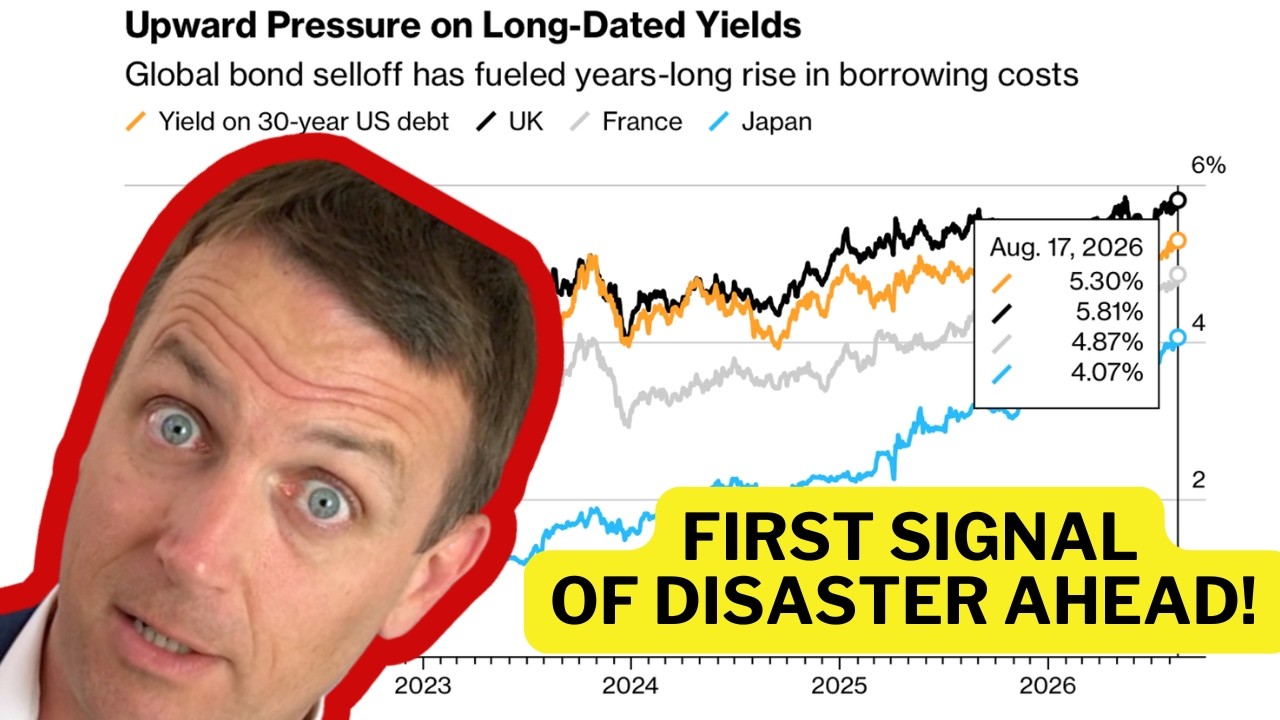
This Is Big - Interest Rates Up, Interest Costs Up!
Watch on YouTubeVideo summary
The central theme of this discussion is that rising interest rates and increasing bond yields are poised to become the defining economic factor for the next five to ten years, overshadowing the current hype surrounding artificial intelligence. After nearly two and a half decades of artificially low interest rates that encouraged excessive borrowing across governments, private equity, and real estate sectors, the financial landscape is shifting dramatically. Long-term US Treasury yields have returned to levels not seen since 2002, signaling the end of an era where debt could be serviced easily through cheap money. This transition marks the beginning of a painful deleveraging phase in the long-term debt cycle, a concept famously illustrated by Ray Dalio, where the cost of servicing debt eventually becomes unsustainable and forces a reckoning that cannot be ignored.
The speaker argues that the current trajectory is leading toward a Ponzi-like scheme where governments are increasingly borrowing money simply to pay interest on existing debt, rather than funding productive growth. As refinancing costs explode, interest payments on the national debt have already doubled in recent years and are projected to consume up to 75% of federal deficits by the end of the decade, rendering current deficit levels of around 6% unsustainable. While inflation was previously used as a tool to manage these burdens, it has failed to stabilize prices or protect purchasing power, instead exacerbating wealth inequality. The reliance on artificial intelligence to solve these structural debt issues is dismissed as unrealistic, with warnings that if the massive capital expenditures for AI data centers do not yield returns, the resulting economic contraction could push the global economy from a recession into a depression.
To navigate this volatile environment, the video suggests that investors must prepare for significant market corrections and potential crises similar to historical events like the 2007-2009 financial crisis or the Greek sovereign debt crisis. The speaker highlights that stock market valuations are currently at historically low levels relative to dividends, implying that a return to normal dividend yields could result in massive percentage drops in indices like the S&P 500. In light of these risks, the recommended strategy is value investing and holding fixed-income assets like short-term Treasuries to maintain nominal certainty while avoiding the pitfalls of over-leveraged positions. Ultimately, the message is that investors need to assess their personal risk tolerance, ensure they have manageable debt structures such as fixed-rate mortgages, and focus on real assets that can survive structural economic shifts, rather than relying on speculative bubbles or technological saviors.
Read the full video transcript
Good day, fellow investors. Few talk
about this because everyone has an AI
bubble in place of their head, but this
could be the key factor for the next
5-10 years when it comes to money and
investing. And that is higher and rising
bond yields. If we look at US, UK,
France, Japan, we are 4-5%
on the long-dated 30-year Treasuries,
far from the below two crazy low
interest rates in the 2020s.
Especially if we they take a longer-term
view, the last time the US 30-year
Treasury was at these levels was in
2002.
25 years almost of low and lower
interest rates, a little bit higher in
the last few years when everyone
expected rates to be cut. Rates now are
higher despite all the expectations. And
the situation is that with the lower
interest rates over the last 15 years,
all were borrowing and spending like
drunken sailors. And now they're still
doing it, but okay, now we are AI
excuse. Governments, private equity,
real estate, nobody has the intention to
pay off the debt. They're just trying to
refinance forever.
That's something that doesn't work. It's
hard to predict, but we are in the first
signs of the long-term debt cycle
development or progress or process. Ray
Dalio showed it. At some point, there
must be deleveraging, and that's the
painful part of the debt cycle. We are
still somewhere here growing, and that
happens when the cost of debt can't be
serviced anymore. When everyone is
saying, "Guys, if we lend you more
money, you're just digging a deeper
hole." And here is the whole Let me just
discuss this JPM chart in detail. Let's
start with the federal deficits and
interest payments over time. Before
interest rates really went down and
everyone was printing money, the average
deficit was around 3%
that can be sustained with inflation.
Now, with money printing low interest
rates, the average deficit is 6%. 6% is
not sustainable. And that is now
reflected in long-term bond yields.
Plus, if you look at net interest
payments, those
are a little bit less than half of the
deficits now, but those grow over time
to 75%
of the deficit. That's crazy. Then, it
means that you're borrowing money to pay
interest. That's a pyramid. That's a
Ponzi scheme, no matter how you look at
it. If you look at the US national debt
4 trillion, maybe by the time you're
watching this video, 3.8% yield, the
cost is 1.5 trillion. So, the US
government is still enjoying low
interest rates. And now as they have to
refinance that, the costs are exploding.
This is 1.5 trillion increasing the
deficit. And it was just half a trillion
4 years ago. Then, the deficits are
there. The debt will pile on. 4% of 50
trillion by the end of this decade,
that's 2 trillion. That's double the
current interest payments. That's 100%
of the current deficit. The first
process in that long-term debt cycle is
when interest payments start to bite,
and that is starting. The solution for
everyone is inflation, but inflation has
a cost. For the last 6 years, US people
haven't
the promised 2% inflation. There is no
price stability. The rich get richer,
the poor get poorer, no matter how you
look at it. US, Germany, the same.
German 40-year yield going to 4%. They
are finally losing control of the money
experiment we have been enjoying for the
last 15 years. And that will be the key
topics
for the next decade. Interest rates,
debt, debt cycle, not AI.
But, I just asked AI because is it
really true that politicians, policy
makers think that AI will solve all the
debt issues? To me, that's crazy. But, I
looked and Gemini says, "Yes, there is a
report from the Congressional Budget
Office. AI will solve everything." Here
it is. Oh my god, this is all the lulu,
in lack of a better word. The situation
is that the key risks are rising,
interest payments are rising.
Any shocks, this gets ugly very, very
fast. Just take Europe and the 2012
crisis. Look at the long-term interest
rates for Greece. Those went close to
40%.
In 2009, everything was great. Greece
looked, "Oh, we're all making money."
Spain, Portugal, everything. If you look
at the debt to GDP now of Spain, it is
higher than it was in 2011-2012.
It's like tinder in a wood. It just
accumulates, accumulates, accumulates,
then you have some drought, and then you
have fires. The situation is bad.
Deficits, interest costs, and the ugly
side of that is when it all
deteriorates, and it starts
deteriorating fast. 2007, everyone was
enjoying the boom. 2009, it was the
world ending. But, that was just real
estate. Now we have governments, private
equity, businesses, Google borrowing
billions to build AI data centers. If
this reverts, this is the big one. What
is the good? Well, if this reverts,
that's the big one, but you can be
protected at least nominally with a
5-year Treasury 4.3%. Perhaps even less
risk in a 2-year Treasury at 4%. It's
impossible to predict, but at least you
have some certainty. If you just say
this is all crazy, I'm going fishing,
and who cares? Wake me up when everyone
is panicking. As I said, it's impossible
to predict, but while we are fishing, we
know that there is true cost impacting
true issues, and that will trickle down
as we are already seeing it in the
piling deficit. Interest payments
doubled. On top of everything, if the AI
bubble bursts, and it all bursts sooner
or later, if this capex from
hyperscalers doesn't lead to a return,
GDP will be in decline because AI is now
holding it, all the investments. Bigger
deficits. Without AI, without the
deficits that are huge, that are
stimulating to the economy, this is not
a recession. We are looking into a
depression. But there might be another
good for young people. You can perhaps
wait in Treasuries, but then perhaps the
interest rates will be higher. Compare
this. What's better? 4% on a Treasury of
1% of the S&P 500. That is the
historical lows and a quarter of the
historical averages that led to 10%
long-term returns. This is insane. If
the dividend yield just returns to 2%,
which was the 2012
situation, that's a minus 50% for the
S&P 500. If we go to 4%, that's a minus
75 for the S&P 500. If all risk
materialize at one,
investments, small investments,
governments, this, that, this will be
the final debt cycle that we will see in
our lives. And perhaps 75% will be
little. Of course, I'm speaking in real
terms. 1,500 for the S&P 500,
let's say three, four K in our nominal
terms, because they will try to print it
away.
And that Spitznagel's 80% crash
scenario. You can check that in the
video here, in the link in the
description below. I'm just looking at
the 100-year chart. It happened once. It
happened twice. And I'm not going to
count the 2000-2009,
because I think we are still in the same
bubble. So, it has to happen. The big
one we have not yet seen it. It happens
every 40 years. This is a blip. So, this
bull market started in 1982. I will be
43 in September this year. So, we are 44
years in the bull market. We are three,
four years overdue. I'm not here to
predict. I'm just saying, if you invest,
you must be ready. How to be ready?
First key question to answer is,
whatever happens, am I okay? If interest
rates go to 15%, am I okay? You have a
fixed mortgage, I hope, with these low
interest rates that I told you to take
in 2018 to 2022. Now, the game is
different. But you have to analyze the
risks of your life. Do you own
businesses that will survive, perhaps
even thrive? Real assets. No structural
life issues. That's key. The answer is
value investing. We'll do a lot over the
next few years. Subscribe for being
ready. You can check what I do on my
research platform.