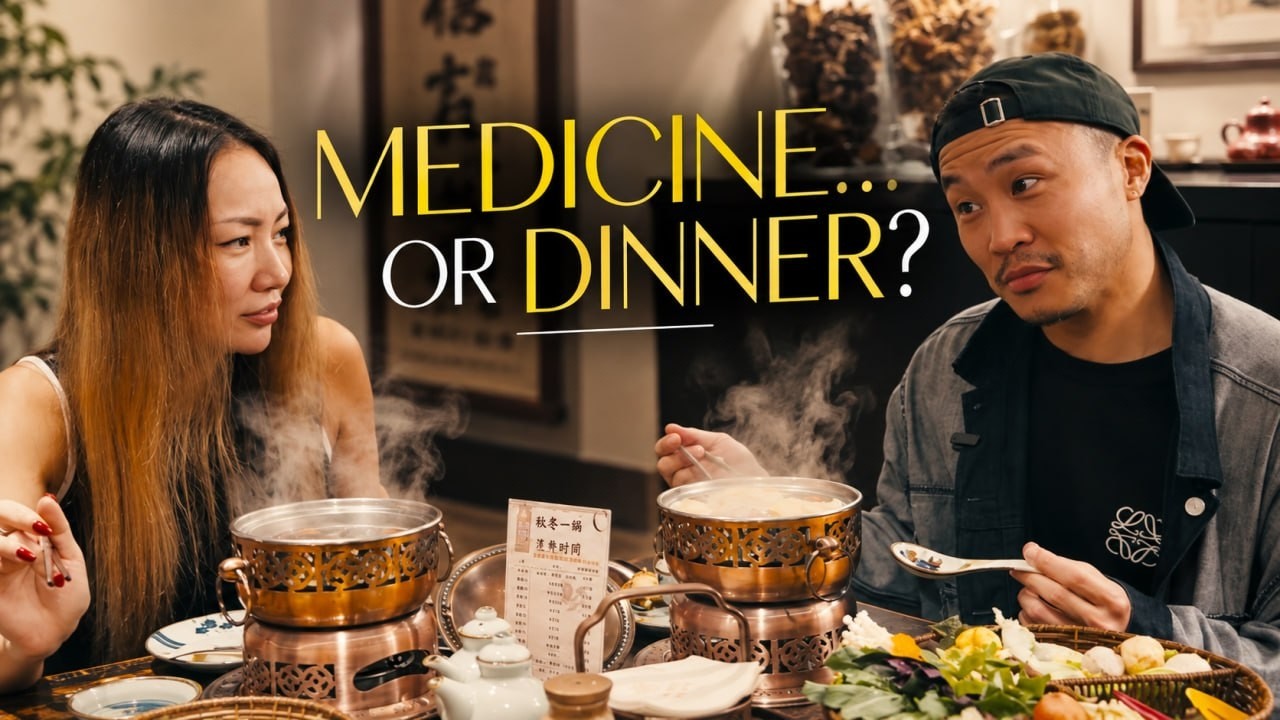
Video summary
The video explores the unique convergence of traditional Chinese medicine and modern dining culture at a restaurant in Guangzhou, where health treatments are seamlessly integrated into the meal experience. Unlike the stereotypical view of TCM as merely herbal remedies for grandparents, this establishment presents a vibrant lifestyle where food acts as medicine tailored to individual body types and seasonal needs. Guests arrive not just to eat hot pot, but to undergo a series of wellness rituals before their meal, including foot reflexology, moxibustion using burning herb sticks, and cupping therapy designed to stimulate meridians and remove stagnation from the body.
The core philosophy presented is that while Western medicine excels at precise, immediate interventions for acute conditions like tumors or cancer, TCM focuses on long-term maintenance and prevention by balancing the body's internal state before illness occurs. The hosts highlight how this approach requires patience rather than seeking quick dopamine hits, emphasizing that true health involves maintaining a balanced constitution over time. This distinction is crucial as it shifts the perspective from treating symptoms to cultivating a resilient physical foundation, ensuring that the benefits of the treatment persist even after stopping specific remedies.
A significant cultural insight emerges regarding the Cantonese approach to TCM, which treats these practices with such seriousness that they are woven directly into daily life and cuisine. In Guangzhou, it is common to find specialized soup shops offering customized broths based on a customer's constitution, a tradition that contrasts with other regions or Western perceptions where such medicine might be viewed with skepticism or shame. The video illustrates how this culture has successfully modernized ancient philosophies without losing their essence, creating an environment where one can receive professional medical advice from doctors on staff while enjoying a meal that is simultaneously a therapeutic supplement.
Ultimately, the experience serves as a bridge between generations and cultures, challenging second-generation immigrants and skeptics to reconsider their relationship with traditional healing methods. The hosts express a newfound appreciation for these practices after witnessing their practical application in a contemporary setting, moving past previous reservations about medicine shops in Chinatowns. By combining ancient wisdom with modern hospitality, the restaurant demonstrates that TCM is not just a relic of the past but a viable, evolving system that can effectively complement Western healthcare to promote holistic well-being in today's fast-paced world.
Read the full video transcript
What if the future's happening already?
>> But most of us just don't know where to
look.
>> Welcome to Global Next China Edition.
>> Let's discover what's next.
Guys, Global Next has made it to
Guangjo, the capital of Guangong
Province. I'm half Cantonese, but it
doesn't mean that I necessarily know
more about TCM than you, Crystal,
because what? You have this deep in your
family. Yeah, my grandma was a
well-known TCM doctor in my province.
So, yeah, I grew up around a lot of
herbs and stuff like that. And hey, we
are at a TCM clinic right now here in
Guanjo. This street is pretty much a
combination of wellness and food. And
this place we're going to go and grab a
meal from is a TCM restaurant.
>> Okay. So most people they don't they
just think TCM is something their
grandma takes.
>> But you're saying that everybody as a
family like it's dim sum can go eat
here.
>> Yeah. Exactly. So if we're going to go
check this out here, you can see they
even have a sort of dumpling that you
can eat in different seasons. So they
will have different herbs in the
dumplin. For example, spring you will
have this color and winter you'll have
that color. It's kind of like the herb
that's good for your body in that
weather. Well, this is new to me. So,
>> I mean, what do you think about it being
a food blogger for so long?
>> I mean, I've been a food blogger for so
long and I've been around so much TCM,
but I can't say that I personally like
>> engage in a lot of TCM.
>> Yeah. Yeah. I mean, Cantonese just has
a, you know, a very unique culture where
food is medicine, right? And I don't
know, like I'm not I'm not Cantonese,
but I'm looking forward to learn more
about the Cantonese TCM.
>> What is this spot called? Cuz I saw
there is no English outside whatsoever.
Uh, it's called town and I think they're
probably from Guangjong Guong like
province. Yeah, just like that one is
from Beijing. So, every single place in
China, they got their own TCM brand.
>> Dude, so much TCM. You got competing
province version of TCM on the same
street. Let's check this out. I'm
rooting for Kongo.
TCM has been around for thousands of
years and it can also treat something
like diabetes, like stroke, high blood
pressure, gout, something that you think
that usually western media medicine will
treat.
>> What does this look like? Right now in
2026 in New York, this is a hipster
Asian, but here this is the real thing.
>> I mean, it is a real thing. It is real
things. So, if you look around, you see
this is a typical TCM pharmacy and you
see all the drawers inside. There's
different kind of herbs. So what happens
is that these pharmacists would put
herbs together based on what your body
need when you get treated by the doctor.
>> Yeah. I mean they got the they're
cooking it up back there French Montana
style.
>> So she's going to give me two pieces of
paper cuz we have two people here. And
then each of us going to see a doctor
with this piece of paper so the doctor
can describe our symptoms. They were
also going to take this piece of paper
later for our medicine.
>> I love it, guys. This is so ancient.
It's so Guong. It's so TCM.
>> Get in touch with my culture.
>> So, this is what we do before we eat our
hot pot. And then this is going to
decide which ingredient that will go
into the hot pot.
>> What are we doing?
>> I want to get I want to get the best
tastiest meal possible. So, I want to
You want to be calm?
>> Come on. Beef.
>> I'm waiting for beef and oysters.
>> I think they're vegetarian.
>> You're like body type is pretty much
Cantonese. That's what she said.
>> No, no, no. No, she's talking about your
body type like
>> Oh, this one. Oh, J. Oh,
>> that's She knew. She knew based off my
body type that I was Kanto before I told
her I was Kanto.
>> And she knew that I got diarrhea easily.
>> Oh my god. So, apparently we're going to
get some like air sticks sticker.
>> I have no idea what that is.
Okay.
>> So, each meridian is like basically a an
area. It's an area that can stimulate
certain parts of our body.
>> But you did the foot reflexology before.
>> Yeah. It's pretty much the same concept.
>> I feel like that's the one that most
even ABC's are familiar with. Stepping
off the rocks.
>> Yeah. Yeah. Okay. We all look a little
bit weird, but you know, hopefully we're
healthier right now.
>> Honestly,
I liked it a lot.
Until you've had your ear pressurized
with reflexology,
you can't speak on it.
>> Okay. So guys, I'm going to do this
thing called moxyction.
So what it is is I believe from my
amateur understanding is that there's a
lot of herb inside of that thing. They
will light it up. There will be smoke
coming out of that stick and the herb
will go into my meridian in you know
throughout my body and depends on what
kind of nutrition or what kind of I
don't know like I I lack or I need it
will be pretty much like a supplement to
my body.
You know what's so interesting is that
Heidi Laauo, the hot pot chain from
Beijing, you can get your fingernails
polished, like a pedicure, manicure type
thing while you're waiting, some free
snacks. But here, you can get cupping
and gouacha and a whole bunch of other
things. You can just get all your
muscles worked out
>> before your hot pot.
>> Yeah, before hot pot. And then the hot
pot's going to heal you. And then while
you're waiting for your table, come get
some TCM treatments. I see the value in
it.
>> It feels like
like a giant octopus just got you.
>> Yeah.
>> And you're done for it.
>> Oh my gosh,
>> David. You're on fire.
You look super funny right now.
>> You know what I think that this makes me
realize and obviously I think a lot of
second generation immigrants go through
this. It's like it's not just tatangs
and like funny kung fu hustle zawa
singing Steven Chow movies.
It's this too. Like this is this might
not be Wing Chun from Itman but this is
what Itman did after doing Wing Chun to
recover. Oh my god, that was bad.
That is bad. If you guys want to know
whether you're like healthy or
unhealthy, just look at the the color of
your cupping mark. So, apparently, see,
he's like this mark is really dark. That
means he's got a lot of stagnated C in
his shoulder area and his waist. You can
see these areas like got pretty bad um
blood stagnation. But hey, you're
getting better after tonight.
>> My back looks like pepperoni.
>> This is probably going to take you like
a week to recover.
>> That's good.
>> I'm so glad that I didn't do it.
>> And now we're at the restaurant and um
we also have this little piece of paper
that we had before from the doctor and
it had all the ingredients, the Tzen
ingredients that doctor prescribed us.
And you can see those are my ingredients
and those are David's ingredients.
They're going to bring some veggie and
then we're going to dump the veggie and
the TCM ingredients together in the pot.
So we can have something called like a
ya which means medicinal food
>> like a medicine broth.
>> Yes. But it's like food and it's, you
know, you can have it as a meal.
>> What What are you happy to see? Because
you grew up with a grandma that's doing
super traditional TCM, right? and then
you get to see it like many years later
sort of take this new form. I think it's
also different kind of culture as well
because I think in Guangong um people
really make TCM some kind of food right
like if you are just in the old corner
of Guangjo you see all these like soup
shops that you can just go there and you
can just get a CCM soup that's made
customized for your body type. We never
have that kind of culture in Chang
province. So, I think the Cantonese just
really take the TCM, like the food, all
these things super seriously. They're
not just running a restaurant. They are
trying to combine whatever they're
already doing with a lifestyle that
people accept, right? They're trying to
modernize themselves, but through a
method really connected to everybody's
day-to-day life. Chinese
philosophies at a deeper core, they take
so long and they're so like the modern
westernized society, it's such a quick
hit dopamine feedback loop.
>> No, because quick hit dopamine hit
feedback loops does not work in the long
term. I think western medicine is really
good for anything that like requires
like a lot of precision, a lot of uh
intervention like for example, if you
have a tumor, if I have cancer, so you
got to control that process right away
and then with precision. But TCM is
something that where you wanted to use
in a longer term and to make sure that
like you maintain that state of your
body so that you don't even get to the
tumor in the first place. People these
days just don't want to they just want
to see result right away. But you know
sometimes it makes you wonder if you can
get quick result. Does that mean that
the result will also disappear you know
the second you don't use these remedies
anymore?
>> That's true. Thank you for taking me
here Crystal. I was a little skeptical
at first. A lot of things that I had
seen before but never actively wanted to
engage with. Like there's probably
medicine shops in Chinatown I feel kind
of ashamed now.
>> Like Chinatown New York, Chinatown
Seattle where I grew up that I never
walked into. Now I see. That's why it's
so important that people bring it into
the new world.
>> Yeah. Yeah. And but we're going to hit
the TCM bar next.
>> Okay. So that's even like another level.
>> So apparently drinking alcohol will be
good for your liver in that bar.
What's it called?