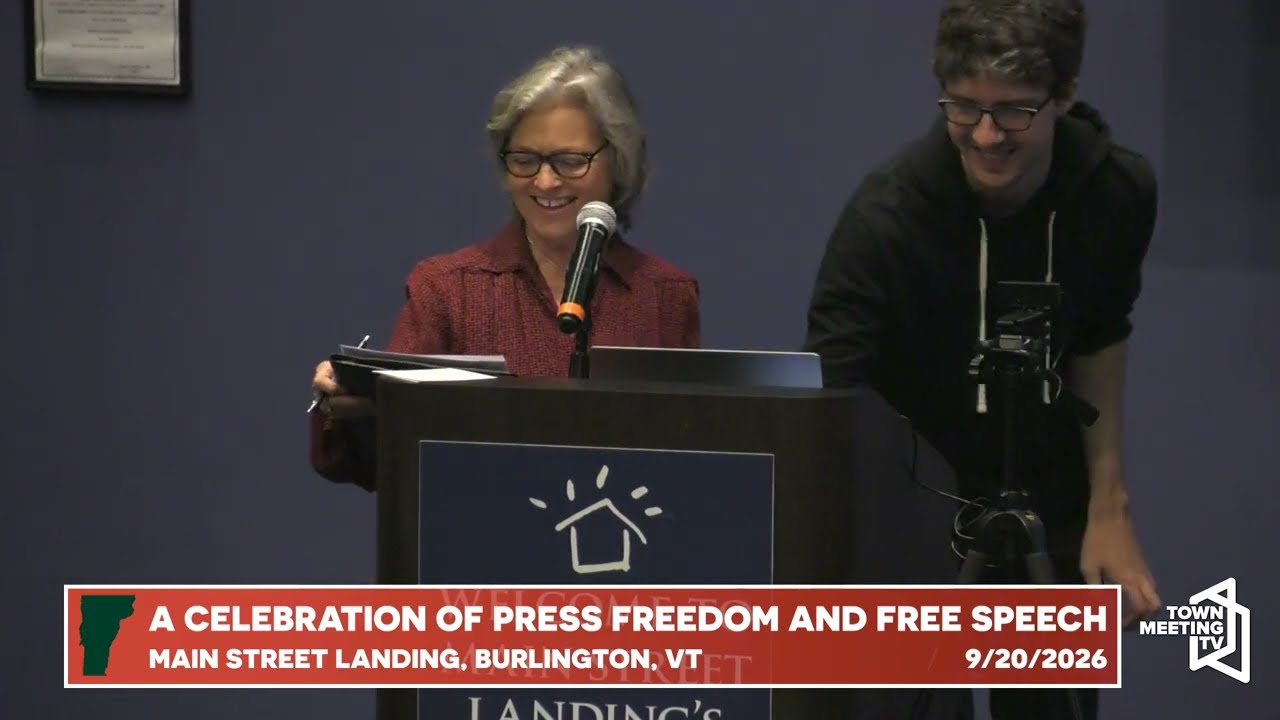
Video summary
The event, hosted by Third Act Vermont on US Constitution Day, brought together a diverse group of speakers to address the critical state of press freedom and free speech in an era of unprecedented challenges. Fran Stoddard opened the proceedings by highlighting alarming statistics from the 2026 Reporters Without Borders index, which reveals that global press freedom is at a twenty-five-year low, with the United States ranking 64th and public trust in news hitting a historic low of 25%. She identified key threats driving this decline, including corporate consolidation, the defunding of public broadcasting, and aggressive legal actions against journalists. These concerns were echoed by FCC Commissioner Anna Gomez, who spoke via Zoom about the regulatory pressures facing critical broadcasters like Disney and ABC under the current administration's controversial policies. Gomez criticized the fast-tracking of mergers that concentrate media ownership in fewer hands and warned against indirect foreign influence from sovereign wealth funds, while also praising consumer pushback as a vital defense against censorship.
The discussion then shifted to the structural and historical foundations of free speech, with Jess Wegman arguing that the loss of the original "First Amendment" provision limiting district sizes has led to unresponsive representation and silenced majorities on issues like healthcare. Complementing this historical perspective, Megan Oorc emphasized the indispensable role of community media in fostering local democracy by providing open access for residents to produce content without editorial interference. She explained how organizations like CCTV balance free speech with safety by refusing to remove hate speech but instead offering resources to counter it and teaching media literacy, ensuring that diverse voices are heard while safeguarding marginalized groups. Anne Galloway, founder of VT Digger, further illuminated the existential crisis facing local journalism, noting that corporate consolidation and hedge fund ownership have hollowed out newsrooms, leaving only a quarter of Americans who trust the news.
To combat these systemic issues, the speakers urged audiences to take active steps in supporting independent media through advocacy for laws like a national Media Shield Law, financial donations, and conscious consumption habits such as seeking original sources over social media summaries. Galloway stressed that every act of reporting remains a democratic demonstration of courage, even as journalists face physical assaults, FBI subpoenas, and bans from the White House. The session concluded with practical advice on how individuals can file comments with the FCC to protect local broadcasters during open dockets, reinforcing the message that fighting national issues requires starting with local engagement and long-term commitment. Ultimately, the event served as a powerful reminder that while the media landscape is bleak, collective action and community support are essential for preserving the lifeline of news in every neighborhood.
Read the full video transcript
Good afternoon.
>> Can everybody hear me?
>> Even closer.
>> Louder. Now, can you hear me?
>> Okay, I will try to stay glued to the
microphone.
>> Welcome everybody to our celebration of
press freedom and free speech. I'm Lois
Price. I'm a member of the press freedom
team of Third Act Vermont.
Third Act is a community of Americans
over 60 who work to ensure a safe and
stable planet as well as to strengthen
our democracy.
Our event today honors US Constitution
Day, the day in 1787
when the founding fathers ratified the
Constitution.
Let it also be a timely reminder that we
can never take our constitutional
freedoms for granted.
I'd like to acknowledge my other team
members who worked hard to make this
event possible. Would you please stand
up? They're mostly in the back of the
hall.
Thank you very much for all your hard
work.
Stand up. Don't be shy.
Thank you. It took a lot of people to
put this event together. I'm very
grateful for all the help from the whole
committee.
Uh before I continue, let me remind you
to turn off your cell phones, please.
And thank you.
And now I'd like to introduce the host
for today, Fran Stoddard.
You may recognize Fran from her 10 years
as producer host of Vermont Public
Television's weekly interview call
profile. You may know her as the host of
Vermont Public Radio's call-in program
Switchboard. You may even know Fran as
the host of the healthc care program
Vital Signs.
Just as likely you may know her from
watching WCAX's Across the Fence. We
could not be in better hands today than
to have Fran as our host for our
celebration of free speech and press
freedom. Please welcome Fran.
Thank you. So, thank you so much, Lois.
Um, and all the volunteers with Third
Act. I think uh this is fantastic uh
thing to be celebrating today. Uh we
certainly have a remarkable panel uh
gathered here to celebrate press freedom
and free speech and to discuss its
challenges. I will introduce each
panelist before they speak for about 5
to eight minutes and then we will have a
Q&A on this very rich subject. Since
Commissioner Gomez is joining us via
Zoom, which is just awesome, we will
have her speak first and immediately
followed by a few questions since she
may have to depart, but she hopes to
stay with us for a while, but we'll we
won't keep her um up on the screen
through the through the uh other
speakers. Uh then we will hear from our
other speakers and save the Q&A for the
three of them and um possibly um
Commissioner Gomez until after they have
made their remarks and it will give you
time to develop your questions. So
please just write one. So hopefully you
have some pieces of paper. Uh there are
volunteers uh from third act who also
have pencils if you need them. uh just
write one question per card and note to
whom you want the question addressed to
or directed to. Pass the cards to the
aisle where third act volunteers will
collect them and get them to me. So all
you people on the aisle, are you with
me? You'll you'll do this if you are
handed a card. All good on the aisle.
Okay, great.
So this is clearly a very timely topic.
We are here to celebrate, but press
freedom is in trouble. The 2026
Reporters Without Borders index put
global press freedom at its lowest point
in 25 years. Hundreds of journalists
have been killed or imprisoned. Attacks
on journalists nearly doubled in 2025.
In the US, the president threatens to
prosecute reporters for treason and is
pursuing multi-billion dollar lawsuits
against major outlets. US press freedom
ranking slid to 64th out of 180
countries. It was 42nd in 2022. So, it
continues to really slide. And even US
trust in the news hit a record low of
25%.
There are threats of corporate
consolidation and ownership, the
defunding of public broadcasting and
news deserts across the country, among
other really serious issues. And we have
many, many courageous defenders of these
two precious freedoms. And so, let's get
to some. One of those holding the line
is Anna Gomez. And it's really fantastic
that we have her here today.
Anna Gomez, and Matt's gonna bring her
up right now.
Anna Gomez is an American
telecommunications attorney, currently
serving as a commissioner of the Federal
Communications Commission, which we she
has had since 2023 when she was
appointed by President Biden. Her term
as FCC commissioner expired this past
July 1st, but she remains in hold over
status until a replacement is appointed.
And there are just three uh
commissioners as I understand it. Now,
there should be five. She's nodding. So,
um we hope her holdover status goes into
at least keeping her appointed because
we need at least three even though there
should be five. Before her appointment,
she was a senior adviser in the State
Department's Bureau of Cyerspace and
Digital Policy, and she served as the
deputy assistant secretary of the
National Telecommunications and
Information Administration from 2009 to
2013.
This summer she was named hero of the
month by the media and democracy
project.
They call it a mad hero for using her
position and voice as a federal
communications commission commissioner
to speak out against regulatory
overreach and for her advocacy for
diverse media that supports democracy.
She is known as an outspoken advocate
for press freedom and for the FCC
working for the common good. She is
truly remarkable. Thank you so much for
joining us, Commissioner. We hope you
can briefly um give us your perspective
on the current media landscape and if
different the perspective of the FCC.
Welcome, Commissioner.
>> Well, um thank you so much. Uh that was
really a lovely introduction. Uh thank
you to Third Act Vermont and to the
Center for Media and Democracy for
hosting this celebration of press
freedom and a free speech. And a huge
thanks to the media and democracy
project for naming me as hero of the
month. I I love being called a mad hero.
Uh
I I only wish I could be there with you
in person uh rather than on on the
screen. Um, you know, as a federal
regulator, I I may seem like an unlikely
voice at a press freedom event since uh
my job usually involves spectrum policy,
broadband access, broadcast licensing.
But when the agency I sit on is using
its licensing authority to threaten news
organizations and to punish coverage
this administration doesn't like, press
freedom becomes everyone's fight,
including mine.
Congress designed the FCC to be an
independent, expert-driven regulator.
And despite this FCC's recent actions,
I'm remain committed to seeing it live
up to that design.
Our forefathers understood that a press
free of government interference and
self-government belong together because
those of us in government roles cannot
govern without journalists willing to
hold power to account.
250 years into our democratic
experiment, that bargain still holds.
And the Constitution Day is a fitting
moment to remember it.
Now, to be clear, presidents have tried
to use the FCC against the press before.
Um, and Franklin Roosevelt, uh, John F.
Kennedy
each press their FCC chairs to act
against news outlets only to be refused.
What sets this moment that we're in
apart is that this agency now goes along
with such pressure rather than resisting
it.
Now, I know many of you worry that media
consolidation narrows the range of
ideas, of opinions, of access to
information. And that worry is
wellounded.
Local journalism is under extraordinary
strain with newsrooms consolidated,
reporters laid off, and editorial
decisions being made far from the
communities that stations are licensed
to serve.
You know, consider the Nextar Techna
merger, the largest local broadcast
television merger in American history.
Together, the two companies would reach
more than 80% of American television
households, more than double the 39%
national cap that Congress wrote into
law. The FCC approved it anyway, drawing
bipartisan criticism, and it took state
attorneys general and a federal judge to
temporarily halt the integration of the
two companies, and that remains in
litigation.
Similarly, the proposed merger of
Paramount and Warner Brothers Discovery
would bring CBS News and CNN under one
roof.
Just a few days ago, the FCC's media
bureau approved indirect foreign
ownership of nearly half of the combined
company
that includes tens of billions of
dollars from sovereign wealth funds in
Saudi Arabia, Qatar, and the United Arab
Emirates. Some of the most repressive
and anti-press freedom governments in
the world. An investment of that size by
its influence over what gets said and
what gets made. So we should all be
worried about this.
Both approvals fit a pattern in which
companies with business before the
government and with a willingness to
curry favor with this administration
received fasttrack approvals.
That pattern took shape when Paramount
settled the baseless lawsuit days before
its merger with Skyance was approved.
The new company capitulated with
commitments to reshape CBS news
editorial direction and 60 Minutes
credibility collapsed in the months that
followed.
Now the same FCC that fasttracks deals
for friendly media is busy threatening
the broadcasters who cover this
administration critically.
Disney and ABC have faced a string of
investigations and even an early license
renewal order, a tool that had gone
unused for more than half a century.
But the FCC licenses local stations
rather than national networks, and any
effort to revoke a license over news
coverage would almost certainly fail in
court. The threat itself is the point,
because enough pressure has already led
some broadcasters to self censor and
others to settle.
The good news is that while the
capitulation is tempting, courage is
contagious.
I am glad Disney has chosen to fight. I
am heartened that the New York Times,
NPR, and PBS, and the Associated Press
have each proven they can win in court
against this administration.
The days of the FCC as a paper tiger are
numbered. What the public will remember
is who complied in advance and who
fought back.
The concern for our press freedom
reaches well beyond any one party. as I
have learned on my first amendment tour
where people across the ideological
spectrum have told me they are united in
their alarm about what this FCC is doing
to press freedom. The First Amendment
does not belong to one party and it
never has. So we must all fight for it
regardless of who the current target is.
It has survived worse than this and it
will survive this too. but only if the
people in rooms like this one keep
fighting for it. And I intend to do so
for as long as I have a seat at the
table as a commissioner at the FCC.
So, thank you so much for inviting me
and I look forward to your questions.
>> Thank you so much, Commissioner.
Uh there are people who if you have um a
question, you can hold it up. I have a
few that were already um made here. So
um Commissioner Gomez, in in the early
2000s, the FCC held public hearings
around the country when considering
major decisions like media
consolidation. Um is there a way for
ordinary citizens to have an effective
response to FCC proposals and decisions
now with these issues that you are have
articulated and are facing?
Yeah, I it it actually is very effective
when we hear from from uh consumers when
we when uh when consumers voice their
objection. Um it it it is effective both
in in um helping the FCC see where
consumer sentiment is, but also because
it tells the corporate parents of media
um how they're being viewed. Uh, you
know, when when uh Jimmy Kimmel was
forced off the air last year,
consumers were outraged and they really
voted with their pocketbooks and uh were
very responsive to Disney and Disney
realized that this was becoming a
business problem for them. Um, and they
immediately brought him back. Um, some
of the conservative stations tried to
preempt that programming, but they
eventually had to stop that again
because consumers were having none of
it. And that is very helpful. It's very
helpful when consumers speak out because
this is not normal and this is not what
consumers want. Consumers don't want
censorship.
um that regardless of whether they like
Jimmy Kimmel or not or they like the
view or not or they don't or they don't
or they like uh Chris Kirsten Walker uh
or not um or they like public media or
not they don't like censorship and when
we make it so when they make it so clear
that that is what is happening consumers
do speak out and it really does have an
effect.
>> Thank you so much. Um, another question.
How can we influence the FCC or the
federal government to restore funding to
national broadcasting system? Is there
any hope of resurrecting the corporation
for public broadcasting? And is that in
your purview?
>> Yeah. Um, I you know, I have it, it
frustrates me what's happening with
public media because public media is so
important for local communities. And
what I keep telling people is we are
seeing this massive media consolidation
where local stations are becoming
nationalized because they're becoming
owned by corporate parents that are not
in those local communities. But you know
who still is in their local communities?
Public media whether it's radio or
television and they are serving their
local communities. Um, so if we're going
to allow this massive consolidation,
then we need to make sure communities
are not left behind and defunding public
media is just going to accelerate this
problem. Um, so I'm very happy to see
that we that it even though we've lost
some stations and it's been very
difficult that we, you know, donors have
come forward um and we are continuing to
have strong public media. But I
certainly urge Congress to fund um uh
the Corporation for Public Broadcasting
uh the uh and make sure that these
communities do not lose their lifelines.
There are parts of this country, for
example, in very remote Alaska, where
the only station that provides them news
and information is the public radio
station. Um, and we can't lose that.
>> Thank you. and um sort of related, but
it what actions um would you like to see
that would better ensure the
independence of news sectors within
networks um
that are, you know, how can we protect
and preserve those networks and should
those actions be made by Congress
through regulation or through us? Um and
by the way, this person also said,
"Thanks for all that you do." So,
>> thank you. Um, I think that there's uh
there's things that the FCC can do to uh
enshrine into rules
uh how it will it regulates media. Uh
because a lot of what the FCC is doing
is it is it's using a very undefined
public interest standard. We license
stations to serve the public interest
which means serving their communities.
and it's using that public interest
standard as basically going after any
content this administration doesn't
like. If it likes it, no problem. If it
doesn't like it, investigations are
initiated because they might be
violating the public interest standard.
So, one thing that I have been calling
for is the FCC should do a rulemaking
that specifically defines what the
public interest standard is. Um,
traditionally when we look at whether a
a local station is serving its
communities, we look at three things.
Competition,
diversity of viewpoints, and um
um
oh localism, are they actually serving
the communities? And when we look at
whether they're serving commu
communities, they will file reams of
paper that tell us here are here's the
disasters that we reported on. We have
this much uh local community news. We go
out and we meet with the with our
communities and we have bake sales and
you know whatever it is that we're doing
to serve our local communities. It's not
the president doesn't like what we say.
That that is not what's part of the
public interest. I think I think the FCC
can make very clear, okay, here's
exactly what we mean when we mean
serving the public interest. And by the
way, we are prohibited from censoring
broadcasters. We are prohibited by the
Communications Act and of course by the
First Amendment. So if the FCC tries to
overreach what that means, then we will
be reversed in court, much like we
should be reversed in court with what
we've been doing recently. Um, which is
why I'm so happy that Disney is suing
because finally I'm hoping that we will
get to a point where the court says,
"Yes, you are really uh um violating the
First Amendment with what you're doing."
Congress can do something similar.
Congress can can also pass uh you know
uh amend the the communications act to
make clear what it means by uh licensing
in the public interest so that the FCC
cannot um go beyond whatever structures
the Congress puts in place for what it
is that we can and cannot do.
>> Great. And finally, um, Commissioner,
given that your first term has actually
expired,
uh, what we're so glad that you're
you're still there. What is the prospect
for you to remain at the FCC and how
long can you expect to stay as as a
voting member of now three when there
should be five, but we hope you stay on.
>> Well, as you noted, there should be five
of us. Um, we have been operating as a
three member commission for over a year
now. Um, and I'd love to have five of
us. Um,
the president has nominated uh, one of
the chairman staffers to serve as
another Republican member of the
commission. Um, and uh, she still hasn't
gone through her confirmation process
yet. Um but
traditionally
uh the usually these nominations are
paired with a member from uh the
minority party. Um and so I have
multiple senators, I have civil rights
groups, I have media groups, I have uh
uh me advocacy groups I should say, I
have a very broad um uh coalition of
people who are supporting my
renomination.
um because I would need to be
renominated and reconfirmed by the
Senate in order to continue serve. As
you noted, I can serve until January of
2000, well, really the end of 2027.
Um unless someone is nominated and
confirmed for my spot. There is nobody
nominated for my position. Um so I will
be in this in this place unless two
things happen. one is someone gets
nominated and confirmed for my spot or
the president fires me. Um, so far so
good. Uh, but uh, but you know, I, as I
like to tell people, and it really is
true, I check my email every morning to
see if I'm coming in to work the next
day.
>> Oh, well, we are so glad that you are
there. Thank you for uh holding holding
some lines that we really need held and
uh we hope that you will stay with us uh
for the rest of this presentation
although we will put take you down from
the big screen and thank you so much for
for being here today.
>> Thank you.
And while Matt is taking care of
technical business, um I will introduce
Jess Wegman. Are we good?
>> We're good.
>> Okay.
So Jess, who is now a local, which is
which is great, has moved to um to
Charlotte. He is a scholar, author and
journalist who is serving as senior
fellow at the Brennan Center for
Justice. He also works with the Coberg
Center on the US Supreme Court, the
future of the Constitution Advisory
Committee and the Brennan Center
Ventures on Electoral Policy and
Democracy Reform. Got all that? It's a
quiz. For a dozen years through 2025,
Wegman was a member of the New York
Times editorial board where he wrote
more than a thousand editorials and
signed pieces on law and politics, the
Supreme Court, democracy, and the rule
of law. He has also worked at the
Atlantic and at NPR. The core of his
work in the last decade has focused on
the intersection of law and politics,
the rule of law, electoral reform, and
the broader challenges facing American
democracy. He is the author of Let the
People pick the President, the Case for
Abolishing the Electoral College. And
his more recent book, which you will
find out in the lobby after this, is The
Lost Founder, James Wilson and the
Forgotten Fight for a People's
Constitution. It sounds fascinating. Um,
so Jess, you have been charged with uh
grounding us on the origins and
foundation of the first amendment to the
constitution, how it came to be, the
importance and meaning in particular of
freedom of the press and freedom of
speech in all of five to eight minutes.
Thank you.
Great. Hi everyone. Thank you, Fran. Uh,
thanks Lois and the third act team for
having me. Is this Should it be higher?
>> Can I um
>> Thank you. I just have some
>> Max, there seems to be some
back here on
>> All right. I'm gonna I'll speak loudly.
Um, so,
uh, I'm not going to speak exactly about
the the First Amendment. I'm going to
use my freedom of speech to, uh, take a
bit of a of a left turn here. Um, and,
uh, I I I I thank you for indulging me
in this. Um, uh, I I think we had
obviously with the the commissioner and
with Megan, we're going to have
wonderful perspectives and and necessary
perspectives on on the First Amendment,
but I will say before I uh talk about
what I want to talk about today, I I
couldn't not say something about
especially given the events of the last
few days, um, I think it's really uh,
you know, I owe my my career, I owe my
livelihood to the First Amendment. Um,
and I don't think I always have
appreciated that. I've been a journalist
for 30 years now. And um I think it's
easy as with so much in uh life to get
complacent. Uh and I am and and if I'm
grateful to Donald Trump for anything,
which sometimes takes a while uh to get
to, it's for um reminding us of how
fragile so many of our uh of our
traditions and our and our rules are and
how much they depend on people actually
upholding them. how much how much of the
American experiment is based on good
faith and on the honor system
essentially. And uh when somebody who is
lacking in both of those things uh takes
power, I think we are all reminded of of
of the delicacy and the fragility of the
of the world and the and the the country
that we've built and how important it is
to uphold these traditions and to uphold
these values and to uphold these rules.
Um, obviously what what has happened
over the last few days with the uh the
president uh the most thin-kinned person
I've ever seen in public life deciding
that he couldn't take criticism from
certain news outlets and then thus
barring them from the White House is
such an obvious violation of the First
Amendment. It's just I mean we shouldn't
even have to be discussing it. But
again, it is good to be reminded of what
the First Amendment says, what it stands
for, and what it will and won't prevent.
Um, so I just want to I want to put that
out there right at the start just to
make clear that I I recognize how lucky
I am and I I think
especially in the last
10 long years I have been made that much
more aware of how lucky I am to do this
work and how lucky I am not to be in
jail for saying the things that I say
without thought. Like I'm I I have
criticized all I mean I've criticized I
I used to criticize the Obama
administration too. Uh but uh you know
I've been able to criticize this
administration and all and hire
government officials for years um with
uh legal impunity which is which is a
very lucky thing. And so I I I don't I
now don't take that for granted. Um so
uh I don't want to if I close it's going
to it's going to turn that off right if
I close this. So, I got to be careful
not to close the screen. All right. I'm
going to I'm going to try to keep it
open. Um,
so, as I said, I'm going to be a little
creative with today's assignment. Um,
which is about the first amendment. Uh
you often hear people say, "Well, the
first amendment was was put first
because the founders knew that free
speech and free press and freedom of
religion were the most important
features, the most essential parts of
any functioning republic.
So I agree it's true uh those are
extremely important features, but it is
not true that the first amendment is
first for that reason. In fact, if James
Madison had had his way, the first
amendment, our first amendment, would
have been the third amendment. So today,
I want to talk briefly about what I'll
call the first first amendment, which
was not about speech or press or
religion, but which, and I promise I'm
going to tie it all together, uh was
about how we as a people make ourselves
heard.
So, first let me give you a little bit
of background. Um, I'm going to guess
most people in this room do not know
that in 1789 when Madison introduced his
slate of proposed amendments to the
Constitution, what we now refer to as
the Bill of Rights, there were not 10,
the 10 that we know. There were 12.
Numbers 3 through 12 are the ones that
we all know today. But the the real
first and second amendments most people
don't know about. The second amendment,
the first second amendment is uh let's
say frankly it's a little dull. Um it
says that if members of Congress want to
pay themselves more money, they cannot
do it until after the next election.
You know, you ask for the raise and then
you wait to see if your boss thinks you
deserve it, right? Your boss in this
case is the American people. Uh in fact
that amendment is now in our
constitution but it is not there as the
second amendment. It is there as the
27th amendment and to date the last that
is currently on the books. Um the the
story of how that amendment became part
of our constitution is now the 27th
amendment is a funny one. So I'm going
to just give you the very quick version.
the the Congressional Pay Amendment
actually passed Congress in 1789 and got
ratified by a number of states at that
time. Uh but it was a few states short
and then the momentum fell off. It sort
of got forgotten over the years. Never
never entered the the constitution.
Then 200 years later, uh, a college
student in Texas was going through the
records of the of the early the years of
early years of the country and realized,
you know, he said, "Wait a minute. This
this thing, this amendment, it it passed
Congress. It got ratified by some of the
states. It didn't get finished, but it
never expired." He said, "Let's get this
thing across the finish line." So that
started a movement over the next several
years where the amendment was
reintroduced in well at the time right
in in the in 1789 1790 there weren't
that many states so you only needed
about uh 7 89 to meet the 3/4 threshold
that the constitution requires for
amendments to get into the constitution.
Uh in the late 1980s there were 50
states. So now the threshold is 38
states. So there were several dozen more
states that now had to ratify this
amendment. They did so because everyone
would jump at the opportunity to keep
Congress people from earning more money.
And uh it was ratified in 1992. It
became the 27th amendment to the US
Constitution uh 200 years after it was
first proposed.
So
the first first amendment was not so
lucky.
Its subject was the size of the House of
Representatives. Not how much they got
paid, but how many of them there were.
I'm not going to read to you today the
text of that amendment out loud because
it's long and mathematically somewhat
confusing. But its purpose is very
simple to explain. It would have linked
the size of the House of Representatives
to the size of the US population in
perpetuity.
As more people lived in or moved into
the country, more representatives would
be added to represent them.
This may not sound to you like a very
big deal, but it is a really big deal.
The whole point of Republican
self-government is that representatives
accurately reflect the desires of their
constituents.
That means they need to be able to meet
with them, to talk to them, to listen to
them, and then to vote in Congress in a
manner that gives effect to what those
people, or at least a majority of those
people say they want.
The Constitution itself today sets the
minimum size of congressional districts
at 30,000, one representatives for every
30,000 people. That by the way was uh
you know George George Washington was
president of the convention and famously
sat there all summer without saying a
word. This was his one contribution to
the constitutional convention at the
very end almost the last day of the
convention. It it had been they had set
it at 40,000 to one 40,000 constituents
per representatives and George stood up
and said let's say let's make it 30,000
to one. It's better make it easier for
the uh lawmakers to you know get around
and talk to people. And they of course
George said it so they changed it.
One representative for every 30,000
people that you've been to Fenway Park.
You know 30,000 people looks like a lot
of people. And yet it still is a it's
few enough that it can allow a lawmaker
to really get a good sense of her or his
district and to represent that district
faithfully in Congress.
the first first amendment would have
locked that number the the ratio of
constituents to lawmakers at no higher
than 50,000 people. So if you do the
math on that that means today's Congress
would have approximately 6,600 members.
Just for perspective that is more than
double the size of the biggest
legislature in the world.
Like the other 11 amendments, those I
told you there were 12 amendments that
that uh got passed through Congress
after Madison introduced them. The first
first amendment got passed and went out
to the states for ratification. Uh I I
said before it has to be threearters of
the states, right? The problem was it
kept falling one state short. it would
almost get to ratification, almost get
to three/arters and then a new state
like Vermont would join the union and
the number required to ratify would go
up. Finally, it just it never it never
quite got there. It never appeared to
get there. Hold remember that. We're
going to come back to that. Um and it
was lost to history.
The good news for a while was that the
founders and those who came after them
really did believe in keeping Congress
up to date with the population. So the
house began the very beginning the very
first house had 59 members. But after
nearly every census for more than a
century, Congress expanded to grow in in
line with the country. As the country
expanded, Congress got bigger.
The bad news is that this growth stopped
suddenly in 1911, more than a hundred
years ago. This was a time when there
were fewer than onethird as many people
living in the United States as today. So
even then, by the way, in a house with
435 members, that was the number that
they set in 1911, and that is the number
we live with today, the average district
size had grown to 200,000 people. That's
seven or so times larger than what the
framers intended.
Today, the House still has 435 members.
Does anyone in the room know the average
size of a congressional district in
2026?
760,000 people. 3/4 of a million people
for a single representative.
This has created all sorts of problems
for American government and politics. To
name a familiar one that everyone here I
think has thought about a lot is
gerrymandering. Gerrymandering is when
politicians draw or redraw district
lines to maintain power for themselves
regardless of what the voters want. It's
an extremely nefarious act uh you know
behavior undertaken by politicians of
all parties and and it's only gotten
worse in recent years as the Supreme
Court has uh refused to deal with it. Um
it is much easier to gerrymander
districts when districts are as big as
they are today. It's much easier to draw
lines in ways that allow uh
representatives to uh just basically
control who their voters are. Um, if
districts were smaller, say 50,000
rather than 750,000, gerrymandering
becomes much much harder, if not
impossible to engage in, and Americans
everywhere could feel much more
confident that they were choosing their
leaders, not the other way around, and
that their voices, their speech was
being heard.
Instead, we are stuck in a situation
where policies that overwhelming
majorities of Americans say again and
again and again that they want, whether
we're talking about background checks
for gun purchases or universal health
care or better parental leave or term
limits for the Supreme Court and
Congress. None of these things happen.
And that I think is as stifling of our
freedom of speech as a p of burning
books or as I mentioned in today's
headlines a president who shuts down a
press coverage that he doesn't like.
So the takeaway here for me is that our
voices, the same ones that we are so
careful to protect through the existing
first amendment, are increasingly being
silenced, if not erased, by politicians
who are exploiting our outdated House of
Representatives for their own benefit. A
house that would have been far more
representative if we'd had the original
First Amendment. under that house. By
the way, Vermont would not have one
representative, but at least a dozen.
Uh, I told you to remember this this
little detail. I said that it appeared
not to have been ratified. Uh, as it
turns out, that first first amendment
may actually have been ratified after
all. Um, in the first wave of
ratification, I said it it it kept
missing by one state. Well, that one
state at the end was Connecticut.
Both houses of Connecticut's legislature
at the time voted to ratify this
amendment. However, they did it in
different sections of the legislature
and they ended up using different uh
slightly different language in their
bills which meant they had to get
together to reconcile the different
language and send it back to the capital
to to have their ratification count. uh
what as you can imagine which it still
happens today um paperwork gets lost uh
people get confused uh uh reporting
doesn't happen the way it should uh the
ratification of the state of Connecticut
was never uh returned to the capital so
we are now faced with a conundrum an
amendment that appears to have met all
the requirements of the constitution and
yet is not in the constitution because
of a clerical error so I guess the
lesson is
hold on to your voices. And don't forget
the stamp.
>> Thank you, Jesse. And
that's all right. I'm so short, you
know, it just gets everything out of
whack. Um, well, speaking of voices to
be heard, um, I think it's very
appropriate that next up is Megan Oorc.
She is the executive director of CC, the
CCT um CCTV Center for Media and
Democracy, an independent nonprofit
community media organization. Most of
you probably know it is um our filmer
today. Founded in 1984, CCTV operates
Town Meeting TV, CCTV Productions, the
CCTV archives and media education
programs that give Vermoners direct
access to tools and airtime to make and
share their own media, connect with
local democracy and understand their
community more deeply. These are the
people that are at your select board
meetings. I mean, it's just remarkable
um how important this is. CCTV is also
part of the Vermont Access Network, a
coalition of 24 community media centers
across the state. Megan's connection to
CCTV and to Burlington dates back to the
1980s um with a fascination with and
respect for archives and that still
thrives today. Uh while she has always
had a passion for archives and their
importance, her focus stays on the
enduring core CCTV mission which is
giving open access um uh channels where
community voices can be seen, heard, and
preserved. So we're going to move from
this very high up um very historic
perspective uh to more local and the
importance of supporting local voices.
Megan, you can tell us about the role
and value of communityrun cable and
online news channels, uh, archives and
public access programs, and how CCTV
fulfills the promise of free speech.
Thank you, Megan.
Can you hear me? Yeah. I tend to speak
quietly, so if in the green shirt, wave
at me if I move away.
Um, that's very familiar. Thanks. You
tickled my brain. Funny bone. That's
really awesome. Um, and over the last
really since 2016, which is not um a
coincidence, as we've visitors come in
to CCTV, especially through the Vermont
Council on World Affairs from around the
world, the conversation
always turns to free speech. And how is
it that you can do this? And how is it
that people can come in and make
programs about whatever they want and
it's not just happening here. It's, you
know, people are feeling this crackdown
um around the world. Um and thank you
Fran for the introduction. I can skip
some of this. Um
my name is Meganor. I serve as the
current executive director of CCTV and
I'm honored to be able to share how our
work relates to free speech. It is my
joy to work with this organization. We
began in 1984 with the simple radical
idea that people um should have the
means um to produce and distribute their
own stories and to understand themselves
and their community through television
at that time. It's still a radical idea
despite the illusion that social media
creates of a people centered
storytelling platform.
CCTV's mission is to advance free
speech, promote local democracy,
facilitate participation in
decisionmaking, build unity and empathy
by convening, recording, airing, and
archiving community content.
Um,
uh, we, as France said, we're a part of
a network of 24 centers. I'm joined by
my colleague Angeli from MMCTV.
We have Media Factory here in the
neighborhood. Um and we are part of
thousands of other organizations like us
around um the country and it's kind of
apppropo that we're going between the
FCC and journalists because we we don't
we partner with both government and the
people um to serve um accountability and
transparency.
Free speech is in the DNA of community
media. It means giving people access as
I said to the means of producing and
distributing content. It means covering
meetings gavel to gavel um without
editorializing even when it gets long in
the weeds when comfortable you know why
why are you here all day long for the
whole meeting right um so that um we can
create and keep a record uh for the
public journalists and our municipal
partners. We hold corporate interests
accountable for giving back. So that's
this kind of wonky um work that we do to
compel cable companies to return money
um for the use of the public rights of
way for to serve this effort. Um we are
a partner um as I said to both
government and the people to provide
transparency and accountability. We are
not required to follow the
constitutional limits that bind
government. But we believe society is
stronger when we can hold ourselves to
that standard.
Over four decades, protecting free
speech has seen tension and conflict.
We've been challenged and we've said no
to removing comments said during public
meetings that were found defamatory or
offensive. We've been asked to turn off
the cameras and we've respectfully
declined. Um, community producers have
used their airtime to advocate for arms
shipments to Sandinistas in Nicaragua.
We supported shows during the meltdown
in Fukushima when the Japanese
government was suppressing news reports
in those countries and those shows that
were recorded here were watched by folks
in Japan.
Um, Nepali Bhutanese who live here
amongst us. um or could be in the
audience here. I cannot see you. Um used
the studio to protest a visit by
Bhutan's visiting secretary of gross
national happiness.
Um and if you know what that means, you
know, uh facilitating community
producers we individually politically
disagree with to produce content that's
important to them. As somebody who's a
staunch um pro-choice
um reproductive freedom person, I've sat
side by side with folks teaching them to
make programming um anti-abortion
programming and I feel that's part of
you know I I I respect that about
myself. Um we don't just facilitate or
air speech we agree with uh we create
space for all building which is a
building block of democracy.
Um, and we rely on people, viewers, you
to be informed and able to think
critically and to counter speech that
you may disagree with by using more
speech.
Most of what happens in our studio is
actually commonplace and not incendiary.
Free speech to us doesn't mean hollering
about controversial subjects. It also
isn't a license to provoke hate or harm
necessarily. and the values of openness
and transparency can cross with the
values values of inclusion and
safeguarding historically marginalized
people. The value of kindness doesn't
always align with the right to speak
one's mind. Community media is built for
this balancing act in a way that
corporate distant platforms are not,
which kind of speaks to this idea of
large representatives and why local
government is so important. We are
small, we're local. The people on air
are your neighbors and the door to our
studios open to anyone. We aren't
encouraging content creation for clicks
or like or likes or to create fear or to
build profitable data sets. We encourage
communication that is real and reflects
the views of our community today.
Excuse me. Got to breathe for a second.
The closeness of this org to the
community is a form of accountability.
In practice, this means providing the
means for people to respond to in
misinformation.
On-screen decla disclaimers to viewers
that not everything is said in a program
is true or reflects the views of the
staff or the community. teaching media
literacy that helps untangle words from
ideas during COVID specifically. Thank
you. That meant adding an on-screen
message during a program created by
community producers against vaccination
and masking that the views did not
conform with CDC guidelines. When
neo-Nazis began using city council
public forums um to spread anti-semitic
hate, we shared guidance from the
Anti-Defamation League with local
municipal leaders. We learned that
removing content would be shortsighted,
would push those ideas into the shadow
when they needed to be held in the
light, and that removing wasn't
protecting the people being targeted.
What they re recommended was for
municipal officials to be ready to
counter hate speech in the moment. and
to practice and be ready to respond with
speech on camera.
When transphobic rhetoric or dog
whistles were used in a program recorded
in our studio, we had staff
conversations about how to balance
freedom of speech with the well-being of
staff who were harmed. We reached out to
community members to create
counterprogramming. We hosted a forum to
help define the lines of free speech and
how to identify hateful speech when it
comes dressed in ambiguous clothing. And
CCTV studios remain open to all people,
but no staff member is compelled to work
on a program that actively seeks to
degrade them or their rights as a
person. Political disagreement, however,
does not rise to this test.
Free speech is a right. It's also a
responsibility. The value of being
careful with your words may matter as
much as the right to say what you want.
We invite you to be part of this work.
Come revisit history through the
archives. Make a show. Share it um share
it on community. Share your thoughts on
community media, not just social media.
Take a class or a workshop. Let your
legislators know that you support the
funding of community media. that's your
local legislators and your um national
legislators
and um support us financially. So CCTV
and places like this can't exist without
your efforts and work
either your checkbook or your
participation. So thank you all and I I
can I can vaguely see some of your
faces. Thank you um for giving me a
chance to share about the work that we
do here. And um thanks Fran.
Thank you so much, Megan, and for all
you do to make free speech possible. And
it's hard work. I I get that. Um I hope
you're all thinking of your questions.
Uh remember, you can pass them to the
people on the aisle. But be um we still
have one more wonderful speaker. Anne
Galloway is the final but not the least
powerhouse here today and is best known
for founding VT Digger. It's a statewide
online news organization
um and for being really a pioneer of the
nonprofit independent news movement in
the United States. She's very well
respected in uh nationally. She led VT
Digger from 2009 to 2022. She is
currently a principal of News Ops, which
is a support service for news
entrepreneurs.
Since 2023, she has worked with 45 news
organizations on business strategy.
Anne has also she is also a dogged
investigative journalist who has
received numerous awards and
recognitions including for her
investigation of a $350 million EB5
immigrant in uh investor fraud at JPE
that I'm sure all of you are familiar
with. Um, and notably in 2023, Galloway
won the Yankee Quill Award from the New
England Society of News Editors for a
lifetime of service.
Anne lives in East Hardwork with her
wonderful husband who is also here. The
last decade um has seen dramatic change
in independent news an and we'd like to
hear about the challenges facing
independent news organizations today and
you know many of them now from across
the country and what the future holds
for independent journalism and Galloway.
Hi everybody.
Thank you Fran. Thank you third act.
Thank you, ACLU of Vermont. It's it's
great to be with you all and uh to
celebrate Constitution Day. Um as Fran
mentioned, I've been asked to talk about
the challenges facing local news.
And in my work, um because I've worked
with so many news organizations now
around the country, I've I've gotten a
fuller perspective on what's happening
out there. And um as we've heard, we're
all less free every day in Trump's
America. Uh the president's
multi-pronged attacks on the press,
banning White House reporters for
coverage he doesn't like, suing the
media over specious claims are an
assault on every American's free speech
rights. Uh ABC, CBS, and the Washington
Post have capitulated
um as Anna go Gomez said previously. And
you know, others have resisted and sued
over First Amendment rights. Resistance,
however, has a cost. 19 months after the
president banned the AP from the White
House over renaming of the Gulf of
Mexico, AP reporters still don't have
full access to the White House, even
after a court decision in its favor.
These assaults hit the press at a time
when it has never been weaker. News
profits are nearly non-existent, and
companies have relentlessly cut
newsrooms around the country, eroding
the quality of local, state, and
national reporting. That negative
feedback loop has contributed to a
majority of Americans abandoning the
news for social media, which basically
promulgates hearsay. What will
independent news look like in five, 10
years from now? Well, I think it's a
complicated picture, but it's entirely
possible that what's left of our free
and independent press
as we know it could cease to exist. I I
know that's a strong claim. Um but uh
I'm not making that dire prediction
lately. I I spent a lot of time as the
Sunday editor of the Rutland Herald and
the Times Argus. I've been a you know
stalward and print papers and and online
reporting for a long time and and I'm
trying to help all the new folks out
there who are trying to, you know, make
their way as startups. We have a
thousand nonprofit and for-profit
startups in this country in the past 15
years, which is an incredible burgeoning
of local news, but it's still not
filling all the gaps. Um, we've got an
ecosystem that has been really hollowed
out. Um, we have 50 million people in
this country who don't have a local news
source. We ha half the counties in this
nation do not have a reli reliable
source of local news and you know the
the local press in the United States has
been spiraling now for about 20 years
and the demise is accelerating. Google
and Facebook now uh you know they
they've taken 77% of newspaper
advertising.
Um 3,500 newspapers have shuttered.
About half the ones that are left are
owned by hedge funds or private
investment firms that have hollowed out
newsrooms to maintain profits. 50% of
the nation's reporting jobs are just
gone.
Um
you know, I'm sorry, this is depressing.
um you know further corporate
consolidation of local radio by
right-wing Sinclair broadcasting and the
sale of CBS and CNN to Republican mega
donors has further eroded independent
media and now the the Republican
Congress has zeroed out the corporation
for public broadcasting. NPR affiliates
in rural areas out west which are often
the sole source of community news have
some of them have closed. Um many of
them have laid off reporters.
Meanwhile,
if things couldn't be worse, the media
standing with the public is in the
toilet. Um you know a as Fran mentioned
um only 25% of Americans trust the news.
Well, here's a worse statistic. 52% of
Americans are turning to social media
for their information. And we all know
that that's where, you know, people are
publishing conspiracy theories,
theories, and falsehoods.
Um, and there's just a lot of there's
not a lot of truthiness there, right?
Um, Google Search, which was once the
saving grace for online news, is no
longer directing readers to news sites.
Instead,
the company is delivering AI summaries
and publishers are seeing a 40% decline
just in the past six months. Um, because
people aren't clicking through to their
news sites. And so that's hurting
audience growth. It's hurting ad sales.
It's hurting subscriptions. It's hurting
memberships.
If AI summaries
and AI agents supplant human reporting,
it's really hard to see how news
organizations
can survive
to do the day in dayout work of
upholding the First Amendment.
Well, the good news is people will
always want the truth, right? So, the
truth finds a way one way or the other
and news may take other forms. Uh we're
already seeing this. Um news may become
the realm of individual journalists, you
know, um there's been a proliferation of
podcasters, of substack writers, of Tik
Tok influencers. Okay, can I say god
forbid? All right, I said it. Um,
if uh if generative AI takes over or if
companies are greenlighted to further
surveil journalists and Americans, who
knows? Maybe we'll we'll go back to
leaflets. Maybe there there mographs
will come back. Remember those? Um maybe
we'll have town criers.
Um,
while you know, and on top of all this,
you know, Trump is setting the tone for
the whole country. He's been belittling
reporters, especially women. Let's be
real.
Um, and his administration,
you know, his attacks have hit a new
low.
We've already talked about,
you know, Politico and CNN and and um
and and MIS now and how those reporters
are no longer allowed, you know, in the
White House. Um but maybe even more
troubling, I mean, those folks are
covering the dril that comes out of
Trump's mouth, so maybe that's not a
terrible thing. I don't know. Um, but
you know, in the meantime, uh, lie
detector tests of dozens of Department
of Defense employees, you know, been
happening because they're trying to find
leakers.
Um,
a Washington Post reporter was forced to
surrender her devices to the FBI last
spring. uh the New York Times reporters
um who were just you know reporting on
this Cotter plane that Trump's been he
was flying around in but now he's not um
you know they were subpoenaed for
reporting on some um issues there and
they were subpoenaed in August and you
know investigations of journalists
confidential sources are underway and
this is the lifeblood of reporting
especially investigative reporting you
have to have confidential sources or
you're done and and the people who come
forward to to to journalists are the
bravest people in the world. They're
risking their careers. They're list now
they're they're risking the safety of
their families and their own personal
safety. So they have to be protected or
we don't have any truth in this country.
That's like the most important thing.
Um,
so you know, the New York Times
journalists, the Washington Post
reporter, you know, it it may be just a
matter of time before those reporters
are compelled to testify. And if that
happens, we know they're good
journalists and they're going to refuse
to do that and they could face jail
time.
>> What happens to reporters at the federal
level impacts reporters everywhere.
As you know, as the National Association
of Black Journalists said in a statement
yesterday,
the president's retaliation against
Politico, CNN, and MSN Now reporters is
a threat not only to news organizations
being targeted, but to every journalist
working to report independently and
without fear of government reprisal.
Local reporters are literally being
targeted. the Freedom of Press
Foundation and you know um Fran alluded
to this earlier. She stated some global
statistics uh and I'm going to cite some
national ones. Um that Freedom of Press
Foundation tracker shows that 82
reporters have been detained by law
enforcement over the past two years in
the United States. Um reporters covering
protests have been shot with pellets and
tear gas. uh in all 363 reporters have
been assaulted since January 2025.
And you know the attacks that
journalists are facing are existential
and physical. um billionaires like Peter
Teal who sued Gawker out of existence
and Republicans like Governor Greg
Gianfort of Montana who bodys slammed a
Guardian reporter in 2017
and other like-minded authoritarians in
this country have it in for reporters
and objective news whatever you think of
it is going by the boards
um with Fox News Murdoch's ownership of
the Wall Street Journal
Sinclair Broadcasting, Yellison's
purchases of CNN and CBS, and Bezos's
ownership of the Washington Post, the
media landscape is tilting further to
the right.
Okay, enough of the depressing stuff.
Um, while while the deck is stacked
against independent news, I I do have
faith in the resistance. And I have to
say that, you know, every time a
reporter asks a tough question, every
time a reporter places a public records
request, um, every time a reporter makes
that extra call, talks to a confidential
source, those actually those are
democratic acts on the behalf of the
public. Um in my experience at VT Digger
um because even here in Vermont
reporting had seen um there had been a
decline in the number of reporters
um and and some of the reporters weren't
asking as many tough questions. When we
at Digger started really aggressively
reporting
um we um people were a gasast. They
didn't want to answer the questions.
They were upset that we were asking
questions. They didn't want to be held
accountable. And that's, you know, you
multiply that by 50 in this country and
then you look at what's happening in DC.
Every time a journalist goes out there
to do their work, there it's an act of
courage. Okay. Um, thousands of
journalists are reporting for local
newspapers, radio, and TV stations
without fear or favor, knowing they
could be singled out for online
harassment, threats, assaults, and
detentions.
But they so they can't do this work
alone. And this is where you come in.
You know, if if we want independent news
organizations and press freedoms to
survive, it's paramount that you all
help support journalists with advocacy,
your attention, and financial support.
So, first, let's talk about advocacy.
Number one on my list is a national
media shield law for journalist source
confidentiality like the proposed 2024
Press Act that passed the House and
failed in the Senate. We have to have
that. We have to have that.
And every state needs a version of the
New York Media Jobs Act. This is a bill
that gives tax credits to media
companies.
Please ask Bernie Sanders, Becca Balon,
and Peter Welch to re-up the Press Act
and to write a national version of the
New York Media Jobs Act. Letters matter.
You know, calls matter. That's something
you all could do to help.
Let's talk about your attention. You may
not realize that your online habits
might be part of the problem.
When you query Google,
click through to a story instead of just
reading the summary. Don't take that
summary at face value. Go to the
original source. That's good for you and
it's good for the publishers. Sometimes
they don't match up. Just saying. It is
AI. Um, and then uh I'd um I'd urge you
to d if you have these accounts, don't
be on Facebook.
dump Instagram. Stop going on Tik Tok. I
know you guys are big Tik Tok fans. I
can tell. Um, and you know, subscribe to
local newspapers, not just here in
Vermont. There are great local
newspapers all over the country. If you
see a national story that you're
interested in, go to the local news
site, see what they're saying about it.
It might be a different story than what
you're reading nationally. It'll
certainly be more authentic. I I did a
lot of um when I when what was I don't
know if you all did this but during the
surge in Minnesota I was reading the
Star Tribune I was reading men post I
was reading Sahan Journal all the local
newspapers up there because they had a
very different take on the ground of
what was happening there. Um, so if and
if you do that and you spend a little
time on these sites, subscribe for a
while, you know, by email. That helps
publishers.
Always subscribe if you can, especially
for the local news outlets. And if you
can make a small donation, um, because
those donations really matter to these
news organizations, especially like I
said with Google taking all the
advertising dollars. Um,
these are just a a few ideas, but um, I
I I just do want to stress that the
future of news and a free press is in
peril unless we all pay attention and we
all help out. Um, reporters are on the
front lines and without them, you're
next. Thank you.
Yes. Thank you so much. And if you guys
don't mind just moving over, grabbing a
microphone and moving over here. We we
just have about 15 minutes to try to
stay on time. But um hopefully there's a
few questions and you've you've held up
your cards. They're being vetted in the
back. If there are more uh people will
come around to grab them. And uh thank
you an for talking about what can we do
come Monday to um think about and so an
has already answered that very important
question about what can we as
individuals do and there is a lot that
we um can do. Um while I'm waiting for a
few more questions a quick one for
Jesse. When the founding fathers created
the first amendment, they could not have
anticipated social media and other forms
of communication that can spread hate,
lies, and propaganda, although
newspapers did back in those days. Um,
but not so rapidly and widely. What
might they have said or done to minimize
that damage?
>> Oh, that's such a hard question. There's
so much about that time that does not
translate to today. Um, you know, it's
funny. I was just thinking about this
issue of the first amendment and you
know we we cherish it and at the same
time it's important to recognize that
this is it's not a natural thing to want
to let all voices be heard right I mean
we're all kind of instinctively
opposed to speech that we don't like and
I think understandably concerned about
speech that uh demagoguery you know
speech that uh riles people up that can
lead to violence um you
That is something that I I think about
all the time. It's not a there's not an
easy answer to that. It's easy to say
I'm a free speech absolutist and in some
ways I am. But that's that's also easy
for me to say as someone who's generally
protected by the laws of this country
and who has not been targeted yet um as
directly as as some people and as some
communities have and as we've seen
really awfully in the last few years
particularly when um you mix social
media with power right so it's not just
the existence of social media which is
sort of
you know hard bad enough Um uh I think
as I I really appreciated what Megan
said is to distinguish between community
media and social media. Um and not to be
fooled by social media's claims to be
representing people or expressing their
voices as much, but it's just um it's
the it's the powerful people using those
bullhorns, those new bullhorns um in
ways that are so damaging and so uh and
so threatening to a lot of people in
this country. I I mean obviously look
there was the Alien and Sedition Act,
right? Which the founders passed uh you
know those um uh to to shut down uh
speech they didn't like and that that
was that was obviously against uh you
know um people trying to use their first
amendment um uh rights. um that got
overturned. But nevertheless, it shows
that throughout history, people in power
have both taken advantage of of uh
opportunities to to get their their
part, you know, their view of the world
heard and taken opportunities to shut
down other people. Um I think this is
just a never this this is going to be
part this is part of the human condition
is how do we balance uh respect for
speech, respect for all viewpoints,
respect for um let's say uh um peaceful
disagreement, right? That's the whole
idea of representative government is to
resolve our differences without weapons
and without violence. Um and how do we
balance that with the danger the very
real dangers of people uh you know using
that speech using those rights um to the
real immediate threat of others. So um
you know I always like to say I think
the democracy works best when it's like
a moderated comment section. you know,
there's like there's like this uh you
know, when you go to comment sections
that aren't moderated, you very quickly
are like, "Oh, god." You know, just just
close the screen. It's it gets bad
really fast. Um I felt lucky to work at
an institution, the New York Times that
that has really invested and had the
thankfully had the money to invest in uh
moderation, common moderation, and it
really made the conversation so much
richer and so much more serious. and it
let it let people sort of engage with
each other and disagree with each other
without kind of descending into the pit.
Um, and so that to me is like an in some
ways a balance like striking a balance
of these two concerns. And I hope that I
hope we can do that more. But it is uh
you know as Ann is was just detailing
it's a bit of a it's a it's a bleak um
uh it's bleak out there right now.
>> Okay. It is a little bleak. So thank you
Jesse. Um I'll I'll turn this one over
to an uh though other people can
comment. There are two things about just
our state. You know, one is there's
there's been consolidation of news
networks just just recently outlets. um
how will that impact verters and also in
this time of you know kind of as this
person says unconstitutional lawlessness
of our executive um and congressional do
you feel that well-crafted legislation
at the state level can protect Vermont
and other state residents in other words
what what do you see happening here at
this state can we can we do something
statewide to to help even despite local
consolidations and other issues
Yeah, I mean I think um consolidations
are kind of inevitable because of the
weakened economic state of of the media.
Um and often, you know, local news
organizations don't want to sell
necessarily, but they see no choice
because um they're not making any money,
you know. Um and and I think uh
fundamentally I mean this is one of the
things that I learned uh at VT Digger
which might be kind of a sidlight but um
you know Vermont's a small state as we
all know there 643,000 of us and uh we
actually have quite a few news outlets
for the size of our population
and um for an online only news
organization I think you have to have a
critical mass of readers to make it
viable from a financial standpoint. And
so I say that because my heart goes out
to the very many um hyper what what we
call in the industry hyperlocals which
are the very small uh newspapers and
towns around the state because in this
environment,
you know, it's incredibly difficult to
make money online if you only have 5,000
readers or 20,000 readers. you just
simply can't do it, you know, and that's
why, you know, um I I've always thought
that it would be better to almost have a
consortium of local news organizations
um that could all benefit from a larger
audience, but it's it's extremely
difficult to pull that off. Um, so I I
think we're in a tough spot until, you
know, local publishers figure out how
they can work with one another uh
potentially um to have shared
advertising sales or shared back office
or you know shared editing honestly uh
and maybe invest the money instead in
reporters because that's the primary
need. The primary need is reporting
staff. Um, and if you can solve for that
and it would mean uh smaller, you know,
if fewer people in the industry, which I
hate to see. So, I it it's just a
nightmare. I don't know how to answer
the question because there are so many
external forces. It's not anybody's
fault. It's it's it's it's like, you
know, I'm on a school committee right
now and and um people are like, "More
people will move to our town. There will
be more kids." And I'm like, "No, you
don't understand. And for the past 20
years, people haven't been having kids.
So, you know, we we've got a national
problem here. And that's kind of like
the situation with news. It's it's it's
it's a it's not it's a global problem.
It's not even just the US. It's
happening everywhere. So, I think more
cooperation, more shared resources is
the way to go. Um, and publishers tend
to be very independent-minded.
So, it's it's hard for them to make that
choice, but I think it's essential for
the public.
>> Okay. Thank you, Ann. And Megan, I'm
going to send this one to you. It's
about education. Uh, what can our
educational system do to help young
people be critical consumers of
information? How can we guide them in
determining what sources of information
can be trusted or to really care about
trusting information? Have you been
dealing with some of that? in some ways
or we all are actually most likely
>> and then we'll sum up.
>> Hello. Yeah. So, um I just want to speak
to the legislation question quickly.
Great.
>> Um because one of the things the Vermont
Access Network that I mentioned earlier
has um since 2018 um enjoyed the support
of all of you through allocations from
the local from this Vermont state
legislature. Um, and that is something
that we are going to continue to work
this upcoming session on finding ways to
fund that. That means that we need to
find new revenue sources. As far as
consolidation goes and working together,
those are all great things. We saw that
with the education system this year that
we have to figure out how to buy our
toilet paper together. We still also
need to find funds
to continue to support a robust local
journalism effort. And so there were
legislative allocations again to the
Secretary of State's office in the form
of grants to local papers to support
those. There's more work being done with
press freedom to support local
journalism
um which is not a legislative effort.
But then um on the national level
there's also the supporting community
media um act. Um so I appreciated you
mentioning those direct things to speak
to Balon and Welch and Sanders about. Um
and then you know journalism credits or
tax credits for hiring journalists and
making sure you have folks are still um
in play and conversations in the Vermont
legislature. So ask your local
legislator what they are aware of that
is supporting community media and
whether that's community media like our
community media or community journalism
which are two separate um friends that
play in the same sandbox. So I'm maybe
not answering your question but um I the
other thing on education would be pay
attention to what's happening with the
meta settlement. So, the biggest
settlement that this state has gotten,
$92 million that will be um coming into
the state over the next 10 years in $8
million increments. And right now, um,
this is an opportunity for folks to
practice,
um,
democratic processing with one another
to figure out where that money is going
to go and how that money is going to be
stretched to support youth mental
health. And then the the pieces in that
which are like these small attempts to
push back on corporations. It's not a,
you know, social media is not just like,
oh, by oops, by the way this is
happening. These are designed platforms
with algorithms to keep us depressed,
angry, upset, buying things online, and
hating each other. So,
thank you.
Jesse, I'll get to you in a second
because what what I love about what's
happening, my last question was going to
be what what do we do? And there have
been a lot of solutions. And um Matt, if
you can just see if Anna is still on
board for a last question for her, which
is also about being active. Um but Jesse
to you about your thoughts.
>> And I think this somewhat speaks to that
question. I I'd like to just inject a
little optimism into the room because I
think it's been a hard it's a hard
conversation to have. It is a hard time.
Um, but I just want to speak from my
personal experience which is uh moving
here from New York City and that's been
a really important part of my life.
We've been here six years. We moved here
at the very beginning of COVID. And I
went from one of the biggest um
states in the country and most urban
states in the country to one of the
smallest and most rural. And so it's
been a shock to my system but in a in a
very positive way. And I I think I've
experienced the importance of being of
working locally. uh um combine this move
with what's happened politically in the
country where I don't think the uh
federal government is a reliable partner
right now in democracy or general uh the
general values that I think most of us
hold um it really has been important to
see verters to speak to people face to
face to have resources like VT Digger
which I think is just unparalleled in
the country uh to have CCTV to have
Front Porch Forum um all of which just
feel like this incredible people.
There's just a lot of um I feel like
there's a lot of goodwill that verters
generate with each other and there's a
lot of forbearance and a lot of
willingness to just let people be who
they are, but also you know gently right
now my own fun porch forum is having a
big debate over socialism and communism
and and it's but it's but it's very it's
very it's very like um you know it's
calm and people are being informative
and being respectful of each other at
the town meeting. uh my wife sat on the
uh our planning commission for several
years where you know she nearly lost her
mind but also she experienced the the
you know the wonders of town government.
So I I really feel extremely lucky to be
here at this moment and recognizing the
value of local. We've been talking about
this all of of lo of being involved
locally. And I actually think if you
when you feel despair, think about you
know you can't fix America right now,
right? America is we're it's in it's in
trouble in a lot of ways. But you can
you can work locally and you can do
things locally and you know to the
extent that you're concerned about
right-wing you know all the things we
talked about with right-wing incursions
into the federal government that itself
began as a local project that began
decades ago that was very organized it
started in the it started when I was
born and it is now bearing fruit and so
the these are long games that we're all
playing and I think this is something
that people uh of our general persuasion
uh have to think about too is this is a
it's a long game and you have to start
at the local level to do it and Vermont
is as good a place as any I think in
America to do that.
>> I think that's true. Thank you, Jesse.
And uh to to Anna, thank you so much for
for hanging in there and being with us.
Um this is another another piece of what
can we do? Uh would a massive campaign
to send messages to the FCC be
effective? And if so, um, how best via
the website at the FCC or real letters
or what else do you recommend while
we're doing this to close our session
here? Thank you for staying with us.
>> Thank you. Um, so
it's very helpful when we have docketed
proceedings to hear from individuals.
Um, we do hear from individuals usually
in the form of complaints. uh uh and we
do collect those and we monitor them and
we we process them. But when we have a a
an open docket, what I'm talking about,
for example, um the FCC issues a public
notice that says um are the ABC local
stations serving their local
communities?
Um, and we hear from
tens of thousands of consumers that say,
"Yes, I like my local my local
broadcaster. Don't touch their
licenses." It actually is very helpful
when we get that kind of response and
they're often coordinated. Um, there's a
lot of organizations that coordinate
those things. Yes, this is filed through
our website. Um, if you look at our
website, we have something called the
express comments where you can literally
send us a paragraph. Um, uh, you don't
have to, you know, worry about
formatting pleadings and all that kind
of stuff. You know, you can just fill
out the fill out the the the form online
and and submit it. Um, so yeah, it can
be very powerful. The problem with that,
of course, is I'm asking you to monitor
what we're doing
um on specific things, and I recognize
we do a lot, and it can be hard to to to
keep track of. Uh but to the extent
you're really motivated, I'm I'm uh
always happy to hear from people. And by
the way, if I get emails from people and
they're about these types of things, I
make sure they get put in the record. Um
uh we I do read all my emails. um and uh
and process them accordingly. I I often
don't respond directly, just so you
know, but I do read them and I do act on
them. Thank you so much, Anna. And
actually, thanks to every everybody. Uh
this has been a remarkable panel. I'd
like to hear for Anna and Jesse and an
Megan and all the incredible work that
they do.
also certainly to third act who put this
all together and to you clearly you are
you are the activist core you're here
you're interested you're listening
please talk to your neighbors talk to
your family talk to your friends uh
there's there's a crisis going on in
this country and clearly you are
concerned and want to do something about
it So u many thanks to all of you for
coming today and thanks to third act. Uh
we hope you uh yeah let's let's applaud
third ACT
and finally check out the tables in the
lobby. Uh Jesse's book is out there
among um other great information. Um so
carry carry today with you. Thank you so
much for coming and thank all of you so
much for doing
Thank you, Anna.