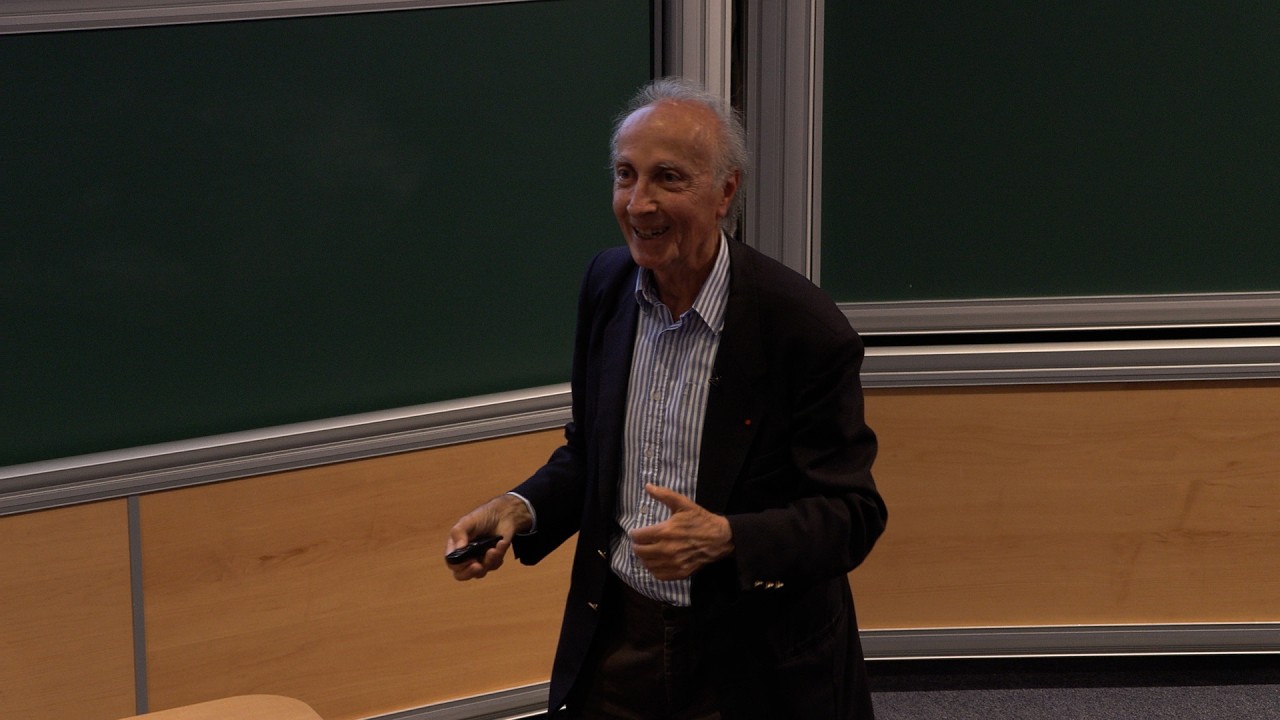
Thibault Damour - Gravitational scattering at null infinity: asymptotics, BMS symmetries, (...)
Watch on YouTubeVideo summary
Thibault Damour opens his presentation by highlighting recent gravitational wave detections, such as the event from January 2015, which provide empirical evidence for the nature of merging black holes and allow for precise tests of normal modes. He transitions to a theoretical discussion comparing the waveforms emitted by coalescing binaries with those resulting from hyperbolic scattering trajectories. While binary mergers involve a spiraling inspiral followed by a merger, scattering events are characterized by an initial approach, a close encounter where radiation is emitted, and a subsequent separation. A crucial feature of these relativistic scattering waveforms is the presence of "memory," meaning the gravitational field at future null infinity differs from its initial state. This difference manifests in the waveform's asymptotic behavior, specifically how the metric perturbation decays as one moves toward infinity, setting the stage for analyzing the structure of spacetime far from the source.
The core of Damour's talk focuses on the mathematical framework used to describe gravity at infinity, particularly the work of Bondi, Sachs, and Penrose regarding asymptotic symmetries and the "peeling theorem." Historically, it was assumed that metric functions could be expanded in pure powers of $1/r$, leading to a specific hierarchy where curvature components decay at distinct rates, with the fastest-decaying component vanishing as $1/r^5$. However, Damour explains that this peeling behavior relies on assumptions about smoothness that may not hold universally. He discusses how logarithmic terms can appear in these expansions, violating the strict power-law decay predicted by the original theorem. This violation is significant because it affects the definition of conserved quantities like angular momentum at infinity; if the decay is too slow or involves logs, standard integrals for energy and momentum may become divergent or ill-defined, challenging the uniqueness of the Bondi-Metzner-Sachs (BMS) symmetry group.
Damour further explores the implications of these infrared effects through the lens of the multipolar post-Minkowskian formalism, a method developed to solve Einstein's equations by matching near-zone and far-zone solutions. He details how tail effects—where gravitational waves scatter off the curved background spacetime and propagate inside the light cone—introduce logarithmic corrections that violate the peeling theorem at future null infinity ($\mathscr{I}^+$). These effects are proportional to the total mass of the system and modify the waveform's coefficients beyond the leading $1/r$ term. The discussion extends to a fascinating puzzle involving string theory calculations by Amati, Chirilli, and Veneziano, where the loss of angular momentum in scattering processes appears at a lower order in the coupling constant than energy loss. This discrepancy suggests that angular momentum might be carried by zero-energy gravitons or absorbed into the field itself, linking classical infrared ambiguities to quantum concepts like supertranslations and raising questions about whether the full BMS group represents a true symmetry of scattering spacetimes or merely a partial description.
In conclusion, Damour emphasizes that while many aspects of asymptotic gravity have been clarified, the infrared structure at infinity remains an active area of research with unresolved subtleties. He notes that recent comparisons between effective field theory calculations and string theory results reveal scheme-dependent terms and issues with zero-frequency gravitons that complicate the matching of different approaches. Although some puzzles regarding angular momentum loss seem to be resolved by accounting for field absorption, fundamental questions about the uniqueness of BMS charges and the validity of peeling in generic scattering scenarios persist. Damour's final message is one of cautious optimism; while major problems in physics are often solved over time, the infrared structure of gravity continues to present intriguing challenges that prevent us from claiming the subject is fully understood, urging the community to remain vigilant about these subtle effects at the edge of spacetime.
Read the full video transcript
So I wanted to complete what has been
said before. Lego VGO Kagra has now
detected 390 events about and one of the
most beautiful is this one from 14 of
January 20125 where the real data after
whitening is this gray thing you see
here these are templates okay uh and
this is the highest signal to noise
ratio and this allows really to check
the quiz normal modes to a few percent
and prove the cur nature of the merging
black holes. Now just to establish the
notation
uh I will talk in the first part about
waveforms from coalesing binaries and uh
the difference with uh from hyperbolic
encounters. So the notation uh h munu is
defined this way without the infamous
factor two of a shocken uh it's a joke
uh from the the waveform you project it
on a null frame at infinity and you what
I will call the complex waveform is the
coefficient of 1 / r which is
essentially the combination of the two
polarization with a minus i in this
convention and I will discuss the issue
of what happens beyond the one / r. Now
when you have coalesing in spiraling and
coalesing binary black hole this is a
space-time diagram where time goes up.
Okay, just
and we have seen this is the type of
waveform for coallesing binaries but I
will be here interested in waveforms
emitted by scattering trajectory. So
just to have in mind that they are very
different from this because you have a
splash of radiation when the two thing
get close and the type of waveform you
get is this. There are the two
polarizations and on these waveforms
when the velocities are relativistic you
see clearly that there is a memory uh
which means that the value of h at the
end of the scattering event is different
from the value at the beginning and what
will be important in what I will tell
about is the way you go towards uh
actually towards minus infinity you you
go towards this limit uh with some slope
also
now so I will be in four dimensions
there will be no cosmological constant
uh we will solve Einstein's equations in
the case of two black holes this is rich
equal zero and I wrote down in harmonic
coordinates the explicit form of
Einstein's equations which are nonlinear
but not
extremely complicated finally okay you
can write them easily So uh historically
I'm going to talk about subtleties about
what happens in the infrared that
infinity at the various type of very far
from the systems. This issue has been
greatly clarified by the after many
previous works but let's say the work of
man Bondi and his colleagues
and uh of reach in around 1960 has been
important for clarifying things
uh although the work of Vladimir Faulk
before contain actually a lot of very
clear results. Now one of the basic uh
idea is to set up a coordinate system
where instead of having the usual
coordinate which is time in
flat space time time would be t
minus r here you say I want an exact
solution of the econal
equation for null waves. uh that is to
say a family of null hypersurfaces
outgoing null hyper surfaces
uh each null hyper surface is
characterized by one value of u and u is
a solution of this okay then you use
coordinate system where u is used as
time and then some radial distance and
some angles you try to fix the metric in
a rigid way by imposing as many
coordinate condition you want this is
the bondi
gauge and then I want to insist here the
then they made the assumption that all
metric function entering this gauge fig
coordinate system admit expansions to
all orders in one / r. This was the main
uh assumption. Now uh this assumption
um has been uh reformulated in a sense
in a very elegant geometric manner by
Roger Penrose who introduced the idea of
let us focus on the structure at
infinity of this type of spacetime
radiative spacetime asytoically
[clears throat] flat by distinguishing
various ways of going to infinity. So
the usual way to get massless waves at
infinity is called scri plus. Okay, this
is a future null infinity. It is this
type of structure here. If you go to
infinity in space, then this is called
space-like infinity I can go to infinity
in the past at the velocity of light or
you can go to infinity slower than the
velocity of light. Okay, just for you to
know there are those five type of
infinities and the idea of Roger was
mainly around these things to assume
that the u there is a conformal
transformation of the physical metric
gimmu by a certain factor which
essentially is 1 / r which brings
infinity at finite distance so that the
conformly related metric jihad munu now
was assumed to be smooth
uh in a sense of admitting even
extensions beyond sky where the
spacetime does not exist. So uh so this
is the analog of saying the previous
bondi things admitted expansion to all
powers in one over r here you assume it
is smooth and actually it's very
important to be at least c4 for some uh
things to be true now what were the main
results uh of the bondi sax penrose
approach the main uh one of the result
was the so-called peeling
peeling behavior okay So in the
formulation of Roger Penrose the
conformal compactification
this peeling behavior means after you do
uh the conformal transformation
the vile tensor of the conformal matrix
chat hat which is numerically equal to
the all by definition of the vile tensor
if we indices this way uh vanishes on
sky plus and vanishes smoothly like the
first power of omega.
which means that if you divide by omega,
you have an object which is a finite
measure of curvature at infinity. Okay.
And this is more or less equivalent if
you assume uh C4 here to the other
formulation of peeling which is that if
you decompose the V curvature the val
curvature has 10 real components in all
which can be packaged in five complex
quantities
and in the notation of Newman and Pedro
these quantities are called S0 1 S 2 3
SI 4 and the peeling theorem
says that
maybe I will need some thing here. Yes.
And the peeling theorem says that the
usual uh radiation uh oh I forgot uh 012
34. Okay. Sorry.
>> It's there.
>> It's there. It's there. I should have
Yes. The usual radiation cipher the one
over R part of the waveform appears in
the curvature. The curvature is made of
two derivative of the waveform. That's
why what appears here is actually the
second u derivative of what was the
complex waveform and this is pi4. Okay.
Then the pi 3 goes like 1 / r² 1 / r
cube 1 / r4. But the crucial thing is
the uh fastest decaying component size
zero which is this combination of things
should decay like 1 / r5 and this is
equivalent to this. So this is called a
theorem but this theorem depends on the
assumptions and uh okay so this was one
of the big results of the bond sax
penrose approach another thing was the
discovery by bondi met and then
generalized by sachs of asytoic an
asytoic symmetry group of equations near
future inf null infinity
and uh I have given The result here uh
this group the BMS bondi met sax group
um is obtained by combining conformal
transformation of the sphere at
infinity. So at infinity the two angles
theta phi make a two sphere s2 a
conformal transformation of a two sphere
in in this complex coordinates
sterographic coordinate is an SL2 C uh
transformation so it's an omographic
transformation with arbitrary complex
number A B CD modulo the determinant it
needs you have six real parameters and
these six real parameters this group is
omorphic to uh the group of Florence
rotation of uh rotations in space and
boost. Okay. And then the surprise was
in addition you have something which are
called super translations where the
time u so remember u is
essentially t minus r plus logarithmic
corrections that these things uh could
be shifted by arbitrarily angular
dependent
shift. So you change the proper time the
time at infinity in an angular
dependent way. If you restrict if you
decompose this so the so-called super
translation in multiple moments the
multiples L equals Z and L equal one
they contain four independent parameters
and this is equivalent to the prankar
translation acting in in spacetime in
the bulk of spacetime but you have this
thing which are huge generalization of
the prankar translations and the problem
was from the group theory point of
The translation subgroup of this group
is uniquely defined as a normal
fourdimensional subgroup. Okay, it's the
only one physically it means from the
bondi sax penos construction at infinity
you can define p mu the radiated angular
linear momentum at infinity in a totally
an ambiguous everybody agrees what is a
good definition of losses of energy and
linear momentum but there is no way to
define a preferred normal subgroup which
would be the lawren group the lawens
group appears but there are many lur
groups. Okay. And if you make a super
translation, they are not equivalent to
each other. So it means you cannot
define a priori uniquely angular
momentum and this will play a role and
is still playing a role. Now uh yes so
so the peeling theorem was uh so
actually it was an assumption. It was
saying if we assume everything is nice
and decays like power laws there is this
peeling. Okay. And early on people
starting with couch torance Novak
Goldberg and Winnie Kur said but maybe u
there could be also solution of
Einstein's equation which do not have
those nice expansion in one of R there
could be logs appearing
uh are we sure that this is the the best
thing okay and in particular wikur in
1985 said the a kind minimal violation
of the idea that the conformal curvature
tensor vanishes linearly in the distance
to the future null infinity omega could
be that it vanishes but like omega log
of omega so it means there is something
singular because if you divide by omega
there is no limit but it's rather mild
okay but this was just said maybe this
could exist and then push and others
have studied general spacetime solution
of formal solution of Einstein equation
because now if you ask the question is
it compatible with solving Einstein
equations to write formal expansion at
infinity that contain power in 1 / r and
log of r. The answer is yes. When you
start putting a log at some order it
will proliferate but you can put logs
there are solution formal solution of
this type. Okay. Now if we turn to more
uh rigorous or all order result
uh yes so maybe I should site that Elmut
Fredish in 1981
proved that the peeling is satisfied if
you give initial data
uh for hyperbolid
thing that is to say if you look at
spacetime
and then you have square plus here and
you give data which decays sufficiently
fast on not on a slice at t equals zero
but on a slice like this then he showed
that if the thing is smooth enough here
it stays smooth in the future so there
exist solution of Einstein equation of
this type rigorous that are peeling and
this is linked to a result of luke
blanche working within the multipolar
post minkoskan formalism I will mention
in a moment which is perturbation theory
but to all orders he could show that if
the spacetime in this framework was
stationary before some time in the past
then peeling is okay. Okay. But at the
same time, I mean a little bit later,
Christo Kleinman in their uh very
monumental work on proving stability of
Minkovski space actually
uh they have estimates on how the
curvature decay at infinity and these
estimates say that the simplest
consequences of peeling which is that P4
goes like 1 / R and P3 goes like 1 / R
square are valid for very general
solution given from t equals0 thing but
after that the estimates leave open the
fact that maybe they don't peel although
my understanding is they cannot prove
that they do not really peel although I
I expect that for generic solution they
looked at uh yes they would not peel now
I want to mention something that I
learned recently when Samuel Gala
visited here it's the a Nice work by
compare Gala and V of 2024 of putting
together all five infinities
uh and modular assumptions that is to
say you you describe formal solution of
Einstein's equation which admit asotic
expansion here here here and at this
corner here you use a type of expansion
valid near space-like infinity that were
introduced by Bobby Vag, Bobby B and B
Schmidt long ago. You do a similar thing
with anatic continuation toward this
thing and then it gives a way of putting
together and what was slightly
surprising to me is I mean because you
impose matching condition at all corners
you have only one BMS group for
everything. So if you do a BMS super
translation here you have to do the same
essentially of the analog everywhere and
then from this point of view BMS would
be a symmetry of all infinities
>> but here the matching is not this
antipal matching
>> it's more subtle it is it contains this
with subtleties and I will come to this
because apparently there are more
subtleties even than uh that will part
of the later story which got changed
two day ago when I got an email of
compare. Uh
so these are fresh news. uh
[clears throat] now ah yes so what I was
saying before is people said you can
have peeling if you assume good one over
expansion or maybe you don't have
peeling but this was purely from looking
at possible solution of unshine equation
at infinity it was not rooted in the
source I mean what you want to know for
instance for scattering if you have two
masses that come then they
collide or I mean they they scatter at
impact parameter then they go away. what
is the structure at infinity and uh
concerning uh peeling at square minus
yeah I should have said that I mentioned
the peeling theorem on square plus there
is an analog thing if you assume
alapenos that everything is smooth
conformally here you have the same
peeling theorem except that it's reverse
that pi zero goes like one / r because
it is the analog of radiation and s four
behaves like 1 / R5 but what they showed
>> can you explain perhaps why so much
focus on this feeling why should we care
you said you said the first two they go
as
>> because let's say yes from the physics
point of view u the wave is at 1 / r
okay angular momentum depends on data at
1 / r and 1 / r² and r cube okay if you
have logs appearing already at one / a a
cube there is a problem of defining
angular momentum some integrals become
divergent or become conditionally
convergent. So it is true that there is
like a folklore people especially in
England started saying this is the
penrose thing and therefore everything
will be defined this way uh but um one
can re-examine everything I'm not okay I
will talk about peeling violation this
peeling violation do not mean that
everything disappears okay if the
peeling was very strongly violated then
you would have nearly no good integral
at infinity.
There are even solution of Einstein's
equation constructed by Lydia Berry for
instance rigorous solution where you
cannot define total energy uh of the
spaceime. Okay, there is infinite energy
in some sense. So we want still to do
some physics. Anyway, the question I
want to ask here in the case of scatter,
what can we say about peeling the
structure at infinity? And a first
answer was given by Walker and Will and
then confirmed by me little bit later
saying that even in linearized gravity
the peeling would be theorem on square
minus is violated in the sense that the
component that should decay like 1 / r5
decays like 1 / r4. Okay. But uh then I
did another computation back in 1986.
Um and then I found that for a more
subtle thing which are now tail effects
so it's not linearized gravity we have
heard today about tail effects it means
the gravitational waves uh are back
scattered uh by the the cool type
curvature of spaceime and u and they
propagate inside the light cone and not
just on the light cone and this delays
the propagation of the waves and gives
the uh infrared effects and um and they
are proportional to G * the total energy
of the spacetime G * the total mass and
then I found that the tail effect acting
on quadrupar waves violated peeling like
one over R4 now this issue
uh yes that indeed you could say who
cares but
u it has attracted recently a lot of
attention first he uh I remember I told
that to Christo Dulu who amplified this
and said there is probably another
source of peeling violation then Kberger
studied this for years
Radu Royan and others I don't remember
all the authors have done a calculation
which suggests that indeed in scattering
you have peeling results peeling
violation although it's not clear
exactly what they have proven uh
recently in 2026 six two different
groups including copera got also um said
that there is indeed a violation of this
type but they said we disagree by your
factor two of the result of tibo this is
where we come to the recent thing
especially because I was signing I I was
the referee for this but I was signing
the referee report so it's public I said
okay uh it is interesting should be
published though I think there the
problem with this thing but two days ago
for told me oh yes there was an error in
the fundamental equation we were using
and then there is an extra term to be
added and now maybe we are compatible so
it's still not totally clear what is the
final result now I want just to give an
idea of the multipolar post minkoskan
formalism so this is a formalism that we
started with look uh in back in 1986
Then it was developed in collaboration
with Bala for years. Luke pushed the
formalism to very high accuracy. So this
formalism is solving Einstein equations
by combining several approaches. Uh it's
called multipolar post minkoskan. Its
full name is PN matched multiple
prominos because in an region outside
the source let's say the source are two
objects moving around outside the source
you expand Einstein's equations you
expand the metric in a post minkoskian
expansion just powers of g then for
instance h1 satisfy this h2 satisfies
nonlinear terms in the right hand side
we all know this but now you need to
compute these integrals and the way to
be computer is to Ah but the general
restarted solution of waves is can be
decomposed in multiples. He gives
something explicit on the right hand
side and then we developed explicit
methods to compute those integrals. One
loop, two loop, three loop. Okay. To
very high order uh and then you can get
explicit solution. Okay. uh uh and then
you match to the source so that the
multiple moments that appear in the
external scheme are connect are really
linked to explicit expression on the
source and I've given here explicit
formula just to show for the quadripole
for instance the quadripole at what you
measure the coefficient of the
decomposition of the wave h at infinity
in in the quadripole uh is measured by
this as function of the time U
and it is expressed by a certain
quantity M which is itself expressed in
another quantity I which is the source
quadupole moment. The source quadruple
moment is obtained by explicit integral
over an effective source which combines
uh which is essentially the land sheet
sum of the timu of the matter and the
tow gravitational of the gravitational
field including all nonlinear terms in
the near zone here and then you have
nonlinear effects in the wave zone like
tail effects memory effects
instantaneous
tail of tail etc. Can you remember in
this calculation what is given and what
is computed?
>> What is given?
>> What is given? Yeah. What is given as
input?
>> Nothing is given. Einstein's equations.
Then you need to say
>> what do you say about the source
>> here? Nothing. The formalism is very
general. Then you say my source will be
a neutron star which oscillates will be
two neutron stars moving on. Then you
need to solve the equations of motion of
the source. solve timu new equals zero
and then insert this explicitly. Okay.
Now yes so now I I'm coming back because
uh in view of these discussions so there
was my old result about peeling
violation which stayed dormant for a
long time then people got interested in
this and as they were dis uh let's say
there were some results in tension with
each other as people say I said okay let
me reexamine uh in a new way what I had
proven using the work of
Luke Blanche, Cha Compair, Oliveri and
Ali Sange
which did uh good work to connect the
metric as given in the multipolar post
Minkovkin formalism to the first
interesting nonlinear order including
tail uh in a bond like gauge okay which
allows to connect the bondi type
expansion to the MPM formalism in a
clear way. Okay. Uh but what I want to
explain is the following. The essence of
this idea that there is peeling
violation come from interesting thing in
the infide. Okay. So it's not just a
calculation peeling not peeling it is
connected to infight structures in
gravity. And this infight structure are
the following. If I consider that the
quadrupole moment is in MPM formalism is
when I look at its behavior in the
infinite path. So for instance if I have
a scattering situation I expect the
quadruple moment to describe two bodies
coming with some velocities at lowest
order but also uh their trajectories in
spaceime are curved because they
interact gravitationally. When you
compute this, you find that the qual
moment has a part which goes like t
square straight line trajectories and
then a t log of minus t. Okay, which
means that when you compute now the
waveform at infinity using tail
corrections, nonlinear corrections, you
find that these coefficients
actually they correspond to for the
moment you measure at infinity for the
waveform decomposed in its quadruple
part that this waveform goes to a
constant.
So it's the value of the waveform h at
minus infinity in time going to
constant. This constant measures the
pipj measure the two velocities of the
bodies. Okay. And and then the next term
that is in one / t where t is the time
in the past. For some strange reason
people call this tail. Although this b
has nothing to do with tail. Actually it
is the logismic deviation of the word
lines due to their gravitational
attraction in a postmikoskian way but it
is there okay it's it's tail in the
sense that the waveform goes through a
constant modulo one / t thing which
decays okay so anyway this thing are in
the waveform and now the point I want to
>> this is time like path this is I I
>> so here it's to yes sorry this no this
is Uh first this is function here it's
the variable of t here it is more um u
that you say the the the future the
time but you take the limit of
the time at infinity
>> past future null infinity
>> it's the past or future null infinity
here but but this thing actually is
valid everywhere in space time okay
including in the other and that will be
yes because what will happen essentially
it's because at future null infinity In
the past you will get this as violation
of peeling and you will get this as
violation of peeling on sky minus. Okay.
So it contains several violations of
peeling in a very simple manner. Now um
yes so for instance so I I I did
recently some new computations to
starting from the waveform okay but
keeping now the terms beyond the 1 / r
okay 1 / r² 1 / r cube and things like
that. And what you find is uh when you
look um when you look at null infinity
here on square plus you find that beyond
the term in 1 / r which is the usual
waveform which exists there is a term in
1 / r² whose coefficient is min -6
g ² e the a coefficient. So the a
coefficient remember was this. So the
value of the waveform at minus infinity
okay enters in the next term in 1 / r
square and although you could say 1 / r²
looks as good as 1 / r actually this
violates peeling because when you
compute the size zero curvature tensor
from this you find that this is
proportional to this and therefore you
get a violation of peeling. Okay, so
this is just a red derivation but using
your uh recent result just to see within
MPM where is this violation to be sure
it is there. Okay, with the same
coefficient minus 6. But now um I I I
push this calculation also of peeling
violation on sky minus which are more
complicated because there are also tail
effects to take into account. And then
there are two terms one which is the old
result I had got which comes just from
linearized gravity which is this B. So B
is the one over T coefficient. But there
is also a tail term with a numerical
coefficient that I want to double check
before showing it exactly. Uh okay. Now
um I'm saying this because up to two
days ago there was this paper of compare
and Sebastian Robert saying we get
something like that but we have not the
same coefficient here. uh and in their
paper they use matching to get antipodal
relation and the delicate things is that
they were missing terms there. So the
they they have a good framework for
understanding better antipodal but I
think there are subtleties that we have
started to discuss with Ali to
understand better. So it shows that it's
still an open problem to understand this
thing but an interesting problem to
understand infrared thing at infinity as
this is
it's a conference on string theory. So I
want to pay homage to the founder of
string theory we is also in a sense the
uh initiator of a lot of the effort uh
that EFT people now are doing and string
theory people. Uh in 1990,
Amati, Daniel Amati, Marello Chafaloni,
Gabriel Venidiano
uh computed
uh the higher order gravitational
deflection and soft brush the in plank
energy super string collisions which
means low modes of the string
essentially gravitons okay colliding at
super plunk energy but computing this
two loop H diagram
and They could explicitly compute the
two loop contribution to the aonal the
log of the impact parameter transform
S matrix. Okay. U getting this for the
two loop contribution and deducing from
it the scattering angle. Okay. Actually
there is a subtlety here but let's not
enter into this. And I remember when I
heard in Italy um conferences, lectures
by Gabriel on this, I realized that this
was a quite interesting thing that might
be useful for LIGO type physics and what
we were doing. And uh then I I I thought
about it and I I showed how to use
scattering result from postminkoskian
theory and import them to better compute
what is the let's say aonian of two
black holes going around each other and
in this paper uh I mentioned the the
work of Amati Chafalo in Veneziano and I
urged amplitude experts to use their
novel techniques to compute the two
loops scattering. Okay. Few months
later, Chung Rostin and Solo
said something of the same type. Okay.
at the time from classical gravity
because yeah I should have said that
starting in the actually it started in
the 50s but let's say in the 80s uh this
group of people and among Ital was one
of the workers here uh had computed the
the one loop uh equations of motion and
metric generated by two world lines but
then we realized that going to higher
order and you see it's the same H
diagram as the two loop before was
looked difficult and then we said okay
we stop and then we use post Newtonian
approximation which is simpler to
compute the integrals okay but um as we
know u the group var
succeeded first in getting this and what
is very beautiful because it is again
string theory flavored is that the first
calculation use the double copy which is
the idea which comes from KKLT which
comes from Fubini Veniano vertex
operators which are factorized uh saying
that young mil is the square uh sorry
the square of Yenstein then they could
compute explicitly the
two loop amplitude and the surprising
thing is when taking this was for two
massive particles going to arbitrary
velocities not ultra relativistic
scattering and you would have expected
that when you take the ultra
relativistic limit you should forget
about the masses and get the result of
ACV I'm a teach in Venezuelan the
surprise was that there was a divergence
and you did not get the same result so
this raised an issue how to reconcile
this what is what was missing in some
sense and uh then what happened is um I
realized by using um an old result with
Donato Bini here saying that if during a
collision you lose angular momentum and
energy this changes the scattering angle
by a quantity kaira that is easy to
compute from this simple formula.
Then I computed what is the angular
momentum lost during the collision of
two uh particles and I got uh this
result and when you add this result to
the result of zurn you get something
which agree with ACV. Okay. So at this
stage everything looked perfect. You
need radiative effects. The high energy
limit is finite. Everybody is happy. Ven
was happy again. Uh although okay I will
not tell about the bottle of wine
[laughter]
which I drank with Julio.
Uh now subtleties. So um Gabriel Lev and
Ediano with uh Gregory Viloviski then um
then um who were among the people like
me who said we need to solve this thing
and they had also separately uh with
Rulus who understood radiative effects
Carlo were important. Okay. Uh but they
insisted on the following point and this
is what I want to say. There is a
puzzle. The puzzle is the following. I I
did not say it but now I say it. The
energ the loss of angular momentum when
you have the scattering of two bodies
goes like the second power of the
coupling constant G. But the loss of
energy goes like the third power of G.
And from a quantum point of view if you
say but the energy is carried by
gravitons it means you do not lose
gravitons
uh with finite energy at order G square.
How can you lose angular momentum?
Because in quantum field theory, angular
momentum is carried by gravitons. Each
gravitton has a spin plus or minus 2 h
bar. So there is a puzzle and um and at
this stage if I had given the only
computation giving the result people
could have said the result is wrong. But
there were many different groups
including the the work of Julio said no
no everything is correct. uh and then I
then in the paper this is taken from the
paper of Gabriel and Gregory uh the low
the angular momentum loss is of lower
order in the coupling constant than the
energy loss and they said it got to the
point where at a recent workshop in GGI
no I think uh there appeared a graviton
having zero energy and robust angular
momentum this state of affairs is one of
our concerns in the present paper. Okay.
So the point is how come angular
momentum has this peculiar property that
from the quantum point of view you
should not lose angular momentum there
are no carriers at infinity. So it's the
point of what is at the quantum level a
zero energy gravitton. Okay a gravitton
should be on shell uh omega square= k².
If it has zero energy it does not exist.
So okay, this is the conceptual point of
view which is still bothering Gabriel.
Uh I think and I think it's good to keep
in mind things that uh you know should
worry no
>> that bother Gabrielle.
>> Yeah. [laughter]
Uh hey let's not you will see my last
slide. Okay. uh now uh so and then in
their paper apart from just saying this
they said but this is linked to the BMS
frame this is linked to the super
translation ambiguity so this is that's
where the you know this is the topic of
my talk to say infrared effects
symmetries at infinity zero frequency
gravitons
things they are all related angular
momentum ambiguity
uh and what they showed explicitly is
that if you Start with a waveform of
this type with a one / r coefficient you
call f and if you do a super translation
so this result here the this value of f
here by this 4 gm over this this is the
value obtained from postmikovskan
perturbation theory this is the value
also you find in weineberg's 1965 paper
in weineberg book on gravitational waves
in 72 the collision I mean from
perturbation theory you want to today
the the waveform at minus infinity as a
pp divided by np the quadruple formula
says that immediately okay so how can it
be wrong but anyway what they say if you
f if you add the super translation you
modify the one over r coefficient of the
waveform and if you choose beta by this
value the veniano vil koviki value with
a log uh you can gauge away this you can
say that the incoming shear is zero. Uh
but remember that in my previous slide
the incoming shear so the incoming shear
was this aig.
Yes, let me say this because I said it
quickly. Uh this thing
uh or in the second derivative plus tail
effects of the quadrupole moment. This
quantity is precisely the uh the
quantity which is responsible for the
angular momentum and that Gabriel and
Gregory showed you can gauge a wave by a
thing if you want to have no angular
momentum loss but from this point of
view there are other consequences of
this say like this thing is gauge
invariant you cannot gauge away this so
in a sense this thing is there okay I'm
not saying it's a proof I'm just saying
there are subtleties is here. um
and yes and and this played a role
recently I will be brief here I don't
want to take more of your time it's the
last talk you are tired in uh over the
recent years um after calculation that
existed first in the 70s people could
tackle the one loop waveform okay before
I was talking about the the exchange of
gravitons between two massive word lines
uh which defines a force or Hamiltonian
a potential between the two word lines.
But uh two word lines can not only
exchange gravitons but they can emit
gravitons
uh both from inside and from the from
the sides also. And then uh several
different groups and they representative
of these groups here computed the the
one loop waveform. Um recently there
have been progress and clarification
both by Stephano and by
Carlo Heisenberg and Rodulo Russo. Um
there are cut terms which are important.
So at some stage with Donato and with
Andrea Geralico we said okay there are
those beautiful results but the
multipolar post minkoskan formalism
developed by Luke for many years is what
is used by LIGO and it is important to
compare the predictions of this
formalism developed over many years and
which is used to the highest level EFT
computation. So u with donato we we we
computed this for the scattering okay
usually the mpm formulism is used mainly
for quasi circular orbits okay or small
eccentricity orbits here it is a very
different situation so we use the same
formula but the calculation are slightly
different in technically and then we we
compare to this and the reason what I'm
saying this is in the comparison first
in the first stage of the comparison
We were surprised that even the
Newtonian level was incorrect that you
say the the three groups that said the
waveform should be this and then it did
not work at the Newtonian level but then
the cut term was added there. Several
other effects were added. So at some
stage everything worked fine but I want
to insist on uh subtleties. Okay,
because subtleties are important and
there are two types of subtleties. One
subtlety is that in the computation you
need to take into account epsilon over
epsilon where you are in dimmerg and you
are in four minus 2 epsilon dimension.
So scheme dependent a prio contribution
but from the mpm point of view they are
there. Okay. So you need uh a scheme
which gives this good epsilon over
epsilon and uh in a sense zero energy
gravitton that is to say because either
you argue you can replace zero energy
gravitons by something or you include
them as a disconnected diagram. Okay. uh
that you in a cut is you couple zero
energy gravitons with non-zero energy
gravitons and then this is necessary to
get something linked to the venetov
koviski super translation but there is a
factor today I don't want to enter into
the details we have a recent paper where
we have checked that this is true in
detail but it shows how subtle the
comparison is and how interesting it is
to compare EFT QFT based results and
string theory based result to uh other
calculations. Okay. And ola that is bad.
Yes. No, it's just this and my
conclusion is uh simply uh a sentence of
pankare because you see in the for many
years people thought the asyto structure
at infinity has been fully understood by
bondi saks penrose there is the BMS
group. Then I did not mention this but
there is Boskeeti and Compilia are
working within the U in the vein of the
strummingers group and thing like that.
So people understood that infrared
effects, zero frequency things are
subtle things. And then I agree with
Pankare that finally there are no
problems the big problems of physics are
never definitely solved. When there are
important problems they are more or less
solved and I think that this infrared
structure of gravity uh is still with
us. There are things to clarify. Okay.
And that's the main takeaway message.
Thank you for your attention.
>> [applause]
>> question [sighs]
>> maybe I have a question
if if you work in the BMS frame where
you remove the initial shear your claim
is that you will still get in violation
>> uh so I don't know yes okay it's a
question while preparing the slide I
said but it is there Okay. To be
checked. Okay. Uh it's just it's a
warning. Okay.
>> Yes. So, so I I have a question about
this comparison. So, you mentioned that
there's subtlety, but on which side of
the comparison does the subtle lie? Is
it on the side of your way of computing
both cos or is it always on the side
where you have to be super careful?
Where do you have to be careful?
question
>> here in that case I mean in that case
this was on the EFT side we never had
any doubt or anything at one loop let's
say at one loop the MPM formalism is
absolutely clear and has no ambiguity
there are by the way they are UV
divergences because you put point masses
but these are understood they don't
reflect in the quadrupole moment and
what you comput but uh Luke has pushed
now the MPM computation to something
which is three loop or beyond and there
you have is you is obliged to use demor
both in the wave zone and in the near
zone and there are subtle terms there we
are discussing with Luke where in the
final answer there are things that
depend on one / epsilon and its finite
part in both regions okay uh so this is
why it would be important and we are
working on these two compared to what
exists on the EFT side and when there
will be two loop results we will see uh
I do not I mean in principle from all
the work of of Luke I think the
subtleties are under control but it's
always good to compare
>> maybe I comment that one of the
subtleties is not inherent to the QT
approach because this disconnected terms
if you do the calculation in the Kish
basis not in the basis with two copies
of the fields then there those terms are
not there you just write all the
diagrams and
>> no but you must include them we have
>> they're automatic because they come from
the epsilon yes
>> of that propagator
>> but they are there you mean
>> they are there but not as a cut because
there are no cuts that computation
>> there's no zero frequency graviton
that's
>> okay but they will contribute the same
quantity
>> yeah
yeah it's absorbing the different
epsilon of that propagator yeah
we check is or the angular momentum
actually if you do it that way you need
that but you can do the computation in a
different way where there's no zero
frequency grab anywhere
>> it maybe is already what July was
answering but I was still not clear on
whether the angular momentum puzzle got
resolved the fact that the angular
momentum violation shows up lower order
in G Newton
>> why it is lower order
>> no I understood why it is lower order
but has a problem with either resolution
to the puzzle
um
there is no solution to the puzzle. If
you start saying you do not emit
gravitons in the energy wise and you
still lose angular momentum. I think
from this point I mean technically from
the classical point of view the formula
giving the angular momentum loss
contains this term. So there is no
problem. It's a mixing between cool
effects and radiative effects. But if
you want to say everything should be
inert space uh is Gabriel still uh
worrying about this.
>> Well, I don't know. I mean I guess it's
just uh
trying to understand what quantity you
are calculating, right? So one thing is
the angular momentum loss. So the fact
that the mechanical angular momentum
changes then can that angular momentum
can go both to radiated angular momentum
but also be absorbed in the field. Yeah.
Right. So maybe the radiated angular
momentum is carried by non non with non
zero energy but there is part of this
mechanical angular momentum that stays
in the field. So I think it's just as
saying it's subtle to define what the
angular momentum is. Anyway,
it's good to keep subtleties in mind,
not to say it's well understood.
>> Um, so what's your verdict on BMS
charges? Because I remember like there
are these celestial amputes which
actually got motivated by the existence
of BMS charges and my impression uh that
I got from discussing with Stephano is
that the speeding violation might
invalidate the existence.
>> Okay. So there are I think two answers.
I think people who compute BMS charges
with peeling violating space time say
you can always define what you want. You
define charges. Personally I always felt
the only real group of symmetry for the
scattering case is the pankar group and
I would like to see it coming out
uniquely and I never understood uh
whether BMS is a group of symmetry of
the I it's not a group of symmetry of
the full thing. It's a group of symmetry
of a partial system. No, when you say
radiation
is disconnected from the system, there
are more symmetries there. What are
these symmetries teaching us about the
what you want to know about the dynamics
was always unclear to me.
>> Okay, last question.
Not let's thank again [applause]
and let us thank the organizers. It
goes.
[music]