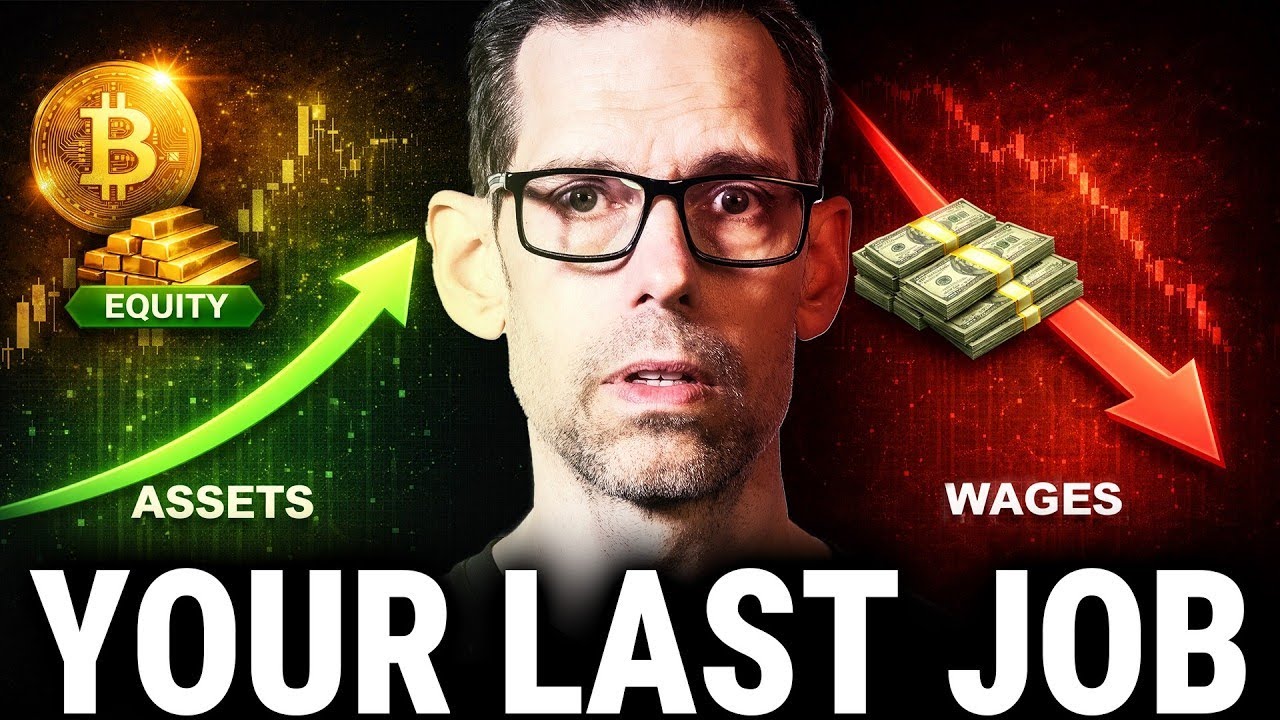
Video summary
The podcast argues that millions of Americans are facing a structural economic crisis disguised as normalcy, citing recent Bureau of Labor Statistics revisions that reveal 1 million jobs in 2024 and 2025 were never created. The speaker contends this is not merely a recession or business cycle but the beginning of an unprecedented transformation driven by rapid AI adoption, which selectively eliminates cognitive-heavy white-collar roles like middle management, marketing, and creative work while leaving manual labor sectors intact. This phenomenon contradicts historical patterns where technology augments human labor; instead, current AI agents are replacing the "human bridge" between tools and outcomes entirely, leading to a substitution effect that destroys careers for decades rather than temporarily disrupting them. Historical analysis reveals a recurring pattern known as Engels' pause or the Luddite fallacy in action: while technological revolutions eventually enrich society over 40 to 80 years, ordinary workers trained in obsolete systems suffer immediate and often permanent devastation before benefits trickle down through political upheaval and reform. The speaker draws parallels between current events and past eras such as the Industrial Revolution's impact on weavers, electrification's effect on farmers, and the internet's hollowing out of white-collar jobs like travel agents and journalists. In each instance, capital owners captured gains immediately while displaced workers faced grinding poverty, with social stability only returning after significant political friction, including strikes, protests, or government bailouts that favored established interests over average citizens. The current situation is further complicated by a fractured political landscape where neither major party offers viable solutions to the displacement crisis. Republicans are depicted as prioritizing stock market growth and AI supremacy through deregulation and cheap labor policies, while Democrats advocate for strict regulations, data center moratoriums, and bans on military AI use. The speaker asserts that this polarization prevents necessary action because politicians avoid acknowledging a recession due to electoral incentives, allowing the transition to proceed unchecked. Consequently, wealth inequality is expected to deepen into a permanent K-shaped civilization where asset owners thrive while wage earners struggle with flat wages and rising housing costs, fueled by debt and inflation. To navigate this inevitable shift, the speaker advises listeners to abandon employee mindsets and adopt entrepreneurial thinking as capital allocators rather than savers in traditional accounts. Key recommendations include diversifying into uncorrelated assets like equities, commodities, gold, Bitcoin, and real estate while maintaining six to twelve months of cash reserves for liquidity during downturns. Crucially, individuals must master AI tools professionally to multiply their output or risk being replaced by those who do not, as companies are already making hiring decisions based on AI proficiency. The speaker emphasizes that the window for launching lean, AI-native businesses is currently wide open but will close quickly, urging people to preserve optionality and avoid debt while positioning themselves to capitalize on emerging opportunities rather than waiting for a return to normalcy that may never come.
Read the full video transcript
Right now, millions of Americans are
quietly losing their jobs. Not factory
workers, not retail clerks,
college-educated professionals. The
people who did everything right. They
got a degree, landed a career, built a
life around a salary that was supposed
to be safe. And they're being told the
economy's just fine.
That is a lie, and I can prove it. But
more importantly, I need you to
understand what that lie is covering up.
Because what's actually happening right
now isn't a recession. It's not a
downturn. It's not even a cycle. It's
the beginning of the largest economic
transformation any of us will live
through. And if you understand what's
really going on, this is also one of the
greatest opportunities to build wealth
that has existed in our lifetimes. But
if you don't, if you sit this out and
wait for things to go back to normal,
history has a very clear answer for what
happens to people like you, and it's not
good. So, let me show you the lie first.
Then, I'll show you what it's hiding,
and then I'll show you exactly what I
think you should do about it. The Bureau
of Labor Statistics just released their
revised jobs numbers for '24 and '25.
How much did they revise them by? A
staggering 1 million jobs down. 1
million jobs the BLS claimed were
created just never existed. Now, this
data is hard to track accurately, so I
get it. I expect some revisions over
time. But in 2025 alone, they were off
by 70%.
15% is an honest miscount. 70%
is manipulation. And the revised number,
total nonfarm employment growth for 2025
was just 181,000
jobs for the entire year. That's 15,000
jobs per month. To put that into
perspective, a single healthy month in
the American economy produces more jobs
than we created in all of 25. Even in
2010, as we were crawling our way out of
the worst recession since the Great
Depression, we were posting roughly
150,000
new jobs per month. 10 times what we
just did. The only two year stretches in
the 21st century with weaker job
creation than 24 and 25 were the ones
where the economy was in full-blown
crisis. The dot-com bust, the Great
Recession. And back then, at least, we
were honest about the fact that we had a
problem. Right now, no one is even
sounding an alarm. These are
recession-level numbers, full stop. But
you've got to understand why no one is
calling it that. And to understand why
this recession is different from what's
come before, you have to look at where
the losses are. Because the softness is
not spread evenly across the economy.
Health care is still adding jobs.
Construction is still adding jobs. The
losses are concentrated in a very
specific place. Cognitive-heavy
white-collar roles. SaaS companies.
Middle management. Creative work.
Marketing. The exact jobs that millions
of people went to college to get. And
the exact jobs that built the modern
middle class. And that tells you
something critical. Normal business
cycles do not selectively gut the
knowledge economy while leaving
everything else intact. When you see
surgical cuts to cognitive work while
manual labor holds steady, you're not
looking at a cycle. You're looking at a
substitution. Something is replacing
those roles. Not delaying them.
Replacing them. Those of you paying
attention, I know already know what this
something is. It's AI adoption, but it's
moving faster than anyone in the
government is willing to admit. Here's
what I want you guys to understand
because it explains where we're headed.
This is not the first time technology
has rewritten the rules of who gets to
earn a living. We've been here before
multiple times, and every single time
the same pattern plays out. The economy
gets richer, the people at the top, they
capture the gains almost immediately
when these transformations happen. But
the ordinary people who were trained in
the old system, they get destroyed
predictably. Not for a year, not for a
rough quarter, for decades. Sometimes
for the rest of their lives. The Luddite
fallacy, the oft-repeated idea that
technology always creates more jobs than
it destroys, is true in the long run,
but in moments of transformation, the
long run has equated to between 40 and
80 years. And in the short run, people's
lives are wrecked while the government
lies about what's happening. The
political system tears itself apart, and
the wealth gap explodes to dangerous
levels. That's the pattern, and it's
playing out again right now in real time
in front of us. So, what I want to do
with this video is walk you through the
lie that the jobs report just exposed,
the historical pattern, what I believe
is coming next, including the political
instability that always follows this
kind of displacement, and what exactly I
think you should do to ensure you come
out on the right side of all of this.
Because the people who see these
transitions clearly and position
themselves early don't just survive
them, they come out ahead, way ahead,
and often for an entire generation.
Let's start with the history because
this is where it all starts becoming
clear. In 1810, a master handloom weaver
in England earned more than most factory
owners. By 1840, the same trade paid
less than child labor in a coal mine. As
British GDP doubled, real wages for the
working class went down. For 50 years,
the economy got richer, but the people
got poorer. Economists have a name for
this period of history. They call it the
Engels' pause, and it's about to happen
again here in the US. Over the next few
years, as people fret about AI's growing
impact on white-collar jobs, you're
going to hear a lot of smart people
throw around a phrase, the Luddite
fallacy. This is the logic that all
throughout history, every time there has
been a technological revolution, like
the one we're living through right now,
ultimately, despite the initial job
losses, more jobs are created than are
lost. It's a statement that is both true
and extraordinarily
misleading. The true story that gave
rise to the name the Luddite fallacy is
part of a historical loop that repeats
over and over as technology advances.
There are three revolutions that we have
great data for that paint a very clear
picture of what's going to happen as AI
transforms the entire labor market.
Let's speed run the pattern so we can
understand the meteorite that is
screaming towards civilization right
now. In the early 1800s, English textile
workers called the Luddites started
smashing machines because they were
terrified those machines would take
their jobs. Economists look at that
reaction and they laugh. With hindsight,
they know what would have been
impossible to see at the time. In the
long run, technology creates more jobs
than it destroys, and everyone gets
richer. It is true. Well, at least
eventually, but as we're going to see,
the people who actually live through
these periods of transition, they get
[music] crushed. And I don't mean
metaphorically. Not they had a few rough
years. When I say crushed, I mean their
lives were destroyed. And in most cases,
they died long before the economy came
back for people like them.
So, while the Luddite fallacy is true in
the macro, it is absolutely brutal in
the micro. Let's look at the details. It
took 60 to 80 years for the gains of
industrialization to reach ordinary
people. 60 to 80 years. The reforms, the
labor laws, the factory acts, none of
that happened automatically. People had
to fight for decades to get any of it.
[music] If you were a displaced weaver
in 1800, you almost certainly died long
before the economy caught back up to
your class. Your grandchildren got the
benefit, but you got the grave. Same
story with electrification and mass
production. The late 1800s brought
electricity, assembly lines, and
mechanized agriculture, and once again,
it gutted the people trained in the old
world. Millions of farmers and rural
craftspeople were pushed off the land
into cities where they had no skills, no
networks, and no safety net. Sears was
the Amazon of its day, and it also wiped
out local economies in the exact same
way. Who won first in that moment? The
Gilded Age robber barons, the Carnegies,
the Rockefellers. Skilled industrial
workers also started doing well
relatively fast. But everybody else,
they got a mouthful of grinding poverty.
It took 40 to 60 years plus the New
Deal, a World War, and the GI Bill to
turn the gain of mass production into a
broad middle class. If you were a
displaced farmer in 1890, your
grandchildren in the 1950s were living
in suburban homes with union jobs, but
you probably spent your life in a
tenement or sharecropping. Those
chickens took two generations to come
home and finally [music] roost. Then
there's the internet. This one's close
enough that we can really count the
bodies. When the internet hit, it did
not just hollow out blue-collar work, it
came for white-collar jobs as well.
Travel agents, print journalists, retail
workers, administrative staff, middle
managers. If your job could be
digitized, you were a target. The
research here is devastating.
Manufacturing workers displaced in the
2000s showed persistent wage losses for
the rest of their careers, and the
deaths of despair research, the surge in
suicides, overdoses,
>> [music]
>> and liver disease from drinking in
middle America connects directly to this
displacement. The gains flowed almost
entirely to college-educated workers in
a handful of cities. San Francisco,
Seattle, New York. Everyone else just
fell behind. Here's the unavoidable
truth. We'll get back to the show in a
moment, but first, let's talk about how
you're fueling your brain. Your brain is
only 2% of your body weight, but it
burns 20% of your total energy. That is
a massive demand, and most people are
running it on glucose. It's unstable,
inefficient fuel that spikes your energy
and then crashes it. Ketones are
different. They're what your brain was
designed to run on. Ketones are the
byproduct of fat metabolism. Your body
is very adept at using them. I take half
a dose of Ketone IQ, and it keeps me
alert and focused for hours. No jitters,
no afternoon fog. This is not some
overhyped wellness trend. Ketone IQ was
developed through a $6 million
Department of Defense contract to
support elite cognitive performance. If
you're ready to fuel your brain
properly, visit ketone.com/impact
for 30%
off your subscription order, or visit
your local Target to get your first shot
free. Again, that's ketone.com/impact.
And now, let's get back to the show.
We'll get back to the show in just a
moment, but first, let's talk about the
most expensive mistake crypto traders
are making right now. 70% of US crypto
traders think tax obligations only apply
to centralized exchanges. If that's you,
you are wrong. Unfortunately, [music]
most people do not realize every
crypto-to-crypto trade is taxable. And
for the first time ever, exchanges are
now required to report [music] your
digital asset sales directly to the IRS.
If your records don't match theirs,
you've got a problem. [music]
Some, formerly Crypto Tax Calculator,
was built specifically to solve this
problem. It supports TurboTax along with
over [music] 3,500
exchange, wallet, and crypto
integrations. It handles [music] DeFi,
NFTs, staking, and airdrops with full
support for US-specific tax rules. And
it strips out spam tokens, so junk
doesn't corrupt your actual gains and
losses. Some generates IRS-ready reports
that maximize your deductions and
minimize what you owe. If you're ready
to turn crypto chaos into confidence,
click the link in the show [music] notes
and use code Tom VIP20
for 20% off your first year [music] at
Some. Now, let's get back to the show.
We are roughly 30 years into the
internet transition, and the gains are
still concentrated at the top. And to
make matters dramatically more
complicated, we haven't even finished
absorbing the last revolution, and AI is
now about to drop a bomb on top of it
all. The pattern across all three
revolutions is this: the economy gets
richer. It really does.
The Luddite fallacy holds in the
aggregate, but the people trained in the
old system just get clobbered. The
capital class captures the gains almost
immediately, and then it takes 40, 60,
80 years, plus massive political
upheaval, for the benefits to reach
ordinary people. Now, I'm not even
saying that should be different. It's
just the way that the system metabolizes
this change, and none of it happens
automatically. People have to fight for
the change every single time. And that
brings us to the part that makes this
moment [music] different from every
revolution that came before it. Because
at least in the prior transitions, the
technology augmented the workers. The
loom still needed a lot of operators.
The assembly line still needed humans at
every station. The internet still needed
people to manage all of the workflows.
As has happened every time before, it
created more jobs. That is not the
problem. It's a question of time scale.
And on top of that, there's always been
what I'll call the human bridge, a
person standing between the tool and the
outcome. A manager translating strategy
into execution, a worker translating
machine capability into a finished
product. Technology got better, but it
still needed a lot of humans in the
loop. AI agents may not eliminate that
bridge in the next decade, but they are
dramatically reducing it in a way that's
never happened before. For the first
time in history, we have a technology
that doesn't just make workers more
productive, it replaces the need for
many of the workers entirely
in a growing number of cognitive tasks.
That's substitution through
augmentation. How many people do you
need in your business army if you can
step inside of the equivalent of a mech
suit and just do the vast majority of
the work yourself? If you're ambitious,
this is absolutely thrilling. I'm living
this right now. I'm building a video
game and because of AI, I'm literally
just teaching myself more and more how
to code the game myself so that I can
get more done and I don't have to hire
as many people. It's literally expanding
what the game can be. It allowed me to
dramatically
reduce the number of people working on
it while expanding what we're able to
accomplish. What we've been able to do
in year four of development versus year
one with a much smaller team now is
nothing short of staggering
and it's at least 90% due to AI. As a
company, I look at our profit and loss
statement and I see revenue going up
while my payroll is going down.
>> [music]
>> I made more revenue in 2025 than any
previous year and I did it with less
people. As an entrepreneur that's been
in the game for nearly 25 years, th-
this is surreal. But when I look at the
history of technological revolutions
like this, I see this terrifying pattern
repeat. If you understand investing,
you're going to be fine. If you're young
and adaptable, you're going to be fine.
If you're entrepreneurial, you've got a
window of extreme opportunity. But if
you're in the heart of your career,
you're in extreme danger of being left
behind and never recovering. History
just does not care about any of us
individually. It doesn't even care about
entire generations. And unfortunately,
by the numbers, the vast majority of
people, and we're talking roughly 90% of
adults here, are most likely to be in
the camp of people who are in danger.
Now, here's a question that you should
be asking. If the revised job numbers
are recession-level bad, why won't
anyone just call it what it is? Because
they can't. [music]
A politician's job is not to lead. It's
to get reelected. And as long as
pointing out a recession is likely to
decrease the number of votes a given
political party receives, they're just
going to refuse to call it a recession.
So Trump, who is actively deporting
cheap labor, but wants the stock market
to rise, is going to have to paint a
rosy picture for as long as he can. This
will give him the time that he needs to
ensure the US maintains AI supremacy,
which is critical to national security
and economic prosperity, and it will
also act as the new cheap labor and the
propellant that keeps the stock market
going up. All the while allowing him to
fund his reckless deficit spending
through techno-fueled growth. The
Democrats, on the other hand, led by the
Democratic Socialist Progressive wing
via AOC, Bernie, and Mondani, will
become more and more aggressively
opposed to AI. Bernie Sanders has
already called for a moratorium on new
data center construction. He held a
public dialogue with AI pioneer Geoffrey
Hinton, the so-called Godfather of AI,
at Georgetown, banging the drum on the
urgent need for regulation. Because hey,
who doesn't want to be more like Europe
and watch our entire economy decline
relative to the rest of the world decade
after decade as we are slowly smothered
by a mountain of regulations.
Nonetheless, progressive Democrats have
made AI a core policy priority, calling
for protections for working class and
white-collar jobs, bans on AI in
military decision-making, and
environmental safeguards on
energy-hungry data centers. And despite
what game theory tells us about how
stupid and short-sighted that would be
on a world stage, polls show that the
public is understandably with them. A
University of Maryland survey found that
bipartisan majorities of Americans favor
government regulation of AI. People are
scared, and based on everything we've
just gone through, why wouldn't they be?
And the progressive left is positioning
itself as the answer. Now, I'm not
telling you all of this so that you can
pick a side. I'm telling you this
because you need to understand the
historical pattern that's playing out
right now. What's happening is exactly
what happens every time we go through
something like this. Whenever the middle
class is weakened and being hollowed
out, and the government refuses to
acknowledge it, you get a political
split. The right says, "Let the market
rip. The growth will save us." The left
says, "Regulate everything. [music]
Protect the workers." And while they
fight each other, the actual transition
rolls right over ordinary people. And in
fairness to the politicians,
technological progress has never, not
even once, been stopped in the entire
history of the human race. It is a truly
unstoppable force because, as I've said
many, many times, any technology that
promises an advantage will be developed,
without question, no matter how dire the
consequences may be. This is a movie we
have seen before, more than once, and
knowing how it ends is the only thing
that's going to help you profit from it.
So, here it goes. Once more, under
history we must turn. In the 1890s, in
the wake of the Second Industrial
Revolution, the panic of 1893 hit. In a
single year, unemployment went from 3%
to nearly 19% [music]
Banks failed. Businesses collapsed at a
rate of two dozen per day. Millions of
displaced farmers and craftspeople who
had already been struggling for decades
were now in outright poverty. And the
government did nothing. A businessman
named Jacob Coxey literally marched an
army of unemployed workers from Ohio to
Washington D.C. begging Congress to
create public works jobs. Congress's
response? They arrested him for walking
on the grass outside of the Capitol
building. That was the federal
government's answer to mass
unemployment. What followed? The
Populist Party exploded in size. State
militias were called in to put down the
Homestead strike. Federal troops crushed
the Pullman strike. The country tore
itself apart for the better part of a
decade before the Progressive Era
reforms even began to address the
underlying problems. And those reforms
only happened because the instability
became so severe that the ruling class
had no choice but to concede. Same
pattern after 2008. The Great Recession
wiped out 8.7 million jobs and trillions
in household wealth. The government's
first instinct? Save the banks. Bail out
AIG. Bail out the lenders who caused the
crisis. And the average person who lost
their home? Thoughts and prayers. What
followed? Occupy Wall Street on the
left, the Tea Party on the right. Both
movements were born from the exact same
anger. The sense that the government
represents well-organized special
interest groups at the general public's
expense. That anger didn't go away when
those movements faded. It just went
underground. And then it resurfaced in
2016 with Trump and Sanders. Two
candidates who had almost nothing in
common ideologically, but who both ran
on the same fundamental message. The
system is rigged against you. And they
were right. It is. Right now, here is
the nightmare's truth. The 2008
displacement was a financial crisis. A
credit bubble. A one-time event. It was
brutal, but the jobs eventually came
back. It took six years, but they did
come back because the underlying demand
for human labor was still there. What
we're entering now is not a one-time
event. It is a permanent structural
shift. The jobs disappearing in 2025 are
not coming back in 2027, not in 2030,
not ever.
They are being automated out of
existence. Each human will simply be
able to do more. And when the population
is declining, there's a limit to what
needs to be done. This will drive people
to gamble. The sophisticated people will
gamble in the stock market, which is way
less risky in the long run, but the
masses will gamble on Kalshi and
Polymarket, where over time you are
guaranteed to lose. And that's why,
unlike in 2008, the people who own a
well-diversified basket of assets are
going to do just fine. Equities are up.
If you own assets, this AI transition
might be the best thing that ever
happened to your portfolio. But if you
don't own assets, if you're part of the
90% of Americans living paycheck to
paycheck, trying to save your way to
prosperity while inflation eats you
alive, you're watching the K-shaped
economy become a permanent K-shaped
civilization. Housing is up 50% in 5
years. Wages are flat. The labor market
is
hemorrhaging cognitive jobs.
>> [music]
>> And on one side, you've got Trump
telling you AI is going to make America
rich, while still running
trillion-dollar deficits. Fingers
crossed. And on the other, you've got
Bernie calling for an AI moratorium, AOC
calling for regulation, and Momdani
trying to tax everything under heaven to
give things away for free. All of which
sounds great until you realize that
every country that overtaxes or tries to
slow down technological adoption just
hands the advantages to the countries
that don't. Neither side has a real
answer, because neither side can afford
to tell you the truth, which is that
this transition is going to be
extraordinarily painful for a very large
number of people, and the political
system as it currently exists is just
not designed to help them. You cannot
have this level of displacement, this
level of toxic wealth inequality, this
level of institutional dishonesty, and
expect social stability. It's not how
humans work. It's not how history works.
The Gilded Age made this abundantly
clear. The Great Depression repeated the
lesson. 2008 hammered it home. When
people can't make ends meet, when they
feel like the system is lying to them,
which it is, when they watch the rich
get richer while they fall farther
behind, they don't sit quietly and wait
for the next election cycle. They get
mad. And that anger always finds an
outlet. Sometimes the outlet is
productive, new political movements,
reform, regulation that eventually
rebalances the system. But sometimes
it's destructive. Sometimes [music] it's
extremism. Sometimes it's worse. And
almost always it takes decades to sort
out. We are already deep in the populist
movement, the polarization, the
institutional distrust, the fury on both
sides of the aisle. None of that
appeared out of nowhere. It's the
downstream effect of 30 years of
internet era displacement combined with
globalism that we never properly
addressed, compounded by a debt-fueled
K-shaped economy that makes it nearly
impossible for ordinary people to get
ahead. And now AI is busy pouring
gasoline on that fire. And the only
thing more dangerous than letting it
burn would be to try to smother it. So,
what does this mean for you?
>> [music]
>> It means if you're sitting there
thinking, I just need to wait for the
market to recover and I'll get another
desk job. Sure, but only if you are an
AI master. Because over the next decade
there will be fewer and fewer of those
jobs left. Anyone who is waiting for a
return to normal is waiting for a world
that's not coming back. The jobs numbers
bear that out. The historical pattern
bears that out. But the government is
not going to confirm it because they
can't afford to. This is a game of
psychology, not fundamentals. It's not a
game of telling the truth about the
history. It's a game of obfuscating
everything and then letting the
sophisticated walk away with the prize
as has happened every time throughout
history. There's a little bit of good
news.
Every single one of these transitions,
as brutal as they were, also created
massive opportunity for people who saw
it coming. The people who understood
what was actually happening and
positioned themselves accordingly. The
people who avoid debt and preserve
optionality and buy when there's blood
in the street, always come out ahead for
an entire generation when you have a
moment of transition like this one. And
this moment it's just no different. The
opportunity is real, but you have to see
clearly and you have to act. So, let me
tell you what I think you should
actually do. First, stop thinking like
an employee and start thinking like an
entrepreneur and capital allocator. Your
cash sitting in a savings account is not
safe. Every dollar you earn but don't
deploy is a dollar the system is
designed to take from you slowly.
>> [music]
>> So, the single most important shift you
can make right now is to stop saving and
start owning things. The right things.
That means getting into assets,
equities, commodities, gold, precious
metals, Bitcoin, real estate, et cetera.
Not 10 different tech stocks, that's
just 10 ways to bet on the same outcome.
You want uncorrelated assets that
respond differently to different
stressors. You don't have to be perfect,
just avoid investing on margin and play
the long game. Second, keep 6 to 12
months of living expenses in cash, not
because cash is a great investment, it
is not, but because the worst thing you
can do in a downturn is be forced to
sell your assets at the bottom.
Liquidity keeps you emotionally sober
when everyone else around you is losing
their minds. Third, learn AI. Not
casually. Not I tried ChatGPT once. I
mean, actually sit down and learn how to
use these tools at a professional level
to multiply your output. Get better than
everyone else. As the prevailing wisdom
goes, AI is not going to take your job.
A person using AI is going to take your
job. The people with the deepest mastery
of AI will be the people that are the
most valuable for at least the next 5 to
10 years. And companies right now are
already making hiring decisions based on
that reality. You can be the person who
commands an AI-augmented workflow, or
you can be the person who gets replaced
by one. There really is no third option
for white-collar workers. Fourth, if you
have any entrepreneurial instinct at
all, now is the time. The barriers to
starting a business have never been
lower. You can launch a product, build a
brand, and run operations with AI doing
work that used to require an entire
department. You can do it by yourself.
The window for small, lean, AI-native
businesses is wide open right now, but
it's not going to stay open forever.
It's not even going to stay open for
long. Right now, the advantage belongs
to the fast and the efficient. And
fifth, don't try to predict the future.
Preserve your optionality. The specifics
on how AI reshapes the economy is
guaranteed to surprise all of us. Your
job is not to guess which surprises are
coming. Your job is to be positioned so
you can absorb the shocks and capitalize
on the opportunities as they emerge.
Now, let me bring all of this full
circle. Remember what's happening right
now has happened over and over
throughout history. In these moments of
transition, the government's going to
lie to you. They are going to try to
keep you blind to what is actually
happening. At the end of the day, this
displacement will eat up an entire
generation, possibly two. And the only
people that are going to win are going
to be the people that position
themselves to own things so that they
can thrive during this period of
transition. To the owners always go the
spoils. Act now, boys and girls. The
displacement is real. It is structural
and it is accelerating. History tells us
exactly what happens next. The capital
class will capture the gains, the middle
will get hollowed out, the political
system will fracture as it is already,
and it takes decades of upheaval before
the benefits will reach ordinary people.
Don't be ordinary people. That's the
pattern. It's never once failed to
repeat. If you're going to win, you
don't need to be lucky. You need to be
prepared. In the long run, the Luddite
fallacy is indeed true. Smashing the
looms or whatever machine, or in our
case the data centers, it's not the
play. In the long run, AI will make
society as a whole much, much richer,
but we don't live in the long run.
We live in the right now. And right now,
the only question that matters is
whether you're going to be the person
who saw this coming
or the person who got blindsided. All
right, if you want to see me explore
ideas like this in real time, be sure to
subscribe right now and join me live
Monday, Wednesday, and Friday at 7:00
a.m. Pacific time. Till then, my
friends, be legendary. Take care. Peace.
If you like this conversation, check out
this episode to learn more.
Of the 47 nations in Europe, all 47
require government-issued photo ID to
vote. India, a country where 63%
of the population live