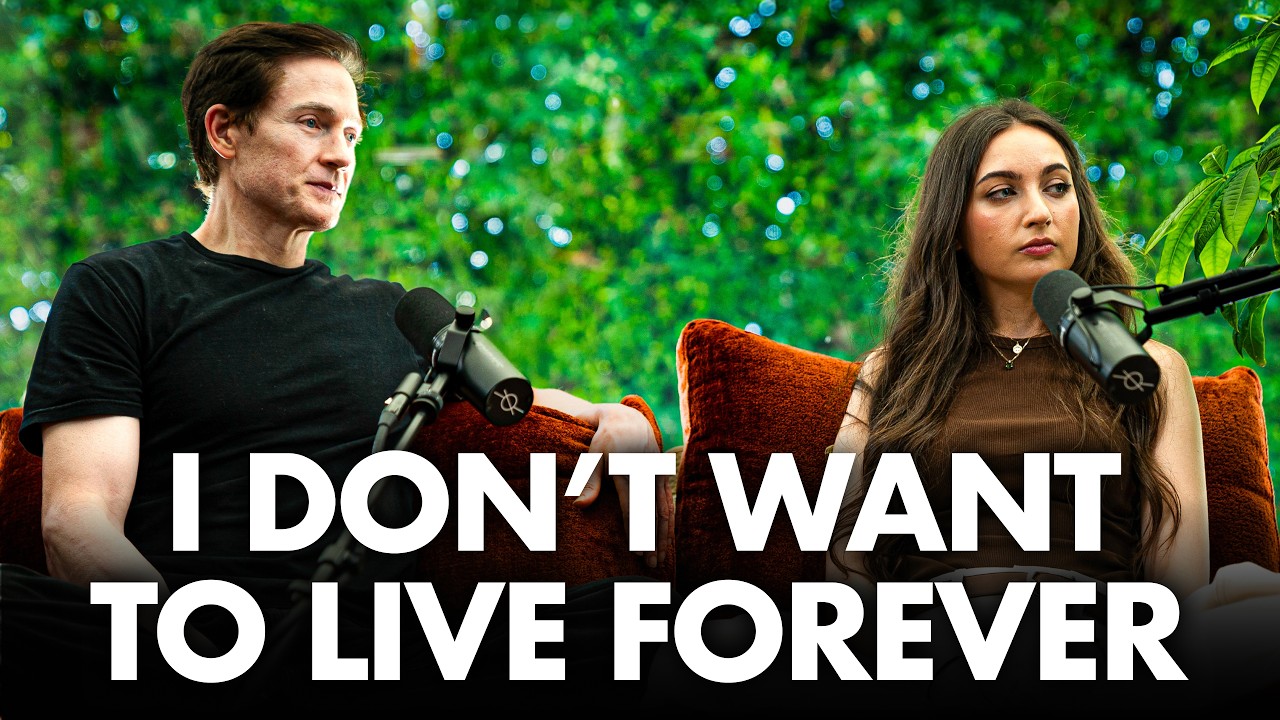
They Built a Movement Around Not Dying. Both Now Have Incurable Diseases.
Watch on YouTubeVideo summary
Brian Johnson and Kate Tolo have launched a bold public science experiment aimed at curing their respective incurable diseases—autoimmune gastritis for Brian and endometriosis with PMOS/adonoma for Kate—within six months, challenging the traditional reliance on male-centric data that often leads to misdiagnoses and delayed care for women. By tracking thousands of biomarkers across menstrual cycles, they seek to establish accurate reference ranges and create robust datasets that address significant gaps in female health research. Their initiative reframes their work not merely as a quest for immortality, but as a commitment to existence and a necessary correction to the historical marginalization of female biology in science. Utilizing advanced technologies such as immune cell sequencing and epigenetic reprogramming to reset cellular age, they hope to develop personalized cures that could eventually lead to scalable treatments for conditions like endometriosis and Parkinson's disease.
Despite facing criticism regarding their self-funded approach, the couple argues that their "N-of-one" experiments can yield population-level insights and advocate for a paradigm shift in how women's health is measured and treated. Their daily lives reflect a stark contrast between Kate's chaotic, creative nature and Brian's highly structured, data-driven routine involving extensive biometric tracking of heart rate variability, metabolic rate, and microbiome testing. While Kate finds this regimen emotionally draining due to her neurodivergent background and past panic attacks, she maintains it to translate complex health concepts into digestible data for the broader world and to serve as a model for other women. Their experiences with psychedelics like psilocybin and 5-MeO-DMT have further altered their understanding of reality and consciousness, leading them to view internal exploration as the new frontier for human advancement rather than external accumulation.
The speakers express deep concern about humanity's tendency toward impulsivity and arrogance when wielding powerful technologies like artificial intelligence and drug design, warning against hubris while emphasizing a need to prioritize existence over power, prestige, and wealth. They aim to shift society's objective function from mere accumulation to survival and flourishing, rejecting political engagement in favor of a singular focus on human flourishing. Acknowledging the trade-off of becoming symbols rather than individuals, they reject lavish lifestyles or cult-like status, preferring simple activities like pickleball, and have decided to discontinue large-scale summits in favor of digital outreach. They argue that building an "anti-entropic system" requires computational models and storytelling capable of outlasting individual leaders, similar to enduring institutions like religion, to help humanity navigate technological upheaval without panic.
Ultimately, Brian and Kate address their shared "legibility problem," where they feel misunderstood by society due to unique ways of processing information and social cues stemming from childhood experiences of alienation. They view themselves as symbols seeing a reality where societal structures and algorithms no longer make sense in the age of AI, leading them to prioritize survival over politics or capitalism. Brian shares a practical strategy for self-regulation by separating his decision-making "morning self" from his stress-induced "evening self," achieving control over his diet and health without shame through external accountability. They also tackle their unhealthy cultural relationship with death, illustrated by a vulnerable reconciliation with Brian's father, concluding that while they have not fully accepted mortality, openness allows for healing experiences. Their goal is to provide ballast and stewardship against online confusion, offering a new value system to help humanity find meaning and connection in this evolving era.
Read the full video transcript
If we are to be don't die, we both have
to cure our incurable diseases. So
either they get us or we get them.
>> Anti-aging entrepreneur Brian Johnson
revealed a recent diagnosis of
autoimmune gastritis. Kate Tolo is the
most measured female in history.
>> One of the sharpest content minds Kate
pitched Brian what if the science
experiment was done in public.
>> So we're spending $2.6 million on my
protocol. I was like oh yeah I think I
have suspected endometriosis. Brian
hears about it and I was diagnosed in
something like 42 days. Women typically
take 6 and 1/2 years to get a diagnosis.
>> I think it's possible that we have a
cure within like 6 months. This has
never been done before. We've done all
of this in 4 weeks time.
>> There's a perception that this is about
you wanting to live forever.
>> I can't understand what living forever
means. I simply want to say yes to
existence. And what I really concluded
is that
Super nice to be here, you guys. Thank
you for inviting me into your beautiful
home, into the sanctum. Uh, I'm excited
to talk to both of you together. Uh, and
my first question really is for Kate.
Like, I just want to know like what is
it actually like to be in a relationship
with this lunatic?
>> Yeah.
>> To look over and you're just smiling.
>> Yeah. Just, you know, have at it.
>> Yeah. Um, it's a lot. It's definitely
different. Um, Brian is a unique,
special human being and I've known that
since day one, since the first moment I
looked into his eyes and honestly, I
feel like it's out of my control. I
don't think I am in charge of whether or
not I love Brian. My body just does.
>> And so,
>> what what is your kind of like
relationship history prior to this? like
in terms of like other guys that you
dated and and the kind of delta between
that and the experience of like living
with Brian.
>> Yeah, I mean I think Brian's just one of
a kind. So I would categorize myself
generally like both in relationships but
also lifestyle, how I think about the
world as a fairly normal average bell
curve person prior to meeting Brian. And
so even in just the way I live life now,
it's entirely different.
Initially you were you came in like as
an employee, right? Like you were
working here for quite a while, right,
before the relationship uh blossomed.
What attracted you to want to be in his
employee to begin with? Like what was it
inside of you that like wanted to be
part of this whole thing?
>> It was his neuroch company that I fell
in love with so deeply. I was 21. I just
moved to New York. I had grown up in a
small town with immigrant parents. So, I
didn't have a ton of exposure to like
what is an engineer and you know what's
a consultant? Like that those words just
didn't mean anything to me. I got to New
York. I was working in fashion because I
learned how to sew when I was 8 years
old and I started to see the world for
the big space that it is and learned
about AI. This is back in 2016 and I
thought that is the next thing happening
and I surveyed the world trying to find
somebody who's actually working on
solving the issue of the crisis that AI
might bring. And I really felt like the
only path forward would be to merge
humanity and and AI in some capacity to
be able to speak the same language. And
so I was looking into brain computer
tech companies brain interfaces. These
are you know can you translate the human
experience into a computer's experience
through some sort of interface. And 2016
December I was sitting in a cafe in
Brooklyn and I got an email from
Singularity University and I had a quote
from a man named Brian Johnson and the
quote resonated deeply with me as a
person who's working on this whose
vision align with mine. So I started
reaching out to him and it took a number
of years and I was just every year
paying him on these various platforms
saying I would love to come work your
neuroch company. But of course going
from fashion to tech is a really hard
transition to make and so yeah it took a
while and then eventually he responded I
think by chance by accident and then we
started working together and it took us
about a year and a half of when we
started this project for science and for
health before it actually took off. Mhm.
>> And then I transitioned full-time to
that with Brian.
>> How do you feel about how this AI
experiment is going so far in the years
between 2016 and what we're seeing
currently? Uh and this premise that the
future is some merging of humanity with
this, you know, superpowered technology.
>> Yeah, I definitely was naive and I've
been humbled by like what's happened
across the last six, seven years. Um, I
still have hope that if we can quantify
and understand the human experience
enough that we may be able to have a
world where we truly merge. And what
we're building is ultimately a path
where we can uh swallow artificial
intelligence to use it for humanity's
benefit. Like what we're really trying
to have survive is our kind. So not like
our biological beings necessarily, but
our shared intelligence, thoughts,
collective consciousness, our libraries,
the internet, those spaces where we come
together and it's something other than
like our biological selves. It's our
spiritual selves collectively. That's
ultimately we're trying to hitch that
onto the backs of AI because AI has the
capacity to run away as a train and
become its own thing and then we're you
know our existence is
>> right. have to like how are you
reconciling like that vision that
aspirational vision with the you know
kind of potential for this being an
existential threat you know that that
will augur the the the extinction of our
species
>> it's like one or the other like Brian
like what's interesting about like
everything that you're doing and and and
maybe this doesn't get enough uh
attention is the fact that like the
substrate that's underlying all of this
really is AI like I had the privilege of
of coming to one of your Jeffersonian
dinners and and the provocative prompt
to instill the conversation to follow is
if there was a superpower AI that had
your best interest at heart uh and would
basically tell you everything you need
to do to be as healthy as possible,
would you surrender all of your
decision-m over to this AI with the
understanding that you could never
revoke it? It would never expire. And
that's that's the very provocative
question obviously. I mean did I get it
right? Is that essentially like the
prompt?
>> And so the premise is that if we can
understand this and we can empower a
certain technology to help us make these
decisions for us because we're terrible
at making these decisions, we're
emotional beings etc. uh that humanity
uh by proxy would be better off as a
result. That remains kind of the thesis.
I mean the the question itself is is
really
more to draw out the person's beliefs
than it is to practically answer the
question. And so I in this Jeffersonian
dinner I I set the stages where I give
two purposely provocative statements
that draws people out. And in doing that
they show their cards, their beliefs,
their biases, their preferences and then
I take that and then I flip it around
and give them a mirror. And so it's a
process that that I go through. What I'm
really trying to do is is with AI,
what's happening now is we are trying to
say intelligent things about reality.
And when you bring up the topic of AI,
you can go down a near infinite number
of paths in trying to string words
together that try to make sense.
>> You can talk about jobs, you can talk
about meaning, you can talk about, you
know, utopia, dystopia, solving cancer.
But I think the purest insight is it's
possible no human can say anything
intelligent about AI. And I don't think
we we fully internalize that that
relative to AI, we may be cavemen in
terms of our ability to understand
what's coming. And therefore, our models
of reality, our perceptions of
ourselves, our goals as a species, maybe
they don't translate into the bridge. I
don't know. And so what I'm really
trying to do is I'm trying to say as at
me as Brian Johnson, can I say one
intelligent thing in this moment? And
what I really concluded is that I simply
want to say yes to existence. That's all
I can say. Outside of that, I have no
idea what to say. I don't know what to
think. I don't know how to feel other
than like I say yes to existence under
all circumstances.
>> Mhm. And that's what this project is
about. And so, of course, people hear us
through the language of the things we do
together, the experimentation and the
therapies and the performance art, but
that's really it is the species at a
moment in time of transitioning to
something different that we can just
openheartedly say we want existence.
>> I there's a perception that this is
about you wanting to live forever, but
there's a ripple in that. Like there's a
difference between this notion of living
forever and don't die. Like what is the
how do you distinguish those two things?
The the human brain is very funny if you
speak about it through the frames of
Buddhism and reincarnation. It doesn't
necessarily a person doesn't feel
concerned about that reincarnation
cycle. If you talk about it through a
Christian lens that you go to heaven
that's soothing. If you talk about it
from an Islamic lens that is soothing.
If you talk about it without those safe
landing spots, it drives people in
crazy. You know, like I can't understand
what living forever means. I don't know
how to compute that. And so you're just
putting them in unknown land. And then
the same is true if a person's an
atheist. And so the mind has certain
tracks that it follows that says this is
a safe thought process or this is a
dangerous thought process. And then if
you try to uh do another frame where you
know we're speaking today on a Tuesday,
tomorrow's Wednesday, all three of us
are probably excited for what's coming
tomorrow. And then when tomorrow comes,
we're probably all excited about
Thursday. So being excited about
tomorrow is the same thing as living
forever. You're just doing one tomorrow
at a time. And so it really is just a
it's how the mind processes information.
And if you catch somebody off guard of
living forever, but you don't give them
like a really uh constrained container
like it's this, it feels like this, it
looks like this, and you feel safe like
this. People are like, I don't know,
man. That kind of sounds really scary. I
don't think I want that. That's kind of
that's bad.
>> The impetus for this having this
conversation now is is because of the
the health journey that Kate has been
on. Um, and so I want to hear more about
um, how that has unfolded and what it is
that you're trying to communicate
publicly around women's health. We were
chatting earlier. I shared that over the
course of many years of hosting this
podcast. I've I've had the good fortune
of conversing with many very
accomplished uh women doctors uh who all
you know share this this sentiment that
you know the science is lacking in terms
of our understanding of of the female
body like when it comes to hormonal
health and the issues that are unique to
women uh that kind of get lumped in with
just overall health and the cannon of
science that is is is basically you know
all all of these studies are essentially
performed on men and so there's a real
gap in understanding and I think there's
a lot of women who suffer as a
consequence of that oversight and this
is something that you've decided to
address headon and do it with
storytelling by sharing your own kind of
personal experience with uh some of the
things that you're contending with.
>> Yeah. So we're spending $2.6 million on
my protocol. I'm measuring 1,900
biomarkers. I'm doing around 100 days of
this just to get baseline data on what
happens to a female's body as she goes
through the menstrual cycle. So like you
can think about the female body as a
waveform and we know generally there's a
waveform like you know X biomarker
changes in this way and this biomarker
changes this way but we don't actually
have enough robust data on exactly what
happens through the female body. And so
I'm taking on that challenge with
Brian's protocol and setting that up.
what we were able to do is like take his
baseline pretty much one day and then
start off the races in terms of
optimizing. But for female health, we
don't have the luxury of having this
huge data set on what we can compare me
to and actually understanding the female
body. So like for example, something as
simple as cholesterol.
We know that in the first half of the
cycle, it can be up to uh 19% higher the
result than in the second half of the
cycle. So there's one study that looked
at this in women and around 6% of women
actually tested high above out of range
for cholesterol in the first half and
then they get tested again and they're
back into the normal range. And so it
has these implications because nobody
when they go to the doctor to get a
blood drawn is being asked what where
are you at in your cycle so we can
compare reference ranges for cholesterol
specifically. And so another study
looked at around 400 metabolites in the
blood. these like downstream byproducts
that are happening in the body and
around half of them they discovered did
fluctuate through the cycle but that has
not been characterized. So we that's we
know it moves. We don't know how. We
don't know what's normal. And it's a
really hard measurement problem because
to be able to do that, you need lots of
women tracking their hormones daily. And
then as soon as you know the LH surge
happens and you transition to the second
half of your cycle, you go in for blood
work testing. That's an extremely
logistically complicated problem to
solve. And so we thought, why don't we
start with my body and see if we can
create the most quantified menstrual
cycle ever. And so now I'm on day 29 of
that process.
>> And the impetus for this was an
endometriosis diagnosis.
>> Yeah.
>> Can you talk a little bit about that?
What is endomtriosis?
How is it traditionally treated and how
are you kind of like treating this
differently or using it as a a means to
better understand uh the female body?
You know, actually we started this
process and then as my team were asking
me about my health background, I was
like, "Oh, yeah. I think I have
suspected endometriosis." And they were
like, "Oh, okay. When did that happen?"
I was like 7 years ago. Did you do
anything about it? No. Like I got heard
when I was like 22
from the doctor, you know, you can go
get surgery to figure it out. I'm not
getting surgery. I have no idea. I'm
young in New York and I'm like, I'm not
doing that. And so all this time goes by
and my symptoms get more and more
severe. But because it's a general trend
and I know that surgery is the option,
I'm like, I don't want to go down that
process. Then Brian hears about it and
he's like, I think we could solve that.
And so he starts calling doctors and
scientists from around the world
sometimes at 4:00 a.m. when he first
wakes up so that he can catch them in
various time zones. And through just
pure persistence like in a startup like
mentality, he able to essentially
organize four different ways to confirm
my diagnosis and get me diagnosed in
something like 42 days. So like an
insane change, whereas women typically
take 6 and 1/2 years to get a diagnosis.
So they live with it for a very very
long time.
>> Interesting.
>> I mean what is it and and how many women
suffer from this? It's around 1 in 10
confirmed um women suffering from it,
but the suspicion is that it's much much
more cuz it's such a general disease
that affects so many people and lots of
women just never get a get a diagnosis.
>> And what it is is in the um uterine
lining, you have cells that grow outside
of the lining and then that creates
problems because they act as if they're
still in the uterus. And so they cause
all these issues like fusing organs
together, scarring, having nerve um
firing. So that they're very very
painful. Um and so like for example, one
of the the symptoms that's very obvious
for endo that I experience is pain while
defecating on my period. You know,
somewhere in my bowel system, there's
endo lesions that are firing while I'm
on my period and just causing
excruciating pain.
>> And so this is something that that
develops over a long period of time.
Hence six and a half years before a
proper diagnosis.
>> No. The reason it's that long is because
surgery is the traditional way of
diagnosing it.
>> I see.
>> And it's expensive to get surgery. It's
very invasive. And so women just put up
with it.
>> Mhm.
>> Or they go to the doctor saying, "Hey, I
have painful periods." And the doctor
will be like, "That's normal." And then
they're sent home. But there's a real
missing education around what is endo.
What can you do about it? What we were
able to do, we got a transvaginal
ultrasound that came back negative. Then
we went and got an endospecific protocol
cuz it turns out you really need someone
who's trained to do these ultrasounds
for endo specifically and that then it
came back positive. Same thing with my
MRI. Firstly, came back negative. We
went and did an endo protocol for MRI.
It came back positive. I got a blood
test done and I also got a saliva test
done. So with four different modalities,
we were able to like kind of triangulate
this and get a confirmed diagnosis. And
at the same time, I also got diagnosed
with two other issues at the same time
that I had no idea that I had PM PMOS,
formerly known as PCOS and then a
condition called adonioma. So my uterus
is essentially swollen and it shouldn't
be.
>> So 10% of women are suffering from this.
It goes undiagnosed, misdiagnosed or
diagnosed late
>> and traditionally the treatment is
surgery and that's it. Right. And so the
exploration that you're on is
are there better ways of detecting this
and are there alternative treatments
that could be effective short of like
having to cut you open?
>> Exactly. Is that and and where are we at
with that?
>> Oh man, it's so sad. So much of it is
just like pushing things forward like
it's like it's laying there. So, we're
actually right now working on getting
this blood blood test available so that
women in the US can go and get this
blood test drawn at home and that'll
give them sign signal on if they've got
it or not without having to go and get
an expensive MRI or
>> and that's a reliable test so you don't
have to do all of the the mult
multiplicity of tests that you had to do
to really confirm this diagnosis.
>> That's right. Yeah. Yep. Yeah.
>> And why is that not already widely
available?
um a combination of sexism, uh people
not knowing about this disease, the fact
that it is um there's many different
ways that this disease can present
itself. Um yeah, it's just an
infrastructure issue, just not enough
attention on this so far.
>> And is this initiative something that's
being celebrated by the broader medical
community? Are you getting push back and
criticism? Like what is the feedback
been like?
>> Very positive. Yeah.
>> Yeah. Are there women doctors who are
like, "Finally, like I'm glad somebody's
doing this because a lot of the
criticism that you get, Brian, is
like,"Well, if you have all this money,
you're spending all this money on
yourself, like why don't you put it into
trials, you know, like gold standard
science? You could be you could be
approaching this totally differently
that would benefit humanity and also,
you know, kind of serve the purpose that
you know, this this mission that you're
on. These end of one of experiments,
like how valid are they really?" Uh so
it's easy to like you know for like a
traditional scientist medical approach
to like have a a battery of criticisms
around like what you guys are doing but
this seems like it's something that
you've is not you're not getting that
kind of
>> no like a sigh of relief like finally
and especially like Brian as a male in
power dedicating his brand his platform
to this cause like just women around the
world and especially like in academic
settings are just like finally
somebody's going to put the spotlight on
this. So, yeah, it's really a testament
like Brian truly um
I have a hard time accepting love and
being seen and being taken care of and
um but that entire first process like
Brian was just like all in reading books
on female health, educating himself. So,
yeah, I was really lucky.
>> You're feeling seen.
>> Yeah. I mean, and it's complicated as a
result. It's really complicated.
>> Let's talk about that. Yeah. Why do you
feel that way, Kate?
>> What do you think after having been with
me for 5 years?
>> Uh, yeah. I So, Kate, we've been trying
to get to the bottom of this
>> actually. And that the hypothesis we had
is that Kate is not legible to herself.
>> What does that mean?
>> She she can't understand herself. She
struggles to understand herself. And I
think and we also were trying to explore
this hypothesis that women are not
broadly legible to society. And so when
you read the history of female health,
the the same words the Greeks use. So
they were trying to understand planetary
alignment. And so they were, you know,
they they were trying to figure out
planets and they would like draw these
circles like they spin in circles to
make sense of the of um the orbits. They
couldn't make sense. because their
assumption was they thought Earth was
stationary and the planets are circ.
>> First of all, like I like I ask a
question about like Kate's psychology
and you're talking about like planets
and
>> Yeah.
>> And so in the same way they they refer
to a the womb as the same kind of
chaotic structure. So they're like the
planets are chaotic and the female womb
is chaotic. And so there's a deep
history of seeing females as chaotic, as
like systems that that can't be
understood. And that's it's not like a a
centrial thing. It's recent. And so
there's a bunch of carryover where women
have never been as legible to the world
as men because they're more complicated
in the same way as planetary, you know,
planets were at some point in time. But
the the women thing's never fully
resolved. And so that's what we've been
working on is is in part what Kate is
doing by this quantification is by
showing how her microbiome changes
throughout her cycle and her eyesight
and pain tolerance and metabolism and
breast size and and and and and you
basically see like there's a system that
moves just not in ways that have been
intelligible or legible.
>> Mhm. But but really it's a system that
you know that produces life like that
like produces these cycles. And so in
many ways we've been trying to like
figure out how to explain this to the
world. It's not just about biomarkers.
Kate is not trying to be the healthiest
person in the world. She's not trying to
biohack herself. It's a legibility
project. And to me like really at the
heart of like what does it mean to be
female and what does it mean to be a
male understanding a female.
This episode is brought to you by
Element right here in black cherry salt.
I'm deep in a fall training block right
now, which is the biggest sustained
running volume that I've attempted since
my back surgery. And here's the thing
that nobody tells you about rebuilding
endurance at almost 60. Hold on one
second.
The margins get thinner. When I under
fuel or underhydrate, I don't just feel
it on the run. I feel it for the rest of
the day. little bit of a headache, some
brain fog, a 3:00 fade. It's not a
mystery. Often, it's as simple as
inadequate electrolytes, which is why
Element lives in my home gym. It's a
zero sugar electrolyte drink mix and
carbonated drink with sodium, potassium,
magnesium, and none of the sugar or
dodgy ingredients that typically you
find in these sports drinks. So, if
you're training for anything this fall,
this is a lowcost experiment with a high
hit rate. Get a free 8count sample pack
of Element's most popular drink mix
flavors with any purchase at
drinklement.com/rich.
Find your favorite flavor or share it
with a friend.
This episode is brought to you by Birch.
Ah, I can just feel it. Here's an honest
question for you. When did you last
upgrade your mattress? We replace our
phones every couple years. our running
shoes every few hundred miles. But the
thing we spend a third of our lives on a
decade, 15 years, given how essential
sleep is to well-being, that math
strikes me as backwards. I've been
sleeping on a Birch mattress for about 5
years now, and it taught me what I've
been tolerating before. Sleeping hot,
waking up stiff, blaming everything
except the slab of synthetic foam
underneath me. Birch, on the other hand,
is built from actual materials. Organic
cotton, natural latex, responsibly
sourced. All engineered to breathe and
no polyurethane foams, no fiberglass,
none of that questionable offging. And
they give you 120 nights on your own bed
to see how your body responds. It's all
risk-free. Your sleep is the foundation
of everything else. So, the upgrade is
overdue. I want all my listeners to
enjoy a deep, restful night's sleep with
a new mattress from Birch. Go to
birchliving.com/richroll
for 27% off sitewide. That's
birchliving.com/richroll
and get 27% off sitewide.
Well, legibility is is an interesting
word choice. I mean, it's really uh
marginality like the you know the long
history of women being marginalized and
men being confused by women and being
dismissive of them and just saying well
they're complicated or like she's being
hysterical and you know that that's the
real context here of like like talk
about you know an idea that we've
incepted. It's like oh this this less
than perspective of women and what
they're capable of etc. that has you
know been a real violence in terms of
like you know existence and you know
kind of the shared consciousness etc
like in an expansive way like
>> it's really you know an awful legacy uh
how how we have treated women perceived
them uh made assumptions about them and
that's reflected in the canon of science
in terms of how we understand them and
this is sort of an antidote to that um
legibility is a digestible word uh that
that sort of sidesteps like you know
like just this this really awful history
in terms of how we've conceptualized
women and their
>> their role and their their strength and
their power and the like in society. And
so this is like a a small example of
just let's celebrate these women. Let's
let's let's improve that. Let's change
that understanding.
>> Yeah.
>> Yeah. Like one simple thing with her
endometriosis is that like I've been
working on my language to communicate to
men what is endometriosis. So, how is it
the case that you have this?
>> This is a whole black box to us. Like, I
don't know. Like,
>> exactly.
>> My daughter had an issue and I was like,
I don't know. This is like a girl
problem, you know, like it's a black
like it's a mystery, you know, we don't
talk we don't talk about it. It's
between the women, you know, like this
is this is not functional. Right.
>> Exactly. So, if if you're hanging out,
you're my friend, you're like, "Oh,
Brian, I've never heard of
endometriosis. What is it?" I'm like,
"Okay, Rich, it's like one in 10 women."
So, like it's a major disease, right?
So, what here's what it is. It's like an
alien is inside of you fusing your guts
together and then it feels like you get
kicked in the balls.
That's what that's what endometriosis
is. Now, if a man is experiencing that,
they're like, "Man, this sucks. We got
to solve this." So, it's like this
>> women compl it's like, "Oh, you're being
you're you know, like you know, you're
being emotional or like you know, like
just it'll go away or like Yeah. The
dismissiveness of that, right?"
>> Exactly. Yeah. Yeah. At at the same
time, I've been super humbled. I was
hoping this was just an issue of
historical sexism making its way into
the medical world. And of course, it is,
but I've been really humbled through
this experience of like I'm a systems
person. We built a business together.
I'm extremely like, you know, if I want
to solve a problem, I'll go and solve
it. It is so hard to measure myself. It
it like just being able to separate the
noise in measurement on just one person
doing the same thing every day versus
the signal of my body's actually
changing. That's one thing. And you
stack up, okay, you want to do that for
hormones so you can correlate it with
where you're at in the cycle. Most most
people think women ovulate on day 14,
halfway through a 28 day cycle. Most
women actually don't have a 28 day
cycle. Most women actually ovulate on
day 17, but it's incredibly variable.
like I think I ovulated this year this
uh cycle on like day 23 or something
like that
>> and so there's like tons of myths around
this but what it means is that it's very
variable so how to kind of lock down in
our existing paradigm of how we consider
measurement that process is incredibly
difficult and if I was to try and
measure 100 women at once I'm not sure
how I would go about it robustly to the
standards by which science has currently
set up our system of what we consider
justice in terms of good science, you
know. So I think we need a paradigm
shift entirely and that's actually why
weirdly the N of one may be the perfect
entry point that actually we may
discover population level science on
women through many many N of one
experiments at home and then with that
you're able to kind of detach the signal
from the noise
>> right and at some point um concoct the
best clinical trial that you could run
at scale.
>> Yes. And it might look entirely
different than what it does for men
right now.
>> Yeah. But in the immediate kind of
daytoday of like dealing with this
condition and trying to understand it,
what else have you discovered that you
think would be helpful to a woman who's
watching or listening to this who is
struggling with that right now?
>> Yeah, we so we have a master plan to
cure endometriosis.
>> Okay.
>> So, right off right up our alley. So
like f first
>> the the the the hubris sitting right
alongside the uh humility.
>> Yeah. Exactly. So like f first I'm going
to give to the haters.
>> So you know Kate and I do this
documentary on Netflix. We are
brighteyed bushy tails. We're like we're
going to you know take on death
>> and then within a year we both have a
diagnosis of an incurable disease.
>> It's so delicious.
>> It's so delicious. So there you go
haters. Like
>> autoimmune disease for you,
endometriosis. Yeah. uh you know karma
is alive and real.
>> Exactly. So like there you go. It's a
gift. Now also the dual diagnosis has
been the best thing that could have ever
happened to us because like if you think
about this from uh the universe's
perspective, irony is always going to
show up and play a role. So it's a
journey now, right? Like if we are to be
don't die, we both have to cure our
incurable diseases. There's just no path
forward.
>> So either they get us or we get them.
But there's just no middle ground.
>> It's clarifying.
>> So like, you know what? We've got we
have our tasks laid out for us very
clearly. So we have been hustling um
both and we immediately got to work. So
we have a we have probably on each of
our teams like three or four
international groups helping us try to
solve this. We've had all these people
rally around the the uh intent. So what
we find is that these in any given area
of course there's a rich world exploring
these things but often times they don't
have the publicity or reach or focal
point and we happen to be that on these
two diseases
>> and so we've just rallied so many
incredible people to work on these
things and so we think we could
potentially make significant headway on
both within 12 months.
>> What is your autoimmune disease
specifically? Uh, how is it impacting
you and where are you at in terms of
like addressing it?
>> It's I have no symptoms. It's uh
basically I don't really I didn't
realize I had it. So, it is my immune
cells mistakenly attack my stomach. So,
they basically eat my endothelial lining
of my stomach. It is a autoimmune
condition I had starting about 30 years
ago with my thyroid. So, it's been
cooking in my body for a very long time.
That has nothing to do with what I've
been doing for the past 5 years. And in
fact, had I not been taking such good
care of myself for the past 5 years, my
diagnosis could be really bad. So, just
to be clear, because a lot of people,
they think this autoimmune condition is
from that. It's not. It's from a thyroid
and
>> hypothyroidism.
>> Yeah, hypothyroidism and the stomach are
very closely linked in the immunology.
So, that's that's the pairing, but it's
not what I've been doing the past couple
years. So, what we're doing now is we
did two things. as soon went as I got um
my immune system sequenced. So, we did a
blood draw, we got a million of my
immune cells and we looked at each one
of these guys individually like who are
you? What's your job and what's your you
know special key and then I went under
again two weeks ago. Kate was there for
it. Uh so I went under general
anesthesia. Uh we had a a scope down my
throat and we took 24 biopsies on my
stomach. And so we biopsied the actual
autoimmune condition. We took those
samples and then we did like an oceans
11 style operation to cool them uh at
the proper speed, deeper cool them at
the proper speed, then cryopreserve
them, transfer them over overseas to a
special lab. So we now have uh a mini
Brian growing in a dish from these
immune cells.
>> And so we'll take these, we'll actually
get results in a couple days. We'll take
my biopsy and my immune system and say
now we have a full picture. Who are you
guys and what are you doing? And with
that we can then say okay we're going to
do this therapy or that therapy and
we'll carve out the path
>> but this has never been done before
we've done all of this in four weeks
time.
>> And how receptive is the traditional
medical community to this initiative or
this ambition?
>> It's purely it's a scientific endeavor.
It is as purely scientific as you can
get.
>> Uhhuh.
>> Yeah. So, it's it's like a it doesn't um
it doesn't get caught up in things like,
you know, should you eat meat or
vegetables, you know, where people are
like going to war with each other. This
is just a pure biology plan.
>> Got it. Uh you mentioned uh many many
Brians growing in a petri dish. Uh you
know, perhaps the the your greatest
accomplishment in ter in terms of like
attention farming is this idea that
you're cloning yourself, right? like
this is just headline bait and internet
gold again. Uh the reality of that is of
course very different. Uh so walk me
through uh where you're at with that.
What's going on? Basically what you're
doing is you're you're establishing a
culture of pur potent stem cells, right?
Which are cells that can express them in
any number of ways that can be
replacement for cells that are diseased
etc. But uh you know eventually and
hopefully like rebuild organs and all
kinds of you know interesting things
that are happening at the very you know
sharp edge of these technological
advances in medicine. Is that is that
accurate?
>> That's right. Yep. So the way this works
is I did a blood draw uh 150
milliliters. Uh you separate the out the
cells and you take the cells and then
you apply Yamina factors and that will
reverse the age of my cells from 48 to
zero epigenetically. So now they're in
an embryionic state. Now what it doesn't
do is my cells at age 48 has gone
through a number of cell divisions and I
have these somatic mutations like it has
the errors in my DNA and my
mitochondria. So it doesn't fix that. It
takes the epigenetic age back to zero.
So embryionic. So now I have these raw
materials. So if I get a disease like an
autoimmune condition and I need to
rebuild my stomach lining, I have my own
cells. I can say, can we build rebuild
my stomach with my own embryionic-like
cells? So now I have the raw material to
do that because if you take somebody
else's cells, your body might reject it.
You have a high risk. And so currently
in the world there's trials going on
where people with Parkinson's disease
are using their IPS-CS induced plural
stem cells to replace the neurons that
die in the Parkinson's process and also
for heart failure. So it's the raw
material. So the the the technology is
phenomenal because
everybody
should have their their cells banked,
>> right? you have this bank and this is
available to you if and when you're
going to need it at some point in your
life.
>> Exactly.
>> And on a surface level it's like okay
this is insane. This is some sort of
gatka you know kind of situation.
>> Uh
an indulgence of a you know wealthy
privileged person but it's just like
anything else. I mean when Elon Musk
started Tesla like his first offering
was that like Lotus supercar which was
very expensive but that's what you have
to do to get to the model 3 that's
affordable etc. So by dent of of of you
kind of investing in this and trying to
share understanding of it, the idea is
that at some point um this will catch
on. It will incept as an idea and then
with scale these things become
affordable and just second nature. On
some level we've already been doing
this. You take like when you have a baby
you can get you can get the stem cells
then and you can bank them etc for
future. So it's not necessarily a new
idea. It's just a more kind of like
advanced refined version of that.
>> Yeah. Yeah. We've done the same with my
immune cells. So, we we did uh during
this immune profile, we take my immune
cells, we also bank them because you
want to store your immune system as
young as you possibly can, right?
Because every day you age and the cells
have more somatic mutations. So, I'm
trying to basically take all of my
body's raw material. In the IPS-C's, you
take it back to zero. Uh epigenetically
with the immune systems. you're taking
48-year-old Brian, but still like your
immune system is your ultimate weapon to
detect disease and cure disease. And so
we're trying to take all these
precautions of like this is the way for
everybody eventually like you're saying
to have a shot at if we say that we are
going to be able to extend our lifespans
and imagine a future where we're not
decrepit, we're healthy and we're
vibrant, we can res, we can rejuvenate
our organs, these will be the raw
materials that will help along that
path. So, we're just like it's it's the
next stage in our evolution. We are an
example of what we're doing. Uh we're an
example of that. We're rolling this out
to our customers today so they they also
have access and we'll just it'll get
cheaper over time and more accessible.
>> How accurate are these uh biological age
measurements? You know, like now we're
all wearing wearables, etc. Depending
upon the device, you you get different
analytics. These things vary wildly.
Like I have one device that says I'm 44
years old. I've got another one that
says I'm like one year younger than I
am. Like the delta is gigantic, right?
And I assume that you have a different
measurement system that on some level
you're going to contend is superior. But
it does seem like do we really how like
reliable is any of this or is this just
all nonsense in the interest of like
this longevity Olympics and the
leaderboard of who's the youngest etc.
I'll take one example. Um, eight sleep.
Um, they're just about to announce this.
They did a age predictor where they had
a model like an AI model and they showed
it data of nights of sleep and it said
the question to the AI was here are two
separate nights of sleep. Is it from the
same person or not? That was the only
task that the AI had in determining this
data set. So, it just went through a
bunch of iterations to find out, okay,
yes, these two data sets are from the
same people. These ones aren't, these
ones are, these ones aren't, etc., etc.
And it got checked on that ability.
Through that process, essentially
mapping what is the same about these
data sets establishes the same person
versus what's different, what changes.
Maybe you have alcohol the night before
one and so your breathing rate is a
little bit higher. In that process, it
actually ironically found all of the
markers that are associated with age. So
your bu how good is your heart pumping
blood for example is a really good age
marker. So it was able to detect within
I think three and a half years of
precision how accurately how old that
person is just based on their sleeping
patterns. And so that's an example of
like scientifically backed um or a
scientific process of within 3 years
delta accuracy of that. And so then you
apply okay take this person have them
sleep in this bed. what does their body
act like? And it's like, okay, it acts
like a 21-year-old with, you know, a
threeyear degree of margin. So, some uh
of these algorithms are just like pretty
much like
>> wash outs, you know, they're like they
just grabbed like three markers, put it
together, and they say, "Yeah, yeah,
this is like typical of like a
21-year-old." Others are actually like
genuinely um predictive and accurate,
and you can actually prove it with
science.
>> Mhm. Yeah. You could probably just do a
ranking. So one thing I'm proud of, we
gave birth to biological age. Like
everyone doing biological age markers
has come from our initiative of like
making it as a centerpiece of
conversation and bringing people in. And
so you can just take a ranking. If you
look at volume of the brain via MRI,
that's a very good marker predicting
age. Like the brain shrinks with age.
There's of course some variation
according to certain things, but that's
going to be a more powerful predictor
than your off-the-shelf wearable. And so
you just look at we basically in our
effort we are willing to accept hundreds
of inputs into biological age. We know
some are better than others. And so the
one like the wearables we kind of
discount a little bit because it's like
it's a the measurement uh robustness is
not as good. You have a lot of
variability etc. So yeah I mean
biological age is a real thing. We
visually know that's true in our lives
and then depends on the measurement
modality and the data behind it.
>> Sure. It depends on how uh how good
these sensors are. It's like your
wearable is never going to be a comp for
like being in a sleep lab where you've
got like things all over you or whatever
and it's measuring you at a at a at a
much more accurate level
>> and then the algorithm making decisions
about uh
>> you know where all of these metrics fall
in the hierarchy of what's important
like and
>> this percolates into you know social
media discourse around this. one month
it's V2 max and the next month it's you
know mitochondrial health and
mitochondrial density like you know it's
it's all it's all about like it's it's
the human mind like wanting to just just
give me like this one thing and then I I
have certainty around that it's more
complicated it's vastly more complicated
than that but for the average person
who's thinking about their longevity
who's living on a budget who has a busy
life you talk about these principles for
you know how to like live an average
life and do what you can within the
constraints of your busy life on a
budget to you know extend your long your
health span and those are
>> they're simple things
>> they're very simple things yeah I mean I
we tell people to
to not be intimidated by the complexity
of the world the chaos the disagreement
but just think about and understand
their health through one marker their
resting heart rate before bed it's an
oversimplification but also that's what
makes it beautiful and so when you go to
before you go go to bed. Your heart rate
is basically an accounting system that
tells you how much food did you consume,
did you drink alcohol, are you stressed,
uh did you stay up late, did you have
light in your eyes, you know, like it's
a basically you can't cheat it.
>> And so the resting heart rate is a
representation of you in your entirety.
And that will then determine how well
you sleep. And sleep is, you know, the
best longevity drug in the entire world
because it determines how you feel in
life. When you're poorly rested, you
have poor willpower. You're generally
more discouraged. When you sleep well,
you feel great. You want to exercise and
eat well. So, it creates that
bifurcation of I do bad stuff or I do
good stuff or I have the ability to do
so. So, yeah, we simplify and we just
say your task is to build your life to
lower your heart rate before bed. Most
people's current habits drive their
heart rate up. So they eat late, they
eat close to bed, they have a lot of
light exposure, they are stressed,
they'll work up until bedtime, they'll
scroll on their phones. So the five
rules are no food 4 hours before bed. So
if your bedtime's 10, final food by
6:00. Two is screens off 30 minutes
before bed. Three is a windown routine.
So, in that last 30 to 60 minutes, read
a book, go for a walk, talk to a friend.
Literally anything other than scrolling
your phone and working. Uh, light, uh,
be be mindful. So, like red and amber
are great. White, bright, white, and
blue is bad. Uh, then, um, last caffeine
by noon. And those five simple things,
uh, dramatically change people's lives
because they finally get into a state
where they can sleep well. A book in
hand before bed and that wind up routine
is the best thing you can do. It's it's
on par with a sleep uh, medication. So,
but really just trying to you're trying
to curb late night bad habits which come
out when you're stressed, you're done,
you just want to like do nothing. So,
those are the things after 10 p.m.
Brian,
>> uh, you know, Brian, you you've
surrendered your will over to these
rules and, you know, it's removed all of
the analysis paralysis and and you're
relatively robot robotic in your your
consistency with this. Like, Kate,
where's the sticking point? Like what
what is where's the struggle
>> for him?
>> For you?
>> For me?
>> Yeah.
>> In what sense?
>> Like which is the hardest thing for you?
Yeah.
>> This is like the antithesis of Kate. I
was telling we I was meeting Brian
somewhere the other day and I arrived at
the garage with one kilometer left on my
gas tank. Like I'm the most measurable
female in the world doing 100 tasks a
day. Like this insane morning routine.
And I arrive and I'm like, "Brian, can
you take me to the gas station so I can
fill up like a canister, take it back to
my car, fill up my car." so I can get
home. So yeah. No, this whole thing is
just like the antis. I'm a creative
chaotic human being and structure is not
my default mode.
>> What's the hardest?
>> It's everything. Every morning I wake up
at 6:30 a.m. on the dot. I immediately
spit into a tube. I turn on my my
therapy light so I get light in my eyes
immediately. I put on a hi HRV device
and measure my HIV every morning. I log
my subjective sleep score, my subjective
feeling. I breathe into a mask for 10
minutes and measure my resting metabolic
rate at rest. I take my blood pressure.
I measure my face to check for like is
the bacteria growing in my skin as I get
later into my cycle. I measure my
reaction time, my grip strength. I
measure my brain using essentially like
a portable MRI device, the neuroch
company that Brian built, Colonel. I
measure my vaginal microbiome, my female
hormones through urine, my cortisol
through urine, I measure my breast size,
I do my smart scales,
just goes on.
>> I mean, you have to understand that
hearing that it comes across like some
kind of uh uh obsessivecompulsive like
neurotic condition.
>> 100%. That's what I'm saying.
>> So, how sustainable
to me? Yeah, that sound like a stained
person to me.
>> He's like, I love that routine. No,
totally. I'm doing this because women
need it. Somebody has to do it. There
needs to be a Rosetta Stone for women to
make to translate it into the masculine
world we live in of numbers and
everything's digestible through data.
And so I will I will zip my mouth shut
and do my task. Doesn't the constriction
of it like impinge upon your happiness
and your ability to enjoy your life and
the ways in which
>> those are very important emotions to be
able to channel and experience in terms
of like your overall well-being.
>> Yes, I am not doing this for my
happiness.
>> I appreciate
on that.
>> I am not doing on my second week I had a
panic attack. My cortisol was through
the roof. Like now fortunately I'm in a
routine where it's I've stabilized so I
feel like I can go a little bit on
autopilot in my 5hour morning routine
but absolutely this is not happening. So
that's why as much as I can hit home
that like we would rather be in a cabin
not living this life.
>> What about your girlfriends? Like what
do those texts look like? What do they
think about all this? I mean, you know,
my sister's an Olympic athlete. And so,
we've grew up in a family where we like
hard things. And so, everyone knows that
I I wake up, I'm alive, and I'm like,
what do I do? That's the most valuable
thing for humanity. And that's my the
way I look at things through. So, my
friends and family are like, you know
what? That's just Kate. Like, she's
going to do her thing.
One of the things I love about Rivian is
the way they fill their vehicles with so
much amazing high performance
technology, but always make sure it
feels like second nature, that it keeps
that human touch. And a great example
would be the haptic halo wheels on the
new R2. On either side of the steering
wheel, there's a dial that you could
roll, push, and pull to adjust things
like the AC or skipped in the next song.
and they have this incredibly satisfying
tactile feel because you're really
clicking a button and rolling a
mechanical wheel. I was recently able to
drive an R2 with R.J. Scrange, the
founder and CEO, and he shared the
thinking behind this cool and unique
feature.
They have these really nice haptic
wheels that are on the steering that
give you this mechanical feel and it's
all software. So, it's haptic feedback
and what you're feeling is actually
there's no detents there. It's all with
software. So walk me through the
thinking on that because as technology
is sort of informing this screen only
experience there is something in the
human animal that craves that kind of
tactile control.
>> Yeah. And that was part of what the
logic was here is we and that was from
the feedback we had in R1 is the desire
from some more mechanical touch points
and and also the ability to not have to
use the multi-touch screen for
everything. Mhm.
>> And so being able to do HVAC through
this side, your entertainment through
that side, you also have drive modes in
here as well.
>> There are just so many features packed
into this vehicle. You can learn all
about them, watch the rest of our
conversation, and even book a demo drive
at stories.
Roll.
This episode is brought to you by
Squarespace. Building something online
is one thing. Getting people to actually
find it, well, that's another. And
that's where most people quietly stall
out. You make the thing, you put it up,
and then crickets. Well, this is where
Squarespace really earns it. It's the
all-in-one platform for building your
site and growing it because it's got all
the SEO tools built right in. metad
descriptions, an autogenerated site map,
all the behindthe-scenes machinery
working so that when someone searches
for what you do, the internet actually
delivers them to your doorstep. You
don't have to understand any of this. It
just runs. And once people are showing
up, you can do something with that. If
you make content, courses, videos,
tutorials, and membership, Squarespace
lets you put it behind a payw wall and
earn recurring revenue. Set the price,
choose one time or subscription, done.
Your expertise becomes something that
pays you back on repeat. Get found, then
get paid for what you know. Not a bad
combination. Head to
squarespace.com/richroll
for a free trial. And when you're ready
to launch, use offer code rich to save
10% off your first purchase of a website
or domain.
This episode is brought to you by
Go Brewing. Fall is beer season. You got
your game days, you got your tailgates,
you got people gathered in somebody's
kitchen. And here's the shift that I
really love. At every single one of
these gatherings now, somebody isn't
drinking. Maybe a lot of somebody's. The
old move was to hand that person a
seltzer and an awkward apologetic look.
But no longer. The new move is to hand
them something genuinely great. And
that's Go Brewing. Started by my friend
Joe Chur and a mission I believe in
enough to have become an investor. They
were one of the first breweries in the
country to go allin on non-alcoholic.
And the craft is super legit. Gold and
silver at the best of craft beer awards
two years running. More World Beer Cup
medals than any other brewery. A spot on
the New York Times best NA beers list.
No added sugars, no shortcuts. It just
happens to leave the alcohol part out.
Now you can find them in over 9,000
stores. But the good stuff, the
exclusive small batch releases, this is
what you want, only lives in their beer
club, shipped straight to your door.
Stock the cooler for the season, and
somebody at your table is going to be
really glad that you did. Visit
gobwing.com/richroll
50 to get a full 50% off your first
subscription order to Go Brewing's Beer
Club.
you're confronting people with
uncertainty in a way that is
discomforting, right? Like if we're
questioning these things, we're
questioning the very nature of reality
as we understand it, right? Uh and and
and that's a difficult pill to swallow.
I'm curious around how your experience
with psilocybin has informed that
perspective because I've had my own
experience with that.
Yeah. I mean, Kate did both live streams
with me. I mean, I guess my favorite
>> I mean, this is this was internet gold,
you know, like you're live streaming
this, you've got like Grimes coming on,
there's special guests, you're putting
on a show. It's all part part of like
this bizarre romcom that you guys are
living. Like this this whole thing is
like it's total theater on one level
while also trying to get at something
meaningful at the same time.
>> Yeah. I mean one I'm very proud that
this was the most quantified uh
psychedelic experiment ever done. We
bridged psilocybin into the world of
longevity. Whereas before it's been an
ancient medicine, it's been more
recently in clinical trials for various
uh you know indications and we bridged
it to longevity and I'm very proud of
that. So it's now people are seeking
funding for that. So that would be cool
if psilocybin were understood as a
longevity therapy. But then I think our
our adventure spirit as a species is to
look outward which makes sense. Our eyes
point forward. Our brain is right behind
us. So in many ways our brain is kind of
hidden from our own perspective. So we
see the world and we say I want to climb
that mountain or I want to go to that
star or I want to go to that moon or I
want to go to this place. We very much
think about ourselves moving forward
with visual contact moving forward. And
psychedelics you reverse that, right?
you're actually going to things you
can't see and you're exploring the inner
world. And if we map the space of
exploration going forward and you say
what is how big is space and how how
fast can you get there? What is the
space internally? I think it's possible
internal exploration is the new world of
exploration. Even though right now Mars
and the moon kind of has the zeitgeist
of like how do we be adventurous as a
species? What is what is cool to do? M
>> and I think this is certainly you know
you find these kind of thought processes
in the world of psychedelics but as we
get really good at drug design with with
AI we don't I mean if you look at the
number of possible psychedelic molecules
that have the capacity to be like
psilocybin or 5DMT
it's very large and if you can now start
designing these and and constructing
experiments you may find that like that
itself is the deliciousness of the
future our ability to start changing the
ways we process reality in ways that you
like in new ways that like almost like a
a GLP1 but for consciousness, right?
Like these these modifications of how we
process the world that just
fundamentally change how we understand
ourselves and how we go about. So I
think that to me is very promising.
>> What was your experience Kate? I mean, I
think it was reflective of our roles
where I can't imagine having so much
faith in your own mind to be able to do
that on a live stream and then not only
do that but then do 5 MO DMT on a live
stream, too.
>> So, my experience was just like, how can
I be the container for Brian in this
moment such that there's a safety net
here that if he wobbles that there's
like some buffering around him. Um, so
yeah, I was just really proud and and in
awe of his ability to like navigate that
so such a complex space publicly and in
lifetime.
>> I mean, for me, it just gave me a
humility and a capaciousness like it
just rewrote my understanding of reality
like how we process time like you're
saying tomorrow and the next day and
it's like this is all an illusion, you
know? Like I went in thinking I'm going
to heal this childhood wound and it sort
of said, "Well, that's really cute. let
me just show you the way things actually
are. And you know, it just
>> not a day goes by that I don't think
about it. Um, and it has fundamentally
altered
>> my convictions around like what's real.
And I'm becoming increasingly convinced
that that, you know, the real outer
space is the nature of consciousness. I
really don't think that this materialist
definition of consciousness is correct.
>> You know, it's called the hard problem
for a reason. And the materialist
definition just always falls apart. And
I think that like we're all I think that
there is one vast consciousness and the
material world is a projection of that
as much as anything else. Like it seems
it seems like that that makes more sense
in the wake of having that experience.
Whether or not that's true is almost
irrelevant to my daily experience
because it's enriched me in that way and
gave me a different lens on how to make
decisions and and navigate, you know,
the difficulties of being in a human
body.
>> Yeah. I feel like that's part of what
you see for yourself having gone through
these experiences is like that's the
prize on the other side of this
ginormous transformation we're going
through as a species that potentially
it's the tools and ability to be able to
go and explore that freely like do you
know what I'm saying like the 10th
dimension type thinking
>> what is it
>> what I really enjoy about these thought
experiments is um and the the one the
contrast I always use which makes sense
to me is contrasting myself with
Homoctus a million years a million years
ago. So let's just say we are going to
experience a million years equivalent of
evolutionary advance in the next what 10
years 15 years 20 years
>> and that we have access to our root
biology like we now can we can design
these molecules we can discover these
molecules at speeds that would defy any
previous model and so if you if that's
the stage then I don't think it's a
reasonable basis at all to imagine that
what is will be that will have the same
motivations, same aspirations, same
characteristics. I mean we see even now
like GLP1s turn off a hunger response
like a primal need of the body just gets
turned off with an injection, right?
That is crazy. What other primal things
just get turned off and so or on or or
or created? And so I guess I what I like
about this is I like that you can
basically
ask a question with no assumptions about
what would be limited is the full suite
of possibilities. And so that to me is
the most exciting moment of this.
>> Yeah. I mean that's a fundamentally
optimistic view of what's going on. And
it's not that I don't share it, but I
think I couch it with recognition that
humans are they're overconfident in
their predictive abilities. Like we kind
of think we know how things are going to
go. And the history of our species is
that we rush forward impulsively and
break things and then deal with the
unforeseen ramifications in the
aftermath. And I don't see any precedent
for this being any different. And so in
your example of like homo erectus, it's
like dropping and giving them an atom
bomb and saying like figure out how to
use this like you know like like we're
literally playing with fire and the fire
is more potent in ways that we can't
possibly imagine. And I think we're
arrogant to think that we can control it
and put these guard rails on and make it
work for us. What are we like
intentionally
bringing in like in a way that we're
we're not we're not developed enough to
really truly understand like how is that
experiment going to go, right? And I
think anybody who says they know how
it's going to go is going to be proven
incorrect.
>> Yeah. Well, I agree with that. This is
the struggle for literally anybody on
planet Earth to say anything
intelligent,
>> right? It's back to that premise then.
And and so
>> and and we're just going to do it. We're
gonna do it. We're gonna barrel forward
and we're gonna see what happens. Yes.
And what will be will be.
>> Yeah. And so the gu the only guardrail I
want to have in place, which again this
I'm not saying this guardrail is not
going to have also negative consequences
because everything always is a double
double-edged sword.
>> But I'm saying the guardrail I want to
have in place is that we as a species
prioritize existence. That we say what
what we can say would might be bad is we
don't want to go to war with each other.
We don't want to put ourselves in that
kind of situation. We don't want to kill
each other. We we don't want to be
making products and services that kill
other humans or make them degraded in
their in their ability that gives them
disease. Like some basic rules of the
road of like can we agree? We don't have
to be kumbaya.
>> Don't we already agree on that? It's
just that our actions bely that
sentiment.
>> Yeah. I mean there there is a starting
point like you know if you look over the
past couple uh decades we've made good
progress right marching those basic
principles forward but still we are a
society that says your highest status is
given with abstract you know
accumulation of money
>> power and status that's that's the
ultimate trophy we give out to people in
society so I'd say that that but that
trophy has side effects and consequences
now it's a good engine of innovation,
but it says we will give you that trophy
even if you kill yourself, even if you
kill others and even if you kill the
planet, you still get the trophy. And so
we just have some misalignment among us
humans on what is worth doing and what
is worth uh granting someone a trophy.
>> Mhm. I'm in total agreement with the
power, property, and prestige incentive
structure of our society being
misaligned with human flourishing. Uh
while also acknowledging, yes, it's it's
given us, you know, all of this bounty
and it incentivizes people to work hard
and innovate and and all the like. It's
also given rise to, you know, tremendous
economic disparity and suffering and
addiction and, you know, all the like
that you talk about all the time. And so
another kind of like substrate
underneath all of this is a questioning
of these of these systems right from
government to healthcare etc. Uh and
back to like the Jeffersonian dinner
that I attended uh you know that was
populated with some interesting
characters who are questioning our
governmental systems. Um, in a way maybe
I don't agree with uh I appreciate the
curiosity to uh engage with a difference
of opinion about like where we should
go. Um, but I can't help but think
that there is this strain of wealthy
uh tech personality,
these people like yourself who are very
wealthy and have figured out a way to
like bend the universe to their will.
Uh, and then in the wake of that like
enjoy, you know, the the benefits of
that like surround themselves with the
trappings of wealth etc. only to
discover like, oh well, this isn't
actually like fulfilling in a way that I
thought it was. Uh, and in the in that
kind of like history of being able to
like make [ __ ] happen and um, and the
kind of uh, hubris that can set in with
that like I know better than everybody
because I was successful in this regard.
Uh, the the real frustration is that you
can't you can't bend time like you know
like time and your mortality are hanging
out there. it doesn't matter how
powerful or prestigious you are etc. Uh
and so what are we going to do about
that you know and so hence we see this
movement around very wealthy people
trying to expend their extend their
health span etc. And with that kind of
galaxy brain mentality, there's a sense
of like, well, we need to change the
government and it needs to be this way
and we know better and like people
shouldn't really have to vote. You know,
they shouldn't they shouldn't have the
right to vote. Like we should just what
they really need is a strong leader and
like maybe a technocratic society would
be better. Like where are you on that? I
think it would be good to like have a
little bit of clarity around like where
you fall and that because it's it's
sympatico with this idea of like giving
your like surrendering your decision-m
and your will over to like a superpower
AI. Similarly, in a government context,
like let's just have somebody who is in
charge, we're going to trust them with
our well-being and society would be
better.
>> Does that make sense?
>> It does. Yeah.
>> Yeah. I've steered clear of any
political engagement and any expression
of opinion. I think our existence
is about a singular thing.
We're trying to change the objective
function of the human race from power,
prestige, and wealth to existence. Now,
you can still achieve power, wealth, and
status in the pursuit of existence. the
same things work, but our only objective
is that swap and and primarily because I
do think that like on some grand scale
in the universe, there's this question
where is life? Are we the only life? Is
it true that other species get to a
point of advance like we are and they
destroy themselves? like we're we're
playing the biggest of all possible
games and politics plays a game in the
species. We do you know it's like a part
of our of our society.
I don't think my opinions matter in that
regard. We are as far as I know we are a
singular voice of this new philosophy.
If you look at planet earth, who is
fighting for existence? Like who is
actually saying like you guys this is
very precious? This is it's
unbelievable. We're actually conscious
all of us on this planet. Our planet is
precious and delicate and we should
probably suspend everything that
compromises
um or or makes us weak in our ability to
persist as a species. And so I'd rather
us be a singular voice, a singular focus
than I would dabble in all these little
side quests which create acrimony,
disagreement. It was splinter. We're
trying to be more of a unifying focus.
And like this is true among all
religions, political class, all people.
So we're really trying to be extremely
narrow in what we say and what we're
trying to achieve.
>> Yeah, fair enough. It was also one of
the things that like was really
important to me when we first started
dating cuz we were private for 3 years
before we announced our relationship.
And a big part of that 3 years was a
like what happens when we reach
conflict? How do we resolve that? It's
also like I remember having
conversations with you really early on
being like I don't know like what
happens if we become really successful
in this path like who are you going to
be on the other side of that? Are you
going to be that person that you're
describing that doesn't realize that
they're pursuing something and then
ultimately changes their mind?
>> And Brian was really clear. He was like,
Kate, like I've already been successful
in all these ways and like it and who am
I? I've set my life up in a way where
he's devoting his body to the bigger
picture of humankind. And that really
for me was like okay yeah I actually I
believe that and I see that and it's
held true that the more power we gain we
try to have real integrity that we are
devoted to the cause rather than to our
own individual self-interests. Now, of
course, like I'm we're, you know,
faultable human beings and so I'm sure
there's plenty of ways that I'm like not
able to see that that still holds. But I
think out of the people, you know, like
we're we're really trying to our essence
is in devotion of a cause.
>> Mhm.
>> You have the property box checked and
this kind of social media celebrity is
sort of checking the prestige box on
some level. like it's human to like
enjoy the attention and all of that. So,
how do you keep that in check so it
doesn't become this hypnotic addictive
thing where you're
>> serving a digital audience?
>> We don't we don't care about it for for
real. I think we would we would be
happier
>> in a cabin in the woods doing our thing.
>> I don't buy that. I don't buy that.
You're loving this, dude. Come on.
>> You you mean we have this conversation
all the time. It's a sacrifice. I know
that sounds like
insane to say, but you you become not a
human. You're a symbol. And that's a
giant that's the biggest trade-off you
can make in life. Like you walk
somewhere and people relate to you as
something that you're not ultimately.
They relate to you as a symbol. They
think you are versus who you are. And so
we like knowingly have walked into that
being like we accept those terms. Sure,
like it's fun at times, but you know,
are we going out to parties in the
weekends, like having these really
insane, lavish lives? Like, no. We're
like hanging out, playing pickle ball,
>> watching a movie. Um it seems that
you've you've backed away from there was
a moment maybe a year ago where it was
like oh you're entering guru terrain
like you know these don't die
gettogethers which are cool like these
community events but it was there was
sort of a there's some drapery around
like you know cult status stuff and it
seems like you've retreated from that.
Is that a is that true? Is that a
conscious thing?
>> I say retreat. I think a a truly
intelligent being on planet Earth right
now would say, "Okay, let me survey the
situation. I am on a habitable planet
with resources. I'm going to measure the
energy capacity of my distant stars. I
have this much capacity to exist and
these are the threats that could
undermine my existence." That would be
like the most coherent thought process
of an intelligent being. And instead we
branch off into these groups like I hate
you because of blank or I want to pursue
this because of my own sensory needs of
filling status or power. But like we are
are we are an intelligent species but we
are also an idiotic species, right? Like
you if you're really truly intelligent,
you just you just want to exist and you
want to not die. And so we just have
never had that opportunity and as a
species we've death has always been
inevitable. Therefore, we make up these
other games like religions and
afterlifees and these status games are
capitalism and accumulation. But I guess
like to get to your point, this is not
about fame. It's not about attention.
It's not about what we personally want.
Like we would so much rather be playing
another game. We're trying to
we're trying to pierce this moment with
our best intellect and say in the like
the most sober way possible,
how can you say something intelligent?
>> Mhm.
>> Without getting distracted in all the
the primal things that occupy our minds.
So, but that genuinely is is our thing.
So, the the don't die back to your
question on the gatherings. We were
formulating a hypothesis on how you
build don't die globally. So like build
these these events, build up local
chapters and we came back because we
said we we're not convinced this is the
right strategy. What you really want to
do and so we wrote two essays. Kate
wrote one called the anti-tropic
systems. I wrote one called immortalism.
And uh Kate's frame was like you want to
basically build anti-tropic systems.
Like think of it like a nation state is
an anti-inropic system. Like it propels
itself over time. uh religion propels us
this over time and individuals if you
look at it through an age perspective
religions are the most enduring
institution society has ever created
they're remarkably resilient actually
DNA even exceeds religions and so we're
trying to say like how do you build this
incredibly resilient structure that
rides through the next couple centuries
with AI and however it emerges and so I
approached it via math Kate approached
it through this framework we said
basically We don't think the move right
now is to build a humanbased
system of organization. It's you have to
build like a computational model that
works on entropy like they like
basically you have to give AI the
philosophy and the math to to go after
this objective. So we wrote this out in
the essays but um that's probably a very
confusing answer.
>> Mhm.
>> I'll I'll take a stab about it. um we
stop the don't die summits because they
reach like 1,700 people per time whereas
our social media efforts reach millions
of people every time and so it's just a
strategy on like communication and
anti-inropic system is like why has
Christianity been around for 2,000 years
and there's no CEO in charge and I'm not
saying that there's not some spiritual
element to it that propels it. And I'm
saying why has it survived that long?
Out of all of our institutions, why has
that and other religions survived for so
long? So something about the structure
of that allows it to defy entropy for
that long. And you compare that to, you
know, the world's most powerful company
as of when I wrote this was like Nvidia
and that's been around for I think like
33 years or something like that. And so
like the contrast there on how
anti-inropic is Nvidia versus
Christianity. Christianity has proven
itself so far to be much more
anti-anropic. So what structure would
allow itself for us to build to be as
anti-ropic as possible? People currently
point themselves at companies. They say
that is the best place for me to spend
our time. Our hypothesis is that there
are so many other anti-ropic systems
that people don't look at right now that
are higher
chance success that have been pooed by
society because they're not in the
zeitgeist. So religion is one of those
things incredibly important. Our brains
operate through storytelling and it's
untapped that we have no zeic guy
storytelling to connect us as a species.
On the individual level, yeah, we care
about each other and we won't, you know,
do something horrible for 50 bucks, but
on the global level, we create systems
for that exact exchange because on the
global level, there's something missing
in terms of our zeitgeist storytelling.
So the guru element is it's framed in
that way, right? Because that's the way
we relate to it today. But what we're
trying to say is science has bulldozed
through storytelling. It's made it very
hard to believe in bigger picture stuff
because science is extremely sound and
it's really like entered the zy. How can
you pair storytelling of our species to
soothe our conscious minds and science
at the same time? That's what immortals
don't die is.
>> Humans are storytelling animals. We use
story to understand the world. It's how
we relate to each other. It's how we
form emotional bonds. Uh and I think
you're you're correct in saying that
we've like lost our appreciation for the
stories that we rely upon to like
understand what's important etc. we've
supplanted it with the rationalist model
with uh you know kind of the
enlightenment of of science and we've
we've kind of put that on you know the
pedestal as the ultimate in human
understanding at the cost of
storytelling and when you were sharing
Brian I was thinking about the movie uh
inception have you seen this movie so
the most entropic thing is is an idea
right like how do you incept
it's not about an indiv individual and
once that idea is firmly planted it has
anthropic properties right it will it
will outlast and have a certain legacy
that isn't contingent upon a certain
individual and as much as
>> you know Jesus Christ is fundamental to
Christianity it it it exists beyond that
individual as an idea as a story
>> you know you look at alcoholics
anonymous there's nobody in charge
there's no boss like this is an idea
right that is about
>> a shared agreement and a story amongst
people, right? And so the idea that you
are trying to incept is this challenge
to a presupposition around our
mortality. Essentially what you're
trying to say,
>> you said it so well. We are playing
inception
>> with life with consciousness.
>> That's entirely what we're doing. We're
implanting an idea in humans minds about
what it means to exist as an intelligent
being. You start at that basic. I wake
up and I'm intelligent. What do I care
about?
What are my priorities? How do I relate
to to you? What stories do I tell? We're
trying to get at the core of like that
thing and and around it, of course, is
like we've got thousands and thousands
of years of stories and and architecture
and culture and ethics and norms. And
this has a friction with what we're
doing, which you've pointed out, but
that's what we hit at every day. We're
basically we're provoking that and
reminding people there's a contrast with
the way they understand reality and
there's a different way to understand
reality and that may be scary initially
but if you just can slow walk bit by bit
you can kind of warm people up thaw them
out. If you look at the actually we did
this deep um analysis on sentiment
towards us for the past 5 years and you
look at the chart it was deeply negative
when this went viral initially. report
is like I'm repulsed by this situation.
It has steadily climbed where now we
just crossed over majority positive and
so we now have defenders actively out
there. So it has been unbelievable that
the zeitgeist has changed so fast in a
5-year time period to almost be thought
of like we might be open to new ideas
about ourselves in the world.
>> And that's why we're willing to make the
tradeoff of losing our day-to-day
existence for it. if you had to distill
uh you know this definition of reality
or this like different understanding of
it down to you know like like a log line
like what is that
yes to existence so I I personally
experienced this with 5DMT so it's an
anthogen right and I did 27 milligrams
which is a gigantic dose so for those
listening you know It's like 5 MOS,
psilocybin, like they're kind of like in
the same like similar worlds. That uh
took me to the most challenging
experience I've ever had in my entire
life. It was also the pinnacle. It was
like peak experience I've had as a
conscious being. And where I went is
to the absolute epicenter of existence.
And at every layer, it's almost like
Dante's Inferno where like every layer,
it was like, I'm going to put this
enormity of pain upon you and you have
to say yes to existence when the body is
screaming panic. Like, I can't control
anything. I don't know what's happening.
I just want to be out. And you have to
just breathe through it and say yes. And
then you get to the next gate and it
gets even more punishing. And you have
to say yes. And then you get to the
center after you finally kind of breathe
through it and you are just absolutely
dumbfounded,
speechless at the the exquisite and
magna like magnificent nature of
existence. Like just our minds cannot
understand it. And so I'm sure people
who are listening to me speak, they're
struggling to connect like what is he
talking about and how do I relate to
that? You can't you can't convey through
words. But you just leave that and
you're so humbled and so appreciative
that we are alive. It's like you just
weep like you just I was speechless for
I don't know how long but it's like that
it's like as a species we just say yes
more fully than anything we've ever done
before. And that to me is it is like um
that's the beauty of this moment.
>> The moment is all there is. We live our
lives captured, you know, rehashing the
past or or or lost in imagining a future
that hasn't happened yet. And we're very
rarely actually present for the only
thing that is real, which is like what's
happening right now. You know, that's a
a form of insanity that is has an
evolutionary advantage. allows us to,
you know, kind of live and thrive and
procreate and all the like, but um it's
fundamentally blind to the true nature
of what actually is, you know, which is
interesting. And you know, my
experiences with a version of of what
you just shared, you know, uh like mimic
that in that way. It just gives you this
profound humility and appreciation
and you're flirting with a sort of
understanding of that reality while also
appreciating that you can't you can't
actually grasp it.
>> Mhm.
>> We never got to the bottom of uh Kate's
discomfort with being seen
>> and a theory of mind.
>> Well, isn't that a nice reflective of
reality? Maybe we'll never get to the
bottom of it.
>> Yeah, that's you're deflecting right
now. I know, but like see,
>> you know.
>> Yeah. I don't know. I I'm really good at
being the space between objects rather
than the object itself. And I think we
live in a world that views things as
objects.
>> But I'm someone who says, how can I
influence the room such that people
might not even notice my involvement or
my presence? Obviously now I'm stepping
more into this object related role but
traditionally I've been much more of the
space and so I'm I'm much more like in
your head in his head trying to
facilitate a certain vibe within the
world. Um but that does make it hard for
me to be seen by others but also for me
to see myself.
>> So you have a sibling who's an Olympic
athlete. Do you grow up in Australia?
>> Where in Australia
>> in Do you know where Brisbane is?
>> Like a 10 to 12 hour drive north. So
kind of right in between the middle of
Australia and the very top. So far north
Queensland
>> but like Olympic athlete sibling. So I
imagine I'm projecting but like
some discipline in the household some
expectations that parents who raised you
to be achievementoriented.
>> Yes and no. They um immigrated from
Bosnia. So more of a immigrant child
mindset where we felt we needed to
>> do them justice for everything they gave
up to move to this to Australia and give
us such a fortunate life.
>> Um my sister's also 6'5 and so from a
very young age both her and my brother
were really into basketball and so our
whole lives centered around basketball
and getting them to practice and
driving. My parents were extremely
dedicated and never like letting them
miss a game. But I mean, Brian just went
home to Australia to my to meet my
parents. What what's your sense on
discipline
>> or just the impact of her upbringing?
Like what you noticed and saw Yeah.
>> that contributes to her character and um
sense of self
>> or or failure of legibility. Yeah. As
you put it.
>> That's what it is. Uh Kate was not
legible to her family. invisible because
your sibling was 6'5 and getting all the
attention.
>> She's neurode divergent and her thought
patterns are different and she's
difficult to understand. She expresses
her ways herself in ways that are not
obvious. They don't fit into certain
boxes or certain patterns. And so unless
you really investigate and can kind of
get your head around it, I went through
her old bedroom and we went through her
art books and school books. She is just
a different person. Like wildly
different. Like even when we go out now,
I always joke that, you know, she's like
socially, you know, challenged because
you'll see a bunch of women you swapping
like gossip and and case like stunned
like she just can't she doesn't know how
to what to do. She's like speechless.
And so you get her engaged on like a
meaningful topic and she'll chime in on
a certain thing, but she just doesn't
flow within society. And so I think you
know she'll I think she'll say this that
I was probably the first person to see
her when she showed up in my life. I was
like, "Ah,
I got you." Like, "I understand this."
And um, you know, we would be in my
office at Colonel and I would just say,
"Talk." You know, and she'd be like,
"About what? I don't care. Just like
go." And she was able to explore like
her expression of what she is, but no
one had ever done that. And so, I think
that she's had a legibility problem her
entire life that she basically gave up
on it at the age we met at you were 23,
24.
>> Mhm. 25.
>> She had 25. she had given up in terms of
you know like
>> expecting that a person would understand
her. So, she was in this supportive
capacity where she could show up and
>> understand you and service you and be
present for you and and give you all the
social signals of like, I understand the
rules of the game and I'm going to be,
you know, a good social partner. But if
you flipped it, there was it's very hard
to get something out of her cuz she
>> Is this a point of commonality like a a
source of your bonding? Because I would
imagine there might have been a
legibility problem with you, Brian,
growing up. I mean, you're a very unique
individual. Uh I don't know if you're
neurode divergent or not, but you're
certainly unique in your uh in in in
your wiring and perhaps, you know, just
a different kind of kid.
>> Uh I do have a a you know, a better
understanding of of how you were raised
and the impact of that on the person
that you've become.
>> Um but now I'm starting to see like
maybe that's something that you share.
>> Yeah.
>> Yeah. I mean, um, the funny thing about
Brian, well, so one is when we met, it
was just that like he he just
wanted to know more. Like I didn't even
feel particularly like understood
initially because it's very hard to
understand, but he just like was like,
"Go like start giving me breadcrumbs and
and every time I usually do that with
someone, I'd get blank stairs." And I
like I remember my very first memory in
life. I was like 6 years old. I was
pacing around the top floor of my family
home growing up. It was like a
Queenslander where like similar to
Florida where you have a lot of cyclones
and so yeah um on stilts and um I was
pacing around and I remember just being
like I've I can I can see that I'm being
taught all these rules subconsciously by
everyone and no none of the adults
realize that they know that they're
being run by all these rules that they
learned a long time ago that no one's
present to now. And I
>> we're all just playing out a program
that was imprinted upon us.
>> Exactly. And I was like, I want to write
all these things down because I know I
will forget them too and I will become
cemented in these rules that oblivious
to me. And I was noticing that the
street signs were the popular kids last
names at school. And I was like, I'm
walking into this system that's like
pre-established that is greater than me
and this frustration of um how much we
don't see what's right in front of us,
the space between the objects rather
than the objects themselves. M
>> and so I just remember wanting to write
that down but never quite being able to
um communicate to the people around me
like do you guys see this and feel like
they could understand. Then Brian rolls
around 25 years later or you know 20
years later and we're interfacing and
I'm kind of just like I'll I'll take a
gamble cuz you gave me the space to say
something. Can you see what I see? And
we slowly, you know, walked into this
world of where we're at now, where we're
saying, "Hey, we'll give up our our our
anonymity, our individual identity as
human beings become symbols because we
see the same picture and like the world
being run by this certain algorithm."
>> Yeah.
>> So, so the legibility issue being a
young person who's seeing things
differently is trying to connect with
other individuals who aren't really
understanding you. And so then there's a
withdrawal. Like I guess I'm I'm I'm on
a solo mission here and better to just
you know kind of keep quiet.
>> Y
>> yeah,
>> precisely.
>> That makes sense.
>> Like that's the entirety like you maybe
now see our pattern, right? Like we that
experience she had at six is what I've
been experiencing the past couple years
and we we're both just like wait a
second the world is structured a certain
way that makes no sense in the context
of AI. Like no sense.
Isn't this obvious? like all the rules
and we're like we got to change the
situation because these rules don't make
any sense. And people here say this are
like you guys are [ __ ] up. What are
you talking about? Right? Like I'm going
to give you all the reasons why that is
an unacceptable way to view the world.
But for Kate and I, we're just like, oh,
like this is so clear.
>> And and specifically like we need to
help people create the systems that
they're going to be able to survive this
next thing. like we'll be fine, right?
Everyone will be fine. But we're not set
up in a way where we have um support
systems, value systems, ideologies,
beliefs that will allow us to usher in
and not panic as AI upheavalss our
societal rules. And we're left with what
ties us together. And so we're like, can
we build some infrastructure and some
ideological thinking to help
>> keep us our brains intact as we go
through this transition, which we think
can anchor on.
>> Prioritize the fact that you're alive
and hold on to that for dear life. Let
go of the politics. Let go of the
wanting status and fame and capitalism
and money in your bank account to go up
and just hold on to those close to you
and your existence and say that's our
most priority asset and we won't give it
up for anything else. So there's there's
an example this I'm I'm going to give an
attempt at this explanation. There's a
professor from University of Chicago who
has this theory called unicontext where
she says that social media has basically
flattened context where before this you
if you went to church you behaved in a
church setting. If you were home you
were home setting right? So you you wore
different masks you had different uh
mannerisms uh and behaviors in those
settings. And now it's because social
media knocks down all those walls and
it's just one unit of context. It has
this side effect where we now live in a
perpetually comparative world where
you're you're never isolated in these
small groups but you're compared across
the spectrum that creates this intense
pressure this in psychological pressure.
And then two is that everything turns
negative. Mhm.
>> So, in a private setting, the example
she uses, I believe, is I can say, "I
really enjoy chicken enchiladas." And
the person's like, "That's cool." But if
you post that on social media, people
are like, "I don't care. You got to tell
me who's racist, right? Because they
like enchiladas." And so, it turns into
like these really sharp takes, which
then creates this perception the world
is very bad. And so, he like the point
of that I think for me is that if a
person in the modern world says, "I kind
of feel bad about life. I kind of feel
bad about myself. I don't know why. I
just like I don't feel good, you know.
Um and h so the the tectonic plates are
shifting underneath the feet of humans
and we don't know what's happening. We
can't quite put our fingers on it. We
just know we feel stuff that makes us
feel different. And so that's what we're
trying to get at is as technology
continues to move fast, we kind of slip
into the psychosis where we can't quite
orient ourselves to say like who are we?
What are we doing? Where's safe? Where's
connection? And that's why we think that
spirituality is the path is like there's
this open question. What does it mean to
be connected
>> and to have a spiritual experience? What
does it mean to be spiritual? And it's
kind of the first opening in kind of
2,000 years since Jesus was here of like
because you had Buddha uh like some big
figures like Buddha, Muhammad, Jesus
where they kind of set these big
structures but right now is this opening
for society of like what is
spirituality? And like we're trying to
poke at this question of like what does
it mean to be human? What does it mean
to exist? What do you value? Why? How do
you behave? How do you relate to others?
And so we're really trying to get our
minds around this and that's why we're
experimenting with all these approaches
is like we think it's really open like
very open for the first time in a very
long time.
>> I actually really love that and I think
that that
gets to the very heart of
what initiated this journey and this
obsession, you know, in the first place.
I mean, I have a theory of mind for you,
Brian. I have no idea if it's accurate.
Um, but I want to share it with you
because I think it's relevant to what
you just what you just said. My theory
is that you were somebody who suffered a
tremendous amount of trauma as a young
person. Uh, you grew up in a chaotic
environment uh of lack in poverty. You
didn't have a dad. you were
indoctrinated into the Mormon faith and
you dutifully uh you know kind of showed
up as as a you know good citizen in that
community. Uh at some point uh you
questioned the faith and broke ranks
with your community. You were like
otherred right and this alienated you
and exiled you uh not only from the
church but from the broader community
and ultimately your nuclear family. And
so there's a tremendous amount of pain
uh that I think you carry and that
you're trying to heal and make sense of
uh
that is a consequence of a set of
circumstances that were extremely
difficult
to
heal that. your first impulse was well
let me transcend my environment and in a
sort of I don't know if it was like I'll
show them but like I'm gonna make a make
you know I'm gonna make my own way in
the world you go out you become this
very successful entrepreneur you make a
lot of money you get a lot of attention
for that and you you know enjoy enjoy
the spoils of all of that only to
realize like oh this actually didn't
heal me and maybe the way I initially
thought it might because I'm just
following
blueprint 1.0, which is power, property,
and prestige, only to discover that it
it has betrayed its promise, right? You
still have this hole in your soul in the
Mormon faith
according to that blueprint. You live
your life in a certain way and you are
promised this beautiful afterlife. All
those questions are answered for
yourself. All you have to do is like act
accordingly.
that being stripped away, you fill it
first with material things, realizing
that's not working. What am I going to
do now? There's sort of a bereftness, a
depression, perhaps a bit of an
existential crisis. And what I've seen
you do is attempt to fill it um maybe
not initially with some version of
spirituality, a sense of a higher power,
uh a surrender to, you know, a humble
sense of powerlessness and the vastness
of the universe and trying to find
comfort in some kind of spiritual
tenants to hang on to, but instead to
deny the prospect of death altogether
because it's so ultimately terrifying.
If there is no afterlife, as I was told
in the Mormon church, and we don't know
what it is, I I can't that I I short
circuit on that. So, what I'm going to
do is create a life in which I don't
have to think about it because I'm going
to do all these things that's going to
allow me to sidestep it and prevent it.
What I think you have now matured into
is a recognition on some level, maybe
not, you're not going to admit it, of of
like perhaps mortality is inescapable,
but in the midst of that and maybe as a
consequence of some of these, you know,
alternative experiences you've had with
psychedelics, in appreciation for
some version of bespoke faith in
something larger than yourself.
So, how does that land? Am I like way
off the reservation with that? Kate,
what do you think? Like
>> I want to
>> Is this a Is this a reductive
explanation to help me make sense of uh
you know, Brian's mind?
>> Do you have anything to say?
>> I would love to hear your take.
>> I figured that you would. Um I think
he's like 20 times more complicated than
that. Like I spend every single second
of my day decoding people from 5 seconds
of information.
There are still things that just don't
add up. Like Brian was also captain of
the football team, high school captain,
what do you call it when you're like
see?
>> Yeah. Like I don't know, some mayor
position. Like didn't have any qualms
with Mormonism until he went on his
mission. So, what I I
agree that a large portion of what
propels Brian into the position that
he's in right now is these this
historical
context. I don't even want to call it
traum tra trauma because it's very hard
to actually look back and truly pick up
the tangible fingerprints of trauma and
you know that's obviously a really
complicated word but
>> well you know he the video that you made
where you visited your father it was a
very beautiful video but I think it was
it's it's it's pretty revealing you know
it provided some context for that
relationship
anyway sorry I interrupted you
>> it's almost like you know how you can
arrive at something from the top down or
bottom up like for example Brian does
therapy through his body like he's very
somatic and he arrives at the same
conclusions as me through physical
experience and the moving of his atoms
in the world whereas I do that through
being alone thinking processing
analyzing getting data points
contrasting them until I find the
overlap um and so you could say it's
entirely you know context trauma driven
or you can say it's entirely
analysis until he came at the conclusion
that he's at right now. Like I don't
think it's one or the other. I've gone
so deep on with it on him that even now
I'm I still put my hands up on like
there's only so much I can understand or
or structure together into a coherent
pretty story that has a very clear
throughine.
>> It's like most people are like that. Um
I think weirdly Brian escapes that
>> pigeon holing bucketing you know
paradigm.
>> Okay. What do you think?
>> I mean that's first I appreciate the
attempt. That's cool. Um, my lived
experience of myself is I wake up every
day and I try to shed my skin and I say,
"What do I think is true?"
And in that contemplation, I'm willing
to basically eliminate everything in my
life that is not true. And that's my
lived experience as I've tried to crawl
through because I feel like, you know, I
was born into a system.
>> I had to experience that system. I had
to at some point question the system.
And if you look at the stages of my
life, I've changed pretty radically,
pretty quickly over short periods of
time. And I still have that same kind of
velocity. And so that's uh and maybe
I've said that multiple times in our
discussion today. I'm just ultimately
trying to string together. I give myself
some kind of constraint.
Seven words is the budget and you can
say what is true to you. And anything
more than that is verbose and garbage.
And so you have to distill reality into
those seven words. Otherwise, I'm in an
intelligible track. But it's very hard.
It's very hard for me to see myself
outside of that. Of course, my own
experience.
>> I understand. I understand.
>> Can I can I ask you something, Brian?
How does it feel to hear that synopsis?
>> Your facial expression changed
and so I sensed like there there's some
kind of emotional response there.
>> Yeah. I I don't want to I don't I don't
mean to offend you like
>> Yeah. It's not offensive
>> or to presuppose anything either.
>> Yeah.
>> Yeah. I mean, it definitely feels um
like Kate said, my lived experience
feels much more complex that so I from
your vantage point, I think the pattern
matching is good, right? You're trying
to piece together these these elements.
>> Yes. This this is what I see. This is
what shows up on the internet. I'm
trying to like make sense of it. Like
how how does this fit into something
that I can understand? And I can
understand how he went from there to
here.
>> Yeah. Yeah. So I guess like intuitively
it um it doesn't isn't it doesn't uh
match my internal liv experience of what
I have. I understand from your
perspective why you would think that and
I think that uh a lot of people make
similar conclusions in looking at me and
I also don't want to say they're wrong
because I I'm not quite sure how to
express confidence of myself right of my
subjective experience and other others
oftentimes have the superpower of seeing
you much more clearly than you can
yourself so I try to be very careful to
never step on other people's insights
which may be the thing I I need to hear
or would be helpful to hear. So I try to
tread very carefully, but yeah, my lived
experience is is it's much more
complicated than what others perceive.
>> Of course. Well, it always is going to
be, you know, because everything is more
complicated than our ability to like
reduce it to something that we can
articulate in a few sentences.
>> I think if I had to like summarize it,
you know how when you do your LLM
creation, you're predicting the next
token, you know, how like it's like you
could have
>> theoretically I understand that, but I'm
not like an AI scientist person.
>> Me either. At least
that that much.
>> Yeah, like the cat, you know, the dog
jumped over the fence. The fence would
being the predictive word when I try
I've gotten much better at predicting
what Brian's next word will be, but I
still am unable to be extremely good at
predicting the next word. And so that's
the part that I'm with you. I do this
analysis on him all the time. He hears
it all the time. We talk about I always
say like the comment section is actually
the always the most right section
ultimately. like it's the consolidation
of the humankind into one space and it
says something about the way that we all
it's it's it's collective collective
intelligence and consciousness the
comment section in in places but still
I'm unable to predict the next word so
all that to say that for some reason
his
his essence is far more complicated than
I think most people and I think it's
what he said the shedding constantly
constantly ly rebirththing himself every
couple of months. It feels like a new
Brian arrives and we're all just like,
"Who's it going to be? We don't know."
>> You're in this constant process of like
change, evolution, growth, and and
transformation, right? Like you're
engaged with change as a as a
relationship, not as a thing you did or
plan to do or in the middle of doing,
but just as a as a as a way of being in
the world, right? So many people
struggle with trying to make a change.
All of us want to be better in a certain
way. I wish I could do that or I plan to
do that. Uh most people fall short.
Not usually because of a lack of
information. It's because of systems or
because of uh emotional reasons etc. So
from an emotional psychological
perspective,
what is it that you think you could
share for somebody who has struggled to
make a change but
feel strongly about like wanting to make
a change that would be helpful to the
average person?
>> For me, the singular thing I care about
is being correct from the vantage point
of the year 2500.
that when they look back,
>> I'm not going to get a simple answer out
of this guy. He's going to tell us 50
years into the future.
>> So like, but but the reason why that's
helpful to me is because, you know, with
that distance of time, we have sobriety
to look back at historical figures and
assess their wisdom in the context where
they they could see something that was
extremely unique and hard, like
invisible, like zero. And so why I use
this as an example is so much of what
keeps people locked in to their
aversions is they're scared of what
other people say. They're scared of the
reactions of their immediate family,
their co-workers, of the comment
section. Like so many of my smart
friends, you know, we're in similar chat
groups and really powerful, smart,
capable people are legitimately fearful
of the comment section. and it keeps
them in a certain state. And so the
reason why the 21st century frame is
useful for me and I think for others is
it tells you to not give a [ __ ] what
anyone thinks.
>> Right? That basically the starting
premise is everybody in the 21st century
is wrong. And there's probably like, you
know, a few hundred of us that maybe get
through with a kernel of truth, like
some kind of insight that carries over
the ages. Otherwise, most things that
exist today will be viewed as extremely
primitive. They're just like you we're
puppeting behaviors that we were given.
So to me, that's it is like you want to
unshackle yourself so you can explore
concepts and uh be a persona. Like you
know, so much of like the the lunacy of
us online is we're willing to do things
that re hell upon us, right? that are
that it's so outrageous and anyone else
who did it would just be clobbered by
hate and dismissal and they would worry
about being ostracized by the tribe and
we're like, you know, we love it. It
feeds us. Um, and so yeah, I'd say that
would be my advice to people is is try
to get yourself in a position where you
don't get trapped by the influence of
other people because ultimately it's a
it's an illusion.
>> Mhm. uh that they don't represent the
the things you necessarily want. And if
you can overcome that, then it gives you
more space to say, I'm okay to ride
through this and and experiment with
what I want to become.
>> Yeah, sure. I mean, that's sort of an
ephemeral idea, though, like I'm
imagining the person who's like, just
help me get over myself so I can lose
those 10 pounds, you know, or like like
drilling it down into something
practical. they wake up in the morning
like what am I going to do differently
today to set myself up for success in
the wake of you know relapses and and
you know shortcomings etc.
>> Okay, so here's something very
practical. Uh so like I had a I had a
behavioral problem uh I ate a lot of
food at night time 7 p.m. the day that
would come I would be dealing from all
the stress of building a startup. I had
little three little kids a challenging
personal relationship and chronic
depression. You stack those on top of
each other and at 7:00 p.m. I'm
powerless to stop myself. So, like if I
have a box of graham crackers, I'm going
to eat the whole goddamn thing, right?
Or like if there's a pan of brownies,
not just one, it's a whole pan, right?
It's the way I soothe myself to deal
with my pain. So, I try to
>> share that. Go ahead, keep going.
>> So, I I c I couldn't stop this
self-destructive behavior. And of
course, when I did that, it made me
miserable, right? I couldn't sleep. Then
I woke up the next day, I felt awful.
Made my depression worse. I got fat.
Like everything was awful. And so what I
realized was that when I woke up in the
morning, even if I was, you know, uh,
beat down, my willpower and my spirit
was as high as it's going to get. Like,
I am going to change myself. I am going
to exercise. I'm going to make good
decisions. I'm not going to do that
thing tonight again. But then as the day
tapers on, different versions of Brian
come out, right? So by the time 700 p.m.
comes, it's a literally a different
Brian. It's a different biochemical
Brian. That biochemical Brian does not
have the capacity to say no. He's just
like he's too worn down. And so the
system I created as I said morning Brian
is my best Brian and he gets to have the
authority to make decisions in my life.
So that means evening Brian who comes on
duty around 5:00 p.m. and then hits his
peak at 7:00 p.m. he does not have
authorization to eat food ever. It's
just it's out. He cannot eat food
period. And that kind of firm rule for
me was like really helpful cuz then I
could break myself out to my different
Brian. But to to give myself space to
say I don't need to need to feel
shameful about Indian Brian. I don't
need to punish him. He doesn't need to
feel guilt. Like he's just doing his
best with the situation he has. But then
setting that firm rule and that has led
to my ability now where I have absolute
perfect control with what I put in my
body. Like absolute perfect. I do not
eat anything that does not nourish my
body and I'm at the proper weight. I'm
the proper biomarkers. I feel great
about food. I don't have an eating
disorder. But to have this kind of
perfection is like one of my life goals.
It's like it's unbelievably empowering
to just say I'm not going to do it. I'm
not going to eat bad stuff. It's it's
real. So, separate yourself into your
different versions. Um, make decisions
and then follow through on those actions
because uh it is the easiest way to set
rules for yourself. You you never want
to put yourself in a situation where
you're making a call in the moment.
>> This is another version of basically
acknowledging your negative inner
monologue that doesn't have your best
interest at heart. First of all,
realizing that there's you and there's
your inner monologue. Like these are two
different things. uh not pretending it
doesn't exist, acknowledging it, but
just saying but disempowering it I guess
on some level uh and then recognizing
that like discipline is freedom, you
know, in this I mean is this is would
you do you share that? Do you have a
different means for this? Like you're
you're now you're the chaotic creative
person who seems maybe a little more
resistant to the notion that your life
should be driven by all of these
restrictive, you know, kind of tenants.
Mhm.
>> How are you wired to like navigate
through all of this?
>> Yeah. I definitely wouldn't be this
disciplined if it wasn't for the
thousands of women watching. Like it's
not like I'm
>> also the communal pressure the as an
accountability partner.
>> Exactly. Yeah. I haven't reached some
like next level of self-control here,
right?
>> You have to do it because like there's
an expectation. There's an external uh
layer on top of this that's
>> informing it. Interesting.
You've said that eradicating death is
the most urgent and important issue of
our time. Um, but setting aside notions
of of
lifespan extension, immortality, etc., I
think that we can all agree, and this
goes back to like systems, that our
culture has a very unhealthy
relationship with death. I have aging
parents right now. I have a mother with
dementia who's in a memory care unit.
And the whole kind of industrial complex
around aging and death is one of the
most inhumane things I've ever seen. And
the degree of suffering is off the
charts. Um, not to mention the kind of
economic incentives that are driving all
of this. And it was interesting. I
recently visited my mother
and it was in the midst of having to put
down one of our dogs who was very, very
old and was suffering.
that our culture accepts as
compassionate, right?
>> And it led me to thinking about like why
we contextualize it different with human
beings when these people really have no
quality of life whatsoever. Yeah.
>> Our priority is to nonetheless extend
it. Um and I think that stems from an
unhealthy relationship or understanding
of death and what this signifies.
>> Uh that is that is kind of a disease in
our society. So I'm curious like setting
aside like okay death is not happening
to acknowledging that death is a reality
you know how do you think about that
like how we interface with the notion of
of death and how we could perhaps have a
healthier perspective on it
for the people we care about.
>> Yeah.
Both my parents are in their mid70s.
They're experiencing aging and I watch
it happen in real time and it's
excruciating to watch.
It's so unpleasant. It's so
uncomfortable to watch it.
And I've had this conversation with my
dad as well of
raising the topic with him in ways I
haven't before of dad,
how do you feel about death? And dad,
have you reconciled with death? And dad,
have we talked about everything you and
I want to talk about before death? Do
you have things you want to say? And do
I have things I want to say? And Kate
has been instrumental. Like I had the
sweetest moment with my dad. We were
having a conversation. We retraced my
childhood and and were frank in ways
that
we had never been before. and we were in
a studio
and Kate was bridging the conversation
and she said something to my dad of
something like
Brian you doesn't express himself to you
because he's played this role in your
life where he's tried to be protective
and supportive and always there and he
hasn't take on the role of being a son
And
my dad got into a position where he
said, "I'm open to I I'm open like I I
want to hear from you." And
for whatever reason, these sounds
started happening inside the studio and
we weren't quite sure what was
happening. And the only thing I could do
is just be quiet. I had nothing to say
to my dad.
And after I said I when I kind of like
understood what was happening, I said,
"Dad,
I want you to understand what silence
feels like,
you know, and like it's like being in
middle school like I I'm going to break
down and cry when like I'm waiting for
my dad and he's not there." And um like
so many times where he's just not there.
And um
he just said, "I want you to feel it."
Silence.
And um
to his credit, he did. He sat in it. And
I think we were able to um you know
broach that because
death that's kind of been the backdrop
now of our conversation.
>> Mhm.
>> And so there's this beauty of
reconciliation that happens between
humans when you're faced with that. You
get this sobriety.
So I I certainly haven't reconciled with
it. Um, my default disposition is
defiance
that, you know, I'm going to personally
save my father from death through all
these things we're doing and my mother
and I'm much less accepting of it
>> than maybe one would expect. But I also
in being open to it, it's allowed me to
have experiences and conversations that
are healing for both of us.
I appreciate the openness that answer.
I think that's worthy of deeper
interrogation on your part. You know, I
think there's a lot there.
>> Yeah.
>> The intolerability, the unacceptability
of it, you know, as an animating
influence on your daily life now in the
present moment, you know,
>> it's beautiful.
I think that's a great place to end it
for today. I'll end it by saying that I
appreciate again like you opening your
home and and and being so vulnerable and
open with me. Um I have a great fondness
for you. Like I don't know you that
well. We've spent some hours together
and I think there's a lot of
misunderstanding about you know who you
are as a human being and who you guys
are as a couple. Part of that is your
fault because of the way you present you
know on the internet. you're inviting,
you know, that kind of misunderstanding
on some level. Uh, but I appreciate the
service that you're performing and I
certainly enjoy watching you perform all
these experiments and you know, I think
from a spirit of
trying to better understand things so
that we can understand things better.
There's so much confusion on the
internet right now like you know it's
just it just everything's flip-flopping
every single way and we need ballast and
we need stewards you know of of
information in this age of skepticism
and the denigration of institutions and
the distrust of experts etc. like where
do we find our footing and behind the
the kind of PT Barnum entertainment
value of what you guys provide. I think
that that is is is the true sensibility
of who you guys are and my hope is that
I've helped to underscore that for you.
So,
thank you for sharing this afternoon
with me. You guys,
>> thanks for being here. I I really
enjoyed it.
>> Cheers.
>> Yeah. And thanks for putting a spotlight
on female health.
>> Awesome. and keep us posted on the
women's health front, please. I think
what you're doing is is is vital and
important, and I'm here to celebrate it.
>> Yay. Thank you.
>> Thanks, you guys.
>> Thanks.
>> Peace.