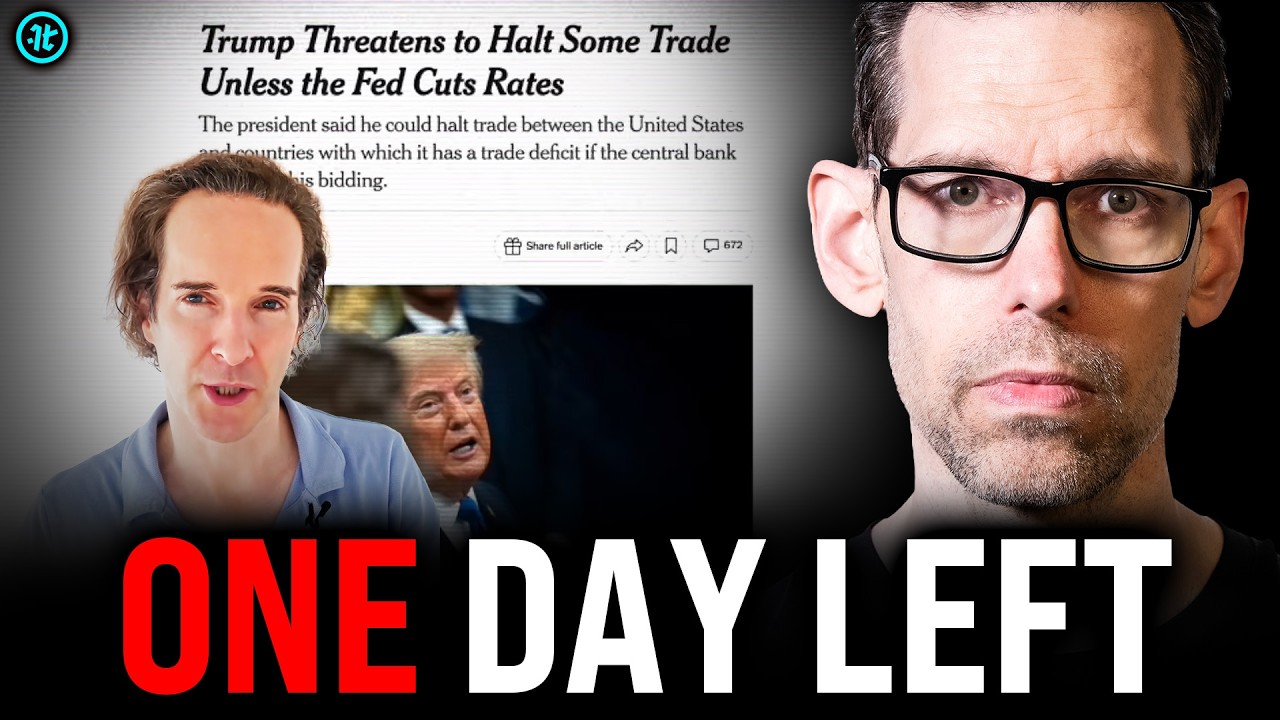
Video summary
A significant monetary reset is currently underway, driven by a growing conflict between the US President's push for lower interest rates and the Federal Reserve's struggle to maintain stability against rising inflation expectations. This tension has severely eroded confidence in the US dollar, prompting major central banks from nations including the Netherlands, France, Germany, Norway, and Japan to withdraw physical gold from American vaults and reduce their holdings of US Treasury debt. The situation mirrors Japan's economic trap, where governments feel forced to print money to service unsustainable debt levels, a process that inevitably leads to inflation that disproportionately harms those who do not understand these mechanisms.
The speaker warns that traditional "safe" investment strategies are no longer reliable, as the S&P 500 index is dangerously concentrated in a small number of AI-related companies, and lowering interest rates without restoring public faith in future growth often results in financial repression rather than economic stimulation. A key development exacerbating this shift is the formation of a consortium by major banks like Goldman Sachs, UBS, and Bank of America to launch a US Dollar stablecoin in 2027, representing a move toward Central Bank Digital Currencies that allow for total tracking and management of spending. Whoever controls these new digital money rails gains immense power, with the US building this infrastructure while Europe and Japan develop their own independent versions, signaling a fundamental change in how global finance operates.
To navigate this volatile environment, experts advise against holding large amounts of cash long-term due to the inevitable erosion of purchasing power by inflation, yet recommend maintaining a liquid emergency fund of three to six months in short-term US debt or savings accounts for flexibility. The recommended strategy involves diversifying into assets that cannot be printed, specifically physical gold and businesses with strong pricing power like Visa or Mastercard, which can pass increased costs directly to consumers during inflationary periods. Historical parallels are drawn to 1971, when President Nixon closed the gold window after countries demanded their gold back due to distrust in US fiscal responsibility, leading to decades of high inflation that serves as a cautionary tale for today's investors.
Ultimately, the system is being reset through debt monetization and inflation, urging individuals to seek assets outside the traditional banking system such as physical gold or Bitcoin to protect their wealth. The speaker emphasizes understanding these underlying mechanisms rather than seeking specific financial advice, encouraging listeners to build their own diversified strategies to maintain optionality during potential market corrections. By attending upcoming free live training on portfolio strategy, viewers can learn how to position themselves against a future where the rules of money and investment are fundamentally altered by political pressure and technological shifts in digital currency rails.
Read the full video transcript
The money system is being reset. This is
getting so crazy. People are really
blind to some of the ways that this is
happening. And right now, we're going to
go through the small handful of things
that are breaking right now that show
you the direction of travel for the
economy and exactly what you need to be
doing with your money. You literally
have 11 days left. That's it. 11 days
until a deadline that no one's really
talking about. And it's going to hit the
money in your bank account and in your
portfolio, whether you're paying
attention to it or not. The president of
the United States gave the people who
print your money, the Fed, an ultimatum.
And the actual words, and I'll put it on
the screen for you, is something like,
"Lower the rate. Well, I'll stop trading
with countries with which we have a
def." Okay, everybody, you've got to
understand how absurd this is. You are
supposed to have a separation between
what's going on in the Fed so that they
are an independent body. They are not
controlled by the people who want to
spend the money. So you've got the
people printing the money and the people
spending the money thinking on their own
going in uh separate directions that
create a dynamic tension that allow you
to make sure that there's balance when
the people spending the money who want
to leverage money to get elected when
they're able to tell the Fed what to do.
Now you have an absolute death spiral
and the world is going to react. So all
eyes as we go through this you're going
to hear me talk about the bond market a
lot. All eyes need to be on the bond
market because if you break the bond
market, that's basically people's trust
that they're going to get paid back from
the government. And when Trump is
talking about doing that, he is queuing
the people who actually understand how
the economy works that you cannot trust
us. Lower interest rates or start this
incredible trade what we haven't seen.
And he called high interest rates a very
fair disadvantage and told the Fed to be
patriots. And this ultimatum comes to
you on September 16th. That's the day
the Fed walks into a room to decide
interest rates, which the market is
currently expecting to go up. He wants
them to go down. But something much
stranger.
>> Here's the thing. You also have to
understand. So, as we look at the bond
market, when people talk about we're
expecting rates to go up versus them to
go down, it's better said that they the
rate needs to go up because people
understand what's being done to the
money. The fact that you've got the
president who, if people are like me,
they believe that the reason that Kevin
Walsh in particular was picked was
because he gave indications that he was
willing to play ball. I do not believe
that Trump and Bessant would have picked
Kevin Walsh if they didn't think, okay,
this is going to be the partner that we
need to get this stuff done, that we're
going to have to work somewhat in
concert with each other to grow our way
out of this debt. Okay, that's a big
part of the drum that Trump is banging
is we've got to grow the economy and to
grow the economy, we've got to lower
rates. Now, the reality is that when
money is cheaper and and people believe
in the future, they feel very
optimistic, they're going to borrow that
money and they're going to then um start
investing in their companies and that
does become stimulatory to the economy.
But I want to be very clear, lowering
rates is not stimulatory to the economy
on its own. In fact, uh we watch Euro
Dollar University around here quite a
bit and there is an idea that they hit
on a lot which I think is very important
which is the lowering of rates is the
Fed responding to the economy. Now I
think it's even sharper to say lowering
the rates is the Fed responding to the
psychology of the economy. But the
problem is it's not an effective
response which is why you don't see that
stimulus working. If it did, Japan would
be in a totally different picture
because they held rates low for an
extraord decades and it didn't stimulate
the economy because the psychology of
people was that this isn't going to um
we're not going to invest. We want to
hold back. We don't want to take on a
bunch of debt. And so it was the rest of
the world which had a different
psychology than the people in Japan
because they get their hand burned on
the stove so badly when the uh real
estate bubble burst in '89. They were
like, "Yo, we're going to be completely
hands off. We don't want to take on a
bunch of debt." And so the economy
didn't ignite. It didn't get stimulated.
The global economy did because everybody
that had the right psychology was like,
"Yo, Japan's basically giving us free
money." They went in and borrowed and
ran with it. But if people don't believe
that borrowing money is going to be in
their best interest, lowering rates
isn't going to stimulate the economy.
That's very important to understand. So,
you're raising rates because people
don't want to buy the debt. They don't
think that you're a trustworthy uh
lender uh to lend to, excuse me. They
don't think you're a trustworthy
borrower. So, they're like, "Hold on a
second. If we're talking 10, 20, 30
years here, there's no way that I think
that you guys are going to pay me enough
to outpace inflation because of the
crazy that Trump is saying. I know
you guys are going to inflate the money
supply. And that means you're going to
have to pay me a very extraordinary
return on my money if I'm going to come
out ahead.
>> And bigger is actually happening at the
same time. And that's why I really
really wanted to put this out for you.
And I apologize the audio might be a bit
windy and so on. I'm on the beach. But
there are pallets of actual gold being
loaded onto planes and flowing out of
America right now. Country after country
pulling their gold home for the first
time since 1971. And the last time a
president leaned on the money printer
while the world pulled this gold out,
what happened to the the dollar? Well,
that's what we're going to cover today.
>> All right. So 1971 is something you're
going to hear people talk about a lot.
It is certainly a very important beat.
But the reason it was 1971 is that the
US government had already been so
fiscally irresponsible that they kept
having to limit the amount of gold that
they would let people take back. Okay?
So there is a historical coralate for
what we're going to hear about which is
different governments coming to the US
taking their gold back out. It's a very
important part of the story and it comes
when they no longer believe that they're
going to be able to get their gold from
you. Okay, that is a very big vote of no
confidence. This is what happened in
1971. Um he's going to give us a name if
I remember right. I think he covers this
uh that you had somebody come over and
basically say no no no we're going to
take a huge amount of gold out and
Vulkar who ends up becoming the Fed
chair uh later but at this time he's
sent to basically try to convince this
guy not to do it and they do it anyway
precisely because they could see that we
were printing money. And when you're
printing money at that level and people
are getting to the point where they
don't trust they're going to be able to
get their gold, that's when you know the
psychology of what's going to be
happening in the bond market. Again,
it's all eyes on the bond market.
Radalio has talked about this. The bond
market governs everything. It lets you
know first of all what rates are going
to be. So, how expensive is a mortgage?
How expensive is a loan going to be? But
it also lets you know what people expect
of the world. And those expectations
drive their behavior more than reality
does. Okay, so 1971, people have the
expectation the US isn't going to be
able to give them the gold whenever they
want it. Spoiler alert, they end up
being right. And in 1971, Nixon
completely closes the gold window and
people couldn't exchange their dollars
for gold. Certainly not at that rate. So
it's like the the read here is that the
world is giving you that same um message
that we think you guys are untrustworthy
that that if you have dollars invested
you have to understand that
>> ancient history it's literally a
playbook that we've seen again and again
and it's literally happening again right
now and I don't care whether you love
Trump or you can't stand them for forget
your your politics that's not what this
is about because when the printer starts
answering to the politicians The people
who understand it early do really really
well but everybody else spends a decade
or two watching their money shrink which
is what we've seen in the 70s and again
after co right how is inflation feel to
you right now so the Trump thing is the
loud noisy thing it's it's in the news
but there are four much quieter things
that are happening at the same time and
people are not connecting them and
that's really why I wanted to put this
out for you guys because I want you to
understand this it's really really
important the system itself like The
plumbing under your bank account, your
pension, your 401k is being reset right
now, not sometime in the future. And
I'll show you the data for it. Gold is
walking out of American vaults. It's
getting shipped home to Europe. The
>> Okay, that's a sign they don't trust
you.
>> Biggest, safest, most boring pile of
money on Earth. Literally just announced
it's dumping a chunk of America's debt.
Okay, there's a whole bunch of people
dumping America's debt because again,
they don't trust that they're going to
get the payout from that that they
otherwise would because they're all
doing inflationadjusted calculations.
So, they're reaching into the future.
They're hearing Trump saying, "You've
got to lower rates." They're looking at
the world, which is clearly signaling
that you need to tighten rates. And
they're like, "Okay, hold on. I know
that you guys are doing something called
financial repression via yield curve
control. So you're artificially
suppressing what the yield of that debt
should be because the market is telling
you no no no you got to pay me way more.
This is exactly why you've got Bessant
buying our own bonds. Remember the bond
market all eyes on the bond market.
You've got Bessant trying to make a
market there both in Japan and the US by
the way which gez. But you've got
Bessant saying, "Okay, I'm gonna be
buying a bunch of this up with my sort
of emergency slush fund and they're
trying to uh make sure that WASH is
prepared to do the same." So now you've
got the US just indicating everywhere
that they're going to be buying its own
debt. And that tells you that the market
wants to see the rates go up. They know
that the very thing that we have to do
and by the way that was not a Roman
salute. That was a graph. Uh that this
is one of the I realized you freeze
frame that four separate things but
they're actually all tied together. And
by the end of this video, give me 10 15
minutes or so. You're going to see the
whole machine and how it actually works
together and know what a regular normal
person like you and me can actually do
about it. So we're not going to panic.
We're not going to like, you know, run
for the bunker. We're going to have a
plan, right? My name is Felix Print. Uh
I'm sitting on the beach. I used to be a
banker and I started teaching this stuff
to regular people about 7 years ago. And
we've taught about 25,000 people over
the last seven years as my mentors doing
the teaching. And none of this is
sponsored. I'm not, you know, ever
endorsed by gold mine or any of that
nonsense. And and you know, fair fair
enough people do that, but I'm very
lucky I don't need to. So I can just
give you my opinions. That's all this
is. I'm not a financial adviser. I can
give you my opinions without any filter.
Not.
>> By the way, every you guys are going to
have to make up your own minds. Be very
clear. Nobody knows what the outcome of
this is going to be. The brightest minds
in investing are betting against each
other. Uh everybody's trying to see
something slightly different than
somebody else and be right. Um there's
no super obvious answer at the specific
level. We're going to get into
strategies which will be very um I think
useful, but you need to think about the
specifics. You're going to have to make
up your own mind. So, um, there's going
to be a lot to cover here because we're
having like four or five things together
and and I'm going to put all of that
together for you into a, uh, into a free
report. You can download that. I'll do
that after I have a dip. Um, and and and
you can download that at
felixpren.org/shift,
I think, because that's really what this
is. This is a shift in the entire well,
in your portfolio, quite frankly.
Fenix/shift. It's in the description.
Uh, download it. It's free. But the fact
that you're even watching this so far is
is is incredible because it puts you
ahead of 99% of people because most will
find out about this in a headline in
about 6 months or 12 months. Um, I'm
going to get it to you into your brain
today. So, give yourself credit for
showing up and watching some financial
education here because the trap most
people are sitting in and don't even
know it is this. When the world feels a
bit shaky, you want to do something
safe, right? And for 40 years, the safe
thing has mean put your money in an
index fund. It's generally the the sort
of accept that uh you know gospel buy
the S&P 500 and just don't think about
it. It's diversified. It's America. It's
always going up, right? Great. Except
every single thing that I just show you
attacks that very idea. The gold
leaving, the debt being dumped, the
digital dollar that's coming, it's all
the world quietly saying the old safe
isn't really all that safe anymore. I
think there's another thing that people
need to take into consideration here and
that is the fact that a very small
number of companies now make up a mass
percent of the gains in the stock market
and they're all technology. This is one
big AI bet. If I were going to say the
thing that scares me the most about the
S&P 500 is that that it's one bet. It's
all AI. And we've talked about this
before. It's so important to understand
that historically speaking, and there
are no guarantees about the future, but
historically speaking, what you're
looking at is as we build out the AI
infrastructure that there's going to be
a delay between the cost of all the debt
that we have to bring on, all the
servicing of the debt that we have to
bring on in order to build out that
infrastructure and when a sufficient
amount of revenue is coming in to
actually deal with that debt. And so
far, while AI is growing extraordinarily
rapidly, we haven't seen enough money
come in. We'll get right back to the
show in a second, but right now, I want
you to picture this. A sizzling fillet
in a cast iron pan. The crust is going
dark. The smell taking over your
kitchen. And just imagine that first
bite. I've been a ButcherBox customer
for years, and that fillet is what I
keep [music] going back to. ButcherBox
delivers 100% grass-fed beef, organic
chicken, wild caught seafood, and more.
All sourced to standards [music] they
can actually tell you about. They've
already done the research and made the
tough sourcing decisions. So, all you
have to do is decide what you want to
smell cooking in your kitchen for
dinner. If you're looking for an easier
way to get great meals on the table,
give ButcherBox a try. Go [music] to
butcherbox.com/impact
to get $20 off your first box, plus your
choice of [music] free ribeye, New York
strip, or filet minan in every box for a
year with free shipping. Always be sure
to use our link so they know we sent
you. We'll return to the show in a
moment, but first, let's talk about what
AI is actually able to do for you. With
most AI, you ask it a question, you get
a good enough answer, then you close the
tab and end up doing the work yourself.
[music]
It's helpful, but it's not always
life-changing. That's what makes
Perplexity Computer so much better. It
connects [music] to the tools you
already use, the e-commerce store, your
ad accounts, your email platform, and
pulls your ad revenue, ad spend, [music]
margin, and inventory into one picture
before you're even awake. You say what
you need done. Then you just get out of
the way. For a limited time only, our
listeners can try Perplexity Computer
for free. [music] Head to
pplx.ai/impact.
Again, that's pplx.ai/impact
to try computer today. Most AI tools are
still answering basic questions.
Perplexity computer is completing full
projects. [music] Now, let's get back to
the show. And there are all kinds of um
accusations. we'll see how true they
are. But there's all kinds of
accusations that debt is hiding in
places that are not people aren't being
honest about. So for instance, the chip
duration, if the chip duration ends up
being 2 to 3 years and then it needs to
be replaced versus the like 5 to 6 years
that they've all built into their math,
then they're far less profitable than
they would have you believe even now. So
not that any of them are profitable, but
they're even more underwater than people
think. So, um, looking at the S&P 500 as
a concentrated AI bet, that's where this
gets scary.
>> The definition of safe is changing. The
most dangerous thing you can own might
be the very thing that you were told is
the safest thing to own, right?
>> I wouldn't say it's the most dangerous
thing that you could own, but it is
certainly has a new risk profile.
>> Um, and if you own,
>> and one thing to remember, all of this
is about duration. So, if you're broadly
distributed across the S&P 500, meaning
the S&P 500 itself as an index is
broadly diversified, then if there's an
issue,
odds are that you're going to come back
because you're not making a concentrated
bet on any one company that might just
go under. You're making a bet
essentially on the entire US economy,
which right now is way way way
overleveraged on AI. But just like when
we had the dot crash, many of those
companies did end up coming back. And so
if you were diversified across a lot of
them, then over time you were going to
come back. The problem is the time
duration. So if you've invested right
now in the S&P 500, part of the reason
that I would say I'd be thoughtful
before you just eject out of it is that
one, inflation is going to um force you
to be in assets somewhere. And then on
top of that, as long as you're thinking
on say a 20-year time horizon and this
isn't something where you need the money
in the next two or three years, odds are
that you start coming back and because
you were diversified across a lot of
companies, then many of those companies
are going to come back and make up for
some portion of the losses. So just keep
in mind time duration is a huge part of
the equation. The S&P 500, and most of
you do, I do, everybody does, right?
It's in your 401k, it's in your Roth
IRA, it's in your pension and so on. you
feel like you're spread out and safe and
diversified, but 40% of that is just 10
stocks. And this year, those same 10
stocks drove 72% of all your gains. So,
when someone says to you, I own 500
stocks on the S&P 500 undiversified, you
actually don't. 72% of your returns are
coming from just 10 companies. And guess
who those 10 companies are? They're
entirely AI companies. And those 10
companies are the most expensive, most
crowded, most
>> one thing I will say very quickly and
this is so the counterbalancing idea to
what I've been saying about okay this is
all an AI bet. Uh there's historically
speaking there's likely to be this
trough of despair between when the debt
service just starts imploding companies
and when the revenue comes in is that
the companies that are funding this are
cash cows without AI. So remember, a lot
of these guys make their money actually
on social media and advertising. And so
that's one of the reasons that the
people that continue to bet on the AI
bet is that it's like, hold on, this is
a totally different world than when we
were building out the internet, uh,
where those companies just didn't exist
without revenue from the internet. These
guys exist without that. like AI is
obviously a huge part of their future
and where they plan to go, but they're
still making billions of dollars in
revenue cash off of something that isn't
tied to AI. So, yes, it would hurt. It
would certainly sting if they have to
write off a lot of this debt, but
they've got the money coming in. So, it
is a fundamentally different landscape.
And this is why I say people have to be
very careful not to ignore the past, but
not to think that the past is
deterministic. dependent names on the
planet at valuations we've never seen in
the history of the world right at the
moment the world is backing away from
the dollar and you don't have to believe
me on that by the way two of the most
careful most respected value investors
alive like the calm ones you know the
ones who are supposed to love a boring
index fund won't touch them one of them
a man named Charlie Mer called his best
friend one of them
>> I'm not sure why he's bringing up
Charlie Munger Charlie Mer's dead but
there you have it I'm sure he would have
uh pulled back even harder as all of
this wound up, but he has passed away.
>> Warren Buffett's own company, they
quietly sold their S&P index fund,
right? And he was telling everybody to
buy that for decades. And the single
most bullish voice on on Wall Street,
the man who called this entire rally
year after year, he's now warning of a
20% drop. So, you get the biggest bull
and the most careful bears all backing
away from it. And you might therefore
want to know what to do about it as
well. And that's also, man, Michael Bur
is uh putting some big bets against the
economy right now. Uh he clearly expects
the bubble to burst. You've got Ray
Dallio talking about something's going
to have to prick this bubble. Um the
dollars and cents of the situation are
crazy. We're buying the stock market at
what sounds good all-time highs. Yay.
But when you start looking at some of
the numbers like the cape index, you
start realizing like god damn, we are
buying these at uh it's not like the
stock market is just at all-time highs.
It's that the ratios that we look at to
understand if something is overvalued or
appropriately valued is getting way out
of whack. And so the question becomes is
AI really this magical force that is
going to justify in the short term these
valuations or is it actually going to
take 20 years for those companies to be
worth that which is precisely what
happened during the dot crash. It was
like everybody was pulling forward so
much revenue that the reality was you
had to wait all those 20 years to get to
that revenue and most people can't deal
with that time mismatch. we're going to
do, not this week, but the coming
weekend um when I'm probably no longer
on the beach. I might still be, who
knows? But I'm going to run a free live
training and it's the first time we've
run this. It's probably most important
thing we've done and probably the last
time we're going to run it and it's
called the index fund strap. Like why
the S&P 500 is actually lying to you.
We're going to do it live. We're going
to do a real Q&A. You can ask me
anything you want. I'll show you how to
check your real concentration and all of
that. And I'll show you where the smart
money is going instead. And by the way,
what he's talking about is real
concentration, I presume, to AI because
AI a lot of times you a company might be
doing really well right now and you
think, oh, that company doesn't have
anything to do with AI, but in reality
they sell them the uh fiber optic cable
or whatever that they need in the data
centers. And so without data centers,
then that cable isn't necessary. And so
that company really is just an echo of
the AI boom. Because when the smart
money leaves those 10 names, it's going
to go somewhere else, but it's going to
leave the people who are in those 10
names that you're in pretty devastated.
And it's completely free. No credit
card, no couch, anything. It's just part
of like what I what I love doing, which
is teaching you um how this really
works. So, show up for yourself, right?
I'm going to show up for myself in the
comments down below. Claim your free
seat. It's at index.com.
indexp.com. And that's precisely,
>> by the way, I let this stuff play
obviously to honor them for the content.
what it is. But let me show you the
machine that's happening right now. So
you understand more than most even
before the week's out. So let's start
with gold because gold is kind of the
lie detector of the financial world.
Gold doesn't have, you know, earnings.
It doesn't have a CEO. It doesn't, you
know, tweet and all of that. All gold
does is sort of sit there and it tends
to hold its value while while paper
money slowly loses it. And for 80 years,
a huge chunk of the world's gold is sat
in in in one place. the vaults under the
Federal Reserve Bank of New York as
allegedly a tunnel to JP Morgan, but
that's a rumor I can't confirm. Anyway,
so countries store their gold in America
because America was the safest, most
trustworthy place on the planet to keep
it. That's basically the deal. But that
deal is breaking. And look at what's
actually happened here. The Netherlands
pulled 86 tons of its gold out of North
America just and they shipped it to
London. France finished pulling out 129
tons out of the New York petrol vaults.
Germany moved about 300 tons of its gold
home again out of New York. Um, now the
central bankers will give you a very
calm, very technical reason for it. You
know, liquidity, you know, preparedness,
trading standards, blah, and yeah, okay,
strip away the jargon. But the only
question is this, why after 80 years of
leaving your gold in America because it
is the safest place on earth would you
suddenly go to all the cost and trouble
and risk of physically shipping at home?
Right? because you think something bad
is going to happen and you're going to
need access to it and that the US is
going to act dishonorably. That's why.
>> Well, you only do that for one reason.
You want it where you can put your hands
on it. You want it out of somebody
else's control. So, this isn't some
technical BS. It's just it's a trust
decision.
>> So much of the battle for the economy
right now is playing out at the level of
gold. Gold is so interesting and if
people don't wrap their head around it,
you guys are going to end up being
confused. You're going to make mistakes.
The way that gold works is we all agree
that there's this thing that holds
value. Remember, it's all fake, man. It
is all fake. Uh right now, some of the
most valuable things on earth are chips.
Our silver is far more used in
industrial uh uses than gold. Gold is
just a thing that everybody agrees. It's
withtood the test of time for thousands
of years. It's been doing its thing. And
so, when I'm really concerned and I want
to get as close to burying my money in
the backyard as I can, I'm going to own
gold. not gold paper, gold, the physical
thing of gold. And that way, whatever
craziness happens to all the money in
the world, if the US devalues our
currency, and by the way, this isn't
just the US, man. Banks the world over
are devaluing their debt. Uh, or that's
part of what they're trying to get to.
They're devaluing their money so that
their debt becomes less painful.
And because so many countries are
printing money, so many countries are
using inflation as a way to run deficits
and be reckless. It isn't just the US,
but that means that I'm going to, as a
nation, as a central bank, I'm going to
slide back to gold. So, previously, they
could just use US debt. Now, that's not
a thing. And so, you've got China
obviously going ham buying gold. But
you've got these guys moving their gold.
You've got central banks all over buying
more gold. Gold is now the number one
reserve asset. But understanding what
that communicates is the important part.
It's the I don't know how this is all
going to play out. I don't know what's
going to blow up when. And so I just
need to make sure that I have that thing
that's going to be safe. And I don't
just want to own it. I want it to be
closer to me. Now, most of these guys
are moving it to London, so there's
still some uh iffiness there, but
storing gold is hard, which now I'll
insert my own take. This is not
universally accepted by any means. But
this is why I keep not selling Bitcoin
is for me, I really want to treat it
like digital gold. It's gold that I can
essentially own that just sits there.
I'm not expecting it to go up. I'm just
expecting it to hold its value against
inflation. That is not the way that it
behaves right now. But that's why I keep
holding on to it. It's back up near 80K.
Before we started rolling is like 79K.
So, uh, it continues to be volatile,
which is a strike against the way that I
use it, just for the record. But I don't
want to have to have physical gold in
somebody's vault. I do not trust people.
I don't trust US. I don't trust London.
They'll confiscate it if they need to.
They've done it historically. But I want
to hold something that is that hedge
against I don't know what people are
going to do. Now I do own some gold just
to be very very clear and I'm sure I
will buy more. Uh but there are
downsides, trade-offs. Trust is leading
the building literally on PL pallets and
on planes. And if you think okay someone
moved a bit of gold, so what?
Let me tell you about a guy called Yan
Newuen, and I can't pronounce that. I
believe he's Dutch. He tracks this stuff
sort of obsessively, and he put out a
reminder this week of what happened the
last time, the last time this happened.
And you got to go back to 1971, the
Netherlands, same country, funny enough.
Um, and they asked to convert $250
million was holding into actual gold
because back then the dollar was
basically backed by gold and you could
swap one for the other. and a young
American official was sent all the way
to Amsterdam to personally beg the Dutch
not to do it. That official's name was
Paul Buler, a man who'd later become the
most famous central banker in the
history of the US. And the head of the
Dutch central bank,
>> he became that for breaking the back of
inflation, raising rates really high,
yada yada,
>> refused. So he wanted the gold. And
Vulkar said to him, "This is a real
quote. You're rocking the boat." And the
Dutch chap said, um, if the boat
capsizes because I asked to swap $250
million for gold, then the boat's
already sunk.
>> Okay, that is an important line. So,
understand that's basically what people
are betting on right now is anybody that
says the gold to dollar ratio is this.
Um,
that has changed before where the US
literally confiscated everybody's gold,
then changed the price. So they bought
it at the old price and then changed it
to make gold much more expensive in
dollars. So that's devaluing dollars
against gold. The value of gold didn't
change. What changed was the dollar got
weaker. And so that's precisely the kind
of thing that people are trying to
protect against. They want to make sure
that they have the gold in their
possession, that it can't be confiscated
from them so that they can change the
rate of the dollar to the gold or
whatever currency to gold. Because the
way he said that's actually a little bit
weird. The dollar is always exchangeable
for gold and gold is always exchangeable
for dollars. It's the rate at which they
are exchangeable that changes.
>> What happened next? A month later in
August 1971,
President Nixon went on television and
slammed the gold window shut forever
>> because we had printed so much money
that now if people actually wanted to
claim their dollar, we weren't or claim
their gold, we weren't going to be able
to pay them back because we were like
reserve uh in in a bank where it's like,
okay, you give me $10 and I loan out $9
and I only keep one in reserves. So, we
were doing a similar thing with gold
where we were way out over our skis
doing something that only works if
people don't want their gold back. But
as soon as they start losing trust in
you, they want their gold back. Guess
what makes them lose trust in you? The
fact that for every uh dollar that you
or every $10 that you get, you spend 11
or 12, which is basically what we're
doing now. People like, "All right, hold
on. I don't trust you guys are going to
maintain this relationship, so give me
back my shit." Cut the dollars linked to
gold completely because too many
countries were showing up asking for the
real thing America didn't have enough
of. That one night is the reason your
dollar today is backed by nothing but a
promise and a money printer. That was
the last great monetary reset. And it
started with one small European country,
the lovely Dutch, asking for its gold
back. Sound a little familiar, right?
But forget the the history books for a
second. There is the part that actually
matters to you right now. What came
after 1971 wasn't some weird economic
footnote. The 10 years that followed
were the great inflation of the 1970s.
Pricely roughly doubled. The value of
the dollar in your pocket. It saved it
carefully. Well, it evaporated. That's
what a monetary reset actually feels
like. It's not some dramatic crash on a
Tuesday afternoon and then a, you know,
taco Tuesday on the afternoon. It is a
slow bleed. It's a little every month
and most people have no idea for it, no
plan for it. They don't know it's
coming. So,
>> okay, the question becomes how do they
do it? This is where mechanism matters a
lot and this is where Warsh comes back
into our story. So, the way that they do
it is they're going to money print.
They're going to artificially keep rates
low. They're going to put ourselves in a
position where they are making the
taxpayer pick up the bill for all of the
deficit spending. And the reason that
they are basically being backed into
that corner is because we have $40
trillion in debt. When you have $40
trillion in debt, the big problem
becomes that you can't service that
debt. You can't pay the interest on that
debt. And so you're left with a small
handful of choices. You can either raise
taxes, which obviously is going to be
unpopular because you're not just going
to be able to raise it on the rich. It's
not nearly enough money. So, you're
gonna raise taxes on everybody. So,
you're either going to raise taxes,
you're going to spend less. You can bet
that that isn't going to be the solution
that people are going to do because
everybody wants their free
Remember, voting is where people get
themselves in this problem. Going to a
primary and backing a candidate that you
know wants to give you more free
at that is where we're creating this
problem. We've got to get somebody in
power that understands that we cannot
keep deficit spending. But just assume
for now you're not going to get that.
I'm going to keep banging the drum
because it's what we ought to do. It is
the moral obligation that we owe to
ourselves and to our children, but we're
most likely not going to do. I'm most
likely going to lose that war. Your
third option becomes what everybody
calls a reset because that's like a
trigger word for people. I think most
people are triggered by it, but they
don't even understand what's happening
mechanistically. What happens
mechanistically is you go, "Okay, well,
if we can't get people to vote for um
spending less money or taxes, then we'll
do the thing that they don't get to vote
for, which is we're going to use
inflation as a way to take your
purchasing power. We're going to devalue
the dollar against things like gold or
assets, which is precisely why you're
going to have to be in assets, which is
precisely why the rich end up getting
richer because they're a proxy for
people who understand assets. So, they
go in and they can escape this. And so,
it will be this, I won't even say slow,
but it will be this steady eating of
your purchasing power through inflation,
through holding rates low. And that is
exactly how you make the debt more
manageable because what happens is you
took on that $40 trillion of debt in the
pre-inflation dollars and now you're
going to be able to pay them back with
postinflation dollars. So as you inflate
it and you're getting uh paid the $2
instead of the $1 and the government is
getting their tax revenue off of your
new $2. It buys you less by the way, but
you have more of those dollars. And so
now the trillions that you're getting uh
from taxing are now paying
pre-inflationary dollars when it's like
oh 40 trillion 40 trillion is nothing
now man 100red trillion is the new 40
trillion and so you're with those
inflated dollars again they are buying
you the same or less. So the fact that
it looks like there's more doesn't help
you as an individual but it definitely
helps the government pay off that debt.
And so that is the game and that is what
people are calling the reset is they're
taking your purchasing power from you
and the only way to hide yourself from
it is to be an assets whether that's
gold whether that's Pokemon cards
whether that is um the S&P 500 owning
some part of what's going on with AI. If
you're doing that then you hope to keep
up with inflation but they are going to
print money. It is the most likely
outcome by far. And if you're not
positioning yourself to weather that,
I think rapid devaluing of your dollar,
you're going to be screwed. For me, gold
leaving the US is the smoke. But there
is always a fire and there is smoke. And
I think this is the most important bit I
want to explain to you. When the US
government spends more than it takes in,
which is always right, it makes up the
difference by borrowing. And the way it
borrows it, it sells you IUS. And they
call them treasuries because it sounds
fancier, but they're IUS. It's just a
piece of paper saying America owes you
money uh plus interest. And and for the
last since World War II, the world has
lined up to buy them because lending
America money was the safest thing you
could possibly do. And that constant
reliable demand is what kept America's
borrowing cheap. It's kept your mortgage
rate low, kept your car loan, your your
credit card all all lower than it should
be. and everything is tied to it. So,
watch what just happened. Norway, right?
Again, we're in Northern Europe, they
run the biggest sovereign wealth fund on
the planet because they have a lot of
oil and it's just a giant national
savings account, $2.3 trillion,
the most conservative big pool of money
in existence in Norway just formally
proposed cutting how much government
debt it hold. and they're going to slash
it by about $80 billion of those US
treasuries, those US IUS. So, you got
the single most cautious large investor
on Earth stepping back from America's
debt. And there is something even more
alarming. The list of historically
reliable buyers of America's debt is
getting longer. Japan, the Gulf States,
Norway. Now, the steady, dependable
buyers who always showed up are just not
showing up. So, why should you care
again? Isn't this some random thing in
the financial world? Well, if fewer
people want to lend America money,
America has to offer a higher interest
rate to temper them. The same way you'd
have to hire you'd have to offer a
better rate to borrow from a nervous
friend, right? And when America's
interest rate goes up, yours goes up,
your mortgage goes up, your car payment
goes up, the interest on the national
debt goes up, the cost on building your
infrastructure goes up, the cost of
building data center goes up, everything
is financed. So this is America's master
switch behind every bit of your
financial life. And the switch is being
flipped. And this is where Japan comes
back. And and not in Japan, but fairly
close to it because a few weeks ago I I
talked about Japan a lot in a video in
the yen. A lot of you watched that. And
I want to be very clear about something.
That story was very real. It was a
warning shot. So for those of you who
didn't watch it, going to give you a
sort of oneline summary of that. The
United States spent a fortune propping
up the Japanese currency and that
briefly cracked a giant hidden trade.
Um, and the Wall Street and it wiped out
about a trillion dollars of stocks in 40
minutes. But the point today is bigger.
That Japan wobble wasn't a one-off Japan
problem. It was the first place the
pressure cracked.
>> Okay, so this is where I think it's
really important for people to
understand again the mechanism here. So
what actually happened to Japan? What
happened to Japan is that they got
inflation and the inflation was an echo
of COVID. Prices went up everywhere and
Japan had been able to operate in a
position where there was no inflation
expectation in Japan. So literally
businesses didn't pay people more. Think
about that for decades. Nobody's getting
a raise. But the costs of things in your
country are also not going up. Then all
of a sudden inflation happens in a way
that is so dramatic that it finds its
way into Japan. And now Japan is in a
situation where it's like, uhoh, we now
have to start giving people more money.
The inflation is real, and so prices
start going up, wages start going up,
and you create an inflation spiral. And
if it were crisisled like it is, you
have a problem. If it had been
innovationled,
uh, where people are just like, "Oh my
god, there's a crazy boom. Everybody's
getting more money now. There's more
money in the system. Everybody feels
richer. Everybody's buying more. It's
causing prices to go up." That's a good
kind of inflation. But alas, this is the
crisisled inflation. Bad news. And so
now, what the hell do we do? And what
they're realizing is Japan has bought
their own debt. Okay. The danger sign
was Japan buying its own debt. Japan
could not get people to buy their debt
because the rates were being held so
low. And everybody said, "I see what
you're doing. You're not giving me what
the market says that this debt is worth.
So, you've got to buy your debt." So,
okay, buying your own debt puts you in
crisis. Turn to look at Bessant and
Walsh. They're buying our own debt. So,
now we're in a position where it's very
similar to what Japan is going through
where interest rates need to rise
because people are unsure that you're
going to be the right person to lend
their money to. So, they need you to
entice them in with higher rates. And lo
and behold, right at the time when the
whole world is backing away from you.
And so, now they're going to have to buy
their own debt. What are they going to
have to do to buy their own debt?
They're going to have to print money.
That's the game. This is what people are
talking about when they say that there
the system is being reset. It's not
like, oh, this is evil mustache twirling
villains in the background. The evil
mustache twirling villains in the
background were set up in 1913 when we
created the central bank and we created
this mechanism. Now, it's just people
going, "Well, this is the mechanism.
This is how I avoid uh getting hurt is I
can give you all the things you want as
a politician. I'm going to keep giving
you free stuff. uh I as the government
can make sure that your economy doesn't
blow up. I'm going to make sure that
there's still appetite for the debt. I'm
going to use your tax dollars to buy it.
Uh sort of I'm going to use your
purchasing power stolen from you by
money printing in order to um keep this
all afloat so that we decline but we
decline more slowly. And the bad news is
it ends up hurting the people who don't
understand it. If you understand this,
you're listening. You're actually
migrating your money over to something
that is in assets, very diversified,
protecting against overconentration and
things like AI, but you're actually
diversified. You've got some gold,
whatever. The don't take any of these
literally. You've got to sus this out
for yourself. I'm eternally paranoid
that I'm doing this wrong. But this is
where you you've got to be thinking,
I've got to be in assets. I've got to be
in what they say, a thing people can't
print. So when money printing is going
off the hook because we backed ourselves
into a corner where we've taken on so
much debt that we can't service the
debt, we can't raise interest rates
because it ends up hurting us as the
government because we owe interest on
that debt and we can't pay that those
higher interest rates and so we've got
to keep rates artificially low. We put
ourselves in this trap and so we are in
the trap. This reset is us dealing with
the trap and the inflation becomes an
inevitable mechanistic um process
because we refuse to um raise taxes on
everybody which would be a part of the
solution but nobody's going to go for
people just want to tax the rich again
it's just not enough money uh and then
the other option is that we could spend
less money but of course we're not going
to do that
>> weakest seam if you wish but now we have
gold walking away we have Norway backing
away the president leaning on the Fed in
a way that we've never seen before. So
yes, different countries, different
headlines, but it's the same machine
groaning underneath the same way. And
once you understand all that together,
you kind of see this is not a
coincidence. And you line them up, it is
the symptom of a system being reset.
Japan was the start, but what I'm
talking about today is the reality right
now. So if the old system is straining,
the gold's leaving, the dead buyers are
backing off, the question is, well, what
replaces it? And here's the part that
unsettles me because they are not
actually hiding it. They're building the
replacement in front of your eyes and
it's just not making the news. And I
don't understand why it isn't making the
news because it's like the most
important thing in the world. On
September 1st, 21 of the largest
financial institutions in the world,
literally Goldman Sachs, City, Banker
America, UBS, and others announced
they're forming a company to launch a US
dollar stable coin. It's going to launch
in 2027. Now, what's a stable coin?
Well, forget about crypto. It's got
nothing to do with crypto, actually.
It's just a digital dollar.
>> That's not true. This is crypto. This is
literally uh all the weird reaction that
people had to um blockchain. Uh if you
were around like 2020 through 2023,
this is the reality. The technology is
real. People were inevitably going to
use it because it's a superior
technology. So, this doesn't have to do
with crypto scams or anything like that.
This is exactly what that technology
allows you to do, which is make money
digital. And quite honestly, they're
going to do the same thing to the stock
market.
>> Dollar that lives on a computer network
instead of in a paper node or a normal
bank account. And you can move it around
the world instantly like 24 hours a day.
There's nothing you need in between.
>> But everybody wants to control the uh
currency that you own. So what's the
stable coin? So that people can benefit
from it. And uh people that are in the
rails game obviously want to be the rail
that wins for all the reasons you would
expect. It's very financially lucrative.
So of course there's going to be a major
race by the banks to get into this and
do all that stuff. Uh but really the
thing to pay attention to is the
underlying debt appetite that this will
create if the US wins.
>> An actual law called the Genius Act that
lets us lays out the rules for there's a
Euro version is being planned to follow.
So for you Europeans, you're not safe
either. And JP Mong is not even joining
that group. It's actually building its
own. That's how important they think to
this. Again, you might be thinking,
well, why do I care? Dollar, right?
Well, here's why. Money that lives on a
computer is money that can be tracked,
moved, and managed in ways a paper note
couldn't. Whoever builds the rails of
the new dollar gets an enormous amount
of say and power about how money flows.
>> It's very true. This is where you're
going to make a philosophical decision
about something like a CBDC,
which is a central bank digital currency
that I'm wildly opposed to because that
effectively means that the government is
going to be able to have the influence
to shut that down, or a decentralized
currency like a Bitcoin or Ethereum,
which is a very different game. So, keep
that in mind.
>> Who can send it? How fast and under what
conditions? And I'm not here to tell you
that's good or bad today, although I'm
obviously leaning towards the bad. I'm
telling you that the people,
>> the control of the money is terrible.
Terrible. Absolutely terrible. People
should be just in absolute outrage
pushing back. Absolutely insisting that
the government not be the ones in
control of the movement of the money.
You do not want the government to be
able to watch what you spend, control
what you spend. A thousand% not. But
money becoming digital is a very good
thing. It just matters who controls it.
>> Are the biggest banks on earth alongside
the government and you and I are not in
the room. So when something this
fundamental to your life gets built
without you, the least you can do is
understand
and know it's being built and what it
means. So the dollar is being rebuilt
into something digital by the loveies on
Wall Street. And I can tell you when you
build new infrastructure like that,
there'll be winners and there'll be
losers. And the people who just keep
their money parked in the safe old thing
because nobody told them something new
was happening, well they tend to be on
the wrong side of it. And that brings us
all the way back to September 16th, the
deadline I mentioned at the top. The Fed
decides on rates. The president has told
them he wants a cut or else literally a
threat. And you see the one thing that's
meant to make the dollar trustworthy and
that's meant to make people want to lend
the US government money is that the
people who print it are separate from
the people who spend it. The Fed is
supposed to be able to say no to
politicians. And that wall, as boring as
it sounds, is a huge part of why the
dollar is trusted and has been trusted
for the last 80 years. So when a
president stands up openly and puts
pressure on the Fed to cut rates to
juice the economy and at the same time
threatens trade war once again with its
trade partners, well people notice that.
They think, well, if the printer now
answers to the politician, how much do I
really want to hold at this current? So
they buy gold, they trim their
treasuries, and they build new digital
things that they control, which is
precisely the four things that we just
watched happen, right? Can you can you
start to see it? Put it all together.
That's one machine. Trump leaning on the
Fed, the gold going home, Norway
stepping back, 21 banks building a
dollar, Japan cracking. It's it isn't
five things. It's actually just one
thing. It is the slow, deliberate
remaking of the money that you have and
own. And it's not a forecast. is I'm not
telling you this is something that could
happen. It's it's happening right now.
It's already stopped. So, what do you
actually do about it? I'm not I'm not
here to scare you. That's really not not
the goal. So, what do you actually do
about this? Because I'm not here to
scare you. I'm I'm leave you sitting in
the dark, right? No, I'm my goal is to
actually prepare you. And I want to be
really clear before I say this. I'm not
a financial adviser. This is not
financial advice. I'm not registered
with anything. Um it's just me telling
you how to think about it. And bear in
mind, Winston isn't here, so you know,
who knows where I'm going to say it. Um,
I'm just going to tell you what I
learned from my Wall Street mentors to
help you then make your own decision.
So, so first thing, don't hold too much
of your life in cash. And I know that
sounds backwards when things are scary.
Keep an emergency fund. Yes. 3 to 6
months of expenses. Uh, you could
possibly hold that in shortterm
short-term US debt essentially.
>> Yeah. So, this is where again, timing is
everything. So, the odds that they're
going to be able to inflate you super
dramatically in the very short term is
very low. So, when you think about
holding something in cash, you want to
make sure that you're getting a return.
Um, not that you guys should do what I
do, but I have been following a very
Buffettesque style where I am backing
slightly out of the markets, not not to
his extent by any stretch of the
imagination, but I am uh where I
normally would have say
uh three years of cash on hand, which I
know is extreme, but for me, I keep very
a large amount of money flexibly so I
can access it whenever I want. I'm now
upping that a little bit more. to say
four four and a half years somewhere in
that ballpark. Uh so backing off some of
my exposure to the riskier um investment
side so equities being a little bit more
cautious there. I am in US debt but I'm
in exclusively short-term US debt. I'm
talking uh a month, two months, three
months at the absolute outset because
it's going to be pretty rare that
there's going to be something so
dramatic that you would be meaningfully
inflated in a narrow uh space of time.
It's when you start getting 6 months, a
year, 3, 5, 10, 20 years, that's where
this stuff starts getting crazy. Um so
that I get some kind of return and I can
watch what happens in the market. So I
don't trust myself to get the timing
right. So certainly I'm in the market.
I'm still uh I'll call it reasonably
exposed to the market, but I've got
enough cash on hand that if it were to
dip, one, I could spend that money uh to
keep my life going. But then two, I
could also put money into the market if
it really feels like we've got a great
opportunity. And that's how you build
back from these things is that you see
the opportunity uh to get in when it's
low, buy low, sell high, right? Best
advice ever. Uh but you've actually got
to be able to move. To do that, you've
got to have the dry powder. So, this
isn't literal cash sitting under your
mattress or even in a savings account,
but cash equivalents, things like a very
short-term treasury. The interest rates
don't move much, but cash would also be
okay. Some sort of savings account. Uh,
but beyond that, cash is definitely the
thing that's going to get taxed really,
really badly by this money printing.
When they print, the rates get pushed
down to please a politician and the
value of the paper in your account will
leak. Guaranteed, right? It's a cash is
an ice cube in this ice cube in this
tropical climate. Second, own things
that hold their value when the paper
money comes under stress. Historically,
that's meant hard.
>> What can't be printed? That that is what
this one is about. What is it that you
can own that cannot be printed?
>> Things that can't be printed. Gold is an
obvious one. Again, don't go 100% into
gold. That'll be a city thing to be
insane. And there's another thing you
can do, and that's what I also do.
pieces of genuinely great businesses,
companies with what's called pricing
power, which just means they can raise
their prices without losing their
customers. Inflation shows up, they ride
it, you know, they don't get crushed by
it. Look at what the president just
bought. He bought Visa and Mastercard.
Not telling you to buy those, but those
are, you know, those kind of businesses
that have a very, very stable moat
because, well, try launching a new
credit card and getting into the hands
of, you know, 300 million Americans.
Well, good luck with that. So if you if
you wish the place where I start with
that research it's the Winston app.
>> So that that is the long and the short
of it. The goal here is that you've got
to understand what's going on in the
marketplace. What are the mechanisms?
Okay, we've just walked through them
all. There's there's not like some other
mechanism right now that you guys need
to be aware of. Those are the
mechanisms. This is how the quote
unquote reset is going to work. Once you
understand that, then it's like, okay,
what am I going to do with my money?
Where do I put myself so that I can uh
have some optionality? That's going to
be huge because no one knows exactly
what the time is going to be. That's
very hard. And so, uh, you know,
basically that history tells you the
bubble's going to pop at some point.
Something is going to prick that, start
deflating it. The government is going to
try to resist that with everything that
they can because typically the thing
that would cause the bubble to burst is
the um rates get raised and everybody
has to contract because to get a hold of
money, it's just become more expensive.
But the government is telling you we
don't want to do that. Uh charging more
or um taxing people more reasons we
talked about that's probably not going
to happen. Uh spending less definitely
not going to happen for reasons that
we've talked about. So now it's like
where can I be that is both diversified
because I don't know exactly what's
going to happen and is going to at least
keep up with inflation and then give you
that optionality that we talked about.
Those are like the highlevel things that
you want to be thinking about so that
you can keep your life going even if
there is some sort of correction that
say 30% 50% which are the kinds of
corrections you see when a massive
bubble starts deflating. So, keeping an
eye on that. The historical signs we've
seen when people start treating gold
like they've got to get it back, that
has been correlated, I won't say
positive by any stretch of the
imagination, but it's been correlated
with the kinds of dips in the economy
that we're talking about here where it's
major corrections. So having that on
your radar, understanding that
overallocating in any one direction,
even to gold, which may seem like it's a
safe thing, but gold can sometimes be
down for years and years where people
are looking at it going, there's no way
gold should be this cheap, and yet it
stays low for years. So you can
absolutely go down on gold. There's no
such thing as a free lunch or a silver
bullet or that thing that's going to
solve all your problems. But
understanding mechanistically what's
going on, understanding from a
psychological perspective why we are
most likely to print instead of being
fiscally responsible, taxing more, etc.
Um, why the debt backs us into a corner,
all of that stuff. Once you understand
it, then from there you build your
strategy with your money. Only you guys
can do that. Taking any one person's
advice is extremely risky because if
they have a flaw in their thinking, now
it's going to take you down with it. So,
uh, be thoughtful. These are strange ass
times, but keeping this stuff at the
center of your focus is how you stay as
safe as anyone can stay in this stuff.
If you like this conversation, check out
this episode to learn more. Let's find
out what young people think about AI and
whether it's going to kill us all.
>> The next topic was one almost everybody
worried about, including Bernie.
>> There are now robots working in
restaurant.