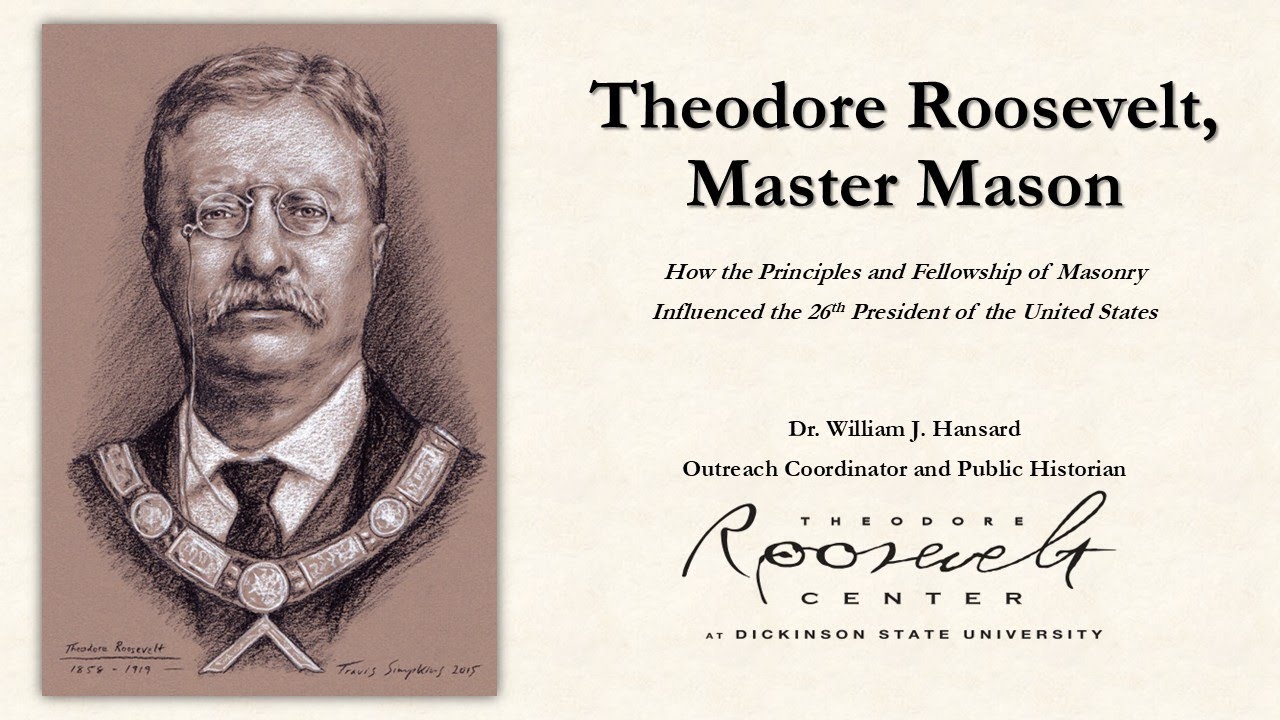
Theodore Roosevelt: Master Mason
Watch on YouTubeVideo summary
The video introduces Theodore Roosevelt as a Master Mason whose life and public service were profoundly shaped by the principles of Freemasonry. Hosted by Ira Drifus from the Patriot Lodge at George Mason University, the discussion features William Hansen from the Theodore Roosevelt Center in North Dakota, who explains how TR's early struggles with severe asthma and heart issues led him to adopt a "strenuous life" of physical activity. This transformation laid the groundwork for his diverse career as a cattle rancher, politician, war hero, and eventually the 26th U.S. President. The narrative highlights that while Masonry is often understudied, it was an extremely important aspect of TR's personal and professional identity, influencing his character from his initiation in 1900 until his death in 1919.
Roosevelt joined the Freemasons in Oyster Bay, New York, shortly after becoming Vice President, a move that some contemporaries viewed with suspicion due to his rapid progression through the degrees. However, his wife Edith actively supported his involvement by donating items like walking sticks made from White House wood and artifacts from the USS Maine for lodge auctions. TR was known for his exceptional preparation, once correcting examiners during his initiation ritual who asked incorrect questions. The video emphasizes that Masonry provided him with a framework for equality and fellowship, allowing him to interact with people of all social standings—from gardeners to presidents—on common ground without the usual social barriers, fostering a sense of brotherhood that he believed was essential for a healthy society.
The influence of Masonic symbolism is most clearly seen in Roosevelt's domestic policy known as the "Square Deal," which focused on corporate regulation, consumer protection, and conservation. The speaker argues that the square tool used in Masonry, representing morality, honesty, and accuracy, likely influenced TR's legislative approach to ensure a fair playing field for all citizens regardless of wealth or background. Furthermore, his strong stance on religious tolerance and social equality was deeply rooted in Masonic teachings; he famously wrote to a bigoted politician asserting that every individual must be treated with respect regardless of their creed, whether Protestant, Catholic, Jewish, or agnostic. This philosophy extended to his belief that the Masonic ideal of treating each man on his merits as a man was crucial for the safety and progress of a republic.
Despite facing some backlash from religious groups who viewed Freemasonry negatively, Roosevelt maintained that the craft's practical lessons in self-respect and mutual aid were vital for solving social problems. The video notes that while he did not have a Masonic funeral, his legacy within the fraternity remains significant, with many members proud of his membership. Throughout his presidency and beyond, TR continued to visit lodges globally, including in Africa and South America, though his busy schedule meant he could not always attend every event. Ultimately, the presentation concludes that Theodore Roosevelt's life serves as a powerful example of how Masonic values can be applied to government and public service, promoting a society where individuals lift each other up through respect, fairness, and shared moral ideals.
Read the full video transcript
My name is Ira Drifus. I'm the master of
the Patriot Lodge here at George Mason
University. We've been here about 13
years. We're a fairly new lodge. We're
an academic lodge as I mentioned earlier
and that means that we sort of
specialize in academic level
research. The other thing is we're
affiliated with the university. So a lot
of our everybody here is in some way
affiliated with actually DMU either as a
student, an alum, a professor. We've had
administrative staff from time to time,
things like that. I, for instance, and
an alum and also a student because I'm
on the free Gazer program and in
Virginia, anybody over 60 can attend
college for free. And so they have to
put up with me in Spanish class.
I have a big interest in Teddy
Roosevelt,
especially the man in the arena thing
because that resonates so much with our
lodge with Freemasonry in general. Now,
you are not a Freemason. Correct.
Correct. So, we won't tell you any
Masonic secrets and you promise not to
divulge them if we did. Okay.
Absolutely. You can trust me. I thought
so. Uh, William Hansford is with the
Petty Ros Theore Roosevelt Center at
Dickinson State University in North
Dakota where I think it's still winter
a little bit starting to warm up. Okay.
And 25 now. That is one of the major
research centers. Of course, uh, when
Theodore Roosevelt was but a youngish
man, he was roaming all over the rest,
hurting cattle and getting in fist
fights.
He was that kind of a guy. And after his
transformation,
Mr. Hansen, Mr. Hansen has promised has
has agreed to talk with us about Teddy
Roosevelt and his
Freemasonry and how
it influenced his life on a personal and
professional level. And on
that, the show's yours. Fantastic. Thank
you very much for that introduction and
thank you all for for having me today. I
really appreciate being invited to to
speak to you. Uh it's interesting
because masonry is a pretty
underststudied aspect of TR's life, but
it was extremely important to him. He
really devoted a lot to it. Um and I
ended up finding a lot more information
about that than I expected to find. Um
so we're going to go through some of
that today. If you'll give me just a
moment, I will get my screen shared and
we will be all set. So today we're going
to talk about Theodore Roosevelt, Master
Mason, how the principles and fellowship
of masonry influenced the 26th president
of the United States. Before we talk
about masonry specifically, I do want to
give you the briefest overview of TR in
general as a person, some basic
information about him. Um he was born in
Manhattan 1858. He's a very curious and
intelligent child, but he's very sickly.
Uh he suffers from debilitating asthma
so bad they thought it might kill him.
Um he suffers from congenital heart
issues, from stomach problems, what they
called chalera at the time. Um, and so
as a young boy, a young man, he will
take up exercise, outdoorsmanship,
hunting, physical activities, the
strenuous life, you may have heard to
help him overcome some of these issues.
And indeed it does. The story is a
little more complicated than that, but
this strenuous life really, really helps
him. Um, his education, he will be
homeschooled as a child, uh, tutored by
family. He will have an eye to
naturalism, to natural history. Um but
then when he goes to Harvard he will
gravitate more toward history and law
and politics. He will graduate magnaum
laad and go to Columbia law school but
drops out of Colombia uh when he is
elected to the New York State Assembly.
Uh his public service uh credits are
long numerous. In addition to
assemblyman he serves in the New York
National Guard. He serves as the a
United States Civil Service
Commissioner, the New York Police
Commissioner. uh assistant secretary of
the navy uh from which position he will
resign to fight in the SpanishAmerican
war uh as the leader of the first
volunteer cavalry cavalry regiment
better known as the rough riders. Uh he
will use that uh fame as a war hero to
catapult him into uh the governorship of
New York. Um then the politicians in New
York who see him as too much of a
reformer will kick him upstairs into the
vice presidency where he will be
powerless until President McKinley is
assassinated and he becomes president of
the United States in
1901. Uh his home will be uh on Long
Island uh uh Oyster Bay, Long Island. He
calls it Sagamore Hill. And this is sort
of a a country farm estate on Long
Island. And that's uh where this picture
of him you see here was taken. Uh and as
was mentioned earlier, he was also a
cattle rancher for a brief period of his
life and a cattle a ranch investor in
North Dakota, which is why the Theodore
Roosevelt Center is here in Dickinson,
North Dakota in the the southwestern
part of our state. Um very briefly, long
list of accomplishments as president. He
will mediate in a major labor strike for
the first time as president. will
establish the Department of Commerce and
Labor, which will later be separated. Uh
he will conserve 230 million acres of
public lands with national parks,
national forests, game preserves,
monuments, so on and so forth. He
establishes the US Forest Service. Um he
will take control of the Panama Canal.
That project had begun under the French
but was floundering. Um the construction
will be completed a decade later. He's
actually the first president to travel
abroad while in office when he goes to
visit the Panama Canal Zone and the
construction taking place. Uh he will be
the first American to win the Nobel
Peace Prize for negotiating peace in the
RussoJapanese War. He signs the Pure
Food and Drug Act. Uh he will send the
American Navy to circumn the globe. Uh
the list goes on and on. He's a prolific
author. He writes about 35 or 40 books
depending on you how you count the
different volumes and additions. Uh
dozens of magazine articles and more
than 150,000 letters over the course of
his life. He will go on adventures in
Africa, in South America. Uh he will
survive an assassin's bullet in 1912. uh
he just lives his life to the absolute
fullest until he uh dies in his sleep
from a pulmonary embolism at the age of
60 at his home in New
York. So with that, let's talk about TR
as a Mason. Um he will be first
introduced to masonry in 1899 uh when he
is the governor of New York and he is uh
attending public events. He's attending
drill corps events uh in his capacity as
the governor of New York. Um and later
uh when he is initiated, he will give a
speech crediting these public events as
actually one of the things that
impresses him and leads him to join the
Freemasons. Um he will be recommended
for membership by William J. Youngs who
was a lawyer and a politician in New
York, one of his neighbors. Uh, and
Youngs will also serve as his private
secretary while he while Roosevelt is
governor. Um, and the Young's family is
very prominent in Oyster Bay. The
Young's Memorial Cemetery is where Roh
Roosevelt and his wife Edith will be
buried later. Uh, Roosevelt is balloted
on December 12th, 1900 and initiated as
an entered apprentice on January 2nd,
1901. Uh, by which time he had moved
from being the governor of New York to
the vice presidentelect. Uh he is
entered into the Matino Lodge uh in
Oyster Bay, New York. Um this is on the
third floor of the Oyster Bay Bank
building which is actually a very
important uh space to Roosevelt. It's
where his secretaries will conduct a lot
of his business on other floors of the
building as well. Um and you see on that
uh petition there um those names that
you see are several other prominent
people of Oyster Bay and prominent uh
Freemasons of the time as well. Um and
also again his neighbors on these other
estates on Long Island. Um but this
becomes an important part of his life
basically from the very beginning. Um
and he will start to move through the
degrees very quickly.
Um he also is going to have some support
from his wife in doing this and that
becomes an important part of it as well.
He has a very uh strong mature healthy
relationship with his second wife Edith.
His first wife died tragically shortly
after childbirth in 1884. Um his second
wife will actively support the Masons
and she will donate items to be sold to
be auctioned at public fairs. Um, some
of the items I was able to find records
of was a doll that uh the group who who
uh who took it on was they named it Ruth
Roosevelt. Um, she donated walking
sticks made of wood from the White House
after it was renovated and wood from the
USS Maine that had been blown up in
Havana Harbor. Um, a pair of beaded
moccasins as well. Um, and there were
probably other items as well that I
simply didn't see uh records for. A lot
of this will actually come from uh a
Masonic magazine, Masonic Standard in
New York. Um, and we'll see that as we
move through. I've actually pulled some
some quotes from them. I found a lot of
information in that magazine which was
really really
useful. Um, so for the uh the passing uh
into the second degree and raising into
the third degree, he does this very
quickly within a matter of weeks. And
from the very beginning, there are
actually concerns from some Masons that
Roosevelt is going to ret uh receive
some special treatment. Um, and without
reading that whole quote I've got there,
um, toward the end, it says, "There will
be no special dispensations and no three
degrees in one night business. Teddy
will feel more at home in the Senate as
a Mason, a majority of the senators
being members of the craft." Um, so
there are those who see this as as
logical, as it's good to welcome
Roosevelt uh into their brotherhood. Um
so he will be passed into the
fellowcraft degree on March 27th of 1901
just a few weeks after he is inaugurated
as vice president under McKinley. Uh and
he was so well prepared for his exam
that the the uh the story goes that he
will correct his examiners who ask an
incorrect question of him during the
ritual. Um and there's actually sort of
a moment of silence uh and they have to
go and and look and see and it turns out
they they were in fact incorrect in what
they had asked. Uh Roosevelt was a very
very studious man and he was very very
well prepared. Uh he will then be raised
as a master mason on April 24th 1901. Um
and there's a legend here that I haven't
been able to verify but it's an amazing
story so I wanted to tell it. Uh this
legend is that uh there were so many
people there. The stairs up the Oyster
Bay Bank building were so crowded that
they literally physically raised him
over people's heads and carried him up
the stairs to uh to the lodge. Um again,
I I haven't found any primary sources
that that back this story up. Uh but
boy, I I hope it's true because it is a
really amusing story. Um Roosevelt's
right-hand man, William Lobe Jr. will be
his uh his instructor for all three of
his degrees. Um Lobe was first his
private secretary and later his
presidential secretary. He's one of his
closest adviserss, closest friends, and
he will will help him through this
process. Um and Roosevelt will take
mason masonry very seriously. You see
this picture of him here. Um this is
1912, so many years later. Uh he is at
the Masonic Temple in Spokane,
Washington there uh wearing his uh his
uh masonry garb
there. So let's talk about how this
influences some of his his life and his
his policies and how he carries himself.
Um and in particular, I want to talk
about the square deal. um because the
square deal is perhaps the most
important uh uh concept principle by
which Roosevelt governs. Uh and it's the
the name that's usually given
specifically to his domestic legislative
program. Um and historians often will
divide this into three C's. this is not
the way he did it but others often will
say that it's corporate regulation,
consumer protection and conservation of
public lands are these sort of three
pillars uh that are part of the square
deal. Um, and I have seen it argued, I
would say pretty plausibly that perhaps
the idea of the square deal was
influenced by the Masonic symbolism of
the square. Uh, the steel square as a
tool of accuracy, uh, as a symbol of
morality, honesty, so on and so forth.
Um, I, you know, do I think that was the
only factor that led him to sort of
think about this square deal? No. Do I
think it's possible that was on his
mind? Absolutely I do. Um and the square
deal is certainly something that even if
he wasn't consciously thinking of it
very much align with those kinds of
values uh that he's learning as a Mason.
Um he will say uh in one of his famous
sort of square deal speeches at the New
York State Fair in 1903 by this time he
is president and he will say we must act
upon the motto of all for each and each
for all. There must be everpresent in
our minds the fundamental truth that in
a republic such as ours, the only safety
is to stand neither for nor against any
man because he is rich or because he is
poor, because he is engaged in one
occupation or another, because he works
with his brains or because he works with
his hands. We must treat each man on his
worth and merits as a man. We must must
see that each is given a square deal
because he is entitled to no more and
should receive no less. So this this
level playing field, right? This this uh
very very even-handed treatment of
everyone, this fair and honest treatment
of everyone is something that Roosevelt
believes in so so strongly. And that's
certainly an aspect of his life that is
being influenced by masonry, I would
argue. Um, again, probably not the only
factor, but there's no doubt that it is
one and that it's something that he is
considering. Um, so Roosevelt will
deliver multiple addresses at lodges or
at least send letters often when he
can't attend lodges, but he will uh uh
attend lodges all over the world. Uh so
in addition to Oyster Bay, New York and
Washington DC, uh he goes to uh a lodge
in Africa, in South America. Uh in 1916
in Trinidad, in the Caribbean, uh he
finds lodges wherever he can find them.
So it is important to him. Uh but he has
of course got great demands on his time
and resources. So it's not something
he's always able to do. Um, but when he
speaks to the Grand Lodge of
Pennsylvania in 1902, uh, he really lays
out to him what masonry means to him and
how it influences him. Uh, and this is
the cesquisentennial of the initiation
of George Washington into Freemasonry.
Uh and on this occasion he will say one
of the things that attracted me so
greatly to masonry that I hailed the
chance of becoming a mason was that it
really did act up to what we as a
government and as a people are pledged
to of treating each man on his merits as
a man. Masonry teaches and fosters in
the man the qualities of self-respect
and self-help. The qualities that make a
man fit to stand by himself. And yet it
must foster in everyone who appreciates
it as it should be appreciated the
beautiful and solemn ritual. It must
foster in him a genuine feeling for the
rights of others and for the feelings of
others. So it's interesting here, right,
that there's uh there's definitely some
some high morality and high ideals here,
but it's also very practical for him,
right? This is something that makes
sense for people and government to do.
It just that this is how we raise each
other up and function as a society is to
behave this way toward each other and
treat each other fairly and help each
other when we need it. Um and to respect
both ourselves and others. And this is
something again you will see this theme
over and over again in most speeches
that he's giving especially during his
presidency. This is really important to
him. Now there is some backlash as you
might have imagined might have expected
to uh tr becoming a Mason in particular.
There's backlash from the Catholic
community at the time. Um, and I found
one particular reprinted uh uh uh quote
here that I thought was was very strong.
Um, and this uh Catholic newspaper
editor says, "When President Roosevelt
asserts that masonry must make the best
type of American citizenship, he offers
a positive and brutal insult to the
millions of his fellow citizens who are
not members, thank God, of the
diabolical craft. His shallowness and
masonic enthusiasm may preclude him from
recognizing the offense, but it is
there. Again, the social problems which
are forcing themselves for solution
cannot be settled by any principles or
lessons of masonry. These problems are
the result of man's departure from God's
truth and the infraction of God's law.
Now, that being said, I don't think this
backlash was very widespread. I did not
find a lot of comments like this. Um,
part of that is I'm not sure how many
people at the time knew uh Roosevelt was
a Freemason. I'm not sure. Um, but
either way, I don't think people most
people would have felt this strongly
negatively about it precisely because of
these values that he is espousing that
everyone can get behind really of
respect for fellow citizens and lifting
each other up and making each other
better. Um, but there were some who were
very much against it.
uh and the Masons for their part, the
Masonic community has a lot of pride in
Roosevelt being one of their members. Um
I won't read out this entire thing here.
Um but I will note that uh he uh the ma
the Masonic standard here mentions the
sort of practicality of masonry,
eminently practical they say. And as I
mentioned, sort of alluded to earlier,
uh he recogni recognizes Freemasonry as
the great lever leveler, excuse me. Uh
which unites the high, the low, the
rich, the poor, and consiliates true
friendship among those who might
otherwise have remained at a perpetual
distance. Um so this is something that
brings people together uh in a way that
that uh benefits us all uh is the way
the Masons see it and the way that
Roosevelt sees it in particular. Um and
they say the country is fortunate in
having for its chief executive a man who
has the courage and the capacity to
apply the principles of masonry to the
problems of government. Um and I think
many people probably agreed whether they
they knew much about the masonry aspect
of it or not. I think those principles
were really really helpful to to
everyone. Uh and there's some aspects of
this here that uh in terms of this
equality that I think are important to
to to continue to talk about here. Um
religious equality was extremely
important to Theodore Roosevelt. Um and
he writes a letter to another
politician, Thomas E. Watson. Um this is
in 1915 at this time. Uh Watson is a man
who is very vocally anti-semitic,
anti-atholic. Uh he is racist. He is
just about anti- everything you can
think of. Um, and Roosevelt will write
this man a very very long letter
basically speaking about speaking out
against everything that Watson uh is
speaking for. Um, and he will tell
Watson, I am not only a Protestant but a
member of the Dutch Reformed Church. I
am a Mason, but I should hold myself an
unworthy citizen of the United States if
I failed to treat and to assi to insist
upon the treatment of every one of my
fellow citizens with absolute disregard
of his creed. Whether he is Protestant
or Catholic, Jew, Gentile, or agnostic
is his own concern. He must be the
master of his own soul. he must extend
to others full liberty of religious
belief and he is entitled to receive the
same treatment himself. Um and to me
this is something that again was
influenced surely at least in part by uh
by masonry right uh uh that that uh as
long as as you are moral and you share
some kind of belief in particular belief
in a supreme being or even not in its
case. He he says agnostic here too which
is interesting. Um but he believes
everyone is equal and that spiritual
matters are between a man and his
creator. that is very important to him.
Uh this will actually come up during
Taft's presidential campaign. William
Howard Taft. Uh Taft was a Unitarian and
there were some who were speaking out
against Taft for that reason and
Roosevelt will tell people all that
matters is that he treats people right
and that he is a good public servant. Um
so that will come up again again and
again. Uh and as we mentioned there is
some social
equality at at the heart of this as
well. Um and he will tell a journalist
toward the end of his life, it's 1919
when he when he tells this story um
that's become very very famous. He says,
"I violate no secret when I say that one
of the greatest values in masonry is
that it affords an opportunity for men
in all walks of life to meet on common
ground, where for the time all men are
equal and have one common interest. For
example, when I was president, the
master of my lodge was worshipful
brother Dowy, gardener on the estate of
one of my neighbors, and a most
excellent public-spirited citizen with
whom I liked to maintain contact.
Clearly, I could not call upon him
socially when I came home. It would have
embarrassed him. Neither could he,
without embarrassment, call on me. In
the lodge, it was different. He was over
me, though I was president, and it was
good for him and good for me.
Uh so again there's there's this really
heartfelt need for for fellowship right
fellowship is very much at the core of
all of this. And Roosevelt believes that
people who engage in respect for one
another in fellowship with one another
in brotherhood with one another are
going to make all of society better.
They're going to improve uh their own
lives and the lives of others. Um, and I
I think that masonry had a lot to do
with the way he saw the world. Uh, and
with that, we have about 10 minutes left
by uh, our Zoom meeting time here. So,
I'm going to stop sharing my screen and
I'm going to thank you again for having
me and uh, welcome any questions or
comments you may have. Oh, before we I
might as well stand in front of the
camera. What the heck? Um, before we get
too far into this, I I want to note that
this was one of the best
presentations of the life of a Mason
that I've ever heard, seen. Thank you. I
did not know I knew that Teddy Roosevelt
was a Mason. I did not know how deeply
it influenced
his public and private life.
One of the themes that I have going this
year is Freemasonry in the 21st century.
How do we adjust as Freemasons to what's
going on? And when I do that, I like to
look at the lives of Freemasons to use
them as examples. So, this works this
works quite well. I have no I I I'm
going to with I'm going to reserve my
questions for a later time so anybody
else can ask something.
Oh, right.
Good evening. You see me? Yes. So, let
me be honest first. I'm I'm a teacher of
US history, so I I could take up an hour
of your time one-on-one. Um, two
questions. One is and the second one is
funny. Um
so so his his um governorship, right,
the governorship that propelled him into
into the vice presidency, was he aware
when they made him vice president, was
he aware of like what the I guess you
would call them the the the corporate
class, what the corporate class was
trying to do. Was he like was he aware
of it and and did he understand it? um
what was going on with the Rockefellers
and the Carnegies and and and the JP
Morgans and what they wanted wanted to
do. And then two is the funny question.
So when he was remaking his image and
into into a Rough Rider um because you
talked about his wife giving away this
stuff to to be auctioned, what happened
to the the the Tiffany hunting knife
that is in those photos where he was
make remaking his image, but he had the
$500 $500 uh hunting knife from
Tiffany's in it? I was just curious if
that was ever if it was auctioned off if
it's known if its presence is if it's if
it location is known. Sure. So uh to the
first question as far as uh when he was
uh propelled into the vice presidency
from the governorship uh he certainly
knew to some extent what was happening
although to him the way he saw it there
were some people who were uh pushing him
that direction for nefarious purposes
for their own reasons and others who
believed it actually was a good thing.
But he certainly knew that he was seen
as something of a rabble rouser,
something of a radical in a way, right?
A radical reformer. Uh he is, you know,
a Republican and a staunch one in some
ways, but he sees that differently than
other Republicans do. Um and so he he
didn't want to be the vice president. He
did not want it. He knew it was more or
less a powerless, symbolic position,
especially at that time. Um and he
really he said that he would rather do
nearly anything. He could take a job as
a professor or do any other number of
things but more or less out of party
loyalty he will decide to take that
position on. I don't think he foresaw um
that he would become president at least
not so quickly. Um so so it was
something that that he really didn't
want to do but like I said he he did it
anyway out of out of party loyalty and
what he thought was best uh for for the
Republican party. Uh, your second
question, I would have to look up uh the
Tiffany knife. I know it still exists.
Um, I don't know if it's the Library of
Congress who has it or if Sagamore Hill
National Historic Site has it. I believe
one of the historic sites still has that
today. My guess would be actually
Sagamore Hill, his home. They have a lot
of his personal effects like that, but I
would have to look that up to be
certain. Uh, and that's a good time to
tell you all. um Ira or anyone make sure
uh anyone can have my contact
information. Please reach out to me. Uh
it's it's my job to to speak with you
all to to answer any questions, any
comments. So after this, I am available
to speak with you anytime. Um but thank
you for those questions. Uh if there are
more, I'm happy to take them. Thank you.
Cool. Okay. Well,
um, I used to be a reporter, so
therefore I have lots of questions, but
I I'll keep it kind of short. One of the
things I'm curious about is was I can't
remember the timeline. Was TR a
premation at the time he was a Rough
Rider? No, he would not have been yet.
So, uh, 1898, uh, is the SpanishAmerican
War. That's when he resigns as Secretary
of the Navy to go fight in Cuba. Um and
then when he becomes governor in 1899 is
when he starts uh attending those public
events and then after that uh in 1900 is
when he actually is inducted into
Freemasonry. So he is not a Mason yet
when he is in the SpanishAmerican War.
You mentioned that there were a lot of
premasons in government at the time he
was president and I'm curious to see if
you know
whether he interacted on a masonic level
with those folks. You know, I don't I
didn't see any like primary source that
didn't come up in in the bit of research
I did for this presentation, but the
answer just logically almost certainly
has to be yes. um both in the state
government and in the federal
government. Uh in the federal
government, uh William McKinley also a
Freemason. Uh uh William Howard Taft
also a Freemason. So some of the other
presidents were as well. I imagine a
fair number of Congress people of
senators and congressman representatives
were. Um so I would have to look deeper
into the sources to know to sort of find
specific instances. Um but we know if
nothing else, William McKinley was also
a Mason. So, they may have interacted on
that level. Um, and again, lots of
people in state government in Albany,
things like that.
Uh, the 30-year-old something. Do you
Here's the a silly question which does
not require a serious answer. Now, it's
it's known that he was a prolific
hunter. Am I I'm assuming I'm on track
with the right president considering a a
Tiffany hunting knife. That confirms it.
Now, if he do you think as a as a
non-Mason, do you think that it would
and he's also quite public about being a
Mason and representatives and whatnot,
do you think
that what was more convenient or
priority for him for to schedule his
hunting sprees around Masonic events in
locations where that would be
appropriate for him or vice versa? Would
he be hunting for the sake of the
meetings or meetings for the sake of the
huntings? Yeah. So he absolutely, you
know, he would go to meetings, go to
lodges when he traveled and go to other
things, but he's not necessarily
scheduling uh his his trips around
different Masonic events and meetings
and what have you. In fact, we have many
letters in our digital library uh that
that show he often is writing people,
sorry, I can't come to this event or
this meeting. Sorry, I can't come to
this. Occasionally he will send letters
uh uh for specific events and things. Uh
and he will uh dutifully pay his dues to
the Matinock Lodge in Oyster Bay. We've
got the records of his secretary William
Lo making sure those dues come in. Um
but yeah, you know, the masonry is
important to him and he will go to those
meetings to those lodges when he can,
but in terms of scheduling, it's almost
never his actual priority unfortunately.
There being no other questions, I'll
I'll just ask one. Did he have a Masonic
funeral? No, he did not. Um uh uh now
what's interesting uh you may know this.
Uh I have heard that the largest Masonic
funeral in United States history was
actually held for for someone he was
affiliated with and that was Buffalo
Bill Cody. Um he had a very large
Masonic funeral um in Denver when he
died. Uh not uh similar time just a
couple years before TR did if I remember
correctly. Um but no, TR did not have a
Masonic funeral. He did have a very
large funeral but not a Masonic one. Uh
FYI, I did a presentation some time ago
about Buffalo Bills the Freemason and I
used pictures of the procession
which was as long as the Macy's Day
parade. Yes, it was huge. Pretty
impressive. Um well, thank you very much
for your time. I
thank you for having me. I so appreciate
it.