Video summary
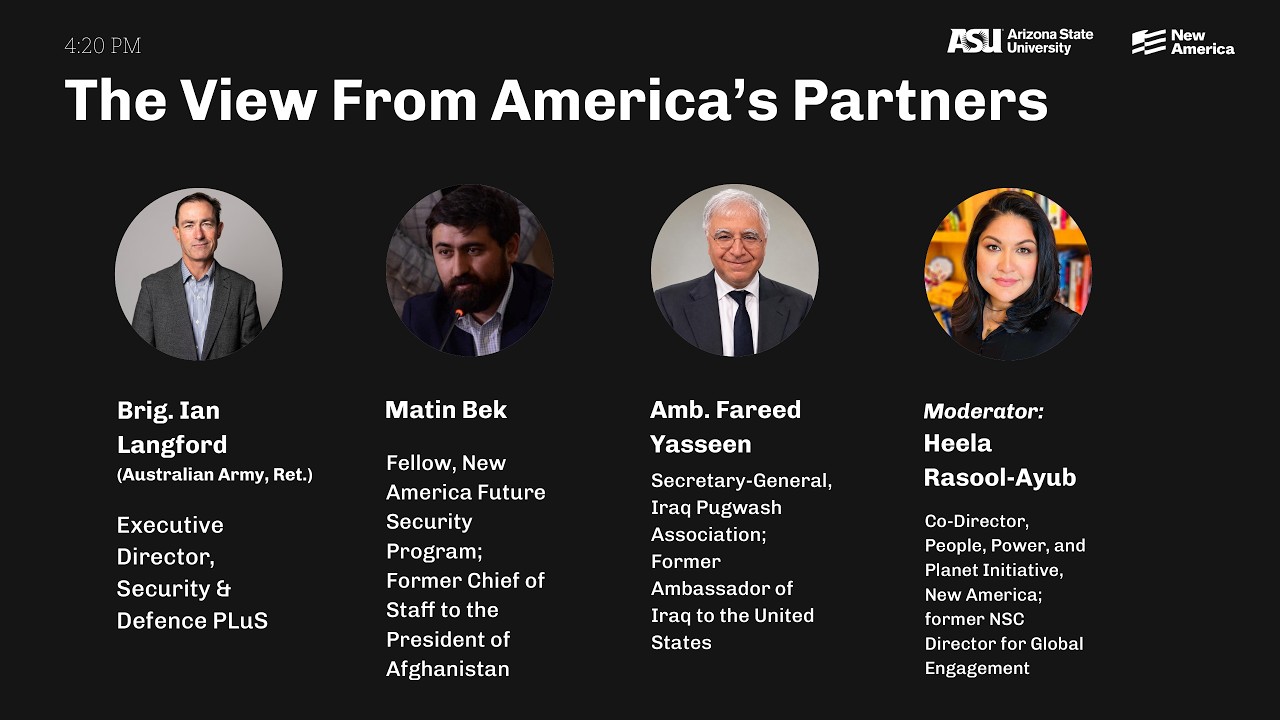
The video explores the complex historical and strategic perspectives of Afghanistan and Iraq from the viewpoints of their former partners, arguing that the current geopolitical landscape is deeply rooted in decisions made decades before the events of September 11, 2001. Panelists Matin Beck and Ambassador Fared Yasin emphasize that US engagement in these regions was not a sudden occurrence but rather the culmination of long-standing Cold War policies and regional dynamics. They recount how Western powers, including the United States and Gulf states, often coddled authoritarian regimes like Saddam Hussein's Iraq despite their aggression against neighbors, leading to disastrous outcomes such as the 1991 Gulf War aftermath where insufficient attention was paid to the stability of the Shia population. Similarly, in Afghanistan, the collapse of the communist regime left a power vacuum that was exploited by various factions, setting the stage for decades of conflict that ultimately resulted in millions of deaths and massive displacement, consequences that continue to reverberate twenty-five years later.
A significant portion of the discussion focuses on critical strategic mistakes made during the post-9/11 interventions that exacerbated instability in both nations. In Iraq, Ambassador Yasin identifies three major errors: treating the country as an occupation zone similar to post-WWII France rather than a sovereign partner, the controversial disbanding of the Iraqi army which flooded the streets with trained soldiers who turned to criminality or insurgency, and the rigid de-Baathification process that dismantled the entire civil service and excluded experienced professionals from governance. In Afghanistan, Matin Beck highlights the failure to accept the Taliban's official surrender after their collapse, a decision driven by political hubris in Washington that led to a prolonged war of choice rather than a necessary war. He also points out the strategic misstep of over-militarizing the country with extensive base-building, which alienated the local population and fueled anti-American sentiment among neighbors like Iran and Russia, ultimately creating a security vacuum that allowed the Taliban to regroup and expand their influence.
The panelists further reflect on the cultural and psychological dimensions of these conflicts, noting how Western strategic hubris led to an overreliance on technology while ignoring the human factors of war, such as the fog of conflict and the importance of local relationships. Brigadier Ian Langford from Australia adds that this sense of superiority and the belief that technology could replace human judgment contributed to a failure to understand the limits of military intervention. He suggests that successful counterinsurgency requires learning from historical precedents like the reconstruction of Germany and Japan, where unconditional surrender was followed by genuine nation-building efforts. The speakers argue that allies often felt unable to challenge US policy due to a shared history of collective security commitments, such as ANZUS, which created a dynamic where partners felt bound to support actions they privately questioned, leading to a situation where the consequences of these wars were borne disproportionately by the local populations while strategic objectives remained elusive.
Looking toward the future, the conversation shifts to the existential challenges facing both nations, including climate change, water scarcity, and demographic pressures, which require international cooperation rather than military intervention. Ambassador Yasin proposes that Iraq could adopt a policy of proactive neutrality similar to Switzerland, leveraging its diverse ethnic makeup to navigate between regional powers like Iran and the United States, while also seeking partnerships with countries facing similar arid environments for agricultural and technological exchange. In contrast, the outlook for Afghanistan remains bleak, with Matin Beck warning that despite a temporary pause in violence following the Taliban's return to power, the country faces an impending civil war due to oppressive policies against women and girls and the exclusion of the Afghan government from the peace process. The panel concludes that while diplomatic thawing is occurring in some areas, the fundamental issues of state-building, reconciliation, and respect for local sovereignty remain unresolved, suggesting that the region will continue to suffer without a fundamental shift in how global powers approach security and engagement in fragile states.
Read the full video transcript
our moderator
um Hila Rasul Aub who is um
she ran uh global engagement at the
National Security Council and is now
doing similar work as a director of uh
her program here at New America and she
will um talk about the view from
America's partners with our all-star
panel here. Thank you. Oh, by the way,
I'm
>> fascinating.
>> Thank you very much.
>> Yeah, you got him from Iraq last night
and very impressive.
>> Well, thank you, Peter. And um I'll
exercise a bit of moderator's
prerogative and start with a personal
reflection as many of our other
moderators and panelists have done. So,
on September 10th, 2001, Amacha Massud
was assassinated in Afghanistan. And I
remember at the time thinking,
"This feels oddly ominous. It feels
weirdly larger than what a murder of a
singular freedom fighter, warlord,
whatever your thoughts are on him, what
it should be." And then the next day,
9/11 happened.
And as an Afghan-American,
I was absorbing the horror of what just
happened in my home country, the fear of
aftershocks, the fear of what was to
come for my community living here in the
US, and also holding the knowledge of
what um the response from the US could
hold for a country and the people that I
was still very deeply connected to. And
now 25 years later, we have some sense
of uh those consequences.
Um according to Brown University's cost
of war estimates,
um the post 911 wars resulted in 4.5 to
4.7 million deaths in Afghanistan, Iraq,
and some of the other countries um in
the war zone and displaced more than 38
million people. these numbers continue
to reverberate and have repercussions.
So today uh what I want to do with our
panel is to look at that history from
the perspective of those countries and
the people who lived and experienced
these wars and the partners who fought
alongside the United States. Um uh I am
joined by Brigadier Ian Langford who
spent more than three decades in the
Australian Army including commanding
Australian special operations forces in
Afghanistan and Iraq. We are joined by
Matin Beck who served at the highest
levels of Afran government including as
chief of staff to President Ashrafani
and as part of Afghanistan's negotiating
team with the Taliban. And we are also
joined by Ambassador Fared Yasin who
served as Iraq's ambassador to the
United States and France and was
involved in negotiating the agreements
between um US and Iraq uh after 2003. So
what I want to do is take a bit of a
historical perspective and start before
911 because both Afghanistan and Iraq's
relationship with the US started long
before then. So I I will start with um
Matine and Ambassador Yasine
to give us a sense of
what did previous US engagement in those
countries leave behind by the time the
post 911 wars began. So Matina, we'll
start with you and then we'll move to
Ambassador Yasine.
>> Uh thank you Hila.
Well
before 911 I don't remember I was Maj K.
uh because when it was interesting let
me start from a personal story. I was
born in the 1986
and my father was already fighting
against the Soviet. So I hadn't seen my
father for two years after two years I
met him. So I don't remember much of
that than I remember the civil war when
the commerce regime collapsed and then
more I connect relate in a way when the
Taliban emerged. So you know what
happened all the changes in Afghanistan.
Uh but that time it was the Afghans who
were suffering from the terrorism from
the Taliban and al-Qaeda and others.
Afghanistan was a lost cause as you
mentioned
Amash Shamasu that time he used to lead
the northern alliance of resistance and
he came to Europe and he gave the
warning but there was not much of a
attention but when 9/11 happened
uh I was in nine gray for me it was hard
to grasp what is the consequence of this
to Afghanistan
and I didn't know I mean everyone was
saying this was unfortunate but African
was saying now things will change then I
didn't of course immediately Afghanistan
became the headline
and so but now when in the prospect when
you look back of course the Taliban and
the civil war and the American support
to the Mujai in 1979
the whole thing after the collap
collapse of the communists and the
complete abandon of Afghanistan. So all
this I think our history, our modern
history is very interconnected with
America's four decade of policy in the
cold war and then afterwards the war on
terror.
>> Thank you Matine and Ambassador Yasin. I
know you had been part of these
conversations long before 911.
>> Um
well thank you for the invitation. Um,
I was in the United States when uh 9/11
happened and uh living in Boston
and uh was concerned uh for the fate of
friends who lived in New York,
particularly downtown.
And uh what I remember very vividly was
that I the relief that I got when I
heard from them via email, not by phone.
You can get through by phone at all.
Um,
but thank you for starting this issue
before 9/11
because for Iraq, it started way before
9/11.
Um, I'm an exiled Iraqi. We left Iraq in
' 74 and I could not return to Iraq
until 2003 because my father was not
liked by by Saddam. And so if I were to
go back, I wasn't sure I was sure that I
would be able uh to leave. And so uh for
a long time I lived in the west in
opposition to Saddam, but very quiet
about it because uh Iraq as very aptly
said uh by Kanan Makia in his 1989 book
Republic of Fear was a republic of fear.
And to prove the point when he published
a book he published it anonymously under
a pseudonym uh because precisely he was
concerned about his family and it was
really awkward because when you come to
the United States and you talk to
officials about Saddam Hussein so what
are you talking about this guy's a
modernist I I remember a session at Tus
University with a former ambassador to
Iraq American ambassador to Iraq who you
know gave the most ludicrous description
of Iraq under under the bath. Um, and
this prevailed and it prevailed even
beyond the gassing of halabja, the
committing of a crime that in sheer
numbers actually outweighs 9/11 and in a
way that was horrible. I mean, uh, I I
lived through this vicariously through
essentially ABC News. I was a nightline
junkie. Um, so for us it started way
before then. And if there's one element
that I want to single out in our history
that actually set us on a trajectory is
the way in which uh the war in 91 came
about and the way it ended
because for a long time Saddam and his
regime were coddled by the West by the
Gulf countries uh precisely the
countries that he attacked precisely the
countries that he, you know, criticized
and railed against.
Um,
and by the way, the war ended, and to
me, this is really personal because this
is when I started becoming politically
active. We I used to live in Boston.
There was a community of Iraqi
intellectuals there uh tied to the
universities in the Boston area.
And we were concerned that if uh the war
would end and Saddam would be left uh
and an uprising would happen as called
for by President Bush,
then uh the cost would be horrible. And
it was and it proved to be. And in fact,
I I know this firsthand because I was
part of the first team that met with
people at the State Department. Remember
the date? 3rd of April 1991. Uh we met
with an assistant secretary of state who
said uh no way you know uh we're we're
we're there. We're uh we've done what we
were tasked to do which was remove
Saddam from Kuwait and we've done our
mission. We're leaving. Uh and uh you
know the rest is history. Uh and it's
unfortunate because they did receive the
Americans did receive advice to do
otherwise.
I remember a dis discussion with uh
Prince Turk Feso who was for a long time
Saudi Arabia's chief of intelligence who
told me that at a meeting with James
Baker
uh as the war was evolving or um at
meeting in Riad attended by the foreign
ministers of um Egypt and Syria both of
them members of the coalition.
Um, Prince Turkey said, "We don't mind
if you would to to remove Saddam. We're
not concerned about the consequences to
the Shia of Iraq. We know that their
nationalists, they proved that over the
Iran Iraq war." And he said that uh,
Prince Saw Alfeso, his older brother and
foreign minister at the time, backed
him. And James Baker said, "Uh um, I'll
get back to you on that." And then
Prince Turkey added that many years
later, probably during the time of the
Baker Hamilton report, they met again at
an event and uh James Baker said to
Prince Turkey, remember the discussion
we had many years ago in Riyad, he said,
"We should have listened to you." And I
think what made him realize that is that
he actually had gone he was sent by
George Bush to northern Iraq to
Kurdistan to see what was happening and
then went back and then did what he
could to salvage the situation. And
that's how the no-fly zone was set up.
That's how Kurdistan was able to uh you
know separate itself from Saddam for
Saddam's regime for 10 years. So to us,
it all started there. And I think had
the United States gone beyond and gotten
rid of Saddam in 1991, uh I think the
history of Iraq and the region would
have been a lot better. I heard earlier
uh one of the speakers talk about the
impact of the of the of the sanctions on
the Iranian population. Well, I Iraq had
10 years of sanctions and especially the
early years were awful. you could see
that in the average size of babies and
and and children. Um so whatever you do
um think of the history and things did
not start on 911.
>> And I I I think it's very important to
remember that history because you know
it is prologue for the future. Brigadier
Lingford, I I I want to turn to you uh
you know, first off also just 911 from
the Australian perspective, from your
personal perspective, but also post 911
as uh the US was making the case for the
war. Um how did Australia understand the
strategic case that was being made after
September 11th? And then what were the
assumptions that were questionable at
the time that maybe as a as an ally you
weren't as comfortable um or difficult
for allies to challenge?
>> Yeah. Well, thank you very much. It's
great to be on this panel. Shout out to
the crowd who are still here. Um your
perseverance is admirable and we
appreciate that, but it's very humbling
to be here. Um many of you may not know
that uh our prime minister was in Blair
House on 911. So John how was over there
and he had a visceral experience in
terms of the emotion and the urgency of
the day. He addressed uh the congress
the day after I think it was to a
standing ovation and he on advice from
his foreign minister invoked ANZIS which
is our now 75year-old defense treaty
with the US and with New Zealand first
time in its history and it was on the
context of collective self-defense. So
that was invoked at Australia's
initiative really in an act of
solidarity but was an expression based
on our history but also our common
interests as it relates to uh defense
and collective security. So there was no
question at all uh in Australia that we
would support the Americans in those
initial uh response options, those
actions to address the security gap that
was discovered straight after 9/11, but
then also the commitment to some sort of
enduring proposition that uh common
security interests meant that we would
be with the US throughout this campaign.
Now there's a little bit of a romantic
notion to this in Australia. We fought
with the US throughout the 20th
centuries in all of its major wars.
World War I obviously World War II most
particularly after the fall of Singapore
where we pivoted from the British to the
Americans as it relates especially to
the Pacific. We were the second nation
to contribute troops to Korea after the
Americans under the opaces of the United
Nations in relation to that emergency in
1950. Our prime minister committed us to
the war in Vietnam in 1965 before he
even asked the parliament. Said that we
were going to do it. Uh and we were
there from 65 to 72. And obviously in
the context of the cold war, Australia
was a reliable ally uh in the sense of
what it did throughout that conflict but
also in establishing things like five
eyes intelligence. You know, and I say
this respectfully to those nations who
aren't in Five Eyes, but they wish they
were. Uh it is a valuable and enduring
framework for cooperation around
collective security that regardless of
uh whose administration uh in what frame
of mind has provided stability to common
interests since it's been sort of in
inception. And so there's all this
evidence that stands as testament uh to
our levels of commitment. I was in East
Teour patrolling the east or Indonesian
border on 911. I was told by a village
tribesman that the White House had been
hit by an aircraft and I wasn't quite
sure what that meant. We went back to
our patrol base. Within 2 weeks, we were
out of uh East Teeour. We'd been
replaced and we were preparing for
operations which would lead to that
first SOTG going into FOB Rhino when the
Rangers went in and then obviously in
that reoccurring theme around
Afghanistan and then into Iraq. the
issue around WND was as pervasive and as
divisive in Australia as it was in the
UK around evidence um and the government
was committed to supporting again US-led
intervention in the broader belief that
it was uh of the common good and we did
that and we live with the consequences
and I don't think frankly even in the
current environment should an envir
should a a contingency like that develop
that the result would be any different.
So the relationship between Australia
and the US uh is uh is there in evidence
for all to see throughout the 20th
century. The reaction after 9/11 was
genuinely felt. It sets the context for
what then happened. And just briefly
thinking about the future and we haven't
really talked about China today for
obvious reasons. But China will shape
very much the security environment for
the rest of our lives. I mean we talk
about wars of choice and then we talk
about wars of existential survival. The
contestation between the US and China is
probably the single dominant security
dimension to the rest of our lives. Um
that will be existential one way or
another. And so Australia does this not
sheerely out of you know benevolence and
some sort of romantic historical
narrative. It's also doing out of its
own self-interests. And there is
obviously you know some element of quid
proquo when it comes to collective
security. And my sense is that you know
part of us think about our recent past
as an investment into guaranteeing our
future.
>> Well we can get into that later in the
conversation but um you know let's then
move into like 911 and this is a lot to
hold in a conversation in 30 minutes and
two very different contexts. Um the
Afghan reception and the Iraqi reception
uh to the US war, US occupation
initially was very different, but during
the course of each individual war, there
are some similarities and some
differences. And so I know I've spoken
with both of you about the impacts of
the surge in both contexts, but I I
would love to hear from all three
panelists. You know, if you could name
three strategic challenges, things that
the US could have done very differently,
what would those three have been? I'll
turn to you first, Ambassador Yasi.
Um, so on Iraq, um,
I I think the United States went there
not knowing much about the country.
>> Mhm.
um and uh not having a plan that was
agreed to with Iraqi partners. Many of
the people who were on the side of the
Americans and their allies in the
country were actually quite disappointed
when after the fall of Saddam, Iraq was
put under a status of occupation.
uh the scenario that people had in mind
was what happened in France after World
War II. Uh recall that at the time there
were two schools of thought. Uh one
American school of thought thought that
France should be occupied and in fact if
memory serves they even printed money
that would serve under with labels under
you know American administration.
Uh but the other point of view prevailed
and Iraq was put under uh occupation. Um
that was one mistake. The other I think
um pretty egregious mistake was the
disbanding of the army in the way that
it was done. I mean you don't kick out
tens of millions of people on the
street, people who have been trained to
fight. And you know the the really
interesting thing that it this had
consequences on on on life in Iraq
whenever there is there was a
large-scale demobilization
uh many criminals turned to uh many
former serial soldiers for whatever
reasons turned to criminality. I mean
most of the outlaws in the west were
former rebel soldiers. In France, you
know, there's the famous Bond Bono that
were former soldiers in the in World War
I. Well, u right after the fall of the
regime, you had in Baghdad a wave of
kidnappings of wealthy doctors and
wealthy individuals and the uh
description given by those who survived
were those of military style operations.
So the criminals who actually came out
because Saddam had announced an amnesty
just before um he fell uh came led to a
sort of a co cooperation between uh
those criminals and and the and
disbanded military. And the third
mistake I think was the way in which uh
debathification was implemented.
Granted, uh, you know, the Bath party
was, uh, an instrument of of of terror,
but given the situation in Iraq, you
could not hold a teacher's position or a
journalist's position or any position
for that matter without being a member
of the party. And so, uh, I think a lot
more discretion should have gone into
implementing these these measures.
>> Thank you.
>> There's actually one more thing. Um the
way the governing council was set up uh
had consequences for the for for for for
the rest of Iraq's you know recent
history. The uh Americans had a good
initial reaction which was to make sure
that the uh representation on the
governing council reflected all of
Iraq's diversity. But in some sense this
turned into some sort of partitioning of
the government rather than uh just uh
happening the people
that you have a natural um people join
and and through technical competency
things like that and you'd have a a
representative group of people running
the country. It was actually instituted
in in a way uh not like Lebanon of
course there's nothing in the Iraqi
constitution that says that the
president or the prime minister or the
ambassador should be of this or that
sect but the practice has emerged and I
think it'll take us a long time to go
beyond that. Well, and I think that's
very interesting, especially your point
on debathification because in
Afghanistan, we had a very different uh
situation with Iraq. There was a very
established civil service and
infrastructure and architecture to the
government. And with a dismantling of
that, you know, u came uh a lot of other
challenges. But with Afghanistan having
already faced you know 20 30 years of
war that infrastructure was already
depleted. And so Matin from your
perspective what were three of the kind
of things that could have been done very
differently um but were not. Well, first
um sometime
I would say like in the negotiation in
the DHA I would say to the Americans I
wish that 9/11 had not happened then
Americans had not intervened in
Afghanistan because the reason why I'm
saying unlike Iraq
people in Afghanistan were already
exhausted by Taliban they were already
fighting so if you see there was no
American troops on the ground it was the
Afghan only there was your support so
it's like the Taliban collapsed like a
house of cards. Not only in the north,
in the south, in the east, in the
center, all part of the country. So I
wish we had finished that phenomenon on
our own, not with an American
intervention first. I think that was
second after that what happened
the Taliban surrender. There's enough
document now. Karai have spoken on that.
there's historical document and they
were officially surrendering and giving
but then that time I think the policy
was mainly with secretary of defense
Ramsfell and he objected to that
surrender they chased them and third
another reason I think when but with all
things happening with Afghanistan
constitution transition election things
was Afghanistan was becoming a model
then at the same time things were going
wrong in Iraq. So attention shifted
towards Iraq. Uh that was another
probably
you I won't call it mistake but a lack
of attention but not much strategic. I
think the another more strategic thing
uh the when you look to the surge
uh when you have the counterinsurgency
in the when President Obama comes to
office so he talks about the war of
necessity war of the choice he focus a
lot on Afghanistan but I think that the
time was too much of resources
we couldn't observe that resources
too much of building of on
militarization
later on when I was in transition team I
travel all the bases there's so many
military airport
and the way the intention was here but
it was misread in Afghanistan in the
region Afghan thought particularly
president Karz thought we are the most
important
land on the earth so the United States
need us geopolitics need
And the Russians start seeing the
American prisons with a self suspension.
The Iranians start seeing the same way.
the the Chinese because there was a lot
of base building in Helman in Paktia in
Pakika every around the country and at
the same time the withdrawal
and with that I think I remember because
I come from the north until search we
didn't had much of a security problem in
the north with the surge with the going
all the night rates so then the Taliban
started expanding in the north the
northeast as well. So to wrap, I know
we're running out of time. I think the
surge was one of the critical thing
which has emboldened the Taliban the way
it was done and the withdrawal
the and also of course our the Afghan
partners. I think that time the peace
should have been pursued that time which
kar objected because of the dual office
so it didn't work. I think we were in a
good ground if we had done and
afterwards of course when the second
administration come Ghani's
administration came then here things
changed President Trump came then Saudi
Assia strategy all the thing beside that
uh then the peace process started
I would say 2018 I was the head of local
governance
uh we announced the ceasefire
For the first time I realized how much
Afghans both side of the war exhausted.
We had a mutually hurting stalemate. The
first time both the parties to the war
had come to conclusion no one can win
the war. But unfortunately that
opportunity was uh hijacked by the
policy which was set up in Washington a
policy of withdrawal which was framed in
peace. And I think here we lost and the
African government was excluded
completely delegitimized.
Um I think these are the initial part of
not putting Taliban in the process of
state building and accepting the
surrender and the search exclusion of
African government from the peace
process. So I would say these are in my
view the most three strategic mistakes
>> and Brigadier uh Langford from your
perspective as an ally on the ground
both in Iraq and Afghanistan. So I'm
asking you to cover a bit of ground um
where did you see some of the most
strategic uh mistakes that were made?
>> Yeah. So my comments might be specific
to the US but it'll be more reflective
of the West. So um most would remember
when General Shinsseeki was effectively
sacked by announcing you need 100 plus
thousand to run a successful
counterinsurgency
early on during the occupation of
Afghanistan and was sort of corrected by
then Secretary Rumsfeld. I think that
strategic hubris dimension to the
western way of war was probably at its
apex at that point and uh that comment
sort of reflected the broader zeitgeist
that somehow technology and some sense
of superiority could prevail over human
factors and the pure physics of what was
being undertaken. Um so hubris on the
part of the west was a big part of it.
Uh the other is ignoring our own
history. So many of you would know Fox
Connor who was the mentor to guys like
Eisenhower. You know, the US does well
when it fights big, when it only fights
when it has to, and when it never fights
alone. And so, you know, putting the
Afghans and the Iraqis in the center of
that paradigm, I think, is pretty
significant when you think about the
ways and approaches that might be
undertaken for what effectively amounts
to an intergenerational
um counterinsurgency. you know the most
two successful counterinsurgencies in
the 20th century was the reconstruction
of Germany and Japan and that's the
benefits of unconditional surrender but
that's the kind of approach you need to
take I think if you take an informed
view that acknowledges history but also
you know strategic hubris in going
forward and then just more broadly the
recognition that um uh you know this
since the revolution of military affairs
as it was declared at the end of the
first Gulf War this idea that technology
replaces is the human factors, the fog
and the friction dimensions to conflict
and the idea that we can, you know,
design our own war termination and war
aims without recognizing all of the
confusion and all of the uncertainty and
all the risks that plays into uh
misadventures and undertakings such as
these. So hubris and ignorance of
history and you know a failure to sort
of recognize the limits of technology.
putting soldiers inside FOBS, not having
them relate to civilians, burying them
behind armor under the opice of force
protection, which is honorable enough,
but then losing and creating dissonance
between you and the constituency you're
trying to help. And then when faced with
the alternative um of course Iraqis and
Afghanistan and its people having to
choose the best alternative as it
relates to their own self-interest as
opposed as opposed to war aims which
should have been consistent with that.
>> And now let's move on to where we are
today and looking forward to the future.
Uh Ambassador Yasin um where is Iraq
right now? I mean, you know, we've there
have been decades of war, but these
countries in addition to geopolitics are
facing other challenges as well.
>> Baghdad is fun
to come.
>> I'm serious. You know, um and um we all
know what happened to Mosul. Mosul is
fun and I really urge you to visit.
Unfortunately, most of the diplomats who
still live in Iraq, who worked in in
Iraq, are operating under rules uh that
are overrestrictive.
Uh I I think they should be relaxed for
them to have a um an experience that is
worth relating to their governments. Um
so I I urge you come visit, you know,
and I'll anybody who wants my contacts,
ask her. I'll show you around. Um so
things are um
problematic for us not because of things
that are intrinsically Iraqi but rather
because of the geography of Iraq and its
inter international relations. I mean
we're caught between you know Iran and
and the and and the United States.
And to me um and here I'm sort of
betraying my my sort of Swiss links. Uh
to me the only situation that Iraq can
live through in the region is to be like
Switzerland in Europe. If you ask uh me
what characterizes Switzerland is a
neutral country. Relevant question is
why is it neutral? Well simply because
in the 17th and 18th centuries all the
wars in Europe were either sectarian or
ethnic and Switzerland is a mixed ethnic
and sectarian country. And there's a map
which I found of Swiss canton that
showed you know Protestant canton and
Catholic canton and mixed canton. And it
looks exactly like a map of Baghdad that
the coalition came up with that showed
you know Sunni neighborhoods and Shia
neighborhoods and mixed neighborhoods.
And so uh in a situation where the
conflicts between neighboring countries
when you have a populations that extend
into these neighboring countries the
only
poss possible policy for you is that of
a proactive neutrality which has its
certain implications. You have a strong
state you have a state that is committed
to its population and we're working on
that. And one of the things that I'll
I'm very proud of is that, you know, the
last 20 years, we've had nine elections.
None of our prime ministers has been
executed. In fact, they're getting
pretty plump salaries and and
retirement. Um there is a lively press.
Okay. Um but like I said, we're caught
up in this uh in this situation
between Iran and Iraq. And we are an oil
producing country and uh uh we export
exclusively through uh the homo trade.
So we're kind of strapped for the time
being.
But the real issues that we have to
confront are completely different. And I
think we're not the only ones. Uh Iraq
is a young population, has a young
population. We have a very high u
population growth. We are plagued by
water scarcity and we're subject to
climate change and these are issues that
are really existential for us and so we
have to find solutions and the wonderful
thing is that there are a lot of
countries that are in the same situation
and there are solutions one of them is
you know Australia Australia is one of
the world's leaders in terms of
agriculture and arid environments and
there are u you're talking about what
kind of relationships we need that we
would like to have with the United
States. Well, there are states in the
United States that are
living in similar circumstances to ours.
You know, water scarcity, hot, arid, and
we could learn from each other. And so,
the one new thing in the um bilateral
relationship between Iraq and the United
States is that there is now a sizable
Iraqi diaspora. And so maybe we could uh
take advantage of that to find, you
know, similar solutions.
>> Thank you, uh, ambassador. And and
Matine, turning to you, I think with
Afghanistan, it's a very different
story. Um, we're almost seeing a bit of
a
a thawing of relations with the Taliban,
with some European countries, and
others. Um, what do you make of this and
and what does this pretend for the
future?
Well, unfortunately, I don't have any
good thing like ambassador to report on
Afghanistan.
I mean, you know, like everyone knows
schools are closed for girls. Instead of
that, there's more jihadi madresses are
popping up. Recently, a video of us son
was popped up from there with a kandari
turban. That's interesting. And after
like 25 years
hund thousands of Afghan die plus
thousands of American
and unfortunately with as I mentioned
with more irresponsible policies here
and also back in Afghanistan
something was just surrender to Taliban
the country and that
five years have passed
you don't see a prospect in the future.
and they have taken over but they have
more anti-people policies still they act
uh as if they're insurgent but they
should have people friendly policies but
they they more act like an occupier in
certain part of the country they don't
mingle with the people
um
there's a lot of celebration here I hear
from the people oh Afghanistan good that
that happened that should have happened
long time ago there's no civil war
nothing but I would say that's a pause
at the moment
the country is unfortunately entering to
another round phase of civil war it's a
misery
maybe in coming years there will be more
headline and it was an opportunity if
Taliban would had leave the process of
reconciliation which they didn't so I
don't they only relying still if a
country is in peace they don't have to
spend three to four billion only in
their own security apparatus.
So uh unfortunately Afghanistan is not
in a good shape and probably right now
is a pause but in the future there will
be more more bad newses coming up from
there.
>> Thank you and I apologize to the
audience because we did not leave time
for audience questions but hopefully you
can catch some of our panelists
afterwards. I thank you all for being
here and um thank you to Peter and
others for hosting us.