Video summary
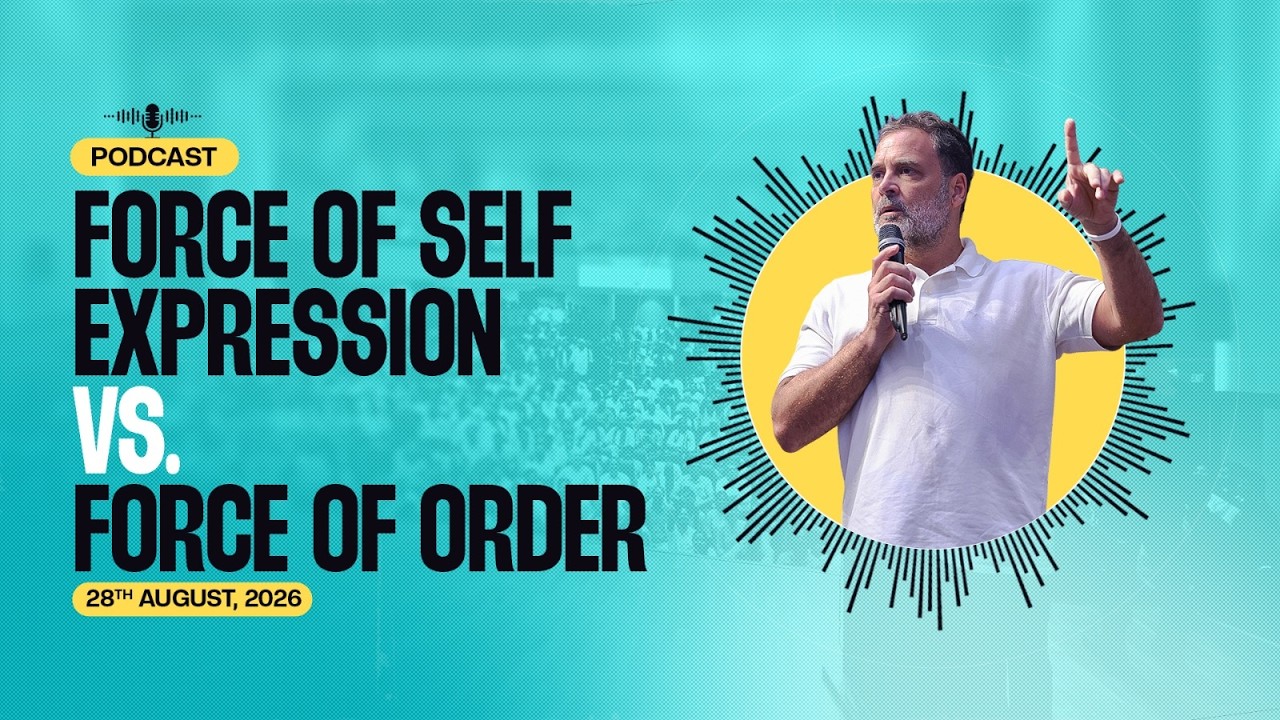
In this podcast episode, the speaker reflects on a significant address delivered at the Rashtriya Congress national convention in New Delhi on August 13, 2026, framing the current political landscape of India as a struggle between two opposing forces: expression and order. The core argument posits that the ruling establishment prioritizes imposing a specific type of order that serves narrow interests, often suppressing voices that do not align with their agenda. This is illustrated through poignant examples, such as student protests at Jantar Mantar where the desire to voice pain was labeled as disorder, and the plight of a mother from Uttarakhand seeking justice for her daughter, only to be silenced under the guise of maintaining peace. In contrast, the opposition's mission is defined as allowing India to express itself freely, even when that expression appears messy or inconvenient, thereby challenging the status quo that stifles genuine dialogue.
The transcript further explores the historical evolution and current trajectory of the RSS, arguing that it has shifted from its original grassroots roots among small traders, artisans, and shopkeepers to becoming an instrument of big capital. This transformation is attributed to policy decisions like demonetization and the rollout of GST, which economically marginalized small business owners and created a vacuum filled by large corporate interests, particularly during the Vajpayee era and intensifying under the current government. Consequently, the organization now functions less as an independent movement and more as a tool for elite economic agendas, highlighting how political philosophy can be manipulated to serve specific class interests rather than the broader populace.
On the subject of foreign policy and national security, the speaker distinguishes between genuine diplomacy based on personal warmth and the strategic defense of national interests, drawing a childhood memory of a state dinner to illustrate the difference. The current administration's approach is criticized for confusion in mediation efforts involving Iran, the US, and Pakistan, as well as contradictions between public statements and military accounts regarding border clashes in Eastern Ladakh and Arunachal Pradesh. These discrepancies suggest serious lapses in handling national security issues that the government has consistently denied, underscoring a disconnect between official narratives and on-the-ground realities that jeopardizes the country's safety and diplomatic integrity.
Ultimately, the message concludes with an appeal to reject limiting labels and embrace the freedom of self-expression without fear, drawing upon Indian traditions that view opponents as teachers to be corrected with affection rather than hatred. The speaker asserts that no single category—whether politician, celebrity, or brother—can fully capture a person's identity, urging individuals to resist confinement to such boxes while upholding the foundational values of truth, non-violence, and love in the fight for justice. By resisting these constraints and fostering an environment where diverse voices can be heard, society can move toward a more authentic and inclusive political moment that honors the true spirit of expression over imposed order.
Read the full video transcript
In this episode of the podcast, I delve
into my address given at the Rachनात्मक
Congress national convention in New
Delhi on 13th August 2026.
Here's the idea you need to hold on to
from the start. There are two forces at
work in India today. The force of
expression and the force of order. And
you need to see the entire political
moment as a contest between them,
expression versus order. We start with
two stories. First, picture the student
protests at Jantar Mantar.
Students were there simply wanting to
voice their pain, and you're told by the
authorities that their expression would
create disorder. Now, imagine a mother
from Uttarakhand whose daughter was
raped and killed 4 years earlier
coming to you, still trying to be heard,
and being met with the same response,
not permitted because it might disturb
the peace. From these two moments, the
larger argument is that the ruling
establishment's core political
philosophy is to impose order on the
country, an order that serves a narrow
set of interests, while our task as the
opposition
is the opposite, to let India express
itself freely, even when that expression
is messy or inconvenient. On the RSS and
capital. Time and again, I've made the
historical argument about the RSS. The
organization was originally rooted in
India's small trading and artisan
classes, shopkeepers, goldsmiths,
blacksmiths, a genuine grassroots base.
That base was hollowed out by policy
decisions like demonetization and the
GST rollout, which hurt small traders
economically. Into that vacuum,
large corporate interests moved first
during the Vajpayee years and more fully
under the current government until the
organization today functions less as an
independent movement and more as an
instrument of big capital. Independence,
a personal memory, the state dinner. To
tell you about the difference between
diplomacy and friendship, I draw an
example from my childhood, from when I
was around 12 years old during a state
visit to the United States. Waiting at
home while my grandmother and mother
attended an official dinner, then
hearing afterward a small human
observation about a coincidence of
matching colors between my grandmother's
sari and a dress worn by the American
first lady at the time. The point being
made to you is this foreign policy is
not about personal warmth or embraces
with world leaders. It is about
defending the country's interests calmly
and deliberately. On recent diplomacy
and border issues, the current
government's handling of foreign policy
is replete with confusion around
mediation involving Iran, the US, and
Pakistan, and a contradiction between
public statements after the Galwan
border clash. There was a difference
between the government's account and the
military officials account of what
happened on the ground regarding
patrolling rights in Eastern Ladakh and
Arunachal Pradesh. These are serious
issues and lapses in national security,
handling something that the government
has constantly denied. Closing no box
fits us. In Indian tradition, an
opponent can be treated as a teacher
rather than an enemy, someone to be
corrected with affection, not hatred.
The final message is that one is often
put in labels, as in people try to put
labels on you, politician, celebrity,
brother, sportsman. However,
no single captures a person fully. So,
one must respect their freedom enough to
resist being confined to any one box and
to keep expressing yourself without
fear. Truth, non-violence, and love are
the foundations of this fight for
justice and self-expression. Thank you
for listening. Jai Hind.
>> [music]
>> Mhm.