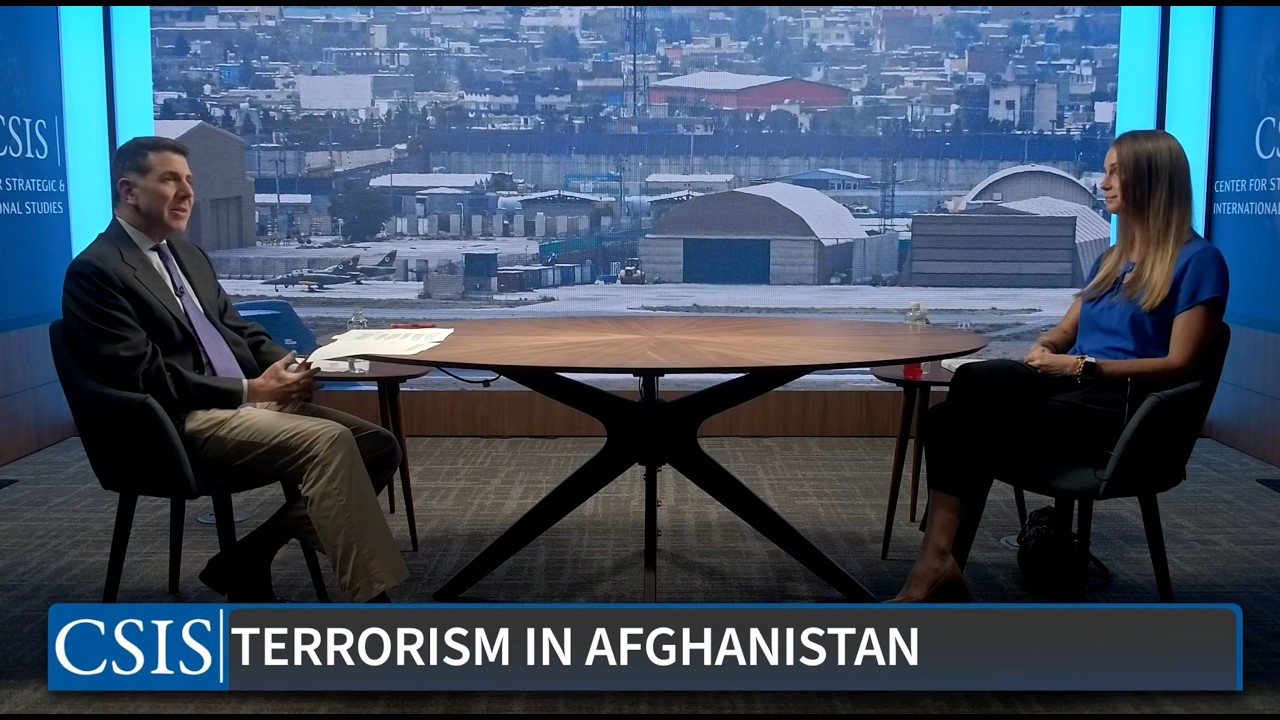
The Terrorism Threat from Afghanistan Five Years after the U.S. Withdrawal
Watch on YouTubeVideo summary
Five years after the United States withdrew its forces from Afghanistan, experts Dan Byman and Trisha Bacon assess that while fears of a large-scale resurgence for Al-Qaeda have largely been unfounded due to devastating leadership decapitation campaigns and global arrests, new complexities have emerged. The primary terrorist threat has shifted significantly toward Islamic State Khorasan (ISK), an extreme group born from former members of the Taliban, Pakistani insurgents, and defectors who rejected both the Afghan government and their former allies. Unlike other regional groups that rely on state sponsors, ISK carved out a unique space by targeting indiscriminately without boundaries, attacking schools, hospitals, and American personnel alike. However, this threat has been mitigated not by US intervention directly in Afghanistan, but through an aggressive counterterrorism partnership with the Taliban government, which now controls all territory and can effectively flush out insurgents that previously operated under a patchwork of competing forces.
The relationship between the Afghan Taliban and ISK illustrates both the effectiveness and the inherent costs of this security arrangement. The Taliban has employed brutal repression against ISK leadership while attempting some outreach to lower-level fighters, successfully reducing ISK's territorial control within Afghanistan to near zero. Consequently, ISK has transformed into a clandestine network that operates covertly across borders in Pakistan and Central Asia, focusing on propaganda generation and transnational plotting rather than holding ground locally. This dynamic highlights the reality of "parallel realities" under Taliban rule: while they ferociously suppress groups like TTP (Tehrik-i-Taliban Pakistan) within their own sphere to prevent them from becoming a model for others, they simultaneously provide sanctuary that allows these groups to plot attacks against neighboring nations. As a result, ISK has escalated its international attack profile as its domestic capabilities have diminished, filling the void left by declining regional power with transnational violence.
A significant concern regarding US capacity post-withdrawal was whether intelligence networks would degrade too severely for Washington to monitor threats without direct presence on the ground. While it is true that robust intelligence apparatuses designed for combat operations were dismantled, experts argue this represented a necessary "right-sizing" rather than a failure of capability. The United States has maintained targeted intelligence networks specifically focused on ISK and Al-Qaeda, revitalized cooperation with Pakistan after an initial decline, and successfully warned of multiple attacks even when local authorities ignored the alerts. This calibrated approach allowed US officials to identify precise locations for high-value targets like Ayman al-Zawahiri in Kabul without needing a full-scale military footprint, demonstrating that sufficient intelligence exists to manage current threats despite the loss of broad operational networks inside Afghanistan.
Ultimately, the post-withdrawal landscape forces a difficult reckoning on how the United States should engage with partners who are effective counterterrorism allies but problematic from an ideological or human rights perspective. The case studies of Pakistan and the Afghan Taliban reveal that these entities often possess a dual nature: they cooperate against specific enemies like Al-Qaeda while simultaneously sponsoring others, such as TTP in Pakistan's border regions. Experts conclude that US policy must accurately recognize this duality rather than assuming partners are wholly good or bad; working with them requires strict boundaries to prevent slippage into areas where their actions contribute to broader threats. The current security situation underscores a complex reality where the most effective tools for preventing terrorism may come from governments and groups whose values clash fundamentally with those of the United States, requiring a nuanced strategy that balances immediate counterterrorism efficacy against long-term strategic risks.
Read the full video transcript
I'm Dan Byman. I'm the director of the
warfare irregular threats and terrorism
program here at CSIS and I'm here with
my colleague Trisha Bacon who is a
professor at American University and
also a non-resident fellow
here at CSIS. And we're here to talk
about Afghanistan 5 years after the US
withdrawal from the country. And in
particular we're going to focus on one
question which is the terrorist threat
from Afghanistan and how it has played
out and what has not occurred that um
has shaped US thinking.
Um Trisha, uh
let's start with setting the scene. Uh
let's go back in time. Can you tell us 5
years ago, 10 years ago, what were the
US concerns regarding terrorism in
Afghanistan if US forces withdrew?
>> I think the main concern for US forces
essentially that we would have a repeat
of what happened during the 1990s, that
the Taliban would provide a large-scale
safe haven that would allow Al-Qaeda to
train, prepare, plot, and conduct
operations particularly in the United
States, but also in the West more
broadly.
>> Um
one concern that came up especially near
the end was the Islamic State Khorasan.
Right? And that was a more active group.
It was one that was seen as more
extreme. The United States was fighting
the Islamic State in Iraq and Syria. Um
if you don't mind just uh talk everyone
through
uh the Islamic State Khorasan or ISK as
we all call it, um ISK's relationship
with the Taliban and with Al-Qaeda.
>> So ISK carved out a really unusual place
in the region more broadly, actually.
It's the only terrorist group operating
in the region that does not have a state
sponsor. Every other terrorist group in
the region has at least one state that
they work with, but ISK carved out this
full like fully rejectionist space. And
when it formed, it had a number of
former Taliban members, a number of
Pakistani Taliban members, and even some
Al-Qaeda members. So, it also had a lot
of defectors and was sort of born in
opposition not only to the Afghan
Republic government and the Pakistani
government, but also to the Taliban and
to Al-Qaeda. So, it was fighting sort of
all the enemies at once. And then as you
say, was doing so in a very extreme way.
This is a group that would target
anything. It It really didn't have any
boundaries. It's targeted school
children taking tests. It's targeted
hospitals. And of course, it's targeted
American service members and American
targets as well.
>> One of the pleasant
developments and one doesn't use that
word very often when you talk about
counterterrorism is that the Taliban has
aggressively fought ISK. And it has
targeted its leaders, it's arrested
them,
very high degree of repression.
There has been some outreach as well to
lower-level ISK fighters.
But for the most part, it's been a
pretty brute force sort of method. And
frankly, this seems to have been
effective. The territory of the Islamic
State in controls Afghanistan has
diminished. Overall influence has
declined. Um
and a big difference I would stress is
the Taliban actually controls the entire
country. And the United States and its
Afghan government allies did not. So,
the Taliban is better able to kind of
flush out ISK from different parts
of the country. And Sebastian Gorka, the
top US counterterrorism official, you
know, he has noted that the Taliban is a
cooperative counterterrorism partner,
which is probably not something many
people expected. Um but one thing that
you've educated me on is that this
success in this successful partnership
and the Taliban's counterterrorism, that
there's a cost to it. Um,
what is that cost?
>> So, there is it's a really interesting
progression because the Taliban was
countering ISK with ferocity even before
the US withdrawal. So, it's sort of
maintained the position that it had
before, but now it's able to execute it
much more effectively cuz as you say, it
controls all the territory in
Afghanistan. Whereas before there was
sort of this patchwork of the US, the
Afghan Republic, and the Taliban all
trying to counter ISK um in their own
ways. And so, one of the things that the
Afghan Taliban has been able to do is
really put pressure on the communities
that ISK was emerging from, particularly
the Salafi commun- communities in
eastern Afghanistan. So, it's gone to
sort of the source of a lot of ISK's
recruits. And as you say, it's done a
lot of repression and it's done a little
bit of outreach. But the effectiveness
that that's had is it's made ISK an
almost entirely covert and clandestine
organization. It doesn't control any
territory anymore in Afghanistan. So, it
has to operate solely in that way.
It's spread more and more into Pakistan
as well, so it's now this kind of
clandestine network that goes across the
two countries. And it's really escalated
that kind of activity. And it's moved
into fill a niche both as a result of
its declining power in the region and
for the Islamic State more broadly,
which is to be this
creator of a lot of propaganda that
reaches out in particular to Central
Asia, to to those in South Asia, and to
serve as sort of a plotting function.
It's been involved in or responsible for
a number of transnational attacks. So,
as its attacks in Afghanistan have gone
down, what we've seen are more attacks
internationally or transnationally
that are either conducted by the group
itself or that it's playing a pivotal
role in the networks that are executing
those attacks.
>> Now, we've talked a lot about ISK, but
when most Americans think of Afghanistan
terrorism, they're thinking of Al-Qaeda.
>> Yeah.
>> And one concern that US officials had
was that Afghanistan would again be a
haven for Al-Qaeda. And we have seen
limited training. Um Ayman al-Zawahiri,
uh who headed Al-Qaeda, was was killed
in Kabul in 2022.
>> Mhm.
>> Uh but for the most part, this is a very
weak group. And this has been, I would
say, a long-term success of US policy
that spans multiple administrations.
There's been global arrests of group
members around the world.
>> Yeah.
>> Uh but there's also been this targeted
assassination campaign that really
devastated group leadership. And we
have, you know, documents from the group
itself talking about how devastating
this campaign has been. So, this kind of
lasting legacy of US counterterrorism
has made the potential haven um less
dangerous. Uh
but one question I'd kind of love for
you to answer is the question of US
capacity in Afghanistan. Um as you know,
one fear of US officials was once the US
packed up stakes, it wouldn't be able to
reach out in Afghanistan, and it would
really be dependent on the Taliban. Um
how accurate is that or was that fear?
>> I think it's fair to say that US
intelligence networks were degraded when
we left Afghanistan, but at the same
time we didn't need the same level of
intelligence networks. I mean, if you
have intelligence networks that are
designed to protect US forces in a
country and a US embassy in a country,
you need a much more robust intelligence
apparatus. So, certainly there was a
decline in that kind of intelligence,
but the US has maintained, I would say,
more targeted intelligence networks,
particularly as they pertain to ISK,
particularly as they pertain to
Al-Qaeda. It's revitalized its
relationship with Pakistan after a
decline in the years after the US
withdrawal. So, it's also getting some
intelligence cooperation there. So, it
has a sufficient intelligence network
that it's been able to warn of multiple
ISK attacks, even when those warnings
weren't heeded. And as you say, identify
a very precise location for Ayman
al-Zawahiri in Kabul in a in a house
owned by the Haqqanis. Um so, it's shown
that kind of capability, which is
sufficient for the threat that's
emanating from the country at this
juncture. Um so, I do think there was a
decline, but in in some ways it was a
right-sizing that is calibrated more
specifically against the kind of threat
we're facing in Afghanistan. And of
course, is also now has a lot of other
intelligence priorities that those
resources can go to.
>> So, we've talked about ISK, we've talked
about al-Qaeda. There's yet a third
group that we should probably discuss,
and that's um Tehrik-i-Taliban Pakistan,
or TTP.
Um
what is the Taliban's relationship with
TTP? What kind of threat does it pose?
Because, you know, almo- over 15 years
ago, there was a plot in the United
States linked to TTP. So, how do we
think about this concern in a broader
counterterrorism context?
>> So, it's interesting. The concern about
the safe haven in Afghanistan, that it
would be a place where a group could
plot and can and conduct attacks from
elsewhere, or that the Taliban would
serve as a model and an inspiration for
other groups. We didn't see that on a
global scale. We saw it on a regional
scale. That is exactly what has happened
to the Pakistanis in all of this. TTP,
our Tehrik-i-Taliban Pakistan, has
emerged as the number one threat for the
Pakistani government because it is
finding just that kind of sanctuary
under the Afghan Taliban. The training,
the ability to hide, the the ability to
um to to to plot in Afghanistan and
conduct attacks in Pakistan. So, in a
way, it's not that the Taliban changed
its stripes, but in the TTP, there is a
a large, sophisticated organization that
is willing to operate in the in certain
kinds of ways within Afghanistan that
are acceptable to the Afghan Taliban,
but yet conduct this pretty extensive
insurgency campaign against the
Pakistani government. So, this is sort
of the the parallel realities of the
Taliban. They are willing to go after
groups that are a threat to them with
ferocity, but they are still willing to
provide haven and allow for those who
have haven underneath its rule to plot
and conduct attacks elsewhere. And so,
the security situation in Pakistan has
gotten significantly worse since 2021.
And in fact, its one-time client, the
Afghan Taliban, and Pakistan are now in
regular conflict with one another over
this.
>> Your point about the tradeoffs and how
difficult um a partnership this is for
the United States, I I think really
highlights the broader issue, which is
you know, how much should the United
States be working with these, I'll say,
troubling partners? And obviously, the
Taliban is one. Another is the uh
Al-Shabaab government in Syria, which is
working closely with the United States
against Hezbollah, against the Islamic
State there. Um
what are your thoughts on, you know, how
to regulate these relationships with
partners who are certainly not ideal
from a US values point of view, but
nevertheless are very effective from a
counterterrorism point of view?
>> I think the critical piece of these is
to accurately recognize the partners
that they are and that they aren't. This
came up in the post-9/11 era with the
Pakistanis, that they were a partner who
were cooperating with us against
Al-Qaeda while still sponsoring the
Taliban and anti-India organizations.
And at times, the US sort of convinced
itself that Pakistan was a better
partner than it was because of its
willingness to go um after Al-Qaeda
specifically. But the reality is we have
a lot of counterterrorism partners that
are good counterterrorism partners in
very specific ways and problematic
partners in a variety of others. And as
long as we're accurately assessing that
duality, working with them where it
makes sense without allowing slippage to
to come into these areas where they're
not good counterterrorism partners and
they may even be contributing to a
threat that we can hold this sort of
complexity at the same time. It's it's
sort of the reality of of this world of
counterterrorism that some of your best
partners in certain areas are ones that
are not comfortable partners in a
variety of others.
>> I think that's
suitably informative and complex point
on which to end.
Again, I'm Daniel Byman here with the
Center for Strategic and International
Studies with my CSIS colleague Trisha
Bacon who is also a professor at
American University.
>> [music]