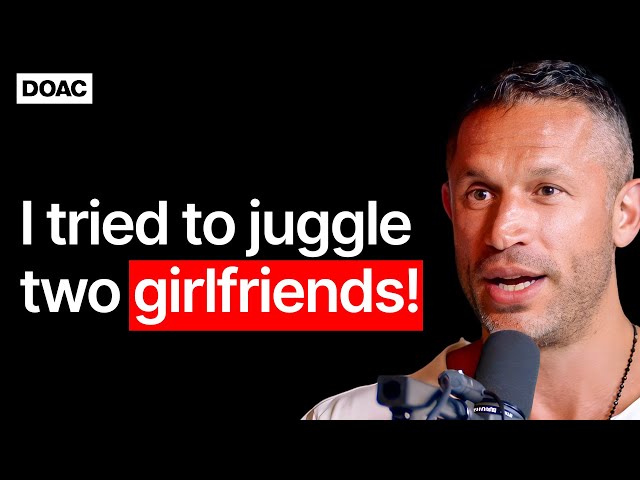
The Surprising & Unbelievable Dark Side Of Open Relationships: Aubrey Marcus | E242
Watch on YouTubeVideo summary
Aubrey Marcus traces his journey from a struggling entrepreneur to one of America's fastest-growing companies, attributing his success to early influences and pivotal moments in his life. Born to parents who were both pioneers—his father a commodities trader featured in *Market Wizards* and his mother a professional tennis player reaching the Wimbledon semi-finals—he grew up with four parental models after his biological parents separated when he was two. This diverse upbringing provided him with contrasting archetypes: an intellectual, philosophical father and a physically robust stepfather who embodied brute strength. These influences shaped his desire for greatness and a thirst for knowledge instilled by his grandmother. A transformative psychedelic experience at age 18 further ignited his passion for psychonautics—the exploration of the inner cosmos—and led him to found Onnit, which grew from zero sales in twelve hours to generating $60 million within four years. Despite professional triumphs, Marcus acknowledges a significant personal cost associated with his upbringing and early business challenges: an inherited pattern of rage that he had to consciously break. In 2013 or 2014, while filming an important video for Onnit in their small office, Marcus lost his temper at the front desk staff member knocking on his door during a take. Upon realizing she was crying from his outburst, he recognized the destructive nature of this inherited behavior and vowed never to fly into such fits again. This moment marked a turning point where he stopped transmitting trauma down his lineage; instead, he focused on healing himself so that when he eventually has children with his wife Whitney, they can pass on a legacy of love rather than fear or anger. He credits his father for encouraging him to explore psychedelic medicine as a tool for self-improvement and breaking generational cycles. Marcus's personal evolution extends deeply into his understanding of relationships, where he moved from an avoidant attachment style rooted in childhood fears of being "in prison" with partners to embracing polyamory. His first major partnership involved bringing other female lovers into the equation as a release valve for desire without cheating, though this arrangement eventually faltered because it did not satisfy his need for deep connection and felt ethically complicated due to jealousy. He then entered an exclusive monogamous relationship with Whitney that lasted about 18 months before he realized his natural desire to experience love in multiple forms could be honored honestly through polyamory. Although philosophically aligned with the concept of non-possessive love inspired by *Sex at Dawn*, Marcus found it emotionally devastating when his partner had other lovers, leading him to realize that trying to compete with others was futile and that true attraction comes from being one's best self rather than mimicking another's strengths. Currently, Marcus has shifted his focus from day-to-day operations as a CEO to the role of a visionary founder guiding projects for "the good of all," while also addressing lingering health challenges related to reliance on stimulants like caffeine and nicotine, as well as sleep medications that hinder natural rest cycles. He admits to being stuck in a loop where obligations force him back into using these substances despite knowing their deleterious effects, but he is committed to resetting his neurochemistry by prioritizing long-term alignment over short-term productivity. To support this healing process and foster deep community bonds, he has developed Fit for Service, an initiative utilizing initiatory practices such as breathwork, sweat lodges, ecstatic dance, and vision quests without necessarily using plant medicines. This platform aims to create a tribe where individuals can collectively process grief and trauma through shared vulnerability, transforming darkness into light through supportive communal experiences.
Read the full video transcript
With Joe Rogan as my partner, we sold
out in 12 hours. Zero to 60 million.
How? Step one.
It was [ __ ] wild. Aubrey Marcus. The
man who built and sold On [music] It
with Joe Rogan. One of the fastest
growing human performance companies in
America. My mother was a professional
tennis player. My father was a pioneer,
and that was the driving desire. It's
like, my parents were big. I know I can
be big, and I was frustrated because
nothing was happening. There was so many
failures, and I really thought like, I'm
just never going to succeed. But, I
think the key moment for me was when Joe
Rogan said, "I can meet you 30 minutes
for coffee." I was starting a supplement
company. I went to Joe, "What supplement
would you like the [music] most? I'm
going to make the best one that's ever
been made." That was the pivotal moment
that changed everything. Alpha Brain. I
really felt like I didn't want to do
anything without it. We sold out of that
product in 12 hours. We could barely
keep it in stock. [music] From zero to
60 million, we were Inc. 500 fastest
growing company over the next 4 years. I
mean, I couldn't have designed a fantasy
better.
But, it comes with a cost, right?
In that moment, I realized like, I'm not
going to fly into a fit of rage and hurt
somebody.
You can see how much it still affects
me.
What happened?
Before this episode starts, I have a
small favor to ask from you. Two months
ago, 74% of people that watch this
channel didn't subscribe. We're now down
to 69%.
My goal is 50%. So, if you've ever liked
any of the videos we've posted, if you
like this channel, can you do me a quick
favor and hit the subscribe button? It
helps this channel more than you know,
and the bigger the channel gets, as
you've seen, the bigger the guest get.
Thank you, and enjoy this episode.
[music]
Aubrey.
When I
read through your story, and a lot of
people's story, what I tend to see is a
series of almost dominos that have
fallen to make the person who they are
today that's sat in front of me. Can you
take me to the first domino that you
think was significant um in your life
that fell to make the man that I see sat
in front of me today that I've spent the
last couple of days learning and
researching about.
I mean, the first domino was my mother
giving birth to me, of course, right?
Like, it starts from the drop. It starts
and we can't ignore all of the things
that happened at birth that have nothing
to do with us. And I was super blessed.
My mother was a professional tennis
player. Went to the semi-finals of
Wimbledon. Lost to Billie Jean King.
Like, legit professional tennis player.
My father was a commodities trader, and
he was a pioneer in his field. So, he
was actually
kind of stretching what the market and
what the world understood about futures
trading. He's written up in a book
called Market Wizards.
They split up really early, and so I got
two more parents. My stepmother was a
naturopathic doctor who worked with a
lot of the NBA basketball teams and the
Lakers in the '80s, the Knicks in the
'90s, the Heat in the 2000s, but from
the naturopathic side, not within the
team aspect of it.
And then, my stepfather was a SWAT team
squad officer. Just big, badass, burly
man.
And from all of those sources, I got
models of greatness. I got models of
really
testing yourself to see what you're
capable of, and I think that's like the
foundation
of what I was. And then, there's my
grandmother who inspired this like
craving desire for knowledge, just to
learn about the world.
And I think the key moment for me with
all of that framework with my parents,
that craving for knowledge instilled by
my grandmother. My grandmother's
tattooed on my arm, actually.
And then, I go and do my first
psychedelic medicine journey after high
school when I'm 18 years old. And I
really feel like I want to
find the knowledge and then be able to
distribute that to the world in an
interesting way. I wanted to build my
own
legacy, so to speak.
And in that first psychedelic medicine
ceremony,
I felt my body disappear, and I felt
what I could only call consciousness, or
maybe even use the word soul, even
though I wasn't religious at all. So, I
didn't believe in souls, but I felt
something come online.
And that was kind of the the genesis of
me being where I am now, even though
that doesn't have a lot to do with all
my business accomplishments and anything
else. It's just
this desire to be great because it was
modeled for me in the parents that I
had, this thirst and quest for
knowledge. That quest for knowledge
turned inward with the psychedelic
medicine journey. So, I was looking
inside. That's the field of
psychonautics, which is really the field
that I'm the most passionate about.
Psychonautics, the exploration of the
inner
aspects, the inner cosmos of who we are.
And then, offering what I learn out to
the world. And sometimes, that comes out
in the form of products and practices
and workout equipment and supplements,
like with the company On It that I
started. Sometimes, it's with a podcast
or a poem or a story.
And uh yeah, that's probably one way to
look at uh who is Aubrey Marcus. If you
were to draw a circle around all of
those products, the content, the
podcast, On It, and then your current
mission today through all of the work
you're doing, what is the similar What
is the mission there? If I don't ask you
If I ask you right now, what is your
mission
in life,
what would it be?
If you were to ask me,
I don't know, 15 years ago,
it would have been just to make a big
impact. I just want to be big. I want to
be big. My parents were big. I know I
can be big. I feel it in me. I feel like
there's something big that's supposed to
emerge, right? And I was frustrated
because nothing was happening.
And so, I founded my company and I
created On It, and then things started
to get big. I started my podcast, things
started to get big. I wrote my book,
things started to get bigger. And that
was the driving desire, right? It was
actually And yes, I wanted it to be for
the good of all. I've always felt very
connected to everybody else and
recognized that you sitting across from
me right here, you're just me living a
different life, right? Like, we're all
part of the same source of life itself.
So, I did always have this belief like,
I want to contribute to the greater good
of all.
As one of my teachers, Don Howard, said,
"Para el bien de todos." For the good of
all. So, that was always there, but it
was a lot more about me. It was a lot
more about me being big,
if I'm being honest.
And now, right now, some of that's
removed. It's like I've a I've
accomplished that thing where it's like,
Aubrey has made his mark, but that
doesn't even matter anymore. Now, I look
out at the whole world and I say, "All
right, world, what do you need? And what
do you need from Aubrey? Like, what can
Aubrey do to help you the most? Like, I
hear you. Like, I know that you're
hurting.
And I know that you're beautiful. You're
beautiful in every way.
And what can I do
to actually serve the world in the best
way possible? And that's the that's the
mission, man.
Your parents breaking up at 2 years old.
Was that significant for you in
hindsight? Do you look back as an adult?
Do you Is that a significant moment?
The ramifications of that were
incredibly significant because it
brought in my stepmother and my
stepfather into the constellation of my
family. So,
there could be very few things that were
more significant than that, as I had
four models of parent rather than two.
And with four, I was able to get a much
more well-rounded approach. Like, the
difference between my father and my
stepfather were immense. What were these
differences?
Well, my father was
an incredibly
acute and attuned intellectual,
philosopher, a thinker, you know, he was
able to actually analyze, a logician. He
was able to analyze the world in this
very kind of philosophical way, and it
helped shape my mind in that way. My
stepfather brought that bear energy of
what it is to be a man, the physicality.
He was always the best to play with as a
kid, too, because of course, you want to
play with the bear. They know how to
roll around and laugh and tell stories,
and you sit on their shoulders, and you
go climbing around. And and it's not
that either both parent didn't have a
little bit of that, but they were very
different archetypes. And so, my
understanding about what it means to be
a man included so many different things.
It included
the eloquence of being able to write
poetry and solve problems and play
Scrabble and play chess, and it involved
also brute force wrestling and playing
and telling stories and standing you
know, standing as a hero against that
which didn't serve, you know? And
and so, with two models of father,
I got to actually
have a much more well-rounded kind of
idea of what it meant to be a man. Was
there lessons that you had to unlearn?
From that? Of course. Yeah, I mean, you
don't learn just the positive aspects of
your parents. You learn the negative
aspects of your parents, too. You Those
Those are learned in
in ways that your mind can't even
comprehend. So, things that my dad was
stressed about, I find myself being
stressed about because I transmitted
this kind of general sense of worry
about things. So, I've had to unlearn
those aspects of worry. My father also,
you know,
was want to fly into fits of rage at a
certain point.
I remember one time,
um this is a a very like
very important story in my own
trajectory,
uh cuz my father, when he would get
angry, he would start He would just
yell, you know, just like he would just
erupt. And
um
it was early and early after I started
on it. It was probably 2013, 2014. And
we had a smaller office then, not the
smallest office. It was the second
biggest office that we had.
And I had my own office, and I was in
there, and I was filming a video, and it
was an important video for me to film.
And we had a kind of front desk customer
service person also in the office who
was handling emails, customer service
things, and also handling anybody coming
in the door.
Something came up where she
started knocking on the door. Well, I
didn't know it was her that was knocking
on the door. I didn't really know who
was knocking on the door. I was trying
to film a video. And back then, we
didn't have a bunch of video editors, so
it wasn't like we weren't able to just
stop. I had to kind of hit it in one
take. You know, we didn't have the tech
resources then. So, I'm like 5 minutes
into this take, I'm killing it, and this
knock comes. And then a second knock,
and then a third knock. And finally, by
the third knock, I couldn't ignore it
anymore. It was throwing me off my
mental track, and I just started yelling
like, "What?
What is it you What the [ __ ] do you
want?" You know, like one of those
moments where I just got really angry.
And then, I hear like, "I'm sorry."
And I was like, "Oh, man, that was That
was our front desk girl. She was just a
sweetheart, like absolute sweetheart,
like the sweetest."
And And I like
take a deep breath, and I like open the
door.
And I walk out there, and she's crying
at her desk.
[snorts]
In that moment, I realized like, "I'm
not going to do that ever again. Like,
I'm not going to do that shit."
I'm not going to fly into a fit of rage
and hurt somebody.
You know, I won't Like, I won't. And
you can see how much it still affects
me, you know, because
that was the point that that pattern
broke for me.
And it's not that it Not that I haven't
gotten mad since then or whatever, but
never like that.
You know, and there's something else in
me that's like, "No, never again."
Because I saw her.
And I saw what I did.
And And of course, I apologized. And But
that's where I stopped that lineage
transmission
and said, "It stops with me."
Where did that
lineal transmission start?
In your father?
Did you ever figure that out?
Yeah, with his with his father.
You know, I mean, it I don't know how
far it went back. I mean, I don't have a
strong genealogical tree. I didn't even
get to meet either of my grandfathers,
actually. But
uh I've heard the stories.
You know, I heard the stories of that.
My dad did the best to kind of shed as
much of the trauma that he could shed,
so he would pass on as little as
possible to me.
And he did his best. And And he was
actually the one that encouraged me to
go on my own psychedelic journey because
that was one of the tools that he used
to try and actually change who he is,
so that he could be better for me and be
better for the world.
And he did He did a great job, you know,
compared to the stories of my
grandfather to him, he did a amazing
job. And it was my job to clean up the
rest. And that's what I'm in the process
of doing is cleaning up the rest.
So, that when I have my son, Huxley's
going to be his name,
you know, of course, source willing that
that we have a we have a child,
I don't want to pass any of that on. I
just want to pass the legacy, a new
fresh fresh legacy, like fresh powder on
a on a mountain, you know, like fresh
tracks, a legacy of love, a legacy of
support, a legacy of like, "I'm here,
son."
And also, you're so much more powerful
than you think you are. And let me show
you. And bring him through all of the
initiations, the sweat lodges, the cold
mountains like I've climbed with Wim
Hof, the
when he's old enough, the medicine
journeys. Bring him through this path of
initiation, but the whole way, just love
love love the whole way, where that
never wavers. So, he's not trying to
prove something to me so that he can get
me to love him. He knows that I love
him. Are you speaking about a younger
version of yourself and your father when
you say that about that approval?
Of course. Of course. Have you got an
example of
when you realized that you would you
were following that pattern?
[laughter]
I mean, the example's most of my whole
life, right? Like,
"Am I doing it right? Am I doing it
right, Dad?"
You know, "Am I doing it good enough,
Dad?" Is it was the subconscious
dialogue that I've been in for a long
time. Now,
it's It was my father first,
you know, so that My father was Dad. So,
my Michael Marcus represented that image
of Dad. But
it would transfer to other people. It
could transfer to a mentor. It could
transfer to a partner. It could transfer
to a boss. And I would put this kind of
approval-seeking
desire on them. They would be the
surrogate father, and I would be trying
to show them how good I am. And And then
then, they would love me. Just like when
I scored 25 points in a basketball game,
my dad was all [ __ ] love and happy.
And when I scored, you know, seven
points and had a bad shooting night,
it's not that he didn't love me, but it
felt like he didn't love me cuz he was
just quiet and sullen. And I was quiet
and sullen, and all of the All of the
love felt like it'd been sucked out of
the room like a vacuum.
Right? So, I learn And that's just one
example of many different ways that I
learned that if you perform well, you're
loved. And if you don't, you're not
loved. What's this ping pong story?
Yeah.
Well, that was That was just one of the
moments that my father
just flew into rage, you know, so I was
4 years old, and
my father was playing ping pong,
and he mishit a ball. It hit off the
corner of the paddle, flew up into the
into the stratosphere, basically, cuz he
was trying to hit a smash. And I go,
"Home run."
I'm just a kid. I was like, I thought
that was a funny thing to say. But for
my father, he was so locked in this
intense competition, which of course
didn't matter. He's not like in the ping
pong world championships. It was in his
house.
And later, he started yelling at me from
like for saying that during his ping
pong match cuz it threw him off his game
or whatever whatever it was.
So,
moments like that really made me kind of
aware to the point of being scared about
what I was saying. And so,
it gave me, and as I said before, like
one of the stoic mindsets is everything
that happens to you happens for you. Why
did it happen for you? I look at that
story now and say,
"Okay, at that moment, I realized that I
have to be very mindful of everything I
say when I say it because there's
drastic consequences if I don't." What
does that make me do? It makes me a very
good listener. It makes me a very good
communicator.
It allows me to understand how my words
could be perceived.
What a What a gift. That's my
superpower. Thanks, Dad.
But it comes with a cost, all
superpowers, right?
Of course. And the cost was
and sometimes still is
less now. I have to be, you know, I have
to be honest and not claim a false
humility. But
sometimes still is. But the cost is
like,
you're not present. You're not really
present if you're thinking all the time
about every different way that what you
say could be perceived by somebody else.
And you're going through these
hypothetical scenarios in your brain
about the hypothetical conversations
about if they took that the wrong way,
how you would respond, and what you
would explain. It's mentally exhausting
and anxious, you know? And it's I lived
so much of my life playing out a million
different scenarios about every single
thing that I said and how that could be
interpreted. And as I said, like, I'm
mostly free of that. But every once in a
while for a text that matters, I'll look
at it, and I'll see like,
like nine different ways that that thing
could be interpreted the wrong way. And
then, I have to manual Like, with manual
override of my own consciousness, be
like, "It's all good. They know you.
They love you. They're not going to take
any of these different interpretations
and then abandon you or get mad at you
or anything like that.
This process you described starts
um according to all of the therapists
and
child trauma experts I've spoken to with
something called awareness.
And that kind of allows you to take on
the challenge, but there's a lot of
people that are living unaware of the um
puppet master in the back room.
Uh-huh. That's pulling the strings.
What has made you aware?
I mean
everybody has their own path.
And so I don't want to sound like my
path is my recommendation, my
prescription for everybody, but for me
it's been the psychedelic medicine path.
And psychedelic medicine doesn't have to
involve taking anything. I think
you mentioned that your partner is a
breathwork practitioner. Breathwork at
the highest level is as psychedelic as
anything. It's incredibly cathartic and
magical and visionary even. I mean
you're actually there's been some
studies showing that actually in that
deep breathing process you're producing
endogenous levels of DMT. DMT, which is
called the spirit molecule, which is
also the active psychedelic compound in
ayahuasca, it's happening when you
breathe.
So there's a lot of different psych-
like psychonautic technologies that can
get you there from sensory deprivation
tanks to sweat lodges to
lots of things, but
I have done
many
and not most of the plant medicines of
the world, most.
And really experienced a lot of the
great lineages
that have had that wisdom and then also
started to look to see how those
lineages
can evolve, how we can use this unique
time where we have access to many
different medicines and access to many
different ways of thinking and
psychological technologies like internal
family systems for example, which has
been paired with psychedelic medicine
therapy.
So using all of this and create a new
emergent lineage about how to hold these
medicines in a way that is accretive and
actually supportive to our life.
Because for me that's been the process.
Again, psychonautics, the ability to
look inside and see everything. As Rumi
said, you know, we're not a drop in the
ocean, we're the ocean in a drop. So if
you want to understand anything about
the cosmos, you can look out at the
cosmos, you can look inside into your
inner cosmos with a K.
And that's the way the Greeks spelled it
and and say like okay.
Like
what's what's really on the inside?
What's really on the inside? And the
medicines
have helped me do that.
Your first experience with plant
medicines was when you were 18 years
old, is that correct?
right.
You went on a um you call it like a
vision.
Is it like a vision mission? I can't
remember the word you used. Yeah. Um
after high school. Yeah, that was it. A
vision mission. Yeah, it was it's I mean
there's a it's a vision quest, but it
there's definitely
many traditional ways to do a vision
quest, which involve fasting for 4 days
with no food, no water and that's more
of the Lakota style of a vision quest or
the North American First Nations, you
know, kind of style. Um this was more of
a medicine vision quest, which is a
little bit different in that I'm still
going on a journey for a vision and
going to a place, but the medicine was
actually there instead of the fasting
and the stillness and the silence. And
it's not to say that the medicine is
better or worse.
It certainly worked out really well for
me, but that was the pivotal moment that
changed everything. I actually had a
vision of who I actually was. So that
first step of four in my mission was
illuminated where I started to
understand the
kind of limitlessness and the undying
source of who I actually really am.
I read that in your story, but then the
next sort of 10 years of your life
didn't seem to
manifest what I would have assumed a
plant medicine journey would have
manifested in the sense that you
described that from 20 onwards you were
still relatively sort of lost and
seeking approval and partying a lot and
drinking a lot.
So there's a
it was interesting because I had
connected to my soul that was all that
is, but
myself, the Aubrey, still wanted
approval, still wanted to be loved,
still wanted to make his mark, still
wanted to be big, you know, so
I was advancing rapidly in the internal
kind of dynamics of understanding who I
was,
but externally I was not meeting that
criteria and I couldn't see beyond a
reason, you know, I there was not a
point where I I thought, well maybe I
don't need this actually.
And actually even now, even after all
this work, it's like
I appreciate that I wanted to really go
for it. I was audacious and I wanted to
have a big company and I wanted to make
a big mark. I wanted to have resources
because resources are now opening up the
possibility for me to really tell
different stories, bring communities
together, do the things that I've that I
really want to do. So I wouldn't have
changed it, but
there was a focus on me, you know, from
in a kind of egoic identity construct
perspective, being
successful.
And that was like the guiding that was
like the guiding principle and I was
failing at it, really.
Like I was failing at it. I had a
marketing company and I kept getting
fired by my different clients and even
if I did a good job and I would start a
I would start things. I
It's funny actually. I smashed my uh for
those looking I smashed my finger and it
was all purple. So I painted it uh with
my wife's nail polish, which is gray. So
I have one painted nail, but it's a
funny example because that was one of my
failed businesses. I was going to start
a men's nail polish line because I saw
like Chuck Liddell and my friend Roger
Huerta they were painting their nails. I
was like, yeah, men can paint their
nails. And I started that, it bombed.
There was so many failures and I really
thought like
I'm just never going to succeed. I mean
I made a I made a decent living, you
know, I always I always found a client
or always found somebody that I that I
could get a paycheck from.
But it wasn't happening until it did.
Until it did. Till it did.
When you think about that moment and the
fact is that aligned
to make
it it happen until it did.
What were those factors that aligned or
what what what was it? Fate? Was it
luck? Was it something that changed
within you? Was it being more aligned
with your own sort of authentic self?
All of the above.
Looking back, I wasn't ready to hold the
bigness yet. I had to I had to, you
know, kind of like sometimes if you have
a young a young stallion and they're
bucking around and they're hot, you got
to run them a little bit. You got to run
the stallion. I had to I had to run a
little bit. And my partner at the time,
Caitlyn, we were running, you know, we
were partying a lot. We were out. I was
standing on the speakers and growling. I
was training MMA with the homies. I was
I was running, you know, I was running.
And I think I needed to do that and at
the same time I was also exploring,
exploring in that path of psychonautics,
building experience.
And
I had this feeling. I just had this
feeling when I watched Joe Rogan do
comedy and we're talking 2008. You know,
this is not the Joe Rogan of now, right?
[laughter]
Way different thing. He was the Fear
Factor guy, the UFC just, you know, the
UFC commentator, but the UFC wasn't what
it is now, not even close.
But I saw him and I was like
I'm that guy's friend. I know it. Like I
know we're friends. And I would and I
would meet him after a show or I'd run
into him in a club and I'd be like, hey
man,
but nothing would ever stick, of course,
because I was a fan and he was the guy
and like that it's very difficult to
bridge that gap in that kind of social
construct.
So he started a podcast.
Okay.
And and I was following when it was
like, oh wow. And that was old Joe Rogan
days back with Brian Redban.
And there was no podcast advertising
then. Again, podcast was in its infancy.
He had no podcast advertisers. So I had
one of my clients
and I was like, look, we should
advertise on Joe Rogan's podcast. We got
to do this. And for those of you who
know, it was the client was Fleshlight,
which is a whole other story.
But
I was like, Joe, we want to advertise on
your podcast.
And he's like, okay, cool. And it's
like, it's Fleshlight. And then his his
manager team was like, what the [ __ ] are
you doing, Joe? You can't you can't
advertise Fleshlight. He's like, damn
right I can. I don't want anybody to
take me so seriously that I can't, you
know, advertise for this thing. So Which
is a sex toy for anybody that doesn't
know.
Yeah, it's a sex toy for men.
But what I stipulated in that was like,
all right, yeah, we're we're totally
down. We'll be your we'll be your
podcast sponsor. I just want to meet you
for 30 minutes for coffee and then we'll
we'll close the deal.
And that was really honestly the play.
It was a it was a strategy. Now I was
tested. I was tested in that moment
because at that point I was friends with
Bode Miller, who is the best skier in
the world, arguably.
At that point he'd won multiple world
championships. He hadn't won the gold
medal yet, which he eventually won in
Vancouver,
but he was the best skier in the world
and he was going to the Kentucky Derby.
And Bode going to the Kentucky Derby is
a big deal. He gets to go with all of
the, you know, the big dogs and it's a
huge party and Bode was
at that point my best friend.
And the Kentucky Derby happened to be
exactly at the time where Joe Rogan
said, "I can meet you 30 minutes for
coffee." So, I had a choice. I could
either say, "Yeah, [ __ ] the coffee.
We'll just advertise."
And I'll go to the Derby. Which old me
would have been like, "Derby, Derby,
let's go. Let's party." You know, the
stallion that wanted to run. But there
was some knowledge inside me that no,
this coffee with Joe Rogan is important.
And I'm going to skip the whole Derby
party.
And I'm going to just meet this man for
coffee.
And I met him for coffee, and the coffee
turned into dinner, and then that dinner
turned into a friendship, and that
turned into him having me on his
podcast, and then a friendship
developed, and out of that friendship
developed really, I was starting a
supplement company, developed Onnit as
we know it now, Joe Rogan as my partner.
And then the combination of
again,
going back to my parents, my stepmother
had a deep knowledge of nutraceuticals
that actually could functionally impact
performance. She worked with basketball
teams. So, she had athletic performance
supplements, cognitive performance
supplements, and I was used to that
concept. So, with her help and with the
all of the scientific research, I could
put together a formula. I knew how to
market cuz I'd marketed things.
And then Joe Rogan was my partner. And
so, we had a way to get that out. We had
a way to let people know.
So, I raised $110,000.
I got $50,000 from a from a kind of
family friend that I'd worked with and
with different clients and done some
public relations work with.
And I had Bodhi, my friend, who So, one
gave 50,000, the other gave 60,000, and
that was the start of Onnit.
It was that money right there. And I
basically blew through and wasted all of
that. And then I went to Joe
and I said, "Hey, man, like what
supplement would you like the most?"
He's like, "Ah, man, I'd like a
all-natural nootropic that really
worked." A nootropic being a cognitive
enhancer. And I was like, "You know
what, Joe? I'm going to make the best
one that's ever been made." He's like,
"All right, man."
And I went to work and I did it. And I
formulated
with all of that help the supplement
that was Alpha Brain. And with Alpha
Brain, then sent it to Joe, and Joe was
like, "Man, this is amazing." It was
actually way too strong at that point.
It was like
it was like it was gnarly. But Joe's a
beast, you know. He's like He's a
savage. So,
at that moment, then
we kind of knew we had something. So, I
dialed down the formula, got it right.
And
when all of that came together and we
launched Alpha Brain, it just clicked.
We sold out of that product in 12 hours.
We had the next batch going. And the
only reason I had the money to even buy
the first batch was because there was
net 30 credit terms
on my purchase order. So, actually we
could receive the product and not have
to pay for 30 days. So, I didn't even
have the money to pay in 30 days unless
I sold it, right? But we sold it in 12
hours, and then there was another order
on the back of that. So, I was actually
sold through two orders before I even
had to pay the first purchase order. So,
we grew Onnit from literally nothing at
that point other than the resources that
we'd have, you know, applied to having a
website and having a shopping cart, etc.
And that was it. It was a rocket ship
from there. And also, you know, being on
Joe Rogan's podcast, people started to
be aware of my ideas and my philosophies
and these other things that I'd been
developing over all of these years in
between all of the partying that I was
doing and all of the other stuff.
And at that moment, I started to have a
stage and a and a platform and started
to build a kingdom.
When you say it grew like a rocket ship,
to close off that story, can you
quantify that in some way for people
that are listening? From that first
launch moment to where it ended up
getting acquired by Unilever, I believe.
Yeah. Yeah.
[laughter]
When you say rocket ship, what do you
mean?
So,
2010, Onnit was founded by me and with
the investment from those two
individuals that I mentioned, Bodhi and
Howard.
And uh we sold a little bit, but we had
a lot of inventory. We couldn't sell it,
and we were failing. It was another
failed business just like my men's nail
polish company. It was going down into
the dirt.
[laughter and gasps]
And then at that moment, with that Alpha
Brain product, we put that on sale, and
then from there, we could barely keep it
in stock. We were just selling through
as much as we could have. And then we
developed other supplements that went.
And we went from I mean, we were Inc.
500 fastest-growing company over the
next, you know, 4 years because we
actually went from, you know, zero to I
don't know what the first year was. I
don't have all the numbers, but imagine
like 12 million, 24 million, 34, you
know, 35 million, 45 million, you know,
and then we then we kind of leveled out
around 60 million in annual revenue for
a while, and then we had some real
trials and tribulations. And a lot of
deep tests at that point to get us to
the level where eventually in 2021,
uh we were able to sell the company to
Unilever and have a huge exit, which has
now given me, you know,
an amazing blessing of abundance of
resources. And
one of the coolest parts about that is
so many people in my life, you know,
talking about community again, so many
people in my life got little pieces of
the company, you know? Like my friend
Mehcad. Mehcad Brooks is now an actor on
Law & Order. He was He was an actor in
True Blood back then. I was like, "Yeah,
man, you can have 10,000 shares. Come
on, just talk about this." I was giving
out I was giving out equity like candy.
I was like, "I love you, man. Here's
some shares." And then all of the
sudden, all of those shares turned into
huge amounts of wealth,
you know, for so many people.
And and that was such a beautiful thing,
not only for me, not only for Joe, but
for everybody that that was everybody
that was around me that I was giving a
little piece of this equity to for Onnit
to build that energy.
Everybody Everybody won. It was like
being on this gigantic 100-person craps
table of everybody you love, and
everybody wins, and the casino just
empties out the bank, and we all go
home, and we're like, "Wow, we did it."
And in the meantime, we made great
products. We inspired people. We got
people to, you know, our our concept was
total human optimization. We got people
to actually get back in touch with this
idea that you can be a little bit better
tomorrow than you are today. And so,
every step of the way, it was something
beautiful. And then the payoff was
beautiful. It was It's just an absolute
dream, man.
And doesn't mean that I didn't live my
own little nightmares of fear and
anxiety and worry and stress and
mistakes all through the process.
But looking back now, holy [ __ ] What an
unbelievable
I mean, I couldn't have designed a
fantasy better.
There's going to be
people listening to this who are the
version of you at the start of that
roller coaster. Yeah.
What would you say to those people? Cuz
I mean, a lot of our listenership are
exactly that person. They have an idea
that they're pursuing a dream. They
maybe for the wrong or the right
reasons. I mean, who am I to say
to to define what either of those
um are. But what would you say to them
in order to prepare them for
that roller coaster?
You have to see it.
You have to see really see it.
Like see it with clear eyes, not with
the deluded eyes of hope, and not with
the shrouded eyes of fear, but really
see what's possible, I think.
People always ask me the question like,
"Can you believe what happened with
Onnit?" And I was like, "Of course I can
believe what happened with Onnit. If I
didn't believe that it could happen, it
wouldn't have happened."
You know, it's the funniest thing. "Can
you believe it?" I was like, "Yeah, I
can believe it. Of course I can believe
it. If I didn't believe it, it wouldn't
have happened." So, the first most
important step is you really have to see
it, and you have to see it
realistically. And to see it
realistically, you have to look at how
difficult it is out there, you know? I
mean, I I meet so many people like,
"Yeah, I'm going to start this clothing
brand." I'm like, and I've been, you
know, done a few things with different
clothes, and it's a hard business. It's
a hard It's a grind. That's difficult.
But you can do it. But you have to see
it, and you have to see the field
correctly. You have to see the
competition. You have to see how
challenging the market is, and actually
see how you're going to elevate above
that. And when you can really see it,
then you can make it happen. But it
depends on how accurate your sight is.
So, you have to see accurately, have the
discretion, and then once that's there,
you have to go all in. Like push all
your chips in. When you see it, push all
your chips in, focus,
and turn all of that energy into a
single point, and push forward
uh with everything you got.
Okay, so see it. I I a few thoughts
spring to mind when you said it talked
about seeing it. So, the first one is
what role does seeing it play cuz you
talked about the adversity. You kind of
like glossed over the adversity of that
journey. And I think part of the reason
I started this podcast in the first
place was because I think the adversity
matters just as much as the eventual
achievement. And obviously, because of
the way that the media works and the way
we tell our stories, we focus a bit more
on the achievement. But what role does
seeing it play in being able to grace
those hurdles as and when they
inevitably come?
[sighs]
Well, the first one is to see it
actually being successful. Right? And I
saw I could see that vision and even
that even as it was happening, it was
still
you know, there was still some part of
me that was like, "Wow, it's really
actually coming true." Cuz I'd seen it
before. I saw the nail polish company
successful, too. I just didn't see it
accurately. I didn't see the market. I
didn't see the idea that this was going
to be a very difficult thing to actually
convince people was cool and that people
would be like, "Why buy your nail polish
when I can just get any nail polish?"
There were I didn't really see it right.
And with Onnit, I saw it right, you
know, and I had the right people and and
with the right team.
So, so seeing it into success is
important. And then
what you're going to encounter is a lot
of things that you didn't see. And
that's where the adversity comes. I
didn't see that coming. I didn't see
that coming.
We had a security breach at Onnit. You
know, it was one of the early days,
2013, 2014, when that was happening to a
lot of different companies. I think I
remember Target had a big one and it was
found out and then Target was like, "Oh
yeah, yeah, this happened and you know,
sorry about that." You know, people got
access to credit cards. That happened to
us.
And there was a choice point and it was
felt like everything was going to be
ruined because we got hacked. Somebody
got access to our customer data.
We didn't have the right firewalls and
all the right cybersecurity.
I mean, I thought we did, but we didn't,
obviously. And
there was a choice point, you know,
nobody nobody else externally discovered
it. We discovered it internally. We
fixed it. And we could have just kind of
crossed our fingers and hoped that
nothing happened.
But I made a different choice and in
that choice, I just said I got to tell
everybody. So, I just sent out an email.
I was like, "Look, y'all, I'm so sorry.
Like, this is on us. We didn't have the
right security. We got hacked and your
information was compromised and we're so
sorry. And here's
you know, a discount code for any Onnit
products that you want and
like our deepest apologies for any
inconvenience this may have caused if
you have to cancel your card or
whatever, I understand and
and I just came out really authentically
and honestly.
And that ended up being one of like
these
powerful moments where instead of the
whole customer base
turning against our company being like,
"These losers can't even secure our
credit cards or whatever."
They actually trusted and
trusted our company and trusted me more
because of just how authentically I
shared about that story.
So, that's one version of a of adversity
that comes from those things that those
monsters that come from the grass that
were slithering around or hiding in the
in the tall grass that you don't see and
then all of a sudden you have to
confront them.
And it's going to be about how you deal
with those things that you didn't see.
And are you guided by that again, that
superstructure that I talked about,
those principles of if you or me living
a different life, what would I want me
to receive? I would want honesty.
Just somebody to be honest and be like,
"Yeah, we [ __ ] up and we're sorry
and and this is the best we can do."
You know, and and that was that was kind
of the guiding principle is
I was bound by this value structure.
And the value structure was the kind of
the guiding light through all of it. And
it it worked.
[snorts]
When you said about seeing it, one of
the things that came to mind as well was
when you can see the competitive
landscape, often that's incredibly
intimidating. There's you know,
entrepreneurs often talk about how being
a little bit delusional and naive is
actually a driving force and were they
to know how difficult it actually was,
like where entrepreneurs
to to have seen your hardest, darkest
days, they might not have bothered. So,
my my second question here is about
seeing it is
what would you say to an entrepreneur
that's starting a business maybe in the
same, you know, in the same field as
Onnit was, that's looking out and
thinking, "Oh my god, but there's
already loads of competitors and Aubrey
did this and Joe did that. Like, I've
got this idea, but there's so many
competitors, I just won't bother." Cuz
I'm sure when you started, there was a
big competitive landscape, right?
[sighs]
It gets more and more difficult,
you know, all the time. And
it's about can you get the right pieces
of the puzzle together, the right
product, the right energy behind it, the
right ethos, the right experience,
something that's actually better than
the field. I mean, when you're talking
about this landscape, you're talking
about one of the beauties of this
capitalist model is you're open to
radical competition.
And that's what drives the evolution.
So, you have to know that you're a
little bit better.
You're a little bit better than
everybody else. And if you're able to
show that in all of the ways that you're
a little bit better, you'll be able to
make it through. And yes, you're still
going to receive immense challenges. You
know, there's going to be times that
security breach was just one of many. We
had another moment where we made a huge
mistake. We thought we were getting an
investment. We distributed all of our
cash. We had zero money in the bank. The
investment didn't happen. And then so we
had all of these accounts payable, no
money in the bank.
And it we called it cashpocalypse at
that point. Our CFO just looked at us,
said, "We're we're bankrupt in 30 days.
I'm leaving." What? Walked out of the
room. Walked out of the room. I was
like, "All right." And then our COO, who
ended up becoming the CEO when I stepped
down in 2020, right before like a year
before the sale,
uh he guided us through and we made it
and it we we made it because of the
relationships that we'd
you know, held with honesty and with
with good faith with everybody. We
weren't We weren't playing games with
anybody, so they trusted us. We were
like, "Hey, we're in a really tight
spot, but if you if you trust us and you
allow us to pay late, you extend our
terms from net 30 net to net 60 to net
90, maybe net 120, you know, like we're
going to pay you in 4 months for the
products that you're delivering."
And they believed in us. They backed us
and and that was what I that got us
through
that moment. So, That CFO that walked
out. Yeah.
He made a big mistake in hindsight.
He made a big mistake. He had also he
had, you know, he had an equity
position. He had options that he that
he, you know,
forfeited. Whoops.
[laughter]
Whoops.
You know, that
[laughter]
our current CEO our current CEO, I mean,
not current CEO, the CEO that emerged,
Jason Havey, he he he couldn't he's such
a sweet such a sweet guy, but he
couldn't help but send uh on the
anniversary of that day where where the
CFO walked out
and and just told us straight up that
we're we were going to be out of
business, for the next couple years on
that anniversary, he'd be like, "Hey,
how's how's it going? We're still here."
[laughter]
Just sent him a text.
[gasps]
Oh, wow.
Wow. I mean, some people that's that's
natural selection of life. There's some
people in the hardest times, they bail,
right? And they're
therefore they aren't
deserving of those kind of good good
moments. Exactly. Per se.
You left in 2020. Mhm.
I don't see a huge desire from you from
looking at what you're doing now to get
in get back in bed in that same kind of
industry
doing the same kind of thing. Mhm. Is
that accurate and if so, why?
[sighs]
[gasps]
The my desire to be a CEO
is not really there. My desire to be
this kind of visionary founder is there.
So, you imagine someone like Richard
Branson and it's certain he's really not
actually running any of the companies
that he's running.
running owning.
He's just kind of guiding them and
I am very interested in continuing to
guide different projects and different
brands.
But I want really competent operators to
really start to navigate. Now, I may end
up actually working with the CEO that
Jason Havey, who was with Onnit for 10
years. He transitioned out. So, he's now
no longer there and so we may team back
up, get the Avengers back together and
put, you know, a few other brands back
on the table. And the reason for that is
because they're great products again
that are doing really important things.
Like, I want to do important things and
the resources that that will allow us
to, you know, kind of accumulate can
then be applied to really great projects
that can benefit again, para el bien de
todos, for the good of all. So, yeah, I
mean, I'm still I'm still in the game,
but I'm just doing it at a different
level. I'm not going to be the guy who's
pouring over the P&Ls, who's chasing
down purchase orders, but I am the guy
who can go out and meet the key allies,
put the pieces of the puzzle together,
share the voice and the kind of idea of
why these products are important and and
so that's going to be there's going to
be another kind of reload and birth of a
new kind of wave of things
um that'll come out and and
there's also but there's so many other
things. Now, I'm going in many different
directions. Of course, there's the
podcast, there's the book that I'm
working on and other books that are
planned after that. There's media and
documentaries that I'm making and
there's stories I want to tell and
there's a lot of different things that
I'm doing, but I'm just at a the
and a and a purview where I have a lot
of competent operators that are helping
execute on all of these different
visions.
Ladies and gentlemen, I am so delighted
to finally be able to announce that one
of my all-time favorite brands are now
sponsoring this podcast. And that is
Whoop. All of you know that I've been on
a bit of a journey in terms of health,
performance, cognitive performance,
sleep, and all those kinds of things.
That's kind of been reflected in the
guests we've had on this podcast. And
Whoop has been a huge part of my life
for many many many years. That's part of
the reason I also had the founder come
on the podcast. After having Will on the
podcast, I love the brand even more.
Hearing about his vision, his passion
for the project, where it came from, his
own obsession with solving a problem
which turned into the product that is
Whoop. Whoop is a wearable health and
fitness coach that provides you with the
feedback and real actionable insights
into sleep, into recovery, into how your
training, into your stress levels, and
your overall health. And for me, it's
empowered me to be the best version of
myself across all of those aspects of my
life. Whoop team have very kindly
offered to give all of you a free month.
So just head to join.whoop.com/ceo
to claim your device and your first free
month on us. You know, I never really
usually pick the chocolate-flavored
Huel. My favorite are the banana flavor.
I love the salted caramel flavor. But
recently, I think I
in part blame Jack in my team, who's
obsessed with the chocolate-flavored
Huel's. I've started drinking the
chocolate-flavored Huel's for the first
time, and I absolutely love them. My
life means that I sometimes disregard my
diet. And it's funny, part of the reason
why I've had a lot of guests on this
podcast recently that talk about diet
and health and and those kinds of things
because I am trying to make an active
effort to be more healthy, to lose a
little bit of weight as well, but to be
more healthy. And the role that Huel
plays in my life is it means that in
those moments where sometimes
I might reach for,
you know,
junk foods,
having an option that is nutritionally
complete, that is high in fiber, that is
incredibly high in protein, that has all
the vitamins and minerals that my body
needs, within arm's reach, that I can
consume on the go, is where Huel has
been a game-changer for me. Love. Let's
talk about love, then. I often wonder,
you know,
we we learn our models of love and
relationships very early, and I've
talked a lot about um how I learned my
model of love, the good and the bad, the
ugly of it, and how I was very much an
avoidant in terms of my attachment
style. I would run from everyone that
should had any interest in me. I'd
pursue someone, and then when they
showed interest in me, I'd run. And I
was like mimicking some like deep model
that I'd learned that relationships mean
you're in prison. Mhm. Basically, the
like the narrative I'd learned because
my father, Yeah. I I was I think
subconsciously convinced he was in
prison
in his relationship. So,
um it took me a lot of awareness and
unpacking to like realize that to the
point where as as I sit here today, I'm
in a great relationship. Obviously, it
has all of the same, you know,
natural imperfections as any
relationship, but one that I think is
the most special thing I've ever
experienced in my life. What's your
journey been like with love? You have a
unique point to your story, which you
know I'm going to talk about.
Yeah. Cuz I I know a lot of people ask
you about it, which is
I don't even know what the correct term
is. Polyamory. Polyamory. I always say
polygamy. I don't know why I say that.
Well, that would be multiple wives.
Okay. Polyamory is multiple loves.
So yeah, my journey with love was was
interesting because, you know, again, I
had my first major partnership was with
who someone who's now my best friend and
also the best man, quote, of my of my
wedding with my wife is was my former
fiance, Caitlin.
And we had a relationship where
she it was not it was not polyamory,
but however,
we could bring other female lovers into
into our equation, right? Into our
Female lovers? Right. So, other girls
could we could have
sexual experiences
with other women.
And so that gave me kind of this release
valve to my desires because
I simply again, I was bound by these
kind of feelings of value and this
feeling of
anybody who I'm with is me living a
different life. So, I can't cheat. You
know, there there were there was one
moment where I did I did actually cheat
one time in my life, and it was so
miserable the feeling that I felt when I
cheated on my partner. Like that one
time I was like, I just cannot do this.
And I see and again, no judgement, you
know, but I see so many successful and
powerful men who are unfaithful to their
partners. And to me, that's like going
and skirting around the problem and just
creating a whole bunch more problems.
And it's also it's it's actually
legitimately unethical. Right? Like
you're manipulating somebody. You're
lying to them. You're not telling the
truth. And so after that one experience
of feeling how just awful I felt when I
actually cheated on it. It was story I
was in Moscow, blah blah blah. It
doesn't [ __ ] matter. Like
fundamentally,
I was like, this I will not do this.
Like this cannot be the way.
And so, in that relationship, the
ability for us to have other lovers that
were female,
then
it kind of satisfied that desire. Al-
although, the problem was is that I was
still always kind of searching for that,
and it was
it wasn't quite right at that point for
me, at that stage of my young stallion
life, right? Wasn't quite right, but it
was beautiful. We had a beautiful
relationship. Love Caitlin. Love that
relationship so much.
But ultimately,
I was you know, that wasn't working out.
She didn't feel like she was going to be
the queen that was going to help me
build my empire. You know, she's a wild
and magical woman, but she wasn't kind
of that warrior queen focused energy
that I was really looking for. And then
Whitney came along, who was my next most
significant partner.
And I saw that in her. I was like, I
think this is the one that can be with
me, be by my side build on it to what
it's going to become
step forward in the world. She's got the
she's got the right stuff for that. So
we started a relationship just purely
monogamous. No other partners, nothing
else.
That lasted about 18 months, and I still
felt this strong desire to be with other
women, to experience the goddess
in many different faces. And I've never
been any been the type that just wants
to have sex with somebody because that
makes me feel good about myself. No, I I
legitimately love women. Like I I love
them. I'm like, it's the greatest
delight for me to be with a woman. You
know, and so, I had that natural desire.
I wasn't willing to be
unfaithful and cheat.
So I went to Whitney and I said, "Hey,
I have this idea.
What about I still want to be with you,
but
I think I need to be polyamorous. And I
know that for this to be fair,
that means that you get to see anybody
you want to.
So if I get to do it, you get to do it.
Unlike, you know, in the former
relationship with Caitlin, I would have
been so jealous. I'd be like, no man
ever, never under any circumstances. I'm
the lion, you know, like I had these old
old other kind of constructs and ideas.
Thanks to, you know, it was really the
book Sex at Dawn by by Chris Ryan that
actually opened my mind to this idea
that there is a different concept that
different tribes have utilized
throughout throughout history where we
didn't have this
possessive kind of jealous
idea what it means to have a partner,
that we were open to having,
you know, having your partner have
multiple loves. And I understood
philosophically that
our love is like the sun. Like it's
shining on all of these different
places. And to have somebody be like,
your sunlight your your erotic sunlight
can only on me. I was like, this is
absurd. Doesn't make any sense to me.
So, philosophically, it didn't make
sense. And I had my own desires, so I
said, "All right, let's be polyamorous."
And I thought
that I would be okay with Whitney seeing
other people.
I thought I was going to I I thought I
was going to breeze through because I
had a girlfriend first. So, Whitney,
after a period of 3 months, she first
she was like,
you know, you're out of your mind. Go
[ __ ] yourself. I'm out. I was like, that
that sucks, but I understand your
decision. I'm not going to change my
decision. It's it's the way forward.
A few months later, she came back. All
right. Let's try this.
And I was already involved with somebody
else, so I had a girlfriend. And then
Whitney was still my primary partner. So
that was the constellation. Primary
partner is Whitney. She lived with me.
And then girlfriend, who I would go meet
at a different meet at her house or meet
at a different place, and then have my
own experiences with that partner.
And then when Whitney,
you know, and I really didn't have the
understanding of how hard this would be
on the other side. I thought like, yeah,
it'll be easy.
I understood it. Then Whitney
got her first partner.
And I cannot describe to you the feeling
that I felt when Whitney had her first
lover. It was it broke me. It absolutely
broke me. Even though I had agreed even
though I had acted on it on my end, when
she was with somebody else, I felt like
I was going to vomit, cry. I wanted to
punch a wall. I wanted to just I
couldn't I couldn't even handle it. And
I also felt so ashamed
for the fact that I had no like very
little compassion for her having gone
through this because I hadn't gone
through it yet.
And it was a really challenging kind of
moment.
And of course, what did I do? You know,
whoever her partner was, I tried to like
be better than them at whatever they
were good at. And at one point, you
know, Whitney was with a professional
fighter and I was like, "I'll be a good
fighter." And I was like, "How stupid?"
Like, she doesn't love me because I'm a
fighter. She loves me because I'm me.
And that was one of the really powerful
lessons that polyamory taught me is you
can't try to compete in somebody else's
strength. You just have to compete to be
the best version of you. And every time
I would try to be like somebody else, I
would become less attractive in her
eyes. And and that's that was really a
deep lesson. But for eight years, we did
the polyamory thing. You know, we had
our moments where we were off and on and
we'd have little breakups and little
issues that would come up.
But we both were free to see who we
wanted to see and be with whoever we
wanted to be with with the understanding
that we were primary partners.
This had so many challenges and moments
where every different boundary that we
thought we had, well, all right, you can
be with them, but you can't be in love
with them. Whoops, I fell in love with
somebody. And then whoops, Whitney fell
in love with somebody. And so that
didn't work. So we're like, okay, I
guess we're able to really be in love
with somebody. But then if you're in
love with somebody, then you want to
spend, you know, and that energy is so
strong. The technical term is limerence.
It's that new relationship energy where
you're just intoxicated with somebody.
Well, you want to be with them more and
then the primary partnership doesn't
make any sense cuz you the person can
feel that you'd rather be with somebody
else and it was just
it was very, very challenging and also
very, very beautiful. You know, the the
paramours that I had and a paramour is
the term for the the other partners you
have outside of your primary partner.
I had unbelievably beautiful
relationships with them and magical,
amazing moments and magical moments with
Whitney. You know, there was so much
energy and passion and drama in that in
that period.
But it was honest. You know, the thing
about it was is that it was honest. We
told each other everything, you know,
everything that happened, we told each
other the truth. There was little
pockets of withholding where we didn't
express exactly how we felt and but
every little minute dishonesty would get
exacerbated into a massive, massive
issue because there was so much pressure
in the system because of the natural
emotions of jealousy and and you know,
worrying about whether our my partner
really loved me the most.
And and that was
a really beautiful and and deeply
challenging experience. And finally, you
know, at the end I I kind of
I kind of was like,
"I can do this, but I I didn't master
it. It was always it was it always got
the best of me. I was never really fully
ever okay
with her seeing other people. I was okay
with me seeing other people and loving
her, but I could never quite do it. I
wasn't up to the task. And that doesn't
mean that somebody else can't be. I just
I gave it my best and with all of my
tools, all of my consciousness, all of
my love,
I couldn't do it. And so with that
knowledge, then, you know,
I met of course I met Vilona and Vilona
like, you know, immediately I I'd been
in love with her for a little while and
and we could tell that story if we like,
but I'd been through the polyamory
journey. So when I met Vilona, I was
like, "I'm not doing that again." You
know, I'm not doing that again. Do you
know anybody that's made that work?
[sighs]
For a time. And and the thing is is I
think it's a it's a journey of growth
and it's a journey of transformation and
evolution.
Um when things are stagnant or stuck, it
may be an opportunity to get things
moving.
I think I would rather have the the ups
and downs, the brisk wind, the floating
into the into the twilight sunsets of
just glorious, beautiful expanses and
then the car crashes into the rocky
crags where it's all blood and broken
glass everywhere, you know,
metaphorically, of course.
I kind of my poet's heart kind of likes
that more than just kind of steady,
bored diminishment of life force.
There's no energy, there's no charge
there.
That never that doesn't really appeal to
me. So polyamory is one of the ways that
you can really drive a lot of energy and
a lot of growth and a lot of
introspection and a lot of a lot of
evolution of your own character uh
through that process. So
has anybody made it work long-term?
It's rare. And I don't think I have a
good model for it because I think part
of the problem is is that the the
culture doesn't really support that yet
and I don't think our consciousness has
evolved to a level where we can handle
it. We don't have models for it. We have
models of jealousy. It's in all of our
songs. It's in all of our it's it's
everywhere. It's like we're flying again
we're going upstream against the
cultural zeitgeist. So if culture
changes, if society changes, I think
that will become more possible. It's of
course some people are doing it and
they're making it work.
I haven't seen it personally really work
on like a long-term level, but I think
it's just because the culture hasn't
blossomed for that to really be
possible. I often wondered if there's
some kind of like evolutionary,
Darwinistic
reason why it doesn't work. And it would
make sense from a Darwinistic
perspective that I want my seed to pass
on and I want I want my genes to
survive. So if I if there's another man
with my partner, for example, then
that's going to
evolve me out of the gene pool. So
there's got to be some kind of, you
know, one would assume there's some kind
of inbuilt, innate mechanism called
jealousy
to prevent that happening.
Yeah, and there's also the genetic
impulse to actually, I mean again, we're
we're having sex, but the impulse is to
impulse is to reproduce, right? Like
that's where [clears throat] it's coming
from. So yes, there's somebody actually
sleeping with your partner, but you're
sleeping with many other people, too. So
you're still genetically, you know,
giving the opportunity to actually
fertilize, you know, many different
people. So there's a there is genetic
support, I think, from like an
evolutionary biology perspective to this
concept, right?
But really to make it work, we got to go
back to that level two that we talked
about earlier, which is community, which
is tribe. Cuz if it's for the good of
the tribe, then it doesn't matter if
it's your genetic, you know, your
genetic DNA. It's like, will this be the
best will this be the best situation for
the tribe? And if the tribe is in love,
the tribe is thriving, the tribe has
energy, the tribe has that life force,
then then that's accretive to the
overall mission. But without that kind
of tribe level understanding,
and perhaps even that humankind level
understanding,
you can't actually I don't think you can
make it work.
I was reflecting as you were saying that
about the tribe on various cult
documentaries I've watched
[laughter]
where there's still jealousy, you know,
um even though they're they're a unit,
they're one big family.
You still see that jealousy throughout.
Yeah.
I [clears throat] think that jealousy is
less like about a evolutionary biology
and more about the ego. The ego knows
itself in relative position. It's a
construct that we create to help
navigate our life and our and our body
and our soul. And so it's this idea,
it's a story about who we are. And that
story about who we are, we only know how
good we are compared to somebody else.
It's like, are you a good ping pong
player? Well,
that depends. Who am I playing? You
know, like if I'm out with my mates,
yeah, I'm a [ __ ] good ping pong
player. If I'm going to a tournament,
I'm the worst. So you know yourself in
relative position to to the context. And
that's the problem. In this kind of
polyamorous dynamic, there's always this
thing of this person's getting loved
more or there's more attention here or
you're comparing all of these different
aspects and attributes. And so until you
can actually observe that ego identity
construct from a from a witness
perspective,
then
you really can't escape the trappings of
comparing yourself and comparing your
situation to somebody else's situation.
Vilona. Oh, yeah. Vilona? Vilona.
Your face lights up when you say her
name. Yeah.
Why is that? What does she mean to you?
I didn't know that I could love somebody
like this.
I didn't I didn't think it was really
possible. I thought it would
I thought it would be like a
I thought there'd always be kind of
like, yeah, this is good enough. This
will work.
You know, like, we'll make this work.
And we'll we'll find a situation that'll
make it work, but
with Vilona, it's like,
no, no, like
I love you so much.
I wouldn't change a thing about you.
Like
and it's this it's this crazy thing that
sounds like it sounds unbeli it it
doesn't sound like it's believable. It
doesn't even sound credible. And I don't
even know if it's reproducible. I can't
say that everybody out there, you got
your Vilona. I wish I could go with a
straight face and say like, "There's
your Vilona out there." And for Vilonas
out there, there's your Aubrey out
there. And I know it. I don't know. I
think maybe I'm really lucky. I don't
know.
But, it's like we met, you know, and I
could feel it, and I could feel it, and
she couldn't see it for a long time, but
I could always see it. I didn't know,
but I could see this possibility. And
when we got together, I mean, I had
bought the I bought the wedding ring
before we actually even had sex.
You know, I mean, if you follow the
story closely, there was a there was a
kind of experience at Burning Man, etc.
And
but really but really though
like I just I just knew. I could feel
it, and I knew it, and I knew she was I
knew she was
my queen. I I just knew it, and she is
in every way. She's the perfect
complement to me.
And it's not that, you know, the Jerry
Maguire's you complete me. No, we're two
complete beings of different skills,
attributes, polarities, energies,
emotionalities, sexualities, but we
merge together, and together we're just
so much more, and life is so much more
beautiful.
Uh
it's a it's a dream, man. It's a dream,
and it's there's no there's no
compromise.
There's no compromise at all.
And and that's what all the you know,
you you go to a wedding and you all the
old-timers will be like, you got you got
to learn compromise, and you're going to
have to pick your battles, and blah blah
blah. It's like, no. No, what about no?
What about no? What about just it's
[ __ ] incredible. And you're in it
together. And I think one of the reasons
why we're able to be that
is cuz we're willing to go into the deep
together. If there's something that's
that's that we can't resolve, then we
have tools. And again, the plant
medicine journey, like, we'll go deep.
We'll go, you know, multiple times we
drank ayahuasca together, and big things
that were brewing come to the surface
and erupt you know, like a giant
volcano, and then we have to sort out
all the magma and all the pieces that'll
come up, but we'll keep going back in,
going into the deep, not looking away
from everything. And with that attitude,
we're just cleaning cleaning the
cleaning the connection and the intimacy
between us all the time.
When you look back in hindsight, cuz I'm
thinking for myself, but I'm also
thinking for the the person that's
listening to this.
Timing plays a role, and when I say
timing, I actually mean the timing of
your growth journey kind of crossing
theirs. Yeah. So, like, had you met
Vylana 10 years earlier, yeah, one would
assume maybe
Yeah. No, it wouldn't have worked. What
was When you reflect in hindsight, what
was the work that you kind of needed to
do to be ready to receive a Vylana?
Well, the stallion had to run.
[laughter]
The stallion had to run, step one.
I needed to run. I needed to be I needed
to experience myself and have myself
reflected in the hearts of other people
who I really loved. And I think people
think of the stallion running, you think
of just having a bunch of one-night
stands, and
who [ __ ] cares? Well, like, what like
you really care that much about that
particular type of pleasure you get in
your genitals? No, you're caring about
it because it's your ego, cuz somehow
that makes you're like collecting
trophies. That's all [ __ ] But, what
I really what I needed was to see myself
reflected in other people and to know
like what my impact could be on
someone's heart and what their impact
could be on my heart.
You know, and that's why I I have so
much love for all of my paramours and
for Whitney for allowing that journey,
particularly in that period. You know,
Stephanie and Savannah and Lorena, all
of the different people that I was with.
And and all of the other names that that
are not mentioned in there, you're in
there, too, right?
Because there was moments that elicited
some aspect of me, some quality that
came online, came alive, and and I was
able to help something come alive in
them. It was so beautiful, and I think
that that chapter of my life needed to
happen. It needed to happen so I could
say, I've done this. I've seen myself
reflected in all of these different
partnerships.
And now I'm ready to devote that energy
to you, Vylana, because I've really I've
felt what this is really like.
So, that's I think step one of, you
know, a many-step journey.
Is there is there a piece of work as
well around I guess that's maybe
adjacent or attached to what you've just
said, but learning how to
control one's emotions? You talked
earlier on about anger and snapping. And
the thing in relationships is if you
haven't got
control of that, the relationship's not
going to last, especially in you know, I
think of myself, you know, you know, the
ego I had with in my younger years, and
I still have an ego now, of course. I'm
not going to pretend I don't. But, I
would I was a
I was the type of person that would just
get up and go. So, if there was any
conflict, again, going back to what I
said about my father feeling like he was
in prison, I would be out there. Mhm.
And that was my response to conflict. It
was just let's get up and go. So, was
there a piece of work that had to be
done to learn how to become a master of
like what to get better at conflict
resolution Mhm. from an emotional
standpoint?
The emotions will come like a wave. And
the Buddhists, they call that the moment
of trigger where you get hooked. They
call it shempa. And then this desire to
actually take that energy and then you
know, flood it onto another person.
And
it's very difficult it's very difficult
to stop that from happening. And
so, but you can. With awareness, you can
feel it coming, and then you can start
to develop your you know, the right
processes and practices about what to
do.
My I have two really dear friends,
Christine Hassler and Stefanos and they
just led a workshop at our Fit for
Service Summit, and they talked about
one of their conflict resolution
techniques, cuz he had that type of
anger that would come up, and that would
be and she would then withdraw and get
small, and they had this dynamic.
What they developed was he actually goes
into the plow stretch position where he
puts his legs over his head when he's in
that when he's in that angry state. And
they actually once soon as he gets
angry, that's their agreement that he's
going to go into that position, and if
he's going to yell at her, he's going to
have to yell at her from between his own
legs through his own ass,
[laughter]
you know? So, like, they developed this
method that they literally use. And
they're some of the most conscious
people. They're you know, they're but
they have as they have a strategy. They
have a practice. And so, Vylana and I
have developed our own practices, but I
would say the most important thing
beyond the practices that you can do
like that
some of the practices we have is like
there's, you know, we can say like a
magic word that'll be like, all right,
when you say this word this level of
conversation is like is the pure level.
Like, we can't we can't [ __ ] around
anymore. Like, this word now now we
enter a new parlay. It's like the
pirates when they're all shooting each
other, they're like, parlay!
And then they go, and they're like, all
right, let's talk this out a little bit.
Okay, so you're like stepping outside of
the
Right. So, we'll have like we'll have a
construct. We'll be like basically call
parlay, and then we'll be able to
negotiate. So, we have some moves like
that we can make. We have for smaller
things, we have this this construct we
call bedrock where anytime we're in like
the deepest state of love, we'll be
like, this is the bedrock. This is where
we'll always return to. This is the
nature of our love. And so, either one
of us can go bedrock, and we go in, and
no matter if we don't want to, if even
if every part of us is fighting, we go
feel the truth of how much we love each
other.
So, those are some of mine. I don't go
into plow position, but those are some
of our own strategies. But, the most
important thing
of all of the things is full radical
ownership of every
aspect in which you may have
overstepped, where you may have made an
assumption, where you may have made a
projection, to really be completely
honest with your own culpability in the
situation.
Because without that step the there's
going to be a kind of accumulating
resentment.
And that accumulating resentment for
that ownership, which was not taken,
will then become the monster that eats
love.
So, you know, Vylana and I, we've had a
couple fights that lasted, you know,
a day, two days, because we weren't able
to get to the point of radical
ownership. We were still kind of
pointing a finger and not able to meet
in the middle of like actually owning.
And it's not always the middle.
Sometimes it's 90/10. And sometimes
you're like, I'm I'm sticking at 10.
It's like, hold. You're like, you want
to take more? You're like, no, hold. I'm
holding at 10. Like, that's all I can
take. You got to come 90. Otherwise,
like, this is an impasse.
[laughter]
And and I and I will I can't I can't
move forward if there's fragments of
that resentment that are there. So, we
just keep talking, keep figuring it out
until we actually get to the truth.
And the beautiful part about that is
there's no fragments of resentment.
There's no marbles that are being added
to the marble mountain of resentment
that's going to ultimately destroy our
love.
There's nothing there because we've
taken ownership for it. We've apologized
for everything we need to apologize for,
and then we've evolved in our own
understanding and taken the onus and the
sovereignty and the responsibility
to learn and to be better the next time.
Have you heard of Professor John
Gottman? His study about couples, and
they found that in his
his study of why couples end up in
divorce. It wasn't arguing or anything
else. It was a build-up of contempt,
which is exactly what you've described
there as the monster that eats love. So,
he said they could be laughing in the
studies, they could be arguing in the
studies, it didn't matter. It was any
sign of contempt, which is basically he
defined as like unaddressed issues
building up. So, when you the got the
example I gave on stage when I did the
Diary of a CEO live tour was your your
partner going, "Babe, come look at
this." And you go,
that. Yeah. That's 5 years of
being sick of that [ __ ] not talking
about it, and unaddressed [ __ ] Just
in that little micro expression. That's
like an unaddressed recurring
conversation of you being sick of, you
know, whatever. So,
I think that's um
a really
central idea to what you're saying
there, this idea of constant working,
constant communication, and constant
conflict resolution. Can you imagine the
world
if if
all couples could replicate that?
Yeah. Like when you see it, it sounds
easy, but there's an an everyday battle
underneath that. Mhm. And I know cuz my
partner's out over there, we do this. We
we have the same everyday battle because
some days I don't want to talk. Yeah.
And some days I think you're wrong and
you think I'm wrong.
And
m- some days my ego gets in the way, and
some days you the thoughts come in, just
do this, and leave, run away, you know,
whatever. And being able to continually
confront that, I think is
an imp- very, very difficult challenge
that I've only seen in a couple, you
know, I I'm talking here about men in
particular. I've only seen it in a
couple of men. Mhm.
You know? Yeah, the the advantage that I
have, again, is and this is my path, and
I'm not saying that this is the formula,
but the plants keep me honest.
You try to You try to, you know, carry
your [ __ ] story of it's all their
fault and you're a victim, and then go
drink a couple cups of that I gone de
las selvas ayahuasca and see if
ayahuasca agrees with you.
[laughter]
You know, like it like it's uh there's a
I'm I'm held accountable to the truth.
And it's not just the medicine now, the
medicine lives in me, right? It I've
consumed it in it and that consciousness
is within me. So, I can't allow
anything that that I that I need to take
ownership for to exist. And and then
sometimes that'll come up in the past. I
mean, I think as my consciousness
evolves,
different levels of
I'm sorry
are elicited from me. I mean, I think
over the past 3 years,
you know, being with Vilona and having
separated from Whitney,
there was probably a a dozen or two
dozen times where there was a new I'm
sorry
that came out because I actually could
see it from a different level of
consciousness now.
And
I mean, she's like, all right, man, like
we split up. Like, you know, like I
think she appreciated it, and I think
she's still working through her own, you
know, with her own process with that,
and it's our own process of of feeling
any grievances we've had, and but I, you
know, I just try to do my best to to own
to own my fault and mistakes in it, and
um and that's an evolving process, but I
am held accountable to this idea of no,
no, I like I have to I have to be
honest, and I have to be real, and I
have to own it, and it doesn't make me
less than
to admit any of these things. It That's
that's the way. That actually makes you
more than to be able to be that
and sometimes just to have the humility
to be like, yeah,
I was an idiot, or I was I made a
mistake, or all of these things, and not
and then not pile on a bunch of shame on
yourself, either. To just know that
you're in an evolutionary process, and
through that evolutionary process, when
you evolve, you're going to be able to
look back to your old self and be like,
damn,
you could have been a lot better.
It's amazing how
there's almost this mental conversation
I have sometimes when I'm
when I
when I'm in that state of conflict with
my partner,
and my ego's there, and my ego's saying,
oh, you're right, da da da da da da. And
then the other voice somehow wins out
and says, you [ __ ] up. You you know,
you reacted badly there. You should just
go and apologize.
And I did this the other day with her
where we'd had a bit of a disagreement
about something,
and, you know, a couple of hours passes,
maybe 12 hours or something passes, I
realize I [ __ ] up. Mhm.
So, I pick myself up,
[laughter]
and I walk over to her, and I just said,
you know what, yeah, from yesterday, I
just want to say I'm really sorry cuz in
reflection, my reaction was not good
there, and it didn't make sense, and I
realized it hurt you, etc., etc. And I'm
really sorry about that. I wish I'd
reacted differently.
In hindsight and upon looking at my
behavior, I realized why I reacted in
that way, and like it's not good enough.
The minute the words came out of my
mouth,
it was like a weight that just lifted.
It was like my ego had been fired. I
felt great. Yeah. The pressure I had on
me up until that point just evaporated.
And it's funny that I don't
I don't get there quicker. Mhm. I'm
getting I think I'm getting there
quicker though. If I zoom out on myself,
I go, okay, look at yourself over the
last 10 years, give yourself some
credit.
But um
but yeah, it's great it's it's all the
work you've done, do you still struggle
with these things?
Yes, but they get smaller and smaller.
So, at like you're talking about like
the the time it takes you to go over
there. So,
maybe there was a time in your life
where it wouldn't have been 12 hours,
maybe it'd have been 12 months, maybe
actually never. Yeah, [laughter] you
know, right? But now the time is
shortening. Now you're in hours. Yeah.
And eventually you're going to get into
minutes. Mhm. And then from minutes,
you're going to get almost to real time.
Almost to real time. And then maybe one
point you'll touch real time, where
you're really actually seeing. I don't
know, I'm I'm not in real time, you
know, but I'm definitely in the minutes
category, you know, I mean, I'm
remember the last little conflict Vilona
and I had actually involved this painted
fingernail. I'll tell the I'll tell this
story. So,
uh
I was really We're in Miami. I'm really
hot. We have these big kind of
wooden-backed uh lounge chairs,
and I'm I'm ready to go upstairs, and
I'm like, babe, I'm super hot. I'm like,
thirsty. I'm I'm ready to go up. She's
like,
uh you sure you don't want to tan your
back a little bit? And I'm like, my
back? Are you trying to say my tan is
uneven? Is like, that bother you? And
it's I went through this whole thing,
and I was like,
all right, fine. I'll tan my back for
you, I guess, if that's important to
you.
Well, so that's what was going through
my head. So, I flipped the latch on the
thing so I could lay flat down cuz I was
laying with my back up. The thing comes
and smashes my finger, just like
smashes, like crushes my fingernail
right between the way that the back of
the chair was falling, and it's just
searing pain. And I like get up, and I
want to like scream and hit something
cuz it hurts so bad, and I couldn't
disambiguate the feeling of pain with my
frustration that she was the one who
wanted me to stay there, and if she
didn't want me to stay there, I wouldn't
have smashed my [ __ ] finger. And
[laughter] so, and then she I'm like in
there, and I'm like kind of fuming, and
she's like, are you mad at me? I'm like,
no, I'm not mad at you.
[laughter]
Cuz I knew logically that I wasn't mad
at her, right? But like, my whole energy
was like, yeah, I'm [ __ ] mad at you.
And I was like, why did you ask me to
tan my back?
[laughter]
And she was like,
oh, actually I just wanted to stay You
know, it took her a moment, but
eventually it was like, actually she
just wanted to stay herself, and that
came out of her mouth in that way, and
then I took it as like some kind of
[laughter] sl- critique of my tan
gradient, you know?
And uh
and ultimately, [clears throat] but we
got in this little conflict, and and the
conflict escalated cuz we're in the in
the heat of this kind of emotion,
and she kind of she kind of walked She
was like, I'm going to the gym. I's
like, all right.
And
like I took like
three, you know, three minutes, four
minutes,
I don't know, maybe five minutes,
whatever. And then I just sent her a
long text. And I went through every
different situation, every different
aspect of it, from the first moment,
acknowledging I wasn't able to
disambiguate the pain from my anger to
her, that I misunderstood what she was
saying about my back, and that was
actually just her way of saying I want
to stay longer, and I projected that she
was critiquing me, but that wasn't
actually the case, and I didn't, you
know, like all of this thing, and then
then I responded poorly in this comment
and this. And then I said, however how
you responded here, here, here, here,
you know, does not feel in alignment
with the ethos of our relationship. So,
it's like this whole bullet-pointed
long, long message. And I sent that to
her, and I was like, all right, that's
the truth of it.
And then she receives that, she comes
back, and she's like, all right, you
know, like I acknowledge these different
things, you know, and and
now here's how we can get better from
this. And then pretty soon,
you know, within about 15 minutes after
that, we just we looked at each other,
and I was like, we're kind of dramatic,
aren't we? And we just started laughing.
And it was over, you know, and so that
process just gets quicker and quicker
and quicker and quicker. And that's the
that's the that's the way of it. It's
just to shorten the amount of time that
you stay out of consciousness.
Well, if that requires a level of
vulnerability that a lot of people um
still find very uncomfortable,
especially men in my in my um
in my experience. We um we actually made
something
to
help our listeners Cool. become a little
bit more vulnerable. And they're these
are these question cards. They're
actually taken from this diary. So,
every time we have a guest here, they
write a question for the next guest.
Mhm. There's been one left for you in
there as well. So, we took all of the
questions, as you can see here. Cool. We
put them on these playing cards so
people can play at home. There's about
70 of them. I've just selected a bunch
of random ones for you here, and I'm
going to just lay them out in front of
you. And if you could just pick one,
All right. and then answer the question,
whichever one you feel called to.
This is like an oracle deck. Yeah. On
the back it has a QR code where you can
see you can scan it to see the person
that answered the question as well.
Here we go.
[sighs and gasps]
Is there something right now that you
know you're doing wrong, but you haven't
fixed yet?
If so, how will you get unstuck?
[sighs]
Well, I don't like the word wrong.
Because the way that I look at my
trajectory is a trajectory of evolution.
So, if I'm doing it, it must mean that I
needed to do that in order to learn how
to evolve from it. However, I understand
the point of the question outside of the
semantics, which are important, you
know, cuz I think we can put ourselves
in wrong, right, good, bad in this very
polarized idea.
So, in the evolution of Aubrey, where am
I still stuck? Where have I not actually
gotten to the place where I want to be
as who I know I can be?
And it's the reliance on
stimulants to keep me alert.
And it's okay that I like my coffee and
I like my nicotine and I like, you know,
kratom sometimes or whatever, but
there's a kind of reliance to go up,
you know, and then there's a reliance to
go down. And I still have, you know,
sleep medication that I take.
And I know it's not good for me.
Like uh particularly the sleep
medication. Like I'm kind of okay with
the caffeine and the nicotine. I could
probably like maybe fast from it for a
little while.
Um
I don't smoke cigarettes or anything,
but uh whether it's a cigar, whether
it's a, you know, a a nicotine pouch or
something like that.
So, that one feels like, yeah, there's a
little cleaning up to do, but but it's
not really it's not really like damaging
me in a fundamental way.
But the sleep meds, I think are. And
they're very sticky because I get in
this loop where
let's take today for example. Last night
I flew into the hotel. I'm kind of
juiced, you know, I'm here in Hollywood.
There's lots of sounds, lots of noises,
and I'm in a new hotel, it's pretty
dope, and I'm just not sleepy. You know,
watch a cool movie.
And
I got a big podcast today, and I got
some other stuff I need to do during the
day. So,
could I have fallen asleep without the
sleep meds? Yes, eventually I could
have.
But that would have come at a cost to
this podcast, and then that would have
come at a cost to the listeners.
And then so I get in this trap of, well,
I can't do it today. I got this thing to
do. So, then I'll reach for the sleep
meds, and I'll take them. And I know
that those are deleterious to my health.
So, I'm kind of stuck in this position
where I'm not giving myself the time
where I don't have any obligations or
any
anything that I want to offer the world
where I can really phase out of all of
this.
And even when I do, cuz I have phased
out of it for all of my ayahuasca
journeys, I have to get off everything.
And I'm able to do it, and I'm like,
this time it's going to stick. And then
I'll get that one night, the night
before a podcast or the night before I
have a bunch of things to do, and I just
can't sleep. And that old the old sleep
med in the drawer. I've flushed them
down the toilet, whatever, but then I'll
find another one or
[laughter]
whatever, I'll figure it out. It starts
calling, and it's like, listen,
like you know the solution. Just pop
this bottle, and you'll go to sleep, and
you'll be able to do what you need to do
tomorrow.
And that voice keeps me stuck. I'm like
stuck in this limbo, and I can't stay
stuck there forever.
So, what I need to do, so part of that
question is like, all right, what do I
need to do to get unstuck?
I'm going to need to give myself the
space to really allow my neurochemistry
to reset.
And also probably have to holistically
change my mindset to say,
I have to look at the whole arc of my
life and all of the conversations I have
and everything that I'm going to do as
more important than any individual
thing. And say, for the whole arc of my
whole life, I have to get my
neurochemistry and everything back in
alignment so that I don't rely on these
other chemicals to help me fall asleep.
And so it's a it's a holistic mindset
shift and also a period, cuz it's going
to be rocky in that period, where I just
push out all of my obligations,
everything that I need to do, and I keep
threatening to do it, and I just haven't
made the space to do it. I haven't
prioritized it enough.
But that must happen. It must happen,
and
it's just a matter of me doing it, and
and I pray,
and I believe, and I trust that I'll do
it before the universe makes me do it
by having some accumulation of the, you
know, negative effects of the a
medication I'm taking, etc.
Like they'll be if you don't listen when
it's time,
you'll have to listen. Like the universe
will make you listen. So,
I'm going to listen before the universe
makes me listen. That key step though of
awareness is you've clearly
you're clearly very aware. Mhm. And
that's what, you know, when I think
about helping my friends or I look at my
friends' situations when they're
struggling with something, that first
step of really being aware of it, like
you even know that it's a voice that
calls you to the drawer. Um
which means, you know, from my
observation that
I also
fully feel like you've done much of the
hard hard work already by just admitting
it to yourself.
Yeah. You know, cuz there's cuz of the
cognitive dissonance, so many people
would justify it away or or, you know,
make it other excuses to make it okay,
but you've you've confronted that. Yeah.
And it's funny cuz you've you've
confronted it even in the at the expense
of how it might make you look. Mhm. And
you're willing to say it out loud as
well. Mhm. That's amazing.
In that story I also saw a
through line to what you're doing with
Fit for Service. Mhm.
For anybody that doesn't isn't aware of
what you're working now with Fit for
Service, what is it? And um how can one
get involved? And if they are to get
involved, what do you hope they take
from it?
It's really the technology of healing
and transforming through community, you
know, so that's really what we're doing
is, yeah, there's a lot of there's
coaching and there's teaching of
different things, but we're going
through a initiatory
exploratory practices. Now, we don't do
psychedelic medicine as far as the
things you take, but we do do all the
psychedelic practices from,
you know, shamanic breath work, which is
incredibly powerful, you know, many
facilitators deep deep breathing, huge
emotional catharsis, ecstatic dance, you
know, vision quests out on the land or,
you know, wanders out on the land.
Vision quests are again longer
sometimes.
Um you know, temazcal, inipi sweat
lodges, you know, by the First Nations
people. All of these different
initiations. And then communication
technology initiations from circling
techniques, which teach you how to
communicate with each other to helping
to collectively process archetypal
grief, you know, masculine grief and
feminine grief, and using those dynamics
to help elicit the strongest healing.
But in the process of doing that all
together,
deep bonds are formed, and we have a
survey that goes out to anybody who's
been to, you know, at least two of our
events, and we say, "Did you meet
somebody in Fit for Service that you
know will be a friend for the rest of
your life?" 100% say yes.
And so we're building, yes, there's the
greater Fit for Service tribe, where
there's a lot of there's a beautiful
rich community, but the bonds that are
formed with those people that maybe you
did that one eye gazing exercise with,
and you started crying cuz you could see
yourself in that other person, or
you were there with them in that one
breath work that was so intense, and the
wind was whipping, and everybody was
screaming, and there was three exorcisms
happening simultaneously, and it was
[ __ ] wild. Like those experiences
then bring a bond
together, and you start to learn that
actually going through these these
difficult things
together
will actually, you know, form
relationships and help you heal and help
you grow.
And it's such a beautiful process to
continue to watch this happen, you know,
with so many different people from so
many different places, you know, and um
it's really inspiring to see people
willing to cuz in in some ways, as we
were talking about, nobody wants to
mine. In some ways, you do expose
yourself to your own darkness willingly
by going into a breath work or going
into an I or going into these things,
but you know that you're fully
supported, and it's and it's with full
intention. So, in that way we are
actually going into the darkness to to
eliminate the light. And uh and just
doing that together.
And it's been
it's been really incredible. It doesn't
feel
it doesn't feel at all like like work.
It feels like I would do this. And and
actually last year we switched to a
donation model cuz we thought like this
is the way to do it. We lost so much
money that we can't do that anymore.
[laughter]
But nonetheless, like so I basically
worked all last year
at a huge financial loss.
And and offered all of these different
summits and festival, all of this stuff.
And it was still worth it. I wouldn't
have I wouldn't have changed it. Now, of
course, it's fundamentally unsustainable
to do it that way, but nonetheless, like
it's what I love it's one of the things
I really love to do.
And all of our coaches feel that way,
and it also draws in some incredible
people
that we get to learn from other master
coaches and other, you know, inspiring
medicine people who kind of carry a
transmission that we learn from.
So, it's
it's kind of like a a little moment
where we get to
be in our own little Jedi school and
just evolving our our own internal
psychic and and emotional and a physical
technology. I watched the um video on
your website fitforservice.com. Mhm. And
it looked um
I don't know. So, sometimes just
observing
a clip or a trailer can make you feel a
certain sense of warmth and
connectedness and that's what I got.
Felt like a big group of friends that
were had gone out to like the desert
somewhere and were connecting at a much
deeper level than you ordinarily see in
that kind of like retreat or event or
whatever. So, I felt really compelled to
to be involved, I guess. So, um I think
everybody should go check it out. Just
go watch the video and go go see see if
it it's calling you cuz I think um
there'll be a lot of people out there
that will realize just from watching
that video that it's right for them.
Yeah.
We do have a closing tradition on this
podcast where the last guest asks a
question for the next guest. Mhm.
Let's see what has been left for you.
Oh, okay.
Oh, mhm.
Interesting.
I actually don't get to see the question
before we open the book, but um this is
a good one. Who is someone you need to
forgive?
And then there's another line, which is
who is someone you need to forgive and
have not.
Which I guess is the same thing, but
Mhm.
Huh.
You know, forgiveness
is
an interesting thing because it's a
it's a spectrum.
There's, yeah, I forgive you.
But do you?
But do you really though?
Are you still kind of holding it on? Are
you saying the words? And are you there?
True forgiveness is the place of love
that sees no
that sees no wrong.
Right? It like it doesn't even actually
register that there was a wrong there.
Like that's the zero state of absolute
forgiveness.
Is to get to a place of
what grievance? What did you do? What?
Remind me again? Cuz I don't see it cuz
kind of how I told the story about my
dad, you know, the way he yelled at me,
like I've seen so clearly I've seen so
clearly
that it gave me a superpower
that I'm able to be in absolute
forgiveness of that.
Absolute forgiveness of that.
And when I get to that place where I've
seen and and would never have traded it
for anything. I wouldn't have changed it
one bit.
Right? When I can get to that place
where I wouldn't have changed a thing,
that's where real forgiveness is.
As it's like if they're like, "I'm
sorry." I'd be like, "For what? Thank
you." I mean, like I see how this
benefited my life.
So, that level of forgiveness,
it's it takes the time to get there. So,
there are actually many places where I
am in the evolutionary process of
getting to that, but maybe
I don't quite fully understand
what that has given me
So,
somebody's done something and I haven't
quite I haven't quite worked that into
my into the way that I can say like,
"All right. This was for the best."
If I had to say, I would have to say
the
the governments of the world
right now.
I don't think I've fully forgiven them.
And the collusion what I've seen between
the collusion between media and politics
and, you know,
big pharma and big big war and this
whole construct of empire.
Some part of me says like, "All right.
The two like if we take the Lord of the
Rings analogy, the two towers need to
rise so that the fellowship of the ring
comes together and that's what gets the
elves and the dwarves to get along with
the with the hobbits and the and all and
the wizards and the humans and everybody
comes together and it's necessary for
the two towers to be to be built and to
and to try and push their darkness on
the world so that the fellowship will
come."
But
there's been so much pain and so much
loss and so much unnecessary suffering
and so much unnecessary fear.
And
it's hard to get to the point where I
can say like
yeah, I wouldn't change a thing with
that.
Cuz
so I guess it's, you know, forgiving
empire. And and I use empire to be that
whole construct of that kind of top-down
manipulative dystopian control that
we've, you know, everybody has their own
little oculus to whatever part of that
they see and I'm not trying to push my
own view of that, but I think we can all
feel that there's a force out there
that's not in our best interests as
sovereign beings.
Have I forgiven that force? Mhm. Not
quite yet. Not quite yet, but maybe when
the full fellowship comes together and
we have all of the allies
I'm starting to see that happen. Like
all of the allies are forming this
lattice work, this network
that's now becoming more available
because because of the pressure of the
force of empire.
But until that fully actually
crystallizes it and it works,
I don't think I'll be able I'm not able
to forgive empire yet.
Aubrey, thank you. Um you're the type of
person that I love to speak to you
because there's I feel like there's no
question you wouldn't answer. And the
most difficult questions, but also you
you take a pause to answer the questions
head-on. And um your story of of
personal transformation and transition
through various chapters in your life
and ego death and
all you've been through, you speak to it
with such vulnerability and openness and
honesty. So, anybody that's in a
different phase or chapter of their
journey to where, you know, you've found
yourself today,
I think they have the honest road map on
how to progress forward and that's the
most inspiring powerful thing. And, you
know, not often you get to sit with
someone who's had such tremendous
business success that can also analyze
that from sort of a meta perspective and
it's now doing work that's tremendously
spiritually aligned um
with a new refreshing take on
um
what their mission should be. And in
your case, it's as you've said, not just
anymore about you. It's much more about
um the broader global community and your
tribe. So, thank you so much for this
conversation today. It's been an honor
to meet you and spend time with you. I
feel freer. I feel inspired. I feel I
feel more powerful for it um and I hope
we can have it again once the
goblins and the Lord of the Rings Yeah,
let's [laughter] all Let's get all the
Let's get all the characters together.
seen Lord of the Rings, so I This is
happening. Here we are. Here we are.
Another ladder, another another
connection, another node in Indra's net
was formed. Sorry, empire. It's
happening.
[laughter]
Aubrey, thank you. You're welcome,
brother. Thank you.
[music]
Quick one. As you guys know, we're lucky
enough to have Blue Jeans as a sponsor
and supporter of this podcast. For
anyone that doesn't know, Blue Jeans is
an online video conferencing tool that
allows you to have slick, fast, good
quality online meetings without any of
those glitches that you'd normally find
with other meeting online providers. You
know the ones I'm talking about. And
they have a new feature called Blue
Jeans Basic, which I wanted to tell you
about. Blue Jeans Basic is essentially a
free version of their top quality video
conferencing and that means that you get
immersive video experiences. You get
that super high quality, super easy and
zero fuss experience. And apart from
zero time limits on meetings and calls,
it also comes with high fidelity audio
and video including Dolby Voice. They
also have expertise grade security, so
you can collaborate
with confidence. It's so smooth that
it's quite literally changed the game
for myself and my team without
compromising quality at all. So, if
you'd like to check them out, search
bluejeans.com and let me know how you
get on.
Let me know how you find it.
[music]
[singing]