Video summary
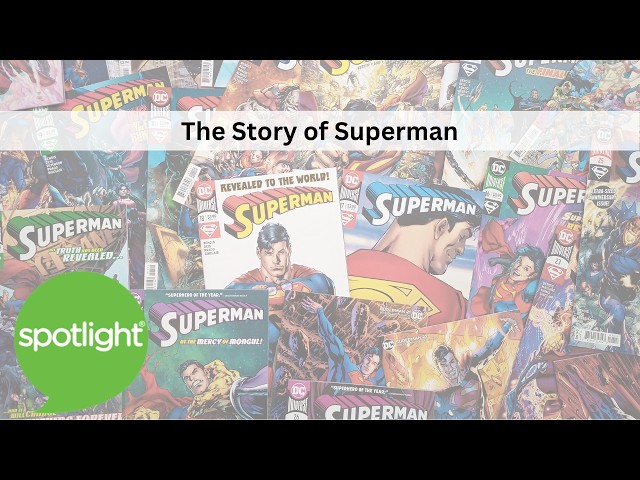
The story of Superman began in 1938 when Jerome "Jerry" Siegel and Joe Shuster, two young Jewish men from Ohio, introduced a new hero to the world during the Great Depression. Growing up as children of immigrants who had struggled for a better life in America, Siegel and Shuster bonded over their shared love of comic books and their own feelings of being outsiders due to their athletic shortcomings and bookish nature. Inspired by Edgar Rice Burroughs' Tarzan and influenced by their desire to be noticed, they created a character with an alter ego who could perform amazing feats like jumping over buildings. This concept of a hidden hero resonated deeply with them, leading to the publication of Superman in Action Comics, which became an immediate bestseller despite the creators receiving very little financial compensation for their groundbreaking work.
As Superman gained immense popularity, the character evolved significantly from his original conception as a strong man protecting Metropolis into a global guardian capable of flying through space and shooting laser beams from his eyes. However, this evolution came at a cost to Siegel and Shuster, who were eventually fired by DC Comics after a legal dispute regarding another character named Superboy. By the time they were rehired in 1959, Superman had transformed into a massive media force that transcended children's entertainment to become a cultural icon for adults as well. The character's legacy expanded further with the release of the first major superhero film in 1978, cementing his status as one of the most recognizable figures in history and proving that the story could adapt to changing times while maintaining its core message.
Beyond his superhuman abilities, Superman carries deep symbolic meaning that reflects the experiences of Jewish immigrants in America during the 1930s. His real name is Kal-El, which means "voice of God" in Hebrew, and he changed his identity to Clark Kent to blend in with society, mirroring how many Jews hid their true selves to fit into American life. Historians have drawn parallels between Superman's journey and biblical figures like Moses, noting that both were sent away to safety as infants and raised by strangers before becoming heroes to their people. Today, while some view him solely as a symbol of the United States, others see his story as a powerful representation of the Jewish immigrant experience, highlighting themes of identity, acceptance, and resilience.
Ultimately, Superman represents an enduring force for good that teaches valuable lessons about morality and integrity in a complex world. Although he may no longer be the most popular character today, people still turn to him during times of crisis because he consistently does what is right without compromising his values. The story reminds us that even when choices are difficult and the line between right and wrong is blurred, goodness remains possible if we stand firm in our beliefs. Through the creative efforts of many writers and artists over the decades, Superman has grown into a universal symbol of hope, showing that despite the challenges faced by individuals and societies, doing what is correct is always achievable.
Read the full video transcript
[music]
Welcome to Spotlight. I'm Alice Irizari.
>> And I'm Colin Laa.
Spotlight uses a special English method
[music]
of broadcasting.
It is easier for people to understand
[music] no matter where in the world
they live.
The boy was born on a dying planet.
To protect him, his father sent him in a
small ship across the stars.
Landing on a small farm in Kansas, the
boy is raised by [music] two childless
farmers.
As he grows, he discovers that he is
different from others.
He is stronger,
faster, and can fly through the air.
Others might use these powers [music]
for their own advantage,
but Clark Kent was raised to do good.
When evil comes, he puts on a red and
[music] blue suit.
He becomes Superman,
the protector of the world.
Most of us know this story. It is
possibly one of the most famous comic
book stories.
But the story of Superman's creation,
who made him and why, is less wellknown.
On today's Spotlight, we examine the
true story of Superman.
>> The story of Superman was first
published by Jerome Jerry Seagull and
Joseph Joe Schuster in 1938.
As the children of people who had
traveled to America for a better life,
Seagull and Shuster grew up during the
Great Depression.
This time of economic hardship caused
extreme poverty,
but it also led to the creation of comic
books.
These books full [music] of pictures
often tell the stories of heroes
fighting [music] evil criminals.
They cost very little to produce and
were easier for people to read than
traditional books.
During the suffering of the Great
Depression,
these stories of good and evil gave
people something to enjoy.
Seagull and Schustster also [music]
loved comic books.
They bonded over their shared love of
these stories [music] in school.
Shuster was the artist of the two.
He had been drawing since he was 4 years
old. Influenced by [music] artists like
Alex Raymond
and Hal Foster.
Seagull was more of a [music]
storyteller.
He began writing by copying the [music]
style of Edgar Rice Burroughs, the
creator of Tarzan.
But Seagull and Schusta were also drawn
together by other factors. They were
both young and Jewish. Both were bad at
sports, thin and bookish.
Both were interested in the idea of a
hero with an alter [music] ego, a way of
hiding to fit into normal life.
In the August 1983
issue of Nemo the Classic Comics
Library, Seagull explained,
"As a high school student, I liked
[music] several beautiful girls who
either did not know I existed or did not
care if I existed.
As a matter of fact, some of them looked
like they hoped I did not exist.
I had the thought, what if I was
amazing?
What if I had something special going
for me? What if I could jump over
buildings or throw cars or something
like that? Then maybe they would notice
me.
This idea of a hidden hero brought
Seagull and Schustster together.
As high schoolers, they were already
working on comics together. [music]
By 1932,
the two had already published [music]
their own comics.
By 1935,
a magazine called New Fun gave them
writing jobs.
As growing artists, the two experimented
with early versions of Superman
like Dr. Oult
and Slam Bradley.
Superman first appeared in Action Comics
in 1938.
The publisher later became known as DC
Comics,
a name that came from another comic
series called Detective Comics.
Superman was an immediate success when
his first story went public. The first
Superman book sold over 200,000
copies,
but Seagull and Schustster did not see
much of its success.
for their work on Superman. DC paid them
$130.
[music]
They also signed their rights to the
character Away to the company.
They would only get money when they
worked on more Superman comics,
but DC could [music] publish Superman
without them if it wished.
>> Because of Superman's popularity,
DC [music]
continued to work with Seagull and
Shuster.
But [music]
after a legal argument over a character
named Super Boy,
DC fired [music] both.
It gave Shuster a job again [music] in
1959.
But by that point, [music]
Superman was a changed hero.
He could shoot light from his eyes and
fly through space on his own.
He was no longer just a strong man
[music] protecting a single city.
He had become the protector of the whole
world.
By the 1970s,
Superman was a [music] media force. Most
people thought superherooes were for
children, but Superman was different. In
1978,
the Warner Brothers Film Studio released
the first of many films based on [music]
the character. It was one of the first
successful superhero films ever made.
Today, Superman is one of the most
recognizable
characters in the world.
For many, Superman has become a symbol
of the United States of America.
But others have argued that Superman's
story is also the story of Jewish people
in the United States.
After [music] all, Superman's first name
was not Clark Kent. It [music] was Cal
L, a name that means voice of God in
Hebrew.
Like many Jewish people coming to
America in the 1930s,
Superman changed [music] his name to
seem more American.
He hid his powers, [music]
his true self from people in the same
way many Jews did.
Miriam Mora is a historian at the
University of Michigan.
She compares Superman [music] to Moses,
one of the founders of the Jewish faith.
She said,
"Moses life is saved when his mother
floats him down the Nile River in a
quickly built [music] boat.
Carl too is sent away to safety on a
quickly built ship.
Both boys are raised by strangers in a
strange land.
Both would become heroes to their
people.
Like all characters, Superman came from
a particular time and place.
who Superman became was influenced by
his creators.
But it is also true that Superman has
become more than Seagull and Schustster
could have imagined.
At first, Superman was just another
character to fill pages in detective
[music] comics. His creators did not
even know where he came from. They added
much of his story later as Superman grew
popular.
Today, through the work of many
creators,
Superman has become a symbol for good in
the world.
Though he may no longer be the most
popular character,
people [music] still turn to him in
times of crisis.
In difficult [music]
times, Superman is a clear force for
[music] good.
He does what he believes is right
without compromising who he is.
The world does not always permit this
kind of easy choice.
It's not always easy to know what is
right and what is wrong.
But Superman shows us that good above
all is still possible.
Books are influenced by the people who
create them, even if that influence is
not obvious.
What other stories can you think of
where religion has influenced fiction?
Do you read comic books? Who is your
favorite superhero?
Why? You can leave a comment on our
website [music] at
www.spotlightenglish.com.
You can also find us on YouTube,
Facebook, Tik Tok, Instagram, and X. You
can also get Spotlight episodes
delivered directly to your Android or
Apple device through our free official
Spotlight English app.
The writer of this program was Dan
[music] Christman.
The producer was Mo Oaks.
The voices you heard were from the
United States and [music]
the United Kingdom.
All quotes were adapted for this episode
and voiced by [music] Spotlight.
No AI or artificial intelligence was
used in this episode.
Spotlight episodes [music]
are written, voiced, and produced by
real [music] people for real people, no
matter where in the world they live.
This episode is called The Story of
Superman.
>> We hope you can join us again [music]
for the next Spotlight episode. Goodbye.
>> [music]