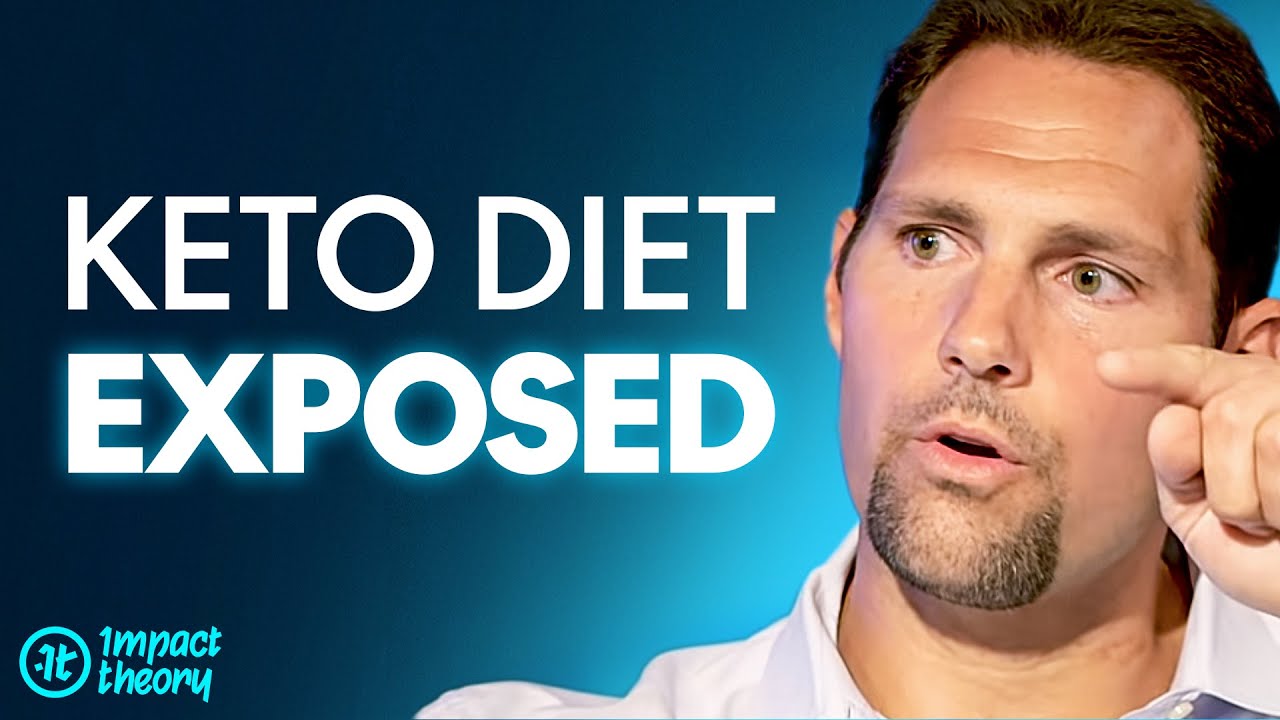
The SHOCKING TRUTH About The KETO DIET | Dom D'Agostino on Health Theory
Watch on YouTubeVideo summary
In this episode of Health Theory, Dom D'Agostino, PhD, a neuroscientist and physiologist known as the "King of Keto," shares his journey from an insecure child inspired by Arnold Schwarzenegger to a leading researcher in nutritional ketosis. His career was significantly shaped by work with organizations like NASA and the US military, where he developed protocols for ultra-elite operators facing hostile conditions such as deep-sea diving or traumatic brain injury. The military initially resisted standard ketogenic diets because they were too slow to induce ketosis and difficult to maintain on MREs; consequently, D'Agostino pioneered the use of exogenous ketone esters. These supplements allow for rapid elevation of blood beta-hydroxybutyrate levels within 30 minutes, bypassing dietary restrictions while providing a neuroprotective effect that shifts brain energy metabolism and alters neurotransmitter systems to reduce seizure risk. A central argument in D'Agostino's research is the superiority of ketones over glucose as an energy substrate for both the heart and the brain. Citing studies on perfused hearts, he demonstrates that burning ketones enhances hydraulic efficiency compared to glucose. In Alzheimer's disease, characterized by "Type 3 diabetes" where the brain becomes insulin resistant and exhibits hypometabolism, glucose cannot effectively cross cell membranes or be utilized due to mitochondrial dysfunction. Ketones offer a distinct metabolic pathway via monocarboxylate transporters that bypasses damaged enzymes like pyruvate dehydrogenase complex, allowing neurons to produce ATP even when glucose utilization fails. This restoration of energy metabolism is crucial because the breakdown of amyloid and tau proteins is an energy-dependent process; without sufficient fuel, these toxic plaques accumulate in the brain. While nutritional ketosis shows promise for treating Alzheimer's, D'Agostino emphasizes that not all patients will respond robustly to metabolic intervention alone. He estimates that only about 20% of individuals with advanced Alzheimer's are "hyper-responders" who show significant cognitive improvement when blood ketone levels reach one to three millimolar ranges. For those resistant to dietary changes, he suggests a gradual approach using tools like MCT oil or exogenous ketones rather than forcing strict compliance immediately. He advises starting by eliminating sugar and processed carbohydrates while maintaining adequate fiber intake for gut health, noting that abruptly removing glucose can initially worsen cognitive deficits before the brain adapts to utilizing ketones efficiently over a period of at least two months. Beyond nutrition, D'Agostino argues that relationships are the single most important factor for longevity and mental hygiene, often outweighing specific dietary protocols like intermittent fasting or being in nutritional ketosis. He explains that strong social connections reduce chronic stress by shifting physiology away from sympathetic dominance (fight-or-flight) toward a state conducive to health. Furthermore, he highlights the epigenetic role of beta-hydroxybutyrate as a histone deacetylase inhibitor, which can alter gene expression to build resilience against stress over time. He encourages self-experimentation rather than relying solely on genetic testing for nutritional prescriptions, citing his own experience where eliminating dairy and wheat cured severe eczema that had persisted for decades. Ultimately, D'Agostino advocates for a holistic approach combining high-quality food sources like grass-fed meats with deep social engagement to serve others and find fulfillment in life.
Read the full video transcript
episode with Dom Deastino. We discuss
how the ketogenic diet can be used to
treat Alzheimer's, why ketones are a way
better fuel source than glucose, why the
military is implementing keto for
soldiers, and how an insecure kid came
to be known as the king of keto.
Hey everybody, welcome to Health Theory.
Today's guest is Domino, PhD. He is a
neuroscientist and physiologist who's
pretty much established himself as the
king of keto. He's also a researcher
who's not only helped some of the
world's most extraordinary athletes push
their limits, but he's also worked with
cutting edge organizations such as NASA
and the US military to develop protocols
to help ultra elite operators thrive in
some of the most hostile conditions
imaginable. not one to just sit on the
sidelines. He himself has gone through
some of these protocols, including
becoming a full-fledged aquinaut by
spending 10 full days underwater. And um
what I want to know is it would be
pretty easy for you at this point to
just sit back, do some research. What
drives you to do things like spending 10
days underwater?
Uh well, I've always had an interest in
environmental extremes and pushing the
limits, uh you know, outside of
academia, outside of my kind of normal
wheelhouse to go out in the field and
experiment with the things that we're
doing in the lab and on rats and mice
and in cell culture, see the real world
applications when it comes to
implementation. I was focused on how our
brain controls our physiology. So that
was really the main focus of my PhD
work. I transitioned into studying why
the brain actually has seizures. So the
mechanisms and sort of the molecular
mechanisms, why we have seizures under
those conditions. And as I moved along
in that research, it became more
interesting to me to develop uh not only
how to predict these seizures, why they
occur, but to develop mitigation
strategies. And I discovered that the
ketogenic diet was used when drugs fail.
And uh and that I didn't know that. I
thought the ketogenic diet was a fat
diet. I thought it was I just associated
it with Atkins or diabetic keto
acidosis. And then I discovered that
ketone esters were being studied by
DARPA for war fighter performance
enhancement.
So and the military organization I was
dealing with, the Office of Navy
Research, did not like the ketogenic
diet. So it sent me down a path to
develop things that could circumvent the
restrictions of the diet to elevate
blood ketones to confer that
neuroprotective effect, you know, under
certain conditions where you can rapidly
be in a state of ketosis and then do a
dive or, you know, if you have traumatic
brain injury or areas, you know,
situations where you'd have seizures,
you could rapidly implement that.
That started my my career path.
Why didn't they like the diet too slow?
in terms of getting into ketosis. Uh it
was it's thought that military personnel
at the time if you put them on a
ketogenic diet it would decrease their
performance their physical and maybe
even cognitive performance and it was
very hard to implement like the military
has MREs they have they already have the
food covered
and it all depended on the diet which
was very hard to follow but a ketone
esester or exogenous ketone
supplementation could rapidly induce it
within 30 minutes and then get your
ketone levels up. You need beta
hydroxybutyrate and accetoacetate and
maybe your listeners know about the
ketogenic diet right uh to certain
threshold and you need to do that very
quickly before going into emission. So
that's sort of the idea is to circumvent
the dietary restriction but also have
tight control. So you're using a
metabolite that your body already makes
uh elevating it to some extent uh
artificially although they're kind of
bio identical to what we have and uh
you're elevating it to levels that
literally change the neuropharmacology
of your brain. Like it's shifting brain
energy metabolism. It's shifting the
glutamate to GABA ratio. It's shifting
you know various neurotransmitter
systems to have an anti-convulsant
effect. And it's also giving your brain
a source of energy that you could
probably say is objectively
uh superior to glucose. So just by
that's going to be a pretty
controversial statement. So why is it
superior to glucose?
Well, I could use the example of the
working perfused heart system where you
literally have a beating heart outside
of the body. But you can give it a
variety of fuels and you can look at
hydraulic efficiency in the presence of
glucose. Glucose and insulin, ketones,
ketones and insulin. And it was
discovered that the hydraulic efficiency
of the heart is enhanced when it's
burning ketones relative to a fuel like
glucose. So there were some studies and
they need to be re reproduced in brain
cells, but studies in the heart
suggested that it was a superior fuel.
and the heart and the brain in
particular are very good utilizers of of
ketones. And that really fascinated me
that there was this alternative energy
substrate that our body uses under
periods of fasting, but the only way to
elevate that in the blood is with
prolonged fasting or starvation uh or
this weird, you know, ketogenic diet
that was very strict. And that was the
place I was in a little over 10 years
ago when you know I was interested in
this as a neuroprotective anti-seizure
approach. So how was I going to package
it and pitch it to
uh the government essentially to fund a
program to to look into this? The
science was you couldn't really argue
with it from a an anti-seizure point of
view. It was a very legitimate
anti-seizure neuroprotective strategy.
But I just had to kind of conceive of a
way to implement it uh in a practical
way kind of out in the field. And that
began my sort of experimenting with the
ketogenic diet and dozens of different
types of, you know, ways to induce
ketosis over time.
The way that you're talking about it is
is actually helping me understand. feel
like I have a pretty robust
understanding of ketogenics, but hearing
the way that you're talking about it,
I'd never heard the thing about the
efficiency um of the heart, the ability
uh to create more ATP per molecule of
oxygen. Like that's really
it's another fuel. It's the fourth
macronutrient if you will, like I like
to call it that
ketones. You have you know carbohydrates
as a fuel, protein of course for
rebuilding and also to some extent a
fuel uh fat and then fat derived
ketones. But now we have ketones that
are in and of itself, you know, can be,
you know, given as a fuel and they are a
metabolic, they're a calorie containing
substance that your body can use for
energy. We're just at the cusp of
understanding the real world
applications. We have this technology
and we have to figure out, you know, how
to best use it. what form is best,
what's bioavailable, what the dosages
would be, what the applications are, the
tolerability, even the safety of these
things all need to be and that's why uh
I'm kind of deep into that research and
but we don't really have any agenda. We
just I just want to find out what works,
you know, uh maybe other people have all
their eggs in one basket for a
particular ketone formulation. uh but
we're just trying to figure out you know
we know there are infinite amount of
ketone salts and even even different
types of ketone esters that can be
developed. There was a news sort of
circulating around at the time in Tampa
that Dr. Mary Newport was using uh MCT
oil, coconut oil and then later ketone
esters to sort of manage the Alzheimer's
symptoms of her husband. So, I became
interested in using ketogenic fats, you
know, into the ketogenic diet and really
went down the path of exploring and
understanding exogenous ketones, too.
Let's talk about that. So, lab Yeah, for
sure. Alzheimer's is becoming super
terrifying. Um, someone that I know and
care deeply about uh has their mother is
struggling with Alzheimer's. My
grandmother-in-law passed away from
complications due to Alzheimer's. So,
why does it work? How do you use it in
somebody's life? Because they're going
to be super resistant to being
compliant,
especially because they don't understand
what's happening, right? So, why are you
making me eat all this stuff? I want to
eat a Snickers bar.
The ideology of Alzheimer's is largely
unknown and it's kind of controversial.
But I think that lifestyle factors,
particularly associated with the gut and
and also inflammation. So,
neuroinflammation is almost like an
attack on the brain. uh it was has been
described that Alzheimer's disease is
type three diabetes
and that the brain is insulin resistant
and a hallmark characteristic of people
with Alzheimer's disease is if you do a
glucose PET scan they have hypo
uh metabolism of the brain and ketones
are a way to help restore brain energy
metabolism in the face of impaired
glucose utilization in the brain. The
only sort of the standard of care is the
ketogenic diet because the ketones go
around the glucose transporter to give
energy to the mitochondria. The ketones
can go around pyuvate dehydrogenase
complex to actually stimulate the
metabolic pathways to make ATP.
So the two pathways are distinct enough
that if one gets damaged, you can still
go the other way.
Yeah. There's glucose hypom metabolism
in
meaning under metabolism metabolism.
Yeah. in patients who have Alzheimer's
disease that is known that you don't
people don't argue that what what people
argue is uh what led to the initiation
of Alzheimer's disease so glucose hypom
metabolism may actually contribute to
the production or processing of amalloid
plaques and and ultimately towel plaques
that form in the brain over time uh the
breakdown of these proteins are is a
very energy dependent pathway or process
right So if the brain is kind of starved
of energy, it can't undergo normal
proteolytic pathways and enzyatic
pathways that it normally does, right?
So these the processing of these
proteins tend to accumulate in the
brain. As we age, our glucose metabolism
in the brain goes down, but ketone
metabolism does not go down. So glucose
is having a problem getting in. It's
having a problem being metabolized
through uh for glucose oxidation in the
mitochondria where ketones readily cross
membranes through different
transporters, monocaroxyic acid
transporters and it's it's a fuel that
can be more readily utilized uh by
neurons and can sort of rescue in the
way uh the metabolic activity and help
restore it to normal function. And when
you restore normal metabolic function,
you balance out sort of brain
homeostasis is restored and the energy
of the brain is also dependent upon
making neurotransmitter systems. So you
tend to boost up all these
neurotransmitter systems in addition to
accelerating ATP production if you give
a metabolic substrate like ketones which
uh in brains of of people who have
Alzheimer's disease can use readily
whereas glucose they can't. Everyone
with advanced Alzheimer's disease
typically has a glucose hypom
metabolism. With that in mind, I would
say that people who do have advanced
Alzheimer's disease, probably only a
third of them respond in a robust
fashion to a metabolic intervention like
nutritional ketosis. And in the
beginning, I was thinking that this
would sort of be the end all beall for
for Alzheimer's disease that if you
elevate ketones into the one to two to
three millimmer range, it's going to
have a positive effect. And it usually
does, but the the people who are like
hyper respponders to this are kind of
going to be uh at most maybe 20 to 30%.
They're going to have an objective
increase in
uh scores like the many mental status
tests or the clock test or things like
that. Um and the others just probably
won't respond. Even though glucose hypom
metabolism is a consequence of
Alzheimer's disease, not everyone will
respond favorably and robustly to a
metabolic intervention.
Target energy.
I hate that answer.
It's true. And so that we have to deal
with it. But now I'm going to ask a
really hard question. Yes.
Okay. So let's say that your mom
tomorrow is diagnosed with Alzheimer's.
Yeah.
What do you do on a day-to-day basis?
Where do you put her in uh around the
clock care? What what are you feeding
her? uh if she's refusing it, are we
like, you know, we tying down the arms
and spoon feeding? Do we get the an IV
drip? Like what are we doing?
Uh well, you look at like where they're
starting from and what are their food
choices? Because
there are some people who just simply
won't change their diet. I mean, their
diet is part of their quality of life.
And
what would you really do at that moment?
Like for real,
what
you know your mom's resistant.
She's not going to change her diet.
Like what other options do we have? like
assume the most
I would have an intervention like I
would you know bring the family together
and say we know this about you we know
that if you do this it will produce this
outcome
what if it's past that point of like
being able to rationalize with them
though
well I I think implementation now is so
much easier than it was 5 10 years ago
you know MCT oil exogenous ketone
supplementation ketone esters so there
are tools that are available that can be
tried
one at a time to ease that person into
something. And then you can, you know,
you want to do an assessment of that
person's sort of activity,
mental, cognitive status before, during,
and after various uh things are are
added to that protocol. And uh and it's
likely that's not it's going to be one
thing that's even going to be helpful.
That's going to be a combination of
things used together. and whether or not
that moves the needle is going to be
dependent on that patient because
so let's walk through some of those
specific things that we try.
I would start, you know, if they're
willing to make the changes and they
personally believe that this system is
going to work. Even if it doesn't work,
I think it would make it work. It would
make it work to some
from a like placebo effect.
I believe so. Yeah. Yeah. And if they
want to implement it, I would go towards
a uh a lower carbohydrate diet. Would
you just lower carbs? Are you
eliminating carbs? Like how low are we
talking?
Uh well, you got to look at like what
their diet is right now. Maybe the first
step would just be elevating their
ketones by any means possible that we
know. So from my perspective, the
easiest way to do it is to use something
like uh an exogenous ketone formulation
that can elevate your your ketone levels
to uh one to two to 3 millmer where we
know that amount of energy in the blood
will be supplying the brain with a
source of fuel. And then you kind of can
sit back and
see objectively through tests if that
has any effect. All right, I'm going to
throw out a few things that I think is
um in that answer, but I just want to
really put a fine point on it. So, like
you said, we're going to reduce
carbohydrates. I'm assuming we're
killing sugar.
The first step would be to just give the
brain an alternative form of energy and
reduce glucose and insulin spikes as
much as possible because that can
contribute to insulin resistance. Cut
out sugar as much as possible or
processed carbohydrates. If they're
eating two 300 grams a day, you want to
bring that down to under 100 grams a day
of lower glycemic carbohydrates,
essentially vegetables, and and go from
there. But if you abruptly take out
glucose from the diet of someone who's,
you know, drinking lots of sugary drinks
and things like that, that may initially
cause even a greater deficit in
cognitive function because your brain is
being fueled off glucose and may take a
while to uh to induce the adaptations
associated with transporting the
ketones, utilizing the ketones, and
switching your brain to an alternative
form of energy. Evolutionarily speaking,
we are hardwired to use that for fuel,
but there are adaptations that happen
over time that optimize the brain and
the body's ability to use that fuel uh
efficiently. So, you have to kind of
stick with it and elevate that fuel in
the blood so it will ultimately get to
the brain. There's no argument about
that. And then allow that to happen for
at least I say two months. and then to
firmly evaluate if this is a valid
therapy.
All right, so sticking on this line of
sort of personal dietary protocols, um
I'm obsessed with trying to live forever
and I know that I'm fighting a very
uphill battle at this point.
So if you just had to get me to 120,
what does that idealized protocol for
longevity look like? to live as long as
pos well I might go I'm going to go out
of my r and say probably focus
on relationships and your support
network I would actually say yeah that
would probably be one of the most
important if you just look at the blue
now going back into like what you
understand at the physiological level
why is that so important what's
happening
your relationships will change the
neuropharmacology of your brain it will
change you know your u
in a way that's neuroprotective
Absolutely. I mean, just by decreasing
your your stress, allowing yourself
maybe more creative downtime instead of
always having to be on or in a fight
orflight mode, you know, living in a
city. So, I think and some people
ask living in a city. What? Well, we
were just came from New York City maybe
last week and uh and that if you were to
monitor, for example, my heart rate
variability or my stress levels that
that would
push my physiology to a state that is
not conducive to living forever. So, I
think everybody's everyone's a unique
metabolic entity. Things are going to
work different for different people and
some people thrive off that. Some
people, you know, that releases their
dopamine, that drive, that fast
life. But I think you need to find out
what kind of works for you. But most
importantly, surround yourself uh among
people who are supporting you. And I
think from an evolutionary perspective,
that's going to be really important to
have that because if you're if you don't
have that support system, you're going
to probably in a be in a chronic state
of stress. And lowering stress from a
psychological standpoint may be as more
or important than it is from a
physiological standpoint. You know, we
know psychologically we can impact our
physiology. That's what I studied, you
know, in grad school. The neural control
of autonomic regulation. If your
sympathetic system is dominant, then
you're going to be in trouble, you know,
over time. So, I would focus on that and
really nailing down nutrition, exercise,
getting outdoors. One a colleague of
mine, uh, Dr. Susan Massino just got a
fellowship at Harvard studying basically
nature as a therapy, right? So actually
uh going back to nature and living in
nature to to basically uh restore and
enhance our psychological health uh
mental hygiene if you will. So there are
things that we can kind of control
um and then there's things outside of
our control. So genetics right I don't
think we are
necessarily destined to our genetic uh
you know our genetics in general we know
that for example beta hydroxybutyrate
has an epigenetic function by by
functioning as something called a
histone dicetylase inhibitor it can
actually change the activation of genes
that when kicked on can confer a a
benefit over time resilience against
stress
do you think there's anything useful
that people should be testing um for in
their own genetics to understand like
genomic eating and things like that. Is
there a viable test?
Yeah, that's I'm not fully convinced at
this point that that is something that
could uh be leveraged right now. You
know, do a genetic testing based on our
23me data if that's what you're talking
about to do a nutritional prescription
prescription based on that data. So, uh,
my wife is, for example, a a pretty good
carb burner. So, I know genetically, I
think she's kind of set up, uh, to
metabolize, utilize, and be carbohydrate
tolerant, if you will. And other people,
undoubtedly from various geographical
regions, may maybe um the Native
American population, for example, uh,
are very carbohydrate intolerant. even
if their calories are maintained, their
glycemic response or insulin response to
a given amount of carbohydrates uh is
much different than someone else who
tolerates carbohydrates well. So I think
that's a really important uh
consideration. So people really do need
to self-experiment and study and not
just keep eating a particular diet or
particular foods and and feeling uh
fatigue, lethargy, you know, skin
rashes, things like that. That's a red
flag. Like I ate
dairy and wheat for so long and had
eczema for and that's an autoimmune
that's your immune system being
hyperactivated by something that the
body is perceiving as a foreign
substance,
right? And when I transitioned to
phasing out any kind of grains or even
uh a lot of dairy protein, the eczema
disappeared 10 years ago when I got into
this area and has never occurred. And
that's something I dealt with my entire
life and had to go to the der
dermatologist for a long time. It wasn't
like a a macro thing. It wasn't a
calorie deficit thing. It was going on
to the ketogenic diet eliminated some
foods. Maybe by elevating beta
hydroxybutyrate, it completely cured uh
what I had was pretty severe eczema for
a long time and it's never come back
over a decade.
It's really interesting. Talk to me
about the difference between macros and
how you're sourcing your macros like
what they're actually coming from. Why
does that matter?
Quantity will kind of trump quality to
to some extent. So if you are running a
calorie deficit of a high carbohydrate
diet that's has processed foods that
calorie deficit will produce a lot of
beneficial things you know for a lot of
that people are looking for like weight
loss insulin sensitivity even a lowering
of inflammation could be achieved simply
by calorie restriction uh and this is
you know there's different you know
areas of thoughts on this but I'm of the
opinion that nutritional ketosis But not
even necessarily that just low
carbohydrate diets allow one to have the
discipline necessary to implement a
dietary strategy that allows for you to
uh induce and sustain a calorie deficit
for one thing. And even if you're not at
a calorie deficit, simply by not spiking
glucose or spiking insulin and by
elevating beta hydroxybutyrate that you
know that comes with a whole host of
other advantages. So including the
anti-inflammatory effects, including
perhaps the autoimmune effects, perhaps
the gut microbiome, uh if the ketogenic
diet is well formulated with soluble,
probably most importantly, uh insoluble
fiber that can help restore gut health
over time. The the foods that are part
of the ketogenic diet, u some people
will argue, you know, against GMOs or
against, you know, grass-fed beef versus
cornfed beef. And if you look at the
lipid composition of fatty meats that
are from animals that were grass-fed,
there is a significant, you know,
difference in, for example,
pro-inflammatory fats or much less in
grass-fed meat. So, I do think that if
you can budget it in to go with foods,
uh ketogenic strategy, it's going to be
you want to get fatty fish, meat, and
and poultry, um to go with grass-fed
relative to u maybe industrial farming
practices.
All right, I want to take a really hard
ride for a second.
Okay.
You said that you grew up watching the
movie Commando a lot and that it
actually had a big impact on the
trajectory of your career. Why is that?
Uh
why Commando first of all? Why Commando?
Why not Commando? Uh so I think every
kid I'm just going to go back into that
12 13year-old mentality where you just
want to be a super you want to be larger
than life, you know, uh comic book
character, right? When you're at that
age 13, 12, 13, 14, you that's when a
lot of insecurities start to settle in.
And I was a pretty insecure kid. I say I
was so shy. I was paranoid to
uh read in read out loud in school. Like
I would literally freeze and have like a
sympathetic kind of overload. And uh and
later on even when I went to go pursue a
PhD,
I was petrified of giving an oral
defense of my PhD. So it was actually
influencing my ability to like sign the
application to do a PhD. So I think
Arnold Schwarzenegger and just having
muscles uh allowed me to
get to a state where I had power and
control and that led me down a path to
uh sort of be like my brother who was
very strong at the time and pretty
dominant in football and just as a
strength athlete and I wanted to be like
him. I wanted to be like Arnold. So I I
immersed myself into
uh lifting and I was a poor student at
the time but to achieve gains in lifting
you know I was reading muscle and
fitness and all these magazines and I
realized that to make progress in what I
wanted to to do which was just build big
muscles I really had to learn biology
and nutrition. So towards the end of
high school, the last two years, I uh
challenged myself with u an academic
path that really forced me to learn. And
I think the discipline that I learned
through weight training and reading
books about Arnold, I parlayed that into
my academics. And then my grades went
from very poor or mediocre to uh pretty
good as I went down the the college
path. And I continued to train and that
gave me a sense of kind of self-worth
and uh you know the bigger I got the
more control I had over my body and I
realized that nutrition is an incredible
tool not only to add muscle and strength
but to change my energy levels and my
physical state and my health.
That's really interesting. I love that.
Um, I want to go back really fast to one
thing that you said about placeos and
how effective they are. Do they work on
you? So, knowing what you know, are you
able to get yourself into a certain
mindset to say this is going to work and
just really invest in that?
I think as a neuroscientist, I would
have to say yes. Uh, even when I was
visiting my my parents, I had some decaf
coffee and I drank it and I'm like,
"Yeah, I'm ready to work." And I went
back maybe and and I realized that, oh,
this is decaf. I was drinking decaf and
I was all, you know, I'm saying I could
only like start working on this thing. I
was not very Sometimes there's a lot of
obnoxious paperwork you get in academia
where it's like, okay, I'll just have a
big cup of coffee and I'll just bang
through through all this. So, it's like
I woke up, I was going to work and I was
like, okay, let me have my coffee first.
I was like, okay, I'm ready. And I did
it. And that was total placebo effect,
you know, that I needed my coffee to
complete that work. And I had decaf. So,
it was actually pretty nice to know, you
know, I did all that work on decaf. I'm
not immune to the placebo effect as a
scientist.
My real question then is do you use it?
Like if I were anytime I go into
something I say to myself, this is going
to work. I'm gonna go all in because I
know that most things don't work anyway
or they certainly don't work as well as
you want. But if you're also fighting
against your own mindset that it's
really not going to work. So even though
I'm hyper aware as somebody who's gone
pretty deep into psychology in the
brain, uh I'm very aware of the placebo
effect. So, in some way it shouldn't
work on me, but because I invest so
much, not in saying, "Oh, placeos are a
thing and it's going to work." I don't
think about that. I just think this is
going to work. I totally believe this.
I'm going to give myself over to it. I'm
going to do everything perfectly and
it's going to have a massive result.
And I was just wondering if you do
something similar, if you think that
kind of thing can boost something's
efficacy. I totally believe that even if
we're if we're hesitant if a certain
system will work, if the ketogenic diet,
if if a supplement will work or
anything, if some kind of uh technique
will work or whatever, you have to be in
100% or it's not going to work, right?
It's like if you have a hesitation, if
you go up to a bar and you're
deadlifting 700 and you're, you know,
you're you're thinking that I might not
I might slip a disc, I might not be able
to pull this up, then it's already done.
Like it's not going to happen. So, you
need to go into every challenge in life
with the understanding that you you're
already there. It's already done. Like
you just have to go through the motions.
You just have to execute. Uh so that
should be sort of your mindset. um that
you can use the placebo effect to your
advantage. So, I feel like I validated a
lot of the the benefits of nutritional
ketosis on myself before they're
validated in various animal model
systems like the lowering of
inflammation, my joints feeling better,
uh eliminating certain things to get rid
of like my eczema, the calming effect I
think the ketogenic diet has. Uh my wife
observed that when animals were in a
state of ketosis, they were easier to
handle, easier to to deal with. So it
was her idea why aren't we studying
anxiety behavior? So that was something
that I wasn't really personally
interested in studying. Uh but it was an
observation sort of as a side effect
that this is happening and I felt it in
myself too and it's something that we
need to study you know in the context of
nutritional ketosis. So that led to a
number of some of some of our most
important work I think is looking at the
behavioral effects of being in ketosis
which really wasn't a big personal
interest of mine but is for my wife and
then that has kind of shot us off in
different directions of things to look
at.
Super interesting. All right before I
ask my last question tell these guys
where they can find you online.
Uh keto nutrition all oneword.org oorgg
and on there I have a blog, I have a
podcast on there. There's products on
there. We do not have our own products,
but there are products on there that I
have tested that are legitimately
products that that can help you induce
and sustain nutritional ketosis. So,
that's on there, but uh it's more
anformational website. So, keto
nutrition.org
and uh yeah, that's like a one-stop kind
of shop website.
All right, perfect. My last question, if
people are going to change one thing to
have the biggest positive impact on
their health, what one thing should they
change
on their health? Well, man, I have to go
kind of out of my comfort zone and just
say really relationships, like get your
relationships right. You could devote
yourself to work where you work yourself
to death, right? But you have to
allocate creative downtime
uh you know with your significant other,
with your family to really get the most
out of life because otherwise it just
goes by in a flash and that creative
downtime
uh is probably the most important thing
for your mental health, mental hygiene,
which really uh can I can look at my
sleep and my heart rate variability and
see major changes in that
and even my glucose levels come down
when I remove myself from stress
environments and get out into nature
things. So I think that's the most
important thing. It's not being in
ketosis. It's not intermittent fasting.
It's not that. So it's it's really
focusing on relationships and and giving
back. So being passionate about
something where the outcome is that you
are serving and giving information that
can help other people. That's kind of
fulfilling. I was a scientist really
delving into mechanistic things. But to
work on something where we get a
scientific effect and publish the paper
and I can do that something myself and
then people can read that paper and
implement it and get beneficial effects
from it. That's very rewarding and
satisfying to me and I didn't really
have that 10 years ago. So I don't know
I probably went way beyond the question
that you just asked but yeah being
passionate about something you're you're
doing and u and having that something
serve other people I think is
is really important. We are very aligned
on that. Dom, thank you so much for
coming on the show. Incredible.
All right, guys. There there is a reason
this man is known as the king of keto,
but I'm telling you that he's so much
bigger than that. And what he's really
earned a reputation for in the industry
is never being dogmatic. He's always
trying to figure out what is true and
never overinvesting in something. and
somebody like that that's always trying
to push the frontiers by just really
looking at what is the data showing us,
what are we learning, where could we be
wrong, and being willing to admit that
they're wrong and change and grow. Like,
I love that so much. And somebody that
can go and talk about something, you
know, as intricate as what's going on
inside the body and then flip it and
start talking about that you should be
connecting and that there's a whole
world that opens up to you when you
recognize fulfillment as something that
should be important to you as well. and
being able to do all of that and to
really try to live a true full human
experience is pretty extraordinary. And
I think that that's why he's really
become a voice for this new generation
of scientists that are really pushing to
push the envelope of what we know and
what we understand and what the body is
capable of and pushing the limits and
boundaries, but also recognizing that
we're trying to give back and help
people and touch lives. And he spent so
much time just doing that. And we were
talking before if this was all just a
part of what he does as curriculum, but
he does it on his free time. He had to
take a vacation day to come here and do
this. And I think it's extraordinary
that he's that moved to help and reach
people that he does that. And I think
it's really, really extraordinary. I
highly encourage you guys to dive into
his world, support him in any way that
you can. He changed my life. This is
about eight years ago when he and Peter
Ratia introduced me to fat, which I' had
been fat phobic up until that moment. I
owe these guys such a debt of gratitude.
Um, so please if there's anything that
you can do, a kind word, retweet a
tweet, whatever it is that you can help
me along this journey, that'd be
absolutely extraordinary. All right, if
you guys haven't already, be sure to
subscribe and until next time, my
friends, be legendary. Take care.
Thank you again. That was fantastic,
man.
Hey everyone, I hope you loved that
episode and I want to take a quick
second to share about our amazing
friends at ButcherBox. ButcherBox
delivers 100% grass-fed and
grass-finished beef, freerange organic
chicken and heritage breed pork straight
to your door every month. When it comes
to cooking, it is super hard to find
high quality meat you can actually
trust. And you guys know how important
that is to me because of what Lisa is
going through with the microbiome. And
I'm telling you right now, it matters
where your food comes from. It matters
what your food ate. It's crazy. And I've
really enjoyed Butcher Box, not only for
my burgers, but for everything here at
Impact House, because you can trust
where it comes from. And every box comes
with at least 9 to 11 lbs of meat. And
that's enough for 24 individualsized
meals. And they ship for free everywhere
nationwide except Alaska and Hawaii. You
guys just live too far away. We have an
amazing offer for everyone. If you want
to try Butcher Box, you're going to get
$20 off your order by using the link in
the description below. So guys, I'm
telling you, give Butcher Box a try.
They are amazing. Use the link in the
description below. Enjoy and be
legendary. Thank you guys so much for
watching and being a part of this
community. If you haven't already, be
sure to subscribe. You're going to get
weekly videos on building a growth
mindset, cultivating grit, and unlocking
your full potential.