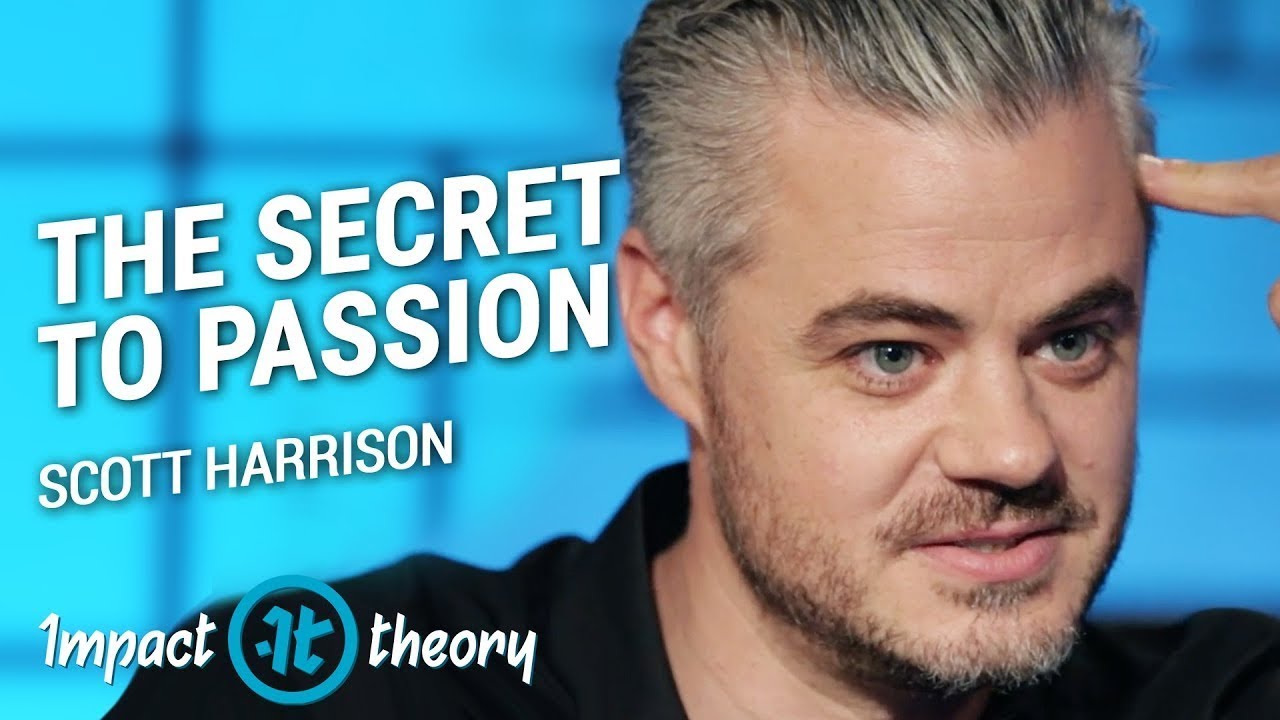
The Secret Formula to Finding Your Passion | Scott Harrison on Impact Theory
Watch on YouTubeVideo summary
Scott Harrison, founder and CEO of Charity: Water, shares his extraordinary journey from a decade-long period of debauchery to becoming one of the most impactful philanthropists of the 21st century. In his twenties, Harrison lived a lavish lifestyle as a nightclub promoter in New York City, earning upwards of $5,000 per night while engaging with vices including cocaine use and gambling. However, feeling spiritually bankrupt despite material success, he realized that an insatiable pursuit of more was ultimately selfish and hollow. This epiphany occurred during a trip to South America where he saw the futility of his lifestyle and envisioned its exact opposite: a life defined by virtue rather than vice, service to others rather than self-indulgence. To fully commit to this transformation, Harrison boarded a Mercy Ship bound for Liberia at age 28, promising to abandon all previous habits including pornography, drugs, and alcohol—a pledge he has kept for over fifteen years. The core of his mission is ending the global water crisis through Charity: Water, which launched in 2006 with an innovative business model where 100% of donations go directly to drilling wells rather than administrative overheads. Since its inception, the organization has raised over $300 million and built wells in approximately 30,000 villages, providing clean water access to roughly 8.4 million people globally. Harrison emphasizes that anyone can start over regardless of their past mistakes; he believes redemption is possible by using one's history as a foundation for growth rather than letting it define them. His philosophy centers on the idea that "you just have to ask and then you have to push through the noes," illustrating this with stories like convincing Verizon and Samsung to donate hundreds of thousands of dollars in technology, such as 400 VR headsets used at a gala to deliver empathy-driven content about water scarcity. Harrison attributes his organization's success to a culture that prioritizes craft excellence alongside mission alignment when hiring staff, ensuring employees are masters of their trade before being introduced to the cause. To maintain high standards and foster deep connection, he takes every employee on field trips annually to locations like Ethiopia or Cambodia so they can witness the direct impact of their work on human lives. Innovation is driven by a commitment to using new technologies for good; when GPS became available, Charity: Water mounted units on drilling rigs to provide real-time transparency, and with VR, they created immersive experiences that connect donors directly to beneficiaries. This approach has allowed them to scale operations significantly, raising $2.7 million in a single year through these technological initiatives alone. Looking toward the future, Harrison aims to impact 100 million people's lives by moving them from dirty water sources to clean ones and hopes his story will inspire other charities to emerge across various verticals addressing hunger, shelter, and healthcare needs. He maintains an optimistic outlook, citing statistics that show progress in reducing poverty and child mortality as fuel for continued effort rather than focusing on remaining problems. Harrison often recounts a story where he gave four speeches at a church with no immediate financial return; years later, one attendee changed his will to leave $100,000 to the organization after dying of cancer, demonstrating that seeds planted today may germinate much later in unexpected ways. His ultimate goal is not just solving water issues but proving that redemption and massive impact are achievable for anyone willing to ask boldly, persist through rejection, and maintain hope even when results seem distant or invisible.
Read the full video transcript
I have learned that you just have to ask
and then you have to push through the
nose.
And enough people have said yes now,
you know, to [music] to now impact 8.5
million lives, but boy, I if I could
count the nos. I mean, there's tens of
thousands of nos that we've all heard
over the last decade.
[applause]
Everybody, welcome to Impact Theory. Our
goal with this show and company is to
introduce you to the people and ideas
that will help you actually execute on
your dreams.
All right, today's guest is the founder
and CEO of Charity: Water, one of the
most innovative and impactful charities
of the 21st century. But his role
helping people is about as far as you
could get from his beginnings as a
nightclub promoter. In his 20s, from the
outside, it looked like he had it all.
He was living a lavish lifestyle, making
upwards of five grand a night,
jet-setting with the mega wealthy, and
driving around in fancy cars, getting
paid to get drunk, and spending many a
night high on cocaine. But after a
decade of debauchery, chasing money and
status, he realized that even too much
was never quite enough. Feeling
emotionally and spiritually bankrupt, he
decided to build a life that was 180° in
the opposite direction.
He sold everything and joined a mercy
ship on its way to Liberia. As he
boarded the ship, he promised to give up
all of his vices, a promise that he
kept, and that trip ultimately changed
the entire course of his life and the
lives of millions of others. Seeing so
many people in need, he became
absolutely obsessed with the notion of
ending the world's water crisis. Now,
nearly 15 years later, he's well on his
way, and since launching Charity: Water
in 2006, he has helped his community
raise over 300
million dollars and build wells in
roughly 30,000 villages that serve over
8.4 million people.
In 2017 alone, his organization raised
50 million dollars, bringing clean water
to an average of 3,561
people a day, an average of one person
every 24 seconds. His staggering
philanthropic accomplishments have seen
him named to Fortune magazine's 40 under
40 list and Forbes Impact 30 list. So,
please help me in welcoming the man who
placed 10th on Fast Company's Most
Creative People in Business list, the
author of Thirst, Scott Harrison.
[applause]
Ready?
I'm so [cheering] nervous.
Good to see you.
You too. Welcome.
for having me.
Dude, thank you for being here.
Your story is absolutely insane. And
what I want to start with is something
that came up over and over and over
which I was really captivated by. It's
this notion of redemption,
which
isn't something that people really push
you on a lot, but I want to hear about
that. What What is the notion of
redemption to you? And why is it so
important?
[snorts]
Gosh, I mean, for me, my
decade of debauchery really started as
an act of rebellion. I was this
Christian kid, you know, brought up in a
really conservative family, playing by
all the rules. And then I just had this
moment where, you know, I said, "Now
it's my turn. You know, now it's time to
go and explore the other side." And, you
know, it started with smoking and then
drinking and then drugs and then
gambling and then pornography and, you
know, one by one,
you know, I just took on the vices of
nightlife.
And 40 clubs and 10 years later, you
know, I found that
I I hated who I was. I mean, I was
rotting inside. And this selfish pursuit
had left me um
the the most deeply unhappy person that
I knew. So, for me, that, you know,
redemption was trying to come home. It
was It was a almost a nostalgia for the
the virtue and the morality and the
spirituality that I'd been brought up
with, that I had rejected. It really
felt like it was a clean slate um that
allowed for me to be able to redeem the
the past. And, you know, you you
mentioned this, but I I went on a
hospital ship to West Africa.
And the cool thing was that from day one
uh
I was able to communicate a very
different story to the 15,000 people on
my list. I mean, I had amassed an email
list of 15,000 of some of the most
influential people in New York who were
going out and spending $25 on a
cocktail, $500 on a bottle of champagne.
So, they went from getting invited to,
you know, the Prada party at the opening
of a new megastore to this really
life-changing, redemptive humanitarian
work.
So, it wasn't lost. Those years weren't
lost. Um I was able to kind of use them
from day one.
Do you think anybody can start over?
I really do. And that was that was
really one of the reasons why I wanted
to write the book and and why it's so
personal. I mean, my wife was like, "I
can't believe you tell people some of
this stuff." You know, no one no one
goes uh
I I think she was just expected
surprised at how honest and it was about
how really bad I was. And I think so
many people believe that their past
defines them.
And you know, I can never start over. Um
you know, the things that I've done uh
are are you know, are impossible to
overcome. And I would hope that my
story, I mean, at 28 years old, you
know, if you had run into me
what, 15 years ago? Um there was this
moment at 28 when I had gone out to
dinner at 10:00, the club at 12:00,
after hours at 5:00. I'd stumbled home,
cooked out of my mind at noon. Right?
I'm taking Ambien to come down. And I
remember grabbing a comforter, trying to
block out the windows. Right? So, that I
could sleep. And I look out the window
on Houston Street in New York City and I
see people on their lunch break in
suits.
Like normal people going to lunch or to,
you know, to the gym.
And
you know, you would
my life is so unrecognizable now from
that. Um I think it took a commitment to
walk away completely
you know, from those vices and and
really to give it all up. But, um I I
believe anyone can change. It's never
too late to change, and you can actually
use the things in your past, use the
darkness
to you can redeem it.
Now, it's really really an extraordinary
story. Now, the people that are
listening right now that want to have a
similar kind of redemptive experience,
walk them through that moment where cuz
I know you had been trying to give up
drugs and alcohol and the other vices to
sort of mixed results. But, then when
the Mercy Ship comes up, you're staring
at the gangway, you're about to walk
out. You really have this moment. What
was that moment, and how can you help
other people get themselves in a place
where they could have something similar?
Yeah.
Well, the the first cathartic moment was
really at the decade point, and and it
was on a opulent vacation in South
America. So, it was it was this moment
where I had collected the the markers of
success, the things that I thought would
make me happy. Right? So, my girlfriend
at the time was on the cover of fashion
magazines. I drove the BMW. I had the
fancy watch. I had the grand piano in my
New York apartment. I had the Labrador
retriever. And I was vacationing on a
compound in South America with servants
waiting on us and horses in the
background and magnums of Dom Pérignon
everywhere and a thousand dollars of
fireworks that we just blew up the night
before. So, it was just this picture of
okay, did it.
And, you know, I did enough of it. And I
realized on this trip that there would
never be enough. It was almost like the
veil was lifted. Um I looked around and
saw it for what it was. There would
never be enough girls, there would never
be enough money. Uh somebody would
always have a better car, a better
watch, you know, private planes. That It
was It was this never ending insatiable
pursuit of more. It was a pursuit of of
me, really. A a pure and utter
selfishness that would have no end.
And,
you know, I realized that the just
thinking about legacy, um you know,
coming up on 30 years old at the time,
and my tombstone was might actually
read, "Here lies a man who got 10
million people wasted over the course of
his life." You know, I mean, who wants
their tombstone to read like here's the
guy that got people drunk for a living?
And there on that
it on that vacation, I asked myself this
question, um what would the exact
opposite of my life look like? What
would the 180°
turn look like? And the
it was a life of virtue, you know, so if
mine was a life of of debauchery, it
would be virtue and instead of vice. And
it would be a life of service to others
and not myself. So then, there was there
were months of floundering and trying to
smoke less and trying to quit drugs and
just this kind of really uneven uh 6 or
7 months that then culminated with um an
incident in New York which which gave me
an excuse to get out, the Mercy Ship
accepting me.
And then this final hurrah where I just
I looked at this 522-ft hospital ship
full of 350 doctors and surgeons and
volunteer crew who were all there for
the right reasons.
And there was something, you know, um
symbolic or almost prophetic about
walking up a gangway, you know, the
gangway being pulled up and then sailing
away into my new life. Sailing onto a
new continent. And you know, I I went
out with a bang. I think I drank eight
beers that night. I smoked three packs
of Marlboro Reds. I remember getting on
the ship with the nicotine patch and the
gum.
You know, just just realizing that I
to to create a new story for my life, I
really had to go all in, you know, I had
to go cold turkey. And you know, and and
I I haven't looked at a pornographic
image in 15 years and I haven't had a
cigarette. I haven't touched coke or I
haven't gambled. Um I I really walked
away from that.
It's interesting. How did you
let go of all the traditional trappings
of success? You know, you've talked
about you give away like some absurd
amount of your money, but even compared
to what you were making it's a lot less
now than it was back then. Yeah. Um
what is it neurochemically is sort of
how I view the world, but what was it in
in that, the way that it makes you feel
or whatever, that's allowed you to
commit so deeply?
I think it was when I realized that
money would not make me happy. There was
a freedom of just saying, "Okay, I'm
going to stop pursuing that."
And
uh then when I realized that giving
money away or raising money to give it
away
um really did make me happy, that became
the new metrics of success. My greatest
ambition personally around money is I
want to write a million-dollar check to
a charity um at a at a certain stage cuz
someone did that for me and they
completely changed the game. You know, a
stranger walked in at a moment when we
absolutely needed the confidence and we
absolutely needed the capital and they
wrote extraordinarily generous.
I love that. How do you So, to me you're
a very effective entrepreneur as well as
having run just an extraordinary
charity, but tell us a little bit about
how you started as a nightclub promoter
and not not to glorify, but the the
things that you did to get into that
business I think are applicable across
the board. Um the thing I'm most
interested in was when you called the
guy up and said, "Do you want somebody
to work for you for free?"
Yeah.
[sighs and gasps]
Well, I got I got my start in nightlife
uh it was a club called Nell's in New
York City and I I was I I played piano
growing up and I loved music and
I kind of stumbled into eventually
producing what was the biggest R&B open
mic night in New York City at the time
and and I just had a knack for um
putting together the band. Um I was
working with a great partner at the time
and and find creating this environment
and this culture where artists wanted to
come and try out the material and just
a safe space. So, Stevie Wonder would
come and Brian McKnight and Whitney
Houston and Prince
would come and perform.
And and and I I grew that for a while
and then someone said, "Well,
that's great. You're doing this thing,
but I bet you can't do the same thing in
fashion. You know, this is a completely
different world." And this new club
opened up and the the owners were on the
cover of New York magazine, the four
owners. And it was a dare. It really
started out as a dare between someone
that I that I wanted to I wanted them to
respect me.
And I said, "Well, they say I can't do
it. Let me see if I can. Let me see if
these skills will port over from music
into fashion." And yeah, I just called.
I left 30 voicemail messages. I've
always been pretty tenacious. If I if I
really want something, you know, I go
after it and I can I can push through a
lot of no's. I I probably left 30
voicemails until finally the club owner
called me back and he said, "Okay, I'll
give you a shot on our deadest night.
It's a Monday night and I'll pay you
$150."
And you know, I I took that start and
then wound up, you know, working at 30
fashion
type clubs over over the last year.
I want to go back to something you just
touched on about tenacity. You said when
you really want something that you can
be quite tenacious and the 30 phone
calls.
In the book you talk about something
that I thought was really bizarre and
wonderful
which was that you convinced a doctor
when you were a kid to let you watch an
autopsy.
Yeah.
Tell that story and then the punchline
which I loved.
I grew up wanting to be a doctor as a
kid who would help sick kids like or
help sick people like my mom get well.
And you know, I remember that the the
science class when you dissect the frog.
I just thought that was fascinating.
And you know, I probably told my
friends, you know, I think I'm going to
go dissect a human. So, I figured out,
uh, you know, who was the local
pathologist. Um, and this is, you know,
maybe three blocks from our big 4,000
person high school.
And call him, write him, you know,
figure out, uh, hey, sir, I really want
to be a pathologist, right? You know, I
give him a whole kind of story of, you
know, your profession is the most
interesting to me to me.
And, you know, next thing I know, I'm
cutting I got a scalpel in my hand and a
saw, and I'm cutting through a human,
you know, down in the basement of the
medical ward as his assistant. I thought
I thought it was just absolutely
fascinating. But, it was as simple I
just asked.
You know, there's so many there are so
many things that that over the last
um, years I've been surprised that
people have just said yes.
You know, things that you might you
might not even have the courage to ask
for.
Um, it was interesting. We, couple years
ago, we did a gala. Um, we had shot This
is actually 3 years ago. So, virtual
reality first hit the scene,
and I saw one of the the earliest VR
films and said, this is something
Charity: Water has to
embrace as a technology. And the the
idea of being able to intravenously
deliver empathy, you know, empathetic
content into someone and get their full
attention for a few minutes while their
phone is off and they're in your world.
So interesting to me. So, we wound up
shooting our first film, uh, with eight
GoPros, you know, on a stick. I mean,
this is before the cameras that you have
now. And, um, we shot a a really moving
8-minute piece of a 13-year-old girl who
gets clean water for the first time in
her life.
So, we have this film,
and I have this vision of serving the
film up at our gala in synchronous
viewing to 400 people at the same time.
And our gala was in the Metropolitan
Museum of Art in the Temple of Dendur.
All right, like the the amazing Egyptian
wing of the Met
with the pool and the glass looking out
on Central Park. And 400 people would be
coming in black tie. And I just had the
vision. I could see it so clearly. They
walk in, they have their dinner, and
then after dinner,
hundreds of volunteers walk out, strap
headsets on everyone, and then at the
same time press play, and take them all
to Ethiopia. Bring them back, I hope,
genuinely moved. Right? I imagine this
in my mind, tears screaming,
streaming down people's faces, mascara
running. And then I would ask them to
give what was in their hearts to clean
water. So, you know, I tell my team the
idea, like, cool idea, right? But we
couldn't get the VR devices.
No one would give them to us.
So, I just wouldn't take no for an
answer. I was trying to figure out could
we go buy You know, it was about $800
for the package. It was a It was an
expensive phone and then this is this is
pre-Oculus and all the stuff that we had
now. It was Gear VR.
And I just It was no after no after no.
It was too expensive to buy. I was
looking into could we buy 400 and list
them on eBay the next day and take the
hit and and everyone was just saying,
"No, no, no. We can't do it. It's too
expensive." I just I wouldn't let go. Um
I found my way to the Verizon CMO.
Um eventually convinced him to loan us
400 of the new
um phones and then leverage that to then
work my way all the way up the Samsung
chain and finally got a VP who, because
Verizon did the phone, said, "Okay, I'll
send you over pallets of the things."
And we got them. And we wound up getting
it all for free.
I think we raised $2.7 million
after people came back um to give 270
villages clean water. So, there's I
think a lot of these things start with
me me seeing it um at the end. You know,
it's almost like seeing the press
release. I mean, I I can see the day on
Earth when everybody has clean water.
You know, I can see that drop the mic
moment where no human being, simply
because of where they're born,
is going to die of bad water, is walking
5 hours to a swamp or a, you know, a
pond or a dirty river. And, you know,
there may be a long way between now and
that moment, but we're, you know, we're
we're working a little closer to it.
This year, I think it's almost 4,000
people getting clean water every day.
And hopefully next year it's 5,000
people a day or 7,000 people a day.
So, I typically see these things and
then because I can see it almost like it
happened, the nose just feel like you
need, you know, there are these
roadblocks that you need to push
through. You need to find a way.
Do you talk to your staff about that? I
find that's really hard to inspire
another people to get them to push past
all the nose to
maybe not even create the vision cuz it
sounds like you can do that really
effectively and give that to them, but
to get them to really believe that it's
possible.
I I teach them how to ask and that they
need to ask. You know, every once in a
while someone will email me back and
they're like, "Oh my gosh, I just
pitched some software company for
$10,000 of licenses and they just said
yes."
And they were fans of charity:water. So,
this we do have a culture of asking. And
again, it's not for us. And having a
business model where 100% of the money
is going directly to provide clean
water, it makes it easier to ask. When
I'm asking Verizon or Samsung for, you
know, half a million dollars of VR gear,
I'm like, "It's not for me. I'm going to
use that gift and I'm going to give, you
know, 100,000 people clean water. Don't
you want to be a part of that?" So, I
think it's excitement, it's asking, it's
invitation. So, I have learned that you
just have to ask and then you have to
push through the nose.
Mhm.
And enough people have said yes now,
you know, to to now impact 8 and 1/2
million lives, but boy, I if I could
count the nose, I mean, there's tens of
thousands of nose that we've all heard
over the last decade.
And is there anything specific that you
teach your staff about how to ask?
Um you don't want to be entitled ever.
So, it's it's a really grateful ask.
You're telling the story of what you're
asking for, why you're asking for it. Um
if if you're asking for a gift in kind,
which we do a lot. I mean, you know, uh
for the free web services or free
software or uh Samsung gave us $50,000
of TVs for our new office. Um this is
the funny story. We we built out our our
headquarters in New York and
amazing. I mean, we we have these
amazing stories of people encountering
Charity Water and being radically
generous. And we had a landlord um who
had given us uh headquarters in New York
for $8 a square foot in SoHo. You know,
market was like 60 a foot or something.
And this landlord then moved us into a
new office
uh in TriBeCa as we grew. It was 20
23, 25,000 square feet or so. And we
didn't really have the money to build it
out. So, he says, "Tell you what, I'll
bring the contractors and the plumbers
in and, you know, you just give them the
speech. See if you can inspire them."
So, you know, he brings them in and I
you know, I've got some some maybe
mob-looking guys, you know, with hands
that feel like they're three times
bigger than mine uh crying in the
conference room as they are moved by our
work and the need and um the impact that
we're making. And you know, this this
office, this what $1.8 million office
build-out um
I think we got $1.3 million donated. Um
cuz everybody wanted to be a part of it.
So, Samsung said, "Well, we can give you
$50,000 of TVs for KPIs and dashboards
all around the office." And the
architect went up donating all of their
fees back. And WeWork said, "Well, we'll
give you furniture that we have in
warehouses cuz we'd rather your staff be
sitting in it to change the world than
sitting in a WeWork warehouse
somewhere." That's the culture that
we're trying to instill. And you get
enough yeses and then you grab onto that
yes and it it powers you through a lot
of nos. It powers you through the the
You've got people working for a lot less
than they could be making somewhere
else. So, obviously that's on the side,
but how do you take somebody that is
really pouring their heart and soul into
this and still hold them to an
exceedingly high standard?
Yeah, I used my wife as an example. So,
she was the second employee
uh of the organization. We worked
together for 9 years. She was the
creative director.
And really built the charity:water
brand. And I remember that people would
write her looking for a job. And the the
incoming would be something like this. I
love charity:water so much, I'll do
anything. You know, I'll clean the
toilets. But we've seen this. We had I
think we had 1,500 people apply to be
the receptionist um last year at
charity:water. You know, 1,500
applicants to answer the phones and
greet people as they walk into
charity:water. So, this [snorts] this is
common. And Vic would be so She would
actually get angry about that. She's
like, I don't want someone who just
wants to work here because they like the
mission. I want someone who wants to be
at best at their craft.
So, she said, "Do you want to be the
very best graphic designer or the best
UI UX designer or the best animator?
Those are the people that I want. We
want the people that are leaving, you
know, Zynga or Google or Adobe or Apple
or Tesla saying, 'Oh my gosh, this thing
that I do that I've gotten really good
at. I didn't know that it was applicable
to end suffering of others. I didn't
know that it could be used in a
charitable context.' So, we always focus
on craft and excellence first uh in the
hiring process and not mission.
Um not kind of the you know, the the
heartful people. Now, it's our job then
to get them really excited about the
mission once they come in. Um we do
that, you know, one of the unique things
in our culture is every year we take our
whole staff to the field. It costs us
like $100,000
to take them to Ethiopia or Cambodia or
Nepal and say, "Even if you are not in
any way directly related to the water
programs,
if you're opening up checks, if you're
you know, if you're working on email
marketing, if you are the receptionist,
we want you to meet the people
that you're indirectly serving. And you
know, that's that's a really important
thing in our culture
where
you know, and the feedback is
unbelievable. People come back and they
meet our local partners and they see
wells or rainwater harvesting systems or
big, you know, solar gravity fed systems
built and and they realize that that's
what their work adds up to. It really
adds up to humans on the end of, you
know, human lives that are
extraordinarily benefiting because of
the thing that they do.
Tell me more about innovation. So, I
know that you have a donor who said,
"I'll give you a million dollars a year
as long as you keep innovating." And you
said long ago it stopped really being
about the the money, but you've
continued to push yourself to innovate
every year.
Um what does that process look like? How
How do you innovate?
A lot of it's had to do with technology.
So, it how can the advance of technology
be used for good? Be used in our
context. So, you know, VR when it first
came out, everybody was talking about
porn, gaming, right? The There was
almost the malevolent uses of VR and
people are going to be locked away in
these other worlds and not talking to
each other. We immediately just went to
the to optimism. How could we take
someone across the world, deliver a
meaningful experience to them, deliver a
a higher sense of connection to the
work, to the impact that they could
make? When GPS came out and we just
realized that you know, GPS was now
something you pretty much mount on
anything and it could talk to
satellites, we said, "Well, let's put
our drilling rigs up
for the world to see." So, we mounted
GPS units to our drilling rigs and we
built web platforms where people could
track them driving around Ethiopia in
real time. And then we gave our drilling
rigs Twitter accounts. So they tweet
their actual location. So it's it's, you
know, if there's a new platform, how can
we use this platform to tell stories? If
it's a new technology, how do we use
this technology to further our values of
hyper-transparency or our values of
connection? So any given time, there's
just a culture where someone can bring a
new idea and and then a a small group
will go and work on it. We do
hackathons. We shut down the office for
2 days every single year. We've been
doing that for 5 years. And things get
built in hackathons that you could see
online.
Um that they're real products that come
out of those those days when we stop and
just think outside the box.
I love how much you think outside the
box and how much you've been able to
accomplish. And hearing you talk and
sitting next to you, optimism just like
pours out of you. What is the importance
in what you're doing or anybody for that
matter of optimism?
Oh, man.
It's I mean, it's essential, I think, if
you are in in any sort of business of of
trying to change the world, trying to
involve people, trying to build a
movement. Um
uh I actually heard a pastor say once
that those with the greatest hope have
the greatest influence.
And I I love that. Like there are two
kinds of people in the world. There are
people in the world that think the world
is getting better and there are people
that are think the world is getting
worse. Who do you want to hang out with?
And I think Bill Gates has done such a
great job in this with his note at the
end of the year. He's like, "Poverty is
on Like this is the best time to ever
live in the world on all of these
metrics, right? From malaria, from child
mortality, even water. When when I
started 12 years ago, there were a
billion people without water. It's 663
million.
You know, 400 people got access to clean
water over the last 10 years. Now,
there's so much work to be done. It's
still one in 10 people alive drinking
bad water, but we are making progress.
and
uh you know, I I talk about like even
those metrics, right? 3,500 people a day
getting clean water. That's the positive
metric, not the 4,000 kids dying today
of bad water.
So, I think people are drawn to
optimism. I think they're drawn to
people with hope. And um you need it for
fuel. You know, if I really thought that
we were
trying to achieve an impossible task,
it'd be hard to get up in the morning.
If I really didn't think that we were
going to make any headway or it was a
losing battle,
uh it would be hard to stay motivated.
Yeah.
I I could literally talk to you all day.
Uh before I ask my last question, tell
these guys where they can find you
online.
Yeah, um charitywater.org.
Um the book, um we've a a pretty cool
story around the book. Um
I gave away the whole advance and all
the proceeds. Um so, Thirst goes
straight to help more people get clean
water. So, the book has actually just
turned into now um this hopefully this
thing where
you know, maybe it'll help millions of
people
um
get clean water and maybe it'll even
help some people um just encourage them
that no matter what their past it is
like, chances are they weren't as bad as
I was. I believe no one's beyond um
redemption. So, that's just
thirstbook.com.
My last question, what's the impact that
you want to have on the world?
[snorts]
I'd like to directly impact at least 100
million people's lives.
So, I would love um 100 million people
to move from dirty water to clean water.
And we're at 8.4. So, 8.4% of the way
there. Um and then I would just hope
that
um that other charities might be birthed
through our story. Um that other
uh
you know, I I would love to do so many
things. I mean, I lose sleep over the
fact that people are going to bed
hungry, that people are going to bed
without shelter. You know, people are
going
to bed without access to health care.
All of these things. I would hope that
the people would take the charity water
playbook, they would take some
inspiration in you know, what a drugged
out nightclub promoter was able to, you
know, to do for one issue. And maybe
even go and start that on a bunch of
other verticals. And that you know, I
know it's happened a couple times. A
couple people have said, you came and
spoke at my middle school I mean
Gosh, I feel really old now.
Um but there there are people that have
said you came and spoke at my middle
school, my life changed and now I've
started a charity and I'm doing it full
time. So I would hope that you know, I I
just look at it as sewing seeds. You
know, you're constantly out there
telling stories.
I'm probably making 150 speeches a year
and I'm just putting the stories out
there
and you never know
what ground it kind of falls on, you
know? I mean, some some is no ground,
right? And some is later ground. You
know, some takes a really really really
long time to germinate and some is
wow, that impacted me and I am making a
change now.
Um one of one of my favorite stories
from a speech
I was speaking in uh in a in Miami um
a pastor friend had said, "Hey, will you
come and speak at my church? There's
four services, right?" And I'm like,
"Sure, that's easy." Speaking four times
in a row for an hour, I was exhausted. I
got to the end of this and said, "You
know, I'm wiped out." It was it was not
in a wealthy community, so nobody gave
money. So I just felt like I poured my
guts out
for no good reason on a Sunday except a
favor, you know, for someone I'd met
once
and nothing happened. Nothing happened a
year later, nothing happened a year
later, nothing happened a year later. A
few years later, I think it was four
years later, $100,000 check arrives in
the office.
And it turns out that someone heard me
speak that night, went home and changed
his will.
He died of cancer four years later.
And he had written us that night into
his will for $100,000 10 communities.
Gets even better. The family turns up
and like, "Well, we don't really know
anything about this organization." So,
they come up to New York. They get so
involved. They've now given hundreds of
thousands of dollars. So, that one of
those four speeches that had no impact
at the time 4 years later, you know, is
going to impact
tens of thousands of lives, maybe
hundreds of thousands of lives. This
family now wants to host us and bring us
into their community. So, you have these
moments that you just really you hold on
to and say, "I don't need to measure the
impact from a speech in the moment or
even in a half decade anymore." Because
you never know how long it might take
for that seed to grow. Um
So, I would hope Sorry, that's a really
long answer to what was probably a short
question.
Not at all, man. That was amazing.
Thank you so much for coming on the
show. That was really incredible.
[applause]
All right, guys. I love his answer about
optimism. And that is something that I
hope all of you will take away from this
interview is that would you rather be
with people that think that the world is
going to hell in a handbasket or would
you rather be around people that really
believe that something is going right
and that knows how to execute, that
knows how to do something with that,
that knows how to think big and then go
through all of the knows to finally get
to the yes. That's the kind of person
you want to spend your time with and
that is exactly this man. He has been
out there doing those 150 speeches a
year for years and years and years
planting all of those seeds so that
something really extraordinary could
blossom out of that. It doesn't matter
what your thing is, but find your thing,
find your purpose and go and plant as
many seeds as this man has and have the
kind of impact that he's having. That is
something that I wish for all of you
guys. All right, if you haven't already,
be sure to subscribe and until next
time, my friends. Be legendary. Take
care.
Thank [applause] you, my friend. That
was amazing.
Hey everybody, thank you so much for
watching and being a part of this
community. If you haven't already, be
sure to subscribe. You're going to get
weekly videos on building a growth
mindset, cultivating grit, and unlocking
your full potential.