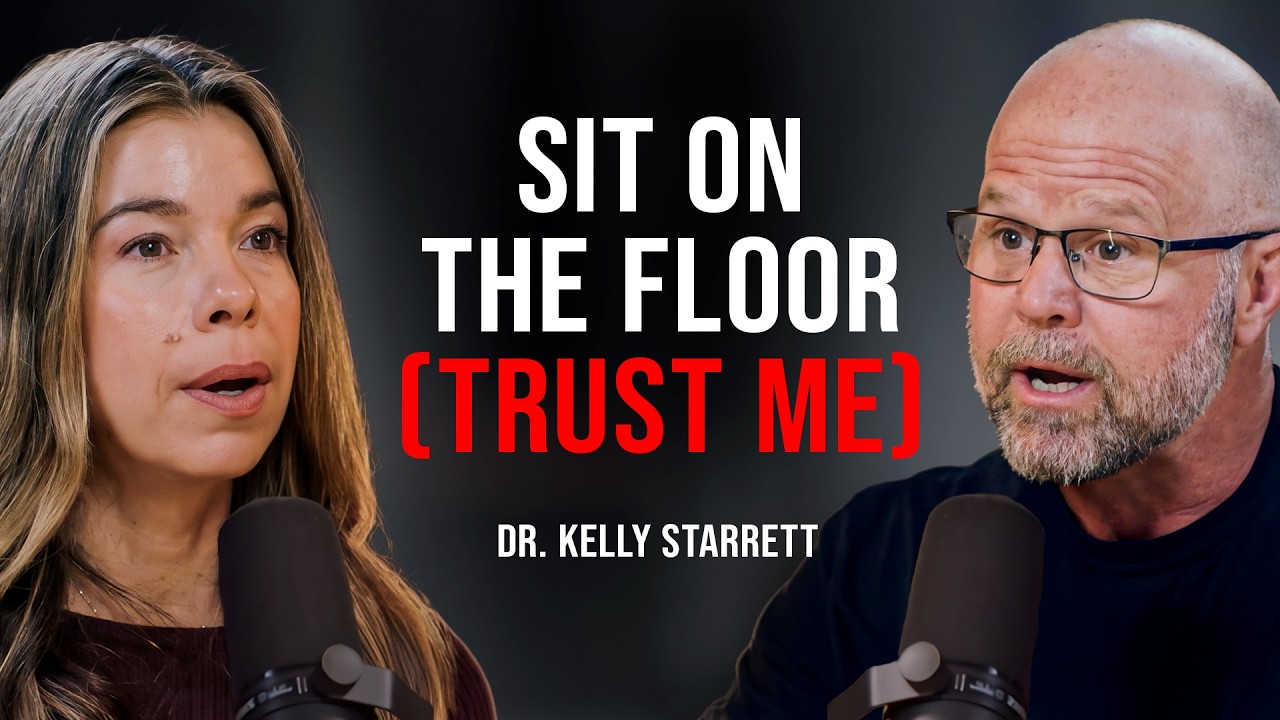
Video summary
Dr. Kelly Starrett presents a holistic approach to health that redefines pain not as a sign of injury but as the body's request for change regarding lifestyle factors like stress, sleep, and nutrition. He advocates moving away from fear-based reactions to discomfort by utilizing desensitization techniques such as soft tissue work, isometrics, and breath control to signal safety to the nervous system before attempting heavy loading. This philosophy extends beyond mere injury prevention; it frames daily movement preparation as a skill-building ritual where simple "spin-ups" and fundamental tests prime blood flow and wake up the body, allowing individuals to operate from 40% capacity rather than starting from zero every day. By addressing issues like excessive soreness through proper nutrition and mobility drills instead of viewing them as necessary for progress, Starrett encourages a mindset that prioritizes full range of motion and tissue health over raw metrics or rigid training checklists.
The core of this healthy lifestyle involves integrating essential movement patterns into daily life to prevent the atrophy caused by sedentary behavior and specialized routines. For those with desk jobs or limited mobility, simple actions like touching bra clasps behind the back or performing morning breath work can restore shoulder function and trunk compliance without requiring a gym membership. Starrett emphasizes that strength training should be viewed as coordination under resistance rather than just capacity building, aligning exercises with real-life contexts such as aging concerns, hobbies, and family activities. The most sustainable approach involves finding enjoyable movement within a community—whether through dance, frisbee, or kettlebell swings—which naturally maintains joint health while fostering social connection. This balance ensures that the body adapts appropriately to loads without triggering fear responses, ultimately serving life rather than dominating it with intense, demoralizing grinds.
To achieve long-term vitality and pain-free living, Starrett recommends breaking up prolonged immobility with frequent "movement snacks" like stair sprints or playing with pets, which significantly reduces mortality risks even for non-exercisers. He stresses the importance of maintaining end-range positions through activities like shoulder hanging or downward dog to keep the body's movement pathways wide open into old age, while also addressing biological shifts such as menopause-related stiffness or hormonal changes from concussions. Recovery strategies include deliberate heat exposure via saunas or hot baths to boost blood flow and growth hormone, alongside adequate sleep which remains the top tool for injury prevention. Furthermore, he critiques the early over-specialization of youth sports that leads to burnout and injuries like ACL tears, urging parents to prioritize diverse physical experiences, sufficient rest, and unstructured free play that develops fundamental motor skills before introducing formal strength training later in development.
Read the full video transcript
Pain is a part of the [music] human
experience and we'll mask it and
certainly medicalize it, but you know,
[music] and we really haven't done a
good job talking about it. Pain doesn't
always mean you're injured. All of the
pros, everyone I've ever worked with is
basically like, I've never been 100%.
Pain is a request for change.
>> Let's translate that to the opposite of
exercising and moving to what most of us
are spending, [music] I would say, the
majority of our day
>> doing, which is sitting. Walking 8,000
steps a day reduces all cause mortality
by 51%. That's a pretty good bargain.
>> You have this great quote, "Train for
life, don't live to train." So, where do
we start?
>> The First Order business is
>> Welcome back to the podcast. I'm really
excited to be sitting here with Dr.
Kelly Starret, who I kind of sounds
cheesy, but like I mean this is this is
10 years in the making, I feel like. I
mean, I've known about your work for a
very long time. And it really wasn't
until I started to get into CrossFit
training that it kind of popped back up
into my my head and my world.
>> Why Why is that? [laughter]
>> Why is that? I mean I mean, you're a
legend. You're a legend, Kelly. So, I'm
super excited to have this conversation
with you and um we were kind of chatting
about where to start because there's
it's a really hard decision where to
start. There's so many fun things to
talk about, right? So many fun things.
>> And we're in the we're in what we're
calling
>> the beginning of third wave of fitness
and strength and conditioning. Like
first wave, you remember, was like power
nut malt malt nut power bars, bad hearty
monitors. Second wave is just this this
fever dream over the last 20 years of
like mass integration and technology and
YouTube. And now we're finally saying,
okay, well, what can we discard and and
really what does matter to us? And I
think uh it's really an exciting time
potentially where we can say, "Okay,
that was some craziness." We live in
these very decorative rooms like your
grandma's room with all the doilies.
It's like oppressive and you don't know
where to start or where to sit. That's
where we've just come from. So now, how
do we take that pastiche of strength and
conditioning, fitness, body composition,
bodybuilding, and then say, "Well, where
what's important for your kids? How do
you have this body that you trust
doesn't hurt?" It's really It's a good
time.
>> Yes. What lessons have we learned? Um, a
body that doesn't hurt. That's kind of a
great place to start. I mean, I I have
this question about common mistakes that
I would say people that are like myself,
you know, we're intelligent,
very much committed, motivated
exercisers,
and yet we still have this pain and, you
know, we're working out with the pain.
What are some common mistakes that you
know myself and others that are like me
are making?
>> Let's frame this first that pain doesn't
always mean you're injured, right? We
want everyone to recognize pain is a
request for change. That's a great place
to start. And so you can use it a little
bit like a check engine light. So when
your knee hurts after that run or that
thing you did, don't panic. It's giving
you it's asking, hey, pay attention. And
that can be modulated by a lot of
features that people are starting to get
their hands around. Oh, you're super
stressed. Went drinking last night.
Didn't sleep right. How's your nutrition
as starters? Much less, we haven't even
talked about your range of motion or did
you warm up or did you cool down? Did
you just redline like an elite athlete?
Because we have access to that now and
then sit at your desk the rest of the
day. Sort of not really having a good
adaptation response. So, when we begin
to pull that, I think the first thing we
can start to say is, "Hey, let's become
curious. Let's not catastrophize." Cuz
it really is like what we expect is I'm
going to have any pain. It's like when I
was 15, my back hurts. It must be
rabies. It must be, you know, I've I've
tweaked myself in some way that
potentially is going to be really
detrimental and never never figure it
out versus, hey, my body's asking for
some input. What tools do I have? And
when do I even begin to think, do I need
help or not? Because when we ask all the
people we work with, who's painfree?
very few hands go up. And so what we
have to do is start to say, okay, maybe
pain is a part of the human experience.
And we really haven't done a good job
talking about it. We've got a good job
masking it and certainly medicalizing
it, but you know, what about your kids?
When your kid comes home after soccer
and she has a painful heel or painful
knee, like where do we begin to not
freak out and yet self soo a little bit?
I think that's a really wonderful place
to start.
>> I for myself, you know, I I get this
sort of nagging pain. I mean, I have one
in my shoulder and I have a little bit
like in the tendon in my forearm and
it's not enough that it's like an injury
where I can't work out.
>> That's right.
>> But it's enough where I do feel more
limited in my workouts. And often times
I'll, you know, with I work with a coach
as you know, she's amazing, Zia War.
But, you know, she'll say, "Okay, well,
let's
>> let's do a different movement today
because you're feeling a little bit more
pain if you're doing, you know, for
example, like heavy deadlifts."
>> Yeah. But, you know, for someone that
has their nutrition pretty much dialed
in to the for the most part and get
enough sleep, you know, so like some of
the the pillars of health are there and
yet you still have the pain like where
where do you start to look like first?
>> What a great great entree. You're like,
I think I'm doing it right. So, when I
work with people who have persistent
pain, chronic pain, which by the way,
nearly all of my athlete friends, um,
all of the pros, everyone I've ever
worked with is basically like I've never
been 100%. Maybe when I was 10 years
old, I was 100%. Everything else is
working around some discomfort or a
tweak. And if you ever play a sport, I
mean, god forbid, you're going to get
tweaked, right? The gym is actually the
safest place on the planet to really
control the variables. So what we can
start to say is well hey the first order
of business is I don't care what it is I
just don't want to have it right just
get me back to and we can do that
through a lot of simple tools called
desensitization
because as everyone knows thanks large
part to this podcast too your brain does
not inter your brain interprets what's
going on with your body your your your
elbow isn't screaming pain your brain
thinks that that is maybe a threat
signal or it's interpreting this this
symptom, this information as threat. And
so what we want because we have seen all
the time where someone's like limping
around and some beautiful people walk
by, the limp goes away, you know, and
then they're limping again. And so you
can really override these things. And if
you've ever been in a fight, have you
ever been in a fight?
>> Like [snorts] a physical fight?
>> Yeah. No.
>> Oh, okay. So the dirtiest secret about
fighting is you don't feel any pain
while you're fighting because your brain
is like that's not important right now.
You're going to feel pain after the
fight, but during the fight, less pain.
So does the activation of the
sympathetic nervous system play a role
in that?
>> Yes. Yes. And so we can override these
things. [gasps] What we try to say is,
hey, what are the tools available to
you? Could you scrape? Can you cup? Can
you massage? Can you do some isometrics?
What about some percussion? Or there are
some simple ways we're like, okay, feels
better. Let's move. And it creates a
window of opportunity for us to move,
which is the same tools and techniques
we use for all of our teams, right?
We're still going to go out and march.
When we define injury, which is
something clever, is that hey, it's not
so bad that I need to go get help.
That's a that's the marker where
suddenly I can't occupy my role in my
family, can't do my job, right? If your
back hurts so bad, you're not going to
work. That's a medical emergency, right?
All the red flags, night, sweats,
dizziness, fever, vomiting, nausea, that
seems obvious. Your child has a fever.
She's not, you know, doesn't need a
voodoo floss or knee. Hey, there's a
clear mechanism of injury. My I tweaked
my I felt a pop. There's a bone sticking
out of my leg, stepped off a curb. Okay,
those are clear indicators that I need
to activate the e emergency medical
system. Everything else is a feature of
training and nutrition and sleep. In
fact, we want to treat pain just like
loss of range of motion, just like loss
of force production. It's just another
sort of data like, oh, HRV is off,
little pain. We should see those as as
similar in terms of the information they
give us, right? Except, you know, you
can have crappy sleep and poor recovery
and still, you know, but that's
annoying. So then we can ask, well, hey,
is there some decongestion that could
happen in these tissues? Well, suddenly
we're like, oh, I understand why sauna
and walking and compression and normate
boots and maybe I use an NMEES device or
lymphatic drainage or voodoo. There's a
lot of things we could do to facilitate
moving congestion, moving swelling up
the chain and clearing it because a
congested tissue like you know someone
has OA in their knee osteoarthritis and
there they haven't done anything but the
knee has reacted to the loading and
maybe the nutrition and the sleep and
whatever and now it's swollen and so
what we're thinking is hey the typical
person can run around with a congested
tissue and that congestion can rate
limit healing but it also limit blood
flow.
But also it can very much be the driver
of sensitivity. So you can sensitize a
tissue by having kind of congestion in
an old tissue. Then we could ask, well,
what about blood flow? Did it get better
once you warmed up? Cuz yeah, once you
start to warm up, starts to feel better.
Ah, that's probably not a problem.
That's, you know, the brain saying, hey,
let's get some some blood flow. How do
we take the garbage out, bring the
groceries in? And the last thing we say
is, well, what about the range of
motion? Because that never gets checked,
right? Well, I can do what I want to do
well enough, but what if it was that you
had a big chunk of missing range of
motion? Well, suddenly we could improve
that. You can improve that while working
on these other systems. And by the time
we've worked through that little rubric,
chances are your brain's like, "It's not
a problem. Let's go lift."
>> All right. So, when it comes to foam
rollers, I mean, it's something that
I've heard such mixed data and evidence.
And I say heard because I haven't really
dived into the literature myself to to
look at what it says, but you've got
real world experience. You know the
science. Um, can foam rolling help you
work through, you know, a painful Yes.
point. How do we do it? Like what should
I be doing?
>> So, let's start with that. Uh, foam
roller doesn't solve all the problems.
If it solved all the problems, there'd
be no problems. We've gotten that
message, right? But uh you may need a
smaller ball, you may need something
harder, you might need something that
fits your body a little differently.
There's no We always talk in a systems
approach that if laying on the ground
and rolling back and forth fixed knee
cancer, we would have fixed knee rabies
already. Like we would have solved these
problems.
The research is clear though that can
help with range of motion. It can help
with blood flow. It can help desensitize
painful things and pretty soon if we
haven't defined our terms, it can be a
little sticky. So if I have you laying
your quad, your quads on a roller and
then contract and relax, that's a very
sophisticated thing we're doing there.
We're teaching your brain it's safe to
develop force in this position. But
that's just really a sneaky version of
an isometric again, right? Um, so
suddenly we realize that, you know, if I
give context to some of the soft tissue
work I'm doing instead of just laying
down and hoping I'm pressing guess, I'm
a little bit more thoughtful about, hey,
I'm going to work above an area of pain,
work below an area of pain, recognizing
that maybe my calves or my quads could
be contributing to knee pain. We find
that when people get enough of a dose of
something, we tend to say, "Hey, let's
limit this to 5 minutes per muscle
system so you don't overdo it, but we
can actually get in there long enough
that we can make some change. That seems
to make a difference." Um, if it's so
painful that you're not breathing,
you're just signaling threat and
contracting all the time, that's no
good. So, one of the things we like to
say to people is, "Hey, let's make sure
you can take a breath while you're doing
that." So, there two kind of rules that
you're never going to overdo it is if
you can breathe. It might be really
uncomfortable, but you should breathe.
And number two, you should be able to
control. You should be able to contract.
So if you're overwhelming your nervous
system where you can't have any muscle
control, maybe that's a little bit too
much. Um, and then, you know, keep in
mind that uh there's a lot of body
workers in the world. So either they're
scamming us because there's so many
massage, Thai massage, shiatsu, like or
there's something to that. And even if
we just said, "Hey, how about the whole
thing is just about low side of control
that you get home and you're like,
"Something hurts and I have some agency
and control over it." Making long-term
tissue changes. We got to load. We need
to move. We have to, you know, but this
is a powerful tool to get out of pain,
restore range of motion, right? To
improve blood flow, to downregulate. Um,
we like to do the soft tissue work in
the evening, for example. So number one,
you we're already sitting on the ground.
But if we do engage in 10 minutes of
soft tissue work, we found that that had
a huge parasympathetic input like a
massage. You no one gets up off the
massage table and like let's fight. Just
doesn't happen, right? But a little bit
of self massage, you're signaling to the
brain it's safe. You're relaxing. You're
touching things that are tight or
restricted or restoring how tissues are
sliding and gliding. And then we'll get
the rest of it tomorrow. And what you'll
find is that your brains is like we sit
on the ground, then we do the soft
tissue, then we go to bed. Now you're
starting to be set up a habit. Now you
start to downregulate your breathing
changes. That's really really powerful.
Soft tissue work is one feature of the
whole system. It's not the only feature.
Isometrics are really powerful, but
what's most important is that we have a
range of motion we're trying to improve
and we're doing test retest on that
range of motion. Did that restore? Or
you mentioned DOMS to lean on some
muscle soreness. Work out really hard.
You went for a run. That running is
getting those tissues sliding and
gliding again, right? Just restoring
those free nerve endings, getting fascia
to move.
I submit that and the research supports
that if you do soft tissue work after
heavy training, decrease your doms. So,
is that valid to have less soreness and
pain after training? Seems good to me. I
liken that. I'll point two resources for
you. There's I think it's flexibility
research incredible Instagram follow all
of the science all of the research
really you know very clear and then my
friend Brent Brookush the Brook Bush
Institute has written and aggregated so
much research about the science of all
this that I want to talk about how we
have integrated the science into actual
practice that's my expertise but if you
really want go to the Brookbush
Institute there's So much research there
about you know what these things do, how
effective they are, interrator
reliability, etc., etc.
>> Can you tell me about this misconception
that you need soreness to have had a
good workout?
>> Oh, right.
>> I mean, I I had that mentality for I
don't even know how long. I mean, I
still battle it. I'm still like, where
was it? [laughter]
>> I'm not sore enough. How about this? you
train and you actually felt good and
then you could I mean move
you everyone who's a beginner you're
going to be sore sorry sorry not sorry
you know um you're going to get off the
toilet and you're going to you know
you're going to have you're going to
curse out your coach and these squats
right but what we start to see is over
time that soreness gets in the way of
your performance right decreased force
production you the goal is to have this
right adaptation response where we can
still go out and perform but not be so
brutalized and sore that we're surprised
and it diminishes us. So, you don't have
to get sore, but we want to have enough
of a stimulus to disrupt homeostasis.
And your mileage may vary based on your
nutrition. I recently found out um I was
needed to get on an iron supplement. Me,
right? Isn't that interesting? Curious
was not taking enough omega-3s. you you
recently were like, "Hey, probably need
up that." I was taking my daily dose, my
omega-3 index, not sufficient. Get on
the iron, get on the omega-3s. Guess who
gets less sore in his training? This
guy. Because uh you know, we can So
there what my point is that there's a
lot of things we can do to mitigate
soreness, but just we're going to do a
bunch of work until you're sore. And I
think that's progress. That's not
progress,
>> right? And also perhaps you're just
using, you know, muscle groups that you
don't often use, right? I mean, that's
>> Yeah. The other thing um
>> and and more importantly, did all that
soreness change your bone density? Did
you get stronger? Like what what are
your metrics? Like you're just sore? You
did a bunch of work and are sore. Again,
there's no you haven't moved the needle.
You just created a lot of noise,
>> right? Uh speaking of soreness, the the
other thing I wanted to ask you about,
and this is a problem I've had for many
years, but I also know at least two to
three other women who have the exact
same problem. And no, it's not frozen
shoulder. It's overhead weight. So like
having like you know if you're doing a
snatch I guess right or like doing
weight overhead whether it's dumbbells
or a barbell or anything that's you know
weight and it having a having a neck
problem with it like not while you're
doing it so much but like the next day
that that's really persistent. So um
have you do you have any idea is this
like a r a mobility problem? Do you know
what I'm talking about? Have you heard
of this?
>> Well, first of all, let's say that
there's very much technique involved
with putting weights over our head as
effectively and powerful as we could. I
know you have an excellent coach. Number
two is that we might become curious
about the fact that, hey, I have tissues
that are really fibroic and stiff. Is
there anything we could do about that?
So, if we just played press and guess,
traps feel tight afterwards, like let's
get you on a roller, let's get you on a
ball, let's start working. and see if we
can restore motion to these segments and
and then run our test again. Does it
make us feel better? Then we could also
ask, do you have full range of motion
overhead? And it could be that you're
working in positions because you have
incomplete overhead position. You can
still do it and it doesn't hurt, but
you're not doing it as efficiently. And
maybe this signal is one of those things
that you're we could improve that.
>> Okay. Yeah. Yeah. I mean, this is
something like even back when, you know,
>> and I believe in serial anecdotal
empiricism, which is what you described.
>> Yeah, it is. And and it's even with
lighter dumbbells, like if I do, you
know, eight eight with each hand. So,
I'm 16 total overhead presses, you know,
and it's like I I've been avoiding the
overhead press because of fear of
activating. And it is the traps that get
sore and sometimes it even spasms. But
um it's it's something that I've now two
friends, two girlfriends that have the
exact same problem where they can't do
overhead presses.
>> And how reasonable that you're like,
"Hey, I do this exercise and it hurts me
or makes me hurt or I don't feel good
afterwards. I'm a little afraid of doing
that exercise. That seems very
reasonable to me."
>> Well, the neck pain, I mean, it'll it'll
last. It'll affect my sleep. I mean,
then it's like this vicious cycle. So,
you know, and I've seen a physical
therapist about it and it's kind of
like, well, is it a compensation thing
where you're like, you know, like you
were mentioning, maybe I'm not as full
range of motion and so something else is
tightening up or I'm comp
overcompensating in some other way
that's not really being
>> beneficial. an easy way to start. So
number one is I would say hey let's
start getting you some hanging where
your arms are parallel over your head
and taking some breaths and do that and
let's see if we start to expose that
overhead position. As we get into
complex understanding of movement we
look at start position effectiveness and
finish position. So if I'm pressing
overhead and I'm starting in a less
effective position then it's really
difficult for me to end in a great
position. Right? That's why that
bottomup kettle bell press forces us to
be in a good shape as we press overhead.
But if I don't have complete overhead
position, my overhead position is here
or I have to internally rotate a little
bit, I'll achieve some overhead like
shape, but that's not full position. So
even if I'm pressing a barbell out here
where I'm not anywhere near full
overhead position, I would still check
this full overhead position. And it
could be that we just don't have as
efficient access for whatever reason
because you've had this amazing life and
now this movement is highlighting
something for us that we can become
curious about
>> cuz you should be able to
>> I'm able to do pull-up assisted pull-ups
doesn't hurt, doesn't flare up with the
with that hanging. Uh I'm going to do
more of it. I do hang and it feels good.
I like
>> No, if you're doing pull-ups, you're
hanging already. You're there. You're
>> I do I do pull-ups and I don't have that
problem. So, it's definitely,
>> you know, we can we can constrain it.
You know, if I have you put your thumbs
backwards, then the shoulder by
necessity is going to be in a
mechanically sort of more effective
position where I'm going to have better
features of stability. The the capsules
wound up. The mechanic of pressing is a
little bit better. And in this
situation, I might even have you, you
know, when anyone has pain with a
problem, an area or movement, there's
two things we can always do. We can
always pause if I have a painful range
or B, I slow down. So, we can slow this
down a little bit and ask you to show me
that you've got control signal that it's
safe to the brain, etc. instead of sort
of I'm overhead, right? And I didn't
really touch some of those overhead
shapes and really use it as a
diagnostic. But in this situation, I'd
be really curious. Again, let's look at
your range of motion of that shoulder. I
bet that there's some rhyming things
that maybe I've got a little restricted
because I didn't know and I'm doing all
the things and now I'm getting this
feedback that this position doesn't
always feel good. Once in a while it's
fine, but if it's happening all the
time, we
>> it's happening. Yeah. And become curious
about it.
>> How how would a person at home like
let's, you know, I'm talking about my
problem, but other people have their
fill in the blank problems.
>> If only there was an app that had all of
these simple movement tests you could do
at home.
>> And that's what and that's the app that
you you have. What's the name of that
app again? It's called the mobility
coach.
>> The mobility coach.
>> And the reason what we're trying to do
is so let me I'll lay out for you real
quick built to move. We've got really
simple
pedestrian assessments and some range of
motion. These are some things. So entree
in the app has really sophisticated self
assessments but easy to do, easy to
understand. We're going to look at
fundamental ranges and you should see it
in the cont. You'd be like, "Oh, I
understand why we're doing that." May
maybe you don't understand why we're
looking at rotation in some of these
things but there are components there
and that all belongs in the hand of the
user. Then we have a whole host of
professional courses where we're much
more sophisticated about complete
incomplete hands-on assessing. But we
don't need that for the average person.
We should be able to know what our
movement minimums are and then start to
identify opportunities to work and
restore those positions because that is
really part of the conversation that
gets lost in search or in in service of
performance and wattage. We're not
looking at did you express normative
ranges even though the classic strength
and conditioning really does ask us to
have full range of motion. That's why
strengthening classic strength and
conditioning is all the same. Front
squat, back squat, lunge, pull-up,
bench. Those are all tests. I've been on
every continent except Antarctica.
Everyone knows what a push-up is. That
is our universal expression of shoulder
extension in a short lever position,
right? I don't need a bunch of tests. I
need to see how well and how much range
you have in a push-up.
>> I love push-ups.
>> My my favorite workout to do anytime I'm
traveling is the Cindy workout.
>> Oh, isn't that so simple? I've done
Cindy more than any other workout in the
history of the world. Everyone, Cindy is
the best workout.
>> We should explain what that is to
people.
>> So, it's five pull-ups, 10 push-ups, 15
air squats. You can do it on the minute,
you can do it as many rounds as you
want. You have 10 minutes, you have 15
minutes. That body weight volume is
excellent. Put a bike on it for 2
minutes, do a round, put a bike on it,
do three rounds. We call it Cindy-ish.
And pretty soon you can rinse, wash,
repeat that combo forever. My favorite
Cindy-ish workout for me is like if I'm
in my, you know, like I said, I'm
traveling, I'm in a hotel, is I'll I'll
do the bodyweight squats and then I do
push-ups and then V-ups and there there
it is.
>> And what you've just described is in 20
minutes.
>> 20 minutes, right?
>> You've got tons of exposure, no
equipment. Wonderful. Wonderful. this uh
we have so many different things that
you mentioned to get into in terms of
range of motion, you know, the the blood
flow, especially with the tendons, you
know, not a lot of blood flow, the
tendons, but maybe we can start there
with this r range of motion and warming
up, you know, cuz I mean, so I work with
my coach and thankfully, you know, she
knows what she's doing. And so if I
hadn't had her, I wouldn't really have
known the difference between warming up
and stretching. M
>> um I certainly wouldn't really
understand what the goal of warming up
is and and you're going to educate me
even more, but just from learning
through experiencing what she tells me
to do, I've realized that it's like,
okay, first thing, you know, I'm just
kind of like I do 2 minutes of just
getting my heart rate up first thing.
So, it's either rowing or jumping rope
and then [snorts] after that 2 minutes,
then we kind of get into more range of
motion. You know, if I'm doing arms,
I'll do passroughs with a pole. Um or
we'll do um you know body weightight
squats first if I'm going to be
squatting that day and then we go
barbell only squats and I eventually
like you know gradually get to the
weight that I'm eventually going to do
but I'm warming up. But I wouldn't have
known
to do all that if I was just kind of
working out on my own.
>> That's crazy. H how did we fail Dr.
Patrick, where you're like, "Hey, I'm
not I'm about to go do this crazy thing
and maybe I just spun on the bike for 10
minutes and I looked around." We just
haven't really taught people, hey,
here's what it looks like. And
theoretically, we should have gotten
that in high school when we were still
engaged in sports, competitive sports,
before be we all became wreck athletes.
But what you see is that there's a real
opportunity to help people feel better
and prepare for the movement. And don't
get me wrong, I think you should be able
to sprint down the street, grab a baby
out of a burning, you know, building and
fight off a tiger like that. Probably
not the best expression of your
physiology in those moments, but we
should we should be able to do those
things cold, right? But when we start to
look around, we start to see that most
people aren't treating their warm-up as
a chance to feel better. who am I today
as I show up at this gym for this thing?
Because your range of motion is a little
bit of a moving target and it's like a
credit score, one of our friends says.
And so you're sort of touching base with
how tired am I? How springy am I? What's
going on? You're getting to know this
carcass today, right? And that might
mean, hey, I you know, I just you are
flying all over the place. Suddenly
you're a little bit stiff from that
plane ride. You your squatting doesn't
feel the same. So, we're trying to
remind the brain of fundamental movement
patterns. We're trying to get hot and
sweaty. We're trying to wake up the
nervous system. You are doing this
jumping which is activating. You're
getting hot and sweaty. You're shifting
blood. There's a lot of things that can
happen. But also, we see that this is a
great opportunity to add in some
movement. And wait for it, play, right?
You can explore positions and shapes
safely here. Tell your brain, if I end
up in this shape later on, it's going to
be safe. some of those path through
passroughs there. We're starting to see
rope flow kind of some of these physical
culture ideas from people like Ido
Portal, Fighting Monkey. We're bringing
those things back into our warm-ups. And
a simple way to ask this is if we
treated your warm-up, your workout like
it was a fight. You and I are going to
fight. What does our warm-up look like?
It does not look like I'm laying on the
ground doing some foam rolling, right?
like you're jumping rope and getting hot
and prepping yourself and doing some
hypoxic work and breathing and
activating and integrating with the
people you're like we're about to fight
like that's a really nice sort of rubric
for am I prepared or have I use this
warm-up as an opportunity to be like I
am not good today I'm just going to take
it easy right I can use as a self
assessment so that's what we try to do
in the warm-up it sometimes it gets a
little bit watered down as a coach I try
to not do the same warm-up every single
day I try to keep my athletes guessing.
I want them to be entertained. I want
them to uh be curious. And that's a
really opportunity to put some of these
things we see in the internet. Hey, that
looks like fun. Let me try that as part
of my warm-up.
>> How much does doing, you know, a warm-up
that's properly a warm-up play a role in
helping with injury prevention? that
[gasps] well I think from a simple idea
that we have a chance to prime and
remind our brains that movement is a
skill right I I sometimes we have like
we're like all movement is good right it
it's all like the movement optimists are
like it doesn't matter what you do and
we're like well from a from injury which
is not what we're trying to do we're
never on this track of hey let's warm up
so we don't get injured I think that's
kind of a fool's errant and like it's
not really inspiring. Don't get injured.
Like I'm not injured. You know what's
going to happen that I'm going to get
injured?
>> Instead, we think, hey, we can actually
get more work done. We can feel better
as we do it. We have less discomfort as
we do it. And what we tend to see is we
don't get as stiff afterwards. And so
often times when we're trying to
compress a lot of really dense work into
a little time, we don't leave permission
for us to really get tissues
hyperprofused, like blood flow ready to
go. If the first motion you do is push
the sled and you put, you know, tear
your Achilles, I'm like, well, that
tissue wasn't as prepared maybe as it
could have been. Maybe we could have
mitigated some of these aches and
tweaks. Maybe some of those insertions
of those connective tissues weren't so,
you know, fryable and dry. Just like the
rotator cuff, for example, it just takes
a minute. It's like hardpacked earth.
And if you just take a, you know,
exercise which like a hoe is blasting on
hard packed earth, the water doesn't
really soak in. takes a second for those
tissues to you know to really become
well perused and then you might have
better range of motion and more
important you'll have better power
better work tolerance and then
afterwards there's all these models
exist already like the Soviets used to
say if you leave the gym stiff you're
going to be stiff I think if we if we
take a look at some of our movement
traditions people have been training and
thinking seriously about this for a long
time but we have sucked the joy out of
the and the potential out of
potentiation out of warm-up for sure but
to your point when we're dripped in
sweat. So, I coach at at Cal Berkeley
and I travel with the women's water polo
team. So, I'm their performance director
and uh our our joke is like I'm the
health coach, right? And sometimes that
means I hand out snacks and sometimes
that means I'm doing mobility work. I'm
helping them manage pain, but I also run
the warm-ups and sort of amongst other
things. And we'll be battling another
team. that team has their coats on and
they're real stiff and not really
trained to each other. Our women are
down to their sports bras. We are
battling and fighting, ready to go. And
I'm like, which team do you want to be
part of here? Right? And so we can
really use that warm-up time to connect,
play, integrate, have fun, and perform
better because those tissues are better
ready to go.
I sometimes do a really short I don't
have if I don't have a lot of time I'm
traveling or I have to get to a podcast
or something and I know I need to get
like my blood flow up for at least 10
minutes like it's important for me
cognition
you know it doesn't matter what I do
>> changing your state I'm transitioning
into now going from brain to
>> you know meat
>> right um but sometimes I'll get on my
Pelaton and I'll do two backtoback
Tobatas so it's like a it's 10-minute 2
to1 ratio, 20 seconds on, 10 seconds
off, 30 second recovery in between,
>> but I don't warm up before I get on that
bike. And I do that and and what I'm
hearing from you is like even that type
of, you know, hyper profusion as you
called it, like where you're getting all
of a sudden you're going from nothing to
boom, you're getting that blood flow up,
man. You're going hard. Um, needs a
warm-up. Well, what we could start to
say is, are we trying to meet all of
your movement needs
only by the time we get there? So, what
we can start to say is, well, what does
the rest of the day look like? Because
if you're just going from sitting to
more sitting and we have a little like
that's already great. You're you're
getting your heart rate up, you're
starting to breathe. We could we could
put in breath holds there. We could do
hypoxic work there. We could we could
you know you just taking the resistance
out and going fast could be a really
great way of you know priming yourself.
The I think the key here though is what
if we had a little movement first thing
in the morning. What if like we do a
thing that we kind of give people three
options. We're like, "Hey, as a place to
start, I would like you to do the hip
spin-up, the shoulder spin up, or a
breath spin up before you leave the
house." Because if the day gets away
from you and you can't train or you
can't exercise, we want to have said,
"Well, what does a physical day look
like for a person?" How do we get more
movement in throughout the rest of the
day instead of just saving it up? Cuz
what I'd really like to do is recognize
that you're a busy working human and
that if we had a little bit of hip prep
in the morning, we worked at a desk that
gave us movement choice. Maybe we sat on
the floor, maybe we sat at the computer,
we walked around a little bit at lunch,
then by the time I actually got to my
workout, I'm not going from 0 to 60, I'm
going from 40 to 60 because I've
prepared my body a little bit more.
Maybe that's a great way to sneak it in.
And the rest of the thing is, hey, when
we have the opportunity to be do a
better thing, fine. Sometimes I'm at the
airport and I grab a fruit, you know,
bucket, you know, a $17, you know, cup
of grapes and two horrible eggs. Like,
that is really not great food, but it's
going to do today and we'll get the rest
of it tomorrow. We're not worried about
it. The main thing is I love that you
are thinking about this as a physical
practice. And hey, there's nothing wrong
with taking the first five sets under
the bar and taking your time and just
moving slowly and adding weight. Hey,
you don't have sometimes when we have
time and luxury to play and move and
prep, let's do it. If not, let's just be
a little bit more conscientious about
it.
>> Awesome. Um, what is this hip like if
you're if you're drawing you talked
about this hip mobility or hip prep like
what what's what does that look like?
>> Well, number one, we wanted something
that you could do. Imagine like again
homage to our the people who've thought
about critically about some of these
things. Uh yoga has sun salutation. And
what I thought was what a great practice
if everyone did sun salutation every
single day before they left the house.
They've touched some end ranges. They
reminded their brain. They had to
breathe. They had to rotate. They had to
weightbear. They had to move their
spines a little bit. Right? That's
great. But that sun sitation sometimes
comes entrapped in a little bit of too
much asa, a little bit too much
spirituality and sometimes our athletes
are like really this doesn't feel
athletic enough. So I was like what
could we do to sort of simulate that?
And that's where we I came up with the
idea of the hip spin up which was
fundamental positions of flexion and
rotation of the hip. We touch some
endrange tissues. We throw some
isometrics in. We make your spine work
with your hips. Just groundbased. Don't
need any equipment. can be scaled and it
gives you a touch of like, hey, what is
am I at least at these full ranges of
motion for a second today because I
think what ends up happening oftentimes
is that we can live in a world where
we're not asked to actually do all the
things our bodies can do and now we're
having to be like, okay, here's your
vitamin, here's your X and such to make
up for the fact that we're not really
doing the things we need to do with our
bodies. What is a what does a simple hip
mobility test look like to
>> Well, the the question here is um you
know what should the hip should what
what should the hip be able to do,
right? And and I say hip as in the
chain, right? But that's the big primary
engine. The the spine is the first
engine, but then we have these big
primary engines of the hips and
shoulders. And what's interesting about
that conversation is that if I ask
people who are very sophisticated about
their running training or their
nutrition, I'm like, "What should the
hip be able to do? What's normal? What's
what's far from normal? What does every
physician agree we should be able to do?
They have no idea. What what's normal
hip flexion? Bring your knee to your
chest." Well, this was really where we
recognized that one of the problems that
we had or opportunities we had is to
make these range of motion tests part of
the training so that I could the
stimulus for adaptation exercise was
also the diagnostic tool, right? So I
can understand what's going on. So
easily we all should be able to hip
squat hip crease below the knee, right?
That's a really simple test. And if
you're struggling to do that, tells me a
little bit about your readiness today.
And again, you could be stiff, you could
have old injuries, you could have, you
know, does, there's no judgment there.
Um, if you stand on one leg, you should
be able to pull your other knee up past
90°. And most people would struggle for
that. Uh, we have a simple test in the
last book called the sit and rise test,
which everyone has heard of now. Just
lower yourself to the ground,
criss-cross applesauce, right, without
falling, and then without putting your
knee down or hand down, pop back up. And
so what's nice about that is that that's
not even a full range of motion test.
It's not even uh doesn't require that
much strength, but it's a good indicator
that you may be missing some hip
flexion. Being able to fold forward to
shift your weight is really the the
limiter there. So if we can begin to
create some some fence post, some
guidelines for people to understand
what's more normative or not around
their own range of motion, then you can
keep an eye on it. and the the sit and
rise test. Isn't there some data on that
with associations and longevity?
>> Yeah, basically imagine that all of
these things are proxies, right? As
you've talked about, like I don't really
care what your grip strength is. I care
what you do with that grip strength, but
if you're doing a lot of fun stuff with
your grip strength, your grip strength
is going to be good. So, it's a proxy
for all these other things, right? And
that test tells us a lot about your
movement choice, your ability to solve
movement problems, your ability to, you
know, modulate your your balance. And so
it may not be that that's the end all
beall. Put a hand down, you could
probably still be a hundred. I mean, we
probably have some aunties in our lives
who are over 90 who've never done the
sit and rise test, never done keto,
never went to a high-intensity exercise
class, but there there's something about
their lifestyle. We just got back from
Japan. We're sleeping on the ground.
Cultures that toilet on the ground,
sleep on the ground, eat on the ground.
Fall risk in the elderly drops to almost
zero. Osteoarthritis in the hips and low
back drops to almost zero. There's
something about maybe we should touch
these shapes once in a while. And then
that makes it so it's on the map of the
brain. We're touching and loading those
tissues. They the brain doesn't start to
pair down some of that movement as as
irrelevant. So really the question is
what should I do every day? And then now
we can ask the next following questions.
What are essential movements in strength
and conditioning which is really just a
formal movement practice under load?
>> Yes. And that that that is my next
question because I recently did the sit
and rise test with someone who is in
good shape. They work out and I had no
problem getting up and doing the sit and
rise test and they did.
>> That's right.
>> So how can someone be healthy out? I
mean, you know, when I mean workout, I
say I mean like strength and
conditioning both, right? They're
they're doing running, they're doing
squats, deadlifts, and and have trouble
with a sit and rise test.
>> It's a great question. [snorts] What it
hints at and what I'd love is get to a
place where you and I have our own ways
we like to train, right? You just you
have things you're like you're a big
power cleaner and deadlifter and rower.
You're you know, do these hard things.
>> Power cleaning is the hardest thing. I
hate doing it but I do it.
>> It's almost like it's an Olympic sport
and you'll spend the rest of your life
working at it. Right.
>> Okay. So
>> that aside, [laughter]
>> so that aside,
>> what we can say is you have your way of
training our way things that we love the
way we like to move our bodies in the
sports we play. I should be able to take
any third party system and thrive there.
So if you go to yoga and you get your
butt kicked, like yoga is not crazy.
Yoga is just saying, "Hey, here's what
humans should be able to do with no
load, but we're going to hold these
isometrics and you have to be able to
breathe for a long time." Go to Pilates
class. If you're really elite, you'll
you'll spank Pilates. You might be sore
afterwards because there are some shapes
you don't spend a lot of time in that
are normative towards Pilates, right?
That are signature Pilates. But ideally,
we should take whatever you're doing and
run it through a blood panel. How do you
like to eat? Cool. I believe you. Let's
go ahead and check over here. And so
that third party validation is a nice
test. And what we often see is we've
compared
uh sort of the capacity of physiology
and we've confused that with choice
skill right coordination but I can
generate thousands of watts over here
but I'm not very coordinated or because
I've generated thousands of watts over
here it's cost me my rotation of my hip
or my hip extension. And ultimately, you
can do that for a while until you want
to learn a new skill, until that tissue
is somehow a little bit misused because
it doesn't have its normal ranges of
motion. And I think when we ask people
to sort of engage in some baseline
testing, then we can start to understand
inputs and outputs. And so, if I have an
elite cyclist, I'm working in the tour
to France, we don't really spend a ton
of time in hip extension training knee
behind the butt like a lunge. We are in
those shapes to make sure that we
restore power, keep the hip doing what
it needs to do. We don't necessarily
have to train in those shapes as heavily
as we might with an Olympic sprinter.
So, but we need to look at where is this
person able to put some of these
isometrics or some mobility work or some
soft tissue work to keep it, you know,
the sort of the window open because what
we're really trying to do for the
typical person, again, we're all
basically wreck athletes at some point
is we're trying to say, let's maintain
as much range as we can, right? Let's
and [clears throat] by that we'll say,
how do I maintain movement choice,
movement options? How do I pick up the
new skill? How do I have a body that's
free and unencumbered? [snorts]
>> I uh we covered this hip thing, but I'm
the shoulders is another kind of
obsession of mine because I do I do get
some pain and there's a couple of
questions I want to ask and one has to
do with the obviously the the ways to
assess shoulder mobility. But the other
is like you know I do work at a desk a
lot and we're going to get into desk
ergonomics people because that's also an
interest of mine as well as I know other
people are interested.
What can someone who is desk working a
lot but also who lifts you know what
what's I would say a common problem in
those individuals in terms of like their
shoulder mobility and what would be a
good you know ROI in terms of like
working your shoulder to reset it.
>> Yeah.
Uh let's take a look and we'll split the
upper body from lower body because it's
easy to go for a walk and we can
decongest right. The lymphatics are
built into our muscle system. The
lymphatic system is sewage system of the
body and they're it's bootstrapped into
our muscles. And so if we go for a walk,
that calf is acting like a second heart.
It's pumping. We're dumping all those
lymphatics through the groin through
that muscle contraction. And it's easy
to say, "Hey, let's decongest, right?
I've just I I ran. I did something and
now I'm just going to walk a little bit
more in the day." It's one of the
reasons, you know, if you fly on an
airplane, you get cankles. It's lack of
movement that's giving you those
cankles, right? That's congestion of the
tissues. Well, it's easy on the to but
if I say, "Hey, I'm going to need you to
get on this rower for an hour." You're
going to be like, "Bro, I'm not doing
that. Get on this assault bike for an
hour. Decongest." What? Just it's
impossible. And so sometimes it's hard
to get enough exaggerated cross pattern
motion and movement of the upper body to
decongest it the way we're working. So
what we can say then suddenly is, well,
what tools do I have available to me?
Well, number one, maybe a little bit of
shoulder motion where I'm touching some
fundamental shapes during the day.
That'd be easy. And that's an easy place
to start because it's, you know, for
example, it's easy never to have to put
your bra on in the back, right? That
would be a test of internal rotation and
some extension. That aptly scratch test,
all the the, you know, hey, let's look
at the if you do the FMS test, can you
get your hand behind your back? But if
you're not practicing and in those
shapes ever, it's going to be tricky.
And if you start loading the upper body
significantly the way you are, the way
the way we're kind of modern training is
has sort of influenced us. Remember that
the first thing the body does after
training stimulus is it lays down more
collagen. It makes the container
stronger to withstand. Now when it
starts to put the muscle down inside
that the the fascial connective tissue
containers are set up first the we have
a bigger engine frame then we can make a
bigger engine. So if you don't do
anything you're going to become stiff
and fibrodic like welcome to being you
know big squats I mean are going to make
your quads stiff if you don't if you
don't keep your eye on it. All that
running makes your can make your quads
very stiff right. So suddenly we can ask
around the shoulder, well let's make
sure that we're doing something to keep
an eye on this range of motion. And uh I
could hint at you could do something
like the shoulder spin up in the morning
which is just touching some fundamental
shapes with some arm swings. It's very
simple. Um you could do something like
David Wex rope flow which is super fun
and very easy to touch a bunch of
shapes. It's basically imagine like PNF
patterns which were this kind of model
of looking at how we load the shoulder
in this rehab that came out these
diagonals and rotation. And if you just
spin a rope a whole bunch, you're going
to touch a ton of rotation. You're going
to be in some of fundamental shapes.
It's really fast. It's easy. It's great
prep. Or we could go, you know, a step
further and say, "Okay, we we've trained
all day long. Now, we're going to hook
you up to this very sophisticated
neuromuscular device that's going to
decongest the tissues, but ultimately
we want to remind you that the body is
not fragile. It's designed to be loaded
and adapt forever. So, let's just at the
very least keep an eye on our range of
motion. And I just came from the airport
where I just got to see people put their
arms over their head in the scanner and
it's sort of a disaster, right? I mean,
they're just banana back inchely rotate.
Like, people just don't aren't very
confident in putting their arms over
their head anymore. But it's because
their life doesn't ask them to do that.
>> And how often I like like what how much
time do you think someone should spend
like myself who is desk sitting a lot
and many of us are and I do work out you
know but as you said I'm not doing that
throughout the day. So like you know is
there a couple minutes a day?
>> Yeah. I think I think we saw if if you
started this conversation about and you
could say hey I think my lower body is
the big problem. Let's focus on that for
a week. upper body is my shoulders are
really that's the thing I want to feel
better at. Well, what we could do is
almost say, well, what's let's look at a
day, right? That's maybe the the
keystone idea. And the morning, what
what did you do in the morning? Did you
just get up on the laptop right away?
Could we go for a five-minute walk?
Could we just get you engaged in a
breath practice? I mean, just getting
your rib cage moving through some
breathing like something even looks like
old school Wimhof style breathing or
oxygen advantage. just getting your
trunk moving and the the trunk wall a
little bit more compliant, you're going
to see your shoulder blades work better.
And if your shoulder blades work better
on your trunk, you're going to have
better arm function. But if my trunk
gets stiff because I sit in a C-shape
and I don't really take any big breaths,
then maybe I'm going to see some
decreased function in the shoulder
blade. So a couple minutes of the day in
the morning, then I'm just going to not
worry. I'm just going to move as much as
I can during the day. That's my goal. Is
the breath work
like I is it equivalent like let's say I
I I do get up and I go for that let's
say short run you know two miles
>> awesome
>> is that doing something similar as the
breath work or is there something
independent because you mentioned the
trunk
>> yes
>> and
>> well I I think what we haven't helped
people understand is that ventilation
efficiency is very much a skill and you
you know doing some formal
thoughtful full range of motion of the
trunk, full exhale range of motion of
the trunk. I would say that most people
are probably occupying some mid-range in
their breathing. They're very shallow
breathing. They're stiff. They're just
breathing in their available container.
If we look at the work Jill Miller wrote
a great book called Body by Breath,
simple ways to mobilize the trunk. So,
we actually have better diaphragm
function, better pelvic floor function.
uh Brian McKenzie really brought some of
the work back into hey let's take a look
at this interesting physiology that we
could harness right IAR here we were
back at yoga nerves are king of the
breath the breath is king of the brain
so one of the easiest ways we can change
state is by being a little bit more
conscientious about our breathing but I
think you're hinting at like when and
where do I do all this so one of the
things that we love is if you're on the
bike and that's part of your warm-up
let's just drop in a couple simple
breath routine practices that make you
have to touch that range of motion
Um,
>> can you give me an example?
>> Yeah. Yeah. Uh, this is from the French
free divers I was working with when
they're coaches. During a simple
warm-up, they take a 10-second inhale,
which is going to kill the average
person. Just that's a long inhale, and
then they do a max breath hold on that
inhale for as long as they can, and then
recover nose only breathing, [snorts]
which is going to constrain the
breathing. You're going to have to
really be functional on that diaphragm.
You're going to have to work harder.
You're going to prep that. And you
repeat that every minute. 10-second
inhale, max breath hold, repeat every
minute. Uh, another simple example is
just, hey, every minute I just want you
to exhale as long as you can, go
ham as long as you can on an exhale. And
when you need to breathe, go ahead and,
you know, just keep it moving instead of
stopping. So, we can almost use some of
this hypoxic work where we just put you
into a little dynamic apnea where we ask
you to work, do a little breath hold of
some kind. Suddenly, you're going to
have to touch that range of motion.
You're going to have to get caught up.
You're breathing all the way out. You're
being a little bit more intentional. And
then we've already set up your brain to
be a little bit more CO2 tolerant. And
we've done a couple other things. So,
the first time that that lactate starts
spiking, CO2 starts to climb, your brain
is like, it's fine. We've already done
this a bunch. So, it's like repairing
the nervous system.
>> Oh, I love that. Or reclaiming that
because I'm trash from this tra trip or
going drink with my friends or the big
work volume last week or, you know,
allows me to reset a little bit.
[clears throat] What I think we're
really seeing some of the innovation is
how do we stack these behaviors so I'm
not giving you another listicle of
things you have to do? And that's what
we want to do. How do I integrate this
into Oh, you're already on the bike.
Great. Let's do some breath work on the
bike. What if you become a little dizzy
when you're doing this breath work? Is
that a sign of anything or is that
normal?
>> I think if you are holding [snorts] your
breath to the place you're passing out,
maybe you know take that back a notch.
Yeah. Right.
>> But um if you get a little
uncomfortable, that's cool. And if you
get a little luminous, just take a
second like you know I think that's the
the word that the yogis would do is
luminous. Right. Your face is tingling.
You're like what's going on? But really,
you're just changing probably what's
happening with pH or you know, some
aspect of that breathing system is being
modulated and you're feeling a little
tingly. Totally okay. Unfortunately,
those things go away. All the getting
high on your own supply that you get
from, you know, it all just becomes
normalized. Um, so I would say, you
know, one of the reasons we start with
breath, anytime someone has neck pain,
anyone times had midback pain or low
back pain, we teach the breath mechanic
first because it's just such a powerful
way of desensitizing a painful spine or
irritated spine. We normalize a lot of
motion and around the spine. the the
book that everyone loves to re reference
is called um the spinal engine by
gravitki and it's a really like it's a
hard book to read everyone it's like
gnarly biomechanics of salamanders side
bending and um but really hints at that
this is a really great whip that the the
spine is a powerful engine and initiator
of movement and that's actually how we
define functional movement in the first
place works of a wave of contraction
from trunk to periphery from core to
sleeve from axle skeleton. It's a
peripheral skeleton. And it's one of the
reasons we take a moment to always
organize the trunk into a little bit
better position if we can because it
allows us to have better function.
Right? So if I'm slouching at my
computer, hard to take a big breath
there. Hard to turn my neck there. If
I'm driving in my car or I'm on my bike
and I'm like, is there a position here
where I could take a bigger breath?
Well, suddenly we might not say that
that's a good position or bad position.
and we're just like, hey, that position
doesn't give me access to as much
physiology, as much power, as much
volume, as much rotation, as much range
of motion. So, we we might make
decisions about how we organize the body
to maintain the integrity of the
breathing movement system.
[clears throat]
And that's a good indicator of when we
start to look at the breath and our
ability to take a diaphragm breath,
breathe laterally in the ribs, actually
get some motion in the in the upper back
and trunk. We suddenly see that we can
start to flip on lights in the room that
was once dark. And lo and behold, we
also got the brain and the mind okay
with high CO2s. So, for example, with uh
with Berkeley, we try to have seven
hypoxic events before we compete. So, I
want my I want the women I work with to
die seven times in a controlled death,
right? Like, we're going to jump rope
and hold our breath and then put a
little bit of that hypoxic load on and
then later on we're in the pool or doing
something of consequence, it's a lot
easier. Is the response to the hypox the
slight hypoxic event
kind of like an adaptation where you're
you're kind of depriving the tissue of a
little bit of oxygen and therefore it's
like oh I got to like make things move
faster and better so that that doesn't
happen again. It may there
[clears throat] it could it's more
likely because it would probably there's
probably some systemic like blood flow
restriction like thing that happens
right like if you can truly desaturate
>> but for the typical person who says hey
I want to run a 5k for example or I'm
doing a half marathon or something like
that
>> um you know they tend to over breathe so
they tend as soon as it gets hard mouth
breathing opens it's very shallow and
turns out they really can't access all
the oxygen on the hemoglobin and this is
sorry that everyone this is a primer on
on you know physiology but it's the it's
the CO2 high levels of CO2 that allow
you to strip the oxygen off the
hemoglobin and again let me point ato
oxygen advantage Brian all the people
who've been talking about this forever
all the yogis but if we can get the
brain stem to handle high circulating
CO2s by o practicing exposing that brain
stem to these climbing CO2 levels then
we're able to tolerate higher workloads,
strip more oxygen off and not quickly
scrub
breathe off that and now we can actually
get more work done because it's the CO2
that's triggering the breathing
response, right? And we don't sort of
realize that that's very trainable and
that we can suddenly really get a lot
more work done and feel better and less
stressed on our bodies if we can handle
those high CO2s, but that's
uncomfortable. So, so these uh seven
sort of slightly hypoxic events really
are just the breath work that you're
doing before your competition
>> 100%. And then instead of saying, "Hey,
let's lay down." We might do that. You
and I put our hands on each other's
shoulders. We take a breath in or a
breath out and then you and I wrestle a
little bit. And so suddenly now I'm
thinking whoever breathes first loses.
We're we're battling a little bit and
doing something dynamic. And then we're
both gonna have this moment of fugue,
right? And that's what we're trying to
do is is make it so that when that
happens, when that first interval hits,
you're much more capable.
>> I wonder I used to be a surfer. I no
longer am able to call myself that. I
mean, I still know how to surf.
>> Always a surfer.
>> Um, but you know, even back in the days
when I used to actually go surfing like
every day, like I was still terrified
every time I'd paddle up, particularly
in like, you know, with the big swell.
>> Valid. And I'm wondering if And now it's
even worse. Like I if I I go out like a
couple times a year and it's like it's
like oh my gosh it's just even though
I'm so fit. I mean I'm not so fit. I
just I'm fit. Yeah. You know but it's
still like paddling is hard and holding
my breath and like you know getting
bombarded by the waves. I'm wondering if
doing some kind of breath work
before going out and paddling out cuz
the fear also gets me right where it's
like I know it's coming. I know I'm
holding my breath for a long period of
time and it's scary and I don't like it.
So I'm wondering if that would prepare
me for
>> 100%. And let me introduce you to the
work of Lar Hamilton [laughter] and
Gabby Ree who are really the first
people who for me put this into the
language and context of performance that
they be for whatever reason Leer got on
to Wimhof and recognized that if he
trained for these to be able to handle
this very dynamic work on a breathold
that he could get more work done, get
held down longer, pop back up, recover
faster, and he saw he saw it as a
competitive advantage. And then those
two cleverly just were like, "Boy, we
can repurpose this into a lot of aspects
of our life." And in your experience,
you what you're actually describing is
something that's very common these days
where I have this very fit human who now
goes and does a sport that they don't do
a lot often or a sport they used to do,
but now they're so fit and it's easy to
overdo it. It's easy not to have that
exposure and it's easy to suddenly maybe
recognize that like, hey, there's some
aspect of my training that's not
preparing me for this sport. And
ideally, I think one of the things
that's happened that's interesting is
that people are exercising because it's
about health, right? I'm I got it's my
bone density and it's my V2 max and
Right. Well, you you're also ath you're
athletic and you're do an athlete and
you do you do sports, but we forgot that
we reason we used to train was to get
better for something. And I think I
really want to recoup that. What are you
training for for people because ideally
you can't you still need to go do your
sport. We wish we could just be fit and
then go do sports. And that's certainly
a recipe for overuse because you can be
like I surf for four hours today my
first time back. You're like why did my
shoulder hurt so bad? Well, you haven't
loaded those tissues. You haven't said
it's safe to your brain. So you hint at
something really important which is that
the brain is really a tool that's
designed for safety. It's and survival.
It's not designed for optimization. And
so when we take this lesson uh that your
brain is really trying to protect you
and is like what's a threat not a
threat. There's a reason you're like I'm
a little concerned about being held down
and like because you probably did that
once or twice and your brain's like
we're not doing that again and I see
what you're doing. You're dragging us
back out. So, how do we signal safety to
the body? How do we signal safety to the
brain? Well, that'd be one way, but
suddenly you start to expand that. Sleep
is safety, nutrition is safety, having
access to my range of motion is safety,
right? Things that don't hurt is safe.
We can really start to put in a lot of
ideas around how do we help the brain
optimize for performance through feeling
safe. And that, you know, having some
hypoxic events beforehand can be really
easy way. And you can even do this
walking with your dog. I mean, I don't
know if you're a psycho like me, but I
might walk my dog and be like, if I
breathe before that sign, everyone in my
family is going to be wiped out by
meteor. And I play these games where I'm
like, I have to just hold my breath to a
certain place. And when you get into the
weeds on the some of the Gracies, always
were working on breath holds, always
interested in this hypoxic work because
ultimately, as you know, in sports and
doing activities, it's this breathing
piece that's the limiting factor. so
often. [snorts]
>> I'm sorry to take it here, Kelly, but
like I'm thinking about my heavy lifts
now. Like how I've never really, you
know, done I I I just breathe how I'm
supposed I just breathe how I breathe
when I'm lifting.
>> Breathe early, brea often. Sounds good.
>> Breathe early, breathe often.
>> No, I mean, that's what we do. Like, I'm
just going to bring my skills in and not
recognize that, wow, this breath could
be a real opportunity to get better and
to learn other skills. You're absolutely
right that there's there's opportunity
here. So, how should I be breathing when
I am, you know, I'm I'm doing a heavy
squat, front squat, and you know, I got
to come back up and like there's, you
know, I'm grunt like grunting, like all
of that. Like, I'm kind of just, you
know, this is all new for me. I've been
lifting for about that, I would say the
last year and a half, maybe two years
now. Um, but, you know, relatively new.
So, fun. But also, I'm realizing like
you start to then realize, oh, I can
optimize here and I can optimize here
and um, you know, Maybe even just use a
different different language that
instead of optimized were like, "Wow, I
can become more skilled. Wow, I think I
deadlifted for like 20 years before I
actually deadlifted for the first time."
I was like, "Oh, that's what she meant a
long time ago." Oh, I think I
understand. And sometimes I work out.
I'm like, "I I might do uh something we
we we love something called an ETO,
which is every 30 seconds you have to do
a lift. It's an easy way for adults for
me to rate limit my ego, protect myself,
put a little cardiorespiratory demand or
metabolic demand on my working and but
sometimes I've done 20 lifts, 20 singles
before I'm like, "Oh, okay. Now I'm
connected again. Now it's starting to
go." So putting that skill in there is
very much the game. And it's okay for us
to be skill limited, not be limited by
how strong your hips are. like like how
nice that we have to we look at all the
things and I'm like well looks like the
limitation for you is that you're just
not very good at this. That's that's
really fun.
>> But in that moment I I'll tell a story
about um one of our two-time Olympians
and heavyweights. His name is Wes Kit
and he's an incredible athlete and an
Olympian in Olympic lifting and
heavyweights which are the strongest
humans on the planet, right? His coach
Dave Spitz, who's a is a genius, local
at Cal Strength, was like, "Hey, um, can
you meet with Wes?" He was just at the
Panm Games, received a heavy clean over
400 and passed out right on stage,
pressurizing for the next jerk, right?
Putting cleaning is getting up to your
shoulders, jerking his put over your
head. And I was like, well, that doesn't
sound like a good way to win, right? And
so Wes came in and what we worked on was
him pressurizing
under those loads. Could he sequence and
take a second and do a little bit more
diligence about getting more air in
creating this high intraabdominal
pressure? And when we started working on
that with him, same drill, same skills,
but just and then also being a little
conscientious, he never missed a jerk
again like set the American record,
qualified for the Olympics. So we can at
the highest level at low level, low
speed walking around, you know, the
breathing, you can have one lung and
still climb Everest. like we're so
efficient. But on the other hand, when
we start to look at, hey, we're going to
do these five reps on this squat. I need
you to get back to that breath. Your
first breath is great. You get back to
the top. Can we pressurize again? Can we
pressurize again? And suddenly that
becomes a skill. Can I breathe while I'm
under this load? And if that doesn't
sound like something you can relate to,
go ahead and do a plank because everyone
on this call or listening has probably
done a plank. And watch what happens
when you plank. you stop breathing or
you breathe very shallowly. So, show me
you can maintain this reference volume,
taking these huge breaths in and out
while you're doing some of these mundane
skills, you're back at yoga again.
>> So, that so that is that a good uh you
know thing to practice would be like
doing the plank and really just trying
to like breathe and pressurize as you
call it.
>> Yeah. Yeah. And what you can certainly
see is um wow as soon as it gets a
little bit hard the first thing that
goes out is the window. So when I work
with uh coaches and teams or even a
group of people will do like you do a
little demo. Hey, let's do a squat or do
something and the first thing people do
is hold their breath. Why? Because
they've created a little stable trunk.
Requires less skill, less movement
control. And they can simplify the
system. So if I just hold my breath,
then I can do a skill for a while. And
what we actually many of us are doing is
going from breathold to breathold to
breathold to breathold when we work. And
you're not actually limited by your
strength. You're limited by your ability
to manage oxygen use because you're not
breathing. You're going from breathold
to breath hold. And you'll see it and
actually watch your kids, watch people
like they literally are existing in a
world where they're going from breathold
to breathold. And often times we're
like, "Oh, that's a curious strategy
given that we're aerobic animals,
>> right? So just take some time, focus on
your breath while you're doing the
static hold. I like that." And train
your train your Yeah.
>> And look, if and we can we establish it
this way. If we we lay you down on the
ground and I have you take the biggest
breath in through your belly, through
your ribs, through your chest, through
your upper back, we could measure that,
right? But I call that the reference
volume because there's no load on your
spine. You don't have to do anything
like you're out of gravity. We can just
like what's the most air in we can get
and we can practice that. Put your hands
here, breathe here, right? We can
measure that. Then in gravity, I
basically want you to be at 90% of that.
So now there are all these competing
demands on that. But if I suddenly have
an idea of how much air I should be able
to move in and out and then I drop down
into a plank and I'm at 30% taking these
really shallow breaths, you're like,
"What what are you doing?" You know, cuz
now why does your swimming suck? Why
does Right. You can start to see that
you're making you're losing capacity.
And again, the reason we're interested
in this is that we're interested in
training these available capacities in
the mundane things that we're already
doing. And so with just a few twists to
the pretzel, we can really juzj up and
get even more bang for the buck.
>> I'm excited. I'm going to We do I do
planks often, you know, mostly at the
end of my workout with uh my coach. And
so I'm going to start practicing. Oh,
it's so fun the the breath work.
>> And you'll be shocked. You're like,
"Wow, I really am breathing here."
That's what is and what a great
strategy. What a great strategy that our
brain goes, this is complicated. This is
potentially a little dangerous. We'll
just simplify the system. We just have
so many wonderful workarounds as the
body to maintain capacity, maintain
range of motion. Let's keep you in the
game. Let's make it so you can still get
your hand to your face and you can
negotiate the world. Right. We have all
of these workarounds.
>> Um it's funny because you mentioned uh
Gabby and Leard who I've are mutual
friends. Um, and I've over the years
like it something has come up every
time, but I was supposed to go train
with them and do their their um
expertise,
>> the pool work at the house. And uh I
know it's going to happen one day.
[laughter]
>> It's a bucket list. Be more prepared for
it.
>> Yeah. Yeah. For for sure.
>> Less embarrassed. And what I what's
really great is I just I want you to
appreciate that when Leair is there,
Leair has 17 2000 levels of hell. Like
there's some way to exceed your
capacity, right? And that's what all
good training is. We're trying to say
how skilled are you as a mover and then
we're going to add a little bit of
construct or constraint to exceed your
ability. And then we're going to try to
keep you there. That's our hypothesis.
We're going to test our hypothesis. Like
that's all we do in exercise. And that
might be adding load. That might be
adding speed. Hey, what did you notice
the first time you had to squat after
rowing that it was a little bit harder
to squat? Breathing real hard makes that
skill harder.
>> Oh yeah. When I have when my coach has
it's like if I design the workouts that
we do like the at the end of our our
session.
>> Um it's hard after you're after you're
doing the rowing and then you have to go
right into the squat or god forbid the
cleaning and then doing a front squat.
So, what you've just discovered there is
that, hey, this movement is a skill, and
there are a lot of ways to challenge
that skill. I hand you a barbell. I hand
you dumbbells. I flip you upside down.
Now, we're competing. Now, there's a
little psychology of, hey, I have to do
this thing. I'm not sure I can. The the
imposture voice, the fear voice. Now,
you're breathing hard. Now, I have to do
20 reps. now. And you see that there are
so many ways to manipulate that that
ultimately when we start to view
strength conditioning as coordination
training with resistance,
the resistance is a lot. But if we're
just about we have a lot of choice here
to make this hard, but if it's just
about capacity, then let's just give you
an exercise bike and do some dumb work.
But it's not how do we become more
skilled? And I guess I think one of the
critiques and a valid critique of the
last 20 years of strength conditioning,
it's become very capacity based. We're
so interested in capacity. But your V2
max
means nothing unless you can handle and
carry that with skill.
>> You have this great quote,
>> train for life, don't live to train,
>> which I mean you kind of touched on it a
little bit and we're we're talking about
both ends of the spectrum here. I mean,
obviously they're athletes that are
training Yeah.
>> for something, but there's a lot of
people listening to this podcast that
are not athletes. They're just
interested in being healthy.
>> Let's Okay, then if that athlete word is
not the right word,
>> okay, what is the right word?
>> What is the right move? Because I think
what we we want to say is that everyone
needs to move their body. We're getting
that message. But we want you to not I'm
I've been saying this lately and it's
very unpopular, but pull-ups are the
worst sport there is. It's what a
terrible sport pull-ups are. It's not
interesting. No one cares. Like going
from 20 to 25 pull-ups, great for you.
Did it make you a better swimmer? That
make you a better surfer? So ultimately
in this quest for bigger front squats,
like strength is never a weakness, you
know, let's slave to like whoa whoa
whoa. at what cost to actually have you
have you left the house and done a
sport? Have you tested your fitness?
Have you spent your fitness credits? We
run a program for adults over 40. Uh you
know, it's like what does a strength
conditioning movement lifestyle program
look like for a busy person who's not
interested in necessarily, you know,
snatching one rep max at the Olympics
again? And um one of the things that we
see there is that
people are still treating exercise like
a commodity where I it's I have to do
the makeup sets of math homework. If I
miss a day I go back. I'm like hold up
hold up hold up.
>> That's not what good consistent strength
conditioning practice looks like at any
sport level. If you and I are competing
we had a tournament this weekend. We
come back in we reclaim right your
positions. there's actual real life
going on. Hey, we're working on, you
know, what you'll see is that the
strength initiing done by real sports
teams changes a lot. Travel,
competition, offseason, inseason, when
do we turn up? What I can't I mean, one
of my critiques of strength and
conditioning right now is that like if
you train kids the way we're training
adults who don't do sports or train
anyone who's like adults who don't do
sports, you will crush them and they
won't be able to do their sport. So, if
you and I train together and then you're
like, "Kelly, I wasn't able to surf
today cuz I'm so beat up." I'm like,
"Well, it doesn't matter. It does
matter." So, ultimately, we're trying to
get to a place where we can start to
think about this training as having
context instead of just being recursive
hell where, oh, my V2 came down or my
pull-ups came down. I lost some capac.
Yes, you should lose capacity. You went
on a vacation, right? You did a sport.
You did you hiked the Grand Canyon.
Like, of course, your pull-ups are going
to change. come back in, get restarted
again. Don't see it as this like perfect
decorative room which doesn't match your
lifestyle, your stress, your nutrition.
We we kind of were like, look what the
Soviets are doing. They could like
you're going to be 82.3% of your one rep
max on Tuesday, 3 weeks from now. Are
you serious? Like, you don't even know
where you are going to be in the world 3
weeks from now. How could we possibly
plan for that? And I don't know if
you're going to get sick or your kids
going to get sick or you're going to
have a deadline at work or so let's go
ahead and just give ourselves
permission. What's the goal today? To
find relative loads and relative speeds
and relative skill and then we'll we'll
go on.
>> Yeah. I think there's a lot of people
that perhaps don't even play sports and
I mean adults here. I'm I'm mostly
talking about adults that are thinking
about these statistics in their head
like, "Oh, I'm 50 years old. I'm 60
years old. My muscle mass is declining.
My strength is declining. you know, my
my cardiorespiratory fitness is
declining and they're
>> scared about that aging process and
they're trying to battle it and slow it.
And so they're like, well, I need to,
you know, put stress on any muscles to
get the adaptations. I need to, you
know, make sure I'm growing at the
least, maintaining muscle mass, you
know, building strength. I need to make
sure I'm, you know, keeping my my my
blood flow going and and, you know,
making challenging my lungs and my
heart, right? my cardiorespiratory
system. And so [snorts] for them,
they're like you're saying, it's the the
the the gym is kind of like
>> checklist.
>> A checklist. Exactly. It's a checklist.
And um and so yeah, how so how should
those people think about training and
what types of training should they I
mean, how what's their mindset like and
then translate that to to action.
>> That is like here here we go. The
million-d dollarar question, right? What
does it look like? The most important
thing I I think let's let's take another
model. Um,
humans in America don't eat fruits and
vegetables. We like we like to pretend
like we do, but we don't. We don't. No
one gets enough fiber. Not 5% of us get
enough fiber a day. Okay. So, so we have
we [clears throat] have what we should
do and what we are doing, right? The
most important thing is to find a way
that you like to move your body in
community. That's the most important
thing. How are you? Do you enjoy dance?
let's go dance. So what we need to do
first and say is if we just reduce
exercise to like this physiologic
you know input so that my heart rate you
know my blood pressure I'm I'm
exercising my that's a side effect I
want you to exercise so that you can
have better communication with your
partners a more fun household that
you're in a community like that's what
we are supposed to do then we can take a
look at that and say okay we have a we
have a physical practice movement
practice game play which is really
important. Then we can say what's the
minimum dose over here of loading of
cardiorespiratory demand and
theoretically you can do that in an
enjoyable way too. You know you have
mentioned CrossFit and for you know we
discovered CrossFit in 2004. We opened a
CrossFit gym in 2005. Um the model of
CrossFit and especially modern
sophisticated CrossFit programming is
that there are a lot of needs being met
simultaneously. You're going to get
strong. You're going to become skilled.
You're going to have to do this under
high aerobic demand and metabolic
demand. And simultaneously, it's pretty
fun. You know, my wife has would
describe herself as having exercise ADD.
Like she doesn't want to do the same
thing every single day. Like I could eat
the same breakfast for the now to the
end of time. She's like, "Nope, that's
not for me." So what we want to do is
again go in and say well what what are
the things that you need to do and what
now we can start to ask what do you have
access to what's you know h how you know
do you have do you have a wait where are
you going to do that how often are you
going to do that and we really end up
getting in the weeds very quickly and
more importantly into the right
conversation and you know they sell
kettle bells at Target now you know and
if you just had a kettle bell at home
and did some swings things, you know, in
your kitchen for 10 or 15 minutes, plus
went to dance class, plus threw a
frisbee. We're going to start to
approximate some pretty good well-
balanced fitness. And then we can take
that the things that you like to do and
the minimums of these things like we
love people hang from a bar. If you can
hang three minutes a day and work on
that's such a great thing to do.
>> Why?
>> Good for your neck, good for your back,
good for your shoulders, right? just do
we just we tend to find that people who
can hang have less shoulder pain, less
neck pain.
>> Okay,
>> it's a fundamental position and what
we're really doing when we're hanging
>> three minutes.
>> Three minutes in total. What we're
really doing when we're hanging is an
isometric and we're just telling our
brain these are really important
positions to be in and that hanging
really popularized by Edoprol was the
first person to be like let's aggregate
hanging. We start to see that shoulders
hurt less, back works better, neck
functions more effectively because we're
just spending time in these end ranges.
You don't like to hang, let me introduce
you to downward dog. Downward dog is
another version of spending a lot of
time with your arms over your head. And
if you ever gone to yoga class, you
spend like two and a half years in
downward dog for a reason because it's a
really important position. So now
[snorts] theoretically, I can take all
the things Dr. Patrick does, all the
things that Dr. Kelly does. And then we
can test them and say who's got the best
and does it get me if my V2 max has
improved a little bit or it's good
enough. Isn't that what we want to do?
Just discover what's good enough so that
we again can be painfree, have the most
movement choice, play, pick up skills,
occupy our role. And then if we want to
go to the Olympics, that's a slightly
different conversation. But for the
average person, we should be able to
say, "Hey, we're our goal isn't to be so
specialized that we're afraid to eat,
you know, have a margarita, drink, eat
an acai bowl, right?" Like we we want to
have tolerance in the system and be
amazing. You know, one of my personal,
you know, bugaboos is I don't always
want to talk about body composition. You
know, the I really stayed away from
nutrition conversations because it was
always about losing body fat. I have to
talk about it because I want to talk
about your tissue health. I want to talk
about all the things that are going to
allow you to not get injured or tweaked.
Simultaneously, one of my goals is to be
less gross for my wife. You know, she is
my wife is the CEO. She has these abs.
She's this like superstar rad woman and
I just I don't want her to leave me. So,
I want to be less gross.
>> I love uh Kelly how you added leisure
time activity in that equation. You
mentioned dancing or whatever it is you
like to do. For me, it's tennis because
I've had I've had um Dr. Ben Lavine. Do
you know about have you heard Ben
Levine? I mean he's a rock star in you
know the exercise physiology world when
it comes to cardiovascular health right
and and his prescription for life from
just you know decades of aggregating
data you know looking at individuals
from an age range from you know younger
athletes middle-aged older really that
is an important part of the equation in
addition to the other you know the
exercise volume and the types of
exercise that people are doing it's got
to at least an hour a week of leisure
time activity in the equation.
>> I've never heard a a minimum of leisure
time activity, but yes. Yes. Yes. We do
not play enough.
>> You're right. And you're absolutely
right. Especially I mean I mean kids
play a lot. And we're going to get into
kids too, but we're both parents and I'm
very interested in that, but adults
don't play enough. And even adults like
that are interested in health and
fitness and improving the way they age
and feeling better, being more mobile,
all of that. Even even those adults
oftentimes don't have any sort of
leisure leisure time activity. I mean
and that could be even riding a bike
with a group. I mean oh that's leisure
time activity. Oh yeah 100%. You know
tennis I guess pickle ball is making a
comeback now. I don't know how you feel
about that but you know that's
>> pickle ball will save America.
>> Yeah. I mean it's it's a it's a lot of
older people are getting into it. My
mom's like I'm going to start doing
pickle ball. Um so I love that leisure
time activities back in the equation
because I feel like we lost that as an
adult as adults. We we we somehow lost
the fun of, you know, playing a sport.
>> I was just in Hawaii this weekend. Uh we
were speaking at the University of
Hawaii and working with some different
we did a keynote there and then I worked
with the strength and conditioning
staff, right? Just had a had a session
with University of Hawaii athletics. Go
Bose. And um on the the outside wall of
the kinesis department is a sign that's
really old from the 70s. that were
replaced and it says leisure like
leisure activity research or leisure
activity research something like that
and Jill and I were like look at that
they were like someone was looking at
like sports and playing sports as a way
of getting fit and like quantifying that
and we have a really good friend who uh
Nicole Christensen CrossFit Roots she
says hey my family doesn't nature for
time so any like health benefits that we
get from riding our bikes or or paddling
or doing it like that's just free money
because it's in service of our sport.
So, let's go ahead and get fit for our
sport. And so, if you're a runner, here
was this radical idea. Train for running
because running is your sport, right?
And Pelatoning is a terrible sport. I
mean, that's just the worst fun, right?
And and yet, like we figured out, hey, I
got to be fit. These are some really
efficient ways to do it in my home,
etc., etc. Someone told me this weekend
who works uh at the University of Hawaii
Law School that the treadmill was
invented in prison because no one could
think of a more demoralizing thing than
doing a bunch of work that didn't do
anything.
>> I was like, "Wow, okay. Sign me up."
>> Yeah. Uh Pelatons
changed my life for the 10-minute blood
flow when I am on the go. I am such a
fan of the exercise bike. We can protect
people's range of motion. It's what we
call high physiology, low skill. Not
many people die. Like your knee doesn't
dislocate. Like you can get a lot of
work done really fast on that thing. If
we had the exercise bike in every
household in America, we would see a lot
of changes.
You know, um I don't know if that scales
or is very egalitarian or even
democratizing. Oh, it's everyone needs a
complex solution to a complex problem.
>> Right. Exactly. Um well, let's talk a
little bit about the healing because,
you know, just I want to I it's
something that I I'm personally
interested in because I do, as I
mentioned at the start of this podcast,
do have pain. Um it's not dehabilitating
pain and it usually goes away pretty
shortly after whatever, you know,
exercise I'm doing, but it's annoying.
And I want to know, you know, like
should I be doing things? You mentioned
voodoo floss, you know, there's the
lacrosse ball. So, so I it's like the
tendon. I have these, you know, it's
like it seems as though my my nagging
pain I know a lot of people experience
this, you know, is there is there you
know what what's the the science behind
this? Is it really just increasing the
blood flow to these not very well,
>> you know, vascularized tissues?
>> Yeah, that that could be it. It could be
that you tweaked yourself a long time.
We have a thousand just so stories,
right? It's really easy. I think they
call it harking, right? Where you look,
right? You look at a data set
afterwards, you're like, "Oh, here's
what I meant to do."
>> So, what we can, if we're looking at a
complex system and we're trying to
derive essential information out of that
complex complexity, it's important that
we take a look at the environment the
person lives in. And and that maybe is
not the first conversation because
that's annoying. Hey, my shoulder's
killing me. I can't play my game. tell
me about your stress like bro like
that's not the place for like come on
make this stop hurting then we can talk
about my stress but we we we do try to
create benchmarks and we call them vital
signs for those people sleep nutrition
because we do sometimes end up re give
me an anecdote here we had a woman at
our gym who had a bad ankle sprain kind
of tear in one of her ligaments
we had a lot of physios at our gym she
healed back up we got her back she's
fully returned to Okay. Couple months
later, I walked back into the gym. She's
wearing her boot again. And I was like,
oh no, like you injured herself again.
She's like, I don't know what happened.
I just just woke up and it started
hurting. And what I said to her was,
"Tell me more." And I was like, "What's
going on? Like, this is not that's not
how the brain works. It's not how your
body works. Like, I've seen you move
after this thing." She's like, "Well, my
dog just died." And that death was so
significant for her that her brain was
basically took stock of what was going
with her body. Was like, "Must be the
ankle again." So just lowering that that
sensit or raising that sensitivity by
that stressful event was enough for her
to trigger her brain thinking that that
body was unsafe. So as we're working
through this and trying to gather
information about a complex system and
remember the brain is the most
sophisticated structure in the known
universe.
We can start with saying well do you
have range of motion here? That's an
easy place to start because we we can
play press and guess where I get you to
scrape and we mobilize and we can do
some isometrics but we could be much
more targeted in our approach here and
rarely is it like the tendon right we
want to see that tendon in a movement
system because that tendon often times
is just putting up with your crap it's
actually doing the job of like three
things like for example um we have we
have a simple test called the couch
stretch have you ever done the couch
stretch you put your knee in the corner
>> but I've heard about Okay. Okay. So,
it's basically just a real simple
assessment of some hip extension that
So, if you were kneeling facing away
from the wall, you put your knee in the
corner. So, your foot is going up the
wall and then you bring your other leg
up into a high kneeling position, right?
So, you're kind it's kind of like a
lunge, but your leg is really bent and
going up the wall. So, it's a short
lever lunge position. And what we're
looking for there is can you get your
back upright without banana backing,
without just kind of arching. Can you
take a breath there? And then can you
squeeze your butt there? And what we
often find is that people are so
restricted in their quads, they can't
even get into that test position because
they're so restricted for whatever
reason, but also it inhibits their
ability to squeeze their butt. So what
we see is sometimes when people are
missing hip extension because this is
really a simple test of looking at what
the tissues should be able to do as we
move towards extension getting that knee
behind my butt like a lunge or run that
butt gets inhibited because the quads
are tight the pelvis tips over whatever
reason the brain is basically like we
can't fire that glute against this
resistance. So we use that as a
assessment for hey let's spend some time
here isometrics we can get your butt
practicing that squeezing. So your brain
says oh in this position I can do a
normal muscular drill get my butt
squeezing when the quads are tight. But
that's a good example of why a lot of
times people have really strict stiff
hamstrings all the time. They're always
sitting in a bent position and then the
hamstring is doing the work of the butt
and the hamstring all the time instead
of the butt doing its job and the
hamstring doing its job together. So,
it's an a good example of sometimes that
hamstring pathology
could be as a result of working in
incomplete positions where a lot of my
physiology is sort of what I call
positionally inhibited. And the same
thing could be true of your shoulder.
>> So, what do we do? So, you me you
mentioned spending some time in the
isometric position to help.
>> Yeah. And and for everyone that just
means we're pausing in a position,
right? And making your brain control
that position when we stop. So if you're
doing a squat and you stop, that's an
isometric.
>> And so shoulder hanging, I mean hanging
from a bar, would that be considered?
>> That might be one working on overhead
position. There would be we could we
also could take if you've ever laid like
you could lay on your back, put a
lacrosse ball or some kind of ball in
your T-spine and put your arm over your
head. And one of the ideas that I stole
right out of my instruction at physio
school is that we mobilize at the
position of restriction whenever we can.
And we want to give context to the
tissues that we're mobilizing. So if I'm
missing internal rotation, so if I put
my arm out to my side. So here here's a
quick primer for everyone. The shoulder
really does four things. I know it seems
like it does a lot more, but don't lose
the narrative here. You put your arm
over your head. Okay? Arm goes out in
front. Arm goes out to the side. Arm
goes behind. That's really it.
>> In some version of that, I'm going from
position to position.
What gets confusing is that the arm can
bend and be straight, right? And it can
rotate. So suddenly I can get into some
very complex positions, but this is just
still arm out in front, right? A plank
is training what? Arm out in front. And
we we have some we call them archetypes,
right? So a pushup, the start of a row,
start of a bench press, those are all
beginning shapes that are similar. And
then we can ask, you know, how am I
spending time in these shapes? Do I have
any exposure to these shapes or do I
even have access to this shape? So, if
my arm is out and I should have a
rotational window of about 160 degrees.
So, it's easy to see, harder to see with
the arm straight, easier to see when the
elbow is bent. So, from 90, arm is
parallel to the ground. I should be able
to go straight up to 90. That's normal
range. If my hand is here, I should be
able to get my hand all the way down to
my hip if I was laying on the ground
without my shoulder coming forward. And
that shoulder coming forward is how your
body solves the problem if you can't
access that position. And that shoulder
coming forward suddenly asks that
deltoid biceps to work really hard. The
deltoids like working like a seat belt
trying to squeeze you back. That's
potentially the mechanism of injury for
biceps tears, for laboral tears. Puts my
rotator cuff at a huge disadvantage. And
what we can say is it's not necessarily
bad because you have pain. It's less
effective if you're trying to access all
the wonderful things that your shoulder
should be able to do. So now when we
give people a few quick tests, you can
be like, "Oh, this must be my internal
rotation." And often times when we just
restore these fundamental shapes,
pain mitigation, we get in the
background, right? But more importantly,
what can we measure? Power, wattage,
poundage. Those are the things that we
really keep our eyes on. Have you heard
I mean I know you've heard of it but
what what causes women who are
permenopausal to get this frozen
shoulder I as you were mentioning the
the range back here like some women
can't
>> I'm so glad you brought that up. So one
of the things that our industry physical
therapy everyone all for did did dirty
by women for a long time is we did not
recognize what Vonda Wright Dr. Vanderai
calls the muscularkeeletal syndrome of
menopause
and that when we suddenly see women in
their 40s and 50s who will show up with
some weird occult tendon thing got a
weird hot tendon I want everyone to ask
the fundamental question hm
[clears throat] I wonder if this is
related to my gonads right which is my
ovaries and testes what is happening is
there some fundamental change in my
biology that has left me because you're
doing everything's the
nutrition's the same but all of a sudden
I woke up and this new body absolutely
we should be asking that question does
this have a hormonal component yes and
we want to we can also work on restoring
your range of motion we could also get
blood flow and res like we could move
slower so that doesn't hurt while
simultaneously maybe we we run that down
>> so so essentially you have to fix the
hormone problem
>> I would say that for generations we
didn't fix the hormone problem uh for as
long as there been humans. But now what
I would say is we are more aware that
this should be a component of care for
women who are permenopausal and
menopausal when we're suddenly seeing a
cult frozen shoulder. And by the way,
frozen shoulder translates in Japanese
and Chinese to 50-year-old shoulder.
Isn't that weird? Yes, that's what it's
called. 50-y old shoulder.
>> I haven't gotten it yet, but I'm like I
have friends that have it. I'm hearing
about it and now I'm like scared.
>> Well, what we can say is how do we
manage range of motion? How do we
optimize? What can we control? And
oftentimes that's enough and then we may
need to jump on that. But when there are
changes in the tissues and there is no
par here. We often have men who come out
of being um exposed to a lot of head
trauma uh in the military in
professional sports. They've rattled
their ant pituitary, right, through
concussions. They don't really make
testosterone. They don't really, you
know, plus all the lifestyle things are
going on. No growth hormone. Tissues
start to fall apart. In two seconds,
we're like, "Men, here's some
testosterone. You're set, right? We
measured it. You've you have all these
concussion histories." Imagine if we
applied the same thing to women. We're
like, "Hey, the system isn't working."
And now you're starting to expose
yourself to these fundamental changes in
your tissues. they're changing because
of the lack of estrogen. So, seems like
that would be another thing we could
look into.
>> Yeah.
One um other thing I want to touch on on
the sort of healing recovery spectrum
is, you know, we're talking about blood
flow profusion. Um the voodoo floss is
like one one way to get to that. I I
like to run on days that I'm not lifting
and I find that if I'm really sore, if I
did something, if I had if I've been
traveling a week, it's crazy. I'll
travel for a week and then I come back
and I do squats and I'm like, I'm sore
and I'm like, I've been doing these. I
can't take a week off like really
[laughter]
>> what
>> what? But I find that if I go for a run
the next day, it is insanely important
for my recovery. It really helps.
>> That's right. That's right. So let I
don't want to interrupt. Yeah. No, but
first of all, your experience there is
really important.
>> I figured out that if I move after these
sessions, I feel better and that works
and I know how to do that. So someone
should not come in and say that's wrong
or let's change that. Bully for you
because you're figuring it out that the
goal is this constant motion. That's
fantastic,
>> right? And I mean there's probably a lot
of things going on, but I feel like
blood flow is one, right? you're getting
all the goodies to your muscle to
recover and your tendons and and so on.
But the other way to do that would be
something that I've definitely talked
about a lot in this podcast and I know
that you're a fan of which is deliberate
heat exposure through sauna or hot tub
where you're also increasing blood flow.
I mean it's sort of mimicking moderate
intensity cardiovascular exercise. So I
wanted to get your thoughts on first of
all using temperature both hot and then
on the opposite end of that would be
cold which causes vasoc constriction
combining the two how how you think
about you know using that for healing
recovery and then we can talk about
growth hormone too cuz I want to bring
up something
>> I love it as well
>> uh we're huge fans of entertainment of
your body Michael Easter talks about the
comfort crisis
just that exposure to those ends making
you a little bit more psychologically
resilient. How about that? There's
probably a ton of really good science.
Thank you for showing us all about the
sauna exposure, heat exposure.
Simultaneously, I would say that what if
the sauna, the miracle of the sauna was
just that you have to chill out and be
in there with your partner and there's
no phone and there's a community. I
think it can work on lots of levels. We
tend uh I think the easiest way of
thinking and I'll borrow this from our
friend Lar and Gabby um that heating up
and cooling down are two of the most
expensive things our bodies does. And if
we can become a little bit more
efficient at it, that's probably a good
thing. Um getting cold and getting hot
might be really great for your range of
motion of your vascule. Just reminding
your, you know, all those smooth
vessels, this is what it means to get
cold and this is what it means to get
hot. And you're right. Maybe maybe the
fundamental aspect of of sauna is that
we just start moving and pumping and
things start, you know, that's great.
I'm into it. Now we can say, well, how
often when should I can I make it too
hot? You actually brought our
temperature way down. Thank you very
much. We listened and now we're at like
180, not 230. You know, I'm not
wretching in the sun anymore, you know,
because I'm overheated. Um, but I think
if we're talking about performance,
um, great research around sauna, we can
sauna, sauna, sauna, but it's a stressor
and we'll definitely smoke you. Um, we
probably tend to use cold a little bit
more judiciously because it can blunt
adaptation to exercise, right? Which is
not what we're trying to do. And yet
simultaneously, I would just say, hey,
if you're a middle-ag wreck guy, get
cold when it works for you, right? Don't
worry about it. If we're trying to win a
gold medal, maybe we think about when
we're dosing that exposure of cold so we
don't blunt any adaptation. But if we're
talking about jumping in some cold water
for a minute, that's not the same thing
as icing, right? [snorts]
>> Yeah. I also love how you talked about
your brain and getting doing the hard
things too. We're training our brain,
right?
>> People freak out when they get cold. I'm
like, what's wrong with you? It's just
cold, you know? And uh you know, full
disclosure, my wife and I are
professional river guides and kayakers
and paddlers. We've been cold our whole
life, it feels like. So, we're like,
"Oh, this is just like my 20s, you know,
being freezing in a river." But I think
um it's real fun to entertain ourselves
a little bit on the side. And I think
maybe we can look at some of those
objects as like toemic objects that
focus other health behaviors. Maybe
that's the best nicest thing about them,
>> right? Yeah. Well, I wanted to bring up
Growth Homer because
one, I want to get your input on what
I'm going to say, but also because
there's not a lot of research on this
like independent research in one area
and in, you know, in the other and you
kind of have to connect the dots, right?
Which isn't always great, but it's a
start. And so, we know that sauna,
deliberate heat exposure does increase
growth hormone. So growth hormone does
respond to a stressful type of you know
stress right? So you can do that through
exercise, you can do it through
deliberate heat exposure, you can do it
through, you know, intermittent fasting.
All those things have been shown to
increase growth hormone. And depending
on the temperature and duration, you can
get a more robust response, right? So
like the longer you do the sauna, the
more hot without going above, you know,
200° Fahrenheit, you're going to get a a
more robust response with growth
hormone. And you know, the effects of
growth hormone, particularly on like
tendons, making them stronger. I believe
that's that's something that's you know
known. So my my idea here is like is
this is using the sauna also potentially
you know helping your tendons because of
that growth hormone pulse that you're
you know getting from from doing
exercise also does right elevates growth
hormone as well but
>> if we're managing
uh someone's pain or after injury again
I might even say hard for me to measure
that growth hormone effect
>> but what is really useful is that I can
get people feel better. We get better
blood flow without having to work hard
on a tissue that may need to protect
temporarily, right? It's easy to do that
and sort of I don't have to, you know,
we're lucky we have a sauna, but maybe
you you have one at home and you don't
have to drive. We can have lots of these
little sort of sort of exposures more
often. And ultimately, I think it would
be real fun to be like, I got into the
the sauna and look at my skin now. It's
amazing, right? One time, but it's
really the consistency of these
exposures. I think we just it's easy to
sort of lose that. Um, we love the sauna
because we have a bunch of friends who
are maniacs who work really hard.
They're at the peak of their power.
They're they're families and we find it
to be the easiest e bra to yank to to
slow them down. In the evening, if you
get hot and cold a couple times, you're
going to fall asleep because it's so
exhausting. But what I really like is
you start to say, "Hey, here's a
practice that's pretty easy,
low skill, and maybe I could really
goose my tissue healing times by
optimizing." Because now we start to
say, "Well, are you getting enough
protein? Are you getting enough sleep?
How are we getting those that blood
moving?" And if there's side effects
from some of these things, that's really
great. We'll take it.
>> Right. And and the and the nice thing
now is I think there's enough research
showing that even getting in a hot tub,
hot bath. You could do a hot bath. Most
people do have a bathtub at home. You
will have to get a little pool
thermometer and make sure you're at 104°
Fahrenheit. So you might have to
constantly refill the the bath for 20 to
stay for it to stay hot for 20 minutes.
But it's also more accessible, I think,
now where it's like, well, people might
go, "Well, I don't have a sauna and
maybe they don't have a gym membership
and their gym doesn't have a sauna." So,
it's nice to know that they can even use
their bathtub at home.
>> Yes. I love that. And the way you're
thinking about this is, okay, here's
what we think best practice looks like
in an elite institution. How do I
transmute that to my little home? You
know, getting hot really once in a while
is probably really good for you.
>> Yeah.
>> Okay. Let's kind of translate to the
opposite of exercising and moving, which
is what we're doing now and sitting and
what most of us are spending, I would
say, the majority of our day%
>> doing.
>> I have to admit I'm selfishly interested
in some of the stuff that you talked
about in your your bestselling book,
Supple Leopard. um desk ergonomics and
and and kind of optimizing that because
I, as I mentioned to you off camera,
embarrassingly have a standing desk. I
mean, I toggle it can toggle it up and
down
>> and yet I'm sitting the whole time that
I'm working at that desk. I used it as a
standing desk like 10 years ago, got
[snorts] out of the practice. But before
we get to the standing desk, I do want
to just mention um you know, there's a
lot of people in my in my life that are
affected by sitting at a desk that I
care about. And so I want this
information to get to them. So where do
we start?
>> Let's define the problem, right? It's
not sitting is bad, standing is good,
right? We're designed to be in motion
throughout the rest of the day, for the
whole day. I think that's the way you
should look at it. And there are
absolutely times where it's appropriate
to simplify. You have trained your body
through high school and college and
university and grad school to be able to
sit and focus and that is not a problem.
What's problem is these marathon bouts.
So Harvard defines sedentary lifestyle
as sitting more than six hours a day in
aggregate. So that's TV, dinner,
commuting, right? all the, you know,
we're we're having to sit like this is
our organis, you know, and again, we
should have a body that's tolerant
enough to handle these sitting things
without my back hurting, without my hips
getting stiff. But what we can start to
ask is, okay, are is there are there
opportunities where we could break up
that sitting into optional, non-optional
sitting? Because remember, the goal is
just to move more, right? So, one of the
things that's been useful is for us is,
you know, that data that says walking
8,000 steps a day reduces all cause
mortality by 51%. That's a pretty good
bargain. 8,000 steps turns out to be
clinically relevant because a lot of
people can get that without having to do
a big crazy walk and organize your whole
life around walking meetings. You can
kind of get that 8,000 steps. So, now
we've got a a benchmark in there where
we're instead of saying don't do this,
we're saying hey, let's do this positive
behavior. And that tends to change
what's going on with all the
sedentariness. You're like, "Oh, gotta
walk." And you know, people have been
down this road before. You know, the
healthiest people in the building were
the smokers cuz they had to get up and
walk to the smoke place, right? And the
further away you put that, the healthier
they got. But what we can then start to
say is, well, okay, I I have this desk
thing. Are there any modifications to
the environment that might allow me to
not be as sedentary? So um we can look
and go further and say well what is a
sedentary behavior? It's like falling a
half below one and a half metabolic
equivalence. That's really what it is.
So you remember the old treadmills like
you can be like watts calories mets. A
met is like an urg or a watt. It's just
a measure of of work output. And one and
a half metabolic equivalents is a
sedentary behavior. So any activity
where I have more than one and a half
metabolic equivalents like like there's
a landmark research that when the Wii
came out remember that that that
PlayStation the Wii
>> and they were like we fit and it turns
out playing Wii burned as many calories
as standing right it wasn't the Wii it
was the now we're not sitting and
playing. So it if we were at a bar stool
working that's still I can focus but now
I have to do a lot more with my trunk
and now I'm above one and a half
metabolic equivalence. As soon as I got
my legs a little bit involved in the
conversation boom above one and a half
and not that we need to proceverate on
that but suddenly you could really do
say that hm those drafters had something
going on. So we say it's not a standing
workstation until you have a place to
put your foot to get you out of this
extension. So, you need a like a a stack
or something. And two, I want you to
have a bar stool so that you can sit
down, you can perch, you can lean, you
can use it as a prop, you can put your
foot on it, you can do half pigeon pose
on it, right? And all of a sudden,
you're like, "Wow, there's a lot of
movement choice." I think the problem
with just sitting is that we don't have
a lot of movement choice here. And as
soon as I go from a sitting
traditionally sitting station to a more
work friendly position, there's a lot
more choice to fidget, move, take a
break, step back, etc., etc. And that
suddenly cracks the whole thing open.
>> So having that range of movement is
really key. And I also have a it's a bar
stool chair.
>> Yes.
>> That um I don't use anymore, but I still
have it. Yeah.
>> And it's kind of like you sit on it like
a saddle. It's a saddle chair.
>> That perfect. You [snorts] can go you
can go down the rabbit hole. You can go
to IKEA and get the cheapest bar stool
you want there. I just want your trunk
to have to work.
>> Yeah, you're right. Like as you're
talking about this, I'm going
>> if we if we as soon as I sit back,
everything turns off. And there's a time
for that, you know. Absolutely. Let's go
ahead and kick back. Welcome to the
couch. Welcome to laying down. But the
rest of the time, we might even say,
well, hm, if we have remote work or I
need some work at home, maybe I sit on
the ground. And so suddenly what you're
doing and as we come back to a a a kind
of a conversation we were having is what
does a day's movement look like? And if
I not able to exercise, could I still
say I I moved enough during the day? I
took care of myself. I was able to put
all these things in. Well, I walked. I
did some breath spin up. I I moved a
little bit more when I was at work. I
sat on the ground for 20 or 30 minutes
in the evening at home while watching
TV. And maybe I did a little mo mobility
work. I pulled out a roller and said,
"What's tight?" Look at that day. It's
pretty agnostic of exercise, but we put
a lot of inputs into the body. And
sometimes that's what we're trying to
do. And since most of us go to work,
maybe there's an opportunity to get some
more inputs.
>> Why is sitting on the ground so
important? You've tal you talked about
this earlier, floor sitting in the
>> in the Japanese culture and Asian
cultures where they're, you know,
squatting and
>> um you've mentioned in your book even
like floor sitting is important. Why why
do you think it's so important?
>> If we um look at the number one reason
people end up in nursing homes, can't
get up and down off the ground
independently. So, let's practice that,
>> right? So, now I have this practice
where I have to get up and down off the
ground. So, and it's built into
something I'm doing.
>> Most of us are watching TV. It's this
the truth, right? Um, so what we found
was that this was a simple behavior to
put in where you could be in some of
these end range positions that you just
don't touch very often. Sit with your
legs straight out in front of you. Oh,
that's uncomfortable. Sit cross-legged.
Oh, that's uncomfortable. Now kneel for
a while. Oh, that's uncomfortable. Now
side saddle, that's uncomfortable. So,
we can touch a lot of postures and most
important thing, as we already hinted
at, is this exposure and consistency.
But if you're on the ground for 20 or 30
minutes, the total time we're spending
at some of these end ranges of your hip,
your knees, a a typical person may not
actually bend their knee all the way.
They don't bend their knee all the way.
They kind of sit in a chair, they walk
around. But when's the last time your
heel touched your butt and uh suddenly
people like, I can't kneel. I'm like,
well, when did that when did that
happen? When did that change?
>> I mean, kids are constantly in that
position.
>> Constantly. So I think what we found um
Philip Beech wrote a wonderful book
called Muscles and meridians. It's a
functional embryology you nerds out
there. It's the best book on embryology
there is. But he has this hypothesis
that it's one of the ways that the body
used to tune itself that we spend time
for example loading and kneeling on the
hip reapproximates the hip into the
socket. We get better hip function after
that. Right? We have all these mechanics
that function better when the hip has
sort of better congruency, is better
centrated, and all you need to do is sit
on the ground or work on the ground or
kneel on the ground. And that happens
automatically. Most of the time when
we're sitting, we're actually sitting on
our femurss. We're not even sitting on
the part of our pelvis that really
handles that weight, the isial
tuberosities, the sitbones. And so his
idea was, well, we can get into some of
these fundamental shapes and patterns
and restorations doing something we
always used to do. two and a half
million years. I mean, I'm a little
fatter, your femur's a little longer,
but 10,000 years ago, we're the same
person. What's changed? Well, we don't
ever get up and down off the ground. So,
suddenly, you were like, "Oh, that yoga,
that matt Pilates, those wrestling
games, those things turn out to be
hugely important. When am I going to put
that in? I'm a busy working person. I
can do it in the evening sitting on the
ground." And you will see your wattage
change.
>> Your wattage change.
>> You'll see your power change. Like as we
improve your range of motion and give
you more movement choice, you will see
anything that you care about improve.
>> That's fascinating. Um okay, so got to
got to watch family movie night on the
floor.
>> Yeah.
>> Um but also older adults, I mean this is
important because you know they're the
last person that ever sits on the floor
because it's uncomfortable and scary.
>> Yeah. their back will start to hurt. And
so
>> so for older adults really, you know,
sitting on the floor sounds like it's
even more important because they're
practicing that getting up and if they
use their hands and that's fine. Totally
fine.
>> Turn on your stomach, use your couch,
crawl up on the couch.
>> Um you'll see that [clears throat]
absolutely have this conversation with
your parents. Your parents are like,
"Oh, I haven't been on the ground since
Vietnam or since Korea." You know, I
mean like they don't get on the ground
anymore. And it really is, you know,
you'll hear people talk about playing
with their grandkids and they're like,
"Wow." You know, it's it's a lot to be
able to get up and down off the ground.
And what's interesting is your range of
motion is the one part of your
physiology that doesn't have to change
as you age. Can you imagine if we just
said, "Oh, yeah. Everyone gets
>> because it doesn't have to. Why? Why?
It's just one the one aspect of your of
your movement. Probably going to lose
some bone density. probably going to
lose some muscle unless we're,
>> you know, enhanced, right? Yeah. And we
have all these But your range of motion
doesn't have to to change
>> as long as you're allowing as long as
you're practicing it, right? I mean,
like if you're not practicing it, then
>> it's going to change. Yeah. But also
remind everyone, muscles and tissues are
like obedient dogs. They adapt and
readapt. It's going to be slower than
when you were 17, but you you can
reclaim that position and shape. I did a
I did a talk at the Olympic Club in San
Francisco, which is kind of a fancy
athletic club, and they were like, "We
want you to talk about mobility and
performance." And I was like, "Great.
[clears throat and cough] There's going
to be no chairs." And the demographic
there was decidedly over 50. And there
were so many people who wanted to have a
very sophisticated conversation about
performance and mobility, but couldn't
sit on the ground. And at the end, we
had was about an hour long. We doing
lots of demos and things. Probably a
third of the room was laying down
because they couldn't sit.
>> Were they just experiencing pain?
>> Just uncomfortable.
>> Uncomfortable.
>> Didn't have the access to the range of
motion. Didn't have to do anything that
required that normative range of motion.
>> You know, that's a problem.
>> Yeah.
>> And it's not always a problem. I mean,
don't get me wrong, I'm glad I don't
have to kill my own chickens every day,
but simultaneously, I may have to be a
little bit more intentional about taking
my body through its shapes.
>> So, my mom, she has this condition. And
it's it's um orthostatic tremor it's
called. And so essentially she is fine
if she walks, if she's moving, if she's
sitting obviously, but if she stands
still, her legs will start to shake
pretty rapid. And so she can lose her
balance really easy. And so she's gotten
in the habit of like if you watch if you
watch her like, you know, go do laundry
in in the laundry room, she'll she'll
sit down. She will sit down on the floor
and do the laundry because she can't
stand. And so even though she's, you
know, 71 now,
>> she is probably like one of the few
older adults that I know
>> that's sitting constantly because she
has to because of this orthostatic
tremor where she stands, you know, she
>> stops getting output. Yeah.
>> Yeah. And so um so I I'll tell her to
keep working on her saying I'm happy.
Yeah. And she's also the one that gets
on the floor and plays with the
grandkids because she's used to being on
the floor.
>> She's used to being on the floor.
>> She's used to being on the floor. And
again, I I think what's wonderful about
that is we can say first of all, we can
have, hey, fall
prevention, mitigation. We could get
better at getting up down off the
ground. We can have better, but also
gives us more movement choice. And
that's really what gets lost in a lot of
this conversation about is letting
people have access to as much physiology
so they can problem solve, move in the
way they want, pick up new novel skills.
You can think of movement, this is
Juliet's analogy, is that um you know
when we're young, our hallway is huge
and you have a lot of choice and what
you do and oh we're going to play
basketball and then we're surfing and
then we're it doesn't matter or yoga.
Okay, you can do whatever. And as you
get older, that hallway potentially gets
narrower and narrower until we're, you
know, on a walker up and down that hall.
And what we're trying to do is say, hey,
how do we keep that as m as wide as
possible? And we have to talk about
tissue health and some range of motion
and you know, community and it's a it's
a it's a conversation about being human,
but ultimately we can have less
suffering and still have a body that we
can care and is built for adventure for
as long as we try,
>> right? And that's and I think that's you
know that that context is really
matters. I want you know what what's
important to you and again I think you
know we wrote supple leopard it came out
in 2013 very much obsessed with winning
more Olympics like let's go world
champions like that's what you know and
now I'm like okay I'm 52 maybe this is
all about maintaining a as much
playability as you can having a body
that you can trust and doesn't hurt all
the time and
>> you know
>> so that you can enjoy life with your
family
>> I love that idea and that's a really
great definition of mobility can Do do
you access and do you can you use that
in things that you love to do?
>> Well, it's your it's your quote. Train
for life, right? Don't live to train.
>> Well, you know, I I do like training. I
love training. I'm obsessed with
training. My wife and I love to train,
but it's always in the context of other
things, right? In service of and I think
that that's
>> that's really great. And look, no shade
if you're the gym is your whole world.
Awesome.
>> Yeah. That's what makes you happy.
That's your life, right? But let's also
now say cuz this is the only thing I
would I would caution is sometimes that
highly decorative room where we're
checking off all the things is not the
same thing as how do we train a group of
people to win an Olympic medal or you
know
>> etc etc. So, Kelly, I just also since
we're talking about this sedentary time
and I mean how sedentary time is defined
and how that is an independent risk
factor for higher all-c cause mortality
and particularly there's an interesting
study that correlates it to cancer
increased cancer risk.
I spend a lot of time sitting. A lot of
us spend a a lot of time sitting. People
that listen to this podcast know that I
I've become over the years really
interested in these exercise snacks or
um actually, as you call them, movement
snacks. And I just want to take a moment
to give you and Juliet props because you
guys have been talking about these for,
you know, I don't even know how long
now. It's been about a almost a decade
maybe. You you've been, you know, it's
been quite a few years. you guys were
ahead of the curve talking about the
importance of, you know, breaking up
your day with moving, moving throughout
the day and how it's not just about
spending that one hour, you know, block
of time at the gym and we're trying to
make up, we're trying to comp
overcompensate for our modern-day
lifestyle, which is very
>> that's absolutely true. But um you know
these there's so much data that has come
out even in the last five years and this
is where my attention I really became
drawn to this literature
>> where
>> it's undeniable that even people that
are taking advantage of everyday life
situations. So they're not even
necessarily doing these structured
exercise movements or these structured
exercise snacks where they're getting up
and doing body weight squats for 2
minutes or something like that. They're
just going around and you know they live
on the third floor. I'm sorry. They they
could live on the third floor of the
building or they could work on the third
floor of a blend. Either way, they take
the stairs to get to that third floor.
They don't just take the stairs. They
sprint up them. They're they're really
going fast or they're taking time to
play tag with their kids or their
grandkids or, you know, sprint around
with their new puppy, whatever it is.
This is everyday situations. They're,
you know, they live in the city and
they're not taking Uber. You know,
they're they're walking briskly to get
to wherever they need to go, shopping or
to work, right? And so people actually
live like this, believe it or not. Yeah,
it is it is something that people still
do and and researchers have studied
these people by putting accelerometers
on their wrist and studying how you know
fast that they are you know this
intentional types of movements that
they're getting throughout the day and
even you know vigorous housework right
to some degree people are moving around
if they're if they're vacuuming really
or mopping or something like that is I
would say more moderate intensity but
but they can they can get their heart
rate up and they're moving right they're
moving around and [snorts] really I
think the the data is clear and
repeatable where individuals that are
doing, you know, these short bursts of
exercise, if they're doing three minutes
of it, three minute bouts of it three
times a day, so a total of 9 minutes a
day, that's a 50% lower cardiovascular
related mortality, 50% lower
cardiovascular related mortal, 40% lower
all-c cause mortality, 40% lower cancer
related mortality. And this is even in
individuals that don't define themselves
or identify as people that actually
exercise because they're like, "No, I
don't go to the gym. I don't exercise."
But they do exercise. I just don't
realize that they're these moments,
right? So, you get props because you've
been talking about this. You and Juliet
both get props. You've been talking
about this and really emphasizing the
importance of movement throughout the
day for a long time. So, thank you for
that public health service. Um, and
let's talk about how, you know, some
people that perhaps they don't have a
puppy or they're not a parent or they
don't live on the third floor of a gym
and unfortunately they use Instacart
because they need to, you know, work
more. whatever their situation is,
they're they're desk bound, right?
That's the the title of one of your
bestselling books, right? So, how can
individuals take, you know, time to get
up and and get these movement snacks,
these exercise snacks?
Amen. Word. I love just the framing of
this. And I suspect part of the problem
and us not recognizing that sort of
additive movement through the day is
that it didn't look like a 1 hour paid
for exercise class which we've trained
people to do, right? Oh, it have to be
an hour and that means it's a half hour
drive to the gym. I have to do an hour
then there's a half hour drive back and
that's a 2-hour endeavor. I couldn't
block. No, you know, like you said
earlier, even some of the sprinting we
got people habituated doing on Pelaton,
that was really effective, like, you
know, go out and just quickly, you know,
is are you going to go to the Olympics?
We're not having that conversation.
We're saying, how can we put this input
in? The research right now coming out of
the Stanford lifestyle medicine group is
that these movement breaks, movement
snacks are even more powerful than we
thought. They can actually do a a ton in
terms of maintaining muscle mass or
challenging. If we even get into the
pain science world, like chronic pain,
persistent pain, walking really fast in
your neighborhood is one of the ways
that your brain starts to pay attention,
puts all those growth factors out there,
rewires itself because your brain says,
"Oh, we're walking fast. Something's
going on. Better make this wiring a
little bit more adaptable." So, you know
what's great about this is that means,
hey, I have 10 minutes. What could I do?
Or I have 20 minutes right when I get
home. That can be real work. And we
actually apply that even to when we're
starting to get our kids doing some
strength and conditioning. We can even
just like 20 minutes of, hey, we got
some front squats in. We like, let's go
through the Frisbee. I think if we start
to view recreation as again um we we'll
borrow Katie Bowman right who is just a
G. She says, "Hey, if we took all your
movement and made a language out of it,
what how many words are you using a day?
What's your vocabulary? What's your
lexicon?" And number one, we want to
have a huge vocabulary, but two, we
actually want to use that vocabulary
during the day. And most of us are
getting up, sitting, walking around,
sitting, walk around a little more, sit,
get into a different car, sit, walk
around, that's it. That's the whole day.
And then I brought my hand to my face a
lot, right? And so one of the first
things we can say is, well, how do I
break that up? So I'm just using more
movement language in the day. And even
just getting up and down off the ground
one time starts to blow up in that
vocabulary. But to your point, you know,
we don't need to obsess on this. Let's
find ways to be enjoyable, to go for a
walk with our neighbors, to, you know,
how can we play more or just monk around
more? And suddenly you're you're
revisiting those those park, you know,
uh I'm sure they have a name where
you're at a park and then there are
these workstations. I can't I can't
believe I'm blanking on this. Um you
know, where suddenly you're like you do
some dips, you hang from a bar, you you
know, you touch your toes, you you
bounce from you know, pole to pole. How
do we work that in so it's not another
thing a busy working mother has to do or
a busy working executive person do? And
then how do we normalize that so that
it's not so weird to to monk to muse
your body a little bit more instead of
these very formal workout channels?
>> I I find [snorts] for myself, you know,
I have I have an a a child, I have a
puppy,
>> and and I now there
>> those are those are two different
things, right? I'll just
>> right two different things. Two
different things. Yes. But I you know
there's there's moments in my life in
the past where you know I my workload is
so high that I find myself I found
myself in this I don't have time to go
like play with puppy the puppy needs to
be played like this is important or you
know
>> go around play kick the ball soccer ball
with my son um and now I find myself
completely different mentality where
it's like these moments are part of that
you know I I spend an hour in the
morning doing my my workout like this is
part of it you know and it's more
motivation for me not and plus I enjoy
it and now it's like giving me a re like
an excuse. It's like oh I enjoy it and
it really does add up and matter and
it's part of that fitness equation
that's always in the back of my mind.
And so I think that it does give people
this kind of they can like it's like oh
finally you mean I don't have to always
spend an hour in the gym or go for that
like long run. While you should be doing
those as well you can have these little
these little I mean movement snaps.
>> I wouldn't go further. Not only can you
but that's the secret to be really
functional. Look Juliet and I are like
there's a lot of talk of longevity. I I
think it's how long have human beings
been on the quest for the, you know,
fountain of youth forever. So, I think
that's an old trope, an old archetype.
But we really want to be durable
>> because what we think is the hits are
going to come. You're going to get sick.
Someone in your family's going to get
cancer. You're going to have a deadline.
Uh I was skiing with my my wife in Japan
just three weeks ago. I took a horrific
high-speed interaction with a rope and I
tore my ACL. And so I have a MCL sprain,
ACL, torn my meniscus. What do you see
me? Have I mentioned? No, I'm still
walking around. I'm still moving. What
can I do? Stay in motion around this and
the hits are going to come for us. So,
how can we prepare the tissues? How do
we prepare our brains? And what you're
hinting at is something very powerful
that constantly being in motion and
seeing the opportunities. I I'll hint
back to our friend uh Dave Spitz uh the
Olympic coach. He he owned a gym and was
suddenly like, "I'm out of shape. I
don't train. I own this gym. All I do is
coach people." So, he started doing
something called never do nothing, which
was one set of bicep curls, one set of
squats, one set of push-ups, one air
chair, one like there was something he
could do that had positive input. And he
got out of that all or nothing. Instead
of 90 minutes of Olympic lifting
training, I'm going to do something for
my body and something that makes me feel
fun to move. Um, I think with the
greatest secret ever is a gentleman
named Caleb Marshall. His uh YouTube
channel's The Fitness Marshall. And if
you put on one of his dance routines,
um, you will see very quickly he and the
amazing women Haley and Allison who work
with him, uh, they you could dance if
you did a three or five minute dance on
YouTube free. Jump on his channel. We
use it for warm-ups. We use it for fun.
But you'll be like, "Wow, I'm mirroring.
I'm touching shapes. I'm moving in ways
that are novel." Three minutes. You
don't have three minutes to do a little
dance. I do. I bet you do.
>> Yeah. The fitness marshall.
>> I also love what you're you're talking
about this, you know, there's there's
been a big push over the past I don't
even know how many years now, maybe 10.
This go hard, go home, right? I mean,
and and like there's there's good
lessons there too, right? You're like,
"Yeah, you got to do it. You got to form
the habits." I think the habits is a big
part of that which you know something
you got to take you got to take the
pieces that work for you but I think
there's also burnout you know sometimes
like you can take it to the extreme
right
>> I spoke one time at Strava headquarters
>> right we did a podcast there a live
podcast and I was like how many people
in this office are consider themselves
injured it was like 95% of the hands
went up because what is straa value
going faster personal PR stars, king of
the mountain, queen of the mountain. And
what we saw was that if you're just in
service of just elite, bleeding edge,
high performance, and that's the only
thing that you do, that's what we get.
>> Well, it sounds like, you know, this
this this idea of like never do nothing.
I like it. It's it's kind of on par with
Ben Lavine's like you have to make it
part of your personal hygiene. Exercise
has to be part of your personal hygiene.
Something you do every day. You brush
your teeth. Why do you brush your teeth?
You brush your teeth because you don't
want to get cavities. You don't want
your teeth fall out. You want good gum
health, right? But and everyone does
that. Like everyone brushes their teeth
every day, at least once a day. But
exercise in some way, shape, or form is
something you have to do every
>> day. Look at the roots of why people
wouldn't want to move their bodies.
Didn't have access as a kid. Didn't come
from a family that valued this. My only
experience with physical education was
PE in the 80s. Like like not great,
right? And so suddenly you realize that
like I don't identify. I identify as a
creative person. Like I haven't even had
the access to I'm a woman. I'm not a
boy. Like suddenly we're you can see
that there are a whole lot of reasons
that people suddenly get the message
where they're like, "What do you mean my
bone density is bad? What do you mean
that I'm losing muscle? What do you mean
I'm pre-diabetic?" And we're starting to
see that in a lot of women in theirif
50s in our neighborhood who are they're
like, "Hey, I'm skinny and I've been
running or walking, speed hiking forever
and calorie restricting cuz I want to be
a certain way that the universe is
telling me I need to be uh for good or
for bad. I'm going to say for bad." And
lo and behold, it it doesn't hold up
against that test
>> of right like, "Hey, we'll take what
you're doing and let's third party
validate it." And for whatever reason,
the messages we got don't comport with
what you're saying, which is, hey, how
can we engage with each other more and
more how do we how do we change that
society? Um, you know, we were just I
said I mentioned we were just at
University of Hawaii and the Queens
grounds there, the Queens Park was
packed with people just outside walking,
throwing, playing soccer. And really,
this is almost a cultural problem. As
long as it's my house and Costco and
then work and then that's all I go and
see and then I have some formal thing
that I do twice a week, we're never
going to solve the problem.
>> I was in China last September and you
were mentioning these these sort of
playgrounds, these parks where they have
all these outdoor, you know,
>> China leads the way.
>> Oh yeah. I mean, it's like it's like
mandatory if you're 50. I mean, you're
out and and it's great. And I was
walking around with my family and not,
you know, there's taichi, a lot of ta
chi, too. And you just see them doing
the taichi in the parks and you see them
doing, you know, they're they're doing
dips and they're like we were out there
doing it with them and it's like the
middle of the day and it's like if
you're over I I said 50, but like it's
actually surprisingly younger than what
you would imagine like if you were here
and that was a thing which is not but it
should be but it's it's it's true a
cultural it's a cultural problem where
you know we're not we're not valuing the
importance of movement you know because
>> and we haven't constructed society so
that that's easy and valued. And there's
a premium on it, right?
>> And seriously, that's a whole that's a
harder problem to solve. Obviously,
that's going to involve civil engineers
and everything. [laughter]
>> That's right. But you're really looking
at human environment interaction.
>> Yeah.
>> Is there a park? Is there a place to
move myself in an urban landscape? Do
are there sidewalks? How? And suddenly
you start to see that oh if we're really
interested in getting to the bottom and
having a population that's healthier and
has less strain on the system and less
and you know cardiorespiratory and
metabolic disease. We have to think
differently about all of these things
and they need to work on the scale of
decades. So we might start by saying hey
if this is really important to us I'm
not sure we should rip out PE out of the
schools.
>> Right.
>> Yes. I mean, also just being outside and
that's something that seems to be a
message that I keep recurring message I
hear you talk about is, you know,
getting outside and being being active
in some way, whether it's going for a
walk or you're doing interval walking or
you're going, you know, to the park and
playing with kids, puppies, whatever.
Um, being outside also is a is there's
an an added layer, right? You're getting
the sunlight, you know, you're getting,
you know, that's really important for
circadian rhythm regulation, vitamin D.
If you want to have a civil society, be
civil towards your neighbors because you
see them all the time walking,
>> right? You're with people
>> 100%.
>> You know, um, rucking really had a
moment. I think I don't think we're past
peak ruck maybe.
>> Okay.
>> Um, and I love that idea because people
suddenly could put a little load through
their spines, 10, 15, 20 pounds, and
walk around the neighborhood again.
Everyone can walk. It's suddenly
accessible. Maybe you're not a runner,
but we could load. And and don't get me
wrong, I'm not saying wearing a six
pound weight vest is going to change
your bone density issues, but if I need
you to work more, carry this pack and
your feet are going to get tired
carrying this pack.
>> I need to start rocking. So, I do Sorry
to interrupt you. I I I you know, on
weekends, part of my my leisure time is
is hike is like hiking. I say hiking.
It's not like really hard hiking cuz I'm
doing it with my 8-year-old, but we we
take our puppy and we we go out and we
do like little short canyon hikes and
stuff. Hour, hour and a half sometimes.
>> Legit.
>> Yeah, legit. But I'm not. And and I had
a conversation with Andrew Huberman the
other day and he was like, "Oh, do you
wear a weighted vest?" And I was like,
"Damn, why am I not doing that?" Right.
>> Well, it's how easier to slip right in.
And and if it's not a weighted vest,
wear a backpack. I would say a backpack
is even easier and better for your body.
You know, you don't have to load. Like
>> I do that when I go to Disney World and
walk, but like
>> That's right. That's right.
>> What What like Let's say I wanted to get
the weighted vest.
>> Perfect.
>> Wait, what weight do you think I should
start with?
>> Yes. Start with some. You know, the idea
is that like let's, you know, don't go
to level 12 immediately. Let's say, hey,
hey, I I found a vest I could afford.
What does that feel like? Hey, maybe I
can have maybe I need a couple things,
right? Maybe uh, you know, if you just
left it by the door and every time you
walked out, you had to carry that thing
around and normalized carrying loads.
Uh, coming back to Philip Beach, he's
like, "Human beings throw. We get up and
down off the ground and we carry
resources." Like, that's really what
human beings do. and that carrying of
resources. And if you're a mother out
there carrying your baby around, you're
doing it already,
>> right? Carry that squirmy 10 pound thing
around and you're going to be exhausted.
Um, but how can we layer in maybe a
better thing on top of something you're
already doing? And you know the research
um if you look at the company nature
quant and nature dose they actually have
an app that will can let you know how
much time you're spending outside every
day and every week and it will score
that based on how rich and green your
environment is. So not all time outside
is equal, right? Like being outside in
green, seeing far like the parks, it
really does change what's going on with
the the biology. But the average
American is spending 20 minutes outside
a week.
>> Get out.
>> That's what the data says.
>> The average American is spending 20
minutes outside a week. And this is just
in any environment, not necessarily
nature.
>> That's right. That's right. They're
going from their house to the work to
the right. We're just not actually
outside. So what you start to see there
are these lot of these type one errors
sort of, you know, woven into our our
biology. Like we don't sit on the
ground. We're not actually eating fiber
and fruits and vegetables. We don't see
the sun ever. We don't know our
neighbors. Like what we have is a lot of
signaling of a lot of threats to the
brain. And no wonder maybe we're not
living as as well as we could if we just
thought differently about the problems
and taught people from much earlier
ages. Our hypothesis is Julian and I
that sport and this is John Rainey,
right? The anxious generation. He's
like, "For kids, we really have two
solutions. Church and sport."
>> And what we feel like is sport is an
opportunity to teach all of these things
about recovery, nutrition, mindset as a
formal framework because we're all going
to stop doing sports the way we kind of
traditionally think about them. We're
all going to become recreational
athletes eventually. But where and when
did you learn all this? Not in health,
not in home. But maybe we need to have a
kind of healthc, you know, back in our
schools and teach kids, hey, walking is
great. You know, it's not always about,
you know, doing the least cool thing,
but and how do we normalize, you know,
more adult recess?
>> Um, it's I I like the idea of this app
you talked about because, you know, we
tal we a lot of people measure their
screen time a lot and it's kind of the
opposite where you're looking at your
not obviously not going to be
>> screen time's never going away.
>> Yeah, it's that's not going away. um
it's only gotten worse. Hopefully
hopefully hopefully we'll we'll swing
around and and make it better again. I
feel like that we're coming to that
point now where people are realizing how
terrible it is for health, but um with
the with the out outside time and
outdoor time, you know, oftent times you
when you have data,
>> you can make a behavior change, right?
And so when people start to realize and
I I know like for example, you know,
people think about when they're eating
and how much they're eating throughout
the day and you ask the average person,
they think they're like, "Oh, no.
definitely eat all my food within 12
hours. There's no way I'm like still
eating
>> 22 hours.
>> It's like 15 to 20 hours, you know, and
and so it's not until they actually have
the data that they realize that they're
eating constantly. And so probably
something similar with I bet most people
are like, there's no way I'm only
getting 20 minutes a week outdoors.
There's no way, right? and and so um it
it would be I think it's kind of an
interesting concept for people to kind
of start paying attention to that
because when you are outside you know
especially if you're in a natural
environment and that's cool that this
app is able to kind of distinguish
somewhat between urban and nature
because there's even been studies
comparing people that exercise in an
urban versus natural environment and
when I say studies that are comparing I
mean head-to-head comparison this the
study looked at it so they're doing the
same you know aerobic walking exercise
in either a natural setting or an urban
environment. And it's that only in the
natural setting that people are having
this really profound anti-depressant
effect. It's affecting their their their
brain, their mood, their mental health,
which is at the core of a lot of our
problems as well, health problems
included. So, um
I guess where I was going with that is I
do like this idea of people kind of
paying more attention to how much time
they're spending outside. I I if we're
remember I work with a lot of fancy
sports teams. I spend a lot of time with
small organizations like the you know
different aspects of the government, the
navy, the army. Everyone's trying to
solve these problems.
And when it comes down to taking the
lessons that we're learning in high
performance and transmuting them so that
we can ultimately have these hyperlocal
effects, which means it is the household
that is the functional unit of change.
And if you want to change your whole
society, grab up your parents, grab up
your in-laws, take your kids, and you're
going to go for a walk in the evening
after dinner.
>> And that could be five minutes. And that
already is a quantum change. That's a
three veillances away from the old
behavior. And those small things, you
know, applied for for decades and
decades and decades. Bone crushing
consistency. I mean, you know, all this
talk about sungazing and circadium. I'm
like, when did you go outside? you're
not doing that anyway. So, it's very
sophisticated and very complex. But
anytime we can take that and put it into
the lens of when and where and how are
we going to do this with my kids or my
family, then we really start to win. I
like to point towards, hey, let's get
more time outside versus limit the
scarcity thing. Like for example, when
we do talk about nutrition with folks,
we have a couple benchmarks. We're like,
we want you to eat 800 grams of fruits
and vegetables every day. It's
quantifying. That's right from EC
Senowski. Great study. But qual
quantifying the sort of nutrient density
of your of your diet, making sure you
get enough fiber and we get a lot of
calorie control in the mix there. But
it's the first time to people were like
actually you're not eating enough fruit
and vegetables. And by the time we add
protein in there, we have a lot of
calorie control in the mix. But also,
you're going to be able to keep those
muscles and the bone and your connective
tissue and your brain, right? So, it's a
lot easier for me to say, "Hey, let's go
ahead and focus on this first, and then
if there's room for cookies, knock
yourself right out."
>> Right. H how how many what is 800 gram
of fruits and vegetables look like for
like
>> like five cups? Five big cups. Uh a big
apple maybe, you know, uh you could
probably do that in four big apples a
day. It's really reasonable. Of course,
we love to eat the rainbow. A banana is
like 80 to 100 grams. But I'll take like
you're a rudabagga person and you're
going to do this all in rudabago. That's
still better than you not doing in a
rudabagga.
>> It's a It's a good This is how I like to
think about nutrition as well is like
what do you need? What does your body
need? You need to get the fruits and
vegetables for the fiber, for the
micronutrients. I mean, and the and the
and the balances of them are really
important too. Phytochemicals that are
in them. You need the protein obviously
for muscle for a lot of I mean you need
protein for everything
>> and you know the fats come along with
that. But yeah, I mean once you like
once you meet those those goals and
those needs, [snorts] you're
everything else is like easy. Like you
don't have to worry about like you're
not eating the refined sugar. Why?
Because you don't need it. It's not part
of the equation.
>> You're so full. And it also represents,
you know, look, I um I'm a complete
advocate for cookies. Like I love myself
a good cookie. Um, but I will tell you
that um, if that cookie represents the
lion share of my calories for the day,
that's different than,
>> you know, I've got this really
well-nourished human who's got his
hitting all these things. And again,
>> beans are on the menu,
>> white potatoes are on the menu. Like
those those things count, lentils, we're
in there. So, I'm agnostic about your
your family traditions, your religious,
cultural traditions. Show me you're
getting all the fruits and vegetables
and then we can have the next
conversation. And because you know
what's going to happen, your sleep's
going to get better. Your connective
fish is going to better. Your gut
health's going to get better. So we
start to see the whole system start to
change. Now my my shoulder doesn't hurt
as much anymore. Oh, isn't that weird?
Started eating more, sleeping better,
shoulder started feeling better, too.
And uh you know, you're absolutely right
that when we focus on that, then um it
is less of a problem. And again, for a
lot of people who are entry is into
nutrition for body composition, if you
eat this way, there's a lot of calorie
control in the background. You're going
to be shocked. And don't worry about the
fruit, everyone. You know, you're like,
"Oh my gosh, these bananas are going to
kill me." They're not. You know, you're
and you're not eating the bananas. But,
you know, one of those loaves, I was
just passing Starbucks, right? And one
of those little piece of lemon loaves is
like 430 calories. It's [snorts] so
good. Do you know how much a pound of
cherries is or a pound of melon? It's
230 calories. So, go ahead and eat a
pound of cherries. Don't do it. You'll
have disaster pants. It'll be a
disaster.
>> But, uh, you'll see that while you can
crush the crap out of fruit and have a
lot of calorie control, plus fiber plus,
you know,
>> in the background. And then that's a
really nice way of saying, hey, if I I'm
spending I got to get this much time
outside, it automatically limits indoor
behavior. Or I've got to get this many
steps that automatically limits these,
you know, so I don't have to say, don't
do this. I'm like, let's get this
instead,
>> right? Focus on what you need. Focus on
what like because
>> I just love it. It's it's great a great
way to think about it. And also, it
helps you like the processed food thing,
you know, with with this. I think as
people became more educated with the
dangers of refined sugars, for example,
they
didn't they they was focused on just
this refined sugar. It's like this
tunnel vision. Refined sugar is bad. And
so it's okay to eat these processed
foods that are high protein
>> protein pretzels.
>> Protein pretzels, protein chips. That's
right. I mean, like everything. It's
it's protein cinnamon buns with no with
no sugar, but it's like alulose, but
it's a cinnamon bun, but it's high
protein, right? All of it's garbage.
It's all garbage. It's a food thing, you
know?
>> And there's times for that. If I'm a
high level athlete, I'm going to have to
eat some processed foods because I got
to get these calories in. That's
fueling. That's not nutrition. We call
that those are different different
things. Oh, we're fueling. Let me
introduce you to the bagel. We're
fueling. Hey, maybe there's less bagels
for an average person.
>> All right, Kelly, I am uh I want to take
this opportunity to talk to you about a
topic that is of interest to me. I know
other folks are interested as well. I
think it's something that's not really
discussed enough and that really has to
do with youth sports, training youth. I
mean this is a whole big area and
there's a lot of interest there's a lot
of excitement there's a lot of problems
um
>> are there
>> I mean I guess I see them I see them on
the you know playing soccer field for
example I I see I see them arising in
even young in young athletes so um maybe
we could just start
>> I mean actually where do you want to
start where do you think's a good start
>> let's call it the industrial youth sport
complex right and say that yes, if you
have a a parent or you're a a guardian
of a child who plays, you're probably
not having the experience with sport
that you were hoping to have. It's a lot
more complicated and that we're asking
parents and guardians to be sports
psychologists, nutrition experts, pseudo
physios, right? You got to do strength
and conditioning. You're suddenly at
performance timing. When do we eat this
meal between these three? I have a
child. Wow. Do we specialize? Do we play
multiple games? Do we specialize in two
sports simultaneously? How do I manage
the crazy parents in the crowd? It's
expensive. It's not right where it's not
working. Most kids are dropping out at
age 13. It's not fun anymore. Youth
injuries are through the roof. Like what
what's happening with sport? And I think
what's happening is we need to train
parents for the job they're already
doing, which is become the high
performance directors for their families
and begin there to sort of pull at these
at these these strings because
theoretically we all got into sports or
got our kids in sports because it was
good for them and it taught us rules
about working with other people and
losing and sacrifice and being coached
and taking feedback. But oo, it doesn't
feel like a really wholesome experience
for everyone anymore, does it?
>> How do we how do we start by just making
training fun for kids?
>> Oh, well, parents, what is this for you?
Is this for your kids first? Right. And
um there's a direct correlation, and I'm
going to out everyone here. The more
experienced and gnarly an athlete you
were, the more chill you are as a
parent. And the less experience you had
playing college or professional sports,
the more hyper aggro you are as a parent
for some reason. You know, we just came
out of the Olympics and we there's a lot
of talk about Norway. Norway. Nor what
is Norway doing that they've dominated
the Winter Olympics and they they don't
keep score with their kids till age 13.
They have national programs that work on
development so kids love it and continue
to move. You know, for us here typically
the tradition is winning and getting my
kid to the next level so she can unlock
the scholarship or go to university or
be pro and it's just not it's not
likely. So, we if we're going to tug at
this, let's start to say that what can
we control at home instead of adding
complexity on long-term youth athletic
development. Does your kids sleep? So,
we can start there. The golden rule is
really adults need 7 to eight hours of
sleep.
>> Yes. Roughly.
>> Yes. Yes.
>> Okay. So, what we say in our program is,
hey, we want you to be in bed for eight
hours without looking at your phone.
You're going to set and then so if you
wake up in the middle of the night,
don't panic. You're just going to lay
there and rest. Super cool. There's not
a single study that says that a child
needs less than 8 to 10 hours of sleep.
Zero studies say that. Like they if
you're growing a body,
>> you need more than that for sure.
>> More than that. So 8 to 10. But if you
go into the typical teenager and and
track them, they're not sleeping eight
hours. So we have this fundamental
problem where kids are not sleeping, not
recovering, not adapting, not growing,
and then we're just adding more volume
and more complexity on top of a system
that's not adapting to the exercise.
>> Then we can go to nutrition and then we
can go like you'll start to see you're
like, oh, it's the same conversation.
How do we normalize some of these
things? And then ask what the next step
is. I think also something that I've
seen is like even starting at like an
early age, you know, five, six, seven,
>> there, like you mentioned, it's not
really there's no focus on development.
It's like it's already like I want my
kid to be on the ARB team
>> and if they're not on the ARB team, then
I want them to get there and how do I
train to get them on the ARB team? Yeah.
>> What's wrong with that mentality?
>> Well, why does that mentality exist in
the first place? I think we every parent
wants their kid to get playtime and be
recognized as the chosen one and not
ride the bench and you know there's a
lot there. Um you know what I can talk
about is you know Juliet and I we
derived a lot of experience and a lot of
benefits from sport. So it was really
important. We saw and we're such fans
but we saw there was an opportunity to
get our kids some of those same lessons.
And so we number one we just said hey
sport is not optional here but that
let's define that you can be in dance
you could be in yoga you can be in club
soccer you have to find something you
want to do swim team what are the local
you know CIO leagues what are the
options available to us but you have to
choose one of those so it wasn't
optional you have to move year round and
then eventually you'll find the thing
that you want to do we did a lot of
sampling of things and you know I have a
daughter who is fully retired
you know, is she's a retired. She's
what's called a narp. Do you know this
term?
>> No.
>> Non-athletic regular person. Okay.
>> At college, right? She's not a D1
athlete. She goes to Michigan, stud,
>> but can snatch a barbell, cook, knows
how to deal with her stiff quads, knows
how to sleep, right? Just has some
tools. She's like, "Oh, this is how I
care for her." And then I have a a child
who's 5'11, is going to play a goalie at
Berkeley next year, and she is a
monster, right? So we have one kid who
we graduated and retired. We have one
kid who we're trying to prep up and the
approach is the same. And what we have
to ask as parents is what can we
control? So I'll give you an example.
The sleep thing I can't if you want to
reduce risk injury risk sleep. You want
to grow and have that kid be better
athlete sleep. And what you're really
going to see is wow we have to have a
lot of conversations at our house around
tech and bedtime. And it's that's going
to be a big one. But can I pause you
there? Because even if you have those
conversations,
>> if you have an athlete and they're
training late because you have games
late, practices are late, and then they
have and they're they're let's say
they're in school because most kids are
in school,
>> hard school,
>> hard school, and the start time is early
>> and they have homework to do when they
get back from their training.
What gives?
But what you'll see is now we start to
say, "Okay, eight hours is going to be
our minimum sleep time." So that means
we all agree that we're going to we're
going to sleep go from, you know, 8 or
we're going to go to bed at 11 cuz we're
night owls too and we're going to sleep
till 7, right? In this situation, then
we can at least start to say here is our
minimum on that. And when we can steal a
half hour here or steal a half hour
there, we will. And you're really
bringing up the problems with this
perfect secret scroll youth athletic
program. I'm like, it falls apart with
when do we eat together as a family?
When do I feed my kid a snack? She comes
home and we ate dinner at 5, you know,
but she had practice late and now we got
to feed her again. And now like I am
pro- cereal. Cereal is like a secret
postworkout fueling panacea. Kids will
eat it. My child can digest milk, so
she's got cow milk on there, right? You
could choose whatever milk, but I need
to get some calories in after that,
right? That thing has a little bit of
protein. It's not going to be huge crazy
fat meal. It's not going to disrupt your
sleep too much, but like you started to
see, you're like, "Wow, when are we
going to do this?" I started making
breakfasts for my kids. They're in high
school that they could take with them
because
when I start to ask look at my wife, I'm
like, "Hey wife, you don't eat
breakfast." She said, "I'm not very
hungry in the morning." My kids weren't
hungry in the morning, but they were
hungry a little bit later. So, I could
wake them up early, force them to eat
this meal they didn't want to eat, have
this terrible interaction, or I could
have them sleep till 7:20, they run out
the door, and I now have controlled
breakfast. Emergency done. Omega's
taken, vitamin D taken, there's a
fermented food, then a little yogurt or
kefir, there's a protein, here's a apple
cut up. I know my child leaves the house
at least with the constructs of things
that look like the first meal of the day
plus some snacks later on and we're
rolling there. And so you really have to
think, I can't play the best game.
What's the next best game I can play?
Where do I have some agency and control?
Because it is really tricky and it's
going to only get trickier. The more
serious your kid gets in sport and with
the demands of high school,
>> it's and theoretically your kids will
need to have friends theoretically. All
right, let's go let's let's rewind a
little bit before high school and talk
about early specialization because you
were talking about like how important it
was to sample everything and you know
like what what are some of the pros and
cons of for example a child just
sticking to one sport after they you
know started doing it when they were
five or whatever. Yeah. And and stuck
with it and then not really
>> trying you know like let's say they're
soccer and they never do baseball or
basketball or something with their upper
body for example. So, what are some of
the pros and cons?
>> Well, I would say number one is the
what's the point? We specialization is a
is here and it's real and you're never
going to be the one parent who just
bucks the whole tradition and like it's
it's going to take a cabal of parents be
like we're not doing this. We're not
playing year round and remember we have
we're aware and we have children in
these sports and club goes year round
but we'll pull Caroline out for example
and for and say hey during this time
maybe you can do another sport maybe for
some of these kids the extra sport is
yoga or dance or strength and
conditioning becomes the extra place to
teach movement skills because kids will
become hyper specialized very quickly.
I'm an outside hitter. I'm a pitcher. I
do this one thing and we don't have a
chance to develop the motor skills
problem solving that happens through a
diversity and sampling. So what you can
do is recognize that hey I can try not
to say okay I'm going to specialize now
in two sports which is how parents solve
the problem. Now my kid is a lacrosse
specialist and a soccer specialist with
camps and both, right? But we have to
look at are there times off. Um how do
specialization is going to is going to
is a feature of the system but we have
to now look at when and where we're
going to put movement diversity other
play and and I'll say I'll take
specialization over not moving. Um I
think it's important to recognize that
Free play does not exist anymore. Will
not exist anymore.
That's a construct of Gen X. We used to
play in the street. It just doesn't
happen. And now we're going to have to
have these formal movement programming
engagement because that's the only place
we're going to get that free play in in
you know club soccer, club basketball
club, those things. So what can we
control? Are we controlling for those
things? Are your kids eating enough? Are
they sleeping enough? you know, do you
have the skills to protect what you can
protect and control what you can control
so that we can keep the kids moving? And
I think if Norway has a phrase, it's
like the most kids for the longest.
That's their goal.
>> The most kids for the longest for the
for the free play, the unstructured
play. That was the question I was going
to ask you like the importance of that.
And I mean it is weird how it doesn't I
mean it doesn't exist anymore. I mean I
guess we're all too afraid of everything
because we have all this information and
it's made us scared of everything. I
remember playing for just hours and
hours outside in the streets. I mean I I
remember you
>> came up with games. You invented
invented games. It was so fun. I mean we
had all kinds of crazy games.
>> Um now parents have to create these sort
of artificial environments that are
playdates, right? And so now playdates
are at least my way of like trying to
allow my child to get free play. Let's
have a play date here. You're in our
yard. Whatever. Like have at it. Like
have fun.
>> The doors are locked. Stay outside.
>> Stay outside. They're always outside.
What like how is that really is that
really important for you know for
athletes for for
>> all youth skills are learned best under
play conditions? In fact, I would go a
step further and say that play is the
secret sauce to any adult having any fun
and sticking to something in the long
term. And if you watch a soccer practice
of an elite team, it doesn't look like a
lot of play. It doesn't look like a lot
of fun. And no wonder kids are like,
"This sucks. My friends aren't here.
It's not fun." So, we really have to
think about
protecting the sanctity of this play
idea and and exploration. And, you know,
David Epste has a new book coming out
about constraints and this constraintled
model of how can we create better play
through a set of constraints. That's how
we problem solve. And you know, you're
hinting at um you know, where's play
need to happen? Resource. Well, we've
just stripped recess. Like, you know,
you see the the playgrounds of the 70s
and ' 80s were kill a child. And now
they're just like these neat little two
foot off the ground things. There's no
expiration, no no feedback. Um you know,
think about the number of times you
jumped off a swing at, you know, peak
velocity and peak apex, right? and just
there's no place for kids to get this
kind of input. So it's really important
that we're looking at well wow tumbling
and gymnastics seems to be really
important skills if you could access
them right and again I everything I'm
going to say I'm just layering on that
not everyone can afford that or do that
but we have to think differently about
what inputs we're having earlier so that
we don't have these problems later. Um,
every kid should be required to have PE
year round. And that PE could be dance,
could be weightlifting, could be yoga,
could be right. We need that sort of
movement literacy, movement competency
as part of the things that we value. If
we're really going to get to the bottom
of because it's not here, I say some
controversial.
We have PE or we have less red dye.
Number five, I'm going to take PE. It's
going to have a bigger impact on the
world. Means we're going to have to fund
it. We're going to have to play it.
>> I'm with you.
>> Yeah. And so I think it's um you know we
need to work on all these different
systems. I'll give you an example. Uh
there's a physician we we work with um
who is president of the knee society for
ACL's. And when a kid would tear his ACL
or her ACL in the 80s and 90s um they
pull out this big drill, drill into the
cortical bone, it's very intense. The
bones are very hard. Now they just core
the bone by hand. They just hand turn
the drill because the bones are so soft.
So, we're seeing this demineralization,
this less hardening of the bones of
children. What is that about?
>> Is that why they're breaking their
They're so like more like I The kids are
breaking their bones. Like
>> we're seeing a a whole host of injuries
that did not exist. Torn lats, more
UCLs, more ACL's. I mean, the epidemic
of ACL right now is is its own topic.
But when you come underneath that, what
we see is didn't have women didn't have
access to movement control, overplay,
did not have uh you know, don't have
good nutrition features, aren't
sleeping, right? No offseason, right?
Just what we can see is we've set up the
the perfect conditions and this is a
normal feature or normal accident given
the sort of errors and the complexity of
of this person engaging in this play
which was supposed to be fun in the
first place. And for offseason now,
offseason is now for me, at least what
I've seen is, okay, it's offseason, but
now we have this other sport, too. I
mean, and and maybe that's that's fine,
but again, going back to the the
unstructured free play and how important
it is. It it's just
>> kids don't do it. Maybe if you surf,
maybe if you're into some extreme
sports, skateboarding is a great example
of like the probably the best uh pickup
basketball though, there are a couple
pockets where that still exists, but
mainly there looks like recreational
sports. kid finds a recreational sport.
She's a skateboarder. She's skating at
the park all the time. That's the best
free play there is. [snorts]
>> And some kids even like decide that they
don't like to exercise. And
>> yeah, what what kid likes to exercise?
>> No one. But you know what kids likes to
play tag and
>> and scramble and climb and and play
games? Every kid. So I think imagine if
we just took our adult sensibility. Let
me introduce you to the Pelaton, Johnny.
You're 12. Like, that sucks. That's a
sucky life. I mean, that is the, you
know, that's not a steer child sport
life. And there are mutants out there
who, you know, who probably picked up
early, but that's not the whole. And I
think if we, um, I'm going to shout out
uh, a gentleman named Jeremy Fr.
um his
uh you can see how he programs for young
long-term youth athletic development in
his community and the number of tag
games and diving and problem solving and
skills and you're like oh that's PE. It
really should look like that.
>> What about um adding in strength
training? Like at what age is that?
Well, I guess I shouldn't say that. Like
what's the readiness? like there's a
there's a readiness
>> that people can look for.
>> So, I mean, do my kids need to front
squat heavy early, right? This is like,
you know, like no, but what we're doing
is we're trying to solve with a complex
thing a complex problem with a simple
solution. Like, our kids need to be
jumping and crawling and sprinting.
Like, you're going to try to replicate
sprinting with a child like in the gym.
That's for adults. We can start to layer
in formal instruction early. That's what
gymnastics and tumbling and parkour
looks like, right? That's why we get our
kids into swim teams because there's
okay to layer in some technical skills
early on. As the child moves into sort
of middle school, we might start to add
in a few things or it looks like, hey,
we're doing working on pull-ups or, you
know, can you control your body weight
in space? We don't necessarily we're not
worried about loading children because
children are loading themselves but you
know it's okay to start to say hey we
also should have some formal movement
training on top of this play structure
training and now when you get out there
um you'll see that there are lots of
people who have good play models um I'll
point out Ido Portal I'll point out gold
medal body fitness GMBB um you know move
there are so many ways where we can be a
little bit more formal in our movement
play where we're exposing um Erwan Laor
who's the originator of Movenat started
to ask people who can do a pull-up how
many of you who can do pull-ups had a
tree in your backyard that you could
climb and there was like a onetoone
correlation I grew up climbing grew up
playing can still do a pull-up so let's
think in those terms how do we change
the environment uh so that there's
better exposure because what we're
seeing is we just kids don't tumble kids
you We Juliet and I worked at a uh we
worked field day for our school, our
middle school and uh there were like
fifth graders who couldn't do a two-foot
hop, fifth graders who couldn't do a
ford somersault, right? It was shocking
to us and we're talking about doing like
we're doing the sack race, right? And
the kids struggle to have enough hip
range of motion to put the sack on. So
by the time fifth grade has come around,
we're really starting to see these
patterns set up where we don't have a
lot of movement fluency, movement
control just because the environment
isn't asking for it.
>> Is what how do you feel about jiu-jitsu?
Is that something that's
>> online with like the gymnastics? Let's
say they don't do gymnastics, they do.
>> Lovely, lovely, lovely. I think suspect
that um if every human had to do
jiu-jitsu, we'd have a better society,
right? Cuz you died 10 times today. Hey,
I got choked out by this, you know, this
old lady choked me out. Like, that's
definitely humbling. Um, you learn how
to have contact. That's safe contact and
formal contact. Um, you know, there
there are real clear this is okay, this
is not okay. You learn to what your
tolerances are. You tap out. You can,
you know, I mean, that would be amazing
if we could create and once again, you
maybe martial arts training or some kind
of training that existed for a reason.
So, Martial arts are another wonderful
way to put kids into some some formal
movement skills before we start to just
say, "Hey, we got to get to the gym."
>> And some of these,
you know, movement skills and working on
I mean, trying to recreate free play
essentially and and make
>> That's right. We're trying to recreate
free play,
>> right? um along with nutrition and you
know trying to really at least get that
minimum dose of like eight hours of of
sleep per night helps with injury
prevention with kids
>> probably bigger than any other thing. If
you want if you are interested in
protecting your children so that they
are less likely to get injured sleep
would be the number one thing I would
lean into. But but also more importantly
is I'm not more importantly but also
equally important would be al not just
you know training in the sport that
they're doing and just adding more
volume and adding more volume right I
mean like
>> does it work for adults?
>> Hell no it doesn't work for adults.
[laughter] I know, but it's going to
work for your child who's like, you
know, it's it's the whole thing is
bananas, too. And if you're in a sport
like that has rink time, your children,
your 12-year-old's playing at 11:00 at
night or has, you know, it like it is
anathema to what it means to develop a
person who is durable and wants to play
and enjoys the game. And, you know,
those kids are going to self- select
eventually. Like Caroline identified
that she wanted to play in college and
was starting to put in the extra work
much earlier.
>> Enjoys the game. That's key. So why do
13year-olds on average is that the drop
12 to 13 year olds why do they why do
they I call it drop out but like it's
>> they they reject it because it's not
fun.
>> Like they're they suddenly aren't with
their friends. They don't have a good
time anymore. It's not enjoyable. Really
becomes about outcome driven. You know
one or zero. I I won. I have value. We
didn't win. It wasn't fun, you know, and
you one of the great opportunities we
have is that where [snorts] do we train
adults to become coaches? So the whole
American model is predicated on you
being a volunteer coach. And where did
you get all that training? Maybe when
you were in high school, you got you
modeled some behavior from a good coach,
but we don't do enough formal coach
development, even how to talk to kids at
different times or where and how we kids
acquire skills and that movement theory,
motor learning. There's a lot of
richness here, but we we have to start
to level up because right now sometimes
we're like, we just need a body, you
know, and men uh particularly are like,
well, I played in high school, so I'm a
qualified coach. And you're like, that's
just insane. Like, you know, it's, oh,
you you did a sport for four years 100
years ago and you think you're qualified
to teach this developing person. No. So,
we can do a lot better.
>> I mean, I'm I'm certainly grateful that
there's people that volunteer out there.
But I can through experience tell you as
my child was doing, you know, the the
wreck, you know, volunteer dad sport
versus the actual coach. Night and day
difference. And I mean, night and day
difference.
>> Yeah. And uh you know this is a
community level problem, right? And I I
think
you know Juliet and I are deep into a
book project called outplay where we're
trying to see if we can straighten what
we can control out because we can't
control you know private equity is
coming into youth sports. That's all you
need to know, right? Oh, this is a
for-profit venture that we can maximize
for efficiency and profit.
>> Do you call it the sport industrial
complex?
>> Youth and sport. Yeah, something like
that. Right. And what you're seeing is
it's very expensive. And is it giving us
better outcomes? Do we have kids playing
longer? Do we keep all the kids playing?
We don't. And um you know, at some point
your child, if she is legit, will become
a specialist. You know, they uh they
asked Caroline to be the goalie for a
different team, you know, when she was a
junior. And I was like, too late. If you
want to do this, you're all in on this
because that's what it takes to play at
these levels. And simultaneously,
you know, one of the, I think, real
opportunities we have to protect kids is
to get them a little stronger and a
little fitter. And that can be very
simple classic strength and
conditioning. We have a lot of parents
who come up to us and say, "Hey, my
daughter's been recruited or my son's
been recruited, but the coach is asking
him what his front squad is and what his
power clean is. What are those things?"
And we're like, "Your child's 18 and has
never been in a formal strength
conditioning program. That's crazy." So,
we're going to have to start to add some
of that back in as we get into high
school so that we be can become a little
bit more durable, but also some of those
things can happen in your own home.
>> What are some of the main, I would say,
important points of your of you and
Juliet's new book, Outplay, that you
could kind of just easy, you know?
>> Oh, well, I tell you uh without giving
the whole thing away, we have real
talks. We can establish what the
research says about needing sleep, but
real tactics about how you're going to
solve that sleep problem.
>> Okay.
>> Um the fueling is such a problem. We see
hugely underfueled kids who are all say
malnourished and underfueled, drinking a
lot of energy drinks, eating a lot of,
you know, reactive snacks. I'm starving.
I eat a bag of, you know, Doritos, you
know. Um so we have we we're not putting
base nutrition on kids who have these
growing body needs. And then our fueling
is really, really tricky. When do we eat
as a family? What's the pregame snack?
So, we try to really kind of get to the
bottom of that. We also try to give
parents a a simple rubric for helping
their kid get out of pain because a lot
of times your kid come, you know, when
we ask, we work with big camps and stuff
all the time and I raise I'm like 100
kids in here. I'm like, who's painfree?
And like one hand goes up and that
girl's 12 years old and she's wrapped in
bubble tape and on drugs obviously cuz
she's the anomaly. And every other hand
these kids are like, "Yeah, my shoulder
hurts. My back hurts. My knee hurts."
And parents head snap around and they're
like, "What is this?" And the kids are
like, "You never asked. We just thought
it was normal." And for children
particularly, those things are so
superficially myofascial. Typically,
it's just very simple inputs. Change the
range of motion, you know, put a little
isometric in there, a little soft
tissue, we're back. And and what about
with the um the the the nutrition part's
interesting because you know I'm not in
the the the middle school high school
phase yet. I'm in like still the picky
eater. I mean I guess they continue to
be picky eaters but for different
reasons, right? And so you know how do
you how do you solve that problem when
it's the kid doesn't want to eat
something? Well, we've we've this is uh
ungenerous, but we've never seen a kid
uh um not eat when they were hungry.
Yeah. Right.
>> Yeah.
>> So, some of this is you as an adult like
we have a three vegetable rule and I
have one child who is a gourmet and like
started subscription cookie business and
loves to cook and eat and I have another
child who loved brown foods, right? And
like was very picky. And what we started
to do is if we just had three meal three
vegetables every dinner there's three
vegetables and you can eat any of those
three vegetables you want but there's
always three vegetables in everything
that we cooked and when we sit down and
this is the meal and there's not a snack
right afterwards or a thing like this is
what we're eating then you know we have
to train our kids and then there's a
place for nutrition on top of that like
an emergency is very inexpensive at
least you're going to get some vitamins
and minerals maybe it's the lowest form
of that. But you know that emergency
fizzy drink, Caroline has been chugging
one of those because at the very least I
know she has some vitamin C and some
micronutrient in her system when she
leaves for school. And our hypothesis is
that hey, if we can control a little bit
more in the morning and a little bit in
the evening plus maybe a snack, the rest
of it you don't have any control over.
So let's control what we can control
there. You know, a lot of times we have
a lot of conversations about when do we
eat and how do we fuel and so we sort of
have some a simple rubric like 3 hours
out just regular meal and and you can
relate to this. You go to a swim meet,
kid swims at 25, she gets like a 1,000
calorie Jamba Juice or a donut. You're
like, dude, your child does not need to
eat. Like she ate breakfast. But then on
the other hand, we have kids who are
playing and playing and playing and
don't want to eat because they're
nervous, don't have access, right? In
this situation, I'm like, have you met
the uncrustable? Like this is a
powerful, you know, tool where we can
get some calories in you to fuel what
you're doing. And so on the other hand,
we have to like force kids to eat. And
and there are body composition issues
there and timing issues there. And how
can we think about fueling in a way
that's you know parents don't go insane.
>> Yeah. Um I like also the idea of it's
like this is this is what we have.
You're going to have three vegetables or
you're going to be hungry
>> and you'll wake up talking about
breakfast.
>> Yeah.
>> You will.
>> Yeah.
>> You know and so as we notice though
we're not talking about optimization.
We're saying okay this is what humans do
and we have to learn and teach that and
here's the framework for that. Right.
Um, you know, when we have training
table, I will stand be set up near the,
you know, the the buffet line. I'm like,
more rice, more fruit. You know, I got
to make these kids eat to support what
they're doing in the pool or on on the
field. And it's it really is fueling is
we see an an epidemic of underfueling
and reliance on caffeine and sugar.
>> Wow. So, in high school high school
sports,
>> it's real bad.
>> Okay. I have a few rapid fire questions
for you on this. So, if you have a
10-year-old soccer player, you've got a
12-year-old swimmer, and you got a
14-year-old basketball player, what
would the first month of training look
like for each of those? Would they be
similar, different? How would they
differ?
>> They differ in terms of, you know, as
we've run these programs, they're
different in terms of maybe the load or
the volume, but not the fundamental
skills. And I'll give you an example.
Um, we're huge fans of handstands.
It's what you mean, talk about being
upside down, learning new skill, great
for shoulders. Kids love it. It's play.
You can walk up. We can pike on. There's
so many ways a downward dog is a
handstand.
>> But that's a great example where
everyone gets handstands and and even my
adults get handstands, right? Because we
we're able to teach and learn in this
play. And that's body weight overhead.
Now I'm going to put the same body
weight overhead on this, you know,
strict press. And you're like, whoa,
whoa, whoa. You know, what are you
doing? But I'm like, handstand is
constraintled. No one dies doing a
handstand. It's skill-based, right? Kids
get it. So what we can start to do is
that, hey, probably if we took the
fundamentals of track and field,
running, jumping, and throwing, that
might probably get us 90% of the way,
right? like um who uh Stuart McMillan,
Altus track and field um has really
[snorts] said, "Hey, we should really
teach people how to skip again." And we
now have to program skipping into our
adult program. But kids can't skip. They
just So if you did a track and field
warm-up, threw some medicine balls
around, bounced and jumped, rolled,
played t like all of a sudden that feels
like a lot of play and a lot of movement
exposure. And then we might say, "Hey,
let's let's work on this aspect of the
barbell or we're going to teach you a
kettle bell swing or basic calisthenics
of push-ups and lunges and and pull-ups,
but in a game."
>> In a game.
>> Yeah. So, body weight control, you know,
done. And then we remember we can make
it hard with breathing and we can also
make it hard with speed and we can make
it hard with Right. There's so many ways
where we can challenge that body weight
control stuff without just saying here,
hold this.
>> Love it. Okay. Um, next question. What
are the five exercises or movement
practices you would keep in nearly every
youth training pro program?
>> We need to spend a lot more time jumping
on landing on one leg. Um, learning to
basically do some tumbling. Um, there's
got to be some aerobic training, but
again, that can be done with tag and
play. You got to have that exposure. Um,
you know, we probably don't train
sprinting acceleration through games
enough. That's a real opportunity there.
Um, you know, it's not about core
strength for kids. It's not about, uh,
you know, if we look at what the body
needs to do,
I'm like, here, Dr. Patrick, is a squat
for you. But if I had a kid jump from a
seated position or do multiple broad
jumps, it's that same squat position,
same squat mechanic applied at speed
load, same shapes, just with a different
set of tools. Does that make sense?
>> So, we can suddenly see that
>> um FIFA had a recognized that they were
having an ACL problem in in soccer. It's
a problem. And they came up with a
really well documented, well validated
way of mitigating lower extremity injury
in children with some simple hopping,
simple neuromuscular control drills on a
single leg. And no one does it. And even
if you do it well, it still purports to
work. So at some point what you know
we've got to just have some fundamental
movement language where we you know
maybe it's jumping jumping pause and we
can hey push that knee out get that foot
straighter right can you take a breath
there um and then can we constrain I I
would submit that if you and I played
spikeball we would touch a thousand
shapes and positions that we could not
get in a formal movement practice. So
more of that and then it becomes a
little bit more formal as we start to
get into high school. I think
>> is your data showing that doing those
sort of movements [clears throat] and
and pro training programs does reduce
the ACL injuries
>> uh like dramatically. And so that's a
thing that we're like well who owns that
problem? Well maybe the parent at home.
And we have to have coaches who are like
insisting on this work because, you
know, they're like, "Hey, I want to
coach, right?" But meanwhile, we have
kids who are unprepared to be coached,
>> right? Um, okay. So, what can a parent
do at home in 10 minutes for 10 minutes
a day? You're kind of talking about some
of the there's overlap here. What can a
parent do at home in 10 minutes a day
that would meaningfully improve
durability and movement options
>> in 10 minutes? You know, I would say you
guys need to play a game, you know, so
what games are available? Um, one of the
things we identified with Caroline as a
goalie early on and even in water polo,
and this came from their coaches, they
said, "Hey, if you're really interested
in your daughters being good at water
polo, they need to do more long toss. We
need to throw a ball." So, we went out
and we started throwing a baseball,
throwing a softball with a mitt, smaller
than a water polo ball. And we do so
much throwing. And even today, I see
women in the pool who do not cannot
throw. They they huck. They It's because
and they've never thrown outside the
pool ever. So, what you can start to see
is, hey, what are these fundamental
skills? Maybe that's a frisbee. Maybe we
go play catch. Maybe it's spikeball.
Maybe it's reaction off the wall. But we
probably need to figure out ways to play
where the brain and the eyes are the
limiter and the driver, not necessarily
the physiology. That's the piece that
we're really needing to lean into now is
we've got to get this brain and this eye
all working together, right? We're
having to train that now. Like we do a
lot of tennis ball work
>> because I need kids to throw and catch
and jump and bounce and there's lots of
great examples on the web of all the
drills you can do playing around with a
tennis ball.
>> There's so many you can do.
>> That's right. And it's I mean it's a
tennis ball there at the local sports
store near us. There's thousands of
tennis balls and I just take hundreds at
a time.
>> Yeah. Um, and then lastly, what should
be removed from a young athletes program
before adding anything new?
>> Uh,
I would say, oo, that's a really good
question. Um, you know, the sort of junk
volume first if we can, right? um the
[snorts] sophistication
that comes along with the trappings of
parents feeling like their kid is
getting a leg up with like sports
ladders. Um we see a lot of agility
training kinds of things that feel
sciency but aren't really sciency
>> really.
>> Right. So, you know, we see a lot of
kids working extra hard on more pitching
or more throwing or more hitting. And
what kids really need is, you know,
gross motor skill development. So, I see
I think parents will go down the rabbit
hole of more special hypers
specialization too early and they'll get
more private lessons in this very small
thing because that's what they think.
But on the other side, there's so much
more, you know, opportunity. We're
picking up dimes. We're stepping over
course.
>> Great. answer. Great answer. Love it.
Well,
>> Dr. Start Kelly, thank you so much for
sharing all this like just vast amounts
of very important information.
Everything from mobility to injury
prevention to moving throughout the day
to helping, you know, train and and
coach our kids better so that they are
able to handle the world, you know.
>> Able to handle the world. That's it.
>> Yes. Yeah. Um,
you have there's a lot of you've got
many books, you've got a podcast, you've
got I mean, let's let's go through.
People want to continue to to listen to
they want to follow your work. They want
to continue
>> and you need to meet my wife. I think
that's really important.
>> For sure. We're going to do that when
April, right?
>> That's right. Uh, please um we just
everything is at the ready state and you
can see our coaching platforms, our
courses. Um, if you're interested in,
hey, I want to begin a mobility
practice, we have an app called Mobility
Coach, which is really good. There are
self- tests in there. If you have a ball
and a roller, we can really get you a
long way in terms of making your body
feel better at home. Um, and you know,
way leads to way. There's so much that's
a any one of those things uh are in
there. Our last book, Built to Move, we
wrote as kind of a primer because a lot
of us nerds are in doing this, but we
wanted to bring neighbors and family
members and and members of our athletic
community along. So, we kind of wrote a
prequel to everything. And that's I
think that's a really nice place to
start.
>> Well, awesome. Uh again, thank you so
much for joining me today.
>> Pleasure. This is been a dream. I mean,
you have been like the science voice in
my head for over a decade. So, being
here is incredible.
>> Thank you.