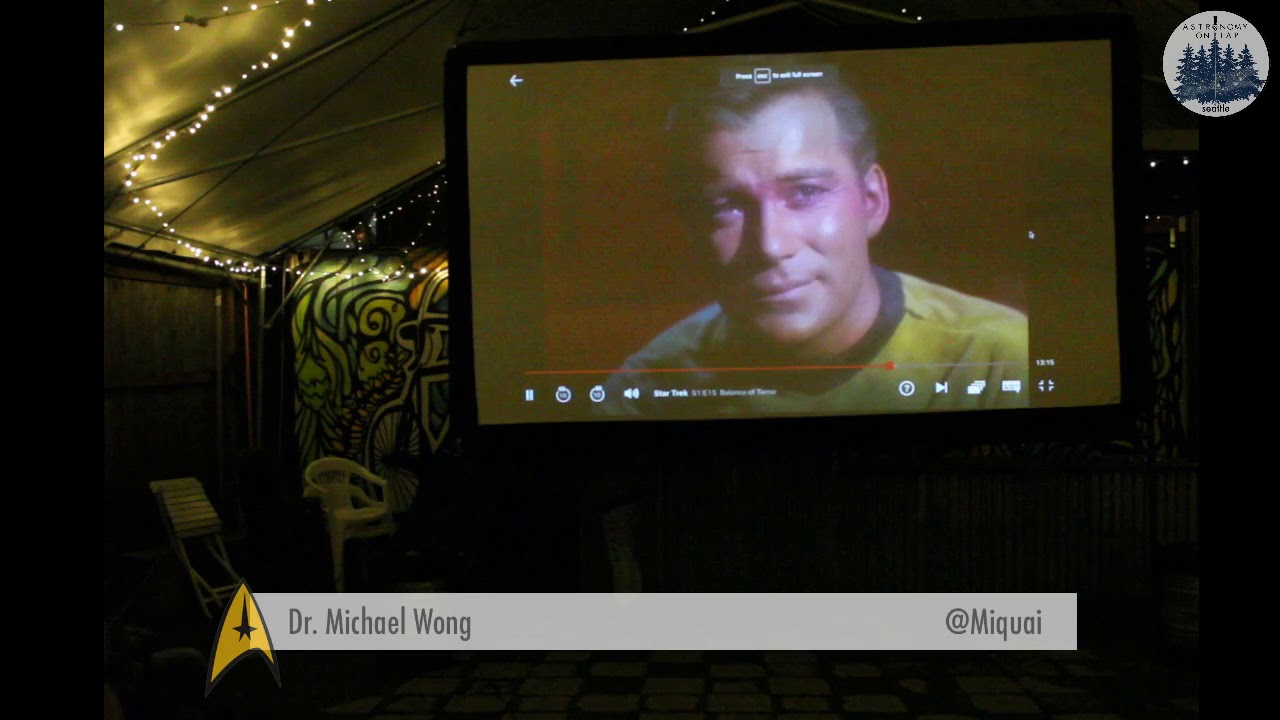
Video summary
Dr. Michael Wong explores how *Star Trek* has long been grounded in real scientific principles, particularly through its vision of warp drive as a method to manipulate spacetime itself. Drawing on Einstein's understanding that gravity is the curvature and rippling of space-time, he explains that if humanity could generate an electromagnetic field powerful enough to distort this fabric, it would allow for faster-than-light travel by expanding space behind a vessel while contracting it in front—a concept known as warp drive. This imaginative leap transforms theoretical physics into a practical engine for exploration, enabling crews to venture beyond the solar system and encounter new civilizations, thereby fulfilling Gene Roddenberry's original vision of boldly going where no one has gone before.
The presentation delves deeply into the scientific accuracy found in *Star Trek*, specifically examining Frank Drake's equation used by Roddenberry to estimate the number of intelligent transmitting civilizations in the galaxy. Although Roddenberry initially scribbled a random formula under studio pressure, it was later revealed that his intuition about the vastness of star counts and Earth-like planets was remarkably prescient; modern astrophysics confirms there are roughly 200 billion stars in our galaxy alone, with many hosting rocky planets within their "Goldilocks zones." While Roddenberry's estimate for habitable worlds differed from current calculations by a factor of over ten thousand due to limited data at the time, his core message—that humanity is small yet special amidst an evolving cosmos—remains profoundly relevant and philosophically enriching.
Furthermore, Dr. Wong highlights how specific episodes accurately depict planetary science, such as the tidal locking of planets around dim red stars which creates permanent day and night sides, a phenomenon seen in real exoplanets like those orbiting TRAPPIST-1. The show also correctly portrays subsurface oceans on icy moons like Europa, sustained by tidal heating from Jupiter's gravitational pull rather than solar warmth, creating potential habitats for life independent of sunlight. Additionally, the episode where *Star Trek* hides a starship in Saturn's atmosphere is scientifically plausible; Dr. Carolyn Porco, who consulted on the reboot series, confirmed that Titan's thick organic haze and methane-rich environment could indeed conceal a vessel from external detection, blending fictional plot devices with genuine planetary science.
Ultimately, the talk concludes by celebrating *Star Trek*'s portrayal of scientists not as emotionless robots but as curious, empathetic individuals like Captain Janeway who balance rigorous intellect with deep humanity. The series encourages viewers to embrace both scientific inquiry and imagination, suggesting that these forces combined can take us anywhere in the universe. By inspiring a new generation to pursue careers in science through its stories of exploration and alliance across species boundaries, *Star Trek* demonstrates that the future is not just something we wait for, but something we create with our minds and hearts, proving that even fictional concepts often have roots in real scientific discovery waiting to be understood.
Read the full video transcript
you may have heard of something called
Faraday's ball
some of you may even have play around
with it in science generally it's
demonstrated with a coil of wire and the
magnet and because the magnet the wire
and the changing magnetic field induces
an electric current in the wire
this discovery helped us unite the
forces of electricity and magnetism
into something that we now understand
that love as
electromagnetism
now imagine
imagine
that you could unite the forces of
electromagnetism with the force of
gravity and as Einstein told us gravity
is looking more than the beggining and
rippling of space pop
so what have you had an electromagnetic
source of energy so powerful that you
could literally warp the space around
you
expand it behind you contract it in
front to the power of science a little
sprinkling of imagination you'll
excreted a tidal wave of space you could
surf faster than the speed of light
what would you do with such a marvelous
engine I think I know I think you would
venture out into space the final
frontier
explore strange new world seek out new
life and new civilizations
boldly find yourself in a remonstrance
you be an explorer
going where no one has gone before
and all the while making new friends
general fond memories and learning what
it means
to be human
this was the vision of a man named gene
roddenberry who in
1964 submitted a proposal to NBC studios
while at the television show but he
called starts and from sergeants very
inception Gene Roddenberry knew that
science was going to be at its core in
fact in his original proposal he wrote
about an equation that was penned by
astro physicist Frank Drake just a few
years ago
the situation looked like that it's
meant to organize our knowledge and our
ignorance about the cosmos and then
attempt to estimate the number of
intelligent transmitting civilizations
of the doubt
thing is
in 1964 you put it just Google Drake's
equation
in fact did Roddenberry had no idea what
drinks bunch look like so under the
pressure of the studio submitted
proposals a lot of time he just
scribbled something random
and submitted
luckily
he studio executives of NBC also I have
no idea
and Sartre wasn't proven
now much later Frank Drake would
actually come on board stars I could
scientifically advise an episode and he
was shown this fictitious equation of
his that Du Monde very original and he
just laughed out loud he said Oh gene
don't you know that raising something to
the first power is simply itself why
would you like that
[Applause]
so this is what rates equation actually
looks like again it has to be the number
of transmitting civilizations in the
galaxy and it multiplies terms together
and we don't have time today to go
through all of them in detail but
suffice to say the last four journey
shown here in red are highly uncertain
it's difficult to know for instance the
probability is for the divergence of
life on planets or the lifetime or the
transmitting civilizations or things
that you spoke have no good grasp
but the first three numbers shown here
in blue are asked for physical numbers
there are numbers that we can know today
thanks to breakthroughs in astrophysics
so if we take those first three numbers
and multiply them together we've got the
number of earth-like planets in the
galaxy that would be the number of stars
in the galaxy multiplied by the fraction
of those stars and planets multiplied by
the number of earth-like planets in our
planetary system
no team Roddenberry back in the sixties
did not know what this number Lots there
was no boyfriends but he did know that
this number was going to be huge because
the number of stars of our galaxy is
literally astronomical
so when we figure out what this number
is the other choice
about how you are going to feel about it
you're gonna feel small because you're
just one life-form on a tiny mote of
dust floating in space where you going
to feel water because you're a part of
this random evolving cosmos it's special
because no matter what else is out there
it's what all of those possibilities
they're still just one and only one of
you
this is the kind of philosophizing that
dr. McCoy brought to Captain Kirk in an
episode of the classic Star Trek series
called the balance of terror this also
captain purpose pitted against the
Romulan commander equally as formidable
as him and Kirk is doing the draining
weight of starship command he's
second-guessing his every move he just
wants vacation
dr. McCoy being his friend comes up to
Kirk and shows him the map reality of
the universe the snap is captain back
into action let's take a look at that
seat
I
wish I were along see woods
picked us dance
responsible
[Music]
Roderich
that's nothing
[Music]
luckily expect an answer
something I saw ups a job
afterwards you
miss galaxy
earth plants
and all of the universe
3d matrix is like this
and all of that
they don't destroy the 1 Inc
[Music]
all right so dr. McCoy says there are
three million earth-type planets in our
galaxy let's see how great that estimate
is so today we know that there are about
200 billion stars in our galaxy now this
is not an exact figure it's an order of
magnitude estimate but it's sufficient
for our purposes thanks to the Kepler
space policy the most powerful men
finding device in all human history so
far we know now that the fraction of
planets fraction stars that have planets
is approximately 1 I just think that
almost every star you can see in night
sky has a planet going around
thanks to the hard master physicists
around the globe we now know that's the
occurrence rate it's a good sized
planets and the so called Wolvie locks
I'll go through what that means in just
a second it's about 20%
this isn't a big number if you bolt
equalities three things together you got
something like 40 milli
all right so a billion he is a thousand
times more than a million so dr. McCoy
was way off in his s he was off by a
factor of over 10,000 but we can forget
bones because I see with love to remind
us denim Jim I'm a doctor not an
astrophysicist
all right so let's talk a little bit
more about what it means to be an
earth-like planet this is our solar
system our sudden with the three largest
personal planets events Venus Earth and
Mars and generally what we talk about
when we talk about birds like world's
expressible planets within the so called
Goldilocks zone this is the range of
distances from star for which they trust
will include helplessly circuits get too
close to the SAR fetus and the water way
too far away like Mars and your water
with freezing ice now scientists can
also calculate what is called a title
walking radius this is a distance from
the star within which your clinic will
be titled aloft and in general what that
means is that the planet will have a
permanent space are permanent hemisphere
that all these phases fun and together
hemisphere will always face wet for pets
moment
so it turns out that our Sun is a
slightly larger SAR than ours most of
the stars in our galaxy are smaller
dimmer and brighter than our Sun and you
can calculate how the title log even is
in the Goldilocks zone change with
stellar sides so as the star gets
smaller and less massive that's less
rather to do it's kinda Lux Aeterna
locking radius if it's closer to the
truck also as far as our get smaller
they have must luminosity their
temperatures are lower so the Goldilocks
zone also moves closer to the Sun and in
fact these two quantities Rossi such
that if you are a terrestrial planet in
the Goldilocks zone around one of the
smallest dimmest reddish stars you are
almost certainly tidally locked
there's an example of a tightly locked
women sparkling it's man is Venus than
the Riemann's who have habits this world
can't live on the day side because it's
far too hot sugar we can't live on the
surface of the night side either because
it's far too cold so what the Ravens do
is they build their cities down into the
ground to take advantage of geothermal
heat
are all totally logical and it's going
to be doomed to be like Grievous to be
uninhabitable on its surface and only
the only possibility for life to be
peeking out in existence in the
subsurface
not necessarily work we gave Remus
or even better an atmosphere and emotion
what about the Sears do want to find out
let's go back to earth the planets have
you noticed it turns out that atmosphere
is in terrible
circulate peace redistribute the earth
it's more somewhat by its equator than
by poles now the officer in charge to
create these front convection cells to
take excess heat from you Aaron talk
about the poles making the poles warmer
than they was the other points well the
poles may be very very frigid in in a
suitable for you and me but they are
still extremely habitable environments
just ask the polar bears and penguins
turns out that scientists are able to
apply the same physical laws above the
sand computer models for atmospheres
other planets including around highway
loggerheads and it turns out that
atmospheres were totally loved also a
certain from the bright hot day side to
the cold nights
first time a title to our clinic the
atmosphere and ocean be little bit with
this we call it at I all earned with a
hemisphere and date with temperate
climate plenty of clouds to reflect the
Sun writes back in the space of its get
too hot and announce you're an ocean
that will bring each to the right side
room will still be cold but not
uninhabited consultum I feel I'm
thinking adapt to those conditions
well somehow Remus lost attached and
indeed this may happen for a great
number of try the new Lost Worlds
huddled close to their home socket and
it's the job the next generation of
telescopes including the James Webb
Space Telescope to find out characterize
whether these highly lots dress no
planets do indeed have atmospheres
perhaps you promotion per second we
distribute their heat around and make
their services
so going back to Ravens even though they
are subsurface colors they still venture
out into space and we have made an
alliance with their Rob Yulin cousins
and form a vast star compact the poses
an existential threat to humanity but in
order to overcome this threat we must
make alliances with other spacefaring
civilizations galaxies create the United
Federation of Planets this is an
alliance between humans Balkans and
Dorian's and others
so literally in Dorian's bunker well
they come from a majority not this world
but this what's right and Doria is a
mood for the gas giant planets very
unlike our Moon which is basically a
hunk of rock in space when were Ken to
the real life icy moon of Jupiter being
Europe but we know that Naropa has a
massive subsurface ocean of liquid water
in fact if you took up all the water on
the surface of our planet to Boulder up
into a ball it wouldn't be smaller than
if you took the water and the subsurface
ocean of Europa and pulled that up
this is an astounding fact how can you
develop and sustain a liquid water
oceans so far away from the Sun the
answer that will take a closer look at
the system that Europa is in is one of
the quartet of satellites
orbiting too large to us that we called
the Galilean so I know Europa Ganymede
listen it turns out these satellites do
their dance around - they were
continuously squished and squashed by
Jupiter a strong magnetic strong
gravitational field
and
this swishing and smashing deposits heat
into their sub surfaces we call this
title here it turns out that I hope
being the closest student experiencing
most of this fisherman's washing it
seems too much tidal heating to be habit
it doesn't make I'll be most
volcanically active out-compete hearts
ellipsis
canter they didn't solicit on the other
hand received far too little time opt to
be astral biologically relevant but
you're welcome yes just enough this is
like a new Goldilocks zone if you will
to maintain or liquid water
so when we say Europa is a good place
for life when you ask us all spot what
does life do what it's like feet luckily
I have all of you in front of me Plus
find examples of living creatures to
remind me what life does you're all
breathing now you're also a light
dusting your food and drinks and our
metabolisms connect with food and drinks
and we'd drink to be oxygen to the air
that we breathe that is how we gain
energy cross slip so are their food
sources and when we pump air sources on
turns out that we think there are deep
wonder Europa's ocean we suspect that
there are hydrothermal vents by studying
the vents on earth we know that they are
a looks chemical energy like some
of the most productive areas of our
biosphere is located at some submarine
party thermal vents completely devoid of
some
good food
Europa it turns out doesn't have an
atmosphere or not very substantial one
but it does have this ice shelf that is
constantly being bombarded by radiation
radiation from the Sun radiation trapped
in Jupiter's magnetosphere some
radiation vents originating from the
volcanically active sister Nehemiah and
then what this radiation does is it
processes device creates temples of
oxygens temples that act like oxygen and
because the title pushing them tweezing
creates cracks and breaks and perhaps
even subduction in the outer shell these
oxidants could flow into the ocean where
they might be consumed by life so this
process makes rope an extremely
potentially habitable environment and
similar processes good you making
and Rory from Star Trek have the gold as
well
now I got last story to share with you
my favorite science and Star Trek story
because it concerns a real-life
scientist named Carolyn Porco she is a
planetary scientist and one of the some
the imaging lead for the Cassini
spacecraft which spent over a thousand
years orbiting Saturn in addition to
being a very prolific excellent
scientist dr. Bruno is a very passionate
speaker so she was given your TED talk
once when she was approached by a man it
was curly dark hair thick glasses man
said hello dr. Berkoff my name is JJ
Abrams and I need your help
and dr. Parker said sure how can I help
you JJ said I am writing a script for a
reboot well this passage frame fiction
show called starts
Carolyn said I love Star Trek how can I
help Jake they said okay but god problem
with the plot you see I've got the wrong
Island he's attacking Earth they're
about to create a black hole where earth
it's and destroy Earth so the enterprise
leaves the smooth back into the solar
system save the day but they can't let
the Romulans know that their company
where can I hide a starship in the solar
system
Carolyn just smiled and she said Gingka
I have the perfect place for you and
this is the result
whatever the case we need to get a four
carat shape with the Technic just go in
there guns blazing there's some mutant
animals we have to go stir coffee would
based on what I've discussed from woken
I could predict it
that's it like I said
you don't want this noise if mr. Scott
can get this to work better for EM if we
don't want to work you had one sentence
would say title it's a magnetic
distortion trance of limits things will
make us invisible can your senses from
sin as long as the veil is not actually
can be shaped by that my luck
wait at home
17:17 doctor
mr. Chekov is correct I can't confirm
this telemetry mr. Sulu is able to do
for us in a position I can be before
they worship steal back the black hole
device I've been possible bring back
equipment or lie
Romulans and Vulcans share a common
ancestor our cultural similarities will
make it easier for me to access the
ship's computer or located the device
also my mother was human which makes us
the only con that
[Music]
I'm coming I
would cite regulation but I know you
listen we ignore
see
[Music]
prepare the truck
[Music]
I'll stop
[Applause]
[Music]
we're
really
well-balanced
okay so that is the story of how taking
a parent asks for help from dr. Carolyn
Porco and how we have a real-life mentor
a scientist to thank for the enterprise
swooping in to Saturn's moon Titan
atmosphere to save the day
sniffles brilliantly written into the
script as an idea that was concocted by
the health Pavel Chekov now if you I
have one time to be put like Carlton
with what happens here of course sharp
up Vincent's heightened and then he goes
on to lab or something about how
Saturn's magnetic fields will get
distorted by the Rings the Rings don't
actually do that we can forgive him
because he's only 17
so what makes Titan's atmosphere such a
great place to hide a starship well it
all starts with the fact that Titans
happens here is full of this molecule of
methane which is a molecule composed of
one atom of carbon and four arms I turns
out that have you shine holds about
sunlight on methane you can pop off on
abba hydrogens creating what is called a
methyl radical and hydrogen will float
out from the space because it's so much
now if two methyl radical is find each
other they may notice that each other is
missing a crucial link and they may inch
closer
man's clothes
and clips
and form a new molecule called epic and
it's this process repeated over and over
and over again that creates longer and
longer chain molecules of 10 times your
appropriate benzene proteome that drop
they've all been observed and they
creates this organic phase the
completely shrouds tightening and makes
it a fantastic place to hide a starship
so I'm pretty happy in general with how
science is portrayed in starts there is
though one little thing that bothers me
sometimes and inside
often the science officer prints in Star
Trek or portrayed as being a little I
think like in order to be a science
officer in charge at you either need to
have suppressed emotions or being right
all the time
or Rito through the robotic or a cyber
perfectionist or to be a symbionts with
the 300 year old creature into account
don't get me wrong all of these traits
make these characters extremely
endearing to watch but they can also
make the surface a little bit hard to
relate to us an average human being so
to end this talk by reminding you about
another very important character in Star
Trek a character is not generally
associated with being a science officer
but who is definitely still a scientist
at heart that character is Kathryn
Janeway
after Gateway was born in Bloomington
Indiana her hobbies include drinking
coffee fine tenants going skiing and
learning new languages and her Starfleet
record shows that she went on to become
one of the greatest officers in the
entire Federation she was the chief
science officer aboard the USS help
attorney before assuming command at the
starship Voyager leaving her crew home
70,000 light-years back to earth where
she was then promoted to vice admiral of
Starfleet Command after Midway it's just
a horrible human being her story can be
any of your stories so I'm gonna now
speak to the younger folks in the
audience
if you haven't had a chance yet maybe go
watch some started maybe you like it
maybe you'll connect with one of the
characters maybe you do inspire maybe
you'll even feel inspired to pursue a
career in science
because as we have seen today the power
of science plus the power of imagination
to take you anywhere
your captain's chairs wait the future is
your
[Applause]
question James has accounts here so is
there a chance for life on paper and
also is there water he answers this lots
of water but Satan is so far away from
the Sun and it must receive signs
but all of the water is frozen solid
rock
does have liquid methane and ethane
seems and so you can imagine a wildly
different kind of biochemistry it could
exist in the BOCES what if I'm to go
into all the details but is a very
exciting place rocks reality the creepy
life there
mainly different from the life you know
what is the possibility of
non-carbon-based life so you may be a
thin enough word out and the crystalline
entity yeah so that's a great question I
would say like from silicon-based life
is an impossibility but not at the
temple to their personal achievement we
are used to you know first reason is
because if you think of the way that
silicon waits upon two things for
instance we'll just take two types of
carbon that is accessible to biology
right now carbon dioxide
[Music]
sports so that's rockin it forms these
long chains and
basically
the polarity of the silicon silicon pipe
design is reversed from the carbon
hypervisor which makes silane extremely
reactive and is back to combusts
spontaneously which makes it also be the
testator's so yeah so it's like mad our
normal purchasing countries
request yes
absolutely so what drives worms or
basically are made when water evaporates
right and so that is receiving constant
sunlight it's
cleaner right beneath where the suckers
it's the most direct line of sight for
some and so there will be a huge have
you simulates the clouds on that land we
realize it because the clouds pile arcs
at that point well actually is it
electrical instance and get away it's
that side the clinics are not being too
hot the clouds are extremely important
to have the ability of those runs very
close
okay great thank you all