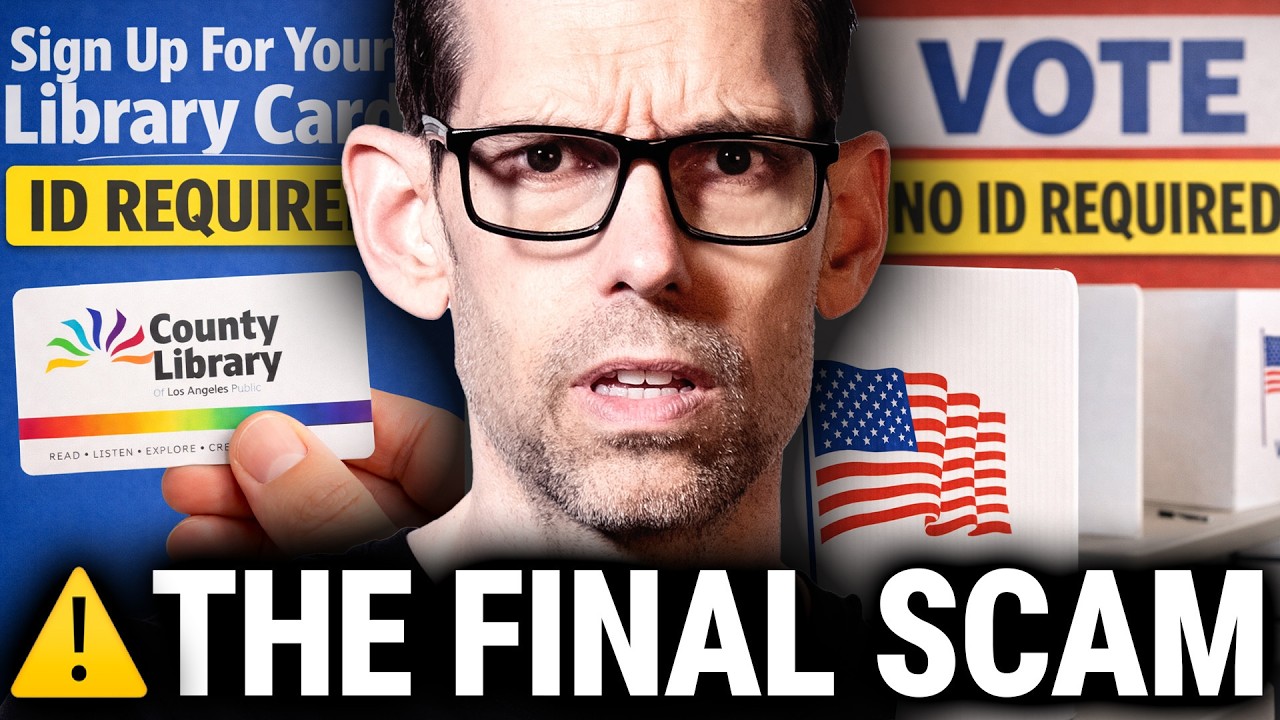
The SAVE Act Explained: Why Voter ID Laws Are Failing (Illegal Immigration & Census Deep Dive)
Watch on YouTubeVideo summary
The podcast opens with a stark contrast between global voting standards and those in the United States, noting that all 47 European nations, India, Mexico, and many other countries require government-issued photo ID to vote. The speaker argues that while Americans need IDs for trivial tasks like buying beer or renting library books, no such requirement exists at polling booths despite widespread bipartisan support; a poll cited indicates that 84% of both Republicans and Democrats favor voter ID laws. Despite this consensus, the Senate has blocked legislation like the SAVE Act (Safeguard American Voter Eligibility), which would mandate documented proof of citizenship for registration, photo IDs for casting ballots, and active maintenance of accurate voter rolls by states. The speaker dismisses common accusations that these measures are racist or suppressive, pointing out that fraud occurs in other systems—such as student elections where individuals have hacked accounts to cast fake votes—and highlights a 2013 New York City Department of Investigation study showing a 97% success rate for undercover investigators casting fraudulent ballots under ineligible names. The core argument shifts from voter ID to the structural incentives surrounding immigration and political power, specifically regarding how illegal immigrants impact the census. The speaker explains that the U.S. Constitution requires counting every person living in the country, not just citizens, which directly determines a state's number of House seats and Electoral College votes. This mechanism creates a powerful incentive for politicians to encourage non-citizen presence within their districts regardless of legal status. Evidence is provided through statements from Commerce Secretary Gina Raimondo confirming that illegal aliens are counted for apportionment, and comments by Congresswoman Yvette Clark expressing the desire to absorb migrants into her district specifically for redistricting purposes. Furthermore, former Senate Majority Leader Chuck Schumer has publicly stated a goal to provide citizenship paths for all undocumented immigrants, which the speaker argues is a strategic move to permanently shift electoral math in favor of Democrats, citing California's political transformation after 1986 amnesty as proof that attracting new populations can alter voting patterns over decades. The discussion then addresses the economic implications of mass immigration within an existing welfare state and national debt crisis. While acknowledging data from the Congressional Budget Office suggesting immigrants might reduce federal deficits by contributing more in taxes than they cost at the national level, the speaker emphasizes a critical distinction: states bear the direct costs for education, housing, emergency services, and healthcare without receiving proportional tax revenue back to their local treasuries. The transcript notes that over 50% of Americans already receive some form of government assistance, and importing more people into this system is described as economic suicide given current debt levels exceeding $38 trillion with annual interest payments surpassing a trillion dollars. The speaker argues that mass migration tends to attract low-skilled workers who may become net drains on state resources due to the high costs associated with education and welfare programs, whereas high-skilled immigrants generate lifetime surpluses, suggesting that selective immigration policies are necessary for long-term economic stability rather than open borders driven by social safety nets. In conclusion, the speaker synthesizes these points into a broader critique of political incentives and fiscal policy, asserting that politicians refuse to pass voter ID laws or restrict low-skilled immigration because doing so would dismantle systems they exploit to maintain power. The argument posits that any system designed without safeguards will inevitably be exploited for advantage, whether by fraudsters in student elections or politicians leveraging census counts and welfare benefits to secure votes. The speaker urges listeners to support voter ID not out of hatred but as a necessary step to protect the integrity of their vote against exploitation, while also calling for an end to "free stuff" funded by money printing which widens inequality rather than solving it. Ultimately, the podcast concludes that balancing the budget and focusing on asset ownership are essential steps toward stabilizing the economy, warning that history shows empires collapse when they rely on debt monetization and unchecked expansion of welfare programs without fiscal restraint.
Read the full video transcript
Of the 47 nations in Europe, all 47
require government-issued photo ID to
vote. India, a country where 63%
of the population live in rural areas,
and where hundreds of millions of people
live on less than $2 a day, photo ID is
still required to vote. Even in Mexico,
biometric voter ID with a photo,
fingerprint, and hologram have been
required since 1992. And right now, in
the United States of America, you need a
government-issued ID to buy a beer,
board a plane, open a bank account, pick
up a prescription, buy cold medicine,
adopt a stray cat, and rent a library
book. In New York, you can't even buy
whipped cream without a license. And in
California, you can't buy spray paint
without one. But in that same state and
many others, you can walk into a polling
booth, simply say a name, no ID
required, and cast a vote that will
decide how trillions of dollars get
spent. Voter ID isn't about race or even
immigration. It's about something else
entirely, and I'm going to prove it. 84
84%
of Americans, Republican and Democrat,
support requiring an ID to vote. That is
a level of bipartisan agreement that
almost never exists. And yet, the Senate
says the bill meant to enshrine the need
for voter ID is dead on arrival. What on
God's green earth would make a
government say no to something 84% of
the voters want? That's what we're going
to be discussing right now, and the
answer is going to shock you, especially
if you've bought in to the distraction
that this is all about race. Buckle up.
If you merely say you want voter ID,
people will call you racist or say
you're suppressing voters. They'll say
there's no need for voter ID because no
one is voting illegally. That is
moronic. [music]
Game theory makes it clear that any
system that can be exploited for
advantage will be exploited. Don't
believe me? Here are some stories pulled
from a vast sea of such stories. A
Florida mother hacked into 117 student
accounts and cast 246 fraudulent votes
so her daughter could become, drumroll,
please, homecoming queen. Both of them
were charged with felonies. A college
student at Cal State installed
keyloggers on campus computers, stole
750 students' passwords, and then cast
over 600 fake votes
to win a student council election.
>> [music]
>> He went to federal prison. At Berkeley
High, a kid running for ASB president
logged into 500 classmates' email
accounts and voted for himself hundreds
of times. For student government,
parents have forged birth certificates
and falsified residency documents so
their 12-year-olds could win Little
League tournaments. A man broke into an
aquarium and stole a fish to win a
fishing tournament. Hollywood actresses
and billionaire CEOs alike bribed
coaches and faked SAT scores to get
their kids into college. Everyone says
voter fraud won't happen, but fraud
happens all the time and for things far
more trivial than a national election.
Now, I'm going to preempt the people who
are going to say, "Well, Tom, if there
was fraud, we would already see it."
I'll stop that right now with the
following true story. In 2013, New York
City's Department of Investigation sent
63 undercover investigators to polling
places to vote under the names of people
who were ineligible. They were dead,
moved away, or convicted felons. 61 out
of the 63 succeeded. That's a 97%
success rate. They didn't even try that
hard. In five cases, investigators in
their 20s and 30s posed as voters aged
82 to 94. One of the two who got caught
was recognized by the felon's mother,
who happened to be a poll worker at that
location. That is our current strategy,
coincidence. Additionally, it is
standard procedure for ballots cast in
person to not contain any identifying
information about the voter. So, once a
fraudulent ballot goes into the box, it
is literally impossible to isolate it or
trace it back. It's mixed in with every
legitimate ballot and counted the same
way. The bipartisan New York State Board
of Elections spokesman, John Conklin,
said it plainly, "It demonstrates that
voter fraud is easy to commit and not
easy to find. It shows that someone with
a little knowledge of where the cracks
are in the system can exploit them and
we'd never know [music] about it." And
UVA law professor, Michael Gilbert, put
the logic point precisely, "The failure
to observe fraud does not mean that no
fraud takes place. If people commit
fraud and risk prison for student
council and homecoming queen and happily
commit fraud by cashing the checks of
dead people, what on earth makes them
think people won't vote under someone
else's name if ID is not required." So,
let's start with the bill itself. The
SAVE Act, which stands for Safeguard
American Voter Eligibility. It does
three things. One, [music] it requires
documented proof of citizenship to
register to vote. Two, it requires a
photo ID to cast a ballot. And three, it
requires states to actively maintain
accurate voter rolls. That's it. That's
the whole bill. Prove you're a citizen,
prove you who you say you are, and
states, keep your list clean. I for one
am fine with the fact that I have to
show ID if I want to adopt a cat or
check out a library book. IDs are an
easy way to limit how easily a system
can be abused. Take your bank account.
You walk into a bank and say, "I'd like
to withdraw money from my account." And
the teller is going to say, "Sure, can I
see some ID?" That's not oppression.
That's not suppression. That's the bank
protecting you. They're making sure
nobody else walks in and takes your
money. Now, imagine a bank that said,
"No ID needed. Just tell us your account
number and we'll hand over the cash."
How long do you think it would take
before someone exploited that? A week? A
day? It would happen so fast no one
would keep their money there. Voting is
the same thing, except instead of
protecting however much money you have
in the bank, it's protecting your vote,
which influences how trillions of
dollars of taxpayer money gets spent.
Every fraudulent vote doesn't just add a
new vote to the system, it cancels out a
legitimate one. Requiring an ID is not
suppression, it's the system protecting
the value of your vote. The next
argument you're going to hear is, "It's
too hard for some people to get an ID."
Let's talk about it. There are roughly
260 million adults in the United States.
Available data that covers the entire
adult population suggests that somewhere
between 95 and 97% of Americans already
have a government-issued photo ID right
now in their wallets because they need
it for everything. You can't buy spray
paint, as I said, or even whipped cream
in some places without ID. But okay,
fair enough, what about the other 3 to
5%? Some are admittedly so burdened by
work that any new strain is going to be
tough to accommodate. But roughly 3% of
adults in the US are legally categorized
as having an intellectual disability.
With or without ID, odds are very low
that they're going to be able to
navigate voting anyway. Not to mention,
only roughly 60% of people turn out to
vote even in a presidential election.
That leaves a vanishingly small number
of people that would actually be
suppressed by requiring voter ID if that
was even the actual intent, which of
course it's not. And even if you assume
a full 3% of adults would want to vote
but be made unable to because they
couldn't get an ID, it makes no sense to
put for their vote being watered down by
fraud to pick up a largely hypothetical
3%. And if people are concerned about
some of the people in this very small
pool that don't already have an ID
being stopped from getting an ID because
they can't afford one, offer everyone a
free ID. It would be trivial to add a
provision to the bill that requires
states to provide ID free of charge. It
would be trivial, but the Democrats
won't even debate the bill. They're
calling it Jim Crow 2.0 and promising to
filibuster so that it can't even be
debated or voted on. That's because this
isn't about protecting voters, it's
about power and exploiting the system to
get it and maintain it and exploiting
the system to do so. And remember India,
a country with hundreds of millions of
people in rural areas, widespread
poverty and literacy challenges that
dwarf anything in the United States?
They've required a photo ID since 1993.
The idea that the richest, most
technologically advanced nation in the
history of planet Earth can't manage
what India, Mexico, and all of Europe
have been doing for decades, that's not
a serious argument. It's a smoke screen.
Which raises the real question. If this
isn't actually about people being unable
to get an ID and 84% of Americans across
party lines support the initiative, why
is the Senate blocking it? What does
someone in power gain by making sure we
don't verify who's voting? We will get
right back to the show in a second, but
first let's talk about the tracking
system built into your phone that you
can't turn off. Every SIM card has a
permanent ID. It's called [music] an
IMSI. Your carrier assigns it once and
it never changes. That ID follows you
everywhere. [music]
Your carrier tracks it, advertisers
track it, bad actors track it. VPNs
can't hide it and encrypted apps can't
change it. Cape [music] solves this with
identifier rotation. Your SIM ID
automatically changes every 24 hours.
Same phone number, new [music] identity
every single day making you untraceable,
but Cape doesn't stop there. Your phone
number itself is protected by a 24-word
cryptographic phrase. [music] Your
voicemail is encrypted. Your payment
data is tokenized and Cape's enhanced
[music] signaling protection blocks
suspicious network connections before
[music] attacks happen. Head to
cape.co/impact
and use code impact to get 33% off your
first 6 months with Cape.
>> [music]
>> And now, let's get back to the show.
We'll get right back to the show in a
second, but first I want to talk about
supplementation. [music] Your supplement
routine is probably costing you time,
money, and results. Every morning you're
taking a handful of individual
ingredients that were never [music]
designed to work together. Peak
Nootropics isn't a random collection of
trendy ingredients. It's a synergistic
system [music] where each component
amplifies the others. Ceremonial grade
cacao delivers mood support and
metabolic function while it's 30% cacao
butter content acts as the optimal
delivery system for all the other
compounds.
>> [music]
>> I'd heard so much about it, I tried it
myself. It is fantastic. Fermented puer
tea from 250-year-old
[music] trees provides sustained energy
and supports metabolic health. Full
spectrum reishi, including spore powder,
supports cellular longevity and
resilience. Calm, sustained energy,
healthy mood and mental focus. Set your
longevity goals in motion. Access 20%
off and begin your journey towards
sustained wellness at
peaklife.com/impact.
And now, let's get back to the show. To
understand the answer, you have to
understand something most people have
never thought about. How illegal
immigrants impact [music] the census,
how the census actually works, and how
dramatically it influences political
power. The US Constitution requires a
census every 10 years. That census
counts every person living in the
country, not every citizen, every
person. And the results of that count
determine how many seats each state gets
in the House of Representatives, and by
extension, how many Electoral College
votes each state gets in presidential
elections. More people in your state
means more seats. More seats means more
power. And it doesn't matter whether
those people can vote or not. According
to the Center for Immigration Studies,
the presence of all immigrants, legal
and illegal, and their US-born minor
children shifted the distribution of 26
House seats and 26 Electoral College
votes in the 2020 census. Of those, 17
seats were shifted by non-citizens
alone, people who cannot legally vote in
a federal election, but whose mere
physical presence in a state increases
that state's political power in
Washington. There's no conspiracy theory
in that. It's not even a disputed fact.
It's just how the census math works.
Given how much power it conveys, can you
not understand why states would want to
get as many bodies in their state as
possible, regardless of their legal
status?
In May of 2024, then Commerce Secretary
Gina Raimondo was asked about all of
this in a Senate hearing. The Commerce
Department, by the way, oversees the
census. So, she was the right person to
ask. Senator Hagerty asked,
>> Illegal aliens today are counted in the
US census. Is that correct? Raimondo
confirmed,
>> Yes, as required by the Constitution.
>> The senator continued, This total census
population, which includes illegal
aliens, is then in turn used for the
allocation of congressional districts
and electoral votes for each state. Is
that correct?
>> Yes. That's the Commerce Secretary of
the United States confirming on the
record that people in the country
illegally are counted [music] in the
census, and that count directly
determines how many congressional seats
and Electoral College votes each state
receives. Politicians don't even try to
hide this fact. In a 2021 House Foreign
Affairs Committee briefing,
Congresswoman Yvette Clark, a Democrat
from Brooklyn, said, and I quote, I I
need more people in my district, but
just for redistricting purposes. She
wasn't caught on a hot mic. She said it
publicly, on camera, in an official
congressional proceeding. She was
talking about absorbing Haitian migrants
into her Brooklyn district, not because
she had a plan to help them, but because
more bodies in her district meant more
political power for her. Now, think
about the incentive structure this
creates. If you're a politician in a
state with millions of non-citizens, you
have a structural reason to keep them
there. Every non-citizen in your state
is padding your power in Congress and in
the Electoral College, regardless of
whether or not they cast a vote. But, it
would be even better if they could cast
a vote, wouldn't it? And that's exactly
why Democrats have publicly stated on
the record that their plan is to find a
path to citizenship for all illegal
immigrants. If you don't believe me, in
2022, then Senate Majority Leader Chuck
Schumer stood in front of the US Capitol
and said on camera, Our ultimate goal is
to help the dreamers, but get a path to
citizenship for all 11 million or
however many undocumented there are
here. Again, it's not a leaked memo or a
slip on a hot mic. That's the most
powerful Democrat in the Senate stating
his ultimate goal on the record.
Honestly, if you're a Democrat, it's a
smart strategy if all you care about is
staying in power. Data consistently
shows that recent immigrants vote
disproportionately
for the party that welcomed them in and
promised benefits. So, if even half of
the 11 million immigrants become
citizens and start voting, you have
permanently shifted the electoral math.
Not for one election,
permanently. If you want an example of
exactly how this plays out, look no
further than California.
>> [music]
>> In 1986, Ronald Reagan signed an amnesty
agreement granting citizenship to nearly
3 million illegal immigrants.
Before that amnesty, California voted
Republican in nine out of 10
presidential elections.
After it, California has not voted
Republican once. Not one single time in
almost 40 years. Now, to be clear, this
isn't about whether immigrants are good
people. My wife is an immigrant. Like
any group, most are awesome. Most of
them came here for a better life, just
like virtually everyone's ancestors did.
This is about whether politicians are
using them as pawns in a power game. And
the answer, based on their own words,
their own votes, and the structural
incentives that are baked into the
system, [music]
the answer is obviously yes. That's why
they won't even vote or debate on the
Save Act. That's why they won't add a
citizenship question to the census.
That's why they call voter ID racist.
The goal isn't to protect immigrants or
voters. It's to protect their power. But
sadly, grabbing power is a much smaller
problem than what we have to discuss
now. Namely, the true cost of
immigration in a system with welfare.
Because that toxic combo is destroying
the middle class. The federal government
added $2.2 trillion in debt in a single
year. Total national debt now stands at
roughly $38.5
trillion.
And for the first time in American
history, annual interest payments alone
are more than a trillion dollars. And
that's nearly doubled in just three
fiscal years. Let me put these numbers
into perspective. The federal deficit
for 2025 was roughly $1.8 trillion.
That means the government spent $1.8
trillion more than it collected in
taxes. That gap is roughly 6%
of GDP, which is more than 50% above our
50-year average. And it's not going to
get better.
The CBO projects deficits will exceed $2
trillion
a year for the next decade. Federal debt
held by the public has hit 100% of GDP
and is on pace to blow past the all-time
record of 106%
set in 1946, right after we had just
finished fighting a world war. So, how
did we get here? The same way every
empire before us got here.
Politicians discovered that the easiest
way to win elections is to promise
people free things, programs, benefits,
safety nets,
>> [music]
>> tax cuts, stimulus checks. The problem
is they can never collect enough taxes
to pay for all of it, so they borrow the
difference. And to be clear, this is not
a partisan problem. Republicans cut
taxes without cutting spending.
Democrats increase spending without
increasing taxes enough to cover it. The
result is the same on either side. The
gap between what the government takes in
and what it spends just keeps growing
year after year, regardless of who is in
power. So, don't think for a second that
you're on the good side. We have got to
solve this problem. Now, a crazy data
point that you have to take into
consideration when you're thinking
through the problem of immigration, get
ready for this, it actually lowers
federal deficits. Sort of. Let me
explain.
>> [music]
>> The Congressional Budget Office, the
non-partisan agency that does the math
for Congress, estimates that the recent
surge in immigration could actually
reduce federal deficits by about 900
billion over the next 10 years. The
reason?
Immigrants pay taxes, income taxes,
payroll taxes, sales taxes, and at the
federal level they continue to
contribute more in revenue than they
cost in benefits, even if they're using
fake social security numbers. They're
still paying. But here's what that
number doesn't capture.
At the state level and local level, the
same CBO found the exact opposite.
[music] Immigration imposed a net cost
of billions of dollars a year because
states bear the direct costs of
education, housing, emergency services,
shelter, and the like. The federal
government gets the tax revenue, sure,
but your city gets the bill. Now, here's
the trillion-dollar question, literally.
If immigration lowers deficits in real
life and not just in statistics, could
we use immigration to solve our
catastrophic debt problem? Well, over
the Biden presidency, we ended up
running a natural experiment. And
unfortunately, our deficits have soared
as we've imported an unprecedented
number of immigrants. That doesn't mean
that immigration has caused our debt
crisis. I want to be very clear about
that, but it does mean it's not going to
solve it. The idea of importing infinite
to flip a fiscal deficit into a surplus
sounds very appealing if you just
extrapolate from the average positive
projected fiscal effects that appear in
some studies, but it ignores real-world
constraints like diminishing economic
returns, infrastructure limits, values
collisions which nobody wants to talk
about, overall social integration
challenges, and the this one's rough the
low versus high-skill composition of who
immigrates, which matters more than
anything else. While immigration can
boost GDP and can reduce federal
deficits in the short-term, the benefits
aren't linear or unlimited. Pumping in
endless numbers of immigrants invariably
eventually creates net costs, backlash,
and social instability. Just look at
history. Immigration expands the labor
supply, which grows the economy by
filling jobs, increasing productivity,
and raising overall output. However,
beyond a certain point, it saturates
markets, especially for low-skilled
work, leading to sharper wage drops,
higher unemployment for natives,
particularly those without high school
diplomas, and reduces pressure for
businesses to raise wages or invest in
productivity enhancing tech or training.
In essence, economies aren't infinitely
elastic. Adding workers does boost
supply, but if demand, jobs and capital,
doesn't keep pace, you get
inefficiencies like underemployment or
black market labor, which we see both of
right now. According to both the
Manhattan Institute and National
Affairs, the skill level of the
immigrant population matters a great
deal in terms of whether they'll be an
economic contributor or a net cost to
the system. High-skilled immigrants, for
example, college educated, generate
lifetime surpluses, but low-skilled ones
often create net drains that can be
hundreds of thousands of dollars per
person over 30 years. This is due to
higher use of education, health, and
welfare programs. Costs that grow
exponentially as more people immigrate.
Mass migration flows tend to skew
low-skilled as global migration
pressures come from poorer regions,
amplifying the burdens.
>> [music]
>> We also have to confront the realities
of incentives. When the richest country
in the world opens its borders and
promises access to infrastructure like
education, health services, and welfare
programs, you are going to,
understandably, attract low-skilled
workers who are fleeing desperate
situations, and will, over time, draw
more out of the system than they
contribute. And none of that is even to
mention what is likely the most damaging
impact of mass immigration, the social,
cultural, and political limits of
integrating a large number of people
into a society too quickly.
>> [music]
>> Rapid influxes of low-skilled migrants,
over time, drains resources, strains
social cohesion, leads to cultural
clashes, reduced trust, and political
backlash. We see it over and over in
history. Historical waves, for example,
here in the US in the 19th century. They
succeeded partly because there were few,
if any, social programs to draw from, so
you just weren't attracting people that
just wanted something on the dole, and
there were built-in pauses that allowed
for cultural assimilation. With our
current state of unbearable debt,
intolerable inequality, taxation through
inflation, and already skyrocketing
populism, this is a time to pause and
adjust the system to focus on
re-stabilizing our economy and society.
It is not a time to create further
vulnerabilities in areas like our voting
system. Nor is it time to weaponize
immigrants who are already being
leveraged to gain political power by
offering promises of mass citizenship
and access to welfare programs. In the
US, [music]
a staggering number of people receive
benefits from one social service or
another. We're talking north of 50%.
Some analyses show an even higher number
depending on whether you count things
like federal student loans, farm
subsidies, or mortgage interest
deductions as, quote unquote, government
benefits.
>> [music]
>> But, sticking to just things like
Medicaid, SNAP, housing assistance,
Social Security, Medicare, unemployment,
and the like, you've still got over 50%
of Americans already receiving some kind
of assistance. Our welfare state has
grown absolutely
massive, and importing more people with
an incentive to broaden those systems
even further without first balancing the
budget is economic suicide for a country
that is already on life support due to
debt. Given all of this,
if we're hell-bent to use immigration as
a deficit reduction strategy, fine, but
it's going to require a selective
immigration process that attracts
skilled workers from around the world
and restricts low-skilled immigrants.
That would almost certainly be good for
the economy long-term, but as discussed,
right now we're doing the exact
opposite. We are enticing low-skilled
people from the most dysfunctional
places on Earth via a massive social
safety net. And in states like
California, Minnesota, and New York,
which build themselves literally as
sanctuaries for immigrants, lawmakers
are doing their best to ensure easy
access to free infrastructure, such as
education and health care, dramatically
increasing the likelihood that arrivals
are a net drain on finite resources. And
again, if you don't believe me, just
look up some of the things that
California's Governor Newsom has said
publicly. Additionally, we're doing
little to nothing to maximize the number
of high-skilled immigrants, who are the
ones that would tend to be net
contributors. Now, hopefully, all of
that explains how immigration can either
be a positive or a negative, depending
on how a country's systems are set up,
and how deficits can so quickly get out
of control when things aren't set up
well. But bodies, legal or otherwise,
pad the census. Social safety nets
attract bodies. Amnesty, paths to
citizenship, and yes, fraud create
votes. And as California demonstrates,
when you attract people with free stuff,
those people tend to vote for more free
stuff. Politicians refuse to pass voter
ID laws because they want a system that
can be exploited, so they can leverage
it to gain and [music] retain power
through, among other things, bad
immigration policy. It's not a
conspiracy. It's a chain of incentives
embedded in a system that politicians
are trying to keep easy to exploit. And
as game theory and reality make
abundantly clear, any system that can be
exploited will be exploited. The tragic
irony of all of this is that even the
well-intentioned people who are most
passionate about equality, the ones
marching, protesting, demanding the rich
pay their fair share, saying that there
are a sanctuary for immigrants, they are
the ones voting for for very policies
that make the rich richer. Every new
program funded by borrowing eventually
requires money printing, and every round
of money printing widens the gap they're
trying to close. They're going to blame
capitalism, and they do, but this isn't
capitalism. This is what happens when a
government counterfeits its own currency
and calls it policy. Every empire that
has ever done what we're doing with
[music] debt and money printing has
collapsed.
Every single one. America is not exempt
from math. So, what should any of us do?
First, support voter ID. Not because you
hate immigrants, because you understand
the incentive structure that's being
protected by leaving the system
unsecured. Second, stop voting for free
stuff. I know this one is going to be
hard to get people to listen to, but
there is no free. There is only paid for
by money printing, which is paid for by
your purchasing power, which hurts the
poor and middle class the most. Third,
demand balanced budget. If we balance
the budget, we don't need to print
money, and if we want to allocate things
in a balanced budget to immigrants, we
can. We just can't do it with an
unbalanced budget. If we stop printing
money, inflation stabilizes. If
inflation stabilizes, inequality begins
to narrow. Everything, everything traces
back to debt, money printing, and
politicians' insatiable appetite for
power. And fourth, get into assets. I
wish this weren't the reality, but your
government has made it impossible to
save your way to prosperity.
>> [music]
>> Cash is a melting ice cream cone. You
need to own things that rise when money
is printed. Stocks, real estate, gold,
silver, Bitcoin, a business, etc.
Needless to say, this is not financial
advice. It's just math. Remember, some
people will cheat on college admissions,
homecoming crowns, fishing competitions,
and student elections when little to
nothing is on the line. Why on earth
would you think they won't cheat on
national elections when there's
trillions of dollars and political power
on the line? 84% of Americans,
Republican and Democrat, support
requiring an ID to vote, but the Senate
won't even debate the topic. Voter ID
isn't about race. It's about power.
All right, if you want to see me explore
topics like this in real time, make sure
you subscribe right now and join me live
Monday, Wednesdays, and Fridays at 7:00
a.m. Pacific time. I will see you there.
Until next time, my friends. Be
legendary. Take care. Peace.
If you like this conversation, check out
this episode to learn more.
AI is the most incredible technology
ever invented, but the Epstein files
have revealed it's also being used as a
form of mind control.
>> [music]
>> Now, I get it that headlines