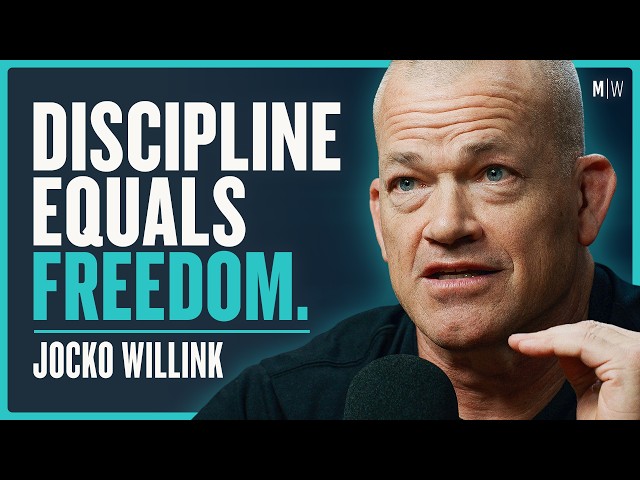
The Savage Mindset That Makes Hard Things Easy - Jocko Willink (4K)
Watch on YouTubeVideo summary
Jocko Willink emphasizes a core philosophy regarding life's challenges: there are no perfect solutions, only necessary trade-offs. He argues that one cannot excel at everything simultaneously; attempting to do so leads to mediocrity across all areas rather than mastery in any single field. This concept is rooted in the "fourth law of combat leadership," which dictates decentralized command and prioritization. Individuals must constantly assess their situation—whether it involves family, business, or health—and decide where to focus efforts at that specific moment. Willink illustrates this with examples from his own life, noting how he balances these priorities by stepping back when necessary but also maintaining a rigorous baseline for health, such as rarely missing workouts over decades, because foundational habits like fitness and sleep are critical supports upon which other endeavors build. The discussion extends to the nature of confidence and humility, positing that true confidence stems from admitting what one does not know rather than pretending otherwise. Willink shares anecdotes about production errors on a film set involving radio interference in cables; instead of panicking or faking expertise, he embraced ignorance by asking for help online (specifically referencing Reddit) to solve the problem quickly. This approach mirrors his advice on performance anxiety: preparation should be driven by humility and extensive training, but at the moment of execution—whether shooting a bow with night vision goggles or giving a presentation—one must switch into an "alter ego" mindset where they are fully committed to succeeding in that specific instance. He cites Kobe Bryant's post-injury social media rant as evidence that venting frustration is often necessary before regaining perspective and drive, reinforcing the idea that expectations shape reality; believing one has a genetic advantage can lead to outperforming those with actual advantages if belief drives effort more than biology does. Willink further explores discipline not as an innate trait but as a conscious choice made in spite of lack of motivation. He contrasts this with talent or physical attributes, which are fixed at birth, whereas the decision to act is always within one's control. This concept creates a compounding effect where small decisions reinforce identity; making good choices early in the day prevents bad ones later, such as resisting donuts after working out versus succumbing to them when tired and unmotivated. For those struggling with difficult periods or "bad months," he advises breaking down recovery into micro-steps rather than expecting immediate fixes. He uses Jiu-Jitsu training as a metaphor for this process: one must continue pushing until they achieve progress, like submitting an opponent during sparring, to realize the reward of their effort. Unlike learning languages where future proficiency is abstract, physical training offers immediate visual feedback through muscle pumps and strength gains, which helps sustain momentum even when external results are slow or non-existent due to factors like body weight. Finally, Willink addresses the rapidly evolving landscape of warfare and information operations, noting that while technology changes—such as fiber-optic drones replacing manned aircraft—the fundamental principles remain constant because they rely on human nature. He highlights a shift toward "warfare of ideas," suggesting that future conflicts will increasingly focus on cyber capabilities and psychological operations rather than just kinetic force. Historical examples like the OSS's use of psychological tactics during WWII, such as attempting to demoralize Hitler via hormone-laced vegetables or using painted raccoons instead of foxes in Japan, illustrate how influencing minds can be more effective than brute force. However, he warns against "knowingness," a state where individuals believe they possess the answer before asking the question, which insulates them from updating their beliefs and leads to polarization. In an era dominated by misinformation and post-truth narratives, maintaining open-mindedness is crucial; understanding that different cultures have vastly different thresholds for sacrifice—as seen in the Vietnam War's My Lai or Iran Valley battles—helps prevent imposing outcomes on others without comprehending their perspective, ultimately leading to failure if one ignores these cultural realities.
Read the full video transcript
I know that you're a fan of the Thomas
Soul quote, there are no solutions, only
trade-offs. What's that mean to you?
That you're never going to completely
solve anything in your life or in the
world. And there's always going to be
compromises that you have to make. And
if you aren't willing to make those
compromises or you don't keep your mind
open for those compromises, you're going
to run into some real problems. But if
you look at it and the fact that, you
know, you might put a little more effort
over here, that's going to take away
from some effort over there. You can't
just do everything at once. So, yeah, no
solutions, only trade-offs. How do
you deal with the tension of feeling
that other thing pull away from you,
right? You know that you need to focus
and you know that by focusing on one
thing, another thing is going to start
to drop away. But the classic
overachiever mindset is well, everything
needs to be growing at all times. So,
there's a an emotional pain of watching
something stagnate or watching something
fall behind. How do you try and navigate
that? You just have to figure out what
the priority is. And and at certain
times, you know, certain things might be
a higher priority right now than it is
at some other point and something else
picks up. And sometimes the family needs
to be the priority. Sometimes the
business, sometimes the other business,
sometimes the health. Like you're just
going to have to weigh those things out
and re recognize that you can't do them
all simultaneously at the same time all
the time. It's just it's not going to
work. So you got to figure out we're
going to make some compromises. We're
going to make some trade-offs. Yeah. the
uh the sentence you can be anything you
want but you can't be everything you
want is so good for that and especially
if you like novelty like doing lots of
different things ah this is interesting
to me I curious I want to you go yeah
okay dude but there is a limit right and
when you start to it's the most obvious
thing in the world if you spread
yourself too thinly across lots of
different things you can't be that great
at all of them you can't be really that
great at any of them after you start to
spin it up after a while yeah and it's
one of those laws of combat that you
teach and used to teach in SEAL teams
and now I teach to businesses prioritize
and execute. Like you've got to figure
out what the priorities are and then
execute on those things. But you got to
figure out what the what the biggest
priority is at any given time. Like I
said, whether it's this business or your
family or your health, at certain times
you got to say, "All right, I got to pay
attention to my family right now. I can
feel things are getting a little bit
sketchy over there." Or, "All right, my
family seems solid right now. I got to
focus on this part of the business." and
then within the business this particular
section of the business you go right on
down the line. How do you think about uh
moving between planning and execution in
that way? Is it something that you can
do at the same time or is it really
important to sort of step back, give
yourself that perspective and then go
back in to actually enact the
strategies? If you end up executing
things yourself, you can only do so much
at one time, right? I mean, if you're if
you've got something going on with your
family, well, hopefully your spouse is
going to be able to take some action on
that, whatever that thing is, and then
you've got businesses, well, you've got
departments inside your business, and
you, you know, assign some plan to
someone inside the business that's going
to step up and take charge of that thing
and run with it. So, that's that's the
fourth law of combat leadership, which
is decentralized command, meaning you
can't do everything yourself. you need
to allow your subordinate leaders to
step up and lead and make things happen.
So that's a it's it's mandatory to do
that if you're going to if you're going
to execute on more more than one thing
in life. Mhm. What about when it comes
to working out what your priority should
be for yourself? It seems like even that
uh not being able to see the wood for
the trees. I'm currently in the midst of
this thing, but I need to actually is
this the best place for my uh for my
attention to be spent right now? Yeah. I
I I think first of all, you got to be
able to detach a little bit and take a
step back and take a look at what's
going on in the world and take take a
look at what's going on in your world to
go, "Oh, you know what? It seems like
this might not be the best thing." Cuz
that's I think what happens is if you
don't take a step back and you don't
detach, then you're not going to
recognize what's happening, what's going
on, and that's how someone can work
until they have no family left or pay so
much attention to their family that they
lose their job, go in the wrong
direction. So, you need to be able to
take a step back and actually assess
what's going on. And you can't get drawn
down into the weeds of any particular
thing for too long, right? Like, you can
do it for a little while. You can do it
depending on the thing. You can do it
for a day or a week or a month
sometimes, but then after that, you got
to say, "All right, I got to take a step
back and and have a look." Well, the
same thing goes for uh health, right? If
you're going to launch a new business,
probably not going to be in the best
condition you've ever been in. I just
going to tick over. Maybe I'll get a,
you know, push pull leg session in
across the week or something like that.
You go, okay, if I really want to find
my future husband or wife, you know that
I I imagine that my sleep's going to
suffer. You know, I'm going to have to
go out more. I'm going to have to be
more social. Maybe I'm going to have to
go to restaurants and like pretend to
eat like a normal
person. Uh it is a lesson that I think
you can only learn with experience. It's
very difficult to tell somebody you need
to do this. It's really something that
you learn through pain. You go, I I I
let my foot off the gas with this one
particular thing. Yeah. Look at what
happened. Didn't go well.
I'd better not do that again. I'd better
not let my health get to the stage where
I haven't slept properly for 3 weeks at
a time. And look, you know, that was
when I got sick. Yeah. And I think that
actually health is one that you you
don't want to totally walk away from
health at any time. And I think that's
one of the reasons that I feel like I'm
doing pretty good right now is I
never I probably haven't taken more
than, you know, two or three days off
from working out in decades. You know
what I mean? So yeah, I mean, okay, I
had a surgery on my neck. So, okay, that
was I took some time after that. But
even after that, like after three days,
I was in my garage gym walking around in
circles like just trying to make
something happen. But I I think when
people completely abandon their health
for a month or two months, I think that
can be I think that's where injuries
start coming into play and you you lose
you really go backwards. It's
foundational, right? The other stuff
that you're trying to do is build on top
of that. Yeah. Yeah. Uh I guess actually
using you as an example for sleep might
not be a particularly good good idea
there. Uh what's your advice for how
people can be more confident in their
decisions in life? Like where does
confidence come from in your opinion? I
think confidence comes
from I well clearly some of it comes
from experience but I think one of the
one of the most profound things that you
can do to become more confident is to
become okay with saying yeah I'm not
exactly sure what to do right now and if
you can say that all of a sudden the
world becomes just a lot easier and you
know if if we're in a meeting and we've
got some you uh a project that we're
going to get started on and it's
something I've never done before and I'm
the boss and I say, "Hey,
Chris, I'm not really sure what to do
right now." Well, that's okay. And you
go, "Well, actually, I at my old
company, we did the same thing, so let's
make this move." And I go, "Okay, that
sounds like a good place to start
anyways." And so now we get started.
Whereas if I come in and I'm like, "I
don't want Chris to know that I don't
know how to do this or I'm not sure of
myself right now or I'm lacking
confidence, so I'm going to pretend to
be confident." I think that's
problematic. So I I think look the no
one knows everything. No one makes all
perfect decisions. No one is understands
every element of the world. So I think a
good way to gain confidence quickly is
to admit the fact that you don't know
everything and and just be okay with
saying, "Yeah, I'm not really sure what
to do here." Does that lower the
pressure? Lowers the bar of
self-expectation?
Absolutely. I think it I think it lowers
the bar of self-expectation. Not to a
negative point where it's like, oh, I've
got low expectations of myself, but if I
was to be coming up here to to sit down
with you and have this talk and I was
thinking, what if he asked me about
something I don't know about? What am I
going to do? And I'd be a little bit
panicked. And then you'd ask me about uh
uh car racing, Formula 1 racing, right?
Which we were talking about before we
started this. And now all a sudden you
said, "Well, hey, in Formula 1 the the
the drivers do this. What do you think
of that protocol?" And I was like trying
to formulate in my head, pretend like I
know what I'm talking about when I
don't. So instead, I just say, "Oh yeah,
I don't know anything about car racing,
so you tell me." And and that means the
whole drive up here to come and sit down
with you and get interviewed by you
instead of me being paranoid that you
might ask something I don't know about.
and my confidence is now shaken.
Instead, I'm rolling in here like, "Oh,
yeah. If he asked me some stuff I don't
know about, I can say, "Oh, yeah. I'm
not really 100% sure about that. What do
you know?" Or, "What's your opinion?"
That's liberating. I think it's very
liberating. Is that sort of humility?
That's I Yes, I think that is humility.
And it's something that you get, you
know, when you're in the military, you
know, you can be in charge of people
that have more experience than you. And
if that makes you
uncomfortable, often times people flex
to try and act like they know more than
they do when it's like, "Oh yeah, you've
run these kind of operations before,
Chris. Why don't you take lead on this?"
Okay, I'm I'm the senior guy. I'm the
boss, but I say, "Hey, Chris, you've
already run these type of operations.
Why don't you take lead on this?" No big
deal. It's Does your respect for me go
down or does it go up? Goes up. Exactly.
As opposed to me saying, "Uh, here's
what we're going to do, Chris." and I
don't know what I'm talking about and
you can clearly see this because you've
done it 25 times and I'm an idiot. So
yeah, I would say be more humble and
you'll be more confident. It's really
interesting to think where you're
lowering the stakes. There's there's no
s in that definition of confidence.
There's no such thing as not having
enough confidence. There is just being
yourself and then if you are yourself
and you meet the limits of whatever your
competence is, your understanding, hand
it off to someone else or say, "Hey,
does no one Oh, brilliant. No one here
knows what to do. Uh, you know, a good
example of this, the first ever cinema
production that we did, so this is our
cinema series, fancy cameras and big
team of people and stuff. Uh, the first
one we ever did was in San Antonio. We
did it in the Alamo with Jordan
Peterson. Uh, and we're setting up.
We've got the cameras here and it's the
first time we've done anything like
this. So, the production's a little bit
more uh spit and sawdust, let's say. and
we're about to get started and the guys
do the sound check like we did before
where you started screaming and uh they
could hear on the background they were
like there's someone speaking there's
someone speaking on the channel what the
[ __ ] is that like is that it's a local
FM radio station how the [ __ ] are we
picking up it was two mics plugged into
a a couple of inline uh amps and a a
[ __ ] recording device and we're
trying to work out like is Is it the
power? Is there a radio station inside
of the building and it's somehow sending
radio signals through the socket in the
wall or whatever it was? And uh no one
knew. And this is this is actually a a
rule for life. If you have a problem,
and I guess chat GPT would probably be a
really good solution for this now
because it's good at at searching lots
of stuff. But if you just put the
problem that you have in and then the
word Reddit afterward almost always. So
sure enough, one of the guys did and
what it turned out to be was if you've
got very long XLR cables that attach to
these microphones and they cross, they
turn into an antenna.
And sure enough, took them out, put
shorter ones in, made sure they didn't
cross, went away. Holy [ __ ] But no one
in there. I've seen this before. You
listen to me. It's like uh
uh just everyone's searching different
[ __ ] like unplugging stuff, trying to
change things around. Yeah. There's a
sense of humility in the fact that, hey,
I don't know what to do. I'm going to go
on the web and Google what to do. No
factor. Yeah. Yeah. I um I like that
idea
that
unconfidence comes from you positioning
uh your level of expertise higher than
it actually is. Yeah. And there's
there's like a whole cycle, too, because
it's almost like a circular thing
because if you want to be confident, you
got to be humble. And then when you're
humble, then you are more confident
because you're okay with not knowing.
You know, I had some guy ask me um it
was about it was about meeting girls.
Like it was a guy wanted to go out and
meet girls and he was lacking confidence
and and he's like, you know, I'm I'm 27
years old or whatever it was. I really
want to meet my mate and I'm searching
and I'm going out. And I said, "Well,
first of all, if you walk up to a girl
with the expectation in your mind that
this could be the one, I mean, imagine
the crazy pressure you're putting
performance anxiety there. Total, you're
going to act like an idiot." And I said,
"Man, just instead just go up and expect
that what she's going to say is like
when you say hi to her, hopefully she'll
say hi back and maybe she won't. And if
she doesn't, no big deal." like that's
where you set the bar and and that's
going to make you it's going to make you
perform a lot better in that scenario.
You know, there's another another
interesting thing I was talking about
lately and we we were just talking about
bow hunting
and I had this thing where somebody
asked me about like how to actually
execute in the moment and get your mind
right when you have to perform. And I I
didn't never really thought about this
before and I actually thought through my
whole life and what my attitude
was.
And if you need to perform, you need to
be very very humble. And like if I've
got an event that I've got to do, I've
got a mission that I've got to do, I've
got to train, I've got to prepare, I've
got to plan. And that whole all of that
is driven from humility, right? I I I
don't think I'm ready. So I'm going to
I'm going to prepare more. I'm going to
rehearse more. I don't I'm not thinking
clearly about what the enemy will do.
So, I need to come up with a better
plan. Like, I'm going to be very humble
and I'm going to therefore prepare very
hard and very
extensively. But at the moment I put my
night vision goggles on and I and I I
lower them down over my eyes, there's
like a switch that goes off that I am
100% going to win. M and where the the
the reason this ties into bow hunting is
I was up at one of the one of the total
archery challenges. If you haven't been
to one of those, go to one of those. Um
they're really cool. They set up all
these uh 3D targets all over usually ski
mountains and you shoot and it's cool.
It's a lot of fun. Bunch of awesome
people there. And I had just gone
through this answer to somebody about
how to actually execute in the
moment. And I realized you go up to take
a a shot, like first of all, going to
tack or going hunting, you're training
all the time because you don't want to
miss the shot. You got to be humble. You
you know how hard it is. You're going to
be out of breath. The pressure is going
to be on and so you got to train train.
Prepare prepare prepare. But when you
get up there and you like knock your
your arrow onto your bow, you've just
got to be like, I'm going to slay this
right now. And I started consciously
thinking about that at TAC and TAC's
really they set up courses that are
shots that are totally ridiculous and
you know you you can lose five 8 10
arrows hitting rocks and trees and
everything else. Yeah. And I went up
with that attitude and I I shot the
whole course with one arrow which is
look is there luck involved? Yes,
there's luck involved but still it's
like that attitude of hey I'm walking
up. I've trained, but now I'm going to
just go slay this thing. And all that
performance anxiety is gone. You go up,
get confident. Yeah, I'm going to I'm
going to I'm going to punch this thing
right through that target. No factor.
And you do it. And I think that's a good
thing to think about when it comes to
execution. Like, yes, be humble, be
prepared, but when you knock that arrow
or you put your night vision goggles on
or you step into that meeting to do that
presentation, you should be like, I'm
about to slay this right now. How do you
avoid the uh humbleness and the humility
turning into performance doubt? Because
I think it I think it has to be a
conscious decision that you make that
when you go in there and for me again it
was very
uh almost like getting into character,
right? Like I'm getting I'm knocking
this arrow or I'm putting my my my night
vision goggles down. I'm that's that's
the switch. I'm going you know what you
go on stage now, right? So hey, do you
prepare prior to Yeah. you're like, "Oh,
I got to do my notes and get everything
set up." But when you walk out on stage,
like when you put that mic on, you
should be like, "All right, it's go
time, and I'm going to slay this
situation that I'm going into." I wonder
whether this is part of the advantage of
uh Beyonce's got an alter ego for on
stage. Uh Kobe alter ego for on the
court. Oh, 100%. And I wonder whether
that allows the humility in practice uh
sort of godliness in in performance.
Have you ever seen the uh Facebook post
that Kobe put after he ruptured his
Achilles? I'm going to read this. It's
so [ __ ] good. This is such BS. All
the training and sacrifice just flew out
of the window with one step that I've
done millions of times. The frustration
is unbearable. The anger is rage. Why
the hell did this happen? makes no damn
sense. Now I'm supposed to come back
from this and be the same player or
better at 35. How in the world am I
supposed to do that? I have no clue. Do
I have the consistent will to overcome
this thing? Maybe I should break out of
this rocking chair and reminisce on the
career that was. Maybe this is how my
book ends. Maybe father time has
defeated me. Then again, maybe not. It's
3:30 a.m. My foot feels like a dead
weight. My head is spinning from the
pain meds and I'm wide awake. Forgive my
venting, but what's the purpose of
social media if I won't bring this to
you? No real image. Feels good to vent.
Let it out. To feel as if this was the
worst thing ever. Because after all the
venting, the real perspective sets in.
There are far greater issues and
challenges in the world than a torn
Achilles. Stop feeling sorry for
yourself. Find the silver lining and get
to work with the same belief, same
drive, and same conviction as ever. One
day, the beginning of a new career
journey will commence. Today is not that
day. If you see me in a fight with a
bear, pray for the bear. I've always
loved that quote. That's mama mentality.
We don't quit. We don't cower. We don't
run. We endure and conquer. I know it's
a long post, but I'm Facebook venting.
Lol. Maybe now I can actually get some
sleep and be excited for surgery
tomorrow. First step of a new challenge.
Thank you for all your prayers and
support. Much love always. Mamba out.
Kobe Bryant, 13th of April, 2013. Yeah.
Yeah. Yeah. And I bet again, he's a
great example. He wasn't walking around
arrogant thinking, "Hey, I'm so good
that I don't need to practice." No, he
was the opposite. Practicing more than
anybody else. And that way, again, going
into the game, give me the ball. You
know, give me the ball. It's It's clutch
time. It's go time. Give me the ball.
I'm going to make this. And that's the
same with Jordan. Same with Larry Bird.
Like, you look at the greats. They all
practiced insane. They they were insane
when it came to practice. They tried to
beat everyone at practice. They'd stay
after practice. And when game time came,
they would, first of all, talk smack,
right? Larry Bird was famous for talking
smack. But give me the ball cuz they
know that they can make the shot. This
episode is brought to you by Nomatic.
Summer is here and travel season is in
full swing. But let's be honest, your
backpack was probably built for a school
field trip, not international
adventures, which is where Nomatic comes
in. I've been able to travel the world
with this bag right here because it's
designed by people who actually
understand the chaos of being on the
move. Everything has its place and no
space goes unused. It's compact enough
to fit under the seat, but somehow fits
everything that you need when you're on
the go. And if you're still on the
fence, their product will last you
literally a lifetime with a lifetime
guarantee. So, this is the final
backpack that you'll ever need to buy.
And you can return or exchange any
product within 30 days for any reason.
So, you can buy a new bag, put your
possessions in it for a full month, and
if you don't like it, they'll just give
you your money back. And they ship
internationally. Right now, you can get
a 20% discount and see everything that I
use and recommend by going to the link
in the description below or heading to
nomadic.com/modernwisdom. That's
nomatic.com/modernwisdom. You spend a
good bit of your career in situations
that would cause most people to feel a
ton of fear. I think that fear is
related to this confidence, conviction
in my decisions.
What have you learned about how to deal
with and overcome fear?
Go. Yep. It's you. When all that all
that
uh fear that's in your head, all the
whatifs and the scenarios that you
create inside your own mind that are way
worse than anything that is actually
going to happen, they all disappear when
you go. So just just take action and and
start moving forward. And it that is
the that is the moment that can last a
million years is waiting to go. And I
found I'm pretty good at it now where oh
I'm like oh yeah I know what that is and
I'm going and then that's it. And once
you go, you know, driving even, you
know, speaking of in being in
combat, if we were driving to a target
and you're, you know, so you're going to
go hit a target somewhere and driving to
the target, the closer you get, you're
thinking about all the things that go
wrong, all the bad things that are going
to happen, all this stuff. When one of
my guys gets wounded, what if they have
IEDs in the yard? Like, there's a bunch
of things going through your mind. Once
you like stop, get out of the vehicle,
you all those things go away. Yep. And
you're doing the thing and you're not
worried about it anymore. And so let's
just go. That's that's that's the
answer. So action is an antidote to
anxiety, man. Action is an antidote to
all kinds of problems in life. Yeah. You
know, it's I was uh I I I ski and I was
up at I was up in uh Big Sky, Montana,
and they've got this this, you know,
challenging trail, and I was at the top
of it, and you're thinking, "Oh, well,
this could be the end of my ACL." And
like all these stupid things are going
through my mind and I'm like it's like
as soon as I got there just boom just
going just go. Is that something you
always had? What that uh I feel fear
immediately lean into it. How trained is
that versus how innate is that? I think
it's I think it's trained because you go
through you go through situations and
it's interesting. You know in the
military they're probably doing it to
you on purpose or maybe it's just the
way it is. But okay, you're going to go
repelling, right? Repelling is
relatively it doesn't feel that crazy.
Well, then you're going to fast rope,
which is a little bit of a step up. And
then you're going to fast if you're
going to repel off of a building, right?
And then you're going to repel out of a
helicopter. Then you're going to fast
rope out of a tower. And then you're
going to fast rope out of a helicopter.
And then you're going to parachute. And
then you're going to freef fall
parachute. And all those
things, they're all things that you can
be afraid of. Even going back to like
the obstacle course, which I think the
tallest obstacle on the obstacle course
might be the the the cargo net, which is
a cargo net that you climb up. It's
probably
I don't know how tall it is, but it's
tall enough that you are not going to be
in good shape if you fall. And you have
to climb up the cargo net and then you
have to go over the top of it and then
climb back down the other side. But even
that, if you're freaked out or you're
scared, you're going to get stuck there.
And there's guys that do get stuck. they
don't climb over the top of it. Not a
lot, but there's occasionally guys that
say, "Yeah, this it's they're not it's
not happening." So, the longer that you
sit, you hang on and look and stare and
contemplate the chances of you falling
off, it doesn't get any better. So,
eventually, you just throw your leg over
and get over that damn thing. So, I
think I probably just experienced it
enough and was cognizant enough to
recognize that at some point. Oh, yeah.
This feeling of caution and fear and all
that stuff in the back of my head. Yeah,
I just need to get rid of all that and
just go. It seems to go away when I move
toward it. Yeah. Uh, it does go away. It
100% goes away. There's got to be
something that you do that you're that
makes you a little bit scared. What
What's the stuff? Going out on stage is
one of those, you know, three and a half
thousand people in London, this big
event that we've been building up to for
six months. And my least I my two
favorite bits of it, three favorite bits
of it, half an hour before I'm about to
go on, as I go on, and then just as I
finish and as I come off, one minute
before I go on is [ __ ] awful. And
it's the in the Humvey driving to the
target with the people thinking about
the things like [ __ ] just you know but
you see uh greyhounds in the traps
before they get set off. It's the exact
same and that's a really really good way
to put it the fact
that the fear of the
thing is only present when the thing
hasn't started. I I wrote a kid's book
called Mikey and the Dragons. And the
the story is, spoiler alert, the kid
he's he he's uh his dad is the king. His
dad dies. The kid now has to defend the
village from the dragons. And you know,
he's scared because he's only a little
kid and he can't pick up the sword and
he can't pick up the shield. It's too
heavy. But he's the kid. He's the son of
the king. He's the prince. He's got to
go fight the dragons. And he gets a note
from his dad that says, "Hey, stand up.
go attack the dragons. You'll see that
there's nothing to be afraid of. And he
gets up there and enters the dragon
cave. And guess what? The dragons are
little tiny cute dragons. And but his
fear is the same fear that we all build
up for whatever that thing is, whether
it's going on stage or whether it's
jumping out of an airplane or whether
it's taking risk with some kind of a
business situation. Well, the more you
sit there and think about it, the worse
it's going to get in your own head. So
good. Uh, I wonder how much of it as
well is fear of the unknown versus fear
of the thing. It's like the story that
I've told myself. It's the fact that
there's uncertainty on the other side of
this and that I like control. That here
is order and there is chaos. And I don't
want to lose some of this beautiful
order by stepping into the cha. But as
you do, you realize that it's not that
you uh that that merges with you. It's
that you push this out of the way. you
know, kind of like how uh a little
reality distortion sphere moves through
and you locally, so this is it was my
Twitter bio for ages to quote from
Naval. He says, uh, I locally reverse
entropy. I [ __ ] love that idea. You
know, you've got this entire universe
entropy, this force that is going to
destroy everything. The only thing that
is not going to survive entropy or that
is going to survive entropy, right? This
permanent
decline all the way down. and you think,
"Yeah, briefly for my time on this
planet, for however many decades I'm
going to be here, I actually locally
reverse entropy, the [ __ ] entire
power of the universe bearing down on
me." It's like, yeah, not while I'm
here. Mhm. I really love that. I think
it's a cool like uh cosmic middle
finger. Yeah. And it's just the fact
that you you can control a lot more than
you think. And the world is happening
and if you let the world happen to you,
it's going to happen to you. But if you
want to make something happen in the
world, you can do that as well. It's a
choice you get to make. Does being in
firefights and and driving in Humvees up
to scary missions, does that make
everything else
seem less fearinducing? R I'm trying to
work out how much carryover you get from
a career of doing what you do to now. Is
it permanently sort of reset a baseline
of that?
Yeah, it it kind of is, man. like what
is the worst case scenario that's gonna
happen and really the when the fear that
I had in combat which was a
deep horrible
um one that you feel in your stomach
knots is you fear that one of your guys
are going to get wounded or killed
and you know fear of me getting killed I
didn't really care uh you know I was
over that I accepted it. That's what
could happen. That's like my job. And
not just my job, like, oh, this is what
I signed up for, but that's kind of what
I always felt like that was just who I
was. But I'm okay with taking that
responsibility for myself, but you know,
putting that responsibility on your
friends is not something that feels
good. And so that gut-wrenching,
horrible
feeling is not something that I I don't
think you're going to experience that in
a normal job. And even with businesses,
you know, I and I've look, I've had
things go wrong at my businesses. We've
had, you know, made mistakes that cost
hundreds of thousands of dollars. And,
you know, I've had my team saying like
reporting to me and telling me about
this negative thing that happened. And I
could see, you know, because I got great
people that they're really disappointed
and they really feel terrible, but I'm
like, "Hey, no one's going to die and
we're going to recover from this and
everything's going to be cool. Like,
we're it's all right." Rogan's got this
insight. The worst thing that's ever
happened to you is the worst thing
that's ever happened to you. Absolutely
true. And if the worst thing that's ever
happened to you is a [ __ ] firefight
in Fallujah. Uh or if the worst thing
that's ever happened to you is
accidentally spending 10 grand on the
wrong business credit card. Both of
those you don't get. There's no Uber
searchcharge discount or whatever for
the worst thing that ever happened to
you being less bad than the worst thing
that ever happened to somebody else. And
the where I really learned that was with
kids because as kids are in sixth grade
and someone, you know, uh, throws a
rotten orange at them and it everyone
laughs at them, that
is horrible for that kid. And you know,
when the kid comes home and and they're
crying and and and they say and you go,
"What happened? They got hit in the head
and they called me, you know, orange
head." And you go, "Oh yeah, don't worry
about it. It's funny.
That doesn't work. Like you you have to
learn to you have to learn to deal with
them as if they've just been in a
firefight. Exactly. Exactly. And and and
you can help them get through it. You
know, you can help them because it it
helps it will help them when they see
that perspective as well. Just like when
I was talking to my team, it's like,
"Oh, we had this horrible thing happen.
It's the worst thing that's ever
happened to the team collectively."
Okay. The me sharing the perspective of
like, "Hey guys, no one's dead. We're
gonna be okay. we're going to, you know,
no one's getting their bonus this
quarter, but okay, me included, but
that's all right. We're going to get
through this and we're going to grow and
we learn from it and we're going to
carry on. So, giving people perspective
can help them, but you can't just say,
"Oh, your problem isn't really a
problem." You can't say that. That
doesn't work. Yeah.
Denying, saying to somebody, the way
that you feel isn't valid.
Is not a constructive way. It's that's
not going to work out well. It's not
going to work out well. with your
partner that comes home and says, "You
you you said that you were going to do
this thing." It's like, "No, I didn't."
It's like, "Well, in their world, you
said that they that they and even the
denial of that, it's like, look, I uh
how about I go and do it anyway?" Even
though, well, you know, there's just a
million different ways of communicating
like that. Uh, I want to know just on
the firefight topic. Um, I've been
spending a good bit of time reading more
um like military history and and and
trying to get a bit more of an
understanding of there's a a great book
called Atrocitology, which is the
hundred greatest human atrocities across
time. It's ranked by the the number of
people that were killed. I've been sort
of trying to think about um that level
of fear, that level of sort of kinetic
uh engagement between people. What is it
that normal people don't understand
about what a modern firefight is like?
What is it that they don't get about
what it's actually like to be there? I
think the the chaos of it and the not
knowing what's uh so here's an example.
We we would in training when I was
running training, we would have guys
shoot paintball at like really
high-speed paintball guns. And so if you
you were a a SEAL platoon commander,
you're a SEAL platoon commander, Chris,
and I would have my SEALs in the
training detachment going out with
paintball and shooting your guys. And
you had paintball, too, and you could
shoot back. So I remember guys would
come to me and they'd say, "Well, you
know, we'd be in a in an urban
environment, right? So, like a fake city
that we have that's concrete buildings,
but it's a fake city. And the platoon
commander Chris comes back to me and
like, "Hey, Jo, this is not realistic."
Oh, why isn't it realistic? Well, we
can't tell where your guys are shooting
from because the paintball the paint
guns don't have muzzle flash and they
don't make a bang. So, we can't tell
where the shots are coming from. And
it's like, guess what? You're not going
to know where you're getting shot at
from. I mean, it's very similar to a
paintball, actually. It's like, you ever
been in a city and you hear a siren over
your left shoulder and you start looking
over your left shoulder and all of a
sudden it comes from the right because
the way sound dynamics work. So, that's
like one tiny example of how confusing
and chaotic it can be. And and so I
think
seeing in the movies you some some
they're doing it better and better now.
Uh the movie just came out called
Warfare, which was was directed and
written by a SEAL, a guy named Ray
Mendoza, who actually was the group of
guys that came and took our my place and
and my guy's place in Romani in 2006. He
came and took his guys took our place.
And so a few weeks later, they had a
they they got hit on an operation and
they had two guys get really badly
wounded. Um, but it was a really and a
couple of their Iraqi soldiers, their
friendly Iraqi soldiers got killed. It's
just a very vicious situation. But when
you see the movie and they he made it
very
realistic and it's chaos, it's chaos and
confusion and guys are not know what's
happening, screaming, wounded guys just
screaming. And so I think that level of
chaos and confusion is is what gets
missed out on. And then what the leader
needs to do is take a step back from
that chaos and confusion, figure out
what's happening and make decisions. So
yeah, that's it. It's not as slick or
sexy as it's been portrayed in movies
traditionally, but people are now
catching up. Yeah, I think people are
catching up now. Um I think people I
think and and this movie warfare is a
great example of oh, there's
total chaos. Yeah, it's not neat. And
and by the way, human beings with an
incredible amount of training are still
going to like do things that you don't
expect them to do. And that that's
that's real. So it's
it's a good it's the Hollywood is is
starting to catch up with that. And I'm
just trying to think back of you know,
Saving Private Ryan did a pretty good
job. You know, that opening scene on the
beach. There was definitely World War II
veterans that were that sat through
that. D-Day veterans that sat through
that and said, "Whoa, like that you guys
got it." And some of the some of the
effects that they did even in Save It
Private in Saving Private Ryan where
uh Tom Hanks is they're getting shot at
and he's sort of like the the it gets
quiet and slow motion type stuff and
he's just kind of detached from the
whole thing. He's just out of body
experience and then someone shakes him.
Hey, Luke, you know, captain, you got to
get and and he kind of gets back in it.
And that's kind of an uh leading
indicator of what they're starting to
get better and better at. Is that a
common uh emotion to feel that? Yeah.
Like, and even earlier we were talking
about um like
noise and when you're it with shooting
your gun in a gunfight. Shooting your
gun is freaking loud. But shooting your
gun in a gunfight, you don't you don't
go, "Oh, that's loud." Now, you might
start to catch a glimpse of that
sometimes where you're like, "Oh, my
machine gunner is right here and he's
dumping rounds." And you go, "That's
really loud right now. We're getting hit
with blink, by the way, which hurts."
So, you there's just these these things
that are happening that there's a lot
going on and yeah, sometimes your
adrenaline's going and you start to slow
down and see things moving in a slower
manner. Time kind of slows down.
Sometimes you start hearing some things
that you might not have heard or not
hearing things that you would hear. You
know another another big thing is you
know we in modern days we have these
radios and we have headphones with noise
cancelling headphones and guys would
start to pass radio traffic on the on
the radio. So if I needed you, hey
Chris, come down to the first floor of
this building. I need I need you to set
security for me. And I would say that on
the radio to you. Hey Chris, you know,
hey Chris, come down to the first floor.
I need you to say. Meanwhile, you're up
there on your machine gun. You don't
hear a damn word that I say. And so what
I have to do is I have to pass word
verbally like Chris and Chris. And it it
like wakes you up because everything
that's going on the headphone just
because Oh, wow. You got a patent
interrupt. Yes. Yes. So it's just
background. It's ambient [ __ ] lift
music. Yes. That's crazy. Yeah. I mean,
what about dealing with uh the level of
adrenaline sort of during and after?
Because, you know, you hear about um I
was talking to a friend, Brown Belt and
BJJ, but fought in Mai for a long time.
Went out to Thailand to fight and we
were watching uh Chris Eubank Jr. versus
Connor Ben boxing fight that happened
the other week in the UK. Probably one
of the biggest, you know, uh the two
sons of two very famous boxers who had a
huge rivalry and now they're doing it
and it's sort of been this big buildup
and all this stuff. It was super epic. I
mean, and it was one of those walkouts
that takes 5 minutes to happen. And
there's a a the dance bit and the both
of the dads are with the sons. So, it
was, you know, it was real sort of hairs
on the back of your neck stuff. Um, but
I asked Josh, uh, "Hey, man, do you want
to be first or do you want to be second
in terms of walkout?" He said, "Well,
typically the the, uh, champion would
come out second, but but I was like,
yeah, I get that and I've always seen
that, but which one do you want to be?
Do you want to get into the ring and
sort of get a sense of the space or do
you want to come out second? And he was
like, "Dude, you always want to be
second because you're stood in the ring,
the adrenaline's already been at its
peak and you're just getting cold, slow,
the adrenaline's not there, you've
already had your moment, now you're
watching this [ __ ] have his moment."
Um, so I wonder the same when it comes
to how long can you sustain adrenaline
for through a a combat mission? And what
happens when you got we have a five
minutes where we regroup at one corner
and then you're like, "Okay, [ __ ] I've
got here we go. We go back up again." It
is like a roller coaster. But what what
you were just saying and what we talked
about
previously, walk out second cuz then the
guy that walked out first gets to spend
an extra 4 and 1/2
minutes contemplating what's about to
happen and living in his own fear,
right? He's running through that fear
loop and freaking out. Whereas you
haven't even walked out yet. So, let him
sit out there on the big stage and let
him freak out about it. I'm sure that
they take their time as well. It's like
your your workout's 5 minutes. It's
like, "Yeah, we're going to start, you
know, 90 seconds late." And it's like
Mousashi showing up 4 hours or 3 hours
late to a sword fight. Like, oh yeah,
you and I are going to fight. Cool. I'll
be there at noon. Show up at 2:30. Yeah.
Do you just sit there and freak out? So,
it's a good plan. Um, but yeah, that
adrenaline, that up and down of that
adrenaline, how how did you manage that?
Well, what's interesting about that is
you would think like if I said to you,
"All right, Chris, you're going to go
down on a patrol right now."
someone there there's going to be enemy
trying to kill you. You'd think to
yourself like, "Okay, well, I'm going to
be freaking locked on for this whole two
hours, right? Like, I'm going to be 3
hours. I'm going to be totally locked
on." Well, after an hour and a half and
nothing's happened yet, and you're hot
and you're tired and you're sweaty and
you're carrying 100 lb worth or 60 lb
worth of
gear, you start to go, "Dude, do I
really want to take a knee at this
corner? Do I really need to take a knee
at this corner right now? Meaning,
you're going to stop and you'd like to
lower your profile a little bit, but
after an hour and a half, maybe you'll
just stand and hold that thing. So, we
It's interesting. We talk about
complacency and how you can't let you
can't get complacent, right? Well, and
people say, "Well, you know, in combat,
of course, you'd never get complacent."
It No, absolutely. People get complacent
in combat. So, when that adrenaline runs
out, you have to have the discipline to
say, "Oh, I'm getting my corner. I need
to take a knee to lower my profile.
Period. End of story. I got to I got to
follow the protocols no matter what.
Does that uh suggest that different
roles within uh military units are the
different people disposed to different
roles? I mean this is obvious that
certain people go toward spotting,
sniping, being the door kickers, being
the people that sit back and do more
planning, people that drive fly drones,
people, you know, all the medics, all
the rest, whatever it might be. But I
have to imagine that within that uh you
may find when somebody gets into
operations that actually I'm perfectly
competent to all of the skills, but my
nervous system just does not agree with
this. So I'm going to have to adapt over
time. And maybe I do need to be somebody
that's sat up top and needs to hold
sustained focus at a sort of a lower uh
rate for a longer period of time. Or
maybe I'm the sort of person I can't
hold it. I I'm good in bursts. I'm like
the Usain Bolt of the [ __ ] special
forces. I kick a door down, do a thing,
and then
All right, we go again. Um I imagine
that that must be something that that
happens during training and uh during
operations, too. Yeah. And you're going
to find like you mentioned being a
sniper. Being a sniper is a is a job of
patience. And so if you're a person
that's freaking hyperactive and you
don't like to sit still for a long time,
being a sniper is going to be a horrible
job for you. Whereas being a breacher
where you're going to walk up to a door,
someone's going to say breacher up and
you're going to go kick that thing in or
blow it up in the next 14 seconds.
That's a job for short short attention
span Chris. But if long attention span
Chris, patient Chris will, you know,
will guide you as a SEAL to be a sniper
as opposed and then and then also like
you've got joint tactical air control,
which is the guy that's got multiple
aircraft overhead and he's got stuff
going on on the ground, but he's got to
take he's got to detach from that and
he's got to put these aircraft, he's got
to stack them in the proper way, keep
them uh out of each other's way in the
air, and then he's got to find targets
on the ground and direct various
aircraft. So there's a lot of cerebral
processing that has to happen. So
depending on who you are, you're going
to sort of get guided to a job that is
suitable for you. Yes. So I I've been
thinking about this after a a cool
genetic test thing that I did that looks
at all of the different alals that
you've got and then maps them to what
they're predictive for. So, some of them
are to do with uh dopamine response,
others are to do with how you process
vitamin B12. Some of them for me uh to
do with how you process cortisol and
adrenaline. And uh my one of the jobs
that it said would not be good for me
would be something with huge peaks and
troughs. So, as long as I can sustain
focus, I could be someone that was
holding it for a long period of time.
But if you've got these massively
intense periods and then these big dips,
uh my nervous system isn't uh built to
come back into land very quickly like
that. I would love I was I knew that we
had this episode. I'd love to see what
your results would be with that. My
ability to clear adrenaline, cortisol,
not so good. I have to guess that you
and the rest of the guys that you were
with would be uh whatever the equivalent
of like a a super super spreader event
for being able to bring that back into
land. It's fascinating. And there's no
genetic test on that thing to get in the
seal teams. So we end up with guys and
you can see them like you can see a guy
that gets really I don't know if this is
the same thing, but you have people that
get really emotional about things and
then some people that don't and
everything in between. So I think some
of that has to I mean certainly I would
think that if your adrenaline is pumping
your emotions are heightened, right? And
then if your adrenaline is not pumping
then you're more emotionally calm. I I
would think that that would be accurate.
So you get you end up with both people
in the SEAL teams. And yeah, like
someone that's super hyper emotional is
probably not going to be ideal sniper.
Not that they're not cuz there are guys
that are emotionally let great snipers
too.
But you know if you've got someone
that as you grow right as you get older
you must learn to regulate some of that
stuff too. I'm I'm assuming so that you
are harder
to disrupt knockoff base. Yeah. Yeah.
Yeah. No, I I mean that that's the
fascinating thing that you realize when
you see the building blocks of who you
are, which are, you know, this 20,000
pairs of alals or whatever it might be.
And like, huh, I always wondered why
[ __ ] like gluten didn't agree with
me. Ah, huh, I always wondered why I
struggled to sleep after something
exciting happened on a nighttime. I
always wondered why, you know, whatever.
I would like to run another experiment
where we like you give me I give you
this test and then I just make stuff up
and tell you cuz I hear about people who
uh do like Whoopstrap and they get told
in the morning you didn't get good sleep
last night and then they start feeling
like oh man I'm really dragging today
and then they get told oh you slept
great last night and they they feel like
they have more energy and pretty soon
they go wait a
I I got told I didn't sleep well, but I
had an awesome day and I did, you know,
I performed well in my stuff. So, I'd be
interested to tell you like, oh, you're
you're emotionally just stable. You're
locked on and see if you were like, oh,
yeah. There's a a great book called The
Expectation Effect by David Robinson.
Just popular science book. It's about
four years old now. And uh he looked at
a study where they did exactly this. So
they gave uh a cohort of
people two different groups. One group
has a particular genetic predisposition
that allows them to blow off CO2 more
efficiently. And that means that for V2
max work, they have uh they're much more
effective. Other group does not have
this mutation. They mixed them up and
split them into two parts. So each group
had equal proportions of people with and
people without. You can see where I'm
going to go. They told group one, "Hey,
you've got this genetic mutation."
Remembering 50% of them don't. You're
going to you're going to crush this.
It's going to be amazing. Group two, you
don't have this genetic mutation. It may
be a little bit more tough for you to
do. Remembering 50% of them do. The
group that were told that they did, but
didn't have it outperformed the group
that did have it, but were told that
they didn't. And he came up with this
synopsis, which is your expectations are
even more powerful than your genes.
Yeah. Have you ever heard of the monster
experiment? No. So they said the exact
same thing except for it was with
kids with speech impediments. So what
they did is they said, "Hey Chris,
listen, you know how occasionally when
you're talking you kind of like stutter
a little bit?" And of course everyone
stutters a little bit sometimes. So I
say, "Hey Chris, that's because you're a
stutterer and it's probably going to get
worse as you get older." And sure
enough, when they told kids that, they
they developed stutters and had it get
worse. And then other kids, they were
they said, "Oh yeah, you've got a the
kids with actual stutters, they say,
hey, you got a little bit of stutter
right now, but it's no factor. It's just
you're going through the phase." And
they would come out of it. And this
turned into a big giant lawsuit cuz it
gave kids like permanent speech
impediments, which is just awful. Yeah.
That's Yeah. Hence, they call it
monster. uh which is interesting because
there's also that thing which I have
heard and read which is when a kid does
something good you don't you don't
compliment them on their talent you
compliment them on their hard work
effort yeah which this is a little bit
of the o opposite right if I say hey you
know Chris you did a great job because
you're so talented then you're like oh
cool I don't have to work that hard but
that's a little bit of the opposite
right a little bit of the opposite
If your workouts feel flat, your
recovery is slow, or you've just been
feeling off, might not be your training
plan or your diet, might be something a
bit more boring like your testosterone.
So, if you're not performing in the gym
or the bedroom the way that you would
like, or you just want to improve your
testosterone naturally, Tonat Ali is a
fantastic researchbacked place to start.
And when it's stacked with zinc, this
can make a huge improvement to your
testosterone production, your strength,
your recovery, and your energy. Which is
why I'm such a massive fan of
Momentous's zinc. It supports
testosterone, boosts vitality, and helps
keep everything running like it should.
And if you're still unsure, Momentous
offers a 30-day money back guarantee.
So, you can buy it, use it every single
day for 29 days. And if you don't love
it, they'll give you your money back.
Plus, they ship internationally. Right
now, you can get 35% off your first
subscription and that 30-day money back
guarantee by going to the link in the
description below or heading to live
momentous.com/modernwisdom and using the
code modernwisdom at checkout. That's l
i v o m n o us.com/modern wisdom and
modern wisdom at checkout. What do most
people misunderstand about discipline
equals freedom?
Um I don't know. I think it was pretty
simple to understand. I agree. But I I
it's with simplicity comes an awful lot
of opportunity for people to Yeah. I I I
guess there's always people that, you
know, as they're trying to fish for a
contrarian thing to say, which I think
you kind of have to fish for it. I think
you have to work for it to get with that
statement. But oh, there's such a thing
as too much discipline. And if you have
too so much discipline in your life,
then you're won't be enjoying your life.
And cool. Yep. If you are so disciplined
that you never go out and you never uh
eat a pizza, cool. You're you're
you're that might you might be bummed
out.
Yep. You can go too far with it. But
generally speaking, if you have an
occasional pizza cuz they taste really
good and once a month or whatever you go
down to the pizza place and you get a
pizza, cool, good for you. That's going
to be awesome. And that's the reward for
freedom. I think it's I think it's
pretty straightforward.
And I guess I guess if I was to fish a
little bit more, I would say
that the idea that discipline is natural
or it's
uh innate innate. And actually my middle
daughter who's a jiu-jitsu
player, she was she was actually
speaking the other day and one of the
things that she said was she was
speaking about discipline and she said,
you know, I was with I was training my
dad and I we went to the gym the other
day and we were we were both training
and I was training with, you know, the
the the guys that I train with and she
was training with the people she trains
with and it's a Sunday and we're
training. and we're both like really
tired when we're done. And we get done
and we're kind of sitting up on the mats
and we're talking and and I look at her
and I said I was I said uh not one part
of me wanted to come train today. Like
0% of me wanted to come train today and
I'm so so glad I came and trained cuz
you know you always feel great when you
get done training. But so my daughter
went and spoke to this group and she
said you know my dad you know Mr.
discipline who's been on this path for
however many decades. My dad didn't want
to train and he had to go, hey, doesn't
matter whether you want to do it or not,
you got to have the discipline, go do
it. And and he did and he got done with
it. So, and I think that's a good thing
to remember that discipline isn't just,
oh, this person is quote more
disciplined than than this other person.
It's like, no, this person is choosing
discipline, this person is not. That's
the way it is. Mhm. So I think that's an
important thing to remember. You have
the option of being disciplined. You you
don't have the option of being born 6'4,
right? You don't have that option. You
either are or you're not. But you do
have the option of choosing discipline
or not. So discipline not necessarily
something that you're born with. I don't
think so at all. I think maybe there's
some small percentage of it. Maybe this
person's a little bit more innately
disciplined than this other person,
but I think it's a choice. Well, how
much of it habit as well and momentum,
you know, as you said that I think this
is one of the vicious cycles that people
get into and it's also why you see
people that have unbelievably outsized
uh results in life and those who kind of
have consistently bad results in life
because each positive experience is
self-reinforcing. It tells you a story
about the sort of person you are and you
start to build on good habits and these
good habits show you more good habits
and you get a little bit more confidence
and you get a little bit more and you
say well this is part of my identity now
I actually can push myself a little bit
so d and you're like holy [ __ ] like you
know it's the 1% per day increase and
you end up at some unbelievably big
number by the end of the year but you
also see the opposite and this is how
you get you know very diverging outcomes
from people that started at relatively
similar places.
Certainly, and this is something that
I've said for a while and is discipline
begets discipline, right? If you make a
bad decision in the morning and you
decide you're not going to get out of
bed, you decide you're not going to work
out. When you get to the office, the
donuts are that much more tempting and
you're probably going to eat one.
Whereas, if you woke up early, you
worked out, you got a little bit of work
done before you even showed up to work,
you show up to work, and now there's
donuts. You're like, I don't need those
right now. You you you just make better
decisions. And that's on the front foot
today or on the back foot. Yeah.
Exactly. So, and yeah, the compounding
thing for sure. And you you make one
good little decision that leads to
another good little opportunity. And
and you know, I'm sure you have friends
like this, too. I have friends that made
just small decision after small bad
decision after small bad decision, and
they end up in terrible, terrible
places, which is awful to see.
An interesting pivot on the make one
good decision begets another good
decision is when you've got a difficult
conversation to have. My friends Alex
says uh the life that you want is on the
other side of the difficult
conversations you're unprepared to have
and he uses this analogy of when you
know you work up to it for ages and the
stress and the you know you're in the
Humvey um metaphorically driving up to
the conversation and you finally do it
and you go I feel amazing and then
immediately like a psychopath like a
serial killer you look around you go
what other bad conversations can I have
and you're like seeking out targets for
like I need ring my mom and tell her
that she did that thing. You know, I've
got that guy that didn't deliver the
Amazon parcel correctly and I need to
speak to this supplier blah blah blah.
But, uh, you it's the same with that.
This sort of momentum thing is a big
deal. And it's why
in that vein when I don't feel like
going to train jiu-jitsu or I don't feel
like waking up or I don't feel like
working out, whatever that thing is,
that feeling that I mentioned to my
daughter of like, I'm so happy I came
and trained today. I know that feeling
so well that it just totally overrides
the Oh, so you're projecting yourself.
Yeah. I'm like, "Oh, yeah. I know how
much better I'm going to feel in an
hour, in an hour and a half." I know
that feeling so well. And I also know
the other feeling, which is, man, I
didn't train today. You know, I it was
Sunday and I decided I needed a day off.
It's like, no, train. I know that. And I
think that is very helpful. What's still
driving you now from a discipline
perspective?
Well, I mean, in
jiu-jitsu, it's just I love jiu-jitsu.
Hey, you know, and
again, if if you want to do something,
how much discipline does it take? You
know what I mean? I love It literally
takes more discipline to not do the
Yeah. Yeah. Yeah. Like you get injured
and your arms, you you know, you can
tell that your arm every time you train
it's getting a little bit worse. It
takes more discipline to be like, "All
right, I need to take a day off." I you
with the neck. Yeah. Yeah. Exactly.
So, yeah. I mean, I enjoy doing these
things. I enjoy working out. Do I enjoy
working out every single day? Nope. And
that's when it's like, oh yeah, but I
know the results of the long run. And I
think that's a that's an important thing
that I've talked about and again talked
about this with my with my daughter is
like if
you give up a little bit today like you
can't get it back. Like if you skip a
workout today, you can't you there's no
possible way to get that back. When you
let something go, it's gone. And Rome
wasn't built in a day, but Rome didn't
fall apart on a day either. It didn't
fall out fall apart because of one
thing. It falls apart just a little bit
at a time. Yeah. Nobody gets fit
overnight. Nobody gets fat overnight.
Exactly. And so you can't, you know, you
can't submit. You can't submit. You have
to you have to get in there and keep it
going. And I know the results of not
doing the thing are are not good. And I
enjoy doing the thing. So in order to
keep doing the thing, you got to do the
thing. Yes. It is. It's this endless
[ __ ] infinite regress of doing the
thing. Yeah. Yeah, I um I I kind of get
the sense as well with that story about
not wanting to go to the gym. I do think
that that's the difference between
discipline and motivation, right?
Motivation. I didn't want to do the
thing. Discipline. I did the thing in
spite of not wanting to do the thing.
Yep. Yep. And look, I've said many
times, you can't count on motivation
like it's not going to be there for you.
Yeah. Or it may, but it may not be. And
it's lovely when it comes along. If you
wait for it to be there,
it's you might be waiting more than you
should. On the other end of that, you
know, the person who is going through a
string of Can I have one of those? You
want a spare one? I want a drop, please.
Thank you. What flavor is this? This is
iced tea lemonade.
Okay. You're still pasteurizing these,
right? Mhm. Yeah. Yeah. That's hardcore.
Yeah, that's good. That's coming from a
Brit, you know, a tea. I know. Look,
it's not the same sort of tea. It's not
the same sort of tea. This isn't a
[ __ ] Earl Gray. Uh, no, I appreciate
what you guys did with this. We also did
it with New Tonic. I really appreciate
the fact that you didn't go heavy on the
carbonation, you know, it if you're
going to have this before a workout, the
last thing you want is Yeah. What?
Just throw out it. So, no. Yeah, that's
lovely.
Uh, do you have a sour apple one? We do.
Yeah, that's my favorite one. It's a
good one. Yeah, it's awesome. It's a
popular one.
Um, I imagine it's all well and good
saying good decisions beget good
decisions. You've got this infinite
domino tumble that helps you to keep the
momentum up. And yes, it is your
responsibility
to deal with the repercussions of the
decisions that you've made, including
the string of bad ones for the last
quite a long time, if that's the
situation that you're in. But it's not
particularly reassuring or comforting, I
don't think, to somebody who's in the
[ __ ] So, what would you say to someone
who's going through a bad month or a
string of bad months and doesn't see any
light at the end of the tunnel?
What are your
options? You know, like, okay, you're
upside down financially. You
relationship went back went south. You
got whatever those things are. Your
credit card debt is up. You you got
fired from your job. Okay, you're you're
in a terrible
situation. What are your options?
you what you have to do is well you kind
of have to prioritize and execute right
like okay I got all these bad things
going on in my life what is my biggest
problem right now and you got to say
okay I got to start with solving that
problem and you got to start to going
back to I think it was the initial thing
that we talked about take take action
you've got to take action and move
forward and if you
don't you the this the downward spiral
doesn't end. And if you allow it to
continue to go down, that's where it's
going to end up. And so you you just
have to what are my
options? Abandon the whole thing. Like
no, that's not the option. That is not
the option. What can I make better right
now? And start to reassemble things and
put them back together. Small steps. I
remember uh advice to a friend that was
going through a period of low mood and
was feeling bad about not being able to
get out of bed and wasn't able to show
up and all of this stuff. I was like,
"Dude, you need to literally see every
single micro step. Like, you're in bed.
You have gone to the bathroom a couple
of times. You haven't seen sunlight in a
few days. Uh you've been ordering Uber
Eats to the door and like, you know,
sort of looking at the floor as the the
[ __ ] delivery guy arrives. Like you
need to think about getting out of bed
in the most rudimentary steps possible.
So what's the first thing you need to
do? You need to pull the covers off you
like that is a step. Okay. Hey like I
mean that's you know that's better than
it was before. One foot out of the bed,
two foot out of the bed, stand up, get a
glass of water, put your shoe, you know
d slow. You know there's something too.
So people ask me about jiu-jitsu and
and they they don't like to fight. They
don't like the idea of it. they don't
like the physical uh close
contact, whatever the case may be. Like,
and they'll say, "I don't like it. How
long, you know, how long do I have to do
it for?" And one of the things that I
say is you have to do jiu-jitsu until
you submit
someone while you're training with
them. And the reason I say that is
because if you can train long enough
that you submit someone,
all of a sudden you go, "Oh, wow. I I
made progress. Yes, I see I see the
reward. And so with Yeah, do those
little things, but do those little
things until at the end of the day you
go that was a pretty good day. Like
don't because if you just get up and
Okay, well I got out of bed and Chris
said get out of the bed but I still
freaking don't like Yeah, I still feel
like crap. Right. Okay. Well, get out
and do a little bit more and do a little
bit more and do a little bit more and do
a little bit more and you can stop when
you get to the end of the day and you
go, "Okay, you know what? Today was a
pretty freaking cool day and I feel
good." Then if you want to go back to
living in the hole and ordering Uber
Eats, go ahead. But at least give me at
least give me the effort to have to make
yourself have a good day. You know the
uh idea
around you do BJJ until you're able to
submit someone that shows that you've
been there for long enough to have made
some progress. Friend made this point to
me. It's such a [ __ ] smart point that
I've never thought of despite the fact
I've lifted weights for like 20
years. Going to the gym, muscular
training in the gym is one of the only
pursuits in life where during the act of
doing the thing, you see the future
progress of where you will be if you
keep doing the thing. So, if I'm trying
to learn Italian with you and we're on
Duallingingo or whatever the [ __ ] the
app
is, at no point during the process of
learning Italian do I understand what it
would be like in 6 months time to be
proficient in Italian. But if you go to
the gym and you get a pump, you go,
"Hey, if I keep doing this for 6 months,
this is what I'll look like flat in a
little while." And I think that that
it's such an under spoken about uh
dynamic of training. I really think that
that is one of the biggest feedback loop
mechanisms of why it happened. I mean, I
guess in BJJ, if you've just learned um
a particular movement and you've drilled
it and drilled it and drilled it and
then you get into rolling and you're
like, huh, I've still got it, but next
week you're like, where the [ __ ] does my
arm like? I can't remember how the
thing. So, maybe a tiny bit like that,
but there's I don't think there's
anything else. You don't get a pump
preview anywhere else on the planet
except for in the gym. And I think that
that's a underspoken about dynamic about
why people love it. Yeah,
that's that being said, you don't see
much progress, you know, the next day,
you know. Yeah, you get a pump and
depending on your physical makeup, like
if you're if you're overweight, you
don't see a pump, you know, which is a
bummer. And so if you're overweight,
you're not going to get any
gratification going to the gym external.
You're not going to see anything. So,
you got to keep going. You got to keep
going until you start making some
progress. pull, you know, until you can
do a pull-up. Once you can finally do a
pull-up, okay, I've heard once that
there's you can't be overweight and do a
pull-up. Like, it's not it's not
possible.
So, pull-up's a good goal to have.
Before we continue, I've been drinking
AG1 every morning for years now, and it
just got even better. AG1 NextG keeps
the same simplicity, one scoop once per
day, but now comes with four clinical
trials backing it. In those trials, AG1
NextGen was clinically shown to fill
common nutrient gaps, improve key
nutrient levels within 3 months and
increase healthy gut bacteria by 10
times even in healthy adults. Basically,
they've upgraded the formula with better
probiotics, more bioavailable nutrients,
and clinical validation. Plus, it's
still NSF certified for sport, so even
Olympic athletes can use it. AG1
genuinely care about holistic health,
which is why I've got my mom to take it,
my dad to take it, and tons of my
friends, too, and why I put it inside of
my body every day. And if I found
anything better, I would switch. But I
haven't, which is why I still use it.
And if you're still unsure, they've got
a 90-day money back guarantee. So, you
can buy it and try it for 3 months if
you don't like it. They'll just give you
your money back. Right now, you can get
a year's free supply of vitamin D3 K2
and five free AG1 travel packs, plus
that 90-day money back guarantee by
going to the link in the description
below or heading to
drinkag.com/modernwisdom. That's
drinkagg.com/modernwisdom. That's a
really good point. [ __ ] Do you see uh
Truit Haynes do the 10,000 then one
10,0002 pull-ups? Yeah, he's I had Cam
on the show last week and I'm just I'm
like completely blown away by what his
kids have done. One of them's a Ranger.
Uh and yeah, and True Truit, correct? Um
yeah, it's absurd, dude. I was I found
that really interesting. Cam, it was he
sort of really beautifully opened up in
a way that I haven't heard him do it
before. And he was
like, I don't know how I feel about
pushing my boys that hard when they were
kids, you know. He's like, I regret in
some ways doing them. He he told me this
story. Um his son that's a ranger I
think was maybe uh um prison warden or
something like that. I had, you know,
good stable steady job contributing law
enforcement stuff. And uh he came home
and said to his dad, he's like, "I'm
gonna apply to Ranger School, I'm going
to become a Ranger." And he's like,
"Well, what you know, you've got, and
it's all well and good, Cam telling his
kids when they're kids, we don't settle
for average. You're going to be an
overachiever. You're going to work
harder than everybody else. We're going
to be elite, so on and so forth." But
when you're faced with you're going to
maybe enter a kinetic future, uh the
rubber really meets the [ __ ] road
with your principles then, right?
Because it's your flesh and blood that's
on the line. And he asked why and his
son said his own words back to him and
said, "Well, you know, we're pains. We
don't settle for average. We don't, you
know, agree with mediocrity. I'm going
to be special
elite." And uh Cam had this sort of
moment where he was like, "Fuck." Like,
"Maybe I've pushed my kids too far.
Maybe I pushed them so far that they
didn't feel happy or content with a
normal a good normal job." Mhm. And what
if my son goes off to war and gets
[ __ ] ill, killed or injured over
there because I've put them in this
place? And it was a really
interesting I've been fascinated for a
very long time with the price that you
need to pay to be somebody that you
admire, you know, to be somebody that is
an extreme performer uh that that is um
in a position that most people would
find enviable. Mhm. And this is another
one of those things. you you don't
understand what it is that drives people
to do the things that they do. Now, some
people have a beautiful balance. You
know, they they do it from a place of
self-love and wanting to maximize their
time on this planet. And it's this, you
know, wonderful uh upward trajectory
toward a goal that they believe in. But
for a lot of people, it's running away
from something that they fear.
insufficiency, a need for validation, uh
comfort, control, um recognition from
the teachers that didn't believe in
them, the bullies that got them in
school, the parents that didn't give
them enough attention, what, you know,
whatever it is. And I think it's it's
just a really lovely redress for most
people to think, okay, I think I want
this thing, and as we said at the very
very beginning, what's the price that I
need to pay in order to be able to get
this thing? Do I want to pay that? Do I
want to pay that price to be true at
Hannes? What do I need to do? Well, I
need to have a childhood where I'm made
to carry a rock up a [ __ ] hill every
night after school for like 10 years. Do
I want that? Like, do I want to be
working so hard that my hands are three
times as his hands were the size of your
hands? Um, you know, that's where I need
to be. Um I just say it was it was
really really interesting from Cam you
know somebody who is an extreme
performer somebody whose sons are also
extreme performers to just look at okay
it it was really really interesting
reflection. Yeah. What what one one
thing that's very interesting when you
look at like uh basic SEAL training,
right? So basic SEAL training, it has
something around an 80% attrition rate
and it is a it is a tough course of
training.
And one one thing that is just
completely makes no sense whatsoever is
in a SEAL class, you'll have a kid from,
you know, Massachusetts whose both
parents went to Harvard. He went to
Harvard and he, you know, spent his
summers on the Cape in their third home
because the other one's in Vermont, the
whole nine yards. And he makes it
through SEAL
train. And then there'll be another kid
from New York State who is also
equivalently, you know, a Princeton kid
and he played whatever sport at
Princeton and he'll quit. So, so you
have two silver spoon kids. One of them
will make it, one will not. Go to the
complete other end of the spectrum and
you have some kid that was raised in the
bario in LA that grew up, you know, a
gang banger or at least gangbanger
adjacent
and he'll he he'll make it through
training and then another guy that's LA
gangbanger or gangbanger adjacent, he
he'll quit. So you
So it's really bizarre. And by the way,
then there's the entire spectrum in
between of what you just said, you know,
oh, I'm going to make it. My girlfriend
that dumped me, she said I could never
be a SEAL. Cool. And he's going to make
it. Or my girlfriend who dumped me who
said I'd never be a SEAL, she's right.
I'm quitting. Like it it makes no sense
whatsoever. Yeah. And and so trying to
figure out like who's going to make it
and who's not going to make it is really
really hard. That's why you need to
test. That's why you can't just do the
genetic thing before and be like, you
know, uh what was that movie where they
could predict whether people were going
to commit crimes or not? Yeah, I I don't
remember the name of the movie, but
what? Minority Report. Thank you. Um,
you know, Minority Report for the SEALs.
Well, you don't even need the test. It's
like, we know that you're going to pass.
we know that you're going to fail, but
you don't know that. And the entire
reason for the test is to see what
happens when it all comes crashing down.
Um on that point, you know, you spoke
about the person that's everything is
going well for them. We've also talked
about the um infinite regress of good
dominoes. After a while, I think a lot
of people that have consistent success
for a long period of time reach a little
bit of escape velocity
and I'm sort of floating out here. or
maybe my life is very different to the
one that I was used to
before. How, especially given that's,
you know, a big trajectory for yourself
as well. How have you learn to keep your
foot on the gas when things are going
well, not when things are going badly?
I think it's just exploring new
arenas.
So, you know, you're doing some stuff
and there's something that looks like it
might be interesting to me and I'll go
try that thing out. and don't always
win, but I'll give it a crack and see
what happens. And I'm not, you know, I'm
very I'm very much an iterative decision
maker, meaning I make very small
decisions at a time. I don't go all in
on some chance. You know, I'm a little
bit more methodical than that. And so,
yeah, I see something that seems like
it's a good opportunity or something
that I'm interested in, I'll go give it
a crack. And if it works, then cool,
I'll do more of it. And if it doesn't
work, then well, maybe I'll back off,
right? So, by not making huge
commitments, at least up front, it
allows you to experiment with ideas,
play around with different things. Yep.
It's just essentially it's maneuver
warfare, which is you look at the enemy
situation and you probe for areas of
weakness, and once you find an area of
weakness, you put more resources behind
that area and assaulting that area. And
if you continue to get good results, you
put more resources and you continue to
do well. And and if you hit a a wall,
and it's interesting that the terms that
they use is surfaces and gaps. So like
surfaces as I hit, it's like defenses.
So if I hit a surface, no penetration.
If I hit a gap, I'm going to exploit
more. And that's pretty much what I'm
doing and what I've been doing for a
long time. Okay. So exploring first and
then exploiting after it. Exploring
first and then exploiting after. Yeah. I
mean, certainly one of the lessons from
today so far is this. I'm I'm not going
to set the bar so unreasonably high that
it's intimidating, that it means that
it's hard to make the first move, that
it's chaotic, that uh it's an
irreversible door, you know, that I go
through it and I'm like, well, if I've
put all of my money into this business,
there is no more money to put into any
other business. It's the equivalent of
that but for confidence for uh momentum
for continuing going with good and bad
momentum. So that's a yeah I think the
small decisions is um like a lovely
little framework on that. One of the
other common areas I think that people
are struggling with young men very
directionless at the
moment. What's your advice? You speak to
a lot of young men, train a lot of young
men. What's your advice to young men
that are struggling with direction in
life?
It's interesting because when I hear
this, I'm I'm always a little bit
puzzled about who these young men are
that are directionless cuz I work with a
lot of different companies. I have a I
have a leadership consulting company. I
work with all different kinds of
companies. And you know whether it's
construction companies, energy
companies, software companies, finance
companies, like they're a bunch of young
men out there and they are getting after
it. Whether they're linemen, whether
they're on oil rigs, whether they're
software developers, like there's all
kinds of people that are out there
crushing. And so when I hear about
people
that would you say are lost or
directionless?
Directionless. Yeah. I mean, what do you
want to do with your
life? I guess that's my question. What
do you want to do with your life?
Because you got one life. It's It's
going by quickly. And this is something
that years ago I I spent a good chunk of
my I guess it was my
30s training MMA fighters. And you know,
we had a jiu-jitsu gym, we had an MMA
gym, and so in the beginning when a when
a a potential fighter would come in and
they'd be 22 years old and I'd say,
"Hey, how old are you?" And they'd say,
"I'm 22." And and they'd say, "You know,
I want to fight. I want to there's a
fight card coming up. I want to be on
it." And I was like, I'd tell them,
"Listen, you got plenty of time. Like,
get better, train, up your
skills." And I said that for probably
three or four years. And then after 3 or
4 years when guys would come in, I would
start telling them the opposite, which
is you need to get on it. You need to be
in here every day. The you're you're
almost out of time. You're 22. You're
late. Because I realized I saw a lot of
people that didn't have any sense of
urgency in their life. And when you
don't have a sense of urgency, things
aren't going to happen. You need to make
things happen. As we already discussed,
they're not just going to happen for
you. You're not going to become a good
fighter unless you make it happen. And
you're not going to do anything in life
unless you make it happen. So if you
feel like right now you're looking
around with and you're lost or
directionless, I would take about 15
minutes and figure out what the hell you
want to do with your life. And I would
start getting after it. So that's that's
my advice. Take 15 minutes, figure out
something that you're into, and go crush
that thing and and make it happen. Yeah.
I
mean, for better or worse, life is
really short.
And it's this ridiculous irony that you
only see in retrospect how short it is,
right? It doesn't feel short at the
time, but I bet when you get to your 80s
and you look back, you think, "Holy
[ __ ] that went by in no time at all."
Yeah. I had that conversation with my
with my mom a couple years ago and you
know she
said, you know, I was like, "Oh, how's
it going talking on the phone?" And she
said, "Oh, it's been a pretty rough
couple months because this person died,
this person died, this person died, and
you know, you know, she's almost 80 or
something like that." And so people die.
And I I kind of I said to her, you know,
Mom, all those people that you're
talking about that are 80, 85, 87 years
old, like they've had a full run at it.
I'm like, I' I've buried my friends that
are 27 years old, 30 years old, 31 years
old. Like, that's that's horrible. And
so people that got this full run, man.
um be thankful that they got that full
run. And right now, if you're a dude and
you're 22 years old and you feel like
you're directionless, get your [ __ ]
together, man, and and go start making
things happen.
Yeah, that sense of urgency is such an
interesting one. You know,
we we are prepared prepared to sort of
waste years trying to work out what
would take us days to do.
Um, it's it is it is I I understand why
some people have degrees of regret
around that because they think, "Fuck,
like I I I don't know where that time
went. I wish I'd known this thing
sooner." But again, if action is the
antidote to anxiety, the only way that
you can work out what it is that you
need to do is by hurrying up and doing
it. And again, if the fear of failure,
uh, the the fear of the unknown is worse
than the actual thing. You know, it it
all ties together, I think, everything
that we've spoken about. And by the way,
you
fail. Like, yeah, you're going to blow
some stuff. You're going to make some
bad decisions. You're going to screw
some things up. Yeah, that's kind of
cool. Like, that does make for good
stories, man. Go get them. Go make them
happen. Don't sit around being afraid
that you might screw something up.
You're going to screw something up.
That's guaranteed. Go do it. Get a good
story out of it.
And also prove to yourself that you're
not made of glass. This was the first
thing that I learned uh in striking
which I'm sure that you at some point
when you'd first started learned as well
which is the probably as a a newcomer to
any striking sport the most important
day that you have is the day when you
stop doing that when a fist comes
towards your face because you realize oh
actually if this happens it's okay y and
it's that uh symbolically for your life
right if I get punched on the nose my
life continues and my nose is still
there. Yep. Yeah. Go get yourself
punched in the face a few times. It's
going to be good for you. A quick aside,
if you haven't been feeling as sharp or
energized as you'd like, getting your
blood work done is the best place to
start, which is why I partnered with
Function. They run lab tests twice a
year that monitor over a 100 biomarkers.
They've got a team of expert physicians
that then take that data, put it in a
simple dashboard, and give you insights
and actionable recommendations to
improve your health and lifespan. They
track everything from your heart health
to your hormone levels, your thyroid
function and nutrient deficiencies. They
even screen for 50 types of cancer at
stage one, which is five times more data
than you get from an annual physical.
Getting your blood work drawn and
analyzed like this would usually cost
thousands. But with function, it is only
$499. And for the first thousand Modern
Wisdom listeners, you get another $100
off, making it 399 bucks. So you can go
to the link in the description below or
head to functionhealth.com/modernwisdom.
That's
functionhealth.com/modernwisdom. I've
heard you say as well, comfort is a slow
death. How do you balance the need for
rest and recovery
uh without letting comfort weaken you in
that way? Yeah. Again, this is a good
lesson I took away from training MMA
fighters, which is you're in a fight
camp, you're in a fight camp for 10
weeks, eight weeks, 12 weeks, it varies
depending on when the call comes,
whatever. But you get a guy, okay, and
Chris, you're my fighter. And Chris, you
know, we start your camp and you don't
come into camp a slouch, right? You're
in decent shape, but now we step it up.
And now, because now it's really about
your skills should be in the bank. We're
going to hone some of the skills. We're
going to make them a little bit uh
focused for this particular opponent,
but now we're just really getting you in
good condition to fight. So, we got 10
weeks. We're we start, you know, we're
doing two a days. We're sparring. We're
doing conditioning
workouts and you know, you've got your
three training partners that you're
sparring with. Sometimes you're
grappling, sometimes you're punching,
sometimes you're doing a combo. We we
used to call it shootute boxing or or
box wrestling. Like you're going to do
the whole thing. And four weeks into it,
five weeks into it, you come into, you
know, you come into the gym and I'm
watching you and the grappling guy that
you normally tear up, he gets the best
of you. And then we time you on the
sprints and you lose to your sprint time
by eight seconds. And I look at you and
I go, "Hey man, tomorrow day off, go eat
steaks." And I might even say, "Take two
days off." Depending on how rough you
look. So it's very obvious. It's It's so
obvious when someone is overtraining it.
It it anyone can see it. You don't have
to be a genius. And so it's the same
thing with like life.
If you start going backwards in life,
you're probably trying to take on too
much stuff and you could use a breather.
So, take a breather. Interesting that uh
our ability to objectively look at the
performance of somebody else compared
with our ability to objectively look at
our own performance. Um, and also, you
know, the do I know if I'm selling
myself short and if this is a moment
where I need to push through versus I've
gone too hard and it's actually time for
me to rest and recover. I think this
internal the balance between having an
internal uh jock and an internal tyrant
um I think is is a delicate one and it's
one where you go [ __ ] like is this how
how close to the red line am I here? Do
I deserve the time off or do I not?
That's another one of my rules is uh oh,
you need a day off today. You can't take
it today. You can take it tomorrow. So,
if you wake up tomorrow today and you're
like, I feel like crap today. Cool. Feel
like crap today? Go do what you're
supposed to do. If you wake up the next
day and you go, "Yeah, I'm really I'm
I'm hurting." Cool. Take that day off
because you can get through today even
if you need a day off. But if you really
truly need a day off and you plan and
and you take it tomorrow, I'm okay with
it. That's a sick idea. James Clear,
this is the best idea around habits,
which is basically the inverse of what
you're talking about. He says, um, never
miss two days in a row. Yeah. That, uh,
one missed day is a mistake. Two missed
days is the start of a new habit. And,
uh, it's just, it is one of the best
ways even with,
you know, it just stops anything
spiraling. All that we've talked about
this compounding down, compounding, it
it stops that from happening. Uh, yeah.
Two days off not allowed.
I think trying to just be a little bit
more objective with that. You You're
able to see the numbers of your guys,
the sprint numbers. They're not there.
Do you ever do a weight do you ever did
you ever have to do like a hard weight
cut for anything or did you always fight
a super No, I I I would at like my
actual competition days in jiu-jitsu,
there was the open class and then there
was like the heavyweight and it was like
2123 was the weight. And so I I would
have to cut like maybe 8 lb 10 lbs to
get down to 213. But I was never a guy
that was cutting, you know, 25 pounds.
Now, I've had to do that with my kids
cuz my kids all wrestle and I've and
I've done it with a a million different
fighters as well. So, um yeah, I've been
through a lot of weight cuts, just not
heavy ones. Yeah, the most I've ever cut
was probably like 12 10 lbs, right?
Yeah. I
uh every single time that there's a UFC
card on and some of the fighters have
got a big YouTube presence, invariably
the most played videos of watching them
go through the weight cut. Like, people
just like watching suffering, right? And
um yeah, I I don't know what it is
that's so compelling about that. It's
the same. Have you watched the tour to
France Unchained documentary on Netflix,
bro? Oh, well, check it out. It is so
[ __ ] good. So, it's like Drive to
Survive the Formula 1 thing, but it's
about the tour. And the beautiful thing
about that is it's protracted suffering,
right? It's protracted
uh storyline and narrative. And there's
stage, I don't know, 25 stages,
something like that of the tour to
France. Tons of them. Some of them are
speed stages. Some of them are hills,
some of them are, you know, all and you
get to see the ups and downs. There's
this sort of permanent risk of injury.
There's a permanent risk of crashes.
There's always some catastrophes,
especially that start at the very, very
beginning. And you get to
see it's not like in powerlift. This is
why there'll never be an amazing
powerlifting documentary because the uh
sport is done in 3 seconds. It's like
you went down, you came back up. Well
done. Or you didn't, right? And either
way, it's over. We like seeing the same
as the weight cut. You know, you're
going to check in 1 hour and you're
going to check in 2 hours, you're going
to check in 3 hours and get back in the
sauna, get back on the bike, get back in
the bath. But they towels back on you,
wrap the [ __ ] thing around your head
here, have some ice, spit it back out
into the, you know, all the way along.
And we love to see that narrative as it
goes. I wonder what would h I mean, they
do those um uh BJJ matches that are no
time limit. Yeah. Right. And some of
those go for three, four hours, which to
me is awesome.
It is. It's like that's the ultra
endurance race. It's the ultra endurance
race. It's also the That's kind
of There is no excuses, right? There's
no It's just you and another person.
There's no time limit. And I think those
are a very good way to do it. Yeah. Uh
interesting stat that I found out. The
US Army's recruitment numbers just hit
the highest levels in 15 years. Mhm.
What do you think's driving that? I
think probably the new administration
coming in. So, I think you've got a
administration and and you know the that
is very pro-American and patriotic and I
think that
that's definitely helping those numbers.
What do you make of Pete Hegath and
everything that's going on there? I
think Pete
is I think people are I think
establishment people inside that inside
that world are scared because he is a
change agent and I think he's bringing
change and I think he's aggressively
bringing change which hey when you
aggressively do things sometimes some
things are going to get like there's
going to be some collateral damage
and that's one of those things that I
think he has decided is worth it and so
I think he's making aggressive change
and I think some people don't like
it and that's the way it is. Yeah,
there's some report thing that I saw
the 120 high ranking roles or Oh yeah, I
think he got rid of a bunch of flag
officers. Uh admirals and generals. Yep.
Yeah. Uh, nine fourstar general
positions and 80 one, two, and three
star roles. Check. That sounds like a
lot. Do you know I mean I don't know if
they have this information readily
available, but I remember when uh in
World War
II in World War II, I think we had less
generals and admirals than we have.
Right. Yes. So that's ridiculous. Yeah.
And you got this increasingly topheavy.
Yes. and and and it's every everyone you
know the military is an organ is a human
organization and so when you have the
ability when people's human nature takes
over and I want to I want to build my
organization to be a little bit bigger
than someone else's organization because
it's going to benefit us and it's going
to make me better and it's going to make
our our chain of command higher then
people do that and they've been doing it
for a long time yeah the goal of
reducing salary expenses by streamlining
upper ranks reallocating leadership
respons responsibilities to lower
ranking officers. Uh Army is expected to
absorb a significant share of the
reductions while the Marine Corps and
Space Force will see minimal impact due
to their already lean leadership
structures. Yeah, the Marine Corps stays
lean. Um I'm not I don't know too much
about Space Force. The Army and the Navy
probably have
excessive, you know, jet flag and
general officers. And again, he's right.
You shouldn't
have you you should have junior people
in charge of things that are
commensurate to their level of
responsibility. It doesn't take an
admiral or a general to do certain jobs
that you know a lieutenant colonel or a
or a major. If you look at what the
majors did in World War II, it's like
insane compared to what a what's a what
level is a major at? An04, right? So
that's like the first field grade
officer in the Army or the Marine Corps
in the Navy would be called a lieutenant
commander. That's what I was. I was a
lieutenant commander in the Navy. But if
you look at what those guys did in World
War II, it's like insane. And
we, you know, we we just I think it's a
good job getting back to that. I think
it's awesome. Bring things closer back
down toward the battlefield as well,
presumably. Yeah. Yeah. I wonder I
wonder how much of it is
just this difficulty this inevitable
bloat that comes along with any
organization that's been around for
ages. Yeah, 100%. What are you going to
do? Like fire this like this there's no
role for us to um elevate you into. You
remember when uh Elon Musk took over
Twitter? Everyone remembers it. He fired
what did he fire? Two/34ers of the
force. Yeah. It was like threequarters
of the of the team. Even 10 Asian guys
running the entire company and and
people freaked out like oh it's never
going to survive it. I mean obviously it
survived and it it in many aspects got
better but you're right when Jack Dorsey
started Twitter there was probably three
employees right and then over time it
grew and he hired engineers I'm sure in
the beginning and software engineers and
programmers and eventually eventually he
hired someone that was in charge of
something that didn't really matter and
then that person hired a team and then
that person hired five more people and
so you guess it's it's bureaucratic
bloat that happens and has it happened
in a Department of Defense.
Absolutely.
Absolutely. And so Pete Hgsth comes in
and says, "Yeah, yeah, we're not doing
it anymore." Which is very contrary to
what a
normal bureaucrat would do. Cuz a normal
bureaucrat would say, "Oh, you're
putting me in charge of something. Cool.
I'm going to make that something as big
as I possibly can and bring as much
money as I can." He invited Doge to come
in there and have a look. Tell me where
we can save money. And if you don't
think there's money that can be saved in
the de department of defense, you're
crazy. Like, of course there is. How
much how many billions of dollars are
unaccounted for every single It's
insane. Totally insane. It's totally
insane. So, I I think seeing that
attitude and I think is what's helping
the recruiting a lot. The uh funny thing
about the Elon pivot that maybe even
relates to this and to the level of
recruitment as well. I remember Elon put
some job listing out saying um if you
want to work harder than you ever have
at anything, the most difficult
problems, 18our days, etc., etc., uh
apply here, twitter.com/job or whatever.
And the responses were this is uh
industrial revolution era style uh
tyranny. Um there is no respect for
workers and all the rest of this stuff.
And I was like, hey, look, I not
everybody is built to do that. And if
you're not built to do that, then I
imagine that this looks like a threat to
you. But you don't understand what it's
like to be in the top
0.1% of coders on the planet to whom if
you were to say you're not allowed to do
this, you would be robbing them of a
source of of real uh well-being and
pleasure. There are people who live to
do that. They want to sleep under their
desk. They want to be able to work on
the hardest problems, so on and so
forth. and you get to attract that kind
of talent, but you never get to attract
that kind of talent who are the most
efficient, who are going to come up with
the best kind of ideas for as long as
there's all of this [ __ ] bloat and
bureaucratic red tape and and [ __ ]
Yeah. Yeah. And the fact that you think,
okay, Twitter, maybe it's important,
maybe it's not. I think we can all agree
that [ __ ] national defense is pretty
important, right? So if there's a if
there is a place where you should not be
allowing bureaucratic [ __ ] and bloat
and unnecessary uh roles to be in there,
it's probably in the Department of
Defense. Yes. And and like I said,
there's going to be some collateral
damage and people will freak out about
the collateral
damage, but when something happens and
you oh yeah, we we got rid of this
program and it turns out that program
was actually something that looks like
we should keep. Okay, cool. We'll bring
it back. It's not it's not that big of a
deal. And it passed the test, by the
way, because everyone, ah, that's not
let's not get rid of that program. Okay,
cool. Yep, you're right. Show me the
show me the numbers. Yep, let's bring
that program back in. So, I think that
it's something, you know, it's it's
revolutionary what's happening in the
government and yeah, I think it's going
to go well. What do you think the future
of warfare is going to look like? you
someone who's spent uh a lot of time on
the ground in kinetic situations,
but are we on the verge of some new
revolution with how this sort of war is
going to be fought? Uh yeah, absolutely.
And if you watch what's going on in
Ukraine right now, it's new. It's a new
form of warfare. And so, you know, the
drones, have you heard about the drones
over there? Have you heard about these
drones that are powered by uh fiber
optic cables? or they're not powered,
but that's how they're controlled
because the radio signals can be
disrupted and so you have to have a
direct line and they're using fiber
optic lines. So when the drone flies,
it's it's dragging like a fiber optic
cable behind it, but it's tiny. It's
like the size of a of a hair. Oh. And so
there's on the battlefield there's just
all these spid spiderw webs everywhere.
But this is just things are going to
advance. They're going to advance very
rapidly and we we'll see what happens.
You know, I've called it for a long time
that we weren't going to need manned
fighter man fighter aircraft anymore,
but we're still making them, but I mean
that that just can't last that much
longer. And then you go to ground
warfare like, okay, we're going to have
some robots that are coming and then you
have drones on top of robots. I mean,
drones are drones are robots. They're
It's weird that making something fly is
so much easier than making it walk
across along the ground. So yeah, it's
drones. And they'll make drones that
it's it's going to be a new form of
warfare. And so what we need to do is
the most important thing is keep an open
mind and not get the same thing I said
about iterative decision-m, right? Like
you can't go all in on some specific
type of drone right now because that
drone is going to be obsolete when they
figure out a way to eliminate the fiber
optic cables or whatever the case may
be.
And and I would, you know, in the back
of my mind, I always think that
ultimately like you are going to need a
human with boots and a gun that's going
to go and secure and hold a place,
right?
I still think you have to have that
capability at some juncture when the
robots are done or when the when they
figure out the defense for the drones,
the defense for the robots and they
figure out an EMP that disrupts all the
digital and all those things just flop
over and die or whatever the case may
be. So, you got to train that uh soldier
to be able to be on the ground and go
and make things happen.
But as time goes on, I am definitely
seeing less and less probability of
that. Something you still need to
prepare for, but less and less
probability. The the robots are coming.
I wonder, you're apparently one of them.
Uh I wonder
whether this
next 10 20 years or so uh is going to be
an exciting time to be behind the scenes
in the military because you know we had
what from you could probably tell me
better but I would imagine something
like from
19 50 to 2000 maybe sort of mid 2000s
largely slowly iterative technology
similar kind of battle formations
you're you're making small adjustments
here and there. Uh look at me
manplaining to you. Um, and then
2020, 2020 to 2025, a [ __ ] a whole
world of change. And you think, huh, I
now a lot of the previous plans are out
of the window, which means
that you need new tactics, you need new
strategies, new approaches. And I wonder
I wonder who is the person that's in
charge of coming up with those new
tactics because yeah I mean experience
like yours that understands what's going
on. How applicable is that now moving
forward? Where are the principles that
you can use and where are the ones where
you think ah that's we're in a different
world now? Yeah. Well, as I look at it,
you know, again, the principles that I
talk about and the principles that I
teach, they're all still applicable.
They're they're 100% applicable, but
you're applying them with a new
technology, which is what always
happens. Like you you the the principles
of warfare don't change just like human
nature doesn't change. Like it it
doesn't change. Warfare is based on
humans and humans apply human nature to
everything that they're doing. So, but
but I think one of the most important
things that we have have to do is like I
said, keep an open mind because things
are going to change so rapidly and if
you get caught in one idea of
warfare, you're going to miss the one
that that flanks you, right? Okay.
You're going to overcommit to something
that doesn't end up being Yeah. Yeah.
Dude, it is uh it's [ __ ] wild. I had
um Joe Londale, part of Anderil, who's
also part of Palunteer. And um I had him
on and he was talking about
these [ __ ] bullets from space.
There's like bullets that can be fire,
these rods that can be fired from space
now. And that, you know, like it's this
weird blend between ground warfare and
space warfare. And the it's it's insane.
So yeah, I between the evolution that
you've seen
of these tanks are worth millions of
dollars. These drones with a little can
of C4. Yeah. Are worth less than a
grand. And there's particular weakness
vector spots on the tank. So the drones
find those. Then the tanks patch that
up. Then the drones get better. Then the
tanks put nets on the front. Then the
drones have little blades that cut
through them. You know, it's uh it's
like watching the evolution of a
predator and a prey, but happening month
by month, you know, with a change and a
change and a change and a change and a
change. Yep. And if you think you know
everything and you think you've got the
problem solved, you're going to get
caught. So, keep an open mind.
Interesting. You know, people always
talk about this how um war drives
forward innovation uh because there's
real mortal consequences. Like, I want
to fly. That's nice. It's like we need
to protect the skies. that's slightly
different. You know, if [ __ ] uh the
Wright brothers were around only a
couple of years later when World War I
had started, it's like maybe they would
have got a bit. I mean, they went pretty
quick. Um but yeah, I and you're seeing
now exactly why that's the case because
people are coming up with all manner of
garage solutions made with cellar tape
and cable ties to fix really really what
was it the they were talking about a
Javelin is a million dollar uh missile
meant to shoot down a $500 drone. That's
it. It's not a good way to win wars. No,
but these EMP things uh that Joe was
telling me about, I can't remember. It's
like gadalinium or this special type of
um um element that's inside of this
super high frequency capacitor that
deploys a really targeted pulse and it
can shoot these things. Like this is
[ __ ] insane. Uh so yeah, you know,
it's not been that long since you were
Yeah. on the and to your point like I
would I will watch a World War II movie
or a Vietnam movie and I'm like oh yeah
I see what's happening like I I done
something like that right there you know
and and now you go well I didn't have
that happening I didn't have a freaking
drone flying over me trying to drop a
grenade on me or just just the advances
are so rapid yeah or a guy I would
imagine now that in some of the special
forces you some point in the not too
distant future there'll be a [ __ ]
head of robot operations or something.
There'll be a guy who's got a a [ __ ]
suit and a laptop and a drone and he can
deploy all [ __ ] out of a Batman belt.
And and and honestly, I mean, when I
think about this, I I always wished that
instead of creating space force, they
created a cyber force, like a a totally
separate cyber warfare
because basically we're talking about
the conflict of ideas, right? That's
what's happening in war is essentially
the physical manifestation of a conflict
of ideas. And so what does that mean?
That means information. And now we have
your information versus my information.
So what does that boil down to in this
day and age? It boils down to cyber
warfare and information operations. You
know, uh how can I make the people on
your team believe the ideas that I have
instead of your ideas?
That's media propaganda. propaganda,
cyber,
internet, that's what it is. And so I
wish that we would have started an arm
of that instead of Space Force. And but
people get really scared because when I
say, "Hey, Chris, what I want to do is I
want to develop uh a weapon system that
changes the way you think or the way
your people think or the way the enemy
think, people, that makes people really
nervous. You're more comfortable. Most
people are more comfortable if I want to
make a weapon system that will, you
know, massacre a bunch of you in a in a
brutal way. Yeah. I want to fire bullets
of space that will take out whole
neighborhoods or whatever. People are
more comfortable with that than me
saying, I want to develop something that
is going to change the way you think and
change the ideas in your head. That for
some reason makes people more scared.
But in my opinion, that should be what
the focus is rather than just upping the
physical mechanical
massacre. You're looking to get sort of
further up the Yeah. Yeah. Yeah. Further
up the stack. Preemptive the whole
thing. Text Tulsi. Tell Tell her she can
I'm sure she can [ __ ] find a few
billion dollars. Tulsi's working on it.
Yeah. Yeah. Yeah. Uh but no, Cyber Force
is I mean I have to assume that this is
contributed to through uh
uh every different agency at the moment
has little wings that are on to this.
But you're right that it is a war of
ideas that starts a war of bullets. And
if you can try and cut off at the knees,
I this a point to do with uh cut off at
the knees.
Uh when you think about are there aliens
in space? One of two answers. Uh one is
no there aren't and the other is yes
there aren't. So either we're completely
alone or there's others out there. Both
answers are equally terrifying. And I
think when you look at um some of the
western anti-westernism and I have to
assume that we are able to create
eastern anti-esternism and Russian
anti-Russianism as well. Uh there's one
of two answers for that. One is this is
because of foreign actors that are
encouraging us to think badly of
ourselves and to fight among our own
group. And the other is we're doing this
to ourselves. And the same as the aliens
thing, both answers are equally
terrifying. Holy [ __ ] We're either
being puppeted or we're turning around
and kicking the ball into our own goal
over and over and over again. And uh
something that is able to step I mean
[ __ ] me. Was it Hitler had gerbles? That
was his like you know this is not new
but the technology is yeah
that's you know what what success would
Hitler have had if he wasn't if he
didn't have gerbles? if he wasn't so
good with propaganda, if he wasn't so
good with media, if he didn't have
control over all that, well, he wouldn't
have had near the success that he had.
So, I would recommend we And again, that
sounds terrible, right? Well, Hitler did
it. It worked, right? Yeah. It's like,
well, that type of warfare is how he had
a massive amount of success. It was
psychological warfare that he was using
inside of his own country to convince
people to think a certain way. Hearts
and minds. telling the this cliche of
winning hearts and minds. It's not just
hearts and minds of your own people, but
it's, you know, decreasing the hearts
and minds of the enemy. Oh, maybe should
we be doing this? Is this actually what
we should? And I mean, you it's a a
really really good point to bring up
because the two main conflicts that
we've got going on at the moment,
Ukraine and uh the Middle
East, nobody can agree on what's
happening. Nobody can agree on why it's
happened. This great idea, it's called
knowingness. So uh a lot of the time
issues
of belief and dogmatism in the modern
world are laid to the feet of
misinformation. So uh poor information
is the reason for this being that and
say well if only if the problem is
misinformation the solution is better
information. Right? If you understand
something that isn't correct we just
need to give you something that corrects
that misbelief and away we go. But
knowingness, which is believing that you
have an answer to the question before
the question has been asked, it's like
an anti-intellectual curiosity. It sort
of insulates you from uh updating your
beliefs. It's a way bigger problem than
misinformation because if it's
misinformation, you can fix it with new
better information. But if it's
knowingness, you're completely you're
completely averse. You know, there's no
penetration. There's no way that I can
get through to you. And this is the I
think the the odd uh
realization when people are so [ __ ]
ardent. We know that the fact is settled
around this. We know the fact is settled
around the Middle East and this is why
it happened and we know the fact is
settled around Ukraine. It's like hey
dude you're saying that you know the
fact is settled. No one can agree on the
facts. How the [ __ ] can the facts be
settled? You think that your fact is
settled. somebody else has a different I
mean even people talk about like what do
we mean by facts now we're in like such
a a posttruth era it's insane insane it
is and it doesn't surprise me maybe even
that I don't know what to believe maybe
apathy confusion nihilism uncertainty
maybe that's the outcome maybe the
outcome isn't even to give you some sort
of narrative that you're supposed to
believe maybe the outcome that you're
trying to get to is I don't know any
narrative to believe. Mhm. And that
makes you more malleable and more
manipulative down the line. Yeah. Well,
I think in in this case is just trying
to have an open mind about what you see
happening and not not
completely buying into any narrative and
just kind of seeing what's happening and
understanding
that that's the way things are going to
go. Like we're going to have people
killing each other. This is un the
unfortunate horrible
uh aspect of mankind is that we have
wars and we kill each other and we we've
been doing it the whole
time. So that's a beautiful horrible
thing when the when the Yeah, it is. But
when when the uh collateral damage is
broadcast to the world, you know, I even
Vietnam, we would have got uh Magnimar
the Magnamara fallacy. The entire point,
the problem with that was looking at the
wrong numbers, but people were seeing
the numbers. Right now you're seeing
every civilian casualty, every building
that was hit accidentally or on purpose
or is, you know, a tactic and oh, they
didn't send a message that said that you
need to leave 10 minutes before or they
used a particular size of arament that
wasn't permitted for this area. you get
into this tied up in red tape and legal
ease about what the specific and it's
just you're drowning in information and
you're seeing I guess for the first time
ever you're seeing collateral damage
which I have to assume is a byproduct of
every kinetic conflict in human history.
uh seen that the the big on the big
I mean all kinds of mistakes to talk
about in Vietnam but one of the things
was the battle of the Irang Valley
um which was like the first major like
like engagement 1965 US military against
the the Vietkong and the North
Vietnamese. And when we got done with
that battle, we had killed like a
thousand of them and they had killed a
hundred of us. And what McNamera and his
uh what was their crew called the
Anyways, the nerds, they they had some
name for them.
Um anyways, what those guys calculated
was, "Oh, Kelly, see we can kill a
thousand of them. They only killed a
hundred of us, so we can beat them." M
and what they didn't realize is
that you kill one American and we are
devastated and the Vietkong and the
North Vietnamese and the communists were
like, "Oh, you killed a hundred of ours.
Cool. We have 100 more." And so we were
we had different a different datam to
start with. We had a different premise
of what we were willing to sacrifice.
And so this is what we're seeing around
the world is like what is what are these
various sides willing to sacrifice for
their cause? And we in America look at
it and we have a totally different
perception analysis of what it what it
is on on any sides. We have a hard time
comprehending
other people's conflicts. And we've gone
into, you know, we go into countries,
oh, of course, everyone's going to want
this. Everyone's going to want this
outcome. We don't understand their
perspective. And so, we don't understand
what outcome they actually want. And
when you go in and try and impose your
outcome on people, they don't like
it. That doesn't work with your kids. It
doesn't work with your employees. And it
doesn't work when you try and do it to
whole nations. So, you have to consider
that as you make moves. M you know who
you should have on the show? A guy
called John Lyle. So he wrote a book
called The Dirty Tricks Department. It
was a a book about the founding of the
OSS and the insane tactics that they
used in World War II to try and stop
World War II. So one of my favorites was
they found the gardener who grew the
vegetables that were eaten by Hitler at
the Eagle's Nest. Eagle's nest. And
there was a psychological profile done
of Hitler saying that he had a fragile
hold on his masculinity. So they tried
to get this gardener to inject the
vegetables with female sex hormones so
that they Hitler's mustache would fall
off and his voice would go soprano and
he he he would lose his mind and then
they would win the war. So that was one
of them. Um I didn't realize that uh uh
I think it's foxes in Japan are a symbol
of foroding. M so they wanted
to create glow-in-the-dark foxes and put
them onto the shores of Japan so that
they would demoralize the Japanese, but
they couldn't get a hold of them enough
foxes. So they like use raccoons
instead. They're like, "Okay, we're
going to get these raccoons and we're
going to paint them with luminous paint
like foxes." But then they put them in
the sea and all the paint washed off. So
then they got a PA system and a huge fox
head on the side of a ship and they were
broadcasting. So like it's just so good.
But he's got another one coming out
which is the OSS came into the CIA and
then I think this one is the the
transitions through that. So
interesting. But when you think about
all of the different strategies
psychologically that have been tried to
be okay, we're going to try and
interject here. We're going to try and
interject that. And I certainly prefer
prefer those over I prefer painted
raccoons over bombs. Yeah. Yeah. Well,
they might be the same. Jo, dude, you're
awesome, man. I appreciate the heck out
of you. Thank you for coming here. Thank
you. What have you got coming up next?
What can people expect? You've got uh uh
Chris Pratt uh doing starring as the
dramatized version of one of your books.
Yes, indeed. Yes, indeed. Is that
filmed? Finish. It's uh filmed. Yep. So,
we already filmed it. Um we filmed it in
August, September, October. We filmed it
up actually around here in LA and
uh Pomona area. And yeah, we we filmed
it. Um it's in the editing process now.
It's and it's, you know, so I've seen
like the it's it's it's going to be
awesome. It's gonna it's going to help a
lot. Dad, executive producer, Hollywood,
man.
The triple threat. Yeah, I guess. Uh,
yeah, dude. I can't wait to see that.
It's awesome. Chris is great. And, uh, I
appreciate the [ __ ] out of you for
coming here. So, thank you. Thanks,
brother. Good seeing you, man. Thank you
very much for tuning in. If you enjoyed
that episode with Joo, how about David
Gogins right here?
Come on, press it.