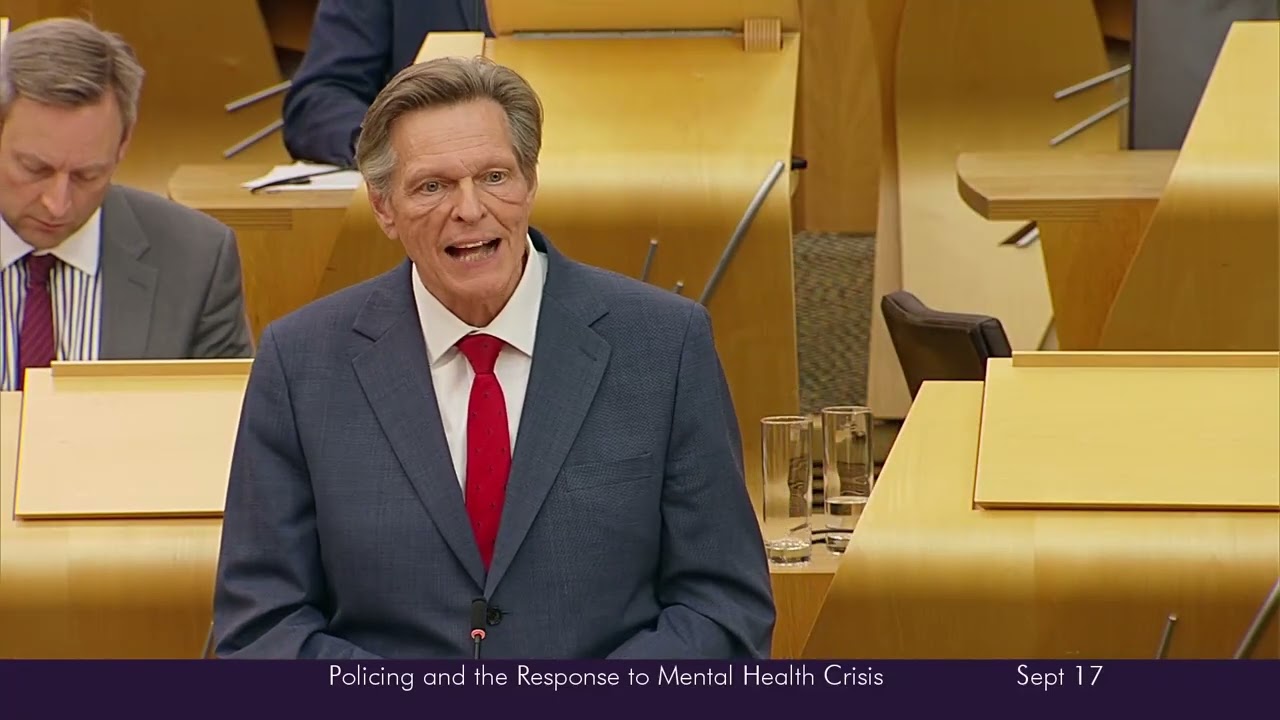
The Response to Mental Health Crisis in Mid Scotland and Fife - 17 September 2026
Watch on YouTubeVideo summary
The parliamentary debate regarding the response to mental health crises in Mid Scotland and Fife highlighted a critical strain on Police Scotland, where officers are increasingly expected to function as social workers rather than focusing on core duties like crime prevention. Data indicates that mental health-related calls have surged from under 400 per day in 2018 to 666 in 2024, absorbing the time equivalent of over 600 full-time officers, with fewer than one in seven incidents involving actual crime. This "mission creep" has blurred the legal boundaries between policing and welfare services under the Police and Fire Reform Act 2012, leading to risk-averse behavior where untrained officers attend calls they are ill-equipped to handle. Consequently, visible policing in rural areas like Perth and Fife has diminished, resulting in longer transport times for detainees due to custody suite closures and a rise in community fear stemming from antisocial behavior and shop thefts.
The discussion further exposed the severe impact on officer well-being, with over 1,000 fewer officers available than pre-pandemic levels and many suffering from mental ill health that forces them to take sick leave or even purchase their own uniforms due to kit shortages. While Minister Kristen Oswald acknowledged this disproportionate burden and cited a partnership delivery group that reported a reduction of over 6,000 mental health incidents since 2024, opposition members challenged these claims as insufficient, noting that frontline officers disagree with the current support levels. Critics pointed out that female officers are disproportionately tasked with mental health callouts and warned against closing crisis centers due to funding cuts, which would force reliance on A&E or police responses during weekends when social work and NHS services are unavailable. The minister rejected the English "right care, right person" framework as inappropriate for Scotland's context, emphasizing instead the need for sustainable local approaches and expanded triage units in cities like Aberdeen, Glasgow, and Edinburgh.
To address these systemic issues, speakers across parties reached a consensus that police should not serve as the default emergency service for non-criminal incidents, calling for a redefinition of legal responsibilities to clarify that "well-being" does not create an open-ended welfare duty. Proposed solutions include investing heavily in preventative community services, third-sector organizations, and housing support to tackle root causes such as inequality and the cost of living, alongside expanding 24/7 mental health triage cars based on upcoming autumn evaluations. The government has committed £17 million to employee assistance programs and is reviewing standard operating procedures under the 2025 Scotland Act to improve police ethics conduct frameworks, aiming to shift toward a prevention-first approach through community walk-in hubs and joint commissions. Ultimately, the debate concluded with strong cross-party agreement on the urgent need to relieve police of mental health burdens to restore their capacity to prevent crime and ensure the safety of communities in Mid Scotland and Fife.
Read the full video transcript
Thank you. If members who are not
staying for members debate could leave
quietly that would be very helpful.
Thank you. We're on our final item of
business. Members business debate on
motion 1039 in the name of Steven K on
policing crime prevention and the
response to mental health crisis in mid
Scotland and F. The debate will be
concluded without any questions being
put and I ask members who wish to speak
in the debate to press the request to
speak buttons now and I call Mr. K for
seven minutes please.
>> Thank you deputy presiding officer.
I'm grateful for the opportunity to have
this issue discussed in the chamber
tonight because the first principle of
policing is not complicated. Sir Robert
Peele's model was built on prevention of
crime and disorder, the maintenance of
public order, and the protection of the
public. Police legitimacy comes from
doing those things effectively with the
consent of the public. However, that
basic purpose has become blurred in
Scotland. Police Scotland is
increasingly expected to be a mental
health service, a social work service,
and under new housing legislation, even
part of the homelessness prevention
system. This isn't right.
Yes, these issues matter, but that
doesn't make them policing
responsibilities.
The police must have the ability to say
this is not our role and other services
must step up to the mark because these
added burdens are putting immense strain
on police resources especially
frontline
resources.
Now, HMICS
found that at times at least half of the
deployable, and that's a smaller number
than the total number of police
officers, the deployable frontline
uniformed officers were dealing with
mental health related calls. Its
conclusion was blunt. Police Scotland
are filling gaps in the health and
social care system.
Figures subsequently given to parliament
are extraordinary.
Mental health related calls rose from
just under 400 a day in 2018 to 666
a day in 2024.
The officer time absorbed was calculated
to be the equivalent of 612
full-time officers.
That is police capacity on a massive
scale being taken away from preventing
crime, investigating crime, patrolling
communities and responding to victims.
And the chief constable herself is now
saying this cannot continue. In her
letter of the 2nd of September, Joe
Farrell said, "Please Scotland recorded
more than 230,000
mental health related incidents in 2526.
around 18% of all incidents and that
approximately 85% of those incidents
involved no crime. She said policing's
role had grown and I quote beyond what
is best for vulnerable people, what is
intended in legislation and what is
financially and operationally
sustainable. So why are police officers
still going to these calls? And part of
the answer to that question is mission
creep. Now the police and fire reform
Scotland act 2012
that gave birth to police Scotland
says that the main purpose of policing
is to improve the quote safety and
well-being of people and communities.
Now that is an unusually broad statutory
formulation. Elsewhere in the United
Kingdom, the core legal duties of police
remain much more closely centered on
protecting life and property, preserving
order, preventing offenses, and bringing
offenders to justice. In Scotland,
well-being has helped blur that
boundary. And over time,
the boundary of the word well-being has
expanded.
In that wording, I don't doubt was
well-intentioned.
But in practice, it has helped create an
open-ended expectation that the police
will pick up whatever other public
services cannot or will not deal with.
It has contributed to a culture in which
the police become the fir the service of
first and last resort whenever another
public service cannot cope. And another
part of the reason is risk aversion.
Officers are understandably concerned
about the consequences for them
personally of making the wrong judgment
call, leaving a person in crisis,
putting the phone down, or deciding
there's no more they can do to help.
This is not healthy.
Officers are being asked to do work they
were not trained for, did not sign up
for, and which properly belongs to other
services. We do not expect doctors or
nurses to tackle crime. Why then do we
expect police officers to respond to
mental health incidents? This cannot go
on. If somebody is committing a crime
poses an immediate threat to life or
serious harm or police powers are
needed, the police must act. But mental
illness alone should not turn somebody
into a police matter. Now the minister
uh who's answering this debate tonight,
I believe needs to answer three
questions.
Will she redefine
the boundary of poling in Scotland so
that health, social care, and housing
responsibilities sit with the
professionals trained to deliver them?
That's the first question. Will she
review section 32 of the 2012 act and
clarify that well-being does not create
an openended welfare duty for Police
Scotland?
Third,
when will frontline officers actually
see the benefit of any changes to their
responsibilities?
Because while ministers talk about
collaboration,
police resources are being consumed,
crimes rising, victims are waiting, and
visible policing is disappearing. The
police cannot be everybody else's
emergency stop. So there's really one
fundamental question that the minister
should address in her response to this
debate tonight. Where does poling end?
Because if government cannot define that
boundary, mission creep will continue.
Frontline capacity already stretched
will continue to disappear. Police
officers will spend less and less time
preventing crime, protecting the public,
and pursuing those who break the law.
And that is surely what we all want to
see Police Scotland doing.
Thank you. Can I remind all members to
please speak through the chair? I call
David Lindon for minutes, please.
>> Thank you very much indeed, Deputy
Officer. And may I start by commending
Mr. KR for securing the debate, a debate
that's very topical. He of course is a
valued member of the criminal justice
committee which this week was taking
evidence um from police Scotland,
Scottish police authority and HM
Inspector of Constabulary on this very
issue. And um although he and I will
often come to debates from from
different um areas certainly politically
and ideologically um I think that some
of the issues that he has raised tonight
are important and and certainly fit
within that wider public sector reform
agenda um that will cast such a shadow
over session 7 of the Scottish
Parliament. But before I go any further
and before I I do get into the the kind
of um the meat of this particular issue,
I do think it's important that the
parliament places on record it sincere
thanks and its appreciation for our
police officers um who work day in and
day out running into incredibly
difficult situations. Um and I pay
tribute in particular to um Chief
Inspector Johnny Waters who leads the
police in Mon Constituency in
Shettleston. Um but Mr. is right to
bring this to the chamber because it is
an issue um that is frustrating uh for
those of us in the criminal justice
field. It's an issue that is no doubt
frustrating for the cabinet secretary
for justice and and Mr. K of course um
put in context some of the challenge but
to to kind of broaden that out a little
bit. I mean we have lost 775,000
poling hours uh last year as a result of
mental health callouts. It's cost police
an estimated 34 million pounds from the
policing budget and we're seeing um
roughly around about5.34
hours taken up on average uh for every
mental health call out. So that is a
colossal amount of police time that
could be spent dealing with issues that
we know are all in all of our
constituencies. So I think he's right to
place that on the record. Um I think
that some some work has been undertaken
um to try and move the dial on this, but
I was certainly very struck um by some
of the written evidence that we had
received from Police Scotland uh to the
committee. Um and in particular a quote
that said, "We have been unable to
generate the momentum and pace of system
change required and mitigate the
immediate pressure which is still
resting on police by default rather than
design." And I know that the previous
cabinet secretary for justice, Miss
Constance, looked at this issue. I know
that the current cabinet secretary is
looking at it. Um, but I do think that
we're going to start having to think out
the box a little bit more on this one
because Mr. K is absolutely right to
acknowledge that there is a gray area
that exists and we heard quite
significant evidence about that at
committee whereby police officers are
turning up at accident emergency areas
and yes for all the body worn cameras in
the world that is still not getting to
the number of the issue why police
officers are unable to do that. I agree
with them. I think there is an issue
about risk aversion and I understand why
police officers particularly because of
the fears of park particularly because
of the fears of peering before
committees like ours if something goes
wrong. So it is in human nature that
people will be risk averse but we have
reached a situation where I think we do
have to look at things differently. I'm
certainly very attracted to learning a
little bit more about the situation that
we explored at committee which is right
to your right person that was piloted by
Humberide police from 202021. Um it is
not a panacea and there are issues that
we're going to have to look at here. But
I think that the this is an example of
where cross government we are going to
have to have further discussions on this
because I can understand that from the
point of view of the health service at
the moment they are stretched. They see
these situations when it's at any
emergency department. Um but one
question that I do have and if I can
press the minister on relates to the
roll out of the mental health triage
cars at my party. Obviously I was
delighted that my party won the
election. Um I'm sure there was a
commitment in the manifesto to roll them
out. Um I think that that would be
welcome but I think we need to have a
much wider conversation in the context
of public service reform where we can
say do we have a place where we can be
dropping people off. Yes, the police
will be called out because of the nature
of these incidents means that there will
be a degree of criminality at times
recorded in that. So the police will
have an involvement in this. But why I'm
absolutely clear about deputy president
officer is we cannot have on average 5.3
hours of policing time being taken up
with these incidents because it's
putting massive pressure on the criminal
justice system and we need to work much
more closely and much less siloed on
this issue.
[applause]
>> Thank you. a cult Liam care to be
followed by Helen McDeed.
>> I'm very grateful presiding officer. I'm
grateful for the early call and
permission to leave early to cover
another event tonight. For nearly three
quarters of my more than a decade in
this parliament, I served as the shadow
cabinet secretary for justice. And
throughout that time, it's always been
the same story. Things like mission
creep in the police are being raised by
the opposition. They are discussed in
the chamber or in committee and nothing
is done. And Steven K is absolutely
right to hammer this point yet again in
his excellent motion today because the
police's own research describes their
officers as a backs stop in the ongoing
mental health crisis. Instead of being
on streets or responding to an instance,
they are babysitting their words. People
in distress in A&E. Incredibly, more
than one in six Police Scotland
incidents were classed as mental health
related in 2024-25.
And the time and cost of this was
accurately and terrifyingly set out by
David Lindon just there. We cannot
continue draining police resources
because the S&P government fails the
health service and won't give the
ambulance service sufficient capacity to
respond.
But this is not only about what the
police have been asked to do and the
gaps they have been asked to fill. It is
also about the impact that mission creep
is having on the officers.
>> As this the Scottish Police Federation
has warned time and time again, the
stress, the pressure, the expectations
placed on officers are going up
exponentially while the resources made
available by the SNP are plummeting. So
when Steven K flags that time absorbed
by mental health incidents was
equivalent to 612 full-time constables,
it is in a context where there are over
1,000 fewer police officers than before
the pandemic. And they are working from
fewer stations with 18 sold between 2023
and 2025 and over 300 of those remaining
requiring repairs. Mr. K.
>> Mr. Okay,
>> my colleague and friend for giving away
because the point is the available
number of officers for frontline duties
is shrinking faster than that number of
lost officers because there are modified
officers, there are officers that
there's a huge sick level. I mean more
than 10% of the forces on absence s
absence at any one time. So that number
is diminishing all the time. Uh and
that's creating a greater crisis beyond
even what we're able to describe in
these words that we're using in this
debate. Liam car
>> my friend is absolutely right on this
because those officers that we've got
unbelievably
some of them are having to buy their own
uniform because of problems with the
standard issue kit and they then had to
use that on the almost 50,000 officer
arrest days which were canceled in 2024
2025 for the reasons that Steven K has
just set out. So it is no wonder that in
that context that last year that 1919
magazine reported that police officers
lost almost 80,000 working days to their
own mental ill health. Indeed in Q1 this
year nearly 32,000
working days were lost to psychological
disorders overworked underresourced and
overlooked by this government. But
presiding officer, in my 10 years here,
there have been four cabinet secretaries
before this one. And in all the debates,
they all gave exactly the same spad
prepared sound bite answers. So, I've
got my bingo card ready, but to allow
the minister to adjust her speech, I'll
warner. What's on it? So, we recognize
the pressure. Well-being is a priority.
Support is available, but it's an
operational matter for Police Scotland.
More must be done. So we are investing
and working with partners and of course
the inevitable we've got more police
support money etc than England yet
nothing changes. It gets worse such that
the data suggests it gets ever more
challenging to serve as an officer in
Scotland. So I beg the cabinet secretary
I beg the minister to go where Yousef
Brown Constance Mat refused to listen to
this debate
listen to the officers. Listen to the
police. investigate the multitude of
evidence that underlying organizational
pressures and mission creep lie at the
heart of this and respond positively to
Steven K's three questions. So I know
sir I would love to see the new cabinet
secretary and minister sort it and I re
uh readily offer any assistance that I
that they need to do so
>> but I fear that the NHS data that the
cabinet secretary left behind when he
was reshuffled in May means I'll wait a
very long time.
>> Thank you. I call Helen McDade to be
followed by Jolong.
>> Sorry, how long did you say?
>> Sorry, four minutes.
>> Four minutes. Thanks. Thanks very much
deputy presiding officer and thanks very
much to Steven Kerr for bringing this
debate forward. Particularly pleased to
talk about this issue and the fact that
it does reference mid Scotland and F. So
I will start by saying an aspect of Miss
Scotland and F and other rural areas.
I've lived in Perser for over 20 years
and I lived in northeast F in previous
occasions. So I do know what life in
towns like Perth, St. Andrews Cooper was
liked and is like now and the atmosphere
has changed. That's not just my
perception. That's what people tell us
when we go around the around the town
centers. The police we used to have I
think approximately four I think maybe
came up to Highland Perser. It's got Pit
Locker, Abberfeld, Dunkel. There's some
issues and obviously there's a lot of
car accidents and and sadly we very
rarely see the police in those areas now
but we hear them nearly every day on the
car accidents and we should take into
account the trauma that that must be for
those police. So their their job has
changed fundamentally in this case not
about mental health except their own and
and I do wish to pay tribute to them
because I hear those sirens and often
the road is closed because it's been a
serious accident. However, talking about
the town center and seeing people around
and perhaps suggesting to ruffians or
whoever might be there that maybe they
shouldn't bother, we never see them. We
never see them. And there is a reason
for that. Um, police Scotland um have
been asked about the closure of the
police custody uh suite in Perth.
Um, and I met the police sergeant as it
happened when I was campaigning and he
asked me what I thought of the police
and I said something and then he started
telling me that he had been the police
custody sergeant in Perth but he now had
to go to Dundee because there was no
custody suite and we hear from other
police that they then don't have
anywhere to take someone if they've got
nothing um you know nothing there they
have to decide whether they're prepared
to drive to Dundee with this person
that's two officers
or even Aberdine if Dundee is full
because there is less and please
Scotland say there is no requirement to
revisit that. I will thank you
>> David Lindon
>> dates um for her remarks so far. Um but
if we're not seeing the police around
too often but custody suites are full,
the two can't be true, can they?
>> Helen McDade.
>> Well, I think they could depending on
how long someone was in a custody suite.
However, I'm not in a position to say
that, but I believe they are true. I was
told by the police sergeant that that
was his experience, and I've been told
by others. However, I mean, I'll be
interested to know what David Lindon's
uh explanation of this perception I
will. Yes, Steven K what Dave is saying
in an answer to David Lyndon's
intervention. The reality is there have
been huge cuts in the capacity of
custody cells. you. It is quite regular
for police officers to have to travel up
to two hours with someone that they feel
should be retained in custody, often for
them to get there, wait a very long time
to be seen, and then for the individual
to be released. So, it is a deeply
frustrating situation. It's born of the
fact that there have been massive cuts
in the capacity and availability of
custody cells.
>> Helen McDeed,
>> thank you. I I welcome both
interventions. And so, that's one
problem. I think we need to also look at
how people are feeling in these areas
which where they don't see police
visibility. Um, and I know from women
about Perth that many women have said to
me that they don't want to walk around
the town center at night in the way that
they used to do maybe as a group of
women that they are frightened to go
across the big areas of grass that we
call the the inches. Um, and the center
is less vibrant. Um, many closed shops.
Um, however, there is a change in how
people feel about that. I've been told
that by many and I've been told that the
taxi drivers, if they're friendly, will
stop and say, "Do you want to lift
because you think you're you're getting
followed?" And shops, the optitians, I
walked up to the optitians, door was
shut, locked. I thought, "Maybe I've got
the wrong time." No, they now have to
lock their door because people were
coming in, stealing all the best
sunglasses, going away, and coming back
a fortnite later and doing it in front
of the staff. the staff had to just sit
there in the way that you were sitting
there do deputy presiding officer and so
that's something that would never have
been contemplated in the past and I know
of a lady who shut her shop because
somebody had come in and given her an
incident and obviously there's always
been crime but the question has to be
asked what has been the benefit to rural
areas from police Scotland and I would
like to see the figures as I as I said
we are aware that there are less about
and where are the police however there
are great examples of the third sector
helping out and I agree
>> the member must conclude. Sorry.
>> Okay. I agree entirely with Steven
Kerr's points that people need that
third sector and there's there's various
good examples of the change mental
health the nuke and community justice
Scotland are doing things. So we need to
look at that but we do need to do
something. Thank you.
>> Thank you. I call Joe Long to be
followed by Maggie Chapman.
>> Thank you deputy presiding officer. I
thank Steven K for bringing forward this
motion today. Uh and I want to start by
recognizing the picture that he paints
of police officers experience and indeed
the experience of those in mental health
crisis. I do so both as a fellow
representative of Midscotland and F and
as my party's spokesperson on mental
well-being. It was precisely through
engagement with the Scottish Police
Federation and in response to their 2023
report on police time spent in mental
health emergencies that Scottish Labour
proposed an emergency mental health
response division across Scotland in our
election manifesto in May. The chief
superintendent publicly raised this
problem of the problem of police time
spent on mental health emergencies as
long ago as 2019 and my colleague Paulie
McNeel highlighted the issue in the
chamber earlier this year. Labour
proposed an emergency mental health
service to ensure that those in crisis
received timely skilled support from
mental health professionals and that
police officers were able to get on with
the job of policing instead of spending
time chaperoning vulnerable people on
A&E wards. Fe was one of the pilot sites
for mental health response cars in 2024
to 25 in which a paramedic from the
Scottish ambulance service and a mental
health nurse attended emergencies
together. The service was funded by F
council and resulted in significant
reduction in the time police spent
supporting people in the A&E department
of the Victoria Hospital. The pilot
originally in Leven and later rolled out
to cover Kicotti and Cowen be ran from
Friday to Sundays on 8:00 a.m. to 6 a.m.
But however, since the pilot ended in
2025, wrangling over funding has meant
that the future of the service has been
uncertain. So I welcome the Scottish
government's commitment to mental health
triage cars in the program for
government. We're very used to seeing
effective interventions piloted but not
scaled up or put on a sustainable
footing. So I will be genuinely
delighted if we start to see more
well-ec programs rolled out in this way.
Just this week I met with Penumbra
mental health uh organization whose team
including peer support workers provide
essential services to people on the road
to recovery. Whether that be through
homebased support for those at risk of
homelessness in F or in the 247 crisis
centers such as Home Point in Dundee.
change mental health has highlighted to
me its work in deploying the distress
brief intervention model in other parts
of Scotland. I also reckon the excellent
recognized the excellent work done in
non-clinical settings like some hes nook
which I had the opportunity to visit in
Glasgow over the summer because the way
to stop people ending up in mental
health crisis is to support those
preventative services and those early
intervention services. There won't be a
magic bullet or a one-sizefits-all
solution, but these models, which have
proven success, together with the
expertise that the third sector brings,
deserve sustainable support and funding.
We need a joined up whole system
approach to mental well-being. The
mental foundation, mental health
foundation highlights how vital it is to
counter the harms to mental health in
the workplace, online, in social media,
and tackling bullying among children and
young people. But we also need to ensure
that mental health is not just a proxy
term for mental ill health. So we must
recognize the positive well-being
effects of community- based services
that not nominally about mental health
at all, but those places, events,
groups, and pastimes that are spaces of
belonging, well-being, connectedness,
and purpose. Yet, these services are
often on the most precarious funding and
the first to be cut when finances are
tight. If the Scottish government is to
succeed with a preventative agenda
around which there is broad crossparting
agreement, this whole system approach
will be necessary to support the
well-being of our people and to let the
police get on with policing.
>> Thank you. I call Maggie Chapman to be
followed by Frieza.
>> Thank you. And I thank Steven K for
securing this debate. We've started some
good conversations on this at the
criminal justice committee. So, I'm
grateful for this opportunity to discuss
further how we can secure safety and
well-being in our communities. The
intersecting crises of climate
catastrophy, cost of living, and housing
all fuel another crisis, the mental
health crisis. Census data shows that
the number of people who report having a
mental health condition more than
doubled between 2011 and 2022, and
Police Scotland being on call 24/7 have
clearly been affected. I mentioned the
other crises because they they cause all
of our services and facilities to be
stretched. University staff report
soaring cases of student mental health
crisis as students struggle to b balance
study and work with poor housing and
decreasing support services. Council
housing officers report increasingly
complex homelessness presentations.
Substance abuse services report clients
declining mental health. Austerity has
taken its toll. The focus of the last 15
years should have been one of prevention
as described by the Christy Commission
and referenced yesterday by Assistant
Chief Constable Katrina Payton at the
criminal justice committee. Instead,
we've seen standards of living fall and
public and third sector infrastructure
not resourced to deal with current
crisis, never mind shift to prevention.
The police are often the only port of
call left. And the over 600 daily police
visits to people in mental health crisis
are not for the most part to people who
have an abundance of wealth and
opportunity. They are happening to
people who are living in homes that they
cannot afford to heat, to those who are
socially isolated because local services
they once relied on have been cut. A
2024 Scottish government survey showed
that 48% of women and 39% of men
reported that their mental health has
been negatively affected by the cost of
living crisis.
No doubt there are similar examples in
midscotland and f but for 25 years
Rosy's social enterprises in abodine in
my region offered specialist creative
workshops for people with mental health
conditions with the products sold
through its gift shop. It provided
inclusion vocational training support
and work experience for people in mental
health recovery. But Rosies has now
closed because of a funding cut made by
Abedine Health and Social Care
Partnership. I'm deeply concerned about
how those affected will be coping. And
of course, police officers should rarely
be the first responders to someone in
mental health crisis anyway. Not just
because mental health professionals are
more appropriate, because the police can
make some mental health crisis worse.
Many people in mental health crisis will
have had previous, often negative
engagement with the police. Just this
week, a constituent of mine in severe
mental distress had six six police
officers turn up to undertake a
so-called welfare check. This
constituent became even more distressed.
They were physically restrained on the
ground. They suffered bru significant
bruising and cuts and ended up being
arrested. I do not believe this would
have happened if a 247 mental health
service had attended.
Aside from being very poor use of police
time, the additional trauma and distrust
will make it harder for other services
to provide support. We desperately need
properly funded urgent response mental
health services. We must expand
>> yes
for giving away. Um I appreciate the
tone of our speech. We come at this
recognizably from different directions,
but I think we've ended up in the same
place, which is to say that the police
should not be the ones who bear the
burden of responding to mental health.
Does she welcome the fact there seems to
be a consensus right across this chamber
from those who've spoken from different
parties tonight that something now needs
to be done to address that fundamental
need?
>> Maggie Chapman,
>> I thank Stephen Care for his
intervention. Yes, absolutely. I think
it's quite clear that while our police
officers should be able to recognize and
support people in mental health crisis,
they should never be the first
responders. We need to we need
desperately to properly fund urgent
medical uh mental health uh response
services. So as David Lindon said
earlier, we must expand the 247 mental
health triage cars pilot piloted in
Dundee
so that appropriate mental health
professionals can urgently attend people
in crisis without the need for police
presence. I hope the minister will give
us an update on on this. In closing, we
need a core minimum of services
available to anyone with mental health
needs and we must all recognize the
links between inequality and poor mental
health. Ultimately, poor mental health
is, as Professor Claire Bambra says, the
human price of the economic decisions we
make. We can choose to create a country
where people have access to warm homes,
decent incomes, good health and social
care when they need it, opportunities
for social connection, and hope for a
live livable future. Then we will have
addressed the mental health crisis that
is causing the problems for our police
service that we discussed today. Thank
you.
>> Thank you. Before I call Mr. Fraser, due
to the number of members who still wish
to speak in the debate, I'm minded to
accept a motion without notice under
rule 8.14.3
to extend the debate by up to 30
minutes. And I now invite Mr. Steven K
to move the motion without notice.
>> Moved.
>> The question is that the debate be
extended by up to 30 minutes. Are we all
agreed?
>> Thank you. That is agreed. and I call
Mr. Fraser to be followed by Julie Mcd.
Thank you presiding officer and can I
commend my friend Steven K on securing a
debate on this very important topic and
it's clear from the contributions we've
heard so far from all different parts of
the chamber that there's a huge degree
of consensus around this particular
issue and I was very struck by the
comprehensive briefing from the Scottish
police authority that was supplied to us
where they say uh policing has become
the default first response service to
people experiencing mental health
distress and crisis and is clearly that
should not be the case but that is the
reality as we've heard from Mr. care and
others. Uh and the figures quoted by the
Scottish Police Authority are stark. In
the year 2025 to 26 alone, the police
had 234,000
mental health calls. These accounted for
22% nearly a quarter of all police
deployments.
that represented, as David London said,
775,000
policing hours or the equivalent of 481
full-time equivalent officers fully
employed. And the most stark statistic
in relation to all that is only 13%
of those callouts result in a crime
being recorded. Fewer than one in seven
are actually related to criminal
activity. This is the police being
diverted as Steven K said into social
work, something that should not be their
core activity instead. And it's a common
complaint across mid Scotland and F uh
and and I'm sure is the case in other
parts of Scotland from communities that
they feel a lack of a police presence.
They don't see police in their
community. When they do call the police,
often perhaps for something that's not
an emergency, they have to wait a long
time for a police officer to attend. And
seldom do they see police out on foot
patrols, which as we know is a good way
of deterring low-level crime and
antisocial behavior, which plagues too
many of our communities. But the police
are starved of resources. The Scottish
Police Authority say they want more
visible policing because that's what the
public expect. And they know that deters
crime and antisocial behavior and they
are right to make that call. And the
police locally in the area Steven K and
I represent do need more resources. We
know there are fewer police officers
today than there were when the SNP first
came to power as Liam K made said in his
particular contribution. And there's a
particular issue in Perth and Canross.
Helen McDeade made a very fair point
about the closure of the custody suite
in Perth a number of years ago. That
means if somebody is picked up in Perth
and can Ross and has to be taken into
custody, two police officers have to
accompany them to Bell Street in Dundee
and sit and wait while they are
processed uh and taken away before they
come back uh into Perth and Ross. But
even more seriously in this in this
context, the nearest uh mental health
admitting facility in Perth and Ross is
Cars View in Dundee. And you then have a
situation where somebody who has to be
taken into mental health custody. Two
officers have to accompany them to cars
view. They can be sitting in cars view
from what we've heard from the local
chief inspector sometimes for for hours
while they're waiting for that person to
be admitted before they can even
consider coming back to resume their
shift. And it's ve very possible and
very frequent. You could have two
officers spending their entire shift
just accompanying one person to carry
and that's taking police away from the
streets and away from their core
activities. So the point has been made
by others. We do need alternative
pathways. It shouldn't be down to the
police to become social workers. What we
need to do is take the burden off the
police and get them back to what should
be their core activities of detecting,
solving and detering crime. That's what
the public expect and that's what the
Scottish government need to get on and
deal with. Thank you, presiding officer.
>> Thank you. I call Julie McDougall to be
followed by Kate Nebans. Four minutes.
>> Thank you, Deputy Presiding Officer. And
I just want to congratulate Steven K for
bringing the forward this important
debate this evening. Uh most things have
been covered but I'll I'll carry on with
what I've got here to say. So our police
police officers as we know play an
essential role in ensuring that we are
all kept safe. Um and as we've heard
they do an excellent job under these
very very difficult circumstances but
they should not be expected as already
mentioned to act as emergency social
workers. Their job is to deter crime as
we've heard and catch criminals and that
is something that we should fully
support them in doing. Um I know myself
only too well um in my role as a f
counselor about the difficulties that
our communities um are facing um even
trying to access the police. when I
attend meetings locally with
organizations, community councils and
people at the grassroots of the
communities and constituents, they all
still come to me each week. Um, and
these complaints are about antisocial
behavior, shop thefts, and day-to-day
crimes which simply are not being
addressed. But I do want to stress, as
has been mentioned, that the blame is
not on individual officers across my
area or anywhere else. they are doing
their level best and I speak regularly
with the police on these matters. It is
the deep structural issues as we're
mentioning today with the policing
system that are causing this which
ironically will cause more mental ill
health because of our constituents
bearing the brunt of unchecked crime in
their areas. But regarding the motion at
hand, um I want to shift focus to
another fundamental issue which has been
touched upon and but I don't feel has
been addressed maybe enough um in
general. Rather than ask what our police
can do for us, we need to be asking what
we can actually do for our police um and
and make sure that um when it comes to
their own well-being that we're
considering this. I also believe that in
our modern system of policing and
damaging um government policies have
resulted in more undue stress being
added to the role. Um the S&P's initial
merger of Police Scotland back in 2013
was supposed to reduce these pressures
and make policing more efficient and
accountable. But over 10 years on it it
has only made these issues much worse.
These there are notable examples of
bullying and harassment within police
Scotland which I have attempted which
have been attempted to be swept under
the rug. The Rona Malone case from a few
years ago is one of them, but there are
plenty um of under reportported
instances of individual officer
misconduct which can see those accused
um being suspended with pay for years on
end before justicees served in some
cases. His m majesty's inspector of
constabularary in Scotland have even
went as far as to report that this
damning delay in justice has left
victims serving the police feeling
suicidal.
Is that really good enough um for our
brave policemen and women? It cannot be
understated how much this damages the
effectiveness of policing in our
communities and it demoralizes our
officers. It deters newcomers into the
force and ultimately it pulls these much
needed resources away from the real
problems on the streets which I've
pointed out earlier. So this is not even
mentioning some of the other issues
spurred on by the S&P government short
change in our police such as the closing
of local police buildings across
Scotland which has also resulted in the
Scottish police officers being
encouraged not to make arrests
um amid capacity issues. And who could
forget the utterly embarrassing hate
monster campaign from the last session
which was the result of Hamza Ysef's
government essentially forcing Police
Scotland to justify his deeply unpopular
attempt to erode free speech in
Scotland. All of this is to make the
point that even if we were to accept the
premise that our police should be there
to take on mental health as part of
their role, there will simply not be
enough officers to do so as a result of
the consistent underfunding and the
undermining of basic police services.
For policing to work, we need to believe
in our police and the police also need
to know that we believe in them. and I
look forward to working with colleagues
across this chamber and local police
representatives across my region to make
sure that we get this right across mid
Scotland and five. Thank you.
>> Thank you. I call Kate Neans to be
followed by Miles Briggs. Uh thank you,
Deputy Presiding Officer. I'm aware that
Steven Kerr and I don't always see eye
to eye on matters of criminal justice.
Uh but today I'm very happy to say that
I support this motion and would like to
thank the member for bringing this topic
to the chamber for discussion. I too am
really worried by the evidence that
there has been a rise in mental health
calls to the police and that police
Scotland is essentially filling gaps in
the health and social care system in
Scotland. People experiencing mental
health crisis should always have access
to the most appropriate service and the
police are rarely that service. Police
Scotland themselves are declaring that
they are under unsustainable pressure
from mental health incidents. Officers
told the review team that is not unusual
for half of the deployable frontline
frontline uniformed officers to be on
mental health related calls at a time.
Expecting overstretched and inadequately
trained police teams to be the primary
response to mental health crisis risks
leaving extremely vulnerable members of
society without the care they need and
can also further stigmatize people
struggling with mental health issues.
For me, this discussion really
highlights the need to move more funding
into community mental health support,
transferring mental health responses
from Police Scotland to properly funded
community crisis services and enabling
us to reduce police callouts. taking
inspiration from communities around the
world like those in Minneapolis where
local governments have been voting in
favor of proposals to reduce their local
law enforcement budgets and remove
police as responders for noncriminal
calls in areas such as homelessness,
mental health, and substance abuse. It's
sadly no wonder that we're seeing this
rise in mental health calls at least
after decades of austerity and declining
funds to our mental health budgets.
If we want to support the long-term
safety and well-being of our
communities, we should be prioritizing
funding preventative services and
addressing the root causes of poor
mental health. And as change mental
health tells us, we should be using
every opportunity to protect and enhance
local mental health crisis pathways.
Investing in community support is also
particularly important when trust in
policing is not shared equally across
society. For example, participants at
focus groups being run by LGBT health
and well-being discussed at length the
significant lack of trust minority
minoritized communities have in policing
and police Scotland with past negative
experiences and systemic inequalities
contributing to hesitancy in seeking
police support. As today's debate is
also about Mid Scotland and F, I feel it
is also important to pay tribute to the
family of Shakub Bio. Fighting now for
over a decade to uncover through a
public inquiry whether race played a
role in Shaku's untimely and tragic
death at the hands of the police. Shaku
was aged just 31 and clearly
experiencing a a crisis. Shaki's family
are still waiting for answers from the
inquiry and I hope they get the solace
and answers they need and deserve soon.
In 2023, Scotland's police force
acknowledged it was institutionally
racist and discriminatory and the chief
constable made a set of commitments to
Shaker Bio's family about understanding,
recognizing, and acting upon
institutional racism within Police
Scotland. Yet, Police Scotland's chief
officer team still does not have one
person from a minority ethnic
background. We've heard very little more
on these commitments since.
The lessons of the Shaker Bio case
demand that we listen to communities and
ensure that people with experience of
racism and other forms of discrimination
help shape the services intended to
support them. That we push for
anti-racism education in schools and
police and justice practices while also
recognizing that our communities and in
particular our marginalized communities
are not best served by the police when
experiencing a mental health crisis. And
ultimately, we need to be investing in
inclusive me community mental health and
broader support services to keep our
communities safe and well. Thank you.
>> Thank you, Miles Briggs.
>> You Deputy Presign officer and can I
congratulate my friend and colleague
Steven K for securing this debate this
evening and I think it is a timely
debate especially given the government's
approach to what could be a significant
redesign of services. So I hope the
cross party consensus which I think is
emerging about needing a new model um is
taken forward urgently because speaking
to police officers in my own region I
know how frustrated they have become and
as Murder Fraser outlined we need to
look at what is a positive outcome for a
police response to a mental health uh
crisis because sitting with an
individual in A&E um for sometimes um a
situation where some medical review
medicine review might take place before
returning that person home is not a use
a good use of anyone's time including
A&Es. Now I visited a few weeks ago in
Aberdine the nuke and was really
impressed already by the data they
shared with me about how they are
actually being the first point of call
that they're taking someone in mental
health crisis and working with them. Now
they're building strong links with the
police who are obviously transporting
them there in some cases, but I think
there's a real good opportunity to see
that expanded. The one in Abodine and uh
Glasgow are operational. There's one
soon to be in Edinburgh. But that is a
good model, but we don't need to just
look at that. We can look at as uh David
Lindon mentioned the right care right
person framework which is delivering
great results in England. The National
Police Chief's Council in England has
suggested this has saved over 1.1
million officer hours with that new
approach. So we know what works in
England and we need to adapt it here in
Scotland as soon as possible. Unless
there is an immediate risk to life, the
police response is not to attend. Now I
think personally I think that a police
response is not an appropriate response
to a mental health crisis and so we need
to develop the services which will meet
that head on. Now I spoke to a number of
police officers uh over the summer
recess about this issue. Um, in fact,
one who has left the police service
because they'd had enough of how they
were being treated. And there was also a
key message I took from a meeting I had
that many police, female police officers
now complain that they are the ones
being tasked with responding to these
callouts. Now, I don't have evidence
that that is the case, but that's what
I've been told by female police officers
and wanted to raise in the debate as
well. Now Maggie Chapman made a
important point I think in relation to
IGBs because over the last five years
serving as a member of parliament for
Edinburgh. Every year I have campaigned
to stop our crisis center being closed
by cuts to the JB. So what
infrastructure we have is slowly being
eroded as well and that's something I
hope the minister also considers.
A&E we were told would be the response
that if they closed that service they
could go to A&E without an accident or
an emergency but that would be where
they would be taken and at weekends we
need to really understand and consider
what is the response because often there
is no social work or NHS services and
that is when the police are the only
response available. So what is that 247
service actually look like because I
don't think we've really developed that.
So to close, Deputy Presiding Officer,
um as I return to covering the health
portfolio, I am disappointed that we've
not seen any real progress on this. I
raised these issues in health committee
during my time and hoped we would as a
country have adapted some of these uh
new models which have worked in England.
I hope this debate and the minister's
response sees this new approach and we
urgently look towards changing how the
police respond. Thank you.
Thank you. I call to respond to the
debate. Minister Kristen Oswald,
>> presiding officer. It's a pleasure to
respond to this important debate to
thank Mr. K for raising the topic and
all members for contributing. And I want
to start by echoing what David Lindon
and Julie McDougall said and convey all
of our sincere thanks to police
officers. And I want to acknowledge that
police officers deployed to mental
health incidents are taking up a
disproportionate amount of officer time
and we are seeing the impacts this is
having on communities and officers.
Police officers should not routinely
find themselves carrying
responsibilities belonging elsewhere in
the public sector. So the cabinet
secretary and I hear the calls from
police officers, the Scottish Police
Federation, the Association of Scottish
Police Superintendent and the the Chief
Constable. I want to reaffirm to them
and this chamber that the Scottish
government is committed to working with
partners to address the challenges
highlighted and to take forward mental
health and poling reform following the
inspectorate thematic review. Public
service reform indeed mental health
service reform is a priority for this
government. The Minister for mental
well-being, the cabinet secretary for
justice and I are all committed to
ensuring people in mental health
distress receive the right support in
the right place at the right time.
Indeed, I know that the cabinet
secretaries for justice and health have
met on this specific topic. But mental
health and distress are multiaceted
issues as Maggie Chapman very eloquently
outlined. And we know that a range of
factors contribute to our mental health.
We can't just address mental health
without also considering employment,
housing, cost of living, opportunity,
and people's relationships. That
requires a whole system approach. And
we've heard that in this chamber.
People's lives are also increasingly
complex and responding to mental health
distress doesn't neatly fit into clear
organizational boundaries.
I would like to say that in response to
the inspector's thematic review, a
partnership delivery group has been
established involving the Scottish
government, Scottish Police Authority,
Police Scotland, Cosa, and other
partners to take forward a collaborative
approach to help improve our emergency
and unscheduled mental health care
pathways. The group developed and
published a framework for collaboration
and a collaborative commitments plan
last year. We're 18 months into this
program of work and we are seeing the
benefits and I know that's something
people have been interested in. I'm
going to make some progress but I'm
going to try and address the remarks
that people have made in my speech which
I hope you will find helpful. So in
relation to some of the points raised by
Maggie Chapman, each health board is now
providing access to a mental health
clinician 24 hours a day, seven days a
week for those who require urgent mental
health assessment or urgent referral to
local mental health services. Police
officers have 24/7 access to those
mental health clinicians. NHS 24's
dedicated mental health hub within the
111 service ensures that emergency calls
from people in distress or in need of
mental health support gets advice get
advice from trained professionals 24
hours a day, 7 days a week. And the
enhanced mental health pathway ensures
referrals from police to NHS 24 mental
health hub are carried out safely and
effectively. And last but certainly not
least, the Scottish ambulance service is
operating mental health paramedic
response units. This is of interest to
to colleagues in the chamber in Glasgow,
Dundee, and in Bernese. And we recognize
that all of this work sits in an
environment of rising mental health
demand. Police officers will always
encounter people in crisis. They have a
vital role in protecting life and
keeping communities safe. And I'm
encouraged that we are doing the right
thing here. The 2026 partnership
delivery group report shows a multi-year
reduction in the number of placing
mental health incidents down by over
6,000 incidents since 2024. That's one
of the things that uh Mr. K Steven K to
many Mr. Cares this evening um asked me
to to look at and I think that there
were a number of very serious points
made. Uh Steven K was interested in
section 32 of the 2012 act in relation
to well-being. And I would say to him
that I don't consider that the
definition of well-being in itself is a
a cause of demand. But I think that the
challenge that we face is broader
pressures across the the public services
and society. The Scottish government is
looking um at a national review of
Scotland's strategic police priorities
to ensure that they remain relevant and
responsive to the needs of Scotland's
communities. give way.
>> I'll give way briefly, but I don't have
a lot of time
>> because I respect where the minister's
coming from. She's she's got her brief,
but I have to say to the minister
sincerely that her understanding of the
of the the effect of the framework is
grossly overexaggerated because the
evidence that we've collected at the
beginning of our time as a criminal
justice committee suggests that the
modest progress is next to zilch and
police officers on the front line would
not agree with the way she's
characterized the available support that
they have for for them in terms of that.
and and and so I would ask her please to
speak herself to the federation, talk to
the superintendent. They will tell you a
completely different story and serving
police officers are telling us a
completely different story than we're
getting tonight from the minister.
>> Minister, I'm grateful to Mr. Care for
that intervention. I'm going to try and
make progress now. So say to members, if
you can bear with me, no, I'm going to
make progress now. As I've said, that
was a a long intervention and Mr. is
quite right to make an intervention if
he wants to, but there are things that I
would certainly want to cover. Um, so
another thing that he asked about was
the the boundaries and, you know, I
think that the the importance of
understanding what these are um is is a
a reasonable point. Um, the the Scottish
government is aware of the um standard
operating procedure review, which Police
Scotland um are looking at. They're
consulting with partners on that. Um,
and I think that, you know, that that's
an important point. Our focus here is on
making sure that people experiencing
distress or crisis receive timely and
appropriate support and that all plays a
part of that discussion. He did ask
about when we would begin to see the
benefits and I think I've covered that
quite adequately um already in terms of
the the data but this is an ongoing body
of work. So you know his point in terms
of this being somewhere that we are
moving towards rather than having
arrived at I think is a reasonable one.
Mr. London talked about mental health
triage cars as did Mr. Long um which we
have have spoken about but there is a
commitment to expand these cars from the
the services that are already there uh
based upon the evaluation of uh the
these three locations that evaluation
should be with us this autumn and then
Mr. Lynon and also Mr. Briggs talks
about the situation in England and Wales
and I would say to them that please
Scotland, the Scottish Police Authority
and the Scottish government agree that
that is not the right approach here in
Scotland uh where we have a continued
approach to partnership working
particularly in light of the recent
findings from Coronial Inquest resulting
from the implementation of that policy
and there was evidence in the committee
last year from the assistant chief
constable that the approach we have here
will be far more sustainable which I
think is an important point. Mr. Liam K
um asked about um as did Julie McDougall
um the the mental health of police
officers. I think that's a really
welcome and important thing to to raise
that there is significant investment 17
million pounds of investment in employee
assistance as well as mandatory mental
health interventions. But I think it's a
serious point and one that we should
continue to uh continue to give time to.
police uniform he also raised and I
would say that's a a matter for the the
chief constell but obviously my
expectation is that people have the kits
that they need Kate Nevin um I would
point to the new police ethics conduct
and scrutiny um Scotland act 2025 which
I think will answer her questions um
public trust in policing is really
important so presiding officer our
ambitious program for government does
reiterate a prevention first approach
across public services that's echoed in
the health and care improving flow plan
that aims to ensure we have one
connected system with simple routes to
care. Mental health obviously being key
there as well as early intervention. It
also outlines our support for expanding
community walk-in mental health hubs and
investment in third sector support
services. I know that some of these will
be items of interest to Mr. Fraser and
Kate Neans who raised these issues. When
somebody is in need of emergency mental
health care, we want to ensure they can
receive that appropriately and in a
timely way. And that's why our focus is
not just on improving access to support,
but on building a stronger system. We
will strengthen crisis support through
the new paramedic response units, expand
access to help by delivering
psychological therapies through NHS 24,
and fund better support for children and
young people in crisis. In addition,
there is a joint commission between
Police Scotland and NHS board chief
executives to move faster on reducing
inappropriate police demand and
improving access to timely mental health
distress and support. I thought that um
Hel Mcdeade made some important points
about partnership working um and would
um absolutely reflect on what she says.
So taken together that comprehensive
package will improve mental health and
well-being in communities, a point that
people made. And I think [snorts]
presiding officer, I'd like to finish
where I started um with a a note of
gratitude to the police. Confidence in
our police service is vital for a safe
and just Scotland. The majority of
adults are confident in the
effectiveness of our police to deal with
incidents to solve crime to catch
criminals. So I look forward to
continuing working in this space with
Police Scotland, with the NHS partners
and with members across this chamber in
delivering this vital program of work in
this vital area.
That concludes our business and I close
this meeting of the parliament.