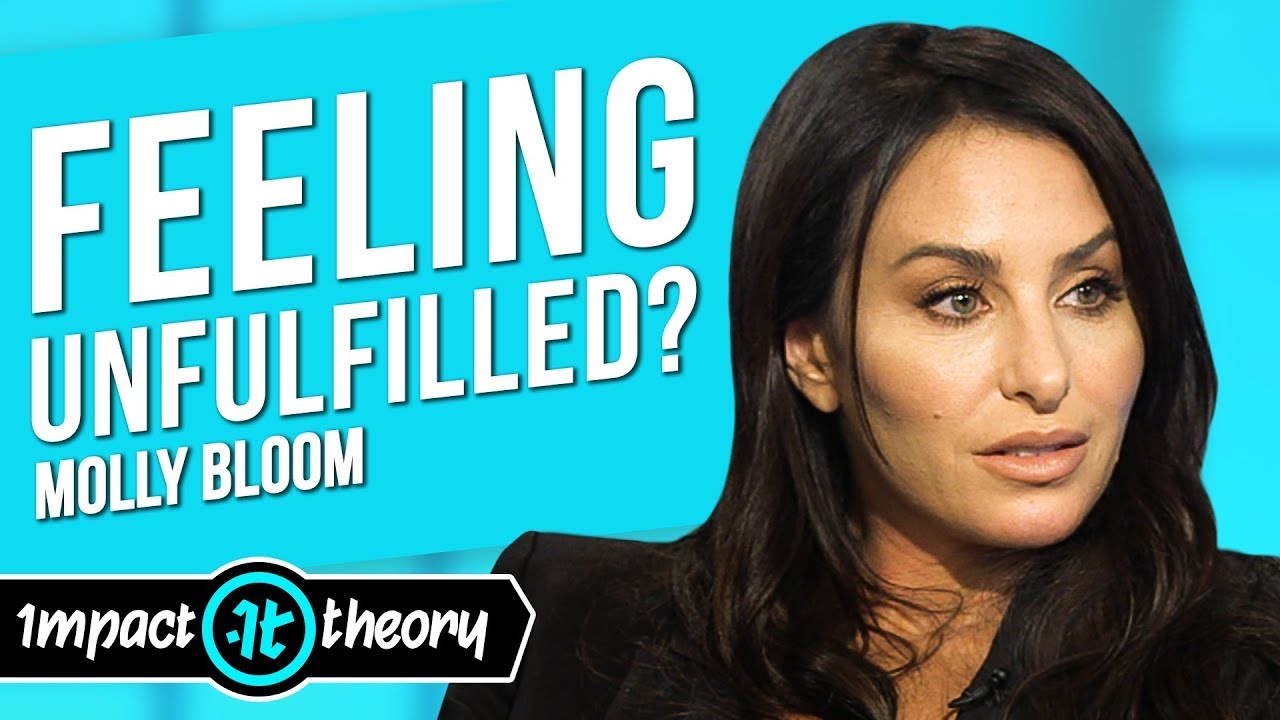
The Real Woman Behind Molly's Game on How to Reach True Fulfillment | Molly Bloom on Impact Theory
Watch on YouTubeVideo summary
Molly Bloom, a former Olympic-level skier and best-selling author known for her role in *Molly's Game*, reflects on how she sought fulfillment through high achievement within a family of massive achievers. Initially driven by a desire to be powerful, make money, and have agency, she built an exclusive underground poker game that eventually handled over $100 million per night with elite players ranging from celebrities to Russian mafia ties. However, this path led her to become someone she did not like, resulting in addiction, isolation, and legal trouble when federal agents arrested her at gunpoint for refusing to cut the mob a deal. When offered immunity and restitution by prosecutors, Bloom realized that external success was meaningless without internal integrity; she recognized that no amount of money or freedom could compensate for acting without dignity, courage, or integrity, which had left her miserable alone in an apartment addicted to drugs. The core lesson Bloom draws from this experience is the concept of "constructive suffering," where one must endure discomfort and fear rather than avoiding them, a discipline instilled by her father who forced her into dangerous situations like jumping off cliffs while skiing with metal rods fused to her spine. She explains that fear acts as the greatest thief of dreams, but overcoming it creates an empowered feeling of pride upon succeeding despite terror. After being leveled financially and reputationally in her thirties, she entered a "survival mode" where having nothing left to lose gave her pure confidence and fearlessness. This mindset allowed her to strategically pivot from a convicted felon with no assets to writing the book that secured Aaron Sorkin's involvement for *Molly's Game*, demonstrating an entrepreneurial spirit born of necessity rather than innate background. Bloom emphasizes that becoming formidable is not about avoiding failure but about leveraging an internal refusal to quit, even when facing catastrophic setbacks like losing one's reputation or freedom. She attributes her ability to navigate Hollywood and rebuild her life to a daily program of action involving meditation to train the mind and working on character flaws such as selfishness and fear through specific contrary actions in real-time. For instance, she practices identifying moments of self-pity and replacing them with gratitude, which over time builds unshakable confidence and emotional intelligence. She also highlights the importance of surrounding oneself with honest accountability partners rather than sycophants to identify blind spots that trip people up, noting that true success requires changing one's own nature rather than accepting limitations as fixed traits. Furthermore, Bloom advocates for women to lean into their femininity rather than imitating men in male-dominated fields, arguing that her unique perspective allowed her to build a community-focused experience around the poker game by focusing on mythology and fantasy rather than just high-stakes gambling. She details how she curated an unforgettable environment with custom candles, attentive staff who memorized guests' preferences, and tables of extraordinary people, proving that creating exceptional experiences drives success more effectively than technical expertise alone. This approach was rooted in her belief that solving problems for others without being asked is one of the best ways to cultivate relationships and build a thriving network, turning a simple game into a sanctuary where participants could escape their daily lives. Ultimately, Bloom's journey illustrates that true fulfillment comes from living a principled life aligned with integrity rather than chasing external validation or wealth at any cost. She shares insights gained from her 12-step recovery program, emphasizing the ability to ride out uncomfortable emotions without numbing them and finding joy in ordinary moments instead of relying on explosive highs like winning millions at poker. Her upcoming book and app aim to provide a gamified, community-supported system for people to train their minds, work on character flaws daily, and connect with others facing similar challenges to tap into the power to make choices aligned with their deepest desires. By combining strategic execution with spiritual growth and relentless perseverance, she demonstrates how anyone can reclaim their life from ashes and become formidable again through consistent effort and a willingness to face fear head-on.
Read the full video transcript
When I
started running these games, I was
definitely looking to prove something
and looking to fulfill something that
was deep inside of me that felt
unfulfilled. And probably what that was
was growing up with this
in this family of massive high
achievers. And so I went out into the
world
deciding that the way to get the lambs
to stop screaming, if you will,
was to be somebody, to make a lot of
money, to be powerful, to have agency.
And um so I was just going. Right? And
so I went out and I did that.
And then it was never enough.
And I became someone I didn't like.
And so the lesson I learned when it all
fell apart
was that
there's no amount of money and there's
no amount of freedom and there's no no
type no situation where I can enjoy it
if I don't like who I am and like the
choices that I'm making.
And don't feel like I'm acting with
dignity and don't feel like I'm acting
with courage and don't feel like I'm
acting with integrity. Like I I really
ended up in that scenario addicted to
drugs,
alone,
you know, and and very miserable.
And so
when when the prosecutors put this this
deal on the table, we'll give you all
your money back
and you and we'll give you immunity.
Um
I knew that the
the only shot for me to have a second
chance, to have a a second act,
was to continue to act with integrity.
Hey everybody, today's episode is
brought to you by our very own Impact
Theory University. Enjoy the episode.
Hey everybody, welcome to Impact Theory.
Today's guest is a best-selling author,
much sought-after keynote speaker, and a
former Olympic-level skier who at 21 was
ranked third overall in North America.
She was, however, also arrested at
gunpoint by 17 federal agents, faced
down a decades' worth of prison time,
and got beaten up by the mob for
refusing to cut them in on an illegal
high-stakes poker game she was running.
And it is no wonder the mob tried to
push in. She took a relatively small
game run out of a dingy back room of a
Los Angeles nightclub and turned it into
the most exclusive high-stakes poker
game in the world. The game would
eventually become so successful that
more than $100 million could change
hands in a single night. And the players
around the table were some of the
wealthiest, most influential, and most
famous people on the planet. From A-list
celebrities to elite bankers, hedge fund
managers, and ultimately people tied to
the Russian mafia. The extraordinary
story of the game itself and her
steadfast refusal to save herself from
prison time by ratting out anyone
involved drew widespread media
attention. She's been featured on
countless shows including Ellen, Vice,
and NPR, and had her life story turned
into the award-winning film Molly's Game
written and directed by Oscar winner
Aaron Sorkin. So, please help me in
welcoming the woman who just 1 year
after emergency back surgery and being
told she would never ski again ended up
not only back on the mountain, but
making the US ski team, the unsinkable
Molly Bloom.
How are you doing there, my dear? How
are you doing? So good. Thanks for that
intro. Oh my god, your story is insane.
It's insane and at the same time this
really cool tale of getting great at
something.
Is that part of what you think has
resonated with people that you were able
to
create this thing that garnered so much
attention from scratch and that you had
to fight like tooth and nail to build
it. Yeah, I I think a
a big part of it is the underdog story.
You know, nothing I have ever
wanted to accomplish, um
I was primed to do, right? It was I was
never the the mathematician, I didn't
know anything about poker. I was coming
from a pretty big deficit uh with with
mogul skiing having, you know, my
entire
top spine fused together and two metal
rods and and then, you know, really
living my life on fire and blowing it up
and then having to wage the comeback, um
I think
is something that gives us hope, you
know, that
the underdog story, the redemption
story.
Um and then, you know, there's the
entertainment value of the mob and
celebrities and hundred million dollar
poker games.
It's so crazy. There's a concept that
you've talked about that you call
constructive suffering. What is that and
what role has that played in your life?
Sure. Um
as a as a young kid, um
as an athlete,
you know,
I didn't wake up one day knowing how to
ski 30 miles an hour through a minefield
of moguls, launch myself into the air
and do inverted and rotational tricks.
And everything about that in the
beginning
felt dangerous, both mentally and
physically and wrong. Um and so you sort
of embark on this disciplined course of
action
in which you feel uncomfortable and it
feels bad, but you keep doing it.
And I think that I've applied that in
academics and business and and in
sports. Do you think that's something
that's teachable? Like the interesting
thing about the relationship between you
and your father, at least as it plays
out in the movie, is that
you know, he's obviously pushing you
very hard. There's the element you've
talked very eloquently about the desire
to please, the desire to hear the
applause that pushed you.
Yeah. Um
how much do you think is is innate in
you that you just wanted that and how
much was it that um your dad was
coaching you and molding you to be like
that and do you think that's something
that you could teach somebody else?
Um I do and I think the part that was
innate in me is innate in almost
everybody and I think that's a deep
desire to have a significant life. And
to and to have a big life.
Um what I didn't know
it was how to do it.
Um and again as a kid or even as an
adult if you don't understand
feels bad
a lot of the time and is inglorious a
lot of the time and happens in the dark
and in in the in betweens um then you're
just listening to your body or your mind
and it feels wrong and so I'm very
grateful that I had a father um
who pushed me really hard. Um we weren't
always great friends.
You know and I guess that was his his
sacrifice for us is that being a parent
isn't a popularity contest all the time.
You prepare your children for life and
to be formidable.
How do you become formidable?
You keep getting back up.
Is is it about skills? Like you're
trying to get so good at something or is
it a mentality? Is it your ability to
face fear? Because obviously in your
story once you really get into your
world and understand it you could go
yeah she is somebody who's formidable.
But if you had to like break that down
into like discrete skills what is it
that actually makes you that way? Well I
certainly didn't start out life
formidable I you know and I don't really
think anyone does except for like maybe
people who are you know like it was a
crazy
improbability for them to be born like
they're already maybe a little
formidable. But I think um I think and
I've made so many mistakes and I've
failed at so many things um but I think
I just always leverage this thing inside
of me that again I think everybody has
which is I'm just not going to quit. I'm
just going to keep coming back at it.
And and then when you get through
something like that and you have the the
perspective and the hindsight, you
realize that this thing that was the
worst thing in the world that broke your
heart and crushed you and brought you to
your knees
that it was the getting through that
that that gave you the biggest gifts.
You know, and that enabled you like
there's not much that rattles me now.
You know, there's not much that scares
me and if it does
I know that you just that you just
persevere through that. I mean, you
know, in some ways when my life fell
apart, it was the most liberated I've
ever been because for the first time in
my life I didn't feel that I had to
impress the world. People had written me
off. And so all of a sudden it's just
you.
Right? With no expectations. And that
liberated mindset is something that
affected me um deeply and that I
remember and that I continue to try to
replicate. Um so I think from being
formidable is just continuing to go at
it and being willing
to to get crushed, you know? The
willingness. Mhm.
How did your and forgive me if I'm
making an assumption that isn't true,
but I'm assuming it was your dad that
really helped you when you were young
learn to process fear, to move towards
it, to push past it. What
what did he actually have you do that
got you comfortable with fear?
He didn't allow it. Okay, so some ki-
kids aren't allowed to like not clean
their room, right? Or like they get
grounded. My dad it was like it if we
were on top of a of a of a hill and and
like he decided that everyone was going
to jump off this cliff, you know,
skiing.
If I didn't do it, like I was in big
trouble.
You know, and so what happened there is
massively uncomfortable in the moment,
right? But what happens there is you're
standing at the top of this mountain,
you're looking at this cliff or this
mogul or whatever, you know, and saying,
"I can't. There's no way. Like, I'm
terrified of this." And if you would
have just quit,
you don't have that empowered feeling of
doing it
because you're terrified, but doing it
anyway, getting to the other side of it
and going,
"Wow, I like I feel so proud of myself
and also just because there's all this
fear doesn't mean I can't do it anyway."
And I guess that was the biggest
takeaway. And listen, you could
definitely argue that I took that
concept too far, right?
Like, there was a time in my life where
I should have been paying attention to
fear
and wasn't, but um it's the balance. But
I do think that fear is the greatest
thief of dreams and a and of a
fulfilling life. Mhm. If you had kids,
how would you push them? Would that be
something for you where you didn't allow
fear, either?
So,
it's interesting that you ask because we
are embarking on that journey now.
Um and and so I'm thinking about it a
lot. Um
And and I think for me,
I I'm better for how my father raised
me, right? But I wish he would have been
more of my friend while doing it. And
you know, he did the best he could. He
was a young dad. The the way that he
behaved was in our best interest, he
believed. But I think especially in this
day and age, like, yes, I think my kids
will be required to to finish what they
start, to take everything seriously that
they do. That was another thing my dad
did with us. It's like, we had to put
our name on everything we did. So, if it
was a chore, if it was a a family bike
ride, there was this pursuit of
excellence that needed to be honored.
And that's a huge asset in life. Um
that's where you're you can you find
yourself continually going above and
beyond where most people aren't, you
know?
But I think I I will take into account
all these lessons and but I think I'll
be like less psychotic about it.
Like, no. Like I'll be their friend
while I'm doing it. Like, "Kiddo, you're
going to have to jump off this cliff.
I'm sorry. That's just the way it is."
Instead of like, "You're going to be
grounded for the rest of your life." You
know?
You brought up your name, having to put
your name on everything that you did.
This is probably the part of your story
that I find most interesting and that I
hope in a similar situation I would have
the guts to live up to. Um
why were you so protective of your name?
Like when you were facing a decade in
jail, it's pretty crazy. You could have
gotten out of that really easily. And I
don't even know that most people would
have blamed you. Why? What What was it
about the whole notion of your name and
who you are and your reputation that was
so important to you?
So
there's a couple things here.
Um
when I
started running these games,
um
I was definitely looking to prove
something and looking to fulfill
something that was deep inside of me
that felt unfulfilled. And probably what
that was was growing up in this family
of massive high achievers, you know, a
brother that's a Harvard-educated
cardiothoracic surgeon, another uh
brother that's a two-time Olympian and
played in the NFL and
was an Abercrombie model and started a
charity for like granting wishes for old
people. Like, you know what I mean? This
was my family, right? And like
I my skill set wasn't so clearly
defined. And so I went out into the
world
deciding that the way to get the lambs
to stop screaming, if you will, was to
be somebody, to make a lot of money, to
be powerful, to have agency. And um so I
was just gunning, right? And so I went
out and I did that.
And then it was never enough.
And I became someone I didn't like.
Um you know, what started out as running
this game and
seeing it as a really cool way to build
a network and to make money and to kind
of be impressive in front of people who
move the needle
became so much about greed and so much
about like
the morality took a backseat and I would
I would be putting people in this game
who couldn't afford it just for my own
gain. And so the lesson I learned when
it all fell apart
was that
there's no amount of money and there's
no amount of freedom and there's no
situation where I can enjoy it if I
don't like who I am and like the choices
that I'm making
and don't feel like I'm acting with
dignity and don't feel like I'm acting
with courage and don't feel like I'm
acting with integrity. Like I I really
ended up in that scenario
addicted to drugs
alone and very miserable.
And so
when when the prosecutors put this this
deal on the table, we'll give you all
your money back
and you and we'll give you immunity.
Um,
I knew that the
the only shot for me to have a second
chance
was to continue to act with integrity.
And to me
I had made all these choices. Nobody,
you know, it wasn't these guys puppet
mastering me to run this game. I had
done this whole thing and I knew how to
do it legally. I chose to do it
illegally um, because I was greedy and
wanted more and I had to take
responsibility for these choices. And so
this was, you know, everyone's always
like, well, why were you so protective
of the guys? I wasn't. I was protective
of this thing that I had reclaimed. This
dignity, this this integrity that I had
gotten back after really
losing it and I couldn't give that up
again.
Yeah, that's pretty extraordinary. What
part of your journey are you most
I'm going to I'm going to use the word
impressed by. I'm not going to say proud
of, so I'm specifically avoiding that
word. But what are you most impressed
by? Was it standing up to player X when
he took the game away, was it um
your skiing and what you accomplished
there after being told you would never
ski again, was it facing down the jail
time? Like what what in that was your
most most sort of formidable moment?
Um
I think it was
being completely
leveled. Like you know, being 35 years
old, millions of dollars in debt, a
convicted felon, reputation destroyed,
um
not hireable, not you know, no one
wanted to make the story because
in terms of in Hollywood because they
were so afraid of all the famous people
that would you know, we're going to
object to it. And just moving that
you know,
like moving it inside and coming up
intellectually with a plan.
And even though it was improbable and
statistically, you know, close to
impossible, just being like, I'm going
to do this. And I'm I'm just never going
to quit until I figure my life out. I'm
not going to stay down.
You know, that was probably the endeavor
that I'm most um impressed by.
So, how do you do that? So, the the
whole notion of or the story I should
say of how you end up getting Aaron
Sorkin to write and direct this is
really extraordinary. Um walk us through
that from the book doesn't quite sell as
well as you want.
Right. And like your life at that point
being in massive turmoil, how do you end
up getting him to do this? Yeah, I mean,
I think
being an entrepreneur is a spirit that
you apply to everything. And so, when I
realized just you know, how sort of
decimated my life was, I was like, okay,
well,
you're now the startup. And so, I looked
at it from that perspective. And so, I
did a ton of research about um the
publishing industry and about Hollywood
because to me the only thing I had left
or the the greatest thing that I thought
I had left in terms of a monetizable
asset was the story. And I also felt if
told in the right way,
the story could create a platform and
then I could someone would hire me.
You know, I could get a job again or at
all. And so you know, it was a very sort
of strategic execution of I'm going to
write the book so that I can own my IP.
And then I looked at Hollywood and I'm
like,
this is tough this tough industry,
right? In terms of like getting things
done. Like you can have this amazing
package and it still fails. There's so
many places of where things fall apart.
But then I started realizing that if you
have content, which I believed that I
did, and you have a writer that's a good
bet, right? Like if you look at Aaron
Sorkin's track record,
he's a great bet, right? Like everything
he does
is successful, has awards nominations,
gets made, makes noise. And so,
you know, there was a category of those
type of people for me
that that I was really shooting for and
and Aaron was at the top.
And so
I started kind of pursuing that, like
trying to get a meeting or whatever. And
most people laughed me out of their
office or said things like, let me just
give you a little piece of advice,
sweetheart. Do you know how many people
don't want this movie made? Like this
movie will just get crushed. No one's
going to make this movie. And I was just
like,
thanks for the advice, you know? Can you
get me a meeting with Aaron Sorkin or
not, you know? And
so finally, you know, I I met a an
attorney and he introduced or he said I
can ask him for a personal favor.
But he was like, but if he doesn't like
it, that's it, right? It's got to
resonate with him.
So I should I I get a meeting with Aaron
and I fly to LA and then
I walk in and I you know, I pitch Aaron.
I give it all I got. I
tell him my story.
And I mean, I talk about this a lot but
cuz he's just so great with words he
sits back in his chair and he gives me
this amused expression and he's like
well I'll tell you one thing I've never
met someone so down on their luck and so
full of themselves.
And I'm like so are you in you know?
And he was and so
you know this this thing that generally
doesn't happen like that was was a very
orchestrated strategic
plan on my part.
Um
but there's also you know luck luck
plays a part there. Um if Aaron wouldn't
have liked the story you know then I
would have just moved on to someone else
but I I just I was really sure I wanted
it to be him. Mhm.
Yes that so I always want the everything
I do to be an instruction manual for
success especially for people who don't
think they can be successful and there
were so many moments in your story where
it's like giving up is the obvious
option and maybe the most logical option
but but you don't and so you said that
that was highly strategic. I want to
talk about how you process through that
strategy so there's nothing in your
background that I came across that would
make me go oh you're an you're sort of
an obvious choice to be an entrepreneur.
Mhm. And yet you act with a lot of
entrepreneurial tendencies that are very
impressive. So you know you have a
rebrand exercise every the bottom has
fallen out you're a felon now
sort of logically it's all over but you
sit down and you say what's my
monetizable asset? How do you even begin
to think to ask the question what's my
monetizable asset? Like how are you
beginning to put that world view
together that tells you this is doable?
Okay well I have like kind of a two part
answer for that. Um first of all I think
it had a lot to do with being in
survival mode.
Define survival mode I've heard you talk
about this. Okay so having to move back
in with your mom at
you know in your 30s
having not only no money, but no bank
account, you know, uh the feds seized
all my assets, my bank accounts were
closed. I couldn't even open a bank
account, not that I would have a dollar
to put in it, right? Being crushed under
this
this debt to the IRS and the DOJ and
having the tabloids
tell your story in the most reductive
way, basically saying that you're like
some girl in a tight skirt that serves
drinks at a poker game, when in
actuality I was the owner-operator and
the bank, you know, and the finance arm.
Um and uh
addicted to drugs and alcohol. I mean,
that's a big one. Um
and just basically being super finished,
you know? So, uh survival mode I think
is comprised of this state where you
have nothing to lose.
Um
and
you can't live like that, right? That's
not a life.
And so,
two things happen in survival mode. One,
I got pretty fearless.
I and two, I had this for the first time
in my life this strange brand of pure
confidence, because no one expected
anything from me.
And so, I think a lot had to do with
that. Now,
when I got out of crisis,
my normal mind came back in, and I
desperately wanted to return to crisis
mode mind without the crisis.
Interesting.
And so, what I did is I like pursued
that with everything I had. I started
reading a ton of books, I spoke to
people that I respect in all different
fields, spiritual people,
neuroscientists, psychologists, elders I
respect in a 12-step program, and I just
through trial and error cycled through
these different sort of ways to to
return me to this liberated, fearless
confident mindset, because it was so
powerful.
You know, and it was so effective.
And um
so,
the answer to that is, I think
you've got to figure out a way
to
to get your own self out of the way.
Because the only thing that's ever stood
in between myself or anyone else and
their ultimate dream is themselves,
right? There's going to be obstacles, of
course, but you can navigate them,
unless you think you can't. So, the two
things, you know, there's there's just
like a a couple of things that I've
found if I practice on a daily basis,
that I can stay sort of in that in that
flow mind, right? And, um,
it's interesting, one of them is
meditation.
And, you know, a lot of people and like,
you know, meditation is stigmatized as
this as as a a very spiritual practice
or a practice to, you know, like calm
you down or whatever, and I think those
are great applications for it, but in my
experience, meditation is an absolutely
critical performance tool.
Um, because it allows you to train your
mind. And the second thing is something
that that I learned in a 12-step
program, if I practice all the time, um,
gets me there, and it's,
you know,
you make a list of your the weak parts
of your character.
Like, interesting. Where, you know, like
for instance, self-pity,
um, selfishness,
fear,
um,
you know, and then you you decide that
you're going to you're going to take
them into the world and work on them.
So, like my process is is, okay, this
week I'm looking at, um,
I'm looking at
fear, right? And I am alert to every
time that I think in a fearful way or I
act in a fearful way, and I take an
action right there, a contrary action,
and create, you know, like put in a a
courageous thought or make a courageous
action. At the end of the day, I review
my day, and when I start to show up more
courageously than fearfully, I move on
to the next thing, which is
you know, selfishness and or self-pity
and you know, the contrary action there
is gratitude or whatever. And over time
a couple things start to happen. One, I
am for the first time truly unshakably
confident. Like I like myself. I know
that I'm doing this work. I know that
I'm showing up in a principled way.
And the second thing that happens is
like my EQ goes through the roof. And
then, you know, the third thing that
happened was
um
I'm not such a you know, I'm not a
nightmare anymore in relationships.
I get engaged. Congratulations.
Um
uh just personal relationships start to
thrive. And so, you know, I think when
people
uh in the past have told me like well,
this is a simple process, right? This
this process of like being successful or
accomplishing your goals is a really
simple process. You just have to decide
to and like put the right, you know,
intention there. I think that's
[ __ ] You know, I think it takes
work and I think it takes a daily
program of action in which you're
working on yourself um and and training
yourself for the opportunities that
arise.
How do you do that? So, one thing that
you've seemed very efficient at is um
learning. So, going to poker, don't know
poker, start learning it. Uh publishing,
learn that. Hollywood, learn that. Like
you've done a really good job of being a
novice, stepping into something and
figuring it out. Do you have a
particular um process that you go
through when you're approaching
something new? Mhm.
Um
I saw this documentary. I I can't
remember the title and I'd like to so I
could adequately quote it, but they it's
about studying really successful people.
And one of the attributes that they
quote that's
that's uh permeates through most
successful people is this rage to
master.
Rage to master? You had me at rage. I
know. Tell me more.
I know. I loved it, right? It just gets
you.
Um
so, everything that I've ever done,
anything I've ever done well, became
somewhat of an obsession. And that
requires an honesty about what you're
pursuing, you know? You can't just just
like in my in my experience, I can't
just decide that I want to do something
that I don't care about. I have to care.
You know? And so, like the first
component is making sure that
that I have that rage to master, that
it's going to be something I want to
spend a lot of time with, you know?
And once you've settled intellectually
on your strategy,
then I think the next part is
making sure that you
that you are putting yourself in the
best position to execute. And that has
to do with taking care of yourself, you
know, getting enough sleep, eating the
right things. And then, you know, when
I'm talking about like training your
mind and and strengthening your
character and just making sure that
you're putting yourself in the best
place for execution, cuz execution is
it, you know?
Um it's really and and and execution, so
much of it is just endurance.
And in in endurance,
like to be able to out-endure your own
mind, too, you know?
Um
if people just kept going a little bit
longer,
they could probably get there.
How do you make sure that that endurance
is fruitful, though? So, I imagine you
you're taking the meetings, right? You
go in, people are telling you this is
never going to work, nobody in Hollywood
wants to see this. I'm guessing it
while there is an element of beating
your head against the wall and just not
giving up, there's also an adjustment of
strategy. Yes.
How do you like suss that moment out
where you're like, what I'm doing isn't
get getting me the result that I want. I
need to be brutally honest about, you
know, the the results that I'm getting
and then be able to see that and adjust.
I think that's a great question and I
think
um
being a great entrepreneur or someone
who survives the world at all takes a
fair amount of uh uh
of flexibility and and being nimble.
What if there's one thing I have learned
in this in life is that we are not just
like passive riders on on our on the
things that like we don't just have to
accept these things about ourselves that
don't work. We get to change them.
And you know, I
probably wouldn't have realized that to
the extent that I did had my life not
fallen apart in such a catastrophic way
and I had I was forced to kind of
you know, come out of the ashes, but
like I know for sure you can change
yourself, you can change your life, and
you can
become more successful at what you want
to become more successful at, whatever
that is.
Do you ever see people struggle with
that? Like they legitimately just cannot
see what they're doing? So, I really
want self-awareness to be something that
people can develop. How do people become
more aware of how they're tripping
themselves up?
Um well, that's a that's a question that
I'm thinking about a lot because I want
to I'm writing a book about sort of how
to change your life and and and and
developing an app as well and
and so I think that there are some
pretty specific questions.
Um
if I if I sat down and thought about it,
like I think there's some specific
questions, but I also think
a really good resource is to ask people
that you trust they're going to tell you
the truth.
And it's a hard question.
You know?
It's a hard question, but it's important
to not surround yourself by sycophants.
It's important to to surround yourself
with people that keep you accountable,
whether it's at work or, you know, if
you sat down with your boss or your
co-workers or your friends or your
family and said, "Look, I want you to be
really honest with me."
You know, if you had to tell me like
where the weakest part of my personality
or like what what I should change like
what is it? You know, being amenable to
listening to that and having the courage
to hear that
is the inflection point. You know,
that's that's the turning point. Meaning
that's the point at which you can begin
to actually improve your life and get
out of whatever hole you're in.
Yeah.
Yeah, I would agree with that pretty
aggressively. You said for years and
years and years your dad specifically
was trying to like get you to realize
the life that you were living was going
to end in the crash that it ended in.
Yes. How did you um reject that when he
was saying it and then how did you guys
heal the relationship after it all
happened? Yeah. Um
I was mad at my dad.
Because he was so hard on you?
Because he was so hard on me and and it
seemed like he was much nicer to my
brothers and liked them better. And he
was
he was such an authoritarian, you know,
and and that just
killed me. But
when everything fell apart and then and
then when I got arrested by the feds
and um you know, federally indicted and
I had to go to New York to get a an
attorney, I called him and he said get a
public defender. He was pissed at me.
You know, he was like I've been trying
to tell you about this for years and now
you're in this place where an attorney
wants $250,000 for a retainer and you
know, they've and the feds have seized
all your assets and now you want money
from me like
And so I got mad at him for being mad at
me for getting federally indicted.
And then right before I got sentenced,
he called me and he said
um I'm coming to California to talk to
you cuz you're my only daughter, you're
about to be sentenced in federal court
and and we cannot not be speaking. And
and so you know, for for people that saw
the movie, the scene that happened in
Central Park happened. It just happened
in in uh Los Angeles and it was a bit
different in terms of his answer to the
question.
When I finally got vulnerable and I
finally just asked the question that
was, you know, really the the the the
root of this
sadness and and anger and resentment. I
was like, "Why don't you like me as much
as my brothers, you know?"
And his answer was, "Look,
I have been a psychotherapist for 40
years.
I know how difficult the world is, and I
think it's even harder for women.
And so I wanted to make you formidable."
And so all those years of thinking,
you know, God, he was so unfair to me
and he he liked them so much better and,
you know, it was kind of diffused in a
moment. And and there was a there was a
an honesty and a
and a contrition on both of our parts.
And and just you know, we're we're
sitting there like the stakes couldn't
be higher. I I might lose my freedom,
right? And
and from that moment on our relationship
changed and like my dad is my best
friend now.
Like before I I go on for keynotes, he's
like calling me like trying to coach me
[ __ ] you know, and I'm like,
"Okay, Dad." But I mean, I have the dad
that I always wanted. I have the
relationship with my dad that I always
wanted, you know, he calls me the champ
now and
I mean, listen, like no matter how high
achieving your siblings are, if you get
Kevin Costner to play your dad in a
movie, you're going to be the favorite
kid, you know?
Like it's it's just a wrap after that.
That's amazing.
Yeah.
It's a pretty fascinating part of your
story and that real life answer about
being harder for women, um and you've
talked a lot about the power of
femininity. I'd love to hear your
thoughts on that. You've said that you
don't think that if women want to be
really successful, they shouldn't try to
ape men. They should try to to lean into
their femininity. So what does that look
like and why is it advantageous? Okay,
so I can just tell you from my
experience. So if I would have gone into
the industry that I went into, which is
gambling, right?
And if I was a man,
I'm screwed. Like, there are a like,
everyone's male. They all have their
sort of like way of thinking about it.
Um and there's so much competition. But
because I was a woman and I had a fresh
perspective and I brought a different
sort of
innate mindset and and and a different
vibe to it, I was able to see a
different way to do things. I was able
to see that this wasn't just about a
poker game, right? This was about
building a community. This was about
mythology. This was about fantasy. This
was about giving someone something to be
part of that was like, you know,
take them out of their regular life.
realize all of that? You you
said moving like this and
We processed and over-processed.
literally just looking at these guys
asking a simple question, why are they
doing this?
Why are they doing this? Why do they
want to be here?
Um
you know, I I
I was obsessed with reading when I was
little and I was obsessed with anything
that fantasy-related,
anything that would get me out of right
here, right now.
And what I realized, I believe largely
in the in the
in the power of experiences.
You know, and that's why
when I
sort of entered into this thing as a
cocktail waitress and ultimately wanted
to
build my own game but was
competing against like the billionaire
boys club for it, I was like, if I can
create this incredible experience,
right? Where
it's it's unforgettable. It's so
memorable. If,
you know, I can create this game where
you're sitting next to your absolute
hero in life. If I can create this game
where um the the economics make enough
sense where you're scared, right? Where
you're like, it's it's, you know, it's
Battle Royale, right? And if I can have
beautiful people who have memorized
everything you drink, everything you
eat, and are making you feel so special,
and um you know, if and and if I can see
strategically a table of nine people
um in which each one is more interesting
than the next, like I believe that even
though I know nothing about running a
game, even though I'm um don't know
anything about finance, I don't know
anything about poker, right? They're
going to want to come back.
You know, I'm a big believer in
experiences, particularly
um
with peop- with everyone, it doesn't
matter, you know, because it's it takes
you out of your daily life and gives you
a place of refuge.
You talked about creating a beautiful
game, and there was something about that
that really struck me, especially
through the lens of like um really
looking at the world from a feminine
perspective and building accordingly,
and but there was so much
entrepreneurial wisdom in the way that
you went about it, from researching the
way the casinos pump in a certain smell
that shows that it increases people's
likelihood to make a big bet, and so you
had custom-made candles. I mean, it was
there was like so much thought that went
into it. That to me are the signs of
what it takes for real greatness, to to
have such a deep understanding of the
game. Um
how what do you think about that? What
are the principles of excellence, and
you know, by way of example, what were
things that you did in the game that you
feel you've never really gotten enough
credit for recognizing the importance
of?
So,
it's in the details, you know, and
you know inside when you're taking a
shortcut, right? When you haven't shown
up 100% and like my philosophy is if you
want to build something great, right? No
shortcuts, ever.
Um
each every detail
you put your name on. So, what were
things that you did for the game that
were the no shortcuts examples? Um like
I continued to seek out extraordinary
people to place around. I I never
stopped recruiting even when I had
tables full of games, you know? I knew
to keep it new and interesting. Um
I you know, I I I really cultivated
relationships with people. I took the
time to learn about their lives. One
thing I know about people is that one of
the best things you can do for them is
solve a problem that they didn't ask you
to solve. Yeah, I can imagine. What's
the most powerful useful thing you've
learned from addiction recovery?
The first thing I have learned is to be
okay with
uncomfortable feelings, emotions, to
just ride it out and weather that storm.
Because um before I
got sober, like
you know, I could withstand a lot, but
then what what I couldn't withstand I
would just numb out.
You know, and then
I couldn't do that anymore and and
and then you have to ride it out and
then you realize that like cuz you think
it's going to last forever, you know,
that uncomfortable feeling and then you
just kind of you stay with it and you
accept it and then
when the next time it happens it's not
really that big of a deal. So,
definitely to just sort of like
ride out discomfort. Um but
the the the main thing I learned from a
12-step program is it's a program of
action to live life peacefully and with
a sense of fulfillment that doesn't
require
watching someone lose a hundred million
dollars at your poker game or doesn't
require going on this crazy trip or
um you know, making five million dollars
that night. Like it's it's a it's this
ability to just be comfortable in your
own skin and to be and to find joy in
the parts of life that aren't exploding
in your face, you know? And And the
other way was not sustainable.
And how do I reconcile in your
personality the
being
formidable, being somebody who's driven,
and you've said multiple times, "I'm
always going to be ambitious." With the
you know, meditating every day, finding
equanimity now regardless of you know,
the ups and downs, sort of being
even-keeled.
Um
is it a balancing act for you? Is it
that there is no discrepancy between the
two and they coexist perfectly? Like,
how does one come to understand what
appear to be two sides of a coin? Yeah,
I mean, I think that
the
First of all, I think meditation will
make you dangerous.
Like, I think that that is aligned with
ambition. Because if you walk into a
room and you don't have this like
annoying inner dialogue and you don't
have fear and you are confident, you're
going to it
But you're also like quiet. They don't
see you coming and you're going to eat
everyone up in that room.
I think meditation makes you dangerous.
You know, I think that there's
applications of it that can make you
peaceful and live a monastic life and
eat rice out of a bowl and all that
stuff, but that's not ever going to be
my intention.
Um but but
living a principled life, meditating,
getting a good night like all this
stuff, this is what allows me to enjoy
being ambitious. I never really enjoyed
my life before. It was always like
Oh, you know, my happiness was tied to
the next win or like even when I did
win, like
almost immediately that voice would come
in like, "It's not enough. You got to do
more. You got to do more." This
relentless pursuit of excellence that
really was a huge reason why I used
drugs and alcohol, too, you know, was to
like shut it up. Like, I need some
peace. And so, this sort of practice of
of making sure I'm living a principled
life and
learning how to manage my mind and and
not tap into the the [ __ ] I don't want
to tap into is the way that I enjoy
being ambitious. So, you're working on
the book now about how to help people
change their lives. What what is a key
thing that you don't think people have
fully understood or that's you know out
there already that you think is going to
be really useful for people? So,
all this stuff is out there, right? It
just is shrouded in a a bit of different
language and vernacular. And
I think training your mind is so
important. Meditation is is the way that
I do it, right? And and it's and it's
really worked for me and it worked in a
short amount of time. Do it however you
want, sit in whatever position you want,
but like train your mind so that it does
what you want it to do and you can
choose what you want to focus on and you
can put, you know, not and choose not to
focus on what you don't. Um in in my in
my experience, like if I had one thing
to say, like it would be that. The
second thing would be, you know,
mhm
work on your character.
Cuz everybody has things to work on and
that's generally what's standing in the
way
of of your success.
Um do you have rules for character, like
what that means, life rules that you
live by?
Um well, yeah, but I think it's mostly
just choosing to live uh
in a way that's opposite of of a weak
character. So, like I think it's a great
exercise for everybody to to decide,
like well, I'm going to look at
selfishness, right? Like where do I like
where am I thinking selfishly and where
am I showing up selfishly and where can
I like maybe even up that score a little
bit. Like it's just it's it's it's way
more simple than I think people think.
Like you don't want to return your car
to at grocery store, well, then return
yours and someone else's. Cuz then you
start to change yourself. That's
interesting.
You know? You start to take daily
actions that change yourself and and
really
you should you're going to show up
better in the world and you're going to
like yourself better. And and I think
that that's a really
highly overlooked, again, performance
tool. Like, I saw you know, I watched I
was around some of the world's most
successful, wealthy,
powerful people.
I can count on this hand and half of
this hand how many people were enjoying
their life. Wow. I think there's
something so powerful about the way you
have found the interface of idea and
reality. Thank you. Yeah, I'm writing a
book and I'm actually um
at the same time launching an app that
can take this program and help you put
it into action without cuz I think
there's two really big
um
downfalls in the self-help industry. One
is that you have to self-motivate all
the time without reward or incentive or
recognition.
Um and so I think you can gamify it a
bit in an app. And then the other one is
I think self-help is kind of [ __ ]
cuz I think it takes a community.
Go on.
Um and so what I want to do is create
this program of action in this app. Um
the program that's created from things
that I've learned that if you practice
this like like you're training for a
sport, whatever, like you can you know,
you can you can get on board, but then
it connects you to a community of people
who are doing the same thing. Because
a huge part of why Again, like, you
know, I I'm an entrepreneur, so if
anywhere I go, I'm going to look at it
through that lens. So, I'm in AA, right?
And I'm like, what about this works,
right? What about this works? Because I
see these people come in and they're
done.
Okay? There's no They're They are done.
Um and then I see them the light go back
on and, you know, they
have families and they have jobs and and
whatever. and I'm like, what's working
here? You know, because I don't see it
working anywhere else in the world. And
it's working at such extreme cases.
So, a huge part of it is community
around shared experience, right? So, if
you decide you want to change your life
and that can look like anything. And it
it really what it is is it's tapping
into a power to live. Because how many
times did I say,
I need to get out of this world, out of
this poker world or I need to not do
drugs anymore or I need to not call that
guy cuz he's an [ __ ] or not eat that
like piece of candy cuz it has too many
carbs or whatever. And then still do it.
So, there right there there's a lack of
power. There's what we want and what we
desperately want, right? Like with every
atom in our body.
Or like procrastination is it is it
lives it lives in that place, too. How
do we tap into the power to make these
choices that are aligned with what we
really want? This coming up with a
program of daily action that actually
like changes your brain, changes your
thoughts, and gives you power of choice,
and then connecting you to a group of
people who want to help you, who are
doing the same thing, or tasked by this
higher calling.
And so, that's kind of what I am
developing right now and
co-launching with my book. Nice. I like
the sound of that. I'll be very
interested to see what you do. So, we
just launched Impact Theory University
and a big thing that we're looking at is
that exact same thing. Like the The
community.
the dropout rate of online courses is
ungodly. Like people they just don't see
it through. And so, how do you help them
see it through? Getting around people
who think like you think, social
accountability. I've always found it
super interesting that um they say that
the the only thing that is going to just
dramatically increase your odds in a
12-step program to being successful is
that you help somebody else, which is
the 12th step, right? So, that to me is
really interesting that that sense of
there's some human dynamic at play where
if I can do something for you, then it
reinforces it in me and they say the
best way to learn something is to teach
it. And so there's really something
extraordinary in that dynamic. So
Totally.
I'll be waiting with baited breath to
see if you pull it off. It's very
exciting.
I might pull it off.
That's right. I'm not betting against
you. Trust me on that one.
Um all right, so what is the best way to
find you and learn more about you? So,
I'm not super active, but whenever
when when I have something to say or
something to share and as this thing
gets closer, I will be sharing on on
social media. And I Instagram is I'm
Molly Bloom and so is Twitter. So I am
like the letter I, the letter M and then
Molly Bloom. And then, you know, as this
thing gets closer we'll have a website
and
more information. What's the impact that
you want to have on the world?
I want to give them an actual
program of action and connect them to a
community of people to help people
change their life and and tap into
power.
The power to do what you want to do in
the world and not give in to this
this powerless state of mind where, you
know, sometimes you can and sometimes
you can't.
I love it. Molly, thank you so much for
coming on the show. That was wonderful.
Guys,
if you haven't seen the movie Molly's
Game, first of all, watch it. I think it
is extraordinarily
well done. It is an amazing story. The
book, equally amazing. Check it out.
Go stress her to be more engaged on
social media. I was mortified by how
little she posts, but what she posts is
awesome. So, get out there, heckle her
until she brings more nuggets of wisdom.
All right, if you haven't already, be
sure to subscribe. And until next time,
my friends, be legendary. Take care.
Molly, thank you. That was amazing.
What's up,
as you guys know, my mission in life is
to provide the no BS instruction manual
for success. And to that end, we've
launched our brand new learning
platform, Impact Theory University. Our
goal with ITU is to provide you with
curriculum that will help you take your
career, business, or personal
development to the next level. So,
regardless of your end goal, ITU is
designed to provide you with the
universal principles and tactics of
success that will propel you forward.
So, whether you want to build a Fortune
500 company, advance quickly up the
ranks at your company, become a more
effective parent, or partner, or simply
get unstuck, there are core principles
that apply, and that's where Impact
Theory University comes in. But to be
clear, ITU is not another podcast or
conversation with an influencer. You can
get all of that for free right here on
our YouTube page. Instead, it is
structured education delivered in a
compelling format and paired with social
support and accountability. We offer two
tracks, business and mindset, and
regardless of which track you choose,
you'll gain access to a library of all
of our pre-recorded classes, as well as
2 hours of live teaching per month,
where you'll have the opportunity to
engage with me, ask questions, and meet
others in the community. Every class
also comes with an actionable worksheet
designed to help you take the immediate
action that is required to make any new
skill stick. And last, but certainly not
least, as a student enrolled in ITU,
you'll get access to an exclusive online
community of other like-minded
individuals who will help you study the
content, work through all of your goals,
and keep you accountable at all times.
ITU pricing starts as low as $47 a month
for the mindset track and $97 a month
for the business track. There's also a
50% discount if you buy the whole year
up front, and additional discounts if
you sign up for both mindset and
business. When you bundle all of the
discounts together, the cost drops to
roughly 80 cents a day. I think ITU
truly is the best content we have ever
made, but if you sign up and don't agree
that it's worth say 10 times what you
paid, just take advantage of our no
questions asked 30-day money-back
guarantee. I don't want any of us to get
paid unless we're delivering
disproportionate value. So, trust that
the refund process will be absolutely
hassle-free. And if this sounds like
something that would help you move
forward in your life, but you can't
afford it, we do have a scholarship
program that you can apply for that
provides free access to those in need.
All right, everybody, if you want to
take advantage of this and make a
dramatic forward in your life, sign up
today. The link is in the description or
you can go directly to
university.impacttheory.com.
I look forward to seeing you on the
inside, my friends, and until then, be
legendary. Take care.
If we find and can imagine the bright
side in anything, that will become a
reality.
But you can't think anything's going to
be given to you other than opportunity.
And the only way to show appreciation
for opportunity is to react.
Not to say thank you.