The Real Story of How Trader Joe's Was Built (And What Every Owner Can Steal)
Watch on YouTubeVideo summary
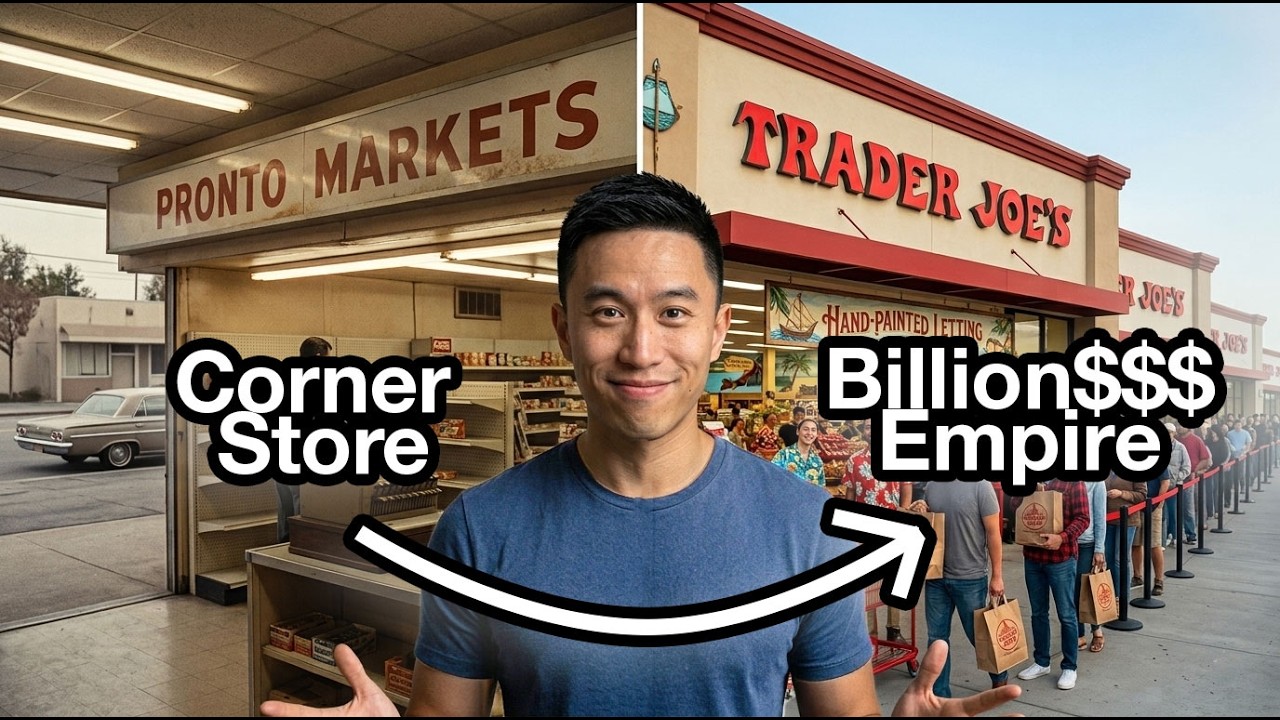
The story of Trader Joe's begins with a small convenience store operator named Joe who faced an existential threat from massive chains like 7-Eleven that could outspend him on everything except product uniqueness. Realizing he could not compete on price or scale, Joe made the counterintuitive decision to stop selling common goods and instead focus exclusively on unusual items, hard-to-find wines, and specialty foods that customers couldn't get anywhere else. He transformed his stores into themed destinations with a nautical aesthetic in 1967, but the true foundation of his success lay in two radical strategies: carrying only about 4,000 specific products instead of the tens of thousands found elsewhere, and sourcing roughly 80% of those items as private label goods under their own name. By controlling recipes and costs while eliminating middlemen, Trader Joe's built a brand that acted as its own quality filter, allowing shoppers to trust any item on the shelf without needing extensive comparisons or loyalty programs.
As the retail landscape shifted in the 2010s toward digital dominance with apps, online delivery, and data mining, almost every competitor rushed to adopt these technologies while Trader Joe's steadfastly refused them. The company rejected an e-commerce website, self-checkout kiosks, sales promotions, coupons, and loyalty cards, choosing instead to maintain a human-centric experience where real staff members greet customers at the register. This refusal might seem like business suicide in an era obsessed with convenience and data collection, yet it created artificial scarcity that drove obsession among their customer base; by discontinuing beloved products without warning or restocking them indefinitely, they turned shopping into an event similar to a limited sneaker drop where availability is fleeting. This strategy forced customers to act quickly when items were available, generated word-of-mouth marketing through the famous "Fearless Flyer" newsletter rather than expensive TV ads, and ensured that every square foot of their stores was utilized efficiently with fast-moving inventory that never gathered dust.
The secret behind this disciplined approach lies in its ownership structure; since 1979, Trader Joe's has been privately owned by the Albrecht family of Aldi Nord, a German discount empire that protected it from Wall Street pressures to expand recklessly just for growth. This private status allowed them to ignore industry checklists and focus on what truly mattered: creating a tight, confident menu where customers do not have to make endless choices because the company has already vetted everything for quality. The lesson extends far beyond grocery retail, proving that saying "no" to standard modernization trends can actually build a stronger moat than simply adding more features or products. By owning their private label brands and refusing to dilute their identity with generic offerings, they achieved sales per square foot roughly double that of Whole Foods while maintaining a cult-like following based on trust rather than transactional loyalty programs.
Ultimately, the enduring success of Trader Joe's teaches business owners that creation beats selection and that scarcity is not a flaw but a powerful feature when used intentionally to drive action and value. The company thrived by asking itself whether every new initiative made them more unique or just another clone of everyone else, answering "no" whenever an option would make them look like the competition rather than stand alone in their own way. While competitors chased endless availability and digital expansion, Trader Joe's doubled down on simplicity, quality control, and a distinct brand personality that resonated deeply with consumers who appreciated being treated as humans rather than data points. Their journey demonstrates that sometimes the most effective strategy is to resist the urge to grow bigger by doing everything, instead focusing on mastering a smaller set of things done exceptionally well so that customers feel they are getting something special that cannot be found anywhere else in the market.
Read the full video transcript
There's a grocery chain in America with
no website that you can actually buy
from. No loyalty cards, no coupons, no
sales, almost no advertisements
whatsoever. Stocking a fraction of the
products of a normal supermarket
carries. [music] And most of what's on
the shelf doesn't even have a brand name
to it. Oh, and every few weeks they'll
take [music] a product you love and
discontinue it forever without a word of
warning. By every rule of modern retail,
that chain should actually be dead by
[music] now. Friends, if you run a shop,
this is the exact discipline that you've
been told to abandon every single day.
I'm Wilson, 20 years in food and
beverage, built 720 Sweets to seven
location before he sold it. And this
chain got rich [music] by saying no.
Now, let me show you how. So, how does a
store built on the word no even get
started? It started with a man named Joe
>> [music]
>> and a small chain of convenience stores
in the late 1950s called Pronto Markets.
Pronto was fine. Milk, bread,
cigarettes, the usual. Nothing special.
But then a giant showed up, 7-Eleven,
backed by the Southern Corporation.
Started expanding [music] into his
backyard and Joe did the math. He was a
small operator about to get crushed by a
chain with deeper pockets, better
locations, and [music] the exact same
product. One or two bad years and he was
done. Now, here's the thing. When you
sell the same stuff as the big dog, the
big dog [music] usually wins because
they have economy of scale. They get
things for cheaper. They can push down
the prices.
>> [music]
>> Every time, cheaper, faster, more of it.
You just cannot out-giant a giant.
[music] So, Joe made a bet that sounds
obvious now in hindsight, but actually
insane back then. He stopped competing
on things that everyone had. He started
to sell the things that nobody had.
Created [music] unusual, hard-to-find
wine, cheese, food that you've tasted on
a trip but couldn't get it back [music]
at home. So, in 1967, he converts the
entire store into something completely
[music]
new. Staff in Hawaiian shirts, nautical
theme, like the captain of a trading
ship hauling back treasures from around
the world. He opens the first one in
Pasadena, California and calls it Trader
[music] Joe's. But a theme and some wine
doesn't build a cult. Something
underneath [music] it did, and that is
the part every operator gets wrong.
Because here's what's really different,
and it wasn't just the fishing nets.
Walk into a normal supermarket and
you're looking at 30,000 skews [music]
of product, endless choices, 14 kinds of
ketchup. Trader Joe's carries around
4,000, [music] and that's it. And that's
not them being small-minded. That's the
entire strategy. They don't stock
everything. They stock the one version
of each thing
>> [music]
>> their buyers tasted, argued over, and
decided what was best. They do the
choosing for you. Then comes the second
move, and this is the money one. Around
80% of what's on that shelf is their own
private label. Their name, their [music]
product, not Heinz, not Kraft, Trader
Joe's. So, why does this even matter?
It's because it's your own label. You
get to control the recipe, you control
the cost, and you keep [music] the
margins that typically goes to a
middleman. You're not a store selling
other people's brands. [music] You are
the brand, and nobody can price match
you because nobody else can carry your
product. And the crazy thing is they
barely [music] advertise. No big TV
spots, just a quirky newsletter called
the Fearless Flyer. [music] They pay the
crew well, keep real humans at the
register, no self-checkout, because the
vibe is [music] the brand. Friends, this
is something that we can really learn
from. When you try to sell everything to
everyone, [music]
you sell nothing to anyone. Trader Joe's
sells 4,000 items to one very specific
[music] person on purpose. But keeping
it not small in a world screaming at you
[music] to get bigger, that takes a kind
of nerve that almost nobody has. And
that nerve is about to get tested,
because every competitor that they have
is about to do the exact opposite.
[music] And for a minute, it's going to
look like that Trader Joe's is getting
left behind. Real quick, friends, if
you're getting any value, make sure you
subscribe along the journey, hit that
like button, and drop me in comment
section below, what's that one thing in
your business that you [music] refuse to
change, no matter what anyone else says.
So, in that way, I know what to break
down next. Okay, so here's where things
get crazy. [music] Because starting in
the 2010s, the ground shifts under every
grocer that is alive. Amazon buys Whole
Foods. Everyone races online, delivery
apps, curbside pickup, an app for your
phone, a loyalty program tracking every
single thing that you buy. [music]
Instacart, DoorDash, endless amount of
new skews. The whole industry agrees on
one thing, and that is modernize or die.
But Trader Joe's look at this and says
no to all of it. No online store, no
delivery, no app, no loyalty cards, no
sales, no mining your data. Now, I want
you to really sit in how [music] scary
that might feel. Because every
consultant, every board member, every
trend online is screaming that you have
to do this. Otherwise, you're leaving
money on the table. Competitors are
adding revenue where you're walking away
from online. Customers are literally
asking, "Why can't I just order this
online?" And you're saying no to it.
"We're staying small. We're staying in
the store. We are staying with us." is
their [music] reply. And the thing is
that it gets worse, on purpose. They'll
discontinue a product that people are
obsessed [music] with. A favorite
all-time selling sauce. A favorite snack
gone overnight. No warning, no apology.
Imagine intentionally taking away the
thing that your best customers drive
across town for. Every instinct as an
operator says that this is suicide. That
growth is right there, and that at that
website, at that app, stock more stuff.
Keep the products people are begging
for. Just say yes, like everyone else.
And that is the exact moment, friends,
where almost every business [music]
breaks his own discipline. But Trader
Joe's didn't, and here's why they were
right. Because every no was quietly
building [music] something a yes would
have destroyed. The discontinued
products, that's scarcity. The scarcity
creates [music] an obsession. And when
you know the seasonal thing that might
vanish, you buy it now. You tell your
friends about it. You post about [music]
it. The refusal to keep everything is
what makes people frantic to grab
anything when it stocks up. It runs like
[music] a sneaker drop. When it's gone,
it's gone. The 80% of private labeling,
that's margin and trust. People learn
that if it's on the Trader Joe's shelf,
[music] the buyer's already vetted it.
The brand itself became the filter. So,
shoppers buy things they've never heard
of just because it's got that label on
it. And the tiny created stores, 4,000
fast-moving products in a small
footprint. So, every square foot works
overtime. Nothing dead on the shelf.
Nothing gathering dust. That's how a
chain with no ads and no website
reportedly posts the highest sales per
square foot in grocery, reportedly
around double of Whole Foods. Roughly
570 stores, and here's the twist that
nobody expects. Trader Joe's isn't some
scrappy [music] independent. Since 1979,
it's been actually quietly owned by the
Albrecht family of Aldi Nord, that
German discount empire. They kept it
private, kept it disciplined, and never
let Wall Street take them into getting
bigger just to get bigger. So, what can
we learn from this? Three things. Number
one, creation beats selection. You don't
win by carrying more. You win by
choosing better
>> [music]
>> so your customer doesn't have to. A
tight confident menu says that we know
exactly what we're great at, and the
giant one says that we weren't so sure,
[music] so we make you decide. Lesson
number two is that scarcity is a
built-in [music] feature, not a flaw. At
720 Sweets, we ran limited seasonal
flavors that we killed on a schedule on
purpose because people line up for the
ones that are about to disappear. The
limited edition that's going to [music]
be phased out. That flavor wasn't more
delicious that week. It was just
leaving. Endless [music] availability is
just being comfortable, but it's also
very forgettable. A little scarcity
gives people a reason to act now. Number
three, own your products and own [music]
your nose. If you can put your own name
on it, do it. That's where your margins
and your trust [music] live. Instead of
reselling what everyone else already
has, and when the whole industry hands
you a checklist of things that you have
to do, remember, saying no [music] to
the checklist can be that your exact
moat. Everyone's copying each other,
they look the same. The one that refuses
[music]
stands alone. Friends, take this as
reference, not Bible, but before you add
that app, that 14-menu item, the thing
that everyone swears that you need, just
ask yourself one question, does this
make me more me or just more like
everyone else? Trader Joe's got rich
answering that honestly. [music] So,
there it is, friends. Trader Joe's
refuses the website, the loyalty card,
the coupons, the ads, [music] and the
giant selection that everyone else
chases. And those refusals are the exact
reason that it built a cult-like
following [music] and the highest sales
per square foot in the business. The
moat wasn't more, the moat was no. If
you find any value from this, make sure
you subscribe along the journey, hit
that like button, otherwise we will see
you in the next video.