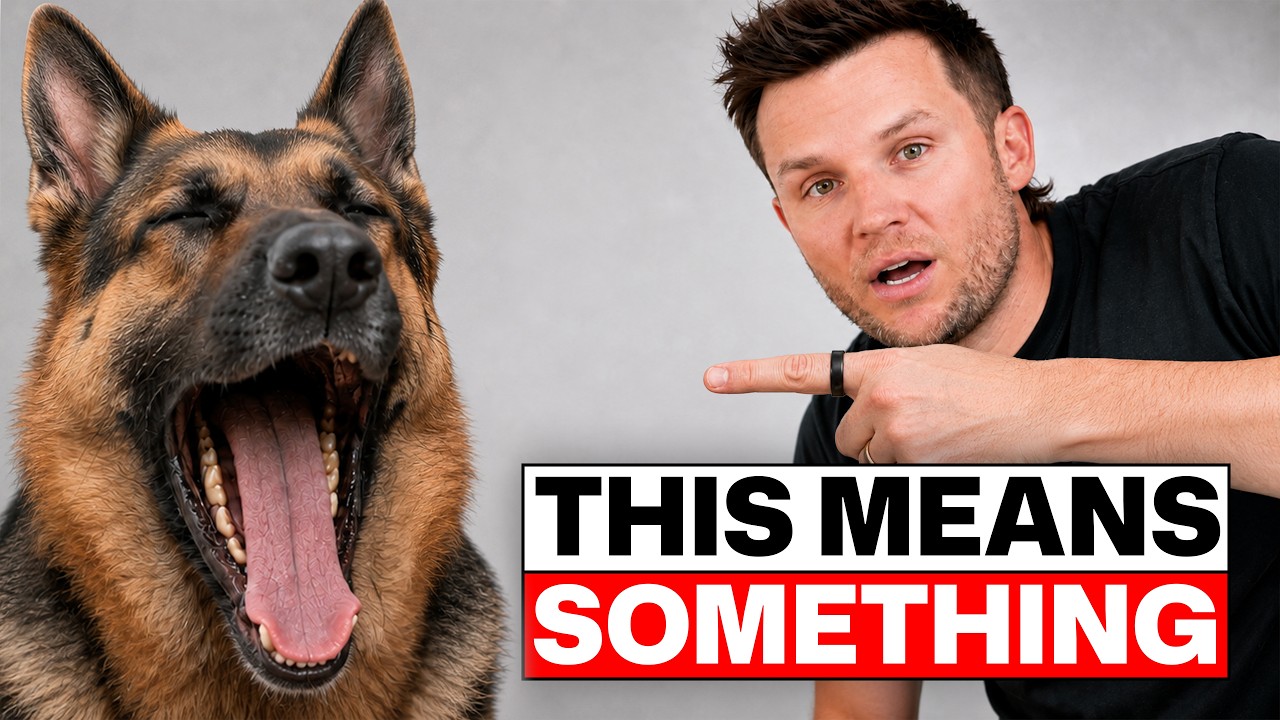
Video summary
Many dog owners instinctively believe that when their pet yawns, it simply means they are tired or bored, but this is often a misconception because dogs frequently use yawning as a complex form of communication unrelated to fatigue. In reality, yawning serves primarily as a "calming signal," which is a behavior animals use to reduce tension and manage emotional states within a pack dynamic. When a dog yawns upon greeting their owner after being away all day, it does not indicate boredom; instead, it signals that the animal is feeling overwhelmed by excitement or stress but is trying hard to keep its emotions in check through self-regulation. Similarly, if an owner returns home with high energy levels such as rushing in loudly or appearing frantic, a dog may yawn to soothe them and help lower their own arousal, effectively saying "let's calm down" before the situation escalates further.
The context of the yawn is crucial for interpreting whether it stems from overstimulation during play or mild discomfort rather than simple tiredness. Even when dogs are running around with another dog having a grand time, they may suddenly stop and yawn to hit their threshold, acting as a natural "pause button" to prevent becoming too stressed by the excitement of the activity. This behavior can also function socially between two playing animals, serving as a signal to maintain friendly interactions and ensure play does not tip into conflict or aggression. If this calming signal is ignored and the dog continues to be pushed beyond its limit without taking breaks, it may eventually resort to more defensive behaviors like growling; therefore, recognizing these early signs allows owners to respect their pet's need for space and prevent escalation while keeping social interactions positive.
Beyond greetings and play, yawning frequently appears in situations involving unfamiliar environments or disruptions to routine, such as visits to the vet, grooming sessions, or when children hug a dog tightly. In these scenarios, the yawn is almost always an indicator of anxiety or discomfort rather than sleepiness, signaling that the dog feels insecure about learning new commands, being handled by strangers, or having their personal space invaded in ways they do not naturally enjoy. By paying close attention to accompanying body language cues like a stiff tail versus a loose wiggly one, owners can accurately distinguish between self-regulation and genuine distress. Understanding these nuances empowers dog owners to respond with patience and appropriate calming measures rather than misinterpreting their pet's needs, ultimately fostering a deeper bond based on clear communication and mutual respect for the animal's emotional state.
Read the full video transcript
Quick question. Your dog just looked at
you and let out a big wide yawn. What's
the first thing that goes through your
head? Now, be honest. Aw, they're tired.
I mean, be honest. That's probably what
you're thinking, right? That's what most
people think. And honestly, most of the
time, they're completely wrong. And it's
very, very important for dog owners to
understand why your dog is actually
yawning. Okay, so let's get the big myth
right out of the way. Yes, of course,
just like people, dogs yawn when they're
tired. But here's the thing that most
people miss when their dog actually does
yawn. Dogs yawn in situations where
tiredness has absolutely nothing to do
with it. They do it when they're midplay
with another dog or even with you, which
is important to know that the difference
or even when another dog approaches them
at the dog park. These are all signals
and they all mean different things. So
if your dog is yawning and they're
clearly not tired, what the heck is
actually going on? The answer comes down
to really fascinating communication.
Dogs are incredibly expressive animals
and yawning is one of the tools in their
communication toolkit. It's called a
calming signal because calming signals
are behaviors dogs use to reduce tension
as like a pack animal. They express
their emotional state or even try to
deescalate situations or even a
potential fight. And yawning is one of
the most common ones used. Yet, nobody
understands what it is until right now.
Now, let's break this down exactly why
your dog is yawning. Starting with the
most relatable scenarios out there that
most dog owners are probably going to
relate to. Let's just say you walk
through that front door, your dog runs
over tail wagon, and then they do this
big yawn or what you think is a yawn.
That sounded like a real yawn, but it
wasn't. Wait, is my dog bored me
already? Are they tired? I looked at the
camera. They were sleeping all freaking
day. No, actually, it means the complete
opposite, which is again, I love dogs.
I'm sure you do, too. This is
fascinating. When your dog yawns right
as they greet you, it's often their way
of saying, "I'm excited, but I'm keeping
it together. I'm keeping it together."
It's a self-regulation behavior. Think
of it as like a dog taking a
deep breath to manage their own
emotions. They're happy to see you and
sometimes almost overwhelmingly so like
they again just like with us and we get
overwhelmed with certain like I have two
kids, two young kids and the young helps
us bring that excitement down to manage
that level. It's it's crazy like dogs
know how to do that instinctually where
us humans are like freaking out. They
don't know what to do and they're like
yeah, what are we doing? Anyway, I
digress. Sometimes the yong when
greeting you can also be a response to
your energy. If you come home stressed,
rushing in, shoulders tense, talking
loudly, getting all frantic, your dog
picks up on all that. The yawn is
essentially their way of saying, "Hey,
we're all good. Let's calm down."
They're actually trying to soothe you. I
know for a fact, this is a quick little
fun fact about me and my dog. When I say
the f- word, my dog gets nervous. She
doesn't like that word. And I've even
noticed my dog yawning when she's
excited. Like when I get out her wee
feed [music] raw, she will yawn and jump
around cuz she's so excited. There's
also a third reason your dog might yawn
when they see you. And this one is
definitely worth paying attention to,
which is mild stress or even discomfort.
If you've come home after a long absence
or if there's some kind of disruption
into your routine or even your house,
like kids are fighting and throwing and
crying or whatever, a yawn can be your
dog's way of expressing low levels of
anxiety. Not panic, not freaking out,
not aggression, not reactivity, just a
quiet signal that says m things are a
little off. Like when I say the f- word.
But the key is to look at the context of
this. Is your dog's body language loose
and wiggly? Probably self-regulation or
even communication. Is their body stiff,
tailed tucked? That yawn probably will
be carrying a little bit more weight in
that context. This is one that really
throws a lot of people off. Your dog is
midplay. They're playing around with
another dog, having a grand old time,
running around, jumping, literally
having the time of their life, and then
they just stop and they yawn and you're
like, I think they need to go take a nap
or like what's going on? A few things
could be happening here. Now, listen up
to this. Number one, they're hitting
their threshold. Even during fun
activities, dogs can get overstimulated,
just like us people. Play is exciting,
and excitement, believe it or not, can
be stressful on a dog's nervous system.
The yawn is a natural pump the brakes
mechanism. It's your dog saying, "This
is awesome, but I just need a second to
make sure everything's okay." If you
watch carefully, you often see this yawn
followed by a full body shake. If you
guys have ever seen that, your dog just
shake right off like they're shaking
water off that's not there. That shake
is another calming signal. It's your dog
literally shaking off the arousal before
jumping back in to play or whatever
they're doing. It's a healthy
self-regulating behavior and you should
actually feel good when you see it. Now,
number two, talking about this list
really quick, they're communicating with
their play partner. So, the dog that
they're playing with or even maybe even
you or somebody that they don't know
that well, when two dogs are playing
together and one yawns, it often
functions like a pause button, a signal
to the other dog that says, "Okay, let's
keep this friendly. Calm down." It's a
way of maintaining social contract
during play. Dogs use these signals
constantly to make sure play doesn't tip
into conflict. And if the dog is well
socialized, they'll recognize that
signal and respond accordingly. Number
three, they're not actually enjoying the
game. Now, that yawn could be, "You know
what? I'm a little nervous about this
one's important, guys, and I don't want
to gloss over it because it matters a
lot to you because your dog trusts you.
And if your dog yawns frequently during
play, especially when they're also
avoiding eye contact or turning away or
even trying to move away slowly, it may
be a sign that they're not having as
much fun as you think. Look for those
signals. If your dog is checking out,
let them check out. A short break can
actually make the next play session even
better for both of you, and it'll make
that experience good, especially if it's
a dog maybe they don't know well, cuz
that's how things escalate really
quickly. All right, now you guys know
what the yawn means when your dog sees
you and even during play. But let's
quickly cover a few other common
situations because once you start
recognizing this signal of the yawn,
you're going to see it everywhere.
You're going to be like, "Oh, are they
nervous? Are they scared? Are they
insecure? Are they happy? Are they have
they had enough?" There's a lot more to
that. Like at the vet or the groomer,
for an example, this is probably the
clearest example I can think of of
stress related yawning, right? Your dog
is in an unfamiliar environment being
handled by strangers. Dogs are firing
[music] off. It smells like cleaning
products, blah blah blah. Yawning here
is almost always a stress signal. If you
see it, ask your dog to down. Give them
a little bit of love. Don't talk to them
too much, but letting them settle down,
like with a down or something. Just,
hey, chill. Right now, during training
sessions as a pro dog trainer, your dog
keeps yawning while you're trying to
teach them a new command. It doesn't
mean that they're not having fun. It
doesn't mean that they're super
stressed. It doesn't mean that they're
not smart. It may mean that the dog is
nervous about learning this new thing. I
work with a ton of stressed out dogs.
They're anxious. They're fearful.
They've gone through hell. They're
reactive. They're aggressive. They want
to bite other people. They want to bite
me. That's going to be stressful. And
you have to really decipher, and that's
what a pro dog trainer should do,
whether or not that's okay to push
through or not. Now, another one I see
all the time is when a dog is hugged by
somebody. It's actually not a natural
behavior for dogs at all. Dogs do not
really love that. If your dogs yawn when
children wrap their arms around them,
nope. Nope. Don't do it. I I just don't
let children hug dogs anyway. It's just
like no. It's just a no-go. Now, I know
people are going to be like, "My dog
loves being hugged." They probably
don't. Now, think of yawning as a first
run on a ladder of communication. It's
your dog trying to handle a situation
calmly and even politely potentially.
And the more we recognize and the more
we understand these things and we
respond to those signals, the less
likely our dogs need to feel to
deescalate things, right? That's where
growling starts to come in, teeth start
to get in show, and that's where it goes
south. I think the biggest breakdown,
guys, is yawning is not just your dog
being tired. Most of the time when your
dog yawns in an active or social
context, [music]
it's communication. And I think it's
important for us to learn that. Like,
learn what that is. When your dog yawns
as they greet you, they're either
self-regulating or they're excited or
they're overstimulated or maybe they're
responding to your energy. And I think
it's just, you know, so many people that
I work with, everyone's like, I want to
stop this. this and I try to explain to
people, [music]
you guys should be getting to the root
cause of the problem. You should be
wondering why your dog is pulling, why
your dog is reacting, why your dog won't
listen to you, why your dog is whining.
That's really important for me. And if
you guys want to learn more about any of
this stuff, like take a real deep dive,
like actually take dog training
seriously, I have put together courses
for you called the [music] Kickstarter
course, which is great for people who
want to kickstart their like the five
core behaviors every dog should know.
Most people don't have. I have the leash
reactivity course with reactive to
neutral. I worked with some of the
nastiest dogs you could possibly think
of and I put everything that I've worked
with and everything I've been successful
with those dogs internationally into
that course. I have the off leash
e-collar course which is really helpful
for people. And I have [music] the
master the walk course which is
literally teaching your dog what the
leash means. Teaching your dog how to
walk nicely next to you. Not to stop
your dog from pulling but to teach your
dog how to walk nicely on the leash.
Guys, thank you so much for watching. I
put videos out like this every Wednesday
and every Saturday. If this is helpful,
you found it entertaining, hit that
subscribe button because I can't wait to
see you guys on the next video. [music]
Thank you so much for watching and
supporting this channel and supporting
my merch and my equipment and my leashes
and my collars as a small family
business. We appreciate you. I will talk
to you on the next one. Peace.