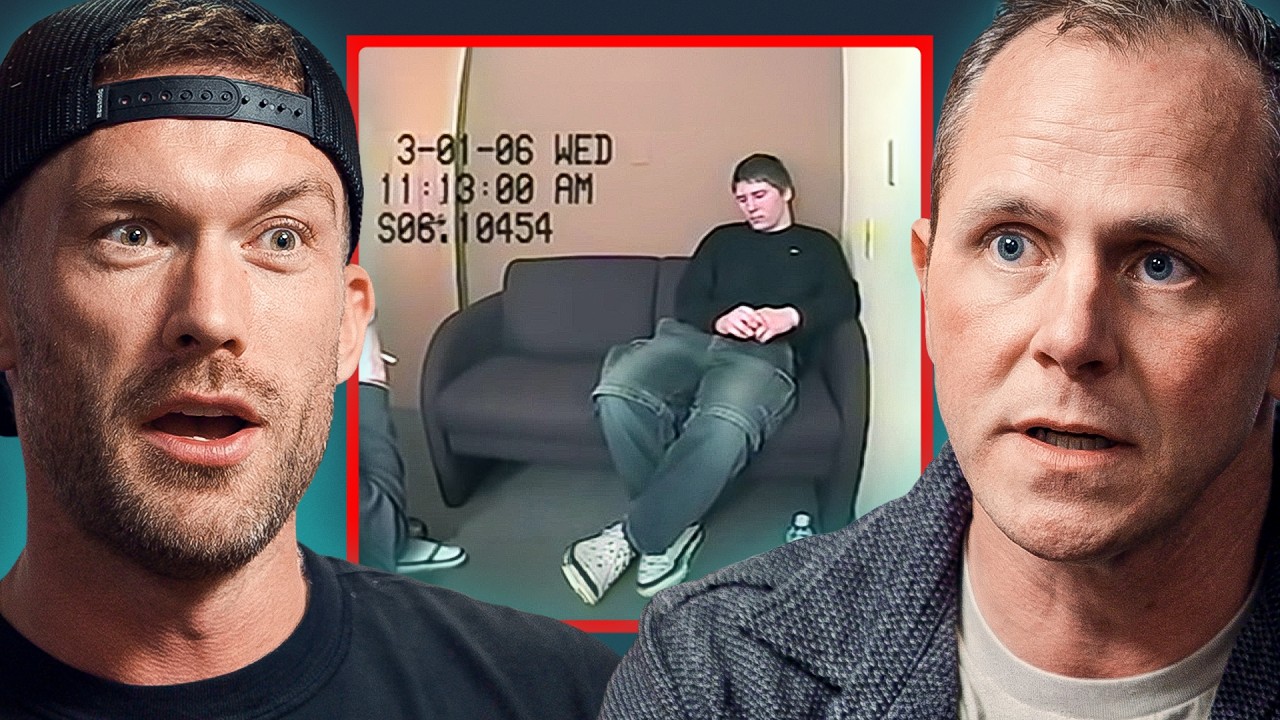
Video summary
The podcast features Chase Hughes explaining a five-step psychological protocol used to elicit confessions, which involves socializing, minimizing, rationalizing, projecting, and finally presenting an alternative question. This process is designed not as a hostile interrogation but as a massive shift in context that protects the suspect's ego while guiding them toward admitting guilt. The speaker illustrates this with a hypothetical scenario involving arms smuggling or texting while driving, where the interrogator begins by establishing rapport through "socializing," asserting that they have dealt with many bad people and are certain the subject is not one of them but rather someone who made mistakes due to circumstances beyond their control. Following the initial socialization, the protocol moves into minimizing the severity of the alleged crime compared to other offenses the interrogator has encountered, followed by rationalizing the suspect's actions based on their background or specific pressures they faced, such as a family member needing medical bills paid. The fourth step involves projecting responsibility onto external factors like threats from criminal rings or difficult life conditions, effectively telling the subject that anyone in their position would have made similar choices. This sequence culminates in an alternative question offering two distinct scenarios: one where the individual acted out of greed and malice, and another where they were coerced into helping a family member, ensuring that whichever option is chosen results in an admission of guilt while allowing the subject to maintain a favorable self-image as someone trying to do good for their loved ones. To demonstrate how these techniques are applied during the initial interview phase before full confrontation, Hughes introduces specific questioning strategies like "bait questions" and "punishment questions." A bait question is designed to trap an innocent person by asking if there is any reason a neighbor might have video footage of them at the scene; an honest answer would be no, but admitting that such footage exists places the subject directly in trouble. Conversely, he uses punishment questions on children to gauge guilt levels regarding minor infractions like spilling chocolate milk, noting how kids immediately assign severe punishments they believe are deserved if they feel guilty about their actions versus those of others. Throughout the discussion, Hughes emphasizes that these methods rely heavily on understanding human psychology rather than brute force or deception alone. He highlights that innocent individuals will typically respond with absolute confidence and hesitation-free denials to bait questions, whereas a guilty party must navigate complex dilemmas where admitting knowledge of evidence is safer than lying about it. The transcript concludes by promoting Element electrolyte drinks as essential for maintaining physical performance and brain health during such high-stakes mental exercises, offering viewers a free sample pack via the provided link before directing them to watch the full episode online.
Read the full video transcript
There's like a five-step protocol that
people use to make someone confess to a
crime.
And if you really examine what the
protocol is, it's just a massive shift
in context and perception.
>> What's the protocol?
>> You ready? All right.
So, it's a socialize, minimize,
rationalize, and project.
>> Is that not four?
>> Yeah. It's four steps, and then there's
an alternative question at the end.
Okay. Is it this or this?
So, just like name a name a crime that's
not gross that we can actually talk
about. Anything you want, like stolen
money.
>> Texting while driving.
>> Okay. Texting while Well, they're not
going to be in an interrogation room.
>> Okay. Yeah, cool. Uh uh um smuggling
arms.
>> Okay, smuggling arms. Great. All right.
So, the first step would be socialize.
>> [ __ ] interrogation room for texting
while driving.
There's just armies of interrogators up
and down the United States highways. All
right.
>> It would It might solve the problem.
Okay. So,
smuggling arms.
So, you're talking to this person, and
you decided that it's time to shift into
interrogation. The beginning of an
interrogation is called the interview
process, and that the shift is called
the confrontation.
So, the confrontation uh is basically
just where you tell them like you're
that they're lying, but you don't do it
in a way that hurts their ego.
Uh so, I might say something like,
"Chris,
I appreciate you, and I just want you to
know I've been doing this a really long
time. I've I've talked to a lot of
people.
And if there's if there's one thing I
know for sure, it's when I'm not getting
the full story.
And I don't think I'm getting the full
story here. And then I go right into the
socialize part of this thing.
And when I say socialize, it's basically
people will understand. So, the line is,
I think at the end of the day,
um
you did this because you're a good
person. And I'm going to explain why.
And I've talked to a lot of bad people,
and I know you're not a bad person. And
I think when people see all of the steps
that led up to you getting wrapped up in
this, that they're going to understand.
Then minimize.
And like I said, I don't think you're a
bad guy.
And and to be honest, I deal with bad
people all the time and people that do
way worse stuff than this. I've seen
people that have done way worse than
this get completely over it. So, it's
not that big of a deal. I'm not Nobody's
accusing you of being some mass murderer
or something like that. This is not the
same thing.
Then it's rationalize.
I know you came from a a poor village.
I know that you had a a really tough
background and I know that you're a good
person. And I'm not saying whether or
not you were doing this to pay for it,
but I know that your aunt has several
hundred thousand dollars of medical
bills that she's needed to pay.
Now I project.
So, now the project is basically it's
not your fault.
And
I think anybody that was handed your
conditions and your life would have
probably made the same choices that you
did.
And
there's I know a lot of times these arms
smuggling rings will use threats and
pressure to get someone into the unit.
So, if that happened to you, I just want
you know that's something that I want to
know about, so I know that you didn't
like deliberately decide to do this.
And then we move into the alternative
question.
And I'll say, "So, Chris,
what I'm really trying to find out here
is
were you doing this just to make a bunch
of money and then go buy a bunch of
drugs and live in some other country or
you really like trying to help one of
your family members?
Cuz I know these guys have been talking
to you and I've looked into you as well
and it doesn't look like you're a bad
person.
So, now it's an alternative question of
are you a piece of crap or did you try
to do something good for your family?
So, that's
>> Both of them are admissions of guilt,
though.
>> Yeah. Yeah, I'm just trying to find out
the reason that this happened.
>> Yeah, you're not. You're trying to find
out an admission of guilt.
>> Yes. Yes. But in the in the conversation
we're trying to find out the reason it
happened.
So, we're going for the admission of
because the the first part of the
interrogation we there's like a long
series of questions we ask and based on
those responses, if they respond a
certain way to each question, then we
move towards the
uh confession methodology.
>> Mhm.
>> So, they're and they're basic questions
like um
if if I if there was a robbery or in
some neighborhood here,
uh can I say the city that we're in?
>> Of course.
>> Okay, so let's say like
two blocks away in maybe yeah, two
blocks from here there's a neighborhood
in Austin
and there's a there's a neighborhood
there and let's say you robbed a house.
One of those questions to determine how
guilty you are is one of my favorite
questions in the world. It's called a
bait question.
And it basically says
um let's let's imagine you did this. I
want to put you in the mindset so you
can understand the question.
Let's say you you
stole a bike out of this person's garage
a couple days ago.
I called you up and was like, "Hey, I
think I you might have seen something
that's going to help us in the case.
Could you please come in here and talk
to us about the about the case?"
You come in
and I say, "Chris, dude, thank you for
for coming in.
Uh
this is important to us. We've got
officers out there that they've been
working all through the night uh
collecting evidence and stuff. I just
want to ask you one question and
you seem like a really good guy. So, I
want you to think really carefully
before you answer this.
Is there any reason
whatsoever that one of the neighbors
would have a ring doorbell camera
that shows your vehicle in that area?"
So, now you're confronted with a dilemma
of
if I say no and he whoops out a video,
now I'm a liar and they probably know
that I did this.
If I say yes, I'm at I'm placing myself
at the scene of the crime, right?
And the cool thing is that someone who's
innocent would be like, "Nope."
And you would be instantly they would
have no hesitation. They have tons of
confidence of nope, there's absolutely
no reason.
So, that's one of those those kind of
set up questions. And another one
>> of whether you've got the ring doorbell
footage or not.
>> Yes, and I don't say that I have it.
>> Is there any reason why?
>> Yes. Is there any reason that one of the
officers would have received some ring
doorbell or some doorbell video camera
footage that shows your vehicle in that
area?
>> Mhm.
>> Not you do anything bad.
Um and another one is and another great
question, I can't reveal all these, but
>> Mhm.
>> another great question is called the
punishment question.
And this works on kids,
it works on adults, it doesn't matter.
And it's just a few words long.
I would say, "What do you think should
happen to the person that did this?"
And you'll always get amazing answers.
I'll give you my kids' example.
And this is from when they were
uh seven and eight, give or take.
I came home from work, I'm in the like
my camo uh uniform,
and we had a white living room rug, and
there's like a little cardboard thing of
chocolate milk just like sitting on its
side, and there's like a little pool of
chocolate milk on the carpet.
And they were both playing the Xbox. The
milk's like right there, a few feet
away. I was like, "What What the hell,
guys?"
They're like, "Oh, I don't know."
And I was like, "Did you guys do this?"
They're like, "Nope." And I said, "All
right, William, kitchen, Charlotte,
dining room."
>> You [ __ ] prisoner prisoner's
dilemma'd them.
>> Yeah.
And I went over to um
Charlotte. Yeah, it was Charlotte. And I
said, "Charlotte, what do you think
should happen to the person that did
this?"
And she goes, "Spankings, grounded, no
more Xbox, can't play with the friends,
no more sleepovers, can't eat in the
living room anymore. It just goes on and
on. I was like, "Okay, all right."
>> It's a kid's equivalent of capital
punishment.
>> Yeah, and I was like, "Damn."
So, I went to William and I said, "Will,
what do you think should happen to the
person that did this?" He goes, "Uh
maybe no more chocolate milk in the
living room?"
And there we go. I had I had my guy.
Really quick.
>> Most people don't realize how much being
dehydrated impacts at the performance,
which is why for the last 5 years I've
started pretty much every morning with
Element. Element is a tasty electrolyte
drink mix with everything that you need
and nothing that you don't. This orange
salt in a cold glass of water is like a
sweet salty orangey nectar, and I really
tell the difference when I take it
versus when I don't. It plays a critical
role in reducing muscle cramps and
fatigue, helps to optimize brain health,
and regulate your appetite, while also
curbing cravings. Best of all, they have
a no questions asked refund policy with
an unlimited duration. So, you can buy
it and try it for as long as you want,
and if you don't like it for any reason,
they'll just give you your money back.
Plus, they offer free shipping in the
US. Right now, you can get a free sample
pack of Element's most popular flavors
with your first purchase by going to the
link in the description below, or
heading to drinklmnt.com/modernwisdom.
That's drinklmnt.com
/
modernwisdom.
Congratulations, you made it to the end
of the clip, and the full-length episode
is available
right here.
Go on.