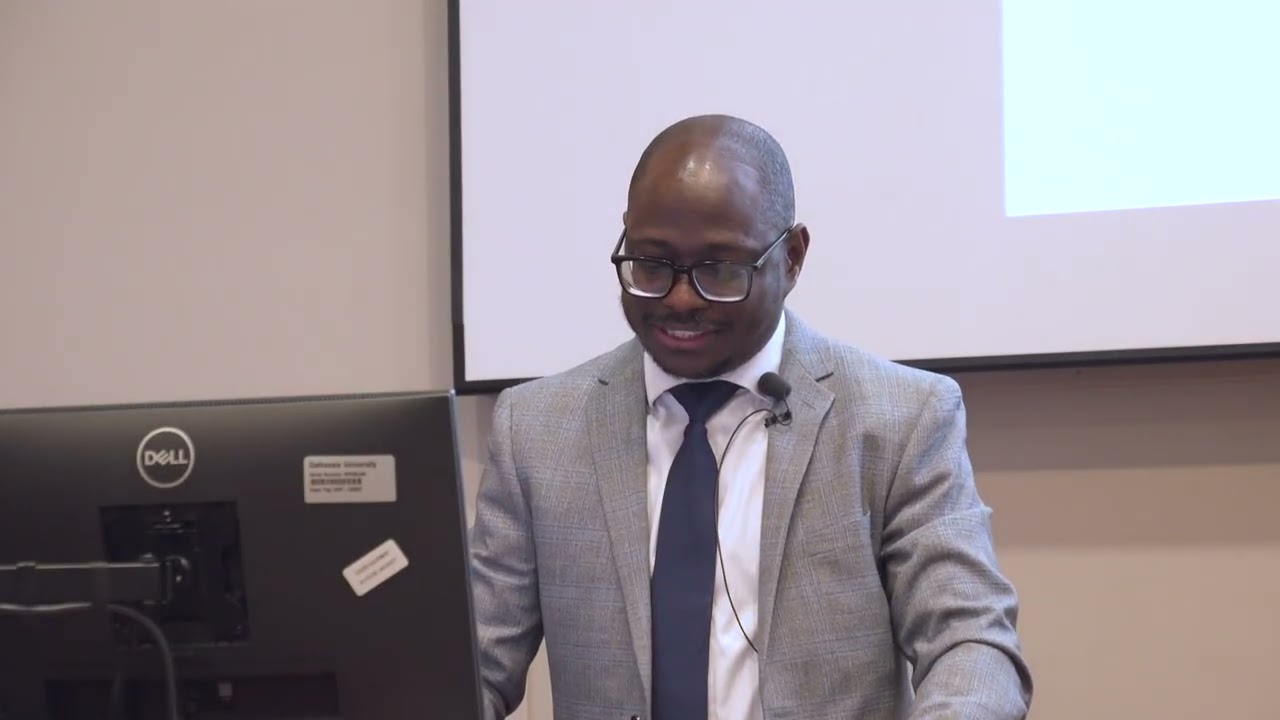
Video summary
The lecture addresses the critical issue of illegitimacy within current climate law, arguing that mere legality is insufficient without genuine legitimacy rooted in public trust and participation. The core problem identified is that governments often reverse environmental policies when they become unpopular to protect political power, a tendency exacerbated by top-down regulatory approaches that ignore local realities. Scholars like Professor Adabi Magalagbay highlight three specific indicators of this illegitimacy: the reduction of diverse community contexts into single-value solutions such as carbon pricing, a normative monopoly where state-centric laws fail to account for social norms and lived experiences on the "shop floor" of daily life, and the false presumption that complex legislation is understood by local populations without meaningful engagement. These factors create a disconnect between enacted laws and the communities they are meant to serve, ultimately undermining effective climate governance.
To counter these challenges, the discussion advocates for a fundamental shift toward bottom-up lawmaking through deliberative systems involving local assemblies rather than relying solely on constitutional entrenchment of municipal powers or high-level mechanisms like carbon pricing alone. This approach emphasizes aligning climate policy with community values, identities, and history to foster deep cultural roots that make laws resilient against political reversal. By focusing on grassroots entities such as labor unions and agricultural communities, policymakers can mediate the communication of law in a way that respects local social norms rather than imposing external solutions. Anecdotal evidence from rural Alberta illustrates how policies localized to respect community values like nature conservation significantly diminish resistance, demonstrating that legitimacy is built through inclusion and understanding rather than coercion or abstract legal frameworks.
Furthermore, the session tackles the pervasive feelings of hopelessness surrounding climate change by distinguishing between scientifically grounded IPCC reports detailing complex mitigation measures and sensationalized media narratives used to fuel anti-climate sentiment. While acknowledging deep-seated colonial legacies as root causes of current illegitimacy, the speakers emphasize that a unified human action is urgently needed to overcome these historical barriers. The dialogue also explores provincial buy-in regarding Canada's climate commitments and the specific challenges of instilling agency in smaller communities, reinforcing the idea that effective governance requires more than just legislative power; it demands a cultural shift where laws reflect the aspirations of the people they affect. Ultimately, building deep roots of climate consciousness from the ground up ensures that environmental protections become politically durable, regardless of shifting government powers or constitutional provisions.
Read the full video transcript
Welcome everyone to a very special ESS
lecture this evening. My name is Deborah
Ross. I'm the manager of outreach and
communications at the College of
Sustainability.
It's great to see you all here and
welcome to everyone online.
It's an honor for us to sc to co-sponsor
this event each year in honor of a dear
friend of the college and Delhausy
colleague Minehard Doell.
We are still in the last week of Migma
history month in Nova Scotia. a chance
for us to celebrate Migma culture,
language, and traditions, and to deepen
our understanding of the history of the
Migma as the original people of Migmagi
and here in Shabuktuk.
I'd also like to acknowledge the African
Nova Scotian community who have shared
these lands for over 400 years.
So, a warm welcome. And finally, I'd
like to introduce Dean Sarah Harding of
the Shoulick School of Law at Delhauszy.
Thanks so much. It's wonderful to see
you all here. Um, this isn't my home
turf. Um, given that I'm here in the
business school as opposed to not in the
law school. Um, but I nonetheless want
to welcome you all here um to the
conversation and to the lecture this
evening. And in particular, I want to
say a warm welcome to Minehart's family.
Um I see Wendy um and and and um the um
Doell family over there. So really
lovely to see you again. Um so um the
real introductions will follow um the
introductions um uh of this lecture
series um of Minehart's work and of um
our speaker tonight. Um, but I do want
to take this opportunity to just add a
few thoughts of my own.
Most of you probably won't know that
Minard and I actually went to law school
together. We graduated together in 1989.
And all the way back then, he was
already incredibly passionate about
environmental law and policy. And that
was at a time when there weren't a whole
lot of people who were incredibly
passionate within law schools in that
field. So he was very much a pathbreaker
at that time. Um I left the country
after we graduated from law school. So I
never had the opportunity to be
Minhart's colleague. Um but I did see
his work from afar. I um always knew
what he was doing and was um was uh
consistently um impressed by uh his work
and the impact he had in environmental
law and policy in climate change uh in
work on decarbonization
and the whole array of topics that he
focused on environmental assessments. Um
I know that um Sarah Sack will say a few
more about uh a few more words about
some of his impact uh as a scholar. Um
but he also had an impact as a teacher
and uh I learned about that impact um
from the alumni I've met over the years
uh the last couple years I've been dean.
Um I've heard a lot of uh marvelous
things about his impact on them as
students uh and uh how difficult it was
for them to uh lose him um at such a an
early uh or young age. Um so uh for me
it's always a really special thing to
come and say a few words at the
beginning of this lecture. Um Sarah asks
me every year and I jump at the chance I
say of course. Um I I find it's uh it
has a very special connection um for me
and uh always very happy to say a few
words. Um and with that um I will um
pass uh the microphone on to Sarah. Oh,
I do want to say one more thing but but
keep coming up. Um I also think it's
particularly special that uh this
evening um we have Ado who um is one of
Minehart's students. So it's a very
touching, very special, very full circle
kind of moment um to have him here as
our speaker for the evening. Sarah,
thank you Sarah.
So my name is uh Sarah Sack and I am the
current director of the marine and
environmental law institute and a
professor here at the Shoulick School of
Law and I was also a close colleague of
mine's um over a number of years when I
first started uh venturing into the
teaching of environmental law. The first
book that I used and still use is an
edited uh case book that Minehard
dedicated a lot of his life to
developing. Um he had he published
extensively books on impact assessment.
Um an early book on climate change and
international environmental law. Um and
I had the pleasure of co-editing a book
with him on climate change loss and
damage which we completed shortly before
he passed away. Um I also had the
pleasure of um co-supervising and
engaging with him in graduate
supervision and um professor magical a
bay who is now on faculty at the
University of Alberta's faculty of law
uh was one of those graduate students
that we co-supervised
um minehard made great contributions to
teaching at the law school but was also
very active at the college of
sustainability. So um uh contributed
widely in teaching in every capacity
imaginable working on um government
policy and um just someone we miss
greatly.
However, we are delighted to have the
opportunity to welcome back um people
who had studied with Minehard and this
includes professor Adabi Magagical Lagay
and I'm going to keep calling him
professor magical a bay because even
though he's graduated and is a professor
he insists on writing emails to me where
he says hi prof.
So this is revenge.
Professor Magic Lagnet
is an assistant professor of law at the
faculty of law University of Alberta. He
previously served as an adjunct
professor while a graduate student here
um at the Shoulick School of Law um and
has taught uh taught for us climate law
among other things and and has taught
climate law also at the University of
Alberta um where he also teaches other
courses like constitutional law,
international business transactions and
other and other things. Um his PhD
thesis was actually the one that won um
Delhauszy uh gold medal. I think they're
called the gold medal. Um the best
doctoral thesis in the uh social
sciences. It focused on just transition
and impact assessment in the context of
climate change which is something that
will have influenced the talk he's going
to give um tonight. And this research
was also featured in a showcase on uh
Parliament Hill. Um,
Professor Magical Agbay also had the
opportunity to co-author a number of
papers with uh Minehard which I think um
is also special and um with that I
welcome you to give our the lecture of
the evening on the potential or the
problem of illegitimacy in climate law.
Thanks, Prof.
Um,
I forgot to include in the bio that I
was once a teaching assistant at the
college of sustainability.
I was a TA in global environmental
governance.
Yes.
Yeah. So, I've been around.
Um,
so it's an immense honor to
be delivering today's lecture.
My gratitude to Miller
um the college of sustainability for
this platform
and um my invitation.
Thank you, Professor Sack Prof. Um, it's
great to be you. Um, a very special
thanks to the Dwell family. Um, Wendy,
Alita, Nicola, we just met um, close to
the waterfront. It was fun. Donuts plant
um, Clara Nadier.
Um
Wendy and Maynard very kindly opened up
their home to a very broke PhD student
in 2019 2020
and they allowed me to stay at their
place at um below market rates
while she and Mayard were away in
Sweden. So um thanks Wendy. I hope I
didn't break anything.
Um, in 2016 when I was practicing law in
Nigeria, I began to consider
um, applying for grat studies here in
Canada. I came across one of Mayan's
videos
on the 2015 Paris agreement and I
reached out to him that morning.
I applied. No, I reached out to him and
I left for court that day. But by
midday, Maynard had responded expressing
interest in my work.
Now I receive quite a number of similar
emails from students across the world
who want to pursue grad studies and I
remember the speed with which Mayard
responded to me and that is a judgment
because I've not been able to match
that.
Mayard and I we were very different.
We had different soccer teams. I support
Chelsea. Is there any Chelsea fan here?
Yay. Come on.
I support Chelsea in the English Premier
League. Minet support um or supported
Beric Dortmund in the German Bundesliga.
Um,
another difference,
I support Edmonton Oilers. We played
tonight. Minard certainly didn't support
Edmonton Oilers.
And Minard had this very
trademark eyebrow waggle. Whenever
something mischievous happened, I don't
have that waggle. like it goes.
But more importantly, Mayard and I,
we deferred in our emphasis on climate
change law.
Um, Minard emphasized effective
policies. He wants effective climate
policies, policies that work.
I emphasized equitable
climate policies,
justice, just transition.
But over time, after 5 years, we
converged.
We realized that for climate loss to be
effective,
they must be equitable
and that ineffective climate policies
will eventually be inequitable to
present and future generations.
And this convergence informed a work we
did together in 2022 which was then
published in 2023.
And I I quote a part of what we wrote in
that work.
Meaningful participation in is
particularly relevant to the integration
of climate change into impact assessment
as it is a site for respect and
recognition of right and interest,
transformative learning for all
stakeholders,
collective and cooperative action,
legitimacy of interventions and adaptive
management.
Um central to that 20 23 publication
was the problem and is the problem of
illegitimacy in climate laws. Um an
issue I will explore today.
What I will do is I will give an
overview of the current state of climate
change and climate laws in Canada and
globally. I will introduce a conceptual
framework. How do you think about
illegitimacy
and what do we do about that? Um,
earlier this month I had a community
engagement event in rural Alberta.
Um, I will draw anecdotal lessons from
that community engagement on how to
think about the issues of legitimacy and
dealing with the problems
of illegitimacy.
So in January of 2025, the world
witnessed the warmest January on record.
It was 1.75
degrees,
higher than what it should normally have
been.
And the last 3 years, 2023
to 2025,
have been the hottest
on record. I I know cuz I now have an
air condition in my house. I shouldn't
need that in Edmonton.
But 1.75,
I hate this stuff. Like 1.5° CC, what
does that even mean? Um, the world
should aim for 1.5 degrees Celsius
average blah blah. What does that mean?
It is more than a number.
It means
a drier climate.
It means more severe drought and food
insecurity in Africa.
It means real people losing their
history and their homes.
It means very serious and severe
hurricane like hurricane Melissa
almost still ongoing in car in the
Caribbean. Multiple countries affected.
It means real people losing culture and
history.
It is more than a number.
It means life-threatening heat waves in
Africa.
How about here in Canada?
1.5° Celsius or more.
What does that mean for us?
It means
more destructive and uncontrollable
wildfire seasons.
And you've experienced it here in Nova
Scotia.
It means melting perafrost
in northern Canada,
catastrophic flooding year in the
Atlantic.
It means
droughts
in the prairie.
It is more than a number.
Serious serious life changing con
consequences
from climate change.
Uh but if it's that serious, shouldn't
we be treating it very seriously?
But we literally continue to add fire
fuel to the fire.
Rather than meaningfully reducing the
human causes of climate change, the
world is doubling down.
The projected and planned fossil fuel
production
till 2030 is
120%.
120% more than would or will be
conducive or suitable for a safe world.
120% more plant production
and global coal demand. There was a time
we thought global coal demand was in
decline and people aren't using coal
anymore. But 2024, 2025 and it's
projected that in 2026
the demand for coal would be the highest
on record. like what are we doing?
After the 2015 PIV agreement, there was
this movement to enact climate
legislation,
climate laws. And this platform shows
almost 2,000 almost 2,000 climate laws
that have been enacted between 2018 and
2025. That's a lot of laws, right? A lot
of laws.
But
what this suggests is that action is
being taken to deal with climate change
in the last few years. However, what we
have witnessed is a worldwide reversal,
a worldwide reversal and watering down
and neutering of climate laws.
So for example, European Union leaders
are now including a revision clause in
their climate commitment which would
allow them the flexibility to review
their climate targets for reasons
including competitiveness.
Another example, after a decade of
negotiation,
countries have failed to approve the
international maritime organization net
zero framework
and that would have helped us reduce
emissions from shipping.
And if you're still not convinced,
um, a while ago, Manny led the creation
of what was called the net zero banking
alliance, and this year that was shut
down.
Do you need another one? How about 48
hours ago, Bill Gates published an
article basically saying, "Let us
prioritize economic growth over climate
change."
There is a reversal in the little
progress that the number of laws that
have been made over the years would have
indicated. There is a global
backsliding.
How about in in Canada?
In Canada. And you would see that I used
Canada the moonwalking lagard. If you
are familiar with Michael Jackson, I I
thought I should use a picture of
Michael Jackson mode walking so you
would have gotten the idea better.
Typically, we've not done well in Canada
as regards climate change. But even the
little we've done,
we are be we are reversing.
Carbon tax gone.
The zero ve mandate as good as gone.
Pipelines making a comeback.
And just recently the Cany government
said, well, we don't believe in climate
objectives anymore. We just want to
emphasize competitiveness. Now
we are backsliding
in Canada.
So what we've seen in Canada and other
places in the world is that we are in an
era of retrenchment.
What I started with
was that I showed you how important this
subject is. It is consequential. It is
lifechanging.
I've shown you laws that appear from
2015 to date. It appeared to show that
we were doing something about it. But
I've now shown you multiple proofs of
how across the world we are
drawing back and backsliding. So the
question you should ask yourself is why.
And explanations you get for the
question why
range from
Donald Trump
Donald Trump and his anti-limate
policies
or you would hear the global farright
or Russia's attack on Ukraine. That's
the reason there is
backsliding in climate actions or
China's economic influence and we need
to compete with China. That is a good
enough reason to draw back on meaningful
climate action. But but I
I would agree that probably there is a
sense in which those explanations
perhaps play a role. But I think the
more accurate narrative I would argue is
simple. We don't need to over complicate
things.
Governments reverse policies that are
not accepted or policies that are
perceived as not accepted by the public
as they do not want to risk their hold
on power.
Government
reverse policies
that are not accepted or perceived as
not accepted by the public because they
do not want to risk their hold
on power.
This is the problem of illegitimacy and
that's what I'm speaking to today.
And I wanted to pay attention to two
concepts. I know I have quite a number
of students in the audience
and on another day I would have jumped
into the crowd to engage with you but
allow me to be professorial.
I I want you to think of two concepts
legality
and legitimacy.
And the point is that legality is not
legitimacy.
law just as law is not the answer to
climate change. Shocker.
The Supreme Court of Canada in the
greenhouse gas pollution pricing act
reference provided a useful articulation
of the unique features of climate
change. The Supreme Court mentioned
three things.
One, climate change has no boundary.
Emissions
have no boundary.
Number two, the effects of climate
change are not directly linked to the
sources of GHG emissions.
Number three, no province, territory or
country can address climate change
on its own.
Okay. In in some if you can't remember
the three points
the Supreme Court said climate change is
a global crisis.
The the global nature of climate change
compels
and I think I went ahead of myself
there. That's a fun one but I will come
back to that. The global nature of
climate change compels a global
response.
And I don't know how familiar you are
with climate change. We've had the 1992
United Nations framework convention on
climate change. We've had the 1997
Kyoto Protocol. We've had the 2015
Paris Agreement.
All the conventions, international
agreement then inform our national laws
like the greenhouse gas pollution
pricing act or the net zero emissions
accountability act or it informs um
provincial laws. So you've got this
international conventions that shape
domestic legislation.
However,
framing climate change as a global issue
and approaching climate change or
climate law making from its global
perspective might be one of the most
overlooked yet crucial limitations of
effectively addressing climate change. I
I would repeat that.
Framing climate change as a primarily
global problem might be one of the most
serious consequential
limitations of effective climate
governance.
Climate change is at once a global
problem and a local reality.
It requires that we we make we make
radical choices,
faring changes in the most basic areas
of life.
It requires that we rethink the food we
eat, how we eat,
the cars we drive, our transportation,
the way we build our houses.
It it requires that I consider should I
do this on Zoom or should I travel
it affects us at the most basic
level.
You don't legislate such a fine
local level phenomenon
from such a high level.
You don't engage such a matter almost
entirely
as a global
top-down concern.
Put simply, and I will try to make this
very simple.
Until we put the local at the center of
climate law making, the problem of
illegitimacy will remain and perhaps
worsen.
So laws, greenhouse gas pollution
pricing act, the Supreme Court in 2020
or 2021 affirmed the legality
of the greenhouse gas pollution pricing
act, but that law never attained
legitimacy.
So a couple of years after the Supreme
Court affirmed the legality,
a government had to come and gutted a
central piece of that legislation
because it didn't attain legitimacy.
Legitimacy, not legality, guarantees the
durability and long-term effectiveness
of law.
Legitimacy,
not legality,
guarantees the durability and long-term
effectiveness
of law. In my class, at this point, I
will stop and say, did you get it? Do
you understand? But I won't do that with
you. Okay, let's move on. Let's talk
about the problem of legitimacy.
These were the best pictures I could
get.
Okay. So,
in 1998 and I I Are there lost students?
Yeah. Any law students? Yay.
Constitutional law is fun, right?
And you love the succession reference.
>> Yeah.
>> Yes. I won't tell your prof.
So the Supreme Court in 1998
engaged with various questions in a case
called the succession reference
and what that is known for often
unwritten constitutional principles but
that's not what I'm talking about. Um
there were parts of that decision where
the Supreme Court gave us the definition
of some of the main features of
legitimacy.
The Supreme Court said that
beyond the need for adherance to the
rule of law, legality,
the Canadian political system must be
capable of reflecting the aspirations of
the people
and that the political system must allow
for the participation and accountability
of the people.
In other words, the court said,
"Participation, if you're taking notes,
I wonder if you will be examined on this
cuz I can see like very serious note
takers."
Wow. Um, students in my school, sorry,
I'm I'm just a very Oh, this is a formal
setting. So, let me go back to type.
So participation, accountability and a
system aligned with the aspirations of
the people those are the features of
legitimacy according to the Supreme
Court in the succession reference.
Um the first Indian prof Indian national
to become an American law professor
Sawya Prakash Sinar made the point that
legitimacy the legitimacy of a legal
order is dependent upon how well that
order accommodates the demands of
liberty, community and social justice
rather than helplessly succumbing to the
police power of the state.
The the flip side is true. Illegitimate
legal orders do not accommodate or seem
not to accommodate
the demands of liberty, community and
social justice.
Such legal orders are bedeled by one or
more of the following. And I tried to
use this pictures to depict these three
things. A single order, a a single value
approach. nomative monopoly and the
presumption
of perfect communication. I call these
three things
the indicia
or the indicators
of illegitimacy.
A single value approach,
native monopoly
and the presumption of perfect
communication. The the the common
denominator of those three
indicia
is
what a legal theorist and sociologist
Jen Griffith
referred to as the neglect of the shop
floor of social life. In those three
things, you find the neglect of the shop
floor of social life.
Griffith argued that the social working
oppression or even acceptance of law
depends upon the mobilization
of legal rules on the shop floor of
social life.
Um in the context of law, legal
theorists have described something
similar in the context of the expressive
function of the law.
So let's return to
the three indicia of inner legitimacy
and I will speak to the three indicity
for this
>> don't write a paper with it but it's
good for this.
Um so let's speak about what these three
things are about. At the heart of the
single value approach is the assumption
of the right answer.
It assumes that conflicting and diverse
values and interest can be justified
under one truth
and diversity can be reduced into one
approach.
instead of being subjected to multiple
assessments
and judgments considering their
contextual factors.
Climate change is a global issue, but
its impact and perceptions
of measures to address it are shaped by
distinct local realities.
A single value approach conflicts with
this feature of climate change.
In Canada, as in many other
jurisdictions,
for example, carbon pricing is
essentialized
as the quintessential climate policy.
And I would have referred you and I
won't trouble you with this with
the story of how we came to have the
GGPA, the Greenhouse gas pollution
pricing act. It began in 2016. I said I
wouldn't bore you with it, but I will.
It began in 2016 with the Vancouver
declaration.
The Vancouver declaration. Every
province in Canada with the federal
government signed up to that. and the
Vancouver declaration had a lot of
climate measures in it including carbon
pricing.
Then fast forward to the Vancouver
declaration becoming the pancanadian
framework on clean growth and climate
change. At that point carbon pricing was
made the essential most important um
subset or most important measure
in the panadian framework. So in the
Vancouver declaration we had many
measures
in the panadian framework we had other
measures except that carbon pricing was
made as the must-have. So what then
happened was that provinces
that had subscribed to the Vancouver
declaration kicked against the
panCanadian framework and subsequently
challenged the greenhouse gas pollution
pricing act in court.
Single value approaches such as the
essententralization of carbon pricing
are driven by single narratives.
For example, putting a price on carbon
must be achieved through explicit
mechanisms like carbon tax and carpent
trade.
These narratives overlook the
sentiments, experiences, and concerns
that shape local resistance
to transition policies. Let's let's talk
about the second one, nominative
monopoly.
the the conventional positivistic
approach to law
represents the state the government as
the sole mobilizer of individuals and
individual actions.
Normative monopoly overlooks the social
context in which people live and assumes
that behaviors are more influenced by
legislation than norms derived from
social relationships.
That assumption forms the basis of state
century clause.
It promotes top down regulatory
approach. A top down regulatory
approach. The state creates the law. The
people follow the law.
Such laws often fail to acknowledge and
consider the lived experiences of those
being governed.
John Griffith reminds us
the behavior that a legislature seeks to
regulate does not take place in a
nomative and structural vacuum but in a
specific social context overflowing with
indigenous behav behavioral norms and
social organization.
Climate law in Canada has primarily
stayed at the level of the state.
This is not only in respect of the
oversized role played by the federal
government but also the loud opposition
of provincial government or some
provincial governments.
The picture we get is one level of
government puzzling with another level
of government and both levels of
government purports to represent the
people.
This is the myth. It's a myth of
representation.
So decoupling decoupling the macro
arguments
of states from the microargument
of people and appreciating the limits of
statebased representation is vital.
So for example the macro reasoning of a
state for a climate slot could be
competitiveness
but the micro reasoning
of
a local organiz a local community would
be cultural sustainance or community
sustainance.
The failure to disagregate
macro arguments from microarguments and
engage stakeholders and right holders on
the shop floor and to address local
concerns constitutes a key barrier to
the legitimacy
of Canadian climate laws.
I will go to
the assumption of perfect communication.
The assumption of perfect communication
is that
law gets to the local communities
unmediated
and that the laws as made by the
legislature is as understood at the
local level.
In fact, there is a presumption in law
and there is a statement in law that
ignorance of the law is not an excuse.
But but the truth is understanding
the law or even finding out the
intentions of the legislature is very
complex. Judges have an entire system to
try to figure out the intention of the
legislature and in many cases they get
it wrong.
But there is this assumption that
those at the local level understood the
laws just as passed
by the legislature.
I call that the presumption of perfect
communication.
So take the greenhouse gas pollution
pricing act for example. It's a mammoth
mammoth legislation
over 300 sections
about four parts in hundreds of pages.
Then as though that wasn't complicated
enough they added some regulations.
How was that law perceived at the local
level? It was simple.
government is making our lives more
expensive
and it didn't matter that government had
a rebate mechanism as part of that law.
But the problem was that
that law whether before it was made or
after it was made, there was no
meaningful engagement with people at the
local level to really explain
what the law was about.
people at the local level
were not engaged. A and that is one of
the problems with the lawmaking venture
in Canada. There is no
requirement for public participation
when laws are made in Canada.
So if legislators make the law in
Canada, they can or might not at their
choosing
engage with the public.
But even if they did,
there is a problem with laws just passed
and assuming that people understood the
law that has been passed.
It is a problem
of assuming perfect communication. So
this is what I call the three indicia
of illegitimacy.
So how do we move away from this?
How do we move away from this?
The process of climate law making must
become more devolved and participatory.
Acceptance of and compliance with laws
are best guaranteed through meaningful
and inclusive participation.
The most important debates are the
debates on the shop floor, not on
parliament.
They are the debates in the small towns
and small cities, not in Halifax or
Edmonton or any other provincial
capital.
The behavioral and cultural shift
required by climate change necessitates
a shopf flooror alignment of legislative
processes. For climate change, indirect
representation
must incorporate elements of direct
representation and deliberative
democracy.
Elsewhere in the world,
we are seeing a response to the clarion
call to address the problem of
illegitimacy.
So we have multiple local level climate
assemblies all through Europe. England,
Scotland, they have they've constituted
climate assemblies. Scotland in fact has
included a mandatory requirement for a
citizens assembly in its climate law.
In France, after the 2018 yellow
vest protest against the green energy
policy of that country,
the country France
convened the French citizens convention
on climate change.
But this highlevel minis, the citizens
assemblies, they are not enough.
More importantly, what I argue is that
we need what James Mansbridge, a
political scientist, has referred to as
deliberative systems. A dynamic complex
system of interdependent parts where the
labors of decision making are divided to
reflect the factual contingencies,
competing normative requirements,
conflicting interests of a large swath,
a large number of citizens.
No singular part of a deliberative
system will achieve the goals of the
system but they can complement balance
and contribute to the overall quality of
the oil. So what does this mean for
climate law making? At the most
fundamental level
it means that
the participation of individuals must be
made mandatory in the legislative
process. a subsidiarity approach to
lawmaking which allows for climate law
making and implementation to occur at
the most local level is most appropriate
in the climate context.
So um about a month ago about a month
ago
my research team took preliminary steps
to begin experimenting with the
deliberative systems approach. What we
did was to
bring together a number of right holders
and stakeholders for an informal meeting
in Kuso highlighted in yellow and these
persons came from across surrounding
towns I prairie
slave lake
swan eels
and at first I I doubted that anybody
would come because we had this event,
this meeting. We had it in the heartland
of Alberta where
people are known for
supposedly anti-climate sentiment.
And
indeed I sent an email to many
counselors in this town and one of the
counselors sent a response to me
certainly not interested.
um our partners, our our our local
partners posted Facebook adverts and
some of the comments we got were like,
"You are climate scammers.
You are sudo science climate
terrorists."
But but the persons who made this
deplorable comments, they were in the
minority.
Many more people were sincerely
inquisitive. Some asked us will the
dialogue the pirate dialogue would it be
fairly would it be a fairly open
discussion? Some asked if climate change
is an emergency why does it seem to last
forever? Do emergencies last forever?
At the dialogue we we had right holders
from indigenous communities. We had a
number of counselors from Kimoso and
surrounding towns. We had farmers. We
had the owner of an oil and gas sales
company. We had members of NOS's, civil
societies at the dialogue.
So we asked people to in three different
groups draw typical persons in their
communities, describe the person's
profile and give the person a name. So
that is Gardner Sandi. They really took
it seriously and did well. Gardner
Sandi.
Uh we have John the Walker Evitari and
Joe the farmer.
And the reason we used persons or
representative personnel is to get
relatively non-individualized picture of
a typical person. But more importantly,
it's to help participants engage freely
without fear of adverse attribution.
To keep engagement concrete and
productive, we designed activities to
tease out what are the values of the
society, what do participants think bad
climate policies entail, and what do
they think a good climate policy for
their areas would entail. So, three
quick lessons that complement those
things I've spoken about about the three
indicia of illegitimacy and what to do
about them. Number one, localism
ruled the room, but it did so in a way
that produced nuance rather than
resistance among each group's personnel.
None of the personnel said climate
change is not real.
Participants did not subject. They
didn't suggest that their personnel
rejected climate actions, but they
pushed back against one sizefits all
climate actions.
Local also meant more to them than their
geography. It encompassed their
livelihood, seasonal realities, service
access, and the decision making culture
of their communities.
What we learned when a policy feels
local and cohoned their personnel seemed
more open to the climate action.
Number two, another lesson.
There was a disconnect between the
values held by their persons and the
values emphasized
by lawmakers whether federal or
provincial. And I give you an example.
Many of the personnels emphasized
respect for indigenous rights. Many of
them emphasized conservation efforts.
But none of the personners
mentioned
efficiency. Now for those familiar with
climate law making, efficiency is
critical to the provincial or federal
lawmaker.
But none of them mentioned that. So we
found a disconnect between the values
emphasized at the local level and the
values emphasized by our lawmakers.
The third point,
the dialogue revealed the complexity of
climate change and community members
perception
of it.
participants included indigenous
including indigenous right holders
stakeholders from um environmental
organizations and I've mentioned this
before but the differences in their
opinions on what constitutes good and
bad climate laws across various sectors
was also evident but they managed their
differences incredibly well
none of them the groups did not agree on
the oil and gas sector Surprise,
surprise.
But they agreed on the need to conserve
and preserve nature in response to
climate change.
A place sensitive climate law, a place
sensitive climate law for the slave lake
region that focuses on nature-based
solution might be more acceptable to the
residents of the slave lake region than
other policies.
Now these are anecdotal findings. It is
not from a formal organized study but
they are pointers to some of the things
we had discussed earlier on.
So finally um there's no shortage of
argument against top against bottom up
legitimate laws. For one, such bottom-up
laws are tough to craft, slow to
develop,
arguably costly, and potentially very
susceptible to compromises required to
resolve conflicts.
But the alternative has failed.
Topdown climate laws have failed.
Climate legislation and litigation are
essential, but we cannot legislate or
litigate ourselves out of the climate
crisis.
The likelihood is that if Minard were
here today, he would agree with some of
the things I've shared. He would
disagree with many of the things I've
shared.
For example, it would probably disagree
with my position on carbon tax and
carbon pricing.
But I think he will agree with the
central thesis of today's presentation.
Our current political and legal systems
do not align with the nature
and demands of climate change.
I I conclude with my 2018 reflections on
what he describes as decades of climate
policy failure in Canada. And he he
noted in his characteristic straight
talking and succinct style
the lessons of the last 20 years go well
beyond climate change. They demonstrate
that the way we govern our society is
not well suited to respond to change to
deal quickly effectively and fairly with
challenges or take advantage of
opportunities ahead. This is troubling
in a world of accelerated change. If we
cannot respond effectively to a crisis
as serious as climate change, we need to
recognize that we likely have a
fundamental and systemic problem.
My presentation today highlights the
systemic illegitimacy
of climate law. I hope that the ideas
I've shared will spark impactful
conversations
on how to address the problem of
illegitimacy. Thank you.
Thank you very much, Professor
Magikalagbay for that very insightful
um lecture. And I do have we had
discussed me having some questions
prepared for us to discuss. But in light
of the time, I'm actually wondering if
we should maybe start with seeing if
there are any questions um from our
student participants. Maybe you'll take
the other mic. Okay. Um and then if we
have time, I'll follow up with you on
some of the questions um that I have. Um
so Emma's right there. Okay.
So
any questions from the room to start us
off?
And Emma's got to run all the way. We're
grateful to Emma Peekom for being here
to help us out.
Some
mic running. Great.
>> Um,
I'm going to ask you a deeper question
about the illegitimacy of the law.
Um, we live in a colonial place called
Canada.
which
I think is the root of the problem is
colonial capitalist systems that are
have not been respected nature since the
beginning.
And then if we go to Nigeria, it's also
colonial creation
with systems that are not respecting the
the the lives of the indigenous people
that are within the territories whether
that territory be called Nigeria or that
territory be called Canada.
So my question really is
about the legitimacy of colonial law and
if we are pretending that a criminal
enterprise called Canada is actually
legitimate
and if that is not actually the root of
the problem. It's it's something I'm
pondering about and I'm wondering what
your reflections are both in the
Canadian context and in the Nigerian
context. Thank you.
Uh well, we we've all been pondering on
that for centuries. E
um
what I try to do and what I try to do is
it's very easy to get lost in the wheat
of
in the wheat of um this very legitimate
issues.
But at times to
very concretely deal with certain
problems, it might be important to in a
sense isolate the problem and then deal
with the problem um um as as simply as
you probably can. So what's the
alternative?
The world is burning.
um
do we
do we forget the fact that the world is
burning and we latch on to this fight
that we've been in for centuries.
So I think the answer and it's probably
not even it's something you've been
pondering about and many of us will
continue to ponder on is um most as
sincerely as we can with the with all
the tools that we can summon even as we
deal with the issues of colonial
injustice.
um we try to co-opt all the solutions we
can get whether that is from indigenous
ways of knowing, African ways of
knowing, western ways of knowing. It's a
human problem. It's a problem of all of
us, whites and black.
We need to find a way to co-opt all our
ways of knowing
to deal with this problem. And
meanwhile, the issues you've raised
about the colonial construct, the
capitalist construct, those are most
very subliminal and deep issues. But at
once, how do we deal with this
subliminal and deal and and deep issues,
but at the same time recognize that
first of all, we are all humans and
there is a human problem we've been
presented. How do we bring together the
strength of all humans to deal with this
distinctly human problem? So I I do not
think it's that problem that we can
engage with on with a divided front. I
think it is a problem that we must find
a way to bring together the humanity of
all humans to deal with and confront.
>> There is a question online which I think
I'm going to paraphrase um in this way.
Um the person online was wondering um if
you could speak to the need to um
address Canada's NDC's and provincial
buyin.
>> The problem of Canadian NDC's and
provincial buying and for those who are
not familiar with NDC's NDCs are a
nationally determined contribution
basically Canada's climate commitment on
the world stage. Um, Canada has
committed to I think 40 to 45% but we
should be increasing that now. I think
we're going around 65% reduction in
emissions probably by 2040 or or
thereabout.
Um, but the buying of provinces is a
political question and not a legal
question. The reason for that is that in
Canada there is no requirement of
provinces or for provinces to implement
international treaties or international
commit or commitment under international
treaties. Provinces for example Alberta
does not have a mandatory
um responsibility to also have for
example 65% reduction by 2040 and 2045.
So again that is a political question
and then it now goes back to how do we
go to each province factoring in the
unique circumstances of provinces the
capacity of provinces the historical
responsibilities of provinces let us
find a way to in the most fair way
allocate responsibilities
but factoring in their unique
circumstances and I can't say that
enough time would not permit me to go
into the very the nuances and the
complexities of of of differentiation.
But um I think one of the mistakes we
made in 2016 was that Canada did not
approach burden sharing with a
differentiation
perspective or a differentiation ways of
handling the issue of the distribution
of climate responsibilities. But we need
to co-opt it again. What does the
peculiar circumstances of provinces,
their capacities, their histoical
responsibilities, what does it mean for
what their responsibilities
um as far as our commitment on the world
stage goes. We need to figure that out.
Good
>> answer.
Other questions? So there's quite a few.
We'll take one, two, three, and then
four in the back.
Hi there. Um my question is about how
you're talking about on the local level
um how it could potentially be a
solution. How but I think um it's easy
to talk about uh that in a city like
Halifax. But um from what I've seen,
it's it's very difficult. Um I think the
agency is lost in smaller communities,
towns. How how do we instill that agency
that uh you know towns like smaller
communities believe that they actually
have an impact?
>> Great question. Um and I gave you the
example of Kinuzo.
Um when we got to Kinuso what I started
out with was that as far as these
engagement or that engagement was
concerned I wasn't the know all expert I
know about climate change but they knew
more about their values their identities
and their history. So what I went to
Kinusa to learn, I went there to learn
their values, their identities and their
history and what that means for the
climate change policy that will suit
their values, their identities and their
history. Now if that's the process then
agencies built into it. It's built into
it because this time around we are not
starting with does this community
believe in carbon pricing like many
citizens assembly play out like come
comment on a specific policy. No, you're
starting from the point of what are the
values of the community and that can
then inform what are the best climate
measures that suit the communities.
>> I think there are two two down here.
One, two, and then one in the back and
then one in the middle again.
Have I missed people on this side?
>> I was hoping you could speak to um the
feelings of hopelessness that come when
we consider um how climate policy feels
unchangeable on an individual level.
Now that that's a massive question and I
wish I could give you very clear
answers, right? But let's try let let me
give you at least bits and pieces of
what could deal with hopelessness. I I
was having a conversation today and it
was the question was misinformation and
disinformation and what that means for
climate change and effective climate
governance. And I I reckon that
when we hear misinformation and
disinformation,
we think of anti-climate
um anti-climate activists, people
pushing against climate policies. But
but it occurred to me and it's occurred
to me for a while now that we have
people engaged in misinformation and
disinformation on both sides.
We have people involved in
misinformation and disinformation on the
proclimate change side and it has been
devastating. And I give you an example
in in 2018 the special 1.5°C report was
released by the impact intergovernmental
panel on climate change. That's the
foremost scientific body on climate
change. And essentially they spelt out
the projected different temperature rise
level and the adverse impact of it. But
how did the media um cover that report?
The media covered it as the world will
end in 12 years.
And politicians also came out and told
us the world will end in 12 years.
So it's now 28 it's now 7 years in and
people are asking the world is not
ending but the reports didn't say so the
scientists didn't say so the politicians
said so and those pushing against
climate policies now they start with
saying you guys told us the world will
end the world is not ending
and Bill Gates in
the publication he made in advocating
for let's move off essentially move off
climate change and focus on economic
growth. What he started that video with
he had a video and he had this
publication. What he started it with is
the world is not ending.
Essentially that now how does all of
this answer your question?
As much as you can get the actual
reports. Okay. And in the actual report,
the impact of climate change are very
consequential and devastating. But there
is a world of difference between what is
contained in the actual report and what
um informs or feel um climate
hopelessness like the world is ending.
Okay. And then in the report you would
also see um the measures that can be
taken and perhaps you can find a place
for yourself. They are very complicated
reports but for example the IPCC
assessment report has something called
the summary for policy makers which is
easier to read. So again and this
applies to chat GPT and it applies to AI
generally get past all of those get the
actual thing yourself and think through
the implications instead of you going by
sensational renderings of of those
wellought out and well researched
reports. Does that help?
>> Yeah. In the interest of time, we have
just one other question and we have
someone right in the middle here who is
next in line and I apologize to the
others. Um, but perhaps people can stick
around afterwards and we can have more
of a conversation. So, go please go
ahead. Cool. Um, so one of the main
parts of this lecture that struck me the
most was kind of this like influx of um
backsliding with regards to climate
legislation. Um and so like in Canada,
uh municipalities are like an order of
government that fall outside of the
constitution and in turn like our arms
of the provinces. And if like local
governments like you said are crucial in
um like forming and negotiating um more
legitimate climate policies that account
for like the dramatic lifestyle changes
that climate action like requires. Would
a constitutional like entrenchment of
municipal powers maybe like uh increased
sovereignty um with regards to
legislating climate action? Um would
that be one appropriate and two like
productive?
>> Constitutional and great question.
Constitutional entrenchment of anything
helps nothing. Sorry. Okay.
Yeah. Um, and but I I think you you hit
a very important point there on the
participation and the role of local
units, what I call or what others have
called the shop floor of social life.
And don't confuse that to mean
municipalities. They are not the same
thing. I I I mean the labor unions. I
mean the agricultural community. Um so
I mean the baseball Oh, is Blue Jays are
the Blue Jays playing today? I I mean I
mean very basic
very basic units at the at the at the at
the at the local level. These units at
the local level are the ones that
mediate
the communication of laws.
They are the ones that inform what
members of the local units think about
laws. So what we are talking about is
the bottom up the bottom up building of
climate laws and why does this matter
and let's see if I can close it with
this and thanks for for queuing me like
I planned this. Thanks for queuing me to
to do this.
What we are focused on here is the
bottom up building of laws. And the
reasoning is this.
Politicians find it easier to do away
with laws that are not culturally
entrenched,
laws that do not have roots in the
culture at the lowest level. So what we
are trying to build is a climate change
sensitive culture and it would be
community to community not municipality
to municipality
it would be community to community
um semi autonomous bodies to
semi-autonomous bodies you wonder what
that means I mean the lo the labor
unions I mean the ACT societies and we
need to begin to have those
conversations to deepen the roots of
climate consciousness
The more we deepen the rule of climate
consciousness at the local level and we
build up, the more it's difficult for
politicians to exper to based on
experience approach climate laws.
Politicians fear
the voting public.
There is a reason Daniel Smith would not
say I am anti-climate change because at
the most basic level most people or many
people believe in climate change. So
what we are talking about and the work
we've not done is to build from the
local level the most basic units. We
need to build the root of climate change
consciousness and governance from the
bottom up such that regardless what is
in the constitution,
government would be afraid to use its
power to change laws at will.
And on that note,
thank you very much for coming and being
our