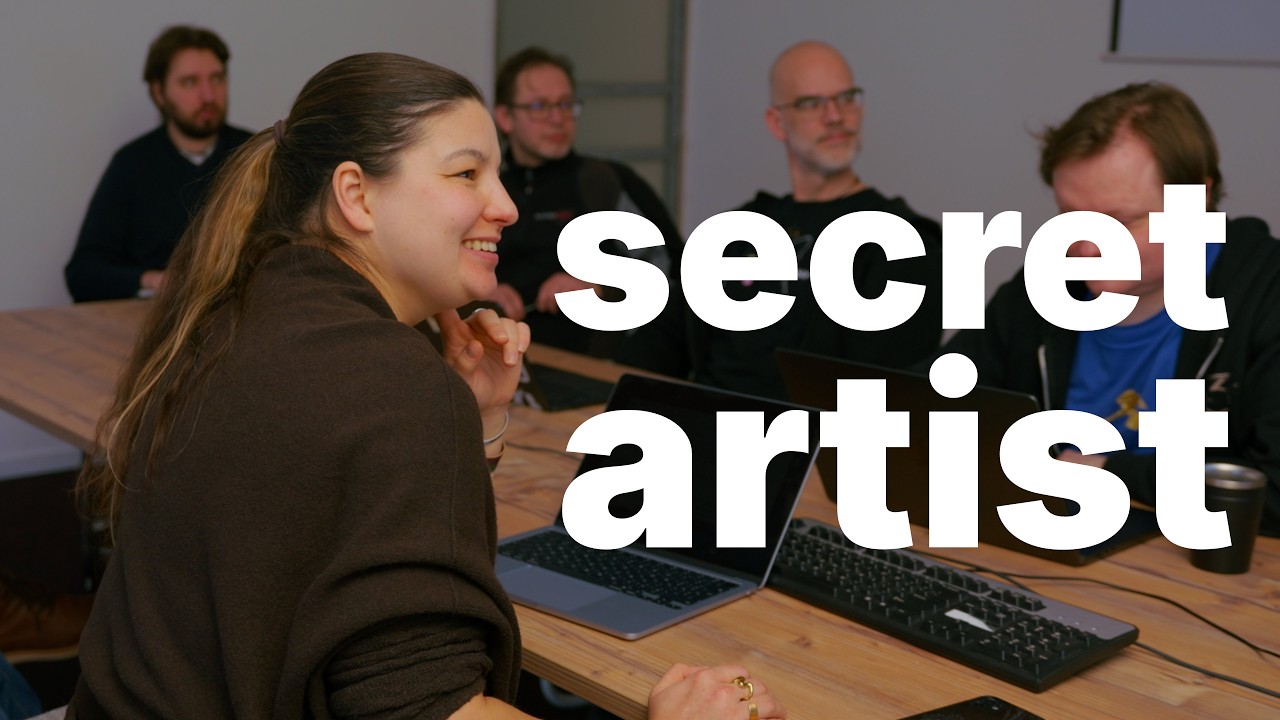
Video summary
The video features a project and development manager at Blender who shares insights into her dual role as both a technical leader and an empathetic team supporter. Having transitioned from being a developer to taking on management responsibilities, she emphasizes the importance of balancing stakeholder expectations with the well-being of her team. She describes herself as someone who actively builds relationships by opening up, making jokes, and organizing fun activities like Secret Santa events to foster a positive environment. This approach is particularly crucial in a remote work setting where direct interaction is limited, helping to bridge gaps between colleagues and ensuring that everyone feels supported personally and professionally.
To better understand her team's dynamics and individual strengths, she introduced personality assessments designed not to label people but to identify their natural talents such as learning, empathy, ideation, and strategic thinking. These insights allow the team to leverage each member's unique abilities for everyday work while addressing areas where support might be needed. For instance, if someone struggles with a specific type of problem-solving or social interaction, they can seek guidance from colleagues whose strengths align with those needs. This method creates a more cohesive unit by making interpersonal dynamics actionable and ensuring that everyone knows who to turn to for different kinds of help within the organization.
Beyond professional development, the manager highlights her personal connection to creativity through photography, crafting, puzzles, and other artistic endeavors which reflect her values of acceptance and freedom in the workplace. She uses physical objects like handmade figures or a large jigsaw puzzle as tools for communication and inspiration, often pointing them out during discussions about complex topics like hair simulation or lighting textures. Her workspace is filled with these creative elements that serve both decorative and functional purposes, illustrating how she integrates art into her daily workflow to maintain motivation and energy among developers who may secretly be artists themselves.
Ultimately, the video concludes by reflecting on the challenges of remote work versus the benefits of a personal-driven organizational culture like Blender's. The manager acknowledges feelings of loneliness when not seeing colleagues day-to-day but stresses that being part of both local and online communities helps understand diverse perspectives better. By combining technical rigor with genuine human connection, she aims to keep people excited about their projects while ensuring they feel safe enough to express concerns or seek reassurance without fear of judgment. This holistic approach demonstrates how blending empathy, creativity, and clear communication can sustain a thriving development environment even in distributed teams.
Read the full video transcript
We're having a secret Santa at the end
of the year.
>> I'm a project manager and development
manager. These half of the time direct
management of people who develop Blender
and part-time is dedicated to projects.
>> So, she's like coordinating development
projects. She's sort of overseeing them,
making sure that people are assigned to
them.
>> She has to juggle between a lot of
different stakeholders' expectations and
make sure the team performs. But, she
also has to take care of them, of their
well-being.
>> A lot of things that I do, they rely on
building relationships with people. I
open up more. I try to make more jokes.
I try to make fun and games, for
example, and entertainment for others.
>> It's also so important to the team at
that scale to have someone they can
reach out to both from personal topics
and to anything.
>> So, she's basically making sure that we
as developers can do the job that we're
supposed to be doing.
>> We never really had like someone who
catches up with other teams and like,
you know, works like more closely. Like,
it was always kind of like, "Hey, can
you kind of, you know, work on this
thing?" And then, you hope that things
go well.
>> Um
>> So, we have notes. There is no concrete
design
>> Mhm.
>> under the project that needs to be
finished already.
>> You mean hair?
>> The hair, yes. So,
what
What am I even talking about?
>> We met with her and Sergey, the three of
us first. She just asked the right
questions.
>> From like talking to all the people,
it's like, okay, so she knows where
attention is needed.
>> She started off as a developer herself
and then took on responsibilities as a
manager. So that already was like, oh,
she already has that title and she has
shown and she has interest in the
technical aspects.
>> Interesting.
>> Okay.
Hacking.
>> the hacking is
done.
>> So it's like we have a testing moment,
right? So early feedback moment. I think
it's going to be iteration of several
repetitions. So you have a checkpoint,
you have corrections, you come back to
checkpoint, you have corrections. So it
happens a few times.
At first it was empty, now
with time passing I brought a bit more
personal items with me. This is a box of
anti-stress toys. I am caring for
well-being and the stress of my
developers. This is handmade strong
female characters. So we have Padme and
V. Over time I also brought a bunch of
books. While you browse through it, you
can see a ton of absolutely different
styles.
>> She's there hunting couple of also
handmade stuff. I think it's not that
much about decoration, but maybe more
about feeling
more positive and comfortable.
Cheering me up.
>> I proposed to everyone who works in
Blender to take a test that measures
what you're naturally good at, so your
strong sides.
>> So, I was doing
these personality cooperative
personality tests.
>> You can also then use that information
to figure out what kind of things are
you naturally strong at.
>> These strengths can be used at everyday
work. As development coordinator, I have
to do a lot of people and I should also
be a good example, I guess.
So, that was
part of the reasons why I said, "Come
on. I I I cannot
back out of this. I should be a good
example." And I do the test, of course.
>> to this personality
corporate test
my five strengths are
>> I'm a apparently a learner. You enjoy
thinking about the past. You understand
the present by researching its history.
>> Apparently, I'm a good arranger.
>> I'm a learner. You have a great desire
to learn.
>> Relator, building deep relationships.
>> Ideation.
>> Ideation, you're fascinated by ideas.
You see connections that others don't.
>> Strategic, you create alternative ways
to proceed.
>> Empathy.
You can sense other people's feelings by
imagining yourself in their lives or
situations.
>> Intellection is also one of them, so it
means I'm attracted to solve puzzles.
>> Achiever, you work hard and possess a
great deal of stamina.
>> Values, which is honesty and loyalty.
>> I'm a relator. I'm a learner. I have
empathy. I'm achiever.
And I have belief.
>> So, the assessment that we all took is
aimed to understand the areas where you
have greatest potential. It looks at
your recurrent patterns of thought,
feeling, and behavior.
>> Your top five talents are your key
drivers.
>> And what I like to do is that to go from
person to person and you can talk about
your traits.
>> I can start for example for myself.
>> A lot of importance is for me into
one-to-one relationship with people.
Like everything builds from there.
>> Where I might be worried
>> Please, if you observe
that I am too much interfering,
controlling, you know where it's coming
from. You can safely say to me
>> Do you also recognize you could take on
too much?
>> Yeah, yeah, yeah, I could. I'm working
on that always. Thinking like, should I
do that?
>> Mhm.
>> But yeah, that could be a thing.
So these things I will put on the wall
and then we will have that as a
collection for all of us.
Photography has stuck with me for a
long, long time. It can be conceptual
when I try to show the idea, for
example, that people should not be
judged to be binary, as the one and
another. But how do I show it in a
picture? Photography becomes the medium
where a lot of other things I can bring
up into it. Work
with colors or maybe some craft that I
made is becoming an object in the photo.
I already noticed for a long time that
if I am making a photo, I try to put
something into it. Like what's
happening? Why is this person here? What
are they doing? What's their mood? It's
very good match with my values over
here, right? That people can be
themselves, right? We see that people
are accepted as as they are at this
workplace.
And people can work on what they value
and they make their own decisions,
right? They have freedom. And they open
up more and they have more motivation,
energy, and excitement. And then you
just connect to that excitement and work
with it.
>> It's the pen holder.
It's my favorite.
>> I really like it. It's like you have
a ghost as a servant.
>> If somebody asks me about like what's
what does hair do when you stretch it,
bend it,
then I can take this thing and actually
point at it.
Kind of nice to have a physical object
that you can explain things on. When you
have curly hair, it also
bends in a very similar way.
>> Being a developer
means you
have your very own kind of art style.
>> We do make a mess of things. I'm not
sure if that's good. Some of the math
you have to implement, some of the stuff
you have to do,
there's a real elegance to doing it
right.
>> I like to do everything that's related
to something creative. Many developers
are secretly artists.
>> This is indeed a Bob Ross.
Uh I did this as a part of a workshop.
Is it art?
I'll leave it up to somebody else. Do I
appreciate what I made and the fact that
I was able to make it?
Yes.
>> This is a a random collage. Natalie
really and me once did an art session
together. We fetched like random stuff
from magazine.
>> This I made myself. Made of clay. This
is supposed to be the mother and the
child. They are from the artist Sue.
>> This is a whale. It's just a little bit
of cardboard.
Glued together. I I tried to get it to
crafting a little bit more, but you
know.
>> This is a slug cat
from a Rain World.
>> This is a beautiful puzzle, which came
in a box of 9,000 pieces as a puzzle.
>> If you want to find a piece, go over
tray by tray by tray.
>> More than 100 hours, more than 200
hours.
>> Actually, I had these on my wall in my
old apartment, but they moved.
Uh and in the new apartment, there was
no room for this. So, I managed to bring
it over here and still maintain the
whole thing. From good old days.
It's called bug emitter. It goes to
check the bug tracker
for the number of open bugs and display
number of open bugs on the next tubes.
You know, from the amount of digit you
can say how far in the past it was
because now we don't fit in a three
digit.
So, we don't know if we fit in a four
digit nowadays. That I built.
>> Sometimes I I point a camera at people.
Open the window a little bit and then
you have this nice soft side light
coming in.
Julian after creating a Rubik's Cube.
>> This?
It's a Rubik's Cube. Well, two by two
Rubik's Cube.
>> So, when I'm stuck on a geometry problem
or two, I just doodle. I go through
about one of these a year.
>> So, we have regression test to ensure
that when we change the code, it looks
the same before and after so that we we
are sure that we don't break things.
This is the first test thing I made.
This is to test
light textures. So, we have point light
here. This is a point light.
And this is I think a area light. This
is a sunlight. The other one was for
testing light texture and this is
for testing all different light types in
a volume when I was implementing light
tree on to
make sure that they all work correctly.
And this was the test thing I created.
The spotlight is
just a wave texture. This is a maple
leaf and to create a texture you just
need one principle BSDF with a thing
wall
and you tweak the parameters. Without
thing wall mode you would need to
combine a lot of nodes. But, right now
you just
need this and some textures. I modeled
this a duck by myself. I have no idea of
modeling. I'm not a good Blender user,
so I had to search for a tutorial
online.
>> I am editing our planning tool. So, this
is what I introduced. There is no
central place and central picture like
all the project. Whenever I'm having a
meeting and learn something, pieces of
information, I go here and I put it into
one place. So, then it's easier for me.
It's easy for other other managers.
>> Communication is a pretty clear thing
for me. When you have to talk with
people about not meeting expectations or
having performance that's that's not so
great. When I see, "Okay, we are nearing
the end of the meeting." I'm like, "Oh,
by the way, don't feel too bad about it.
We're we're still happy with you."
>> Blender has been a part of my half of my
life. I always wanted to have technical
challenges, but also communicating or
working with people, having some sort of
creativity in it as well. And that's
really what what brings and sticks me to
Blender because I think it's
it's all of those things together
combined. And that's what I really
enjoy. Pe- people always need to keep in
mind that I can only communicate I can
only good faith and what not. And I can
only all have like I can only some own
agendas and stuff.
>> If you have these second thoughts, were
you worried about how things went,
you're always welcome to chat with me.
Like just to
Okay, this happened. This happened.
Yeah, just maybe to give a bit of a
reassurance.
>> Being remote,
we don't see a lot
of that side from you.
And uh I think it's a shame. Yeah.
>> Yeah, like we don't have a chance to
talk to you
over lunch, right? About what happened
recently.
>> Yeah, I would say that's the biggest
challenge when working remote. So, it's
like not having the
direct interaction possibilities with
people. And not hearing everything right
away. But also, of course, at times it
feels a little bit lonely. I would say
that you're just you don't have your
colleagues day-to-day. You're just you
know, you open your computer at the
beginning of the day you
you are in a chat, you have some
meetings, video calls, but yeah, you're
not having the direct interaction with
people. I also have to to deal with a
lot of remote people and the people in
the community of course. So, I think
it's important to
be in the same position in order to
understand what the community what the
online people need because when you
hear, you might not face the same
challenges as if you are remote. And so,
I think that's important to to hear and
live that part of the project as well.
>> Let me see.
Like this, this.
Wait, my favorite is
Yeah, I think this one.
There's a lot going on and it's a
feeling of a looking into somebody's
studio. I think it's also super nice to
be able to have a printed version. You
gives you a very different feel
than
digital thing.
The good part of this test is also it
doesn't try to put people in boxes like,
"Okay, you are like that." It's more
intricate.
>> you people you have, the more
interactions and relationships and
people things, people issues they are.
>> If I need help in strategic strategic
thinking, I can go to this person. If I
need help with meeting new people, I can
go to this person because very naturally
strong at this.
>> It was very interesting to share those
things and also to see where we are
where we are having gaps.
>> We are building relationships, right?
And maybe it's like reaching out to a
group that is harder.
>> To have all of this in mind and still
make it actionable.
And that it can be handled by the team.
And I think that's what's very
interesting because you need someone
who's dedicated to that.
>> That blue overload might be saying about
Blender as an organization that is like
very
personal driven, right? So there's a lot
of personal relations. So we need group
uh more power into how do we excite more
people? How do we kind of get people
support Blender? I'm happy that it
happened. Even Sergey jumped into
listen, although he is not believing in
this.
>> Mhm.
>> So that's nice of him.