Video summary
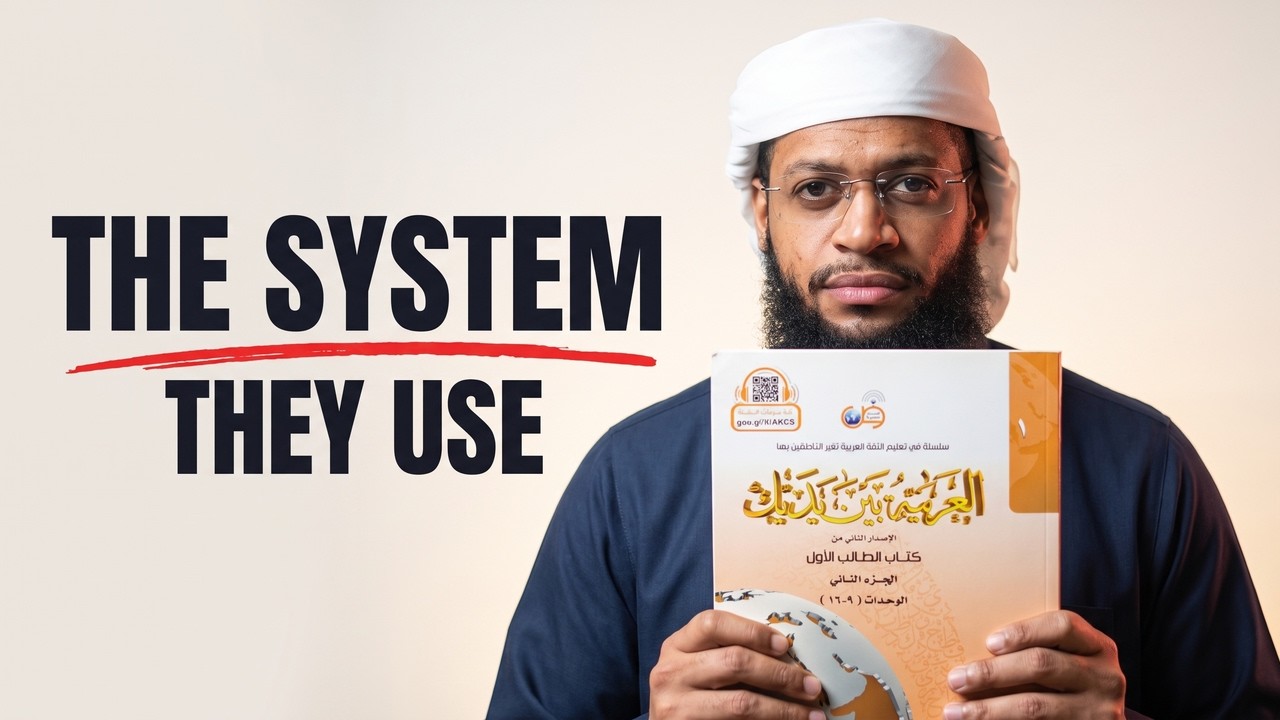
The video introduces and reviews "Al-Arabiyyah Bayna Yaday Awladina," an educational book series designed specifically for children to learn Arabic, created by the organization Arabic For All. The reviewer highlights that these physical books offer a tactile learning experience where kids can fill out exercises themselves, fostering excitement and engagement compared to digital-only methods. Each lesson in the curriculum is meticulously organized with audio materials available online, allowing parents who may not yet be fluent speakers to guide their children effectively. A key feature of the program is its structured approach at the end of every lesson, which breaks down vocabulary lists and clearly defines the specific learning objectives for each session, ensuring that students achieve measurable progress rather than relying on scattered or unstructured study methods common in other language courses.
The instructional methodology emphasizes listening comprehension as the foundation for speaking ability, drawing parallels to how deaf individuals struggle with pronunciation due to a lack of auditory input. The reviewer explains that children learn languages by first memorizing entire conversational blocks and sentences before gradually analyzing their grammatical components. This approach mirrors natural acquisition processes seen in other languages like Tagalog or Catalan, where learners understand phrases as whole units initially. By focusing on root-based morphology early on, the curriculum helps students recognize patterns; for instance, understanding a single verb root allows them to derive multiple related words and meanings simply by changing vowel patterns, which accelerates vocabulary retention compared to rote memorization of isolated lists.
To maximize effectiveness without requiring parents to be fluent themselves, the video recommends hiring private tutors who specialize in teaching Arabic to non-native speakers and are skilled at instructing children exclusively in the target language. The reviewer shares a personal anecdote about his own ten-year journey learning Arabic before realizing he should have started earlier with his first child, noting that early proficiency significantly aids religious practices like understanding Quranic recitations or sermons. He suggests a strict household rule where television is only permitted if it features content in Arabic, citing this as the method by which two of his children acquired fluency without formal structured lessons. Ultimately, the video encourages parents to start immediately while their children's brains are most receptive, promising that within a year and a half, families will see remarkable results through consistent exposure and guided practice using these comprehensive resources.
Read the full video transcript
As-salamu alaykum wa rahmatullahi wa
barakatuh. In this video, I'm going to
do a unboxing a review of this series of
books that you see in my hands,
literally Al-Arabiyyah Bayna Yadayk, and
this is
basically the equivalent of Al-Arabiyyah
Bayna Yadayk but for kids, Al-Arabiyyah
Bayna Yaday Bayna Yaday Awladina or
Bayna Yaday Awlad Na'am Awladina.
And um
the company or organization that takes
care of these, which are the same ones
that put together Al-Arabiyyah Bayna
Yadayk, is called Arabic for all, and
they were kind enough to send me a copy
of this full series, and I'm going to
revise it and review it with you guys
and go over it, and we are going to talk
about how we can make sure that all of
this knowledge right here, how we can
how can we transfer it into our
children's mind even if our Arabic still
not
there, but we don't want to waste time
until I learn Arabic and then my
children and learn Arabic themself.
Ideally, we want to as soon as we
realize as adults like, "Oh wow, I wish
I learned Arabic before." As soon as you
realize that, you want to make sure that
you start doing whatever you can so your
children don't have to realize late as
well that they should have learned
Arabic. So, first of all, let's talk
about the the actual work itself, the
>> [snorts]
>> the quality of the books and um
and the images of the books made for
children as well. The touch feels very
very good. It feels it feels good to
write on it, and it's always nice to
have the physical copies especially for
kids because it's a different feeling
for them, and and it's a different
excitement to actually, uh you know,
fill out the exercises themself
and whatnot. They actually have a
website that's called
kids.arabicforall.net, which
I'll put in the description below, and
you can go on there and there are audio
materials that go with The books
themselves, you can buy them from their
website. And as you can see, they are
about $7, let's say $8 each. And if you
go into the audio materials here at the
top, later once you have the books and
use the audios that they have here, you
can even download all of them here.
One thing that I like about Arabic for
all.net and as an organization and you
know, an organization that put together
curriculums to learn Arabic is that they
are very well organized. If you have
done
before, you might you might not you
might have not realized that at the end
of the books, actually there is a
breakdown of all the words and as well
there's a breakdown of very importantly
the purpose of the lesson. So for each
lesson, there is a a purpose in I don't
think they they have put it here because
for children learning Arabic for
children is a little bit, you know,
simpler and they they pick it up quicker
and they are able to build patterns
faster. But what they did is they put
the breakdown of all the vocabulary. So
at the end of each lesson, the
instructor that's teaching those
children can test them on on that
vocabulary as well and make sure that
they have, you know, achieved anything
that they had to achieve in that lesson.
Which this is what makes a difference
when somebody learns Arabic by just
just, you know, scattered from
in a scattered way where
sometimes certain teachers, they don't
follow a specific curriculum or whatever
it might be, uh, which is fine as well.
You still going to learn, but if you
have a book and you and each book has,
let's say, whatever, 70 lessons and each
lesson has a particular and and each
lesson has a particular amount of
vocabulary and basically you understand
what you have to accomplish to learn
Arabic, which, let's say, for example,
for the English language, they say
10,000 vocabulary words, right? Let's
say for the Arabic language, since is a
root-based language, as in you learn one
root, for example, kataba, and you once
you understand this morphological
phenomenon, the sarf of the three root
letters, you later on are able to
understand from one root letter
different meanings that come from that
same root letter. So, for example, once
you understand what the pattern of the
verb or infa'ala and for fa'ala and for
af'ala and for istaf'ala, once you
understand what this pattern usually
means, then you just have to add three
letters to it and you have a bunch of
other words. So, let me give you an
example. If you know kharaja, [snorts]
to come out or to leave or to exit, and
then you understand the pattern of
af'ala,
then you take these three letters and
add it into this pattern and now you
know kharaja, which is to leave, but you
know as well akhraja, which is to take
out or kick out, and then you know as
well istaf'ala, if you know this
pattern, istaf'ala, you know that it
usually means to extract something or to
ask for something or to consider
something a particular thing. Now, in
this case, for kharaja, istakhraja,
usually it might it might mean to
extract something from something.
Likewise, if you know the pattern of
fa'ala, which is similar to the af'ala,
then you know that kharaja to take
something out as well. Likewise for
infa'ala, usually it means that the
thing has been done by itself.
Inkharaja, it can mean that something
just came out of somewhere without
anybody really causing that thing to to
come out of that thing. And so, because
it's a root-based language, it's easier
to learn. And as an adult, it helps you
to make these correlations. But
children, they start building these
patterns faster than than adults. And
especially because adults as well, we
tend to try and understand too much. Try
and stop and try and make make sense of
it and instead of just allowing yourself
to learn how a children would learn.
Now, this doesn't mean that a children
shouldn't learn things like for example,
here we have kaff al-mukhatab, right?
So, you could consider this
as grammar. So, masmuka, the possessive
pronouns. Masmuka, what's your name?
Masmuki, what's your name for a female?
Masmukum, right? So, we learn these on
on book one. Likewise, we learn
ma al-istifhamiyyah, you know, to ask a
question. Ma hadha, what is this? And
so, this is how you you learn grammar
progressively. Instead of starting with
al-ajrumiyyah from the very beginning
trying to understand al-ajrumiyyah, you
just start by learning
little little concepts of grammar that
anybody when they learn a language would
use in their first communication
sentences. Like, "Oh, what's your name?
Where are you from?" From mean aina
anta. All of these things is is grammar
as well, but it's pieces of grammar that
are very useful in the beginning in
order for you to form sentences that
make sense. And so, this is on the first
book. Then as well, one thing that I
like about about this is So, when it
comes to learning a language listening
to how the thing is said is what helps
for your brain to form the language in
your brain as a [clears throat] tilkaia
something that's automatic for you to
do. And I tell you this after having
grew up speaking Catalan, Spanish,
learned French, learned English, and
learned Arabic. All of these last three
to fluency. They weren't my languages.
Catalan and Spanish you can say that
those are my my mother tongues and my
national tongues. And these three
languages, especially French, cuz
Arabic, English we did it in school.
Arabic was the only one that I actually
sat down in a class and went over books
and etc. etc. obviously because I'm more
interested about it to understand my
religion and whatnot. But French, to be
honest, my writing is very bad. My my
grammar, my everything when it comes to
to the actual technicalities of the
language in French is very bad. Mes yeux
pas français.
Ooh. N'importe quelle personne qui qui
m'entend parler français. Peut-être
qu'il faudra qu'il m'entende pendant
peut-être 2 heures parler ou même même
disons une demi-heure. Si je parle
pendant une demi-heure, je vais
commencer à dire des bavures, je vais
commencer à dire des des choses que
qu'une personne qui est native, qui a
grandi dans cette langue,
euh tombe pas dans ce dans ce genre de
bavure. Mais moi mon français, il est il
est vraiment de la street quoi, de la
street de Paris.
So my French is is fluent, but I learned
it by listening. And the reason why I'm
mentioning this is because if you pay
attention to people who are deaf, their
problem is not speaking. Yet when they
speak, they sound, you know, I don't
want to I don't want to imitate them.
But for the sake of the example, to make
the example clear, they sound like and
like they're not able to pronounce the
whole the whole the full sentences. And
it sounds like they have a problem in
speaking. But the real problem is in
listening. And because they don't hear
how it's being said and how it's spoken,
they are only able to communicate with
with sign languages.
But when it comes to the the voice and
the sound that they that they produce
with their mouth, they don't have a
problem with that. They can yell and
they can try and and communicate
speaking. And likewise, I remember
growing up there was a there was a girl
in my class. She was half deaf. And
because she was half deaf, she was able
to speak, but it wasn't 100% accurate.
And so this shows you that when it comes
to to being able to form a language and
being able to produce language, you will
need to listen a lot. And this is why I
like the, you know, how Arabic for All
make their books is because they they
make part of the curriculum listening a
lot. And and when I met the the author
of
of the book or one of the authors,
Dr. Abdur Rahim ibn Ibrahim al-Fawzan,
which I will as well I'll put the link
in the description so you can go and
watch the the interview. We spoke about
how to learn Arabic as a somebody who is
not Arab and and whatnot. And one thing
that we spoke about a lot, which opened
my eyes when it comes to how our program
was set up when we were teaching
al-Arabiyyah bayna yadayk in al-Andalus
Institute, it opened my eyes in in
making students, you know, use the
language more and listen more. So what
the what the Sheikh said is that when
you go over al-Arabiyyah bayna yadayk,
all you have to do is go over a lesson,
especially the first one because it's
all conversational. Go over the lesson
and then make the students just repeat
that same thing. So in the beginning you
start memorizing sentences. Where are
you from? You just memorize where are
you from as one block and you just
memorize that. And now you know that
where are you from? You just know that
that means, you know, where are you
from, basically. And this is how you
start with a language. Like for example,
there are certain things that I that I
might know how to say in for example in
Tagalog, right? I grew up around a lot
of Filipinos in in Barcelona, Spain. I
used to play as an import as well. Play
basketball in a Filipino team.
So, I know for example, "Ang pag ang Ang
pag Ang pag ang ko Muhammad. Ang pag ang
ko Muhammad." I just know that "Ang pag
ang ko" means "My name is." I don't know
which of those words is my I don't know
which one is is. I don't know which one
is name. But, I know that "Ang pag ang
ko Muhammad" means "My name is." Right?
And you And if any Filipino in the
comments, you can correct me. And so,
this is how you start learning a
language. You memorize the actual full
sentence first. And once you start
communicating, and then little by little
you will be able to start debunking the
whole sentence and be able to use blocks
of that sentence that you have memorized
to produce more to produce more more
language. So, first you know how to say
"Min aina anta?" Where are you from?
Then, you're able to produce where I
come from, where I go to, where And
you're able to use that word or those
different words in many different
sentences. So, now you are start being
able to produce more sentences. Now,
let's talk about how would you,
you know, make sure that your children
go over these. And And it's important
that we talk about this because me,
personally, I have realized that, you
know, it took me learn It took me
learning the Arabic language myself, and
it took me 10 years to learn the Arabic
language myself to realize
how late
I was in terms of of speaking to my
children. And the thing is that when my
when I had my first child, I my Arabic
wasn't good yet at at the stage or of
speaking on a day-to-day basis to my
children. And it it didn't feel
comfortable. Now, after 10 with other
children that other children that I had,
now I'm able to to do so. And I wish I,
you know, I did it with my my oldest
kids because then they would have grew
up with their first language or their
home lang their, you know, mother tongue
home language being the Arabic language.
And that on a long-term just gives you
so much facility in or ease in terms of
of your deen, whether it's memorizing
the Quran, whether it's sitting on a at
a khutbah, and maybe you're not
proficient at fusha, but you understand
60 to 80% of what the Imam is saying,
especially if the Imam is, you know,
paying attention to speaking in a in a
way where the mass of the people
understands in a easy easy Arabic, which
most of the Imams do. And I think that
many times we don't we don't realize how
important it is for us to put time into
teaching the Arabic language into our
children because ourself, yet we haven't
seen the importance. And you don't
really see the importance until you
actually get it and you have the Arabic
language with you and you read the Quran
every day and you hear it whatever
anything just just hear just turn on the
Quran in the radio is a reminder. And
just hearing the Quran while you're
washing the dishes is a reminder because
you understand and then it's going over
a story and it's reminding you of things
you might be going through right now.
So, in simple, how would I, you know, if
I'm not yet proficient myself in Arabic,
how would I make sure that my children
go over this? And look, when it comes to
knowledge, all there is is
going over books. I was having this
conversation with a brother not long
ago. We were talking about how
you know, there's there's knowledge that
we don't know just because we haven't
gone over the book yet. And the first
step to acquiring that knowledge is just
go going over the book. Like just
just reading because there is knowledge
out there that it doesn't take rocket
science to understand. So, when it comes
to learning Arabic, maybe the first few
books it will be the, you know, the the
the pattern formation, the skill
formation is going to be a little bit
tougher. But then your children, the the
once they get these, all of these rest
of the books is going to be so simple.
So, what I would recommend is that you
find
somebody who ideally who is recommended
by by a teacher that you know knows how
to teach the Arabic language. And it's
not every teacher that knows the Arabic
language that know how to teach it. And
I'm saying that because a lot of people
think that because somebody's native
that they will teach better. And that's
not necessarily the case.
But you want to find someone that knows
how to teach the Arabic language to
non-Arab. That's first thing. Somebody
who knows how to children. That's
another thing cuz teaching children is
not the same as teaching adults. You
want to find somebody who can teach your
children all in Arabic. That's very
important. In the beginning maybe yes,
they might be able to to you know do a
little bit of of of of English here and
there, but then you want your children
to be listening to listen to Arabic all
the time. So, you want the teacher to
teach them in Arabic. And again with the
example that we said about the deaf
people, the reason why they can't speak
is because they don't hear it. So, if
you want this if you hear it, your
children will just replicate what they
are hearing. And so for that you can
simply just go on websites that have,
you know, private tutors to teach the
Arabic language. Or if you know someone,
whatever you might be, just find a
private tutor that can sit down for even
if it's 3 hours a week. Ideally you want
to do to do it on a day day-to-day basis
and just have that teacher go with your
children over this book. That's how
simply it That's how simple it is. Just
go take that teacher and have them go
over these books with your children. And
believe me after a year, a year and a
half, and once your children have gone
over these books, they will surprise you
and and you will be so glad that you did
and you will see the fruits of your
children knowing Arabic in the future
when they when they grow older. Now
obviously before you get into these
books or your children, you want them to
learn how to read. So, if you don't know
how to read or your children don't know
how to read, what I would recommend you
is to go and check the description. I
have a full free course that you can go
over. In two days, you will learn how to
learn Arabic, even if it's a slow pace
and texts that are easy with harakat,
with vowels, but it's all you need in
order for you to to learn how to read.
And you can do it yourself and do it
with your children. And in one weekend
in two weekends, you guys can be good
readers of the Arabic language. And then
next step is going into this. And
believe me, this is all your children
would need
in order for them to know Arabic. Al
Arabiya bayna yadayk, Al Arabiya bayna
yaday awladina.
I haven't [clears throat] gone over this
one, but I have gone over Al Arabiya
bayna yadayk times and times and taught
it myself. And I can tell you that it's
all you need in order for you to have B2
level of Arabic. And B2 level is what
you will need to understand a very
simple tafsir. Like this tafsir right
here, for example. Very simple tafsir to
understand.
And just imagine what that would do in
your house. If you If you put effort
into this and then just imagine Imagine
yourself like watching Arabic cartoons
with your children, uh
reading to them a story before they go
to sleep only in Arabic. And by the way,
before we finish this, watching Arabic
cartoons, my children, two of them, they
learned Arabic by literally just having
a very strict rule in the house. You
cannot watch anything unless it's Arabic
cartoons or cartoons in Arabic. And they
literally learned Arabic like that. No
No structured Arabic learning, literally
just just watching Arabic cartoons. So,
I would recommend you that you have that
strict rule in your house of only
allowing your children to watch Arabic
cartoons. And believe me, after 1 year,
it will surprise you. So, this video is
to hopefully encourage you to have your
children learn the Arabic language, even
if you Perhaps you don't have time, or
you might think that you don't have
time, or whatever it may be, have your
children at least benefit from And let
them benefit from their early from their
young brain, so they can learn the
Arabic language before they become a
little bit older.