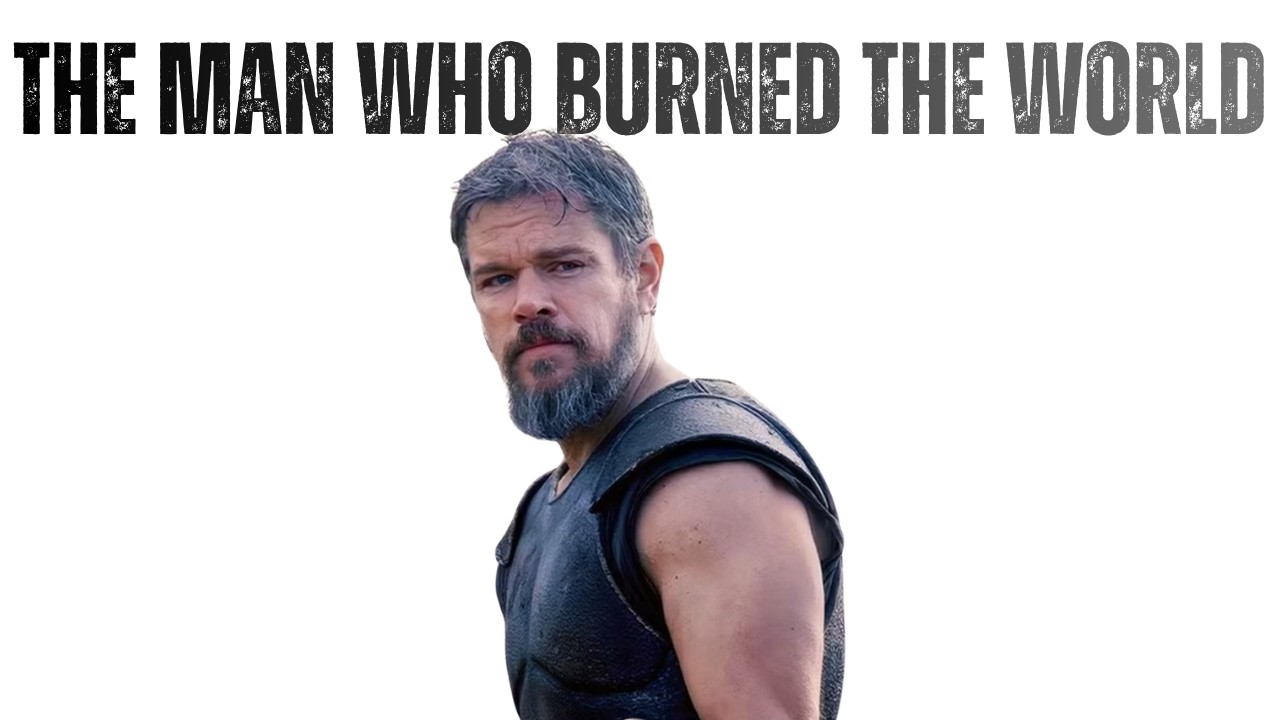
Video summary
Christopher Nolan's adaptation of *The Odyssey* reimagines Homer's epic by grounding its mythological elements in a harsh, realistic framework that strips away divine intervention to focus on human responsibility. While traditional interpretations often attribute fate and disaster to the whims of gods like Zeus or Poseidon, this film argues that humanity's recklessness alone drives our destiny. The narrative suggests that the ancient deities have either abandoned mortals or serve merely as scapegoats for actions rooted in human arrogance and violence. By removing external forces from blame, Nolan presents a story where characters must face the consequences of their own choices without the comfort of divine absolution, creating a grounded tale about the weight of personal sin rather than supernatural punishment.
The central thematic leap in this version is Odysseus's profound guilt over violating *xenia*, or the sacred law of hospitality, which he broke by using the Trojan Horse to sack Troy instead of offering it as an honorable gift. This initial act of treachery sets off a chain reaction that spreads like a disease through Greece, transforming once-hospitable giants into faceless, robotic warriors programmed for war and devoid of humanity. The film portrays these monsters not as mythical beasts but as the inevitable result of glorifying violence and abandoning moral codes; similarly, Circe is reimagined not as a deceptive witch but as a victim who turns soldiers back into their true violent selves when they invade her sanctuary. Through this lens, Odysseus's entire journey becomes a punishment for his original violation, leaving him haunted by self-loathing and unable to return home until he must confront the destruction caused by his own ingenuity.
The emotional climax of the film occurs in its third act, where the framing device reveals that Athena appears as an innocent priestess killed during Odysseus's flashback to Troy, symbolizing how his past sins have destroyed his present reality and severed him from his family. Upon returning to Ithaca, he finds a home desecrated by his absence, with a wife he has forgotten and a son who barely knows him, illustrating the tragic cost of his ego-driven war efforts. This revelation is mirrored in the film's connection to *Oppenheimer*, drawing parallels between Odysseus and Oppenheimer as two tortured geniuses forced to bear the responsibility for their own curiosity that destroyed parts of their worlds. The narrative posits that neither genius nor good intentions are enough; without a core foundation of mutual respect and basic courtesies like hospitality, civilization collapses into greed and endless war.
Ultimately, Nolan's *Odyssey* concludes with a bleak but necessary warning about the human condition: we are the makers of our own doom because there are no gods to blame for our failures. The film questions whether violence is an inherent part of our nature or if it stems from a failure to extend kindness even to strangers we do not know, suggesting that losing this ability to treat others with dignity causes civilization to fall apart forever. By linking the Bronze Age's brutal warfare with the Atomic Age's devastating power, the story asserts that without empathy and adherence to fundamental laws of conduct, humanity will only grow worse rather than better. The final message is a somber reflection on how our capacity for destruction lies within us, urging viewers to consider if we can ever truly regain the lost thread of civilization or if greed and violence remain our inevitable calling card.
Read the full video transcript
There have been so many translations and
interpretations of one of the greatest
stories of our time. And Christopher
Nolan's Odyssey is yet another entry
into the long list of adaptations of the
original epic.
I think from a technical level, Nolan
was the perfect man for the job. A story
that is again epic demands scale. And
who better to do that than Nolan?
With him, you know what to expect. He's
going to create a real horrifying
Cyclops, a real ship at sea, shots on
location, a sense of scale and grandeur,
and hundreds of people involved. It's
not going to be the volume and bad VFX.
And with the Odyssey, we have to begin
with the gods. Because in the very first
chapter, in the very first book, where
Athena and Zeus discuss Odysseus and his
possible fate after he angered Poseidon,
and Athena pleads the case for why Zeus
should help him.
Nolan's decision to subdue the presence
of the gods, at least in the flesh,
gives the story a more grounded
approach, potentially suggesting that
the gods have abandoned them, or that
they have abandoned the gods. Still, to
me, they were quite present. Athena is
alluded to being the beggar at the
beginning of the film, and as Mentor, as
she takes his disguise in the pole.
Telemachus says that Mentor has Athena's
eyes.
Zeus and Poseidon can be found
throughout the film, especially
Poseidon's, when Polyphemus invokes his
father and how tumultuous Odysseus's
journey becomes as a result of
Poseidon's wrath. We see what happens
when some of his men steal Helios's
cattle,
despite the warning, and how Zeus's
lightning later destroys their boat.
But the gods can sometimes serve as
scapegoats, allowing people to hide
behind the will of the gods. Agamemnon
asked for winds and sacrificed his
daughter.
And Nolan's adaptation is not interested
in any sort of external force to absolve
any individuals. And Odysseus isn't
either. He's not interested in, quote,
omens and sacrifices, rather just wit
and ingenuity. [music]
Nolan takes that idea of blaming the
gods that Zeus mentions in the first
book and agrees with the king of the
gods when he says that humanity's
recklessness alone drives their fate
more so than the gods.
The biggest interpretational leap that
Nolan takes is regarding Odysseus and
the massive guilt he feels for violating
the core tenant of Greek life, Zeus's
law.
Zeus's law or xenia in the Odyssey is
the hospitality that you are supposed to
show to any stranger or guest that
enters one's home. I do wish Nolan spent
some more time exploring what these
customs entail, which is more than just
respect, but also [music] food, fresh
clothes, baths, gifts, and the overall
warmth of a home.
Nolan's Odysseus proposes that he had
violated that act through the use of the
Trojan horse that commenced the sack of
Troy, which was supposed to be an
offering.
Whether or not his act was worthy of
[music] being deemed fair during a time
of war,
Odysseus is more focused on how this
violation opened Pandora's box with
people everywhere now discarding Zeus's
law.
This violation spreading like a disease
through ancient Greece, where now anyone
will do anything, even desecrate great
sacred laws, to obtain what they desire.
Odysseus, who is a man who championed a
fair fight, plucking [music] his bow
even at wild prey to warn them, a
supposed honorable man, the one time he
doesn't pluck his bow is upon leaving
the Trojan horse at Troy. And before
[music] he reaches Calypso's Island, he
is haunted by this idea.
Because instead of going straight home
after [music] the Trojan War, he decides
to sightsee, to continue pillaging, and
to bask in his great glory and great
violation. [music]
And he begins to get punished for it.
The entire journey is his punishment for
his original violation, Nolan suggests.
The giants he encounters, the
Laestrygonians, are the results [music]
of the glorification of war, the
departure from the Bronze Age into the
Iron Age, all because of what he
started.
Instead of being man-eating ogres or
beasts, [music]
they are giants, almost robotic,
programmed for war and without faces.
Their hospitality is extinguished, their
humanity gone.
When Odysseus's men introduce
themselves, expected to be greeted with
Odysseus's law, the giants do not abide
by such law, and some of his men are
killed.
Odysseus's consequence.
This trickles down to Circe, a change
that I really enjoyed, turning her from
a deceptive witch into a woman, a
victim, incredibly fearful of what
soldiers are, what men are, people who
revel in violence, men who rape and
pillage and destroy. So, she simply
turns them into what they really are.
Through Odysseus's lens, she too suffers
from the actions he took that one night.
He began this story with an army, and
slowly he has lost them all, and now he
has become a lonely man searching for
punishment, even yearning to hear the
siren's song because he is so
self-loathing, so self-sabotaging, a man
who doesn't want to go home.
All until his consequence reaches Ithaca
and Penelope and Telemachus.
His own home is desecrated because of
him, a son that he barely knows and a
wife that he has forgotten.
And I want to mention how strong that
third act is, particularly the scene of
Athena as the priestess, which only
works because of the framing of Odysseus
as the genius, as the hero of the Trojan
War in the second act, which works to
inform both us and Telemachus' view of
his father, our view of his father.
And after which we are shown his great
triumph in Troy, which is mirrored by
his monologue to Penelope in the final
act.
Telemachus expects a war hero, a great
man, and even though he doesn't see it,
he is instead greeted by a man who wears
the sorrows of a world he helped
destroy. And it's fascinating that
Athena tells him that it's not his will
alone that has done this, and that he is
even against the will of the gods.
And yet Odysseus still blames himself.
He blames himself for his men, blames
himself for his act. The same ego, the
same arrogance that has won him the war,
all comes crashing down on him.
And that cut to Athena's face as the
priestess was a truly horrifying one.
It's an image a scene that I'll never
forget, I think my favorite in the
entire film.
I don't think it was Athena herself
being killed as Athena often takes many
forms. So, I think when Athena does show
herself to Odysseus, she reveals herself
in the form of that young innocent
Athenian priestess that he killed to
remind him of his guilt.
And it could also be a nod to Athena's
involvement in the first place. In the
text, during the sack of Troy, Ajax the
Lesser kidnaps Princess Cassandra under
the protection of Athena and rapes her,
desecrating Athena's temple.
Alternatively, it could also simply be
that she is not a god at all, but a
memory of Odysseus' sin.
And finally, it could have been Athena
herself showing off the abandonment of
the gods and of Zeus' law that Odysseus
laments. Regardless, the entirety of
that scene, along with Ludwig's
thundering score and Odysseus'
homecoming, really brings all the
movie's themes together. With moments
like this, and Odysseus stringing his
bow to reveal himself to Penelope with
the same score as the siren song when he
was punishing himself are Nolan at his
absolute best.
I've tended to be a bit critical of
Nolan for his lack of emotionality over
the years.
I do still believe there is a layer of
frost when it comes to him, but I've
really come to appreciate how
sentimental he is when it comes to the
themes of family, the return home, and
time as one thing that is so fickle
as seen in Interstellar, Tenet, and now
here. I think the most interesting
thematic connection comes with
Oppenheimer and the Odyssey. Two men
forced to bear the responsibility for
their own curiosity or ingenuity. Two
men who destroyed their world and are
now forced to carry the weight of their
sins.
The scenes of Odysseus walking through a
burning Troy looking completely appalled
and Oppenheimer at the rally are two
thematically mirrored moments that are
some of Nolan's finest. It's like
Odysseus is Oppenheimer's ancestor.
Nolan, like Athena mentions in the film
and what Zeus says in book one of the
Odyssey, he both fears and believes in
humanity's propensity for monstrous
acts, for misusing the powers presented
to us. But the focus is seldom on how
the people use it and instead how the
tortured geniuses have changed their
world forever and how they reckon with
that and some of the personal
consequences associated with that.
We've seen with both Prometheus'
descendant and the modern Prometheus
that genius, cleverness, and wit are not
enough. Intentions are not enough.
Violence in the Bronze Age is connected
to violence in the Atomic Age and there
aren't any gods to blame. There aren't
any scapegoats.
Nolan asks, is this our nature? Is this
how we treat each other?
Nolan notes that a core of Zeus's law is
being at the mercy of strangers, that it
is something that we still abide by to
this day. But if we cannot take care of
each other even if we don't know each
other, if we cannot extend that hand,
how can we move forward?
He claims that treating others the way
we want to be treated is the backbone of
civilization. It is the thread that
connects us to Homer, to the ancient
Greeks. It connects us to each other.
And losing that key thread causes the
downfall of civilization.
When we lose our ability to perform the
most basic courtesies like hospitality,
then how can we truly regain that?
And Oppenheimer is the conclusion,
ultimately saying that we never will.
That it will only grow worse. That
greed, violence, war is our calling
card. And men are never sated.
If we cannot open our home to strangers,
then what exactly will this world
become?
At the end of the day, Nolan suggests
that we are the makers of our own doom.