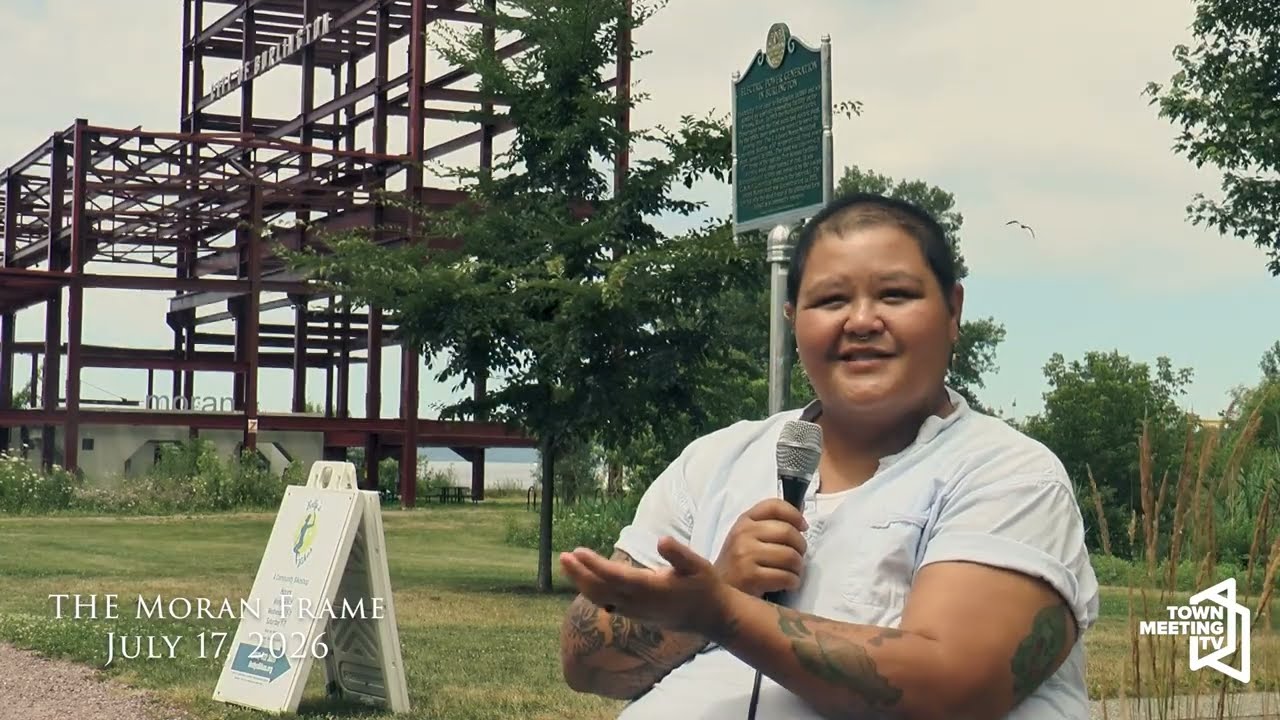
Video summary
The video introduces Ita Menow, a long-time Burlington resident who works for the city and has witnessed the transformation of the historic Moran plant into what is now known as The Moran Frame. Originally constructed in the 1950s to generate electricity by burning coal, the facility was decommissioned during the 1980s under Mayor Bernie Sanders, leaving the massive structure vacant for decades. For forty years, the building stood behind its current brick facade covered in pigeon droppings and filled with old hopper equipment used to feed fuel into boilers, representing a period of uncertainty as the city struggled to determine its future use while grappling with significant costs that stalled development efforts for many years.
The revitalization process gained momentum when Mayor Bob Kiss initiated a community-wide campaign asking residents what they wanted to do with the site, receiving thousands of postcards and diverse suggestions ranging from casinos to ice climbing walls. Although initial funding challenges delayed progress, renewed efforts under Mayor Mural Weinberger led to a request for proposals that resulted in hiring a team dedicated to stripping the plant down to its structural skeleton. This strategic decision revealed the iconic steel frame beneath the crumbling exterior, creating an open-air public space where picnic tables allow people to gather and enjoy the site as a piece of living art while preserving it as a tangible memory of Burlington's industrial past.
Beyond serving as a community hub or "third place" for social interaction, The Moran Frame symbolizes the city's profound commitment to sustainability by eliminating fossil fuels from its energy portfolio entirely. Ita highlights how repurposing this former coal plant rather than demolishing it demonstrates that a municipality can change direction while maintaining affordable energy and honoring its history. This transformation offers a powerful counter-narrative for young people who might otherwise feel compelled to leave Burlington, reframing the city as an opportunity-rich environment where residents can orient themselves toward community building instead of seeing their hometown solely as something to escape from.
Ultimately, Ita concludes that The Moran Frame stands as a testament to the value of repurposing existing structures over engaging in cycles of rapid consumption associated with fast fashion and food. By turning a decaying industrial relic into a welcoming, solid, and thoughtful public space, the project illustrates how communities can create meaningful landmarks that foster connection and pride. This approach not only addresses environmental goals but also provides a visual reminder that cities have the capacity to evolve responsibly, ensuring that future generations inherit a place defined by innovation and community spirit rather than abandonment or decay.
Read the full video transcript
Heat. Heat.
Okay, great. Hello, my name is Ita
Menow. Uh, I'm a Burlington resident and
I work for the city of Burlington. I've
worked for the city of Burlington for
over 20 years now in multiple city
departments and I've seen many
iterations of uh the Moran plant
including its current iteration as the
Moran frame.
Sure. I that's a great question. Um
full disclosure I'm not a part of the
team that that uh that envisioned this.
I'm not a part of the team that uh
brought it into fruition but I have been
around and while while it was happening
and uh it was
uh created initially in the 50s the
Moran plant as a coal burning
um facility to create electricity for
the city of Burlington. It was
decommissioned in the 80s I think under
Bernie. Um, and what that means is that
it stopped functioning as a generation
facility for energy. Um, and for golly,
40 years, the city was thinking, what do
we do with this building? Cuz it's this
giant building uh behind us, I mean,
what you see is a frame, but it was
covered in bricks and pigeons and pigeon
droppings and more. There's so many
pigeons. Um and uh it was filled with uh
hoppers that they used to put the coal
in that was put into the boilers to fire
it up and to create you know the uh tur
make the turbines turn and create
electricity. Um,
and then, uh, when Bob Kiss was mayor,
whatever years that was, when Bob Kiss
was mayor, there was a big push,
um, a city-wide push to have residents
decide what to do with the facility. Um
and uh the community came together.
Hundreds of people, thousands of people
sent in postcard. Hundreds of people
came together to give feedback to the
city about what they wanted uh the Moran
plant to look like. And we had
recommendations from like uh casinos to
an ice climbing wall. And then it was
just kind of in flux for a while trying
to find funding and uh developers who
who could make the resident's dream come
true. Um for lots of different reasons,
mostly I think due to expense. It was
really expensive. Um the uh the city
rebooted its efforts like 10 or 15 years
later while when Mural Weinberger was
mayor, uh reboosted its efforts to um to
figure out what to do with the Moran
plant and uh a group of folks came in
and they made this recommendation to so
uh when uh Maro Weinberger was mayor
where there was uh an RFP or request for
proposals put out to uh find somebody to
figure out what to do with this space
and these folks were hired. Um I can't
remember their names, sorry. These folks
were hired and this was their proposal
was to kind of break down to its to its
bones. Uh break down the mar plant to
its bones and see what the community can
envision once that was done and the
frame was the frame was born. And I know
that there's a a future vision for what
the Moran frame can be. Uh it can be uh
it's a cool piece of public art right
now. Um there are picnic tables for
people to gather. There are people
gathered there right now having a good
time. Um it is a a beautiful uh
representation of what a city can do
with some of its buildings that are uh
that are falling apart and crumbling.
um and what a city can do to make a
promise to its future.
I think that it could be uh uh I think
that it could continue to be a spot for
people to hang out. I think that, you
know, if um the city and its community
partners decide that the Moran fra uh
the Moran frame can be
can uh has a way to fulfill its promise
to become a community like a community
spot like a third place. I think that it
could do that. I I think that, you know,
some of the plans that the uh that the
developers put together about its
future, I think that those plans were
really cool and it can be something
amazing. Uh for me, I work in the energy
sector right now and um I think it's
such a beautiful thing that uh a city,
one of the first cities in the country
that is fully committed to uh to having
a an energy portfolio that is uh that is
green. That means that there's no fossil
fuels in his energy portfolio. Um, I
think that removing a
a coal burning facility,
um, but keeping its uh, presence, its
frame as a memory, I think in this kind
of a city. I think that that's a really
cool uh symbol for how a city can change
and how it can continue to keep energy
affordable um and and continue to be a a
symbol in how Burlington can pave its uh
pave a way for its future residents to
think about community and to orient
itself towards the community rather then
um rather than seeing all of our young
people try to escape Burlington as fast
as possible, I think it can be a a place
that young people can see as um an
opportunity, not just something to run
away from.
Words of wisdom, I think I I I'm a huge
uh fan of repurposing. I I really
dislike uh fast fashion and uh fast food
and all of these things. This heavy
desire for us to consume, consume,
consume. I think the Moran plant and the
Moran frame can show us that we can
repurpose things that have existed in
our community and really make something
solid and thoughtful and uh welcoming.