Video summary
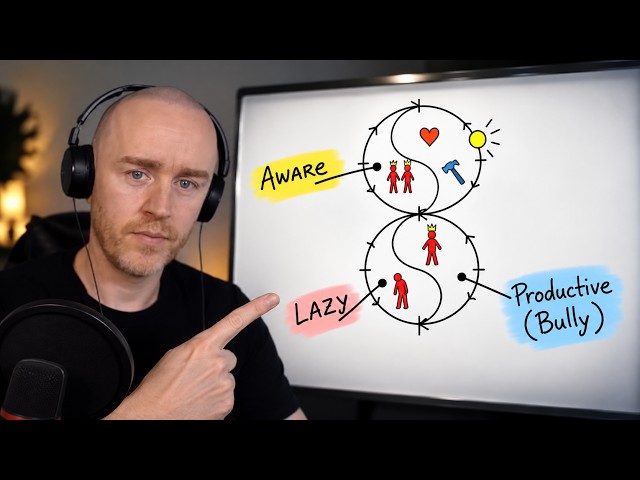
The video explores the metaphysics of procrastination by moving beyond surface-level productivity hacks to examine the internal psychological dynamics at play. The speaker introduces a model consisting of two opposing mindsets: the "distressed mindset" and the "productive persona." In this lower state, individuals are trapped in a cycle where they believe their laziness is a behavioral flaw that must be fixed through external discipline and self-improvement strategies. This approach creates an internal conflict between the judgmental part of the self, which labels one as lazy and induces feelings of guilt and shame, and the stressed persona, which relentlessly pushes for productivity to prove worthiness. Consequently, the mind orbits in a counterclockwise direction, endlessly trying to suppress the "lazy" shadow while bullying itself into action, resulting in anxiety, tension, and eventual burnout without resolving the core issue.
The breakthrough occurs when the individual realizes that this struggle is not about behavior but rather a perceptual problem. The speaker argues that the solution lies in shifting from a behavioral framework to an inner work perspective where one accepts that they do not have a laziness problem but rather a distorted way of seeing themselves and their goals. At this higher level of awareness, the previously opposing forces—the shadow and the persona—are integrated. The judgmental labels are released, and the concept of being "productive" is reinterpreted from self-coercion and bullying into a genuine desire to act. This shift allows the individual to recognize that both the fear of laziness and the pressure to be productive were contributing factors to the cycle of procrastination, effectively breaking the trap of the Chinese finger trap where tighter effort leads to more entrapment.
Once this perceptual shift is achieved, two new aspects of the self emerge: the "free spirit" and the "builder." The free spirit represents spontaneity, genuine desire, and the freedom to choose actions without coercion or obligation, embodying a healthier feminine aspect of the psyche. Simultaneously, the builder brings forth decisiveness, boundaries, and implementation skills, representing the masculine aspect that acts from clarity rather than fear. In this liberated state, individuals can pursue their goals with guilt-free play and natural motivation, free from the need for self-admonishment or massive planning schemes. The video concludes by suggesting that while this is a transitional mindset to reach an even higher state of natural integration, staying here allows one to relate to themselves and their work without pressure, anxiety, or the repetitive patterns of the past, offering a sustainable path out of chronic procrastination.
Read the full video transcript
If you're unfamiliar with my work,
I'm going to talk about procrastination,
but I'm going to do it in a way that's a
little bit different. I'm going to
actually depict what it looks like, the
metaphysics in it. I'm going to use
diagrams
to try and depict what's going on
internally in the mind
around this problem. So, we're going to
jump into it now. I'm going to use
diagrams and
typically people stumble upon my work
after they've tried everything else.
Kind of a chronic procrastination
problem maybe they've developed over the
years. So, if that's the case for you
and you've struggled with this for a
long time and you've tried all the
productivity hacks and the
self-discipline and the scheduling
techniques and the apps and everything
else,
stay with me because this video will
offer you a different explanation and a
different solution in terms of how to
deal with procrastination. So, hope you
find this useful
and let's dive in. Let's take a look at
some of these diagrams that I'm talking
about.
So, metaphysics
of procrastination.
We're talking about the invisible, the
unseen, the what's happening underneath
the surface.
What I'm showing you here
are basically [clears throat]
two mindsets.
So, this here is our first mindset and
this is what I refer to as the
distressed mindset.
And when we [clears throat] have
procrastination as a problem,
that's the mindset. This here is the
mind. The mind gets stuck orbiting or
following the underlying rule that
upholds that mindset. So, it's moving in
a counterclockwise
direction. That depicts that it's
following the rule that undermines
underlies this mindset.
But, what is the mindset? What is the
rule that undermines it, too? Well,
effectively, it's moving in this
direction, it's adhering to this
mindset.
Always in the same direction, never in
the different direction. But, the rule
in this lower mindset, when we're
dealing with procrastination, it sounds
a bit
abstract or a little bit general, but
I'll it'll make sense in a moment. The
rule, when we're in this lower mindset,
is that we must
look outside of ourselves
in terms of fixing behavior
to find the solution to the problem of
procrastination.
Always look outside yourself, okay?
It's about fixing, etc., etc.
But, what is in the mindset? The mindset
is conflicted. It has two
opposing parts. This is why it there's a
conflict in us when we have
procrastination. One part feels one type
of way, the other part feels a different
type of way.
And the first of these parts that we'll
look at here
is what I call the well, it's labeled as
the lazy part. Okay? This is the
judgment that people will have against
themselves when they are struggling with
procrastination. So, this aspect of the
mind here
is what we call the lazy part.
Most people who have procrastination as
a problem are convinced at this level
that they are lazy. So, when the mind is
here
orbiting around in this phase
that's where you're going to get all
those emotions that are associated with
this. And what are those emotions
typically?
Guilt, shame, unworthiness, okay?
So,
disappointment, depression,
all sorts of low, heavy feelings
we'll experience when the mind is
stuck in this aspect of this mindset,
following this rule of seek outside
yourself. There's a problem it's you and
it needs to be fixed through your
behavior.
Okay? So, it's moving in this direction
and that's the Those are the feelings we
will have.
Now, the opposite So, that would be like
Jung's shadow. Nobody wants that. People
want to get it rid of that. They're
desperately trying to lose that aspect,
right?
And so, they push it away, repress it.
The other aspect that we'll look at next
is going to be more of a Jungian idea of
the persona and that is more
it's the I would call this the
productive
aspect, right? So, this is the part that
pretty much everybody wants to be. This
aspect of this mindset is the stressed
mindset, which is where we're trying to
be more productive.
We identify this part is
attempting
to really fix this part. So, this part
here
is attempting to fix this part here.
Okay? So, the mind
comes out of this. Now, usually when it
comes out of this part of the the
laziness, it's now into implementing
self-improvement strategies.
Still following the same underlying law,
but that's what it's doing and it's
trying and attempts to be more
productive. I need to be more productive
and more deeply attached to that that
aspect.
So, the the the difference here is we're
desperately trying to get rid of the
idea that we're lazy
and we're doing that by being more
productive, identifying with I got to be
more productive, I got to do more, etc.
And the mind in this phase here,
well, the emotions that are experienced
at that point are going to be all sorts
of
tension and anxiety here.
As it's moving in this direction and
we're getting up to this point here,
usually what happens is the person
realizes
I'm failing to implement all these big
intentions and plans, etc. And that
tended turns into a self-directed anger
typically.
Okay, so we start to get the anger gets
directed towards the self.
We're coming out of the persona and now
we're going back into cuz of all that
self-directed anger and judgment, I'm
not good enough, I'm lazy.
And we go around and around and around
and around. And what we're going to do
the mind it gets trapped in this mindset
following this rule that says you must
fix your behavior.
That's the rule. It's a behavioral
problem that will not be able to get
fixed until you tweak your behavior.
So it's the the productive persona
versus the lazy aspect of the shadow.
There is no solution to this.
The solution, I'll come to you now,
is basically the mind is the solution.
The mind gets to this point here and it
needs to make a choice to break out of
it and go into this new mindset up here.
What is the
entry fee
to get into this new higher mindset?
This lower mindset down here,
I would refer to it as the distressed
mindset where nothing works. This
mindset up here
is actually a transitory transitional
mindset to move into an even higher
mindset in which we use but this our
goal in all of this inner work is to
just get to this mindset and stay there.
That's where things work. But the
admission fee
to get into it
uh at this point here
is effectively
you must accept
that you don't have a behavioral
problem.
It's not about fixing your behavior.
The rule here at this level,
this mindset, and you may notice now
that the mind is moving in a completely
opposite to direction to the one it used
to move in.
The rule or the admission fee is that
you must accept that you have a
perceptual problem. And that you're not
seeing things clearly.
The only problem you've had is that it's
a you have a perceptual issue.
So,
it's no longer going to be about purely
behavioral tweaks.
Now, when we're at this level and we're
following that rule of I'm looking at my
perception, that's the key to all of
this,
something very, very interesting happens
at this point here.
What was seen as two different parts
previously
are brought into awareness
and they are both seen as
the same thing.
The persona and the shadow at this lower
level of consciousness are actually seen
now in full light as both contributing
to the issue.
Down here, in this level of
consciousness, this is one we identify
we want this, we trust this one.
And we despise and resent this one. Up
here, we're realizing that both of those
aspects are actually problematic.
Not just the shadow part, not just this
lazy thing that you're labeling yourself
as. It's the attempts to make yourself
being productive by tweaking behavior,
etc., etc., that are contributing to
your problem. But when you're at this
level in this mindset, you're beginning
to realize here,
well actually they are actually both
contributors to the problem. And it's
able to bring you out of this into a
completely So, the first the first phase
here is what I would call awareness.
Where you're basically at this point
here, in this phase, you know, you're
bringing awareness.
So, I'll write it in there.
You're bringing awareness.
You're seeing Now, you're you're seeing
the perceptual problem for what it is.
That's a big deal.
Right? It's almost as if at this level
of consciousness or this mindset, you're
able to look down at this entire
scenario and see it for what it is.
Right? It's a Chinese finger trap.
And that you can the the harder you try
to tweak behavior and force yourself,
the worse it gets.
We start to really understand what these
two things are.
And
at the level
of awareness, there's a just watching
there's awareness to understanding how
it all works and there's also a process
of questioning that goes on. So, a big
part of the work at this level
here
is first of all, we we we actually
address both the shadow and the persona,
the lazy and the productive aspects
differently.
What happens with the the laziness stuff
in the shadow, the judgmental, you know,
you're lazy, you're not good enough,
that gets questioned and let go of.
That up at this level of consciousness,
there is no judgments.
Or it's about letting go of all those
judgments and realizing they don't
actually explain it.
Now, it's a little different for the
persona. At this level of consciousness,
what we're doing is we're seeing that as
certainly part of the problem, but we're
not letting it go. What we're doing with
it is we are actually reinterpreting it.
Okay, so you're still allowed to refer
to yourself at this level up here as
being productive, but what being
productive means is it no longer means
this.
Which now
I'll I'll write it in here because this
is important. The reinterpretation, you
realize that at this level down here,
what productive really meant, which we
were attached to for a very long time,
is that you bully yourself.
You start to see that productive persona
for what it is,
which is demanding, yelling,
criticizing, bullying, coercing
yourself.
And you realize, oh, that was part of
the problem, too, at with higher level
of awareness.
Now,
so we're at this we've accepted we have
a perceptual problem. We're beginning to
see how it all works and the trap we get
caught in.
And when we're in this level, so we're
coming through here and we're doing all
this awareness and we're questioning and
we're seeing how it all works.
And when we get into this part here,
something very, very interesting
happens.
The first thing that happens is
something I refer to as the free spirit
comes online.
And the second thing that happens,
something I call your builder
comes online.
So, these are
>> [clears throat]
>> actually
alternatives, alternative ways
to live and proceed with your
productivity
uh to the persona of productive and the
shadow of laziness. Those are the two
things that we're letting go of. And
when at this level, when we're here,
we're actually
what's coming online, what's coming into
our consciousness now, is these aspects
of the self, which is about the the free
spirit is about recognizing that there
is no coercion. I am absolutely free to
do the thing, to not do it.
There's come There's no coercion
involved with it. The builder aspect is
all about
having boundaries with things, saying no
to things, protecting the free spirit,
um no longer using personal productivity
to
torture yourself,
dare I say it.
So, what you're doing is So, these two
aspects the it's the it's like the
masculine and feminine, right? The
free spirit aspect when it comes online
is really all about spontaneity or
desire or your yes, your strong yes to
things. This is what actually what I
want. There's no more have to's, need to
do's, should do's, or any of that stuff.
It's I want this.
And it's it's about identifying that and
actually going after the things that you
really want in life.
From a genuine heart
feeling place, rather than obligation or
pressure.
And the the
uh
the builder aspect is about
implementation.
It's about decisiveness.
It's not about big plans or big massive
schemes. That's where all this stuff
comes in down here when we develop
covert contracts around how can I stop
being lazy? I have to do a lot, right?
This is all about boundaries. Boundaries
with yourself, boundaries with your
goals, right? Et cetera, et cetera.
So, when we're at this level, and again,
our goal is to
get out of this mindset and just get to
this by recognizing we have a perceptual
problem and staying there as long as we
possibly can.
When the mind is there,
you will be going through phases now of,
"Okay, I'm becoming aware. I'm bringing
awareness that an old pattern of
coercing myself and judging myself."
And now you're doing things in this
phase where you're practicing guilt-free
play, et cetera, et cetera.
Um non-conditional play.
And you're doing things like you're
becoming decisive.
Right? You're having boundaries with
yourself. And you're able to see very
clearly the way you used to relate to
yourself, and the new way you're
relating to yourself. And you notice
too, by the way, that you're getting a
lot more done without any pressure,
anxiety, stress.
Okay? So, this is about the mind.
You've heard it a million times, the
mind is powerful.
We're getting out with the idea that
this is a behavioral problem, and we're
getting into the idea this is all a
perceptual, this is an inner work issue,
where we can start to do the things we
want, to go after the things we want
without any pressure,
self-judgment,
berating ourselves, admonishing
ourselves, pressuring ourselves.
None of that's necessary. This is a
completely new, dare I say the word,
paradigm, right? Where we're realizing
there's actually a different way to do
this, and it's very effective.
It's extremely effective. It doesn't
have the same bravado
and bullying yourself as we used to have
in our because that's really what you'll
become to see is that the old way of
doing it is all about bullying yourself.
There's no bullying required.
There's also no laziness. Laziness is
just a judgment. What happens to that
part? It becomes this free spirit where
it realizes I'm totally free.
And I'm allowed to want things, admit
the things that I want to myself. That's
the the healthier feminine aspect of the
psyche. So, this is the feminine aspect,
and this is the
masculine aspect. And after a while of
inhabiting this mindset, where you're
adhering to that law,
you will actually break out of even that
mindset, and there's higher mindsets to
go to, where there's no even
doing this inner work of questioning.
You you you've integrated it now, and
you've you're basically
in the the next level, you're totally
living from that just as a natural way
of being.
Right? So,
I hope this is useful.
The metaphysics
of
personal productivity, if you like, or
of procrastination is what we're
focusing on here.
A lot of the stuff and the insights that
you will get in this mindset here
are
in my book, my new book. It's called
After You Don't Show Up.
But it's about how you bring those two
aspects of yourself online. Right?
Escaping this trap that we're caught in
for years sometimes, right? This doesn't
There is no
fixing this.
This doesn't get better. If your mind is
stuck down here at this level,
nothing changes. You're literally, quite
literally, going in circles. You're
going through phases,
same repeating the same old patterns.
But up here, at this level of
consciousness,
something new is possible with relate
yourself and your goals
without any guilt or pressure or
anxiety.
So, if you want to learn more, some of
the details in the types of insights
that are in it, you can get my book. The
link is below. Another thing I would
encourage you to consider doing
is to join our group. We have a group on
Tuesdays. The link for it is below. You
can find out more where we talk about
this type of stuff. What we're talking
about breaking out of this
and no longer having that be the way
that we relate to ourselves and our
personal productivity and our goals. And
basically, our job is to just get to
this and stay there. And no more
regressing down to this level.
So, those are the resources. They're
there if you want to check them out.
Hope this is useful. And um
hopefully, there's food for thought
there and maybe a new way of thinking
about a lot of this stuff.
Take care of yourself.
And I'll see you guys very soon.
>> [music]