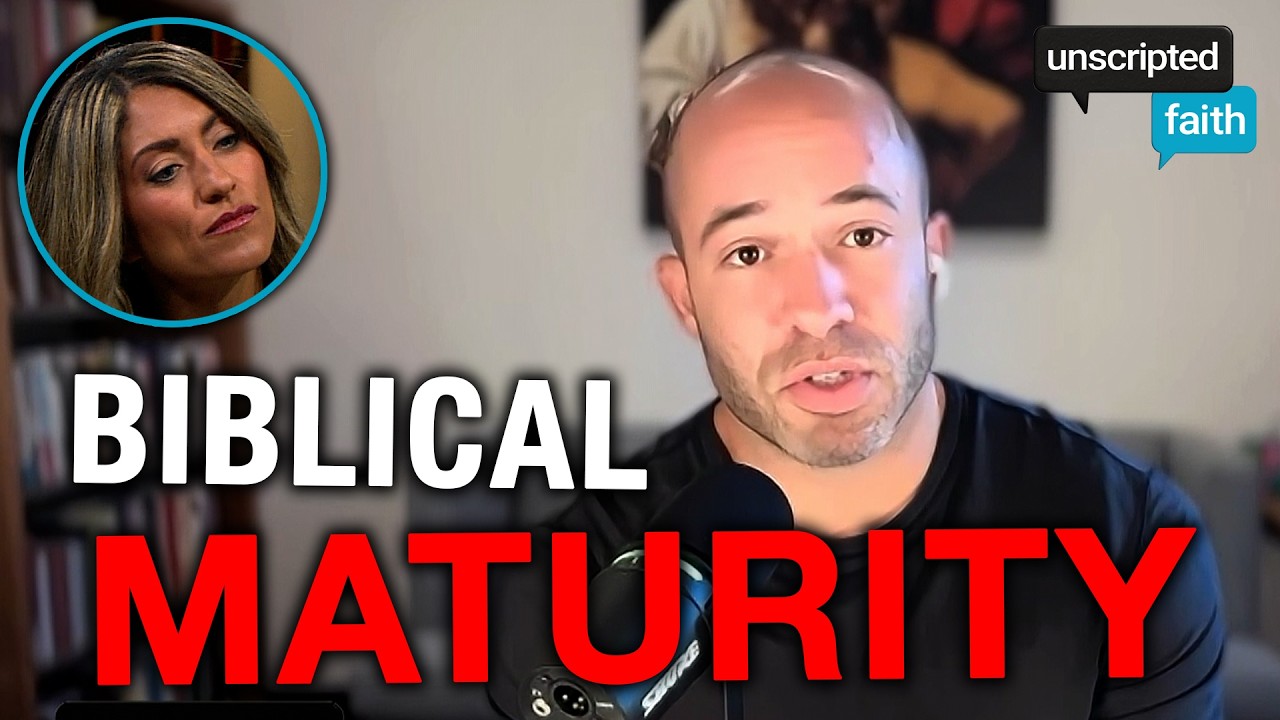
The Masculinity Crisis Nobody Wants to Talk About | Unscripted Faith
Watch on YouTubeVideo summary
Pastor Seth Trout argues that the current cultural conversation regarding masculinity is often based on a counterfeit version of manhood sold by society, leading to widespread confusion and a mental health crisis among men. He shares his personal journey from being a cynical teenager who viewed religious practices as performative to finding genuine faith through a transformative spiritual experience. His path further deepened after witnessing the struggles of friends dealing with severe illness and gender identity issues, which drove him to study philosophy and psychology before becoming a pastor dedicated to helping people navigate suffering and identity. Trout emphasizes that true masculinity is not defined by toxic stereotypes but by a God-given design that involves humility, discipline, responsibility, and chivalry, distinguishing men as equal yet not equivalent to women in their unique roles within God's creation.
The core of Trout's message challenges the modern progressive lie that men and women are interchangeable, as well as the reactionary extreme that views them as fundamentally different species with unequal dignity. Instead, he proposes a biblical framework where men are called to serve, protect, and provide, drawing a powerful parallel to Adam's role in the Garden of Eden before the Fall. Trout illustrates how Adam's passivity allowed sin to enter the world, suggesting that true masculinity requires active strength, initiative, and the courage to stand against evil rather than remaining passive. By reclaiming this Genesis 2 calling, men can find a compelling vision that makes the difficult work of delayed gratification and self-discipline exciting and purposeful, rather than viewing it as a burden or an outdated social script.
To combat the individualistic culture that encourages men to simply "do what they want," Trout advocates for restoring a healthy sense of shame and honor regarding one's family name and God's design. He warns against the trap of slothfulness, noting that many young men fall into depression because they fail to believe that God has prepared specific good works for them to accomplish. The solution lies in casting a vision where embracing God's plan for service, creation, and provision is seen as more fun and fulfilling than the fleeting excitement of hookup culture or reckless behavior. Ultimately, Trout encourages viewers to reject laziness and pursue their calling with relentless vitality, understanding that building oneself up through education and character development is necessary before one can effectively change the world or fulfill God's promises.
Read the full video transcript
Is masculinity toxic or is that just
what culture wants men to believe? Seth
Trout says men are being sold a
counterfeit version of manhood and the
confusion is costing us. So, what does
real man masculinity actually look like?
Seth, welcome to Unscripted Faith.
>> Hello. Thanks for having me.
>> We are honored to have you, Pastor Seth.
if you would take a moment before we
dive into this masculinity and the
counterfeits we've been sold, would you
share with me your God story?
>> Yeah, my story is kind of what you hope
any kid's story would be. When I think
about parents and I think about my kids,
if their story is somewhat like mine,
I'd be happy about it. You know, I had
two parents, mom and dad love each
other, love the Lord, they're still part
of the same church they've been a part
of for going on 38 years, something like
that. It's remarkably boring unless it's
your kids, then it's exactly what you
pray for. And my my mother, I have a lot
of memories of her reading the Bible
early in the morning. I think my dad
really uh took hold of his faith around
when I was like 12, something like that.
But I was involved in our church and our
student ministries. And I was at a
summer camp when the camp speaker said,
"Some of you don't buy this." And I
remember at the time being really
cynical. I was a pretty intellectual kid
and thinking, "Everybody is here just
for dating." That was the whole reason
that I thought youth ministry happened.
You know, I'm like, I know the stories.
I know the Bible. I was a relatively
moral kid. I wasn't out doing wild
stuff, but I'd see the the guys raise
their hands in worship. And I thought,
they're doing this to attract the women.
And I'd see the women bow their heads in
prayer, and I'd say, "They're doing this
so they can look like a potential godly
spouse." And so, I definitely, you know,
through puberty was in the cynic phase
of, you know, everybody's drinking this
Kool-Aid, but not me. But I remember it
was like heaven opened up and a ton of
bricks fell in my head. We sang the song
uh Breathe. Uh I you're my I need you.
I'm desperate for you. Lost without you.
And I remember singing that the first
time through and like rolling my eyes
like what a bunch of uh sociology. This
is nonsense. But then like we got to the
second time we sang the chorus and it
was like God's finger flicked in the
inside of my skull.
>> Said, "You need this. You're not who you
think you are." And that's when I came
to believe that God was real and that
like he threat he almost shook his fist
at me. I was like, "How dare you dismiss
me like that?" And then over the course
of the next handful of years, I uh came
to faith and faith came to grip me in a
more uh arresting way. Um I had two
friends that their stories really
affected my story. It was again kind of
vicarious. one buddy uh who played
volleyball with me, he had shoulder pain
and then we graduated high school and
that shoulder pain was actually stage
four lung cancer and he passed away a
couple months after that. I remember
going to his funeral. It was at a Roman
Catholic church and just being filled
with anger at the platitudes and the
cotton candy uh the lack of dealing with
reality. And that's when I started
reading voraciously like I started I was
a philosophy major at Arizona State
University. I read everything, kind of
went crazy there. And then I had another
friend whose dad was kicked off the
mission field for crossdressing and
doing kind of like the the trans thing.
And he had told me that he had found
estrogen pills online and had been
taking them and they're helping him feel
like himself. And I remember as a
19-year-old just going, "You shouldn't
do that. That's you shouldn't take any
hormone stuff without doctor
supervision." But that's all that I had
to tell him was don't do drugs without
doctor's approval. And you know this is
you know almost 20 years ago now and
that was before the transgender thing
had kind of really kicked off in a way
that it has you know the last 15 years.
And I didn't really have a category for
it. And he said I don't feel like a man.
And I remember going well I don't I I
never had the question do I feel like a
man. I just know that I my body says I'm
a man. I'm a man. And I never thought
like if I want to figure out if I have a
man, should I look anywhere besides my
pants? You know, like the idea that you
look in your heart or your mind? What
are you talking about? And so just
feeling confused by that. And that again
led me to I end up adding a psych major
to my philosophy major. And so really it
was what was happening to my two friends
led me to study and grow. And uh I ended
up becoming a pastor. I've been a pastor
now 15 years. Really trying to help
people with those two things like
suffering and identity are like the
things that people wrestle with. And
those have been two markers of my
ministry in the local church and through
the writing.
>> Wow. It really does boil down to those
two things, doesn't it? Suffering and
identity. Knowing who's you are, knowing
who he is, and finding that in your own
life. So, let me ask you, you know,
you're you're all about masculinity and
helping us to understand this better.
What does it feel like to be a man? And
what is this masculinity we should be
looking at?
Well, I think the Bible has more to say
about what a man should feel like to
other people than what he should feel
like to himself. You know, our inner
life as as men and women is to be
congruent with the fruit of the spirit,
walking with him in relationship with
him. But the first half of the book that
I wrote is really about what should a
man feel like to other people. So, if
I'm walking in my God-given masculinity,
how do other people experience me when I
walk into the room? How does the
temperature change? Does it get warmer
or colder? You know, are people do they
feel safe or scared? Do they feel
intimidated or and depending on who they
are that might change that but really I
think a man should feel like humility,
discipline, responsibility and chivalry.
Man's not a god. So he has to be humble.
Submit to created reality. Submit to
your need for grace. Receive God's
grace. Man's not an animal. He should
have discipline. Uh we're not like ring
bell drool like a Pavlov's dog. You
know, we have moral vision. We have
moral vision, right? I want to eat six
donuts, but more than that, I want to
function at work. So my greater desires
supersede my lesser desires. That
creates discipline in my life. Uh I'm
not a child. I have responsibility. I
don't need to be motherthered. My wife
should not be a mother to me. She should
not be tending to me, reminding me like
as though I was like a seven-year-old
who needed prompting. And that I'm not a
woman, so I should be chivalous. And
this is 1 Peter 3:7 uh where the where
Peter says, "Show honor to the woman as
the weaker vessel. Live with your wife
in an understanding way because she's
co-airs with you of the grace of God."
And so you get this idea that men and
women are equal but not equivalent. And
I think that the progressive lie has
said that men and women are
interchangeable. And I think you get
some versions of like a right-wing weird
conservative lie like in the uh kind of
the grifter communities that say that
men and women are so fundamentally
different. They're basically different
species. And that's especially a lie
that young men are buying into nowadays
because of figures like Andrew Tate and
the Tik Tok stuff that's going on is
just this view that women have less
dignity than men. It's wildly common
among young men and increasingly so. And
I think that's somewhat of a a reactive
unhealthy response to the kind of
feminist progressive view that men and
women are fundamentally interchangeable.
>> I love that you make that distinguisher.
They are equal but not equivalent. very
different but also very much in God's
image co-airs as you stated and
scripture says so share with me how do
we begin to combat this how do we begin
to right side that pendulum swing that
we are seeing happen in culture hey
friend if this conversation is
encouraging you consider donating to
Cornerstone [music] TV to make these
programs possible you can do that at
ctvnorgdonate [music]
>> you know I think people always do what
they want and I I think even if they're
doing what they don't want, it's because
they want something more like there's a
greater vision. You know, if someone
like wants to commit adultery, but more
than that, they want to be respected by
their community, then they tend to not
do that. And so, I do think like healthy
shame or healthy social pressure or
healthy scripts for what a man ought to
do is part of that. And I think part of
why young men flounder is there's no one
telling them here's what you should do
when you grow up. And it's kind of told
to them, do what you want. You know,
figure it out for yourself. And so
that's some of what creates the mental
health crisis is it's like this choice
anxiety. It's no longer grow up, aspire
to be a husband, father, maker, uh, and
and brother. It's chart your own course.
And so I do think part of what we need
to do is supply to young men a
compelling bullseye that they can shoot
at and remind them that if hey, you're
not going to be flawless. You're going
to sin. You're going to need God's
grace. That's okay. But here's something
that you should be energized by and
excited about. And so I think painting
the picture that the Bible gives of man
as something that's compelling because
the reason people go to college and do
fraternities and do the drink and do the
hookup culture is because it seems
exciting and fun. It's not because they
just hate their parents. It's because
that seems more fun and exciting than
doing the Christian thing. And until
we're able to cast vision in a way that
God's design for man is actually more
exciting and more fun and more
compelling than what the world has to
offer, people will continue to choose
the world. A gospel preacher named
Thomas Chalmer's called it the expulsive
power of the greater affection. And so
until there's a greater affection for
Christ, a greater affection for God's
design, men are just going to do the
script and do the sex, drugs, and rock
and roll thing all along those lines.
And I think that compelling vision for
masculinity is right in Genesis 1, 2,
and 3. Like in Genesis 1, man and woman
together are to be fruitful and
multiply. Obviously, you need a man and
a woman to do that. And subdue and have
dominion, which is the cultural mandate
theologians call it. That's they call to
work to create to ga gain wealth to
supply goods and services to unfold the
potential. It's like kneading bread
treading grapes.
>> But then the man by himself is put in
the garden in Genesis 2 and he's told to
serve and protect or work and keep that
could be translated that he's put as
this priestly figure meant to preside
over the garden. And what happens in
Genesis 3 when the serpent shows up?
Nothing. Because Adam fails, the first
thing that happens is Adam's abdication,
Adam's passivity creates the environment
where Eve can sin and eat the fruit. And
so even pre Eve's sin, you have Adam's
passivity and not doing what God had
just told him to do in Genesis 2. What
should have happened is the serpent
slithers up and Adam stomps on its head
and says, "Hey, I'm here to serve and
keep the garden. Get away from my wife."
>> Or Eve should have had this dialogue
with the serpent going and Adam should
have said, "Hold up. Wait a minute. God
did actually say, don't eat of that
fruit of the tree. Don't touch that,
honey. And you get out of here, serpent.
But what happens? It's it's passive. And
so this initiation, this chivalry, this
strength that honors, this protect and
provide is very much a Genesis 2
calling. And I think that if men see
that not just as a traditional social
script, but as part of God's authorship,
they'd be excited to run after it. And
they'd be going, I want to climb that
mountain. I want to take that hill. and
the delayed gratification it would
require would be something that would
actually they'd be willing to pay that
cost.
>> Wow. You have said so much there, Pastor
Seth. I mean, that is so good. And I
love that you highlight I've not often
heard, especially um from the male
perspective. I've not often heard people
pick up and share about the passivity of
Adam in the garden. I myself wrote a
book and that's one of the things I
highlight on. men h man was present with
Eve in that moment and I love that you
said if they could catch a glimpse of
this if they could understand this is
your purpose you've got the right you
can stand up and not be passive but
actually take that hill it will change
everything for them from their core
motivation to how they live it out loud
in our last few moments here what is the
word that you would give give one
encouraging word one declaration
to our viewers, whether male or female,
of how we can embrace and encourage this
masculinity with those closest to us,
our husbands, our brothers, our friends.
>> I think is uh let is it going to sound
as backwards as going to sound? I think
digital culture has made laziness the
biggest trap that men can fall into. The
sloth, the slugardliness. The book of
Proverbs talk about how the slugard
brings shame to his father and
bitterness to his mother. And I think
that we're in a pretty individualistic
culture where this idea that I'm trying
to bring honor to my family name is
something that we're allergic to. But I
think we should bring back a little bit
of that healthy shame and honor culture
and go, what does it mean to bring honor
to my family name? What does it mean to
throw off slugardliness? What does it
mean to pursue with relentless verility
what God has called me to do? Because I
think a lot of male pattern depression
is not believing this that God has
prepared good works for you to do that
you should walk in them beforehand. And
so God has a design for my life. He has
a design for your life. And believing
that he's called me to something and I
need to become something so I can do
those things. You want to change the
world and world hunger, you probably
have to go to school, accumulate some
capital, get a medical degree, get a law
degree. Like you have to build yourself
before you can change the world. And I
think a lot of young men in particular
need to have a vision for how God might
use them because he's promised that he
he will. He has a plan for how to use
you. But if you don't walk in it, then
you're just falling into the sin of Adam
just again and again and again.
>> Pastor Seth, thank you so much. You are
a profound thinker, a wonderful
communicator, and we are so thankful
that you are helping us to get rid of
the counterfeit and walk into true
authentic masculinity. Thank you for
being with us today. Thanks for having
me.