The Machine That Says No: 1-Bit Music on the ZX Spectrum - EMF 2026
Watch on YouTubeVideo summary
The speaker presents a whistle-stop tour of creating music on the original 1982 ZX Spectrum, a machine famously lacking any dedicated sound chip or Digital-to-Analog Converter (DAC). Instead of relying on standard audio hardware like the Commodore 64, this bare-bones computer utilizes an Uncommitted Logic Array (ULA) to generate sound by vibrating its internal speaker. By toggling pin 28 of the ULA between high and low states at specific intervals, the system produces square waves that create audible frequencies; however, doing so consumes nearly all processor power, effectively halting other tasks like running games or reading keyboard input unless cleverly interleaved with short pauses. The presentation demonstrates how even simple beep commands in BASIC can form rudimentary melodies, though these often sound harsh and piercing due to the limited frequency range of the tiny speaker inside the console's casing.
To overcome the limitations of a single square wave generator, the talk delves into Z80 assembly language techniques that allow for more complex audio manipulation through precise control of pulse width modulation (PWM). By varying the duty cycle—the ratio of time the signal is high versus low—programmers can alter the tonal quality to sound less like a harsh beeper and more like a synthesizer. The speaker explains how mathematical calculations regarding T-states, or clock cycles per instruction, are used to determine exact frequencies, such as generating a 668 Hz tone. Furthermore, by rapidly switching between two different pulse widths in quick succession, the system creates an interleaved effect where human ears perceive two distinct notes playing simultaneously, effectively simulating polyphony on hardware capable of only one bit of audio data at any given moment.
The presentation highlights significant advancements made by community figures like Wham and Tim Follin, who pushed these constraints to create sophisticated music boxes with percussion rhythms and duophony. The speaker builds upon their work by hacking existing routines to integrate keyboard input for real-time performance, allowing users to play tunes while managing the processor's limited resources through careful timing loops. Advanced demonstrations include using two connected ZX Spectrums to achieve "two-bit" stereo sound, where each machine handles a separate audio channel, resulting in richer and fuller musical arrangements that exploit the hardware's inability to reproduce low-frequency artifacts due to its small speaker design.
Ultimately, the video concludes by celebrating the ingenuity required to turn a simple computer beeper into an instrument capable of playing jazz-like melodies and complex compositions without modern sound chips. The speaker acknowledges the contributions of pioneers in this niche scene who turned technical limitations into creative opportunities, proving that with enough mathematical precision and clever programming tricks, one can produce surprisingly good music on 1982 technology. Through a combination of assembly language loops, pulse width manipulation, and multi-machine setups, the talk illustrates how enthusiasts transformed a machine designed merely to beep for error messages into a versatile musical tool capable of surprising auditory results.
Read the full video transcript
[applause]
>> Thank you.
Hello.
I'm on the back.
So, this talk is a whistle-stop tour.
So, I'm going to go dead quick through
this cuz I've got quite a lot of notes
that I want to get through.
Um I'm My journey My journey
is of trying to to make my ZX Spectrums
I don't want to pluralize it to spectra.
It feels weird. And my ZX Spectrums make
nice noises. ZX Spectrums do not make
nice noises. This gives me massive
anxiety this in the background if anyone
has had one. For I'm expecting this any
moment. Um
which is
a classic thing. I'm using I'm using two
Spectrums proper and a recreation of one
using Chris Smith's
recreation of the ULA. But, for all
intents and purposes, it's three
48K ZX Spectrums 1982.
>> [cough]
[clears throat]
>> The Spectrum itself, he says shouting,
can make noise.
But, it's it's not very good and most
importantly, this happens.
It doesn't do anything.
While it makes the noise, it completely
uses all of the processor power to use
the noise. And that's a bit of a pain if
you want to do something what musical
for instance or indeed fun with it. So,
it's a cheaper machine 1982. It's cheap
at the time. It's competing with things
like the Commodore 64 that has a
dedicated sound chip. This has no sound
chip. This has no no DAC, darling. This
is just a bare-bones machine. The
technology itself dates back to 1950s
really where you've just got a beeper.
The idea is the beeper will beep to tell
you the computer has done something.
It's not for making music. So, anything
beyond that is a little perverse. If you
want to leave now, that's fine.
>> [laughter]
>> I'm cheating and using flash loading.
Watch.
No tapes.
>> [music]
>> I DON'T WANT TO SHOW OFF, BUT I QUITE
LIKE THIS piece of music that I wrote.
But, it is just using beeping. It's in
basic and it's just the
beepy bit. I see you nodding your head.
Like you're you're bopping to this. Um
I think we should stop there. Um
It's a really It's a really simple
program. Hm.
And it uses a lot of
beep commands stored in data statements.
It's a little bit reductionist as a way
of making music, but it is possible.
In 1985,
Sinclair introduced the 128K Spectrum.
This does not exist in my life. This had
a
AY-3-8190
series audio chip in it, which was a
legacy thing from We don't include that.
I'm not interested in that. I'm
interested in the idea of how we can
make it on the original machine.
Lesson time.
I wrote this in basic as well.
I'm going to tell you about the ULA.
That's the uncommitted logic array that
Ferranti built to go within the ZX
Spectrum. This is Sorry. This is
>> [laughter]
>> I can't move out of everybody's way.
It's where it is. Hello.
The Z80 processor, a really common
processor at the time. The ULA was built
and it did lots of the input and output.
Now, it has a load of pins. It's got 40
pins, and this one
pin 28
is the one we're interested in. It's
directly connected to the buzzer
speaker. We can move that speaker into
one of two states, high or low.
A little bit of physics. We can move it
high and low, so we can move the speaker
both forwards and backwards. If we do
that at a regular interval, we get sound
of a particular wavelength and thus a
particular frequency.
Now, there's going to be a question
later. David, I'm going to ask you say
pulse width, okay?
>> [laughter]
>> The first thing is a
square wave. The second one is a pulse
wave of a different width. This has a
different tonal quality. This will
become
important later in the talk.
Different duty cycle different pulse
width.
Okay.
Physics.
Vibrating the air rhythmically, that's
what sound is. We can vibrate the air
rhythmically.
I'll turn that up.
>> [music]
>> Right, faster is higher and beyond about
20 times per second we're hearing it as
a note. When we're up into this
frequency,
it's a pretty piercing note. At some
point it becomes beyond the frequency of
our hearing and dogs can play
and young people.
>> [laughter]
>> Um
But we can also do the thing where we
change the we don't we can change the
the the pulse width each time. So, we
could shorten it, which I'm about to do.
So, it will
it will get quicker, which does this.
Which is good, isn't it?
Yeah, okay. So, we can make sound
effects like that. That's really what
this was being used for most of the time
anyway. Um and it's quite good fun to
do. I had to put a note to myself how to
get out of that when I'm doing that.
We can also make those kind of things by
sort of effectively randomly cycling
when this is going up and down. This is
what we'd expect.
>> [laughter]
>> I'm going to talk about Z80 assembly.
I'm really sorry if this goes over
people's head. It won't uh it won't last
too long, I promise you. I'm going to
teach you four instructions in Z80 and
we're going to make a uh
we're going to make a musical loop.
The people at the front are well
trapped, so
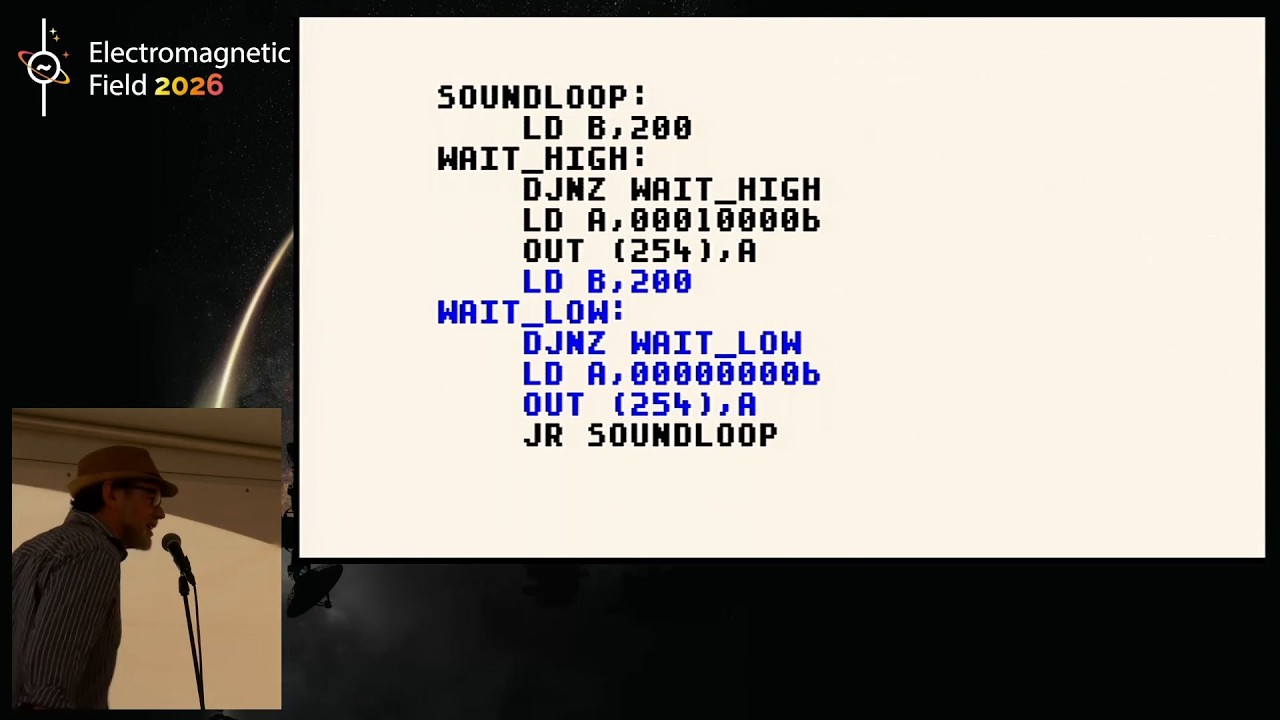
Right, here it is. Here's my sound loop.
This is the most simple sound loop I
could think of writing in Z80 assembly,
which I have done. The uh things on the
left, sound loop, wait, high are just
labels. The section in blue is basically
repeated the section in red. Uh sorry,
the section in black. So, I can take you
through the section in black. I load B
with a counter, which is 200. I do a
DJNZ,
not Z. Uh decrease B and then jump when
it's not zero. So, that'll be B will go
to 199, 198, 100, and so on and so
forth. So, it repeats that cycle jumping
back over and over. Then, I load the A
register with a binary number. Anyone?
No, rubbish. Uh and then I send that to
the output port 254,
which in turn sets pin
28 high on the ULA. Woo. I then do the
exact the same again, but I set the pin
low. This is why this completely hangs
up the processor because it just gets
caught in a loop. I'm going to do this
now.
Oh, no. No, I'm not going TO DO IT.
MATHS. I BEG YOUR PARDON. T states. Let
me tell you about T states. T states are
how how long each instruction takes.
Seven, then the maths, 13 * 199, 13 T
states, but it does it 199 times. Eight
to jump out of the cycle, seven, 11. So,
if we can add them all up. I know what
you're thinking, sir. It's what about
that jump back to the start? That's an
extra eight T states, but we're not
going to worry about that for this.
It gives us this many T states. How many
How long is that?
Well, in music, given the clock speed of
the Spectrum, a whopping just under 3.
5 MHz, 3.4 something something MHz, we
get
a beautiful
668 Hz tone. I was so pleased when this
actually worked out and I then used my
app on my phone to check the frequency.
Of course, [bell] it's stuck and I need
to reset the Spectrum.
What we can do though is use the fact
that we've got if like persistence of
vision, we have that idea of we kind of
hear things and we remember them for a
little time, so we can do this kind of
thing.
Right, okay.
So, you're all I'm playing this. Um
Matthew Smith
It's got sound effects, but it also has
a tune in game.
1983
AND WHAT IT'S DOING WE CAN hear it
actually. It's jumping to the sound
routine, making a little bleep, and then
jumping back to the game. And it's doing
it repeatedly and we're getting Hall of
the Mountain King.
Very nice. Um it actually runs slightly
quicker if you turn the music off.
>> [laughter]
>> If you speed running the game, that's
what you want to do. If you speed
running Manic Miner in 2026, what are
you doing with your life?
I wanted to make nice music and I
thought I could probably steal that
idea. I can write something in that 8T
so I can in that interleave time, I can
read the keyboard. Reading the keyboard
is a really frustrating on a Spectrum.
Um but there it is. So, I've done this.
Ignore that. Right, and I'm going to do
that.
Look,
I have
>> [music]
>> Yeah, that went wrong in the end.
>> [laughter]
>> Thank you for clapping early. Um
It's not very nice sounding, is it,
though?
>> [applause]
>> In my journey to try and make better
sound, yes, I did do that. Thank you.
That's what I've been doing this week.
Writing Z80 bloody thing. I designed a
font for this. I hope you're all happy.
David
coming back to [clears throat] you. What
makes things sound nicer?
PULSE WIDTH. YES, WELL REMEMBERED. SO,
BY CHANGING the pulse width, we could
probably do something so we don't end up
with square waves all the time, so it
might sound more interesting. Um I'm not
the first person to to think of this.
Joffa Smith, uh Jonathan Smith did some
excellent programming in the 1980s with
some stuff I'm not going to demo his
work. It's far too good. I'm going to
play with mine instead. Um so
Sorry. Sorry to all of you. Um
we can hopefully hear during this piece
of music
that the
beeping is not so square wave.
It's a little bit more synthy, if you
will. Um thanks. It just runs because
obviously
no keyboard routine. So, uh we're going
to have to wait.
Putting the pause in right at the end.
>> [music]
[music]
>> That pause not worth the effort. I put
that in this week, as well.
Um
Back to here. Um I was going, right,
okay, if I'm clever with my fancy pants
Z80, I can read the keyboard and work
out how long each reading of the
keyboard God, it's annoying. Reading the
keys on the outside of the keyboard are
quicker than reading the ones to more at
the middle. That's a frustration.
I know.
So, um
having having done that, I just like,
"Well, well, we can probably play
something. I can probably do that.
Probably."
So, I will go to this one.
>> [clears throat]
>> Thank you. [laughter]
So, this though
I'm doing the same thing and I'm using
that if I go lower
we can hear the more sort of like the
pulse width changing slowly. Woo, woo,
woo, woo, woo. Very good. Well done me.
I was proud of that.
We now have to come to the most
important contribution to the Spectrum
music scene, two gentlemen.
Um
Wham.
Um so, uh
Uh
fantastic programmers. They released
Wham the music box. Melbourne House, God
knows, Australian software company,
1985. [laughter]
Goodness knows how they got that license
and why they thought this would be a
good idea. Um
but it's a good piece of software.
It's Careless [laughter] Whisper.
Uh but notice we have two often it. We
have two notes at the same time. We also
have percussion built into it. Well, I
can't do percussion at the same time as
the music. So, uh careful.
It's coming up, so I'm going to let it
happen.
Oh, where's the next one?
Oh, there's two in it. Yeah.
Okay, fine. Let's have a go at it.
Has the music just stopped for a reason?
We'll find that out.
Yeah, okay, that's fine. Try try try
try. So, I was like, I can I can hack
out the routine. Actually, I didn't have
to do do the work. Some other people
other nerds had hacked out the hacked
out the routines in in advance.
Built on the shoulders of giants and all
that. So, I've hacked out the routine
from that.
>> How are we doing for time?
Uh
15 minutes.
>> Brilliant. Okay, so again, I've sort of
like built this into something I play
with the keyboard. We can hear now the
same kind of repetition that we had
before when it was hopping between
notes, but also we've got duophony.
This is quite hard.
Not this goes hard, like the kids would
say. This is quite tricky.
Yeah, absolutely terrible.
>> [laughter]
>> But, you saw what I was going for.
Um
>> [applause]
>> Other people's routines were hacked and
doing very similar things.
Exactly the same thing where we can have
two notes at the same time, but it's
doing that. How is two notes at the same
time happening?
It's magic. It's just magic. NO, IT'S
WE'RE BACK TO ANDY'S physics lessons.
Right, so here is a very narrow pulse
width thing at a particular wavelength
at a particular frequency.
Here is another
thing at a different frequency.
Here are the two interleaved,
known as an interleaved pulse train or
similar. People use different words to
describe that. But, in decoding this is
as our ears, we hear this as two
different tones happening at the same
time. So, if we're clever enough with
the mathematics
of how long each instruction is doing
and we're doing two separate counters,
we can kind of create this fake
polyphony. Polyphony.
>> [laughter]
>> That was rubbish, wasn't it?
I bring you to Tim Follin. Tim Follin
was about 16 when he started programming
in the '80s and he did horrifically
clever things with this. I'm in awe of
this gentleman.
He So, here he is taking that to the
extreme where he's playing with lots of
pin pulses in chains pin pulse streams
that play together.
The music sounds distinctively
one bit fizzy, which is an effect of it
being
the way it's being done, but also it
becomes quite quiet because of the fact
that the speaker is spending most of its
time in one position. It's just hopping
up and down, but it's really impressive.
>> [music]
>> Amazing.
Note the uh
percussion rhythm, ISN'T IT?
YOU CAN'T PLAY THE GAME WHILE YOU'RE
DOING IT THOUGH BECAUSE OBVIOUSLY IT'S
taking it up all the processor. The
game's
uh terrible. I went polite there. The
game's terrible, but flipping heck, the
music's good.
Um
Notably, it doesn't matter
it doesn't matter that there's
absolutely nothing in the low end and
stuff going on. The speaker built inside
the spec There was no way of getting the
sound out of the Spectrum unless you
were to
generally It wasn't coming through your
TV. It's coming out of a speaker inside
the body of the Spectrum. It's tiny. So,
if there's any artifacts in the low
frequencies, it really did not matter
because they would just not be able to
reproduce it by the speaker. So, uh
exploiting that. But, crikey, this is
good.
Um so, I uh take you to another piece of
music. This is going to uh so, this is
using the same kind of pimples thing.
I'm going to play it by hand. It's a bit
weird. Uh again, just give me time.
>> Uh
12 minutes.
>> Okay.
Uh
I want
>> [bell]
[bell]
[music]
>> Right. That'll do with that. Um so, we
can hear THAT PIMPLES THING.
>> [applause and cheering]
>> I'M BASICALLY INTO DEMOING DIFFERENT
things here. So, uh
this is Yeah, okay, this gets a bit
weird. Uh so, that was kind of pimplesy
stuff and sounds like this. The next
thing is again a new the lifted engine.
Um I So, I wrote this software. You
might notice the border changes at the
same time as I do stuff sometimes.
That's because writing to the speaker
also writes to the border. If you choose
to Yeah, I know. If you choose to go, I
want to leave the border black, you're
masking out the particular bits to do
that. So, um sometimes I just quite like
it. Apologies for the epileptic in the
audience that are going, "Oh, yes,
that's triggering for me." Um so, hm um
it should come with warning. Yeah, uh
right.
Uh, this is using the sandwich engine
that's known because it was from a
particular game. And then I'm going to
move to something with two spectrums, so
hence I've got those set up.
I'll just do this quickly cuz it's got
percussion and it's quite nice.
>> [clears throat]
[music]
>> There we go. So, that was that.
But, hopefully you can hear there's some
quite fun playing with the way the
pulse width is changing, but also the
way there's interleave percussion and
I'm controlling it kind of segment by
segment by hand. Right, I'm going to do
something on two spectrums. Obvi- Not
obviously.
I can't Pardon?
Two-bit music, yes, two.
One bit is never enough, so two two
spectrums is
Let's get out of that
and do this.
I mean, I might not be doing anything,
but I
No, I am, I promise.
Right.
>> [music]
[music]
>> GOD DAMN
>> [cheering]
[applause]
>> RIGHT. UM, I'M GOING TO I'M GOING TO
CONCLUDE HANG ON. I'M GOING TO CONCLUDE
HERE, but acknowledgements where
acknowledgements are due. Nothing could
be done without these people's
contribution to the Spectrum one-bit
music scene, particularly George
Michael.
Um
Uh, some of those people I believe are
not their given names at birth, but
there we go. Uh,
I made some flashy things to make it
pretty.
And then I left you with a gentle piece
of music I've written. IT'S IT'S [music]
QUITE JAZZY.
>> [applause]
[applause]
>> THAT WAS ANDY JENKINSON AND THE surprise
second bit.
Give him another big hand, folks,
because that was incredible. Thank you.
>> [cheering]
[applause]