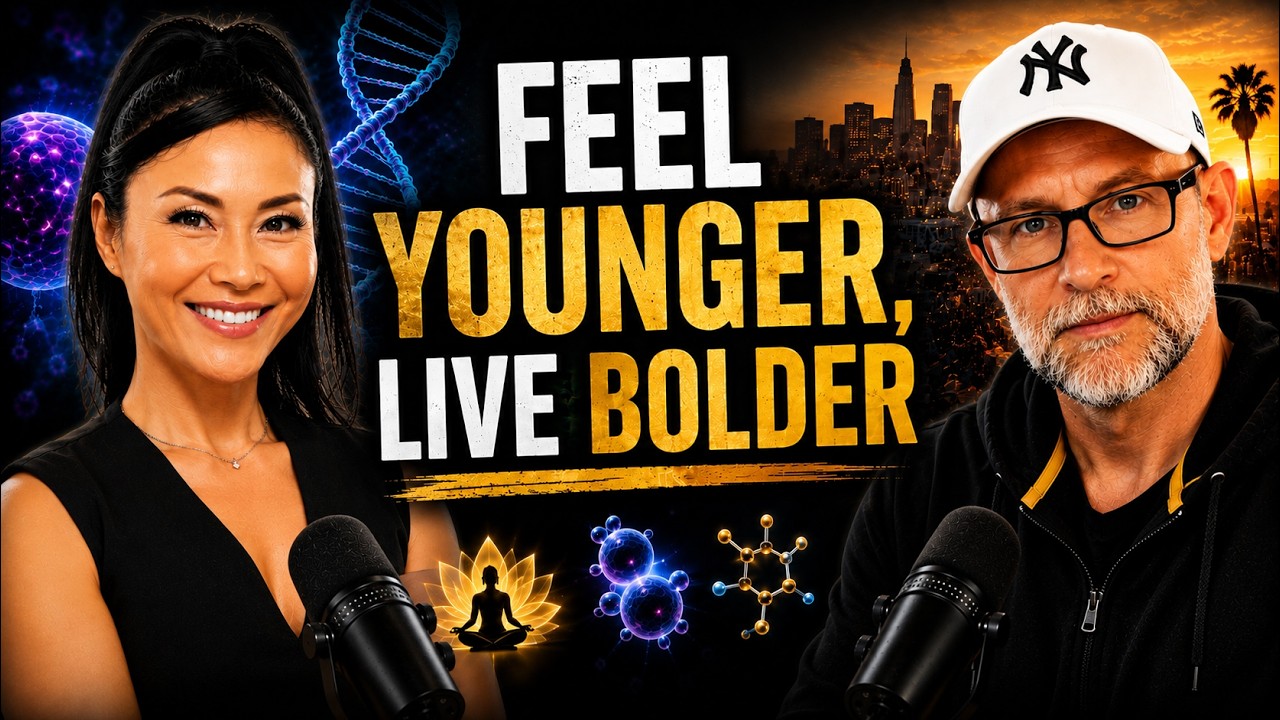
Video summary
Dr. Joy Kong, known as the "Tiger of Beijing," shares her unique journey from a child born during China's Cultural Revolution to becoming a leading figure in regenerative medicine based in Los Angeles. Her path was not straightforward; she faced significant hurdles including visa rejections and obstacles that tested her resilience before eventually settling in San Francisco. Driven by a fascination with the mysteries of life, she initially pursued psychiatry but realized that modern Western medicine often focuses too narrowly on granular molecular details while losing sight of the holistic system approach found in traditional Chinese medicine. This realization led her to integrate Eastern and Western philosophies, giving rise to functional, integrative, and anti-aging medicine which views the body as a complex network where organs interact through thousands of compounds rather than isolated parts.
A central theme of Dr. Kong's work is stem cell therapy derived from birth tissues like umbilical cords and placentas, which she describes as a legal and safe alternative to embryonic or fetal cells in the United States. These early tissue-derived stem cells retain high potency because they have not yet specialized into specific organs, allowing them to differentiate into various cell types needed for repair when signaled correctly by younger mitochondria. She explains that these therapies work through multiple mechanisms: reducing inflammation, modulating the immune system toward regeneration, breaking down scar tissue, promoting new blood vessel formation, and even delivering energy sources like healthy mitochondria directly to damaged areas. Whether administered via injection into joints or intravenously where cells naturally migrate to sites of injury guided by chemical signals, these treatments aim to make the body "new again" without destroying embryos or posing a risk of cancer growth when proper protocols are followed.
Despite growing popularity among influential figures like Joe Rogan and Tony Robbins due to their personal benefits, Dr. Kong highlights that misinformation persists regarding legality and safety, often forcing patients to travel overseas unnecessarily. She emphasizes that while costs can vary widely between $5,000 and $50,000 depending on the scope of treatment—from simple joint injections to comprehensive IV protocols including aesthetic enhancements—her clinic strives for mid-range pricing in the U.S. without compromising quality or integrity. Dr. Kong also addresses controversies by clarifying that no aborted fetuses are used in American treatments and that younger stem cells do not promote cancer but may actually help fight it, urging patients to seek education through her academy which trains physicians on proper techniques rather than relying on fragmented information from sales representatives.
Beyond clinical practice, Dr. Kong is dedicated to educating the medical community and empowering individuals with knowledge about their health options while maintaining moral courage against systemic suppression of innovative therapies. Her approach combines scientific rigor with a deep respect for nature's design, incorporating tools like specific lasers that can non-invasively guide cells to target organs by enhancing their activity and adhesion properties. Through her podcast, book memoirs detailing her life story, social media presence, and dedicated company focused on clean products infused with stem cells and peptides, she continues to break down barriers between disciplines such as psychology, sociology, biology, and traditional healing arts. Ultimately, Dr. Kong's mission is not just about treating symptoms but fostering a culture of resilience, integrity, and holistic understanding that allows both doctors and patients to thrive despite regulatory challenges or societal skepticism surrounding regenerative medicine.
Read the full video transcript
Hello legends. So my next guest has been
referred to as the tiger of Beijing.
Take a look at this.
>> Really, we're talking about birth tissue
derived stem cells because in this
country, embryionic stem cells is not
legal. Fetal stem cells is not legal.
But young cells from the birth tissue
which usually are tossed away when the
new baby is born, those tissues contain
really really potent and and young stem
cells and those can be harvested. So
usually those will be the sources that
comes from somebody else. So
okay,
I was I've certainly learned something
new. Let's go and meet Dr. Kong.
>> [music]
[music]
>> Dr. Kong, how are you? I'm doing great.
Thank you so much, Chris. Great to see
you.
>> Yes, thank you. What time is it? Are you
in LA?
>> Yes, it's 7:55 a.m.
>> I'm sorry.
[laughter]
>> Yes. Thank you for joining us. Um, wow,
what a fascinating history. So, Joy,
have you read um
uh Wild Swans?
Um I is it Jean Jean Chang I believe
wrote it.
>> Yeah. Yeah. I think you know I think I
did. That was a long time ago. Yeah I
did.
>> Yeah it was the same for me but it had
quite a profound effect on me
>> years ago. It was um friends at home. It
it's three generations of women under
chairman Mao and uh you know it was it
was it that cultural revolution it's
quite an eyeopener.
>> Mhm.
>> Dr.
>> Well, I call the tail end of it. I I you
know I I I'm sure I uh it impacted my
life but I was born um in the middle of
that cultural revolution. So um my first
five years that's when that was going
on. So I wouldn't say, you know, I
experienced it as someone that's more
conscious about the social environment,
but um yeah, China has gone through a,
you know, seismic change since then, for
sure.
>> Yes, absolutely.
Well, they al always said, "Let sleeping
China lie, for when she awakes, the
whole world will know." Um
>> Yes. So,
um, friends at home, I'm just going to
read off off my screen here because I
want to get this right. Dr. Kong is a
UCLA trained triple board certified
physician specializing in stem cell
therapy, peptide therapy, and in
integrative medicine.
um a published researcher and a podcast
host and has been recognized as top
doctor of the year in stem cell therapy,
stem cell doctor of the decade and her
podcast won best physician public
education uh podcast this year. Her
memoir Tiger of Beijing was named 2020
book of the year.
Congratulations, Dr. Kong, and uh quite
a journey.
>> Thank you, Chris. Yeah, it certainly has
been.
>> Yeah.
>> So,
uh how did you come to be in China and
now you're in LA?
>> Well, part of that journey was
documented in this memoir because that
was quite a dramatic beginning because
in my book, it started with my visa
rejection. So there's a whole lot of
story before the visa but the book
started with the rejection. Um so it
took um well it it took me eight months
after the rejection to actually land in
San Francisco. And that's a really
really interesting story.
But um once in San Francisco
I encountered another obstacle in life
and
having to overcome that and be free
um as a person. That that was the second
part of the book. And then from there I
decided to study biology because I was
fascinated with the human life uh or or
life itself, the mystery and and how
everything works. And then from there I
decided to become a doctor. Um I at
first I thought I wanted to be a
professor. My parents are teachers and
my dad's a professor. I grew up on the
university campus and that's really what
uh what I wanted to do just to be in the
learning environment and uh uh be
teaching and learning. But what I
realized was that medicine engages so
many parts of my brain that creates this
incredible satisfaction where I connect
with humans and I use science and I use
technology, you know, the different
devices and tools um which can either
detect condition problems or uh treat
certain conditions and then um and then
I have to understand right the human
psychology ology, the the sociology, it
really brings together different parts
of um of our world. So to me that was
the ultimate you know uh alchemy where I
can bring everything together.
[clears throat] Um, so I actually, um,
love the brain, which was why initially
I went into
psychiatry because I wanted to
kind of crack the the the last frontier
of medicine. I was having a good time
because I loved mental health and and
even aberrations in mental health. That
was fascinating. But what I saw was a
lack of
um
kind of a more um
a wiser or a more mature way of looking
at the body because people are going in
way too granular. All of a sudden, all
we can think about is receptors and and
uh um you know different molecules
interacting with each other on a very
granular level forgetting that the
entire body is interacting with each
other. The entire system are
cross-alking but modern medicine is not
quite taking into that into account. uh
it got so down to the basics that it
lost a forest. Uh it was and to me that
was a
a form of immaturity when you have lost
the big picture. Coming from China, we
didn't have the language for the
granular stuff because we didn't have
the instrument and we just you know
throughout history we didn't we didn't
get to that point. But modern medicine
is giving you language for such um
intricate details which can be very
powerful but then it doesn't
um utilize the system approach and
traditional forms of medicine that's all
they do Chinese medicine the Indian you
know aya etc are focusing on the ground
the the the bigger picture and how
different organs may be interacting with
each other how different herbs are
interacting acting with the body. So,
and each herb can have thousands of
compounds. So, how is that creating an
effect when you have all these organs
and and thousands of compounds all
trying to uh talk to each other? So, it
became be becomes very complex and that
is uh overwhelming for modern medicine
because how do you deal with this
complexity? So it would rather just
ignore the complexity and go straight
into the the [clears throat] the
low like a very um uh basic details. And
so my intuition is always to combine the
two. I mean not just me you know there
are a lot of people that have been
talking about east west integration for
a long time but I saw the need and I I
know how well Chinese medicine worked.
You know, I spent my first 20 years in
China. My mom's life was saved by
Chinese medicine when she was about to
die when she was really dying from um
multiple myoma, you know, a form of very
severe um blood disorder and and a form
of cancer. So
that um
uh philosophy of wanting to bring
different things together so we can take
care of the trees but also uh understand
the forest was uh was what drove me to
this new branch of medicine called
functional medicine or integrative
medicine, holistic medicine, anti-aging
medicine. They're all talking about the
same thing. Alternative medicine is all
about looking at the intricacy of the
human body and not forgetting different
relationships. Some relationships are as
simple as different vitamins. We have
numerous vitamins in our body and how
are they um interacting with different
organs sometimes at the same time. Um
and and
so if you don't have one, all these
different symptoms are affected. So
that's like a a basic example of how one
thing can tie different systems
together. And unfortunately, the
conventional form of medicine is not
looking at that. So to me,
intellectually we need to practice this
new form of medicine. And um once I got
into that uh holistic realm, that's when
I encountered stem cell therapy. And to
me, that was a huge aha moment that I
would never never veer away from because
what I saw was the most holistic
approach you can imagine. is using the
intelligence that made us and allow that
to talk to your entire body to all your
organs and to
promote repair because what can make you
can make you new again. So um that's
kind of my journey into stem cells.
That's why now I'm focusing so much on
stem cells. Of course exoomes is an
offshoot of stem cell therapy. Um, and
then peptides, we can target different
organs. That's a kind of a different
branch, but this is all tapping into the
the secrets, the codes that nature has.
Yeah,
>> absolutely. Yes. We're really behind
uh here in the west with medicine.
I studied
um psychology, sociology, biology,
then youth work and then social work.
And the whole kind of emphasis there is
on holistic practice, you know,
factoring everyone's social
circumstance, their psychology,
their physical health, diet, all this
kind of stuff. And yet if you go to an
English doctor,
all they're really trained to do is just
prescribe you a pill just like
immediately. Or if it's worse, they send
you a surgeon that's just like, "Yeah,
I'll operate. What when do you when do
you want it?" There's there's no kind
of, you know, how are you living your
life?
>> Decision.
>> Yeah. I I'm guessing it's probably a bit
the same in the States, in the
mainstream, is it?
>> Oh, yeah. If you are going to your
doctor that's all based on insurance
coverage, I'm afraid that's what you're
gonna get.
>> Yeah. Yeah. I'm fascinated. Um it's I
played a little clip from your YouTube
at the beginning there. Do I understand
that the stem cells come from the
placenta when a when a baby's born?
>> Well, we actually have stem cells
throughout our body right now as we
speak. So in initially of course it came
from the sort of I mean the fertilized
egg um and from that egg there's
all this cell differentiation which
means gaining function [clears throat]
while you gain function you lose
potentials. So the cells are uh evolving
to form eventually form organs right
forming structures. So in your organ
let's say your liver there is uh the
liver working cell but there's also the
liver stem cell and that stem cell has
lost so much potential has gained so
much specialization that all it can
differentiate into is a liver cell but
the rest of but if you go upstream there
could be other cell types. So there are
a lot there are probably a you know
thousand differentiation or a thousand
variations of stem cells within the
human body um all the way down to
pluropotent stem cells. So these are
cells that can become anything in the
body. So all these are coexisting in the
body. So what do you want to tap into
when you are going more upstream when
the cells were still younger in its kind
of evolutionary age that means it has
more potential it can become more things
uh then the signals they sent will have
certain ramifications is more upstream
so where do we intercept uh that's the
art of stem cell therapy so we can use
early birth
tissue as a source for stem cells and
these are more upstream. So from the
emble cord or placenta a lot of these
cells were trapped in the early embryo
and fetus development.
So they have retained a lot of the
characteristics of the embryionic stem
cells of the early much earlier
generations and you can use those and
that will give you greater variety of
signals to trigger more upstream
regeneration.
>> Wow.
Uh so a question
Joy ha has do you think that stem cell
um what's the words for it when you have
the stem cell therapy?
>> Um do you think it's become more popular
because of Joe Rogan?
>> Joe Rogan helped Tony Robbins helped. uh
these two are really are a front of the
stem cell uh medicine because they have
such huge influence and they have
personally received benefits. I mean
these are people who have access to
everything right anything that's
available and when they've tried
everything and and nothing had quite got
them to where they want to be and then
stem cells created such fast and drastic
improvement. Yeah, of course they're
excited. They want to spread the word.
So, absolutely. Tony Robbins
[clears throat] wrote the book Life
Force and I actually critiqued it on
YouTube. I had a few videos I I
critiqued the the um the chapters on
stem cell therapy. So, there were there
were some some mistakes in the in in the
chapters written by you know doctor that
Tony Robbins invited. So my problem with
the field is that there's a lot of
misinformation partially from doctors
just going ahead and doing stem cell
therapy without a good foundation of the
knowledge of what kind of cells they
are, how they function. So if you don't
have the fundamental knowledge you know
in in a solid place then you will say
things that are not based on really on
scientific uh foundation. So so that's
my problem with it and which is why I
founded an academy American academy of
integrated cell therapy. We've been
providing training since 2018 and uh we
have started doing certification
trainings
specifically really to get doctors to be
fully proficient and not just getting
bits and pieces from here and there and
from from reps of stem cell companies.
uh maybe they they read an art article
or two but no you know be a lot more uh
of a true physician right true pioneer.
So you want to understand um a much
greater variety of of research results
so that you can speak intelligently.
Yeah. So so that's kind of one of my
missions which is education. So going
back to wanting to be a professor. So
I'm uh in a sense uh you know fulfill
that. Anyhow I I'm actually confusious
descendant. I'm you know 73rd
generation. So wanting to teach, wanting
to to you know kind of pass down the
knowledge has I guess is in my bones.
[laughter]
>> You're actually a descendant of
Confucious.
>> Yeah. 73rd generation. Yes.
>> Oh wow.
>> In a long time. 2500 years ago.
>> That's fascinating.
Yes.
>> Yeah.
>> I used to live in um Hong Kong and
China.
>> Oh.
>> And I loved the Confucious stuff. I
worked on a nightclub in in Hong Kong
and um it was all run by the the the
local triads,
>> but
>> but they had this real sense of like
they would do things in a real certain
way. So on the very first day there when
the boss found out that I just moved
into a an apartment and there was
nothing in it, he just went up to the
till in in the club, took out I don't
know 5,000 Hong Kong dollars and uh he
he he just gave it to me and then I
>> Oh wow. I'm doing the research and it
says Confucious says uh boss boss must
look after employer in return employer
looks after the boss. So yeah.
>> Oh you mean employee?
>> Yeah employee. Yeah. Sorry.
>> Yes. Wow. Confucious said that.
[laughter]
>> Yeah. It's it's like a sort of you know
unwritten law. I
I I suppose
>> that's wonderful. That's wonderful
because the west is always um a lot of
time questioning right if you don't know
God you know how can you behave well how
can you know the rules of being a decent
human um China has a different system
and it's a lot is about human decency
about doing the right thing so so even
without this particular entity of an
all- knowing god um you understand that
there's
a a nature of human existence. There's a
natural way. So like Dowoism, the way
and and that's the rule of how a human
should interact with its you know its
peers and how it should uh yeah function
as a decent human being. So yes um they
have uh you know various various uh you
know sayings and and uh and and these uh
kind of standards that we try to live
by.
>> Yes. We talk about this a lot on this
show. I think my my friends out there
we're kind of of the opinion that
religion isn't really like knowing God.
um that really God is no nosis and
knowing knowing right from wrong and we
call it in in ancient England we called
it natural law
>> and we actually have a sort of um
constitution in England even though it's
been sort of walked over in in recent
times but
>> the constitution essentially is just do
the right thing, you know, don't don't
harm other people um unless they're
going to commit you harm and all this
kind of stuff. So,
>> yes, fascinating. Um
>> I met Tony Robbins
>> just Have you met him?
>> Yes, definitely. I um actually just came
back from Fiji uh to his live and wealth
mastery, but he wasn't there, but I was
in other events where he was there. We
were we we spoke. Yes.
>> Yeah. He's quite quite a character. Hey.
>> [laughter]
>> Yeah, I went I went to his um awaken the
giant within seminar about
>> Oh, unleash the power within. Yeah,
>> that's the one. It was
>> humongous uh event. 16 20,000 people.
>> Yeah.
>> Yeah. The one I went to is probably a
bit smaller than that, but he taught us
the firewalk which was just
>> Oh, you did that?
>> Yeah. I I did it and then I um I used to
do it quite a lot. I used to teach
people how to how to do it. But I still
kind of use that psychology. If I'm ever
in a um a challenging situation, I'm
just
and change your mindset. Do it.
>> Wow. Nice. Nice.
>> Yeah.
>> Yeah. I mean, Joe Rogan, he's kind of
like the man, isn't he, with that that
kind of stuff. He takes his health and
fitness seriously. Um
>> yeah. So I think you know and I I wish
all the doctors do that right. So I
myself I practice what I preach and it's
very important. So I don't put junk in
my body and I exercise. The only thing
I'm not doing very well on is sleep. But
there are some basic tenants of um what
you can do to enhance your health. So,
so the foundation has to be to to to be
respected that will be nutrition,
movement,
sleep and then mindset. How you can
modulate your your interaction with the
world and not be taken down in a sense
by by things that may not be happening
your way. [laughter]
And that's a constant, you know,
constant battle. Um so and for people
who have gone through difficulties like
I have I mean it's not like I had a
traumatic childhood yes were there
trauma yes but um I'm very much about
agency about taking responsibilities and
not wallowing in our sufferings um I am
very much about looking forward and you
know I kind of dust off uh I get a
little bit of a warrior mindset and
that's why the tiger um the tiger is not
going to be pouting and and you know be
be [laughter]
always moping um tigers strategizing and
thinking ahead and so that's the spirit
that I want to share and maybe awaken in
other people and that's one reason I
wrote my book
and I think the fact that I wrote it as
a memoir made it just a little bit more
potent for people because if I had
written it as a novel like I first was
um was going to do it would have diluted
the power in it because it it would be a
fiction. This one I'm exposing myself
more which I doesn't really matter to
me. Um you know this is not about me.
This is about human resilience and what
people can can really gather. So by
showing the world this actually
happened. This is real and this is how I
overcame it despite
being sometimes felt like I was being
crushed but coming out a winner and from
that I think I can inspire people which
I have um I've met so many people who
came to me men women different
backgrounds been inspired by the story
and it really resonated which is just
just incredible um yeah and is with the
same spirit that I I'm bringing to my
work like my
work in a not very friendly environment
when it comes to regenerative medicine
because we are breaking tradition. We
are moving ahead in a way that is not
embraced and welcome
by uh the status quo. So there's a lot
of um u suppression you either outward
or or a a more subtle level of
suppression. On the surface maybe the
governing body says oh no we support it.
We want this to you know to be uh to to
thrive this new branch of medicine. We
just want it to be more responsible and
and more monitored. But in actuality
a lot of times that has killed
innovation and it has killed companies.
So um and then it has effectively
stopped a lot of doctors from getting
the word out even to this point. People
still think that stem cell therapy is
illegal in the US. I mean where did that
rhetoric come from? How did that even
become a thing? That 10 years later,
I've been doing this for 10 years,
that's still a prevalent notion that
somehow you can only go overseas to get
treatment. So, what's the result? A lot
of people don't have the resources to go
overseas or they don't have the impetus
that, you know, it's a huge thing. They
have to make the arrangement to do it. A
lot of them do, but they're missing the
opportunity that it could be in their
city next door. a doctor is actually
providing the treatment legally and what
a travesty that people have no ideas and
when a lot of times even these till this
day I may be going to biohacking
conference right the these are
biohackers you would think that they
know the latest and a lot of them do
know that you can get stem cell therapy
but there are still people who think
it's not legal so this is tells you how
entrenched these misinformation can be
>> so um so I'm faced with different levels
of obstacles, misinformation and
systemic suppression. So, I have to use
some of that tiger spirit in order to do
this because if I had been always
worried about what the regulation says,
you know, oh, you know, how is that
going to what does the malpractice
insurance [clears throat] cover it? Um,
oh what, you know, what what does the
medical board? So if all I can think of
is what if instead of what if this can
really really make a huge difference in
people. So if I my what ifs is focused
on my own uh you know safety then I
would have never saved so many lives and
made such incredible differences um in
just in in so many and and and bringing
bringing the knowledge uh into you know
so many people's lives. So I think the
priority as a healer, as a doctor needs
to be set straight. What I go
what what I go off by, what I base my
opinion by is research from around the
world. So if the research has shown
incredible benefits in a wide range of
conditions and with so little side
effects. I mean, I challenge you to go
look for side effects of stem cell
therapy. It's so incredibly safe. Of
course, if your doctor is doing the
procedure wrong and it is injecting
things in places they shouldn't be
injecting, that's a whole other story.
But if you adhere to proper protocols
and using products that are clean, that
are are properly produced, then it's
extraordinarily safe. So, so anyhow, if
you know that you're giving something
that's safe and that's potent, then it's
it's up to you whether or not what you
believe is right for patients and you
can focus on that and do the right
thing. So, yeah, that I think requires
some of the tiger spirit.
Yeah, I think because you've had some
harsh experiences in life, you know
right from wrong and you you know how to
act with moral courage.
>> Mhm.
>> You know,
>> yeah, maybe. Maybe. But I've always been
like that though.
>> Oh, okay.
>> So, that just kind of part of my makeup.
Um even when I was growing in China,
growing up in China, there are so many
rules and I really did not like all
these artificial rules. Um because I
always felt that I need to understand
why there are rules around and what's
the purpose. Um so I would never blindly
follow. I would dissect the rules that
that was imposed on me and make decision
whether or not it actually makes sense.
And if it doesn't make sense, just
somebody's arbitrary rule or you know
that the the reason for the rule is not
uh for the benefit of everybody. It's
only benefiting a particular number of
people to me that is not a rightful rule
and then that is not my rule. So by
universal law then that is not a rule
that I need to abide by. So I've always
want to go by, you know, what's the
right thing. So to me, that's a that's a
the higher uh level of of rule of uh of
law. Yeah. So I go by the higher law
[laughter]
>> like moral authority.
>> Exactly.
>> Yeah. Are you familiar? Um this is a guy
I think he had a big influence on
Anthony Robbins. Dr. Robert Young.
>> Oh, yeah.
>> He's um he wrote this book which I I got
a signed copy from him years ago when I
met him in in in England. He wrote the
PH Miracle.
>> Okay. Mhm.
>> And um
yeah, that book changed my life. the the
the how can you say it was such a
massive paradigm shift to me to un to be
taught that our bodies have a pH level
like like all living creatures plants
etc. Mhm.
>> Um and uh
>> yeah really it really changed my life
but
>> yeah there there that's great yeah there
so that's part of the awakening right
part of the fundamental understandings
and there are a lot of understandings
that we've come to including
you know nutrition and including you
know what minerals can do for our body
what about hormones and that's a huge
part of anti-aging medicine so the body
is very complex pH just one uh one of
thousands of different factors, right?
It's very important. Um but we're just,
you know, beginning to, you know, kind
of peel off the the mystery of the body
layer by layer. Um so this is why my
academy is called American Academy of
Integrative Cell Therapy because I do
not want people to think cell therapy is
end all be all and this is all you need
to to heal the body. No, the body is
very complex. If you lack certain um
vitamin or certain amino acids, your
body can't rebuild itself. And so we
have to respect that. If you you have
underlying infections, these bugs are in
your body. You have to somehow subdue
them or get rid of them. Otherwise,
you're always suffering. So the body is
very very complex. Yeah. So the the
integration is really key.
So doctor, for those of us out out here
that are sort of unaware of stem cell
therapy, what what are the mechanics of
it? What what do you I mean I'm I get
it. You're trying to regenerate
new new growth. Would I be right?
>> Right. So it it's all about making the
body new. So what the stem cell therapy
is doing depends on what kind of cells
you're using. So you're if you're using
a end more um cells that can
differentiate into a local tissue cell
like there are um companies that will
seduce seduce um will induce uh stem
cells to go into certain directions
by using certain signaling molecules.
Let's say they they indu induce cells to
become neural progenitor cells. So then
they can become neurons and and that's a
more targeted a treatment. But what we
can do these days is that we don't have
to be super specific. We can use cells
that are more upstream. One has ability
to differentiate into anything you want.
um or two by sending signals to your
tissue local
organ specific stem cells that only has
one direction to go which is to
replenish cells of that organ. We can
have cells like meenymal stem cells
really good at doing that by sending
signals waking up the local tissue
specific stem cells and making them
divide and differentiate. Now we can
make new tissue. So there they're
different approaches. So now even with
these broader approach which is a lot of
fun messenyal stem cells that's a major
cell type that I utilize but there are
al also other cells and that
[clears throat] can be very powerful and
they can work in conjunction. So one of
the things I brought to the field is to
combine different cell types. Um and
that has not done been done very much
but coming from a background of
utilizing not just one herb that can
have thousands of compounds but multiple
herbs coming together to create this new
symphony that can have a system um kind
of um you know upleveling of effects. So
by combining different cell types and
they can go into the body and do their
magic and work together, we can create
some incredible regeneration
um by
reducing the inflammation,
modulating the immune system because
that that's one thing messenyal stem
cells really good at is to shift the
immune system to a more regenerative um
tendency and then it can break down scar
tissue. It can promote vascular
formation. So more blood new blood
supply. It can help you fight microbes.
You can protect the tissue that may
otherwise die due to certain damages and
signaling. And it can also help kill off
cancer cells and it can also deliver new
energy source like mitochondria. Uh
especially if you use younger cells,
you're going to get younger
mitochondria. So so all these are
mechanisms of how the cells work. But as
far as how we um utilize these stem
cells, there are two broad approaches.
One is to send signals so your body can
repair and regenerate. The other one is
to actually send cells that can become
part of your body. So um hope that
answers your question.
>> Yes, absolutely. Um what
is there one sort of procedure that
people seek out more than others?
Uh I think the most popular one that
people are utilizing it for is for joint
and soft tissue injuries and muscular
skeletal problems. I call it the bread
and butter of stem cell therapy. That's
the most basic and the easiest. um other
ones
is not as common but um um that we
utilize more systemic approach something
like autoimmune conditions which has a
lot of research evidence and then there
are also a lot of evidence in helping
with different organs. So in our clinic
80% of our patients actually have severe
and chronic health issues and that
ranges from um very difficult to treat
brain issues like traumatic brain
injury, Alzheimer's, uh Parkinson's, MS,
ALS, stroke. So all these are very uh
very difficult uh issues but we have
seen sometimes drastic improvements in
patients and then people with all kinds
of internal organ issues. We we've seen
incredible results in heart, lung,
liver, um kidney repair, um testicles,
ovarian function. So we can help so many
organs in the system and it's really
because the beauty of how the cells
work. I can put cells into the IV route
and they know where to go because
they're attracted by inflammation and
injury. So they find their way to places
that need their help and once they get
there they will send signals that's
appropriate for local damages. So that's
the elegance of stem cell therapy and
and it also makes it so fascinating and
fun to do.
So these are the yeah but we can also do
targeted approaches for for example the
brain. We can um inject cells into the
nasal membrane. First of all, we can
open up the bloodb brain barrier so more
cells can through the IV route can get
into the brain. But we can also inject
into the nasal membrane and that'll be
uptaken into the brain. We can also use
exoomes which are very easy to be uh
absorbed um and and by the mucosal
membrane and that will be uptaken into
the brain. So there there are different
ways that we can access the body. It
sounds in it sounds fascinating.
You you sound very clever. [laughter]
>> Well, you know, you're dealing with a
very clever system. So, how can we, you
know, utilize how it what uh works? And
um yeah and another thing if you
mentioned clever I thought was pretty
clever when I incorporated laser into
our stem cell treatment because what
light can do and these laser and we can
set them into different frequencies they
can talk to different organs but not
only that they can actually make the
cells more active make them give them
more potentials to divide make them more
mobile and also make them stick to the
organ that you're shining the light on.
So that is just fascinating. So I can
literally I'm not going to inject into
someone's heart or liver, but I can
shine the light on those organs and the
cells will be attracted. So this is a
non-invasive way of putting cells into a
particular location and and that has
amplified, you know, our capabilities.
>> That's incredible. What about um is
there any sort of controversy around
this area? Are there sort of groups out
there that disagree with it?
Controversy a lot of times uh come from
concerns about legality. So these are
some of the artificial
um constraints placed on the field. And
the other uh controversy is
misunderstanding that people still were
somehow holding on to
uh circulating ideas of um of either
embryos being destroyed or fetuses being
destroyed asking you know is are you
getting cells from aborted fetuses and I
don't know anybody I don't know a single
human being that does that. There are
people that do that in some countries,
but not in the US. I've never met
anybody that that does that. It's not
legal. Excuse me. So, uh, but that
somehow people are still worried about
it. You know, worried about we're
destroying life in some way or form. And
embryionic stem cells, there are cell
lines that are utilizing cells from
embryionic stem cells. So you have to
destroy an embryo in order to get
embryionic stem cells which came from
day 5 to 7 after fertilization
but uh it's not used in in humans is is
in research in the US. So no one is
using embryionic stem cells or aborted
fetuses. So that's been one of the the
major misconception.
And um another one you know I have to
emphasize is that people are worried
about um promoting cancer and you have
to really look at what cells you're
using. If you're using your own cells
which has declined in its capabilities
and it in its ability to detect cancer
and respond to cancer appropriately
because it lost that ability. It
continues to
perform its function which is to help
things grow. So then it will produce
growth factors that can end up promoting
existing cancer. But if you use younger
sources like what I use from the
umbilical cord, there's no evidence that
it can actually promote cancer growth in
the human body. So
on the contrary, there's so much
evidence that it's anti-cancer. So you
really have to know what uh you know
where these uh ideas come from and the
information come from and be be
discerning of what kind of cells we're
talking about.
>> And Dr. Joy, one um question. So for
people out there who are watching or
listening now, how how affordable is
this to
say the average person?
>> Yeah, the cost has been one concern.
Um the range is quite wide. So generally
it can range between $5,000 to $50,000.
So it's a huge range. uh and people
think that they will get better prices
going overseas and that's definitely not
true because I've got so many patients
who are looking at going overseas and
who some of them have gone overseas and
then coming to our clinic saying you
know you have better cells better
protocols and you're cheaper so um the
cost is you know I try to um make sure
that our cost is in the mid-range in the
US and and slightly lower, you know, for
the quality we provide, you know, we're
really providing incredible value. So,
that's always my approach. I want to
give value but not sacrificing quality.
So, um, if you're doing just a simple
injection, like in our clinic, we we
charge $5,500 for a simple joint
injection. But if you want IV treatment,
which I think is one of the most
powerful form of therapy, I say this
because I've seen it in my clinic in the
past 10 years and I've trained hundreds
of doctors and they tell me what happens
when they provide the treatment and most
of them are IV treatments. So that um in
our clinic it starts at $8,500.
the more cells you use. So the more
products it's going to be required and
the products are expensive and that um
will you know start to add up the cost
and if a person wants intraasal you know
they want to add on different things and
so you add more products more procedure
you want to inject into the joints and
maybe we also do sexual rejuvenation we
can inject into the penis vagina
enhancing sexual function we can also do
aesthetic treatments so stem cells or
exoomes on the face or hair uh to
promote uh hair restoration and facial
rejuvenation. So all these things add
up. So if you want to do everything then
it's going to be more expensive. Yeah.
>> Yeah. Of course. Of course. Um doctor,
on a a completely different note,
there's obviously a lot going on in the
world at the moment.
What what's the sort of feeling in LA
about President Trump's actions
of recent?
>> You mean the war?
>> Yeah. The the the war and the
>> I don't think you know I um
[clears throat] I I'm trying to focus on
healing people and educating other
doctors. So I yeah I I I try not to get
into the politics. Um I think the world
is definitely shifting. Um some actions
are you're either in the wise category
or in the unwise category. So I think
worse of such is always unwise. Um so
there are ways to solve problems unless
you have ulterior motive that you want
certain things to happen. Um you're not
focused on solving problems. So um
fundamentally I'm very much against war.
Um I think is a result of the breakdown
of human communication and decency when
you cannot just talk things out. So
that's kind of my general
>> yeah sense.
>> Forgive me for asking. It's just that
obviously we get a very one-sided
portrayal.
>> Yeah. There's wide range of of opinions
within the United States whether or not
as a country it's you know decided to do
something.
>> Yeah. Got you. Got you. Well, doctor,
it's been an absolute pleasure hosting
you on the show. Um, I'd love to see
what what the questions are that our
friends out there have got for you and
then we can uh maybe invite you back on
uh to answer them. I think it's been a
fascinating chat. Perhaps we can learn
more about your story when we when we
chat next time.
>> And absolutely.
>> I meant to say if you see me looking
across, I wasn't being rude. I've been
showing all your your websites and uh
your Instagram.
>> Yeah. So, just maybe give people a range
of, you know, idea of what I I've worked
on to bring to the world. Um, one is my
clinic in Los Angeles. Um, two is that I
set up a stem cell company. Like I
mentioned, we have a unique stem cell
formulation. So I wanted to make sure
that I'm a pillar of integrity in the
field uh because I've experienced so
much lack of integrity in the stem cell
field partially because it's a very
profitable uh arena of medicine. So many
people got into it and a lot of them are
business people who are utilizing
expertise of scientists to to you know
to to start making money in the field.
um at that I don't mind. But if you
start to fudge your data or lie about
what you're doing and not producing the
best products based on science, that's
what I have a problem with. I don't have
any problem with people making money by
bringing [clears throat] um a value to
the world. But because of what I saw and
how disappointed I was, that's why I
started a stem cell company. And then
from that an offshoot of a cosmetic
company called Char Omni where I started
to produce [clears throat] really
amazing skin cream because I wanted to
produce something that's 100% natural
because I absolutely tried to live by um
the the rules of being clean, right? Not
inducing not introducing toxic uh
material into this very sacred body that
we've been given. And um so that but
then I also put stem cells and um and
and peptides into the formulation which
makes it supercharged. And then I have
an academy u training doctors. We do
certification courses twice a year. And
then um I um of course do my podcast uh
the Dr. Joycon podcast which has been
over three years and I've interviewed a
lot of amazing people. I think I hope
people go in uh you know check it out.
So yeah. So these are some of the
resources I want to make sure that that
people realize that I I've been working
very hard. That's for sure.
>> Yeah, we can see that. I mean, we know
from experience what it's like to get so
many subscribers on on on YouTube. It's
not easy.
>> That has taken many years.
>> Yeah. It's a whole It's a whole career
in itself, isn't it? Just just just to
do the YouTube.
>> Yeah. Starting from the very first video
in my living room when I my staff member
asked me what is a stem cell that was
the the very beginning. Yeah.
>> So doctor what we're going to do we're
going to put all your links friends at
home we're going to uh put links for Dr.
Kong's book the websites Instagram
LinkedIn if if you um I mean people can
approach you Dr. Kong, can't they for
information?
>> Yeah. So, Instagram probably is the best
place. Um, just um at dr_joy
Kong. Um, you people can send me
messages and and uh and and follow my
fun uh fun reels. [laughter]
>> Yes, you've got quite a few followers on
Instagram.
[laughter]
>> Yeah, that's the new way of dealing with
life, isn't it? Is how many followers
someone's got on Instagram.
>> [laughter]
>> I know. Isn't that interesting?
>> Yeah. How times have changed. But um
doctor, if you can hang around, please
wait while I just play us out so I can
thank you properly at the end. But if
you need to shoot that that's not a
problem. Um
>> no, I'm I'm good.
>> Wonderful. Then in that case, just to
say thank you ever so much again.
Friends, as I said, all the links are
below. If you can like and subscribe,
that would be absolutely awesome. and I
should be back from Everest by the time
this podcast goes out. So, can I just
say a massive thank you to everybody
that has um donated to help me shine a
light for our struggling veterans.
Um, and if you can spare £5 or five
bucks, there's a link there'll be a link
somewhere in the description below.
Doctor, thanks ever so much again. Much
love everybody.
>> Thank you Chris.
>> You're welcome.
[music]
>> Truth with things that are not real. And
I really want [music]
us to be real with love. Love that last
in [singing] the past. I messed [music]
up.