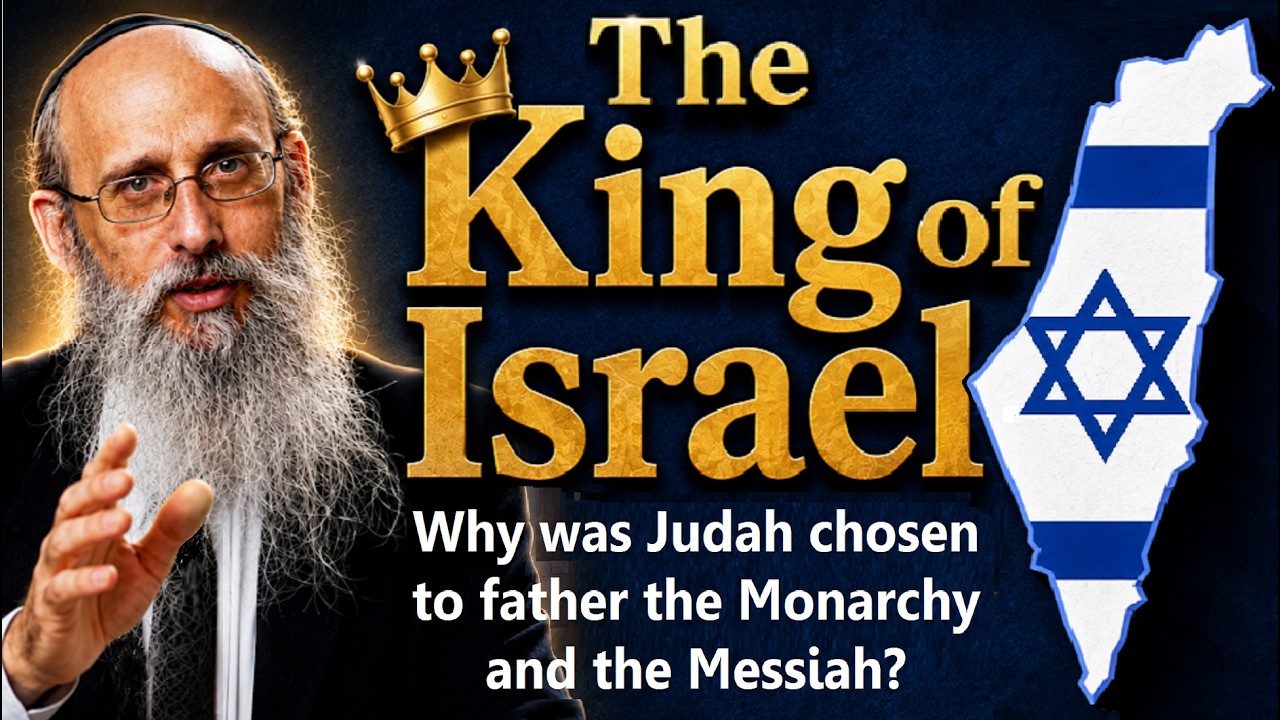
THE KING OF ISRAEL: Why was Judah chosen for the Monarchy and The Messiah? Rabbi Yisroel Blumenthal
Watch on YouTubeVideo summary
The video explores why the tribe of Judah was chosen as the lineage for Israel's monarchy and the future Messiah, tracing this distinction back to a specific etymological and historical understanding of the name itself. According to Rabbi Yisroel Blumenthal, the Hebrew word "Yehuda" is derived from Leah's prayer in Genesis 29:35 where she thanks God by saying "Hamashem," which translates to acknowledging or admitting that one has received a blessing. The sages expanded on this linguistic root to teach that Judah became the father of kings at the precise moment he admitted his own wrongdoing, an act described as embarrassing yet necessary in Genesis 38:26. This admission is not merely about saying sorry but represents a profound character trait essential for leadership, setting the stage for a deeper analysis of what it truly means to rule with integrity.
To understand why admitting mistakes is central to royalty, the speaker argues that an effective king must possess two seemingly contradictory qualities simultaneously. On one hand, a leader must be able to ignore the opinions and criticisms of others; using Abraham Lincoln during the Civil War as an example, the video illustrates how a good monarch sticks to their vision for the nation's well-being without being swayed by public pressure or conflicting advice. If a king were easily influenced by every opinion he heard, his leadership would be unstable and reactive rather than visionary. This ability to remain steadfast requires viewing one's own value as intrinsic and independent of external validation, ensuring that decisions are made based on the greater good rather than the desire to please everyone around him.
On the other hand, a true king must deeply value every single citizen within his realm, treating each person with inherent dignity regardless of their actions or status. The video posits that these two traits—ignoring opinions while valuing people—are not opposites but complementary aspects of mature leadership. A leader who values deeds over individuals becomes cruel and dismissive, whereas a leader who ignores the validity of certain opinions without devaluing the person holding them maintains justice and compassion. This balance is difficult to achieve because humans naturally tend to tie their sense of worth to what they say or do; admitting an error feels like diminishing one's value when it actually proves that one's core identity remains intact regardless of mistakes, a realization that frees a leader from defensiveness and excuses.
Ultimately, the video concludes that Judah is considered the father of kings specifically because his ability to admit wrongdoing embodies the very essence of good leadership. By acknowledging errors without making excuses or seeking mitigating factors, an individual demonstrates that they value their own humanity as a child of God above any specific action they might have taken. This same perspective allows them to see others with equal clarity: recognizing the intrinsic worth in every person while remaining unshaken by flawed opinions or bad deeds. Therefore, the monarchy and the Messiah come from Judah not just because of lineage, but because this tribe mastered the difficult art of combining unwavering conviction with deep empathy for all subjects, a quality that defines true kingship.
Read the full video transcript
[music]
Monarchs, kings in Israel come from the
tribe of Judah, Yehuda.
King David comes from the tribe of
Judah. The Messiah will come from the
tribe of Judah. Our patriarch, our
forefather Jacob in his blessing to his
children.
Genesis 49 tells us that kings will come
from the tribe of Judah. We understand,
our teachers taught us that the name
Judah, the name Yehuda, the Hebrew name
Yehuda, is associated with this quality
of royalty of kingship. What does Yehuda
mean? Well, Yehuda's mother, Jacob's
wife, Leia, she gave him this name by
saying hamashem.
This time, I will thank the Lord. This
is in Genesis 29, chapter 29:35.
Thanking in Hebrew, the word for
thanking is admitting, acknowledging
because when you thank someone, you're
admitting and acknowledging that you
benefited that you were blessed from
this person, that you got something from
this person. So when Leia said this time
means to acknowledge and admit, she's
thanking Hashem. She's thanking God,
she's thanking the Lord. And this is the
name of Judah. Somehow this is
associated with royalty. Our teachers,
our sages took this one step further and
they taught us that the point in
history, the point in time when Judah
became the father of kings was in a
situation where he admitted a
wrongdoing. In Genesis 38 26, Judah
admits a wrongdoing. It was embarrassing
for him to admit that wrongdoing, but he
did so anyways. And at that point, our
sages teach us that's when he became the
father of kings. Now, what is admitting
a wrongdoing? What does admitting a
mistake have to do with royalty?
And perhaps we can understand it this
way. A king, a leader needs to have two
qualities, two character traits which
seem to be opposites of each other. They
seem to be diametrically opposed. On the
one hand, a king, a leader needs to be
someone who knows how to ignore the
opinions and the the talk of other
people. Let's use Abraham Lincoln as an
example. During the Civil War in the
United States, Abraham Lincoln, he
understood what the United States stands
for, what the experiment of democracy is
all about. And he felt and he understood
that if he'll just allow a bunch of
states to secede, to leave the Union,
then the experiment of democracy failed.
Throughout the years of the civil war,
he kept on being criticized by people
from close to him and people from far
from him. What's the big deal? Let these
people let these states go away. Why do
you have to make a war about this?
What's the point? In order to be a good
leader, he had to ignore the criticism,
ignore the talk, ignore the quote
unquote advice that he was receiving
from people around him and stick to the
cause. put in front of his mind the good
of his country, the good of his nation
and ignore the criticism. So on the one
hand, a good king has to be someone who
knows how to ignore. He's not going to
be swayed by the opinion someone's going
to tell him to do this. He's going to he
can't change course just because people
are talking to him and people want him
to change course. On the other hand, the
king, a good king, a good leader has to
value every one of his subjects. He has
to value every citizen in his country.
If he sees no value in people, he's
going to be a cruel monarch. He's going
to be he's going to be stepping on
people. Who who is this person? Why
should I care for him? So on the one
hand, he has to have deep value for
every citizen of the country, for every
subject of the monarchy, every subject
of the king. And the other hand, he has
to have basically no value for their
opinion. He can't val on the merit of
the opinion itself, but not because that
person said it. So on the one hand he is
giving attributing value to people on
the other hand he's not attributing
value to the opinions of people
but in order to be a good king a good
monarch a good leader he needs those two
opposing qualities but it has to start
from inside himself and now let me
explain why do we have difficulty
admitting a mistake people even when
they admit a mistake but they say but
with an excuse they try to find
mitigating factors.
Why is it so hard to admit a mistake?
And the reason it's so difficult to
admit a mistake is we have this need to
see ourselves as valuable and
significant and producing and and and
important and we tend to associate our
importance and our value with our deeds
with our words. So if we admit a mistake
we say something that I did yesterday,
something that I said yesterday is wrong
that's minimizing our integral value our
intrinsic value goes down. If you made a
mistake, that means you're not valuable.
But that's a wrong way of looking at
life. It's a wrong way of looking at
yourself. The correct way to look at
yourself is you're valuable because
you're valuable. Not because of what you
said, not because of what you did.
You're valuable simply because you were
a child of God. You are valuable and
significant and important regardless of
what you said or did. What you said or
did is is a is a different story. So if
a person sees himself in that light that
he values himself for himself not for
any reason not for any not because of
anything he said or did such a pro
person has no problem admitting a
mistake okay I I made a mistake I did
something wrong I could have done
something very wrong and and extremely
terrible but that doesn't change who I
am I am valuable because I am valuable
so a person who has this quality that
he's able to admit a mistake truly admit
a mistake without any excuse excuses say
I did that is someone who knows how to
value himself for no outside reason but
the fact that he is a human being
created in the image of God and at the
same time not value his actions if his
his actions are deserving of criticism
let them be criticized if they're
deserving of being pointed out as wrong
and and as evil let it be so such a
person could be a king because if a
person looks at himself that way he's
able to look at other people that way
he's able to see the intrinsic value of
people and not attach value to the deeds
and to the words of people simply
because the people said it or pe the
people did it and that is the quality of
a leader. A leader needs to be someone
who's not swayed by the opinions of
people. He's not swayed by the words or
the deeds of people. At the same time,
he has to be someone that values people.
So yes, Yehuda admitting mistakes,
acknowledging is an integral part of
being a king. That is why Judah is the
father of the kings because admitting
mistakes which is what the word Judah
means. The ability to admit and
acknowledge that is the core of what it
is to be a good leader and to be a good
king.
[music]
Heat. Heat.
[music]
Heat.
[music]
Heat.
[music]
>> [music]